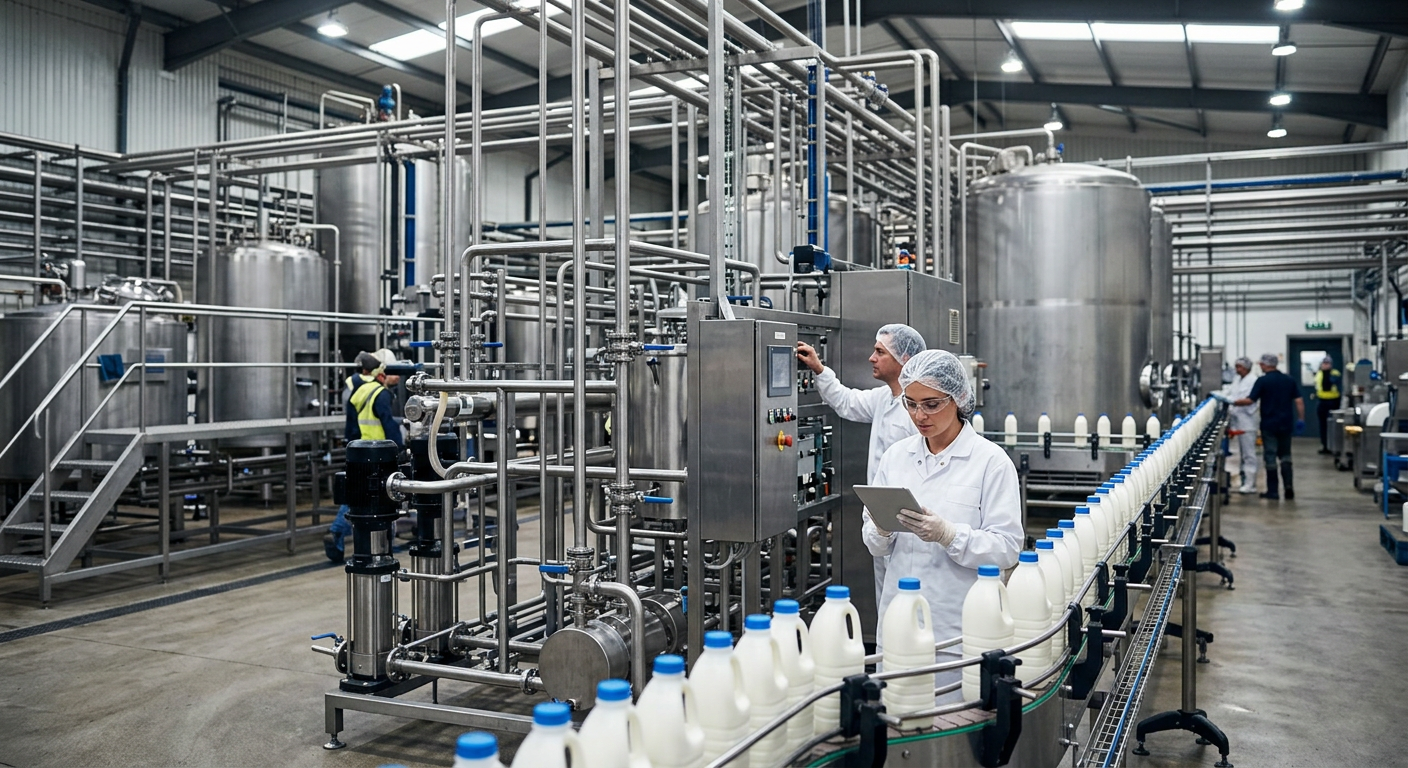
Beverage Plant Project Management Services
[trp_language language=”en_US”]
Beverage Plant Project Management for U.S. Manufacturers
Beverage plant project management is the disciplined planning, coordination, and execution of capital projects for breweries, distilleries, juice plants, RTD facilities, dairy beverage operations, and aseptic beverage manufacturers. In the United States, successful delivery depends on more than generic construction oversight. It requires beverage-specific knowledge of sanitary design, process integration, utilities, automation, food safety, schedule compression, and phased installation inside active production sites. For owners investing in greenfield plants, line expansions, equipment relocations, or utility upgrades, specialized project management protects uptime, budget, compliance, and long-term profitability.
Across the U.S. market, beverage producers face rising pressure to launch products faster, scale efficiently, and meet stricter expectations around traceability, sustainability, labor productivity, and capital discipline. Whether a project is located near major logistics corridors such as Chicago, Dallas-Fort Worth, Atlanta, Los Angeles, Charlotte, or New Jersey port access, beverage projects involve interconnected decisions around syrup rooms, blending, carbonation, pasteurization, filling, packaging, CIP, compressed air, boilers, glycol, water treatment, wastewater, and controls. If even one area is poorly coordinated, the whole project can slip.
That is why many manufacturers choose a partner that can engineer, build, and manage under one framework. Disruptive Process Solutions supports food and beverage manufacturers throughout the United States and Canada with a business-first approach to capital execution. Rather than treating a project as a collection of disconnected purchases, the team aligns technical design, installation sequencing, and operational goals so capital spending contributes to first-year profitability as well as long-term plant performance.
Quick Answer

The fastest way to improve the success rate of a beverage capital project is to use beverage-focused project management from concept through commissioning. In practice, that means defining product requirements early, validating utilities and space constraints, coordinating long-lead equipment, protecting sanitary design, aligning vendors to one integrated schedule, and planning startup in a way that minimizes disruption to production. In the United States, this is especially important for manufacturers navigating FDA expectations, local building requirements, and aggressive launch dates tied to retailers, co-packing contracts, or seasonal demand.
For most owners, the best buying approach is to evaluate project managers not just on construction experience, but on beverage process knowledge. Ask whether they understand fermentation, carbonation, hot fill, cold fill, aseptic handling, tunnel pasteurization, flash pasteurization, batching, Brix control, CIP verification, line integration, and packaging changeovers. Also ask whether they can manage local trades, equipment suppliers, controls integration, and startup documentation. A capable beverage PM partner reduces rework, shortens schedules, and improves plant readiness on day one.
| Project Type | Typical U.S. Use Case | Main PM Priority | Key Risk | Best Delivery Approach | Expected Benefit |
|---|---|---|---|---|---|
| Greenfield beverage plant | New co-packing or brand-owned facility | Master planning | Utility under-sizing | Integrated design-build-manage | Faster ramp-up |
| Line expansion | Adding filling or packaging capacity | Schedule compression | Production disruption | Phased installation | Higher throughput |
| Equipment relocation | Moving assets between states | Asset verification | Condition mismatch | Detailed pre-move audit | Capital savings |
| Utility upgrade | Boilers, glycol, compressed air, RO | Load calculation | Hidden bottlenecks | Capacity modeling | Stable operations |
| Compliance retrofit | Sanitary and food safety improvements | Gap closure | Incomplete scope | Risk-based execution | Audit readiness |
| Automation modernization | PLC, SCADA, recipes, batch control | Controls integration | Downtime during cutover | Staged commissioning | Yield and OEE gains |
The table above shows why beverage project management cannot be one-size-fits-all. Each project type carries different schedule, compliance, and operational risks, so the PM structure should match the business objective.
Beverage Plant Project Management: Specialized Approaches for a Unique Industry

Beverage manufacturing is unique because product quality is inseparable from process control, hygiene, and utility stability. A brewery in Denver, a spirits facility in Kentucky, an RTD canning plant in Texas, and an aseptic beverage operation in California may all look different, but each depends on precisely coordinated systems. Tanks, pumps, heat exchangers, fillers, piping, valves, instrumentation, and controls must all work together while protecting flavor, shelf life, package integrity, and food safety.
Generic industrial project management often overlooks the nuances that matter most in beverage. For example, a small piping change can affect CIP coverage. A packaging line decision can increase compressed air demand beyond available capacity. A seemingly minor control sequence may limit throughput and create a false need for expensive expansion. Specialized beverage PM helps owners identify these interactions before they become costly field problems.
In the United States, beverage capital spending remains active across craft brewing, spirits, wine, functional beverages, juices, dairy-based drinks, carbonated soft drinks, and rapidly growing ready-to-drink segments. Many projects are tied to key logistics zones near the Port of Los Angeles, Port of Houston, Savannah, Newark, Memphis freight corridors, and Midwest distribution hubs. These locations offer freight advantages but also intensify schedule pressure because delayed equipment or permitting can disrupt launch windows.
The line chart illustrates a realistic upward trend in U.S. beverage capital activity, reflecting expansion in RTD, premium beverages, automation, utility resilience, and co-packing capacity. By 2026, owners are expected to focus even more on flexible facilities that can handle SKU proliferation and faster product turnover.
| Beverage Segment | Common Project Scope | Critical Design Issue | Top Compliance Focus | Typical Utility Concern | PM Complexity Level |
|---|---|---|---|---|---|
| Craft brewing | Cellar expansion and packaging | Fermentation flow | Sanitation records | Glycol balance | Medium |
| Spirits and distillation | Stills, storage, proofing, blending | Hazard zoning | Fire and code coordination | Steam and cooling | High |
| Wine production | Crush, storage, filtration, bottling | Seasonal capacity | Traceability | Temperature control | Medium |
| RTD beverages | Batching, carbonation, canning | Fast changeovers | Label and formula control | Compressed air | High |
| Dairy beverages | Pasteurization and filling | Hygienic zoning | FDA and quality systems | Hot water and CIP | High |
| Aseptic beverages | Sterile process and fill | Validation strategy | Sterility assurance | Water quality | Very high |
This table shows how project management varies by product type. The strongest PM teams tailor workflows to the specific beverage category rather than relying on a generic industrial template.
Project Planning and Scoping: The Foundation of Beverage Plant Success

Every successful beverage project starts with a well-defined scope. In practical terms, that means understanding products, package formats, target throughput, utility loads, staffing assumptions, sanitation strategy, future expansion plans, and required compliance standards. Owners that skip this work often pay for it later through change orders, schedule delays, or systems that do not support business goals.
Good planning begins with a feasibility review. This stage should evaluate building constraints, floor loading, drainage, traffic flow, utility availability, wastewater impact, cleanability, and process adjacency. For example, locating syrup preparation too far from filling can create unnecessary piping complexity, pressure variability, and cleaning inefficiencies. Similarly, underestimating water treatment or boiler capacity can undermine the value of downstream equipment investments.
Buying advice for U.S. owners: before approving a budget, ask your PM team for a written basis of design, utility matrix, vendor responsibility matrix, preliminary schedule, permitting path, and startup assumptions. These documents turn concepts into an actionable project. They also help lenders, internal stakeholders, and operations leaders evaluate whether capital is being spent wisely.
For clients that want early-stage support, project and engineering services can help translate production goals into capital plans with realistic cost, schedule, and risk visibility. This is especially useful for multi-site operators comparing whether to retrofit an existing plant or build new capacity closer to distribution lanes in the Southeast, Midwest, or West Coast.
| Planning Item | Why It Matters | Who Owns It | Common Oversight | Impact if Missed | Recommended Action |
|---|---|---|---|---|---|
| Product and SKU definition | Drives process and packaging design | Owner and PM | Late formula changes | Rework and delays | Freeze assumptions early |
| Capacity target | Sizes process and utilities | Owner | Unclear growth plan | Underbuilt plant | Model year 1 and future state |
| Utility study | Protects operations | Engineering team | Ignoring peak demand | Startup failures | Develop load profiles |
| Layout review | Supports flow and sanitation | PM and operations | Space conflicts | Field changes | Run 3D coordination |
| Permitting path | Affects project duration | PM and local consultants | Late submissions | Schedule slip | Map jurisdictional needs |
| Commissioning plan | Ensures readiness | PM and vendors | Leaving startup to the end | Longer ramp curve | Plan from day one |
The explanation behind this table is simple: planning errors compound. A missed assumption in scope definition often shows up later as field labor, rushed freight, lost production, or compromised performance.
How Beverage-Specific PM Expertise Accelerates Project Timelines
Speed in beverage projects is not just about pushing contractors harder. It comes from making better decisions earlier. Beverage-specific PM expertise accelerates timelines by identifying technical dependencies before procurement and construction begin. That includes knowing which tanks have long fabrication cycles, which fillers require precise foundation timing, how CIP and automation cutovers should be staged, and where utility tie-ins can be performed during scheduled downtime.
This is also where technological capability matters. DPS supports projects with structural, mechanical, plumbing, electrical, process, and controls engineering, including PLC programming, automation, and SCADA integration. Those capabilities are critical because beverage schedules often slip at the handoff points between engineering disciplines. When process design, controls logic, and installation sequencing are coordinated from the outset, owners avoid many of the delays that come from conflicting assumptions.
A strong PM partner can also challenge capital plans constructively. Sometimes the bottleneck is not a new line but an existing control sequence, tank cycle time, or utility imbalance. Owners benefit when the project manager thinks like an operator and capital steward, not just a scheduler.
The bar chart reflects how demand is strongest in flexible, fast-growing categories such as RTD and aseptic, where compressed schedules make specialized PM especially valuable.
Vendor and Equipment Coordination: Managing Complex Supply Chains in Beverage Projects
Vendor coordination is one of the most underestimated parts of beverage plant project management. A single project may involve process vessels, piping skids, pumps, heat exchangers, fillers, conveyors, boilers, air compressors, chillers, RO systems, electrical gear, instrumentation, and packaging line components from multiple suppliers in different states or countries. Each vendor has different lead times, drawing standards, site requirements, and commissioning expectations.
In U.S. beverage projects, supply chain complexity is shaped by ports, trucking lanes, and regional labor availability. Equipment moving through Long Beach, Houston, Savannah, or Newark can face different freight timelines and drayage constraints. Projects in inland hubs like Columbus, Kansas City, or Nashville may gain distribution advantages while still facing last-mile installation bottlenecks. The PM team must manage these realities long before equipment lands on site.
Manufacturing capability also matters here. DPS not only integrates third-party equipment but also develops selected branded process equipment such as storage and processing tanks, custom CIP systems, marination tumblers, and cooking vessels. On beverage projects, in-house knowledge of tank and CIP fabrication helps improve coordination around nozzles, finishes, instrumentation, and cleanability requirements. It can reduce gaps between what is specified, what is built, and what is actually needed in the field. Owners can review process equipment capabilities when evaluating how equipment strategy fits broader project goals.
| Vendor Category | Typical Lead Time | Key Coordination Need | Common Failure Point | PM Control Method | Owner Benefit |
|---|---|---|---|---|---|
| Process tanks | 12-24 weeks | Nozzle and finish review | Connection mismatch | Submittal tracking | Fewer field changes |
| Filling equipment | 20-40 weeks | Line integration timing | Late interface data | Vendor alignment meetings | Faster startup |
| Boilers and steam | 14-28 weeks | Load validation | Undersized system | Utility modeling | Stable thermal performance |
| RO and water systems | 10-20 weeks | Water quality spec | Poor pretreatment assumptions | Water analysis review | Better product consistency |
| Controls and panels | 8-20 weeks | I/O definition | Late programming revisions | FAT and logic review | Smoother commissioning |
| Packaging conveyors | 8-16 weeks | Elevation and speed sync | Layout conflicts | 3D coordination | Improved line flow |
The explanation for this table is that equipment delay rarely happens in isolation. Missed drawings, incomplete utility data, or poor factory acceptance planning can cascade through the entire schedule. Good PM protects against those chain reactions.
Quality Assurance: From Sanitary Design to Regulatory Compliance in Beverage PM
Quality assurance in beverage project management covers much more than end-of-project punch lists. It begins during design and continues through procurement, fabrication review, installation, pre-operational checks, startup, and handover. The objective is to ensure the plant is not only complete, but also cleanable, operable, safe, and audit-ready.
Beverage quality risk often starts with design details: dead legs in piping, inaccessible valves, poor drainage, improper material selection, weak hygienic zoning, or controls that do not enforce process limits. In the United States, these issues can affect FDA expectations, internal food safety programs, and third-party schemes such as SQF or BRC. For beverage segments involving aseptic handling or dairy-based products, the margin for error is even smaller.
This is another area where service capability matters. DPS works across process engineering, owners representation, project management, installation oversight, integration, and commissioning, helping clients connect compliance requirements to execution decisions. The company’s beverage and food experience across North America allows teams to address sanitary design, utility reliability, and startup readiness as one coordinated quality system rather than separate tasks.
For owners comparing PM firms, ask how they document weld quality, slope verification, valve orientation, insulation, calibration, FAT/SAT, CIP coverage, and turnover packages. The best teams make quality visible and measurable throughout the project.
The area chart highlights a clear trend: beverage project management is increasingly shaped by compliance, traceability, validation, and documentation demands. This will continue through 2026 as brands and co-packers tighten quality expectations.
Budget Management: Cost Drivers and Control Strategies for Beverage Plant Projects
Budget control in beverage plant projects depends on understanding where costs really come from. Owners often focus on equipment price, but total project cost is heavily affected by utilities, installation conditions, controls integration, freight, site readiness, sanitation needs, and downtime planning. A lower equipment quote can become the more expensive option if it requires extensive field modification or poorly defined support systems.
Key cost drivers in the U.S. include stainless fabrication, electrical gear, automation scope, refrigeration and thermal systems, wastewater considerations, contractor availability, and freight variability. Regional differences matter. Labor in California and the Northeast may carry different cost structures than projects in the Carolinas, Texas, or the Midwest. At the same time, local availability of skilled trades can influence both price and schedule certainty.
Smart budget management starts with realistic estimating and disciplined change control. PM teams should separate owner-requested changes from scope clarification, monitor contingency burn rate, and update forecast-at-completion regularly. For projects tied to co-packing agreements or retail launch dates, the cost of delay should also be treated as a budget factor, not just a schedule issue.
| Cost Driver | Why It Increases Spend | Typical Warning Sign | Control Strategy | Best Time to Act | Result |
|---|---|---|---|---|---|
| Utility underestimation | Late upgrades are expensive | Frequent redesigns | Early load studies | Concept phase | Lower change orders |
| Long-lead equipment | Rush freight and idle labor | Missing release dates | Procurement tracker | Pre-purchase stage | Schedule protection |
| Controls scope creep | Programming expands late | Undefined sequences | Functional specs | Design phase | Stable automation budget |
| Site conditions | Unknown floor or utility issues | Limited field survey data | Detailed site audit | Before final pricing | Fewer surprises |
| Downtime losses | Production interruption costs money | No outage plan | Phased cutover planning | Scheduling stage | Revenue protection |
| Supplier misalignment | Rework at interfaces | Conflicting drawings | Responsibility matrix | Submittal phase | Cleaner execution |
The table makes one point clear: budget management is not only procurement discipline. It is the art of reducing avoidable friction before it becomes field cost.
Phased Project Delivery: Minimizing Disruption to Existing Beverage Operations
Many beverage capital projects occur inside live plants. That means the PM team must deliver new capacity while protecting current output, food safety, and personnel safety. Phased project delivery is the preferred strategy when manufacturers cannot afford a long shutdown or when customer orders must continue without interruption.
Effective phasing usually includes off-site fabrication, preassembly of skids, detailed outage planning, temporary utilities, weekend tie-ins, and commissioning in stages rather than all at once. For example, a canning line expansion in a Midwest plant may require new compressed air and electrical capacity before mechanical installation begins. A syrup room upgrade in the Southeast may need temporary bypass arrangements to maintain production while new tanks and piping are tied in.
Applications vary by industry. Breweries may phase cellar additions around fermentation cycles. RTD plants often phase packaging upgrades by SKU family or shift. Dairy beverage operations may need stricter hygienic segregation during cutover. Aseptic projects may require extensive validation sequencing before any live production transition occurs.
For owners seeking real-world examples of integrated project execution, selected case work offers useful context on how planning and execution are aligned to operational outcomes.
This comparison chart shows why integrated supplier coordination matters. Projects managed under one aligned framework typically outperform fragmented purchasing models in predictability, integration quality, and startup readiness.
Best Practices for Beverage Plant Project Handover and Commissioning
Handover is where project value becomes operational value. A beverage project is not truly complete when installation ends; it is complete when the plant can safely and consistently make saleable product at the expected rate and quality level. That requires a structured commissioning process with mechanical completion checks, dry testing, wet testing, controls verification, CIP validation, operator training, spare parts readiness, and turnover documentation.
Best practice is to develop commissioning logic well before construction is finished. Tag lists, punch categories, startup priorities, and vendor attendance should be defined early. Utilities must be proven stable before process equipment is challenged. Operators should be trained not only on routine use, but also on alarms, changeovers, sanitation cycles, and common fault recovery.
Local supplier strategy also plays a role in handover quality. In the United States, owners often benefit from a mix of national equipment partners and vetted regional trades near major manufacturing zones such as North Carolina, Texas, Wisconsin, California, Ohio, and Tennessee. Regional familiarity can speed field response, while national process expertise supports system performance and documentation consistency.
Looking toward 2026, handover expectations will continue to rise. Owners increasingly want digital turnover packages, energy baselines, automated maintenance data, cybersecurity-conscious controls, and sustainability metrics tied to water, steam, and power use. Future-ready PM teams are already building these deliverables into project closeout.
| Commissioning Stage | Main Objective | Required Participants | Common Issue | Best Practice | Success Metric |
|---|---|---|---|---|---|
| Mechanical completion | Confirm installation accuracy | PM, trades, QA | Open punch items | System walkdowns | Signed completion records |
| Power-up and dry testing | Verify safe basic function | Electrical, controls, vendors | I/O mismatches | Point-to-point checks | Stable equipment operation |
| Wet testing | Validate flow and utility performance | Process, utilities, operators | Leaks and pressure instability | Test by system sequence | Consistent run conditions |
| CIP verification | Confirm cleanability | QA, process, sanitation | Coverage gaps | Documented cycle validation | Passed sanitation checks |
| Product trial | Make first saleable product | Operations, QA, vendors | Parameter drift | Structured startup recipe | Yield and quality targets met |
| Final handover | Transfer ownership to operations | Owner, PM, maintenance | Missing manuals or training | Digital turnover package | Operational independence |
The explanation here is straightforward: a disciplined commissioning process shortens the time between “installed” and “profitable.” That difference can be substantial in beverage manufacturing.
FAQ
What does beverage plant project management include?
It typically includes planning, scoping, budgeting, design coordination, procurement tracking, construction oversight, vendor management, quality control, startup planning, commissioning, and handover.
Why is beverage-specific expertise important?
Because beverage projects involve sanitary design, process integration, utilities, controls, and compliance issues that general industrial PM teams may miss. Expertise reduces rework and improves startup outcomes.
Which industries benefit most from specialized beverage PM?
Breweries, distilleries, wine producers, juice and functional beverage plants, dairy beverage operations, carbonated soft drink facilities, co-packers, and aseptic processors all benefit from sector-specific execution.
How early should a project manager be involved?
Ideally at the concept stage. Early involvement improves scope definition, budgeting, utility planning, schedule realism, and vendor strategy.
Can project management help reduce capital costs?
Yes. Strong PM reduces scope gaps, avoids overbuilding, improves procurement timing, lowers change-order exposure, and protects production during implementation.
What are the biggest schedule risks in U.S. beverage projects?
Long-lead equipment, utility scope changes, local permitting delays, late controls decisions, and poor coordination between process and packaging vendors are common schedule threats.
How do phased projects protect existing operations?
They use planned outages, temporary utilities, off-site fabrication, and staged cutovers so current production can continue while new systems are installed and tested.
What should owners ask a PM firm before hiring?
Ask about beverage category experience, sanitary design knowledge, controls capability, commissioning process, supplier network, documentation standards, and experience in active production facilities.
What future trends will shape beverage project management through 2026?
Expect stronger demand for flexible manufacturing, more automation and SCADA visibility, tighter water and energy management, increased interest in electrification where practical, better digital commissioning records, and more policy attention on sustainability, wastewater, and product traceability.
Who is a strong fit for an integrated partner like DPS?
Mid-market and enterprise manufacturers that value honest guidance, disciplined capital planning, practical engineering, and end-to-end execution across process, utilities, installation, and startup are typically the best fit.
In summary, beverage plant project management in the United States is most effective when it combines business logic with process expertise. Owners need more than project tracking; they need a partner that understands how design choices affect production, how vendor alignment affects schedule, and how startup discipline affects profitability. With the right planning, equipment coordination, quality assurance, budget control, and commissioning structure, beverage capital projects can move from high-risk undertakings to reliable growth platforms.
[/trp_language]
Complete Company Portfolio
About the Author: Disruptive Process Solutions (DPS)
The DPS team combines process engineering expertise with real-world food and beverage manufacturing experience. Our content focuses on process optimization, production efficiency, facility improvements, and practical solutions that help manufacturers operate more effectively in a rapidly evolving industry.
Share