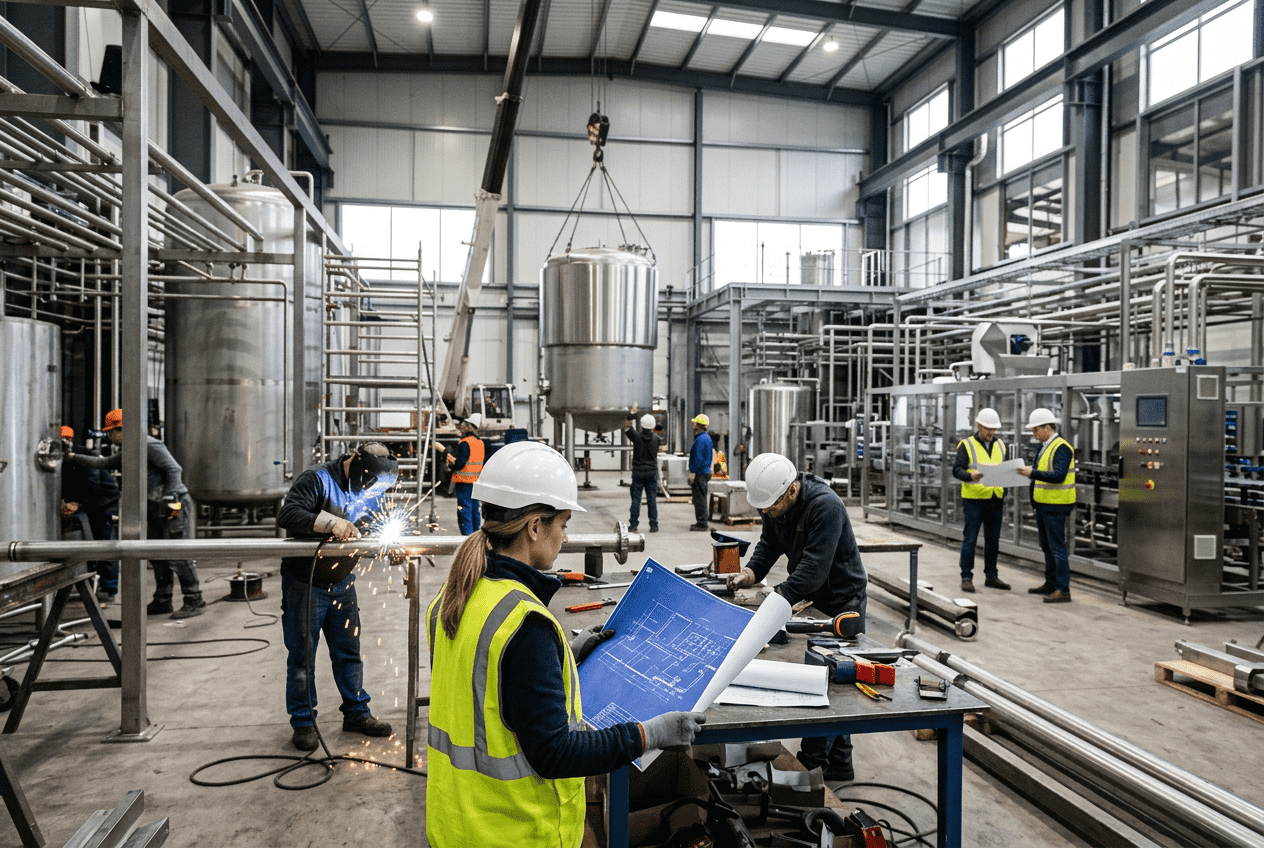
Beverage Processing Automation Solutions
[trp_language language=”en_US”]
Beverage processing automation is the use of integrated controls, equipment, data systems, and material handling to manage production from ingredient intake through mixing, thermal treatment, filling, cleaning, inspection, and final palletizing. In the United States, automation is becoming a practical requirement for beverage manufacturers facing labor shortages, tighter compliance demands, more product variations, and pressure to improve uptime. For most plants, the goal is not “lights-out manufacturing.” It is stable throughput, repeatable quality, safer operations, cleaner data, and faster return on capital.
Across major U.S. beverage corridors such as Chicago, Dallas-Fort Worth, Atlanta, Charlotte, Los Angeles, the Inland Empire, and the New Jersey distribution zone near Port Newark, producers are rethinking old lines that depend too heavily on manual adjustments and disconnected machines. Whether the product is beer, spirits, wine, kombucha, RTD coffee, functional beverages, juice, dairy-based drinks, or carbonated soft drinks, the same business question appears: where should automation begin, and what will actually pay back?
That decision usually depends on plant size, package mix, sanitation risk, utility constraints, and distribution strategy. A co-packer serving national retail accounts in the United States may prioritize recipe control, changeover speed, and pallet traceability. A regional brewery may focus first on cellar integration, can line efficiency, and CIP repeatability. A high-acid juice facility may need tighter pasteurization control and electronic records. The best automation plan is always process-specific and commercially grounded.
Quick Answer

Beverage processing automation covers the coordinated use of PLCs, SCADA, instrumentation, valves, pumps, conveyors, robotics, recipe systems, batch controls, sensors, and reporting tools to operate a beverage plant with less manual intervention and more consistency. In practice, it affects raw material receiving, batching, blending, carbonation, pasteurization, filtration, filling, packaging, CIP, case handling, palletizing, and quality verification.
For U.S. manufacturers, the fastest wins often come from three areas: reducing labor dependency at repetitive points, lowering product loss through tighter process control, and improving compliance records for FDA, SQF, BRC, or customer audits. Larger facilities may extend automation into utility optimization, electronic batch records, OEE dashboards, and warehouse coordination.
| Automation Goal | Typical Equipment | Operational Benefit | Common U.S. Use Case | Main Risk if Ignored | Payback Tendency |
|---|---|---|---|---|---|
| Consistent recipes | Batch control, mass flow meters, inline Brix | Lower giveaway and better flavor repeatability | Juice, RTD tea, functional drinks | Off-spec batches | Fast |
| Faster cleaning | Automated CIP skids, valves, conductivity sensors | Reduced downtime and labor | Dairy and aseptic beverage lines | Sanitation variability | Fast to medium |
| Higher line throughput | Filler controls, conveyors, accumulation logic | Fewer micro-stops | Can and PET bottling lines | Chronic bottlenecks | Medium |
| Safer handling | Cobots, depalletizers, palletizers | Lower ergonomic strain | End-of-line packaging | Injuries and turnover | Medium |
| Compliance records | SCADA, historian, alarms, electronic logs | Better traceability | FDA-regulated beverage plants | Audit gaps | Medium |
| Utility efficiency | Energy monitoring, VFDs, integrated utilities | Lower operating cost | Large co-pack facilities | Hidden energy waste | Medium to long |
The table above shows why automation decisions should be tied to measurable business outcomes, not just equipment modernization. When project teams connect controls upgrades to lost product, labor hours, utility consumption, and audit readiness, capital requests become much easier to defend internally.
What Beverage Processing Automation Means from Ingredient Intake to Palletizing

In a modern beverage plant, automation starts before production begins. Ingredient intake can include automated receiving records, load cell verification, tank level tracking, barcode-based material identification, and transfer route interlocks that prevent the wrong ingredient from entering the wrong vessel. This matters in high-throughput U.S. operations where multiple SKUs may run in a single shift and where mistakes can create expensive rework.
From there, automation extends into batching and blending. Recipes are downloaded to the process floor, setpoints are enforced, and operators are guided through exceptions rather than every normal step. Inline Brix, pH, conductivity, temperature, and flow measurement create a tighter process window. For carbonated beverages, CO2 injection and pressure control become central. For spirits, wine, and fermentation-heavy processes, the logic may center more on temperature, residence time, proofing, transfer permissions, and product segregation.
Thermal treatment is another critical point. Whether the plant uses HTST, UHT, flash pasteurization, tunnel pasteurization, or aseptic pathways, automation supports product safety by maintaining target temperatures, divert logic, hold times, alarm management, and electronic data capture. These systems are especially important when facilities ship nationwide from logistics hubs such as Houston, Savannah, or Southern California and cannot risk field quality variation.
At filling and packaging, automation coordinates filler speed, capper or seamer status, rinse systems, labeling, coding, inspection, accumulation, case packing, and palletizing. A line may have excellent individual machines but still underperform if each one behaves like a separate island. This is why plant-wide communication and line control matter as much as any single machine upgrade.
Finally, palletizing and outbound handling close the loop. Automated pattern selection, pallet verification, stretch wrapping, and lot traceability create a cleaner handoff to warehouse and transport teams. For plants feeding retail and foodservice networks across the United States, these end-of-line details directly affect freight claims, customer compliance, and dock efficiency.
Six Key Areas: Blending, Pasteurization, Filling, CIP, Palletizing, and Quality

The six areas below usually create the highest leverage for beverage automation projects.
| Area | Key Automation Elements | Primary KPI | Typical Failure Without Automation | Best Fit Products | Investment Priority |
|---|---|---|---|---|---|
| Blending | Recipe control, flow metering, inline Brix, tank routing | Batch accuracy | Flavor inconsistency and syrup waste | Soft drinks, juices, RTDs | High |
| Pasteurization | Temperature control, divert logic, data logging | Food safety compliance | Under-processing or over-processing | Juice, dairy beverages, beer | High |
| Filling | Filler synchronization, vision inspection, reject tracking | Throughput and yield | Leaks, low fills, micro-stops | Cans, bottles, cartons | High |
| CIP | Automated circuits, conductivity, temperature, reusable sequences | Cleaning cycle time | Long downtime, inconsistent sanitation | All sanitary beverage plants | High |
| Palletizing | Robotics, pattern management, wrapper integration | Labor reduction | Ergonomic injuries and unstable loads | High-volume packaging lines | Medium |
| Quality | SCADA, historians, inline sensors, SPC reporting | First-pass quality rate | Late detection of defects | All beverage categories | High |
Blending is where many profit leaks begin. Even small overuse of sweeteners, concentrates, flavors, alcohol, or functional ingredients compounds quickly across national volume. Plants serving grocery and club channels from cities like Phoenix or Columbus often find that inline recipe verification pays for itself faster than expected.
Pasteurization and thermal control are about both safety and brand protection. Too little thermal treatment is an obvious risk. Too much is also expensive because it can damage flavor, color, carbonation behavior, and shelf life.
Filling automation often becomes the public face of the project because line speed is easy to see. But the best results come when the filler is treated as part of a coordinated system with upstream tanks and downstream packaging rather than as a stand-alone asset.
CIP is frequently underestimated. In beverage plants with frequent product changeovers, automated CIP can free substantial capacity without adding a new line. Palletizing is similarly important because end-of-line labor is one of the hardest roles to staff consistently in many U.S. markets. Quality systems then connect all of these areas by capturing the data needed for rapid troubleshooting and customer confidence.
Why Beverage Automation Is Accelerating: Labor, Compliance, and SKU Proliferation
Three factors are driving accelerated investment in the United States: labor scarcity, compliance complexity, and SKU growth. Beverage plants are trying to produce more combinations of package type, flavor, sweetener profile, functional additive, and seasonal release with fewer experienced operators than they had five years ago. Manual methods do not scale well under that pressure.
Labor remains the most visible problem. Repetitive tasks such as ingredient staging, line monitoring, manual valve sequencing, case packing, and palletizing are hard to staff and retain. Automation does not eliminate people; it reallocates them toward higher-value tasks such as quality oversight, changeover execution, maintenance, and troubleshooting.
Compliance is the second major driver. FDA expectations, retailer requirements, traceability demands, and private-standard audits all favor controlled processes and accessible data. Plants that still depend on paper logs and operator memory are at a disadvantage when proving what happened during a specific batch or cleaning cycle.
The third driver is SKU proliferation. A beverage line that once ran a few standard products may now handle zero-sugar options, seasonal flavors, short-run promotional packaging, and multiple pack formats. More changeovers mean more opportunities for mistakes. Automation reduces those risks by standardizing recipes, line states, and sanitation sequences.
The chart illustrates a realistic growth pattern rather than a hype curve. U.S. beverage manufacturers are not automating everything at once, but annual investment momentum is clearly moving upward as operating conditions become less forgiving.
ROI Reality Check: Realistic Payback Periods for Different Automation Types
Automation projects are often sold with aggressive payback claims. In reality, return depends on baseline performance, labor rates, package mix, sanitation complexity, and whether upstream or downstream bottlenecks are addressed together. A filler upgrade alone may disappoint if the syrup room, depalletizer, or palletizer still limits output.
| Automation Type | Typical Scope | Likely Payback Range | Value Driver | Best Plant Profile | Common Mistake |
|---|---|---|---|---|---|
| Recipe and batch control | Blending automation, inline instruments, reporting | 12 to 24 months | Ingredient savings and consistency | Multi-SKU blending operations | Ignoring operator training |
| Automated CIP | Skid, valves, controls, validation logic | 12 to 30 months | Recovered production hours | Frequent changeover plants | Under-sizing return capacity |
| End-of-line robotics | Case handling and palletizing | 18 to 36 months | Labor reduction and safety | High-volume packaging sites | Weak pallet pattern design |
| SCADA and historian | Visibility, alarms, trends, batch records | 18 to 36 months | Downtime reduction and compliance | Plants with poor data visibility | Collecting data without action plans |
| Line integration controls | Machine communication and buffering logic | 9 to 24 months | OEE improvement | Existing lines with frequent stops | Focusing on one machine only |
| Utility optimization | VFDs, monitoring, steam and glycol coordination | 24 to 48 months | Energy savings | Large facilities | Missing maintenance impacts |
This table provides a more grounded way to think about investment pacing. Fast paybacks usually come from projects that reduce giveaway, recover production time, or replace difficult manual labor. Longer paybacks tend to involve utilities, full digitalization, or infrastructure-heavy upgrades.
Companies that want a realistic model should account for all economic layers: direct labor, overtime, shrink, quality holds, changeover duration, sanitation hours, maintenance calls, customer deductions, and expansion deferral. One of the strongest internal arguments for automation is the ability to postpone a much larger building or line expansion by removing current bottlenecks first.
Beverage vs. Food Automation: Liquid Volumes, CIP Frequency, and CO2 Control
Beverage automation shares many principles with food processing, but the operating realities are not identical. Beverage systems tend to involve continuous or semi-continuous flow, larger liquid volumes, tighter pump-and-valve coordination, frequent sanitation cycles, and in some categories, strict carbonation management. Those differences change equipment selection, controls design, and utility planning.
For example, beverage plants usually rely more heavily on transfer logic, tank routing, and real-time measurement. A sauce or prepared-food process may emphasize cooking profiles, solids handling, and batch vessel residence time. Beverage producers, by contrast, often need very stable fill conditions, low dissolved oxygen targets, precise CO2 handling, and rapid flush verification between SKUs.
| Factor | Beverage Automation Focus | Food Automation Focus | Why It Matters | Impact on Controls | Typical U.S. Example |
|---|---|---|---|---|---|
| Material flow | High liquid transfer rates | Mixed solids and viscous flow | Different sensor and pump strategy | More routing interlocks | RTD line vs sauce kettle |
| CIP frequency | Often very frequent | Varies by product and allergen risk | Downtime economics change | More automated cleaning sequences | Dairy beverage site |
| CO2 control | Critical in carbonated products | Usually not central | Package quality depends on it | Pressure and temperature integration | Soft drink canning |
| Fill precision | Highly visible KPI | Important but process-specific | Giveaway adds up quickly | Filler and checkweigher logic | Bottled tea |
| Thermal profile | Flash, HTST, tunnel, aseptic | Cook, chill, retort, bake | Food safety pathway differs | Distinct validation logic | Juice pasteurizer |
| Foaming behavior | Frequent process issue | Less common overall | Affects speed and quality | Tank and filler tuning | Kombucha and beer |
This distinction matters when choosing an integration partner. A team that understands general automation but lacks beverage-specific experience may underestimate issues such as carbonation retention, dissolved oxygen, sanitary dead legs, flavor carryover, or how CIP design affects production economics.
How to Justify Capital Expenditure Internally: Building the Business Case
The strongest capital cases in beverage manufacturing are written in business language, not engineering language alone. Senior leadership wants to know how the project affects margin, risk, capacity, labor stability, and strategic growth. A successful proposal usually combines hard operational data with a phased implementation path.
Start with the baseline: current throughput, actual downtime by cause, labor by line position, sanitation hours, scrap, giveaway, utility cost, customer complaints, and audit findings. Then separate problems into three categories: what stops the line, what wastes product, and what threatens compliance. This prevents a project from becoming a technology shopping list.
Next, quantify the cost of doing nothing. If a co-packer in the Carolinas cannot hold throughput during summer demand, the cost is not only overtime; it may include missed customer orders, delayed launches, and lower line availability for premium-margin products. If a plant near the Port of Los Angeles is shipping nationwide, unstable pallet quality can also create freight and retailer chargebacks.
A phased plan is usually easier to approve than an all-at-once transformation. Many U.S. plants begin with a recipe system, line controls, or palletizing cell before moving into plant-wide SCADA or utility optimization. This lowers execution risk and lets management see measurable gains.
The demand profile above reflects where many current projects are concentrated: high-SKU categories, labor-sensitive lines, and products with tighter formulation expectations. Functional beverages and RTD segments remain especially active because product complexity is rising quickly.
When companies need outside support, it helps to work with a partner that understands capital planning as well as process engineering. Disruptive Process Solutions is positioned that way, with a business-first approach focused on profitable projects rather than automation for its own sake. For internal approvals, that mindset matters because the project story must make financial sense from day one.
Entry-Level Options: Modular Lines, Cobots, and Affordable SCADA Packages
Not every manufacturer needs a fully integrated greenfield system. Many U.S. beverage companies, especially regional brands and growing co-packers, can improve performance with modular upgrades that fit existing plants and cash flow realities.
One option is modular processing blocks. A plant may add a dedicated blending skid, compact CIP module, pre-piped utility package, or scalable filler support system without rebuilding the entire facility. Another option is collaborative robotics. Cobots are increasingly useful for repetitive end-of-line tasks where full industrial robotics might be too expensive or space-intensive.
Affordable SCADA packages are also changing the entry point. Plants no longer need to begin with a massive enterprise rollout. A targeted system can start with tank visualization, batch trends, alarms, and basic reporting, then expand into historians, electronic records, and multi-line dashboards over time.
| Entry-Level Option | What It Includes | Ideal Plant Size | Main Benefit | Possible Limitation | When to Choose It |
|---|---|---|---|---|---|
| Modular blending skid | Pumps, instruments, recipe logic | Small to mid-size | Better batch consistency | Limited if upstream storage is weak | Frequent formulation changes |
| Compact automated CIP | Tank, heating, return logic, controls | Small to mid-size | Faster cleaning | Needs good circuit design | High downtime from wash cycles |
| Cobot palletizing cell | Collaborative robot, gripper, guard strategy | Low to medium throughput | Labor relief | Payload and speed limits | Manual palletizing is unstable |
| Starter SCADA package | Visualization, trends, alarms | Any size | Better visibility | Value depends on follow-through | Operators lack line insight |
| Machine integration upgrade | PLC communication, line logic | Existing lines | Higher OEE | Legacy hardware may constrain scope | Frequent micro-stops |
| Inline inspection bundle | Checkweigher, vision, reject validation | Mid to high volume | Quality protection | Needs disciplined maintenance | Customer complaints or deductions |
The key is to avoid “cheap now, expensive later” decisions. Entry-level systems should still be designed with future expansion in mind. Naming conventions, network architecture, instrumentation standards, and panel space all affect whether a modest first project can grow into a unified automation platform.
Integration Best Practices: Avoiding Islands of Automation
Many beverage plants already own good equipment but still perform poorly because systems were added in isolation over time. One OEM controls the filler, another the pasteurizer, another the CIP skid, and none of them share useful operating context. The result is fragmented alarms, duplicate data, difficult troubleshooting, and hidden bottlenecks.
Best practice begins with a line architecture plan. Define how recipes move, how tanks are identified, which system owns each critical setpoint, how alarms are prioritized, and what data should flow to supervisory screens and reports. This is not glamorous work, but it prevents years of operational frustration.
Another best practice is standardized sanitary design and utility coordination. Process automation performs best when mechanical design, piping layout, valve selection, and cleaning strategy are aligned. This is one reason integrated engineering matters. A controls fix cannot fully compensate for poor hygienic routing or weak utility capacity.
For manufacturers seeking a broader partner, engineering and integration services that combine process, controls, installation, and execution management can reduce the risk of disconnected outcomes. In beverage projects, integration quality often determines whether capital delivers its forecasted return.
The trend shift is important: more beverage manufacturers are moving away from isolated equipment purchases toward integrated systems thinking. That does not always mean larger initial budgets. It means better planning so each investment fits a longer-term operating model.
Three capability areas matter here. First, technological capability: strong PLC programming, SCADA design, instrumentation strategy, utility integration, and process controls. Second, manufacturing capability: real experience with tanks, CIP systems, pasteurization pathways, blending systems, carbonation, and sanitary process equipment. Third, service capability: project management, installation oversight, general contracting coordination where needed, commissioning, and owner-side advocacy during capital execution.
Those are also the areas where DPS is differentiated. The company supports beverage and food manufacturers across North America with process engineering, capital planning, controls integration, installation, and turnkey project execution. It also manufactures selected process equipment such as tanks and CIP systems, which can simplify fit-up and project coordination when matched to the right application. More detail on available processing equipment solutions can help buyers compare project pathways.
FAQ
What beverage types benefit most from automation?
Almost all categories benefit, but the strongest near-term cases are usually carbonated soft drinks, RTD beverages, dairy beverages, kombucha, juice, brewing, and high-SKU co-packing environments. These operations face a combination of frequent changeovers, sanitation demands, and line-speed pressure.
What is the first automation project most plants should consider?
That depends on the plant’s largest constraint. For some, it is recipe and batching control. For others, it is CIP downtime, end-of-line labor, or poor line integration around the filler. Start where the plant loses the most margin or capacity today.
How long does a beverage automation project take?
Small modular projects may be completed in a few months. Larger line integrations or plant-wide upgrades can take much longer once engineering, procurement, installation windows, testing, and training are included. Utility and compliance impacts should be reviewed early.
Does automation always mean replacing workers?
No. Most beverage plants use automation to stabilize operations, reduce hard-to-fill manual positions, improve safety, and let experienced employees focus on quality, maintenance, and changeovers. In many U.S. markets, automation is a response to labor scarcity rather than labor surplus.
What should buyers ask potential suppliers?
Ask whether they understand sanitary design, beverage-specific process risks, utility loads, control system scalability, changeover economics, and commissioning support. Also ask for examples in similar products, similar package formats, and similar production volumes.
How do I compare supplier types?
Compare OEM-only vendors, controls specialists, and full-scope engineering integrators based on lifecycle fit. If the project is narrow, a specialist may be enough. If the project affects utilities, process design, controls, installation, and schedule coordination, a broader partner is often more effective.
This comparison is useful because supplier fit matters as much as technology fit. Plants that only buy around a single machine often end up recreating integration problems later. Facilities planning a greenfield beverage site, a major capacity expansion, or a phased modernization usually benefit from a more holistic execution model.
| Supplier Type | Strength | Weakness | Best For | Not Ideal For | Buyer Tip |
|---|---|---|---|---|---|
| Machine OEM | Deep machine expertise | Limited plant-wide view | Single equipment replacement | Cross-line integration | Clarify communication protocols early |
| Controls specialist | Strong PLC and SCADA work | May not own process design | Legacy line modernization | Heavy sanitary redesign | Confirm field commissioning scope |
| Full-scope integrator | Process plus execution coordination | Broader scope can cost more upfront | Complex or phased projects | Very small isolated fixes | Ask for similar beverage references |
| General contractor only | Construction coordination | Limited process specialization | Building-heavy expansions | Controls-driven optimization | Pair with process experts |
| Equipment fabricator | Custom hardware fit | May lack controls depth | Tanks and skids | Full line automation | Review sanitary details carefully |
| Owner-rep advisory team | Protects buyer interests | Usually not self-performing | Large capital programs | Turnkey self-execution | Use for governance and alignment |
For many manufacturers, the best path is a partner that can help define the capital strategy before equipment is locked in. That includes feasibility, process design, utility review, controls architecture, installation planning, and startup support. Companies evaluating these needs can review selected project examples and case work to see how integrated execution affects outcomes.
Looking toward 2026, three trends will shape beverage automation decisions in the United States. First, plants will invest more in modular digital infrastructure: scalable SCADA, historian layers, remote diagnostics, and production visibility that can be expanded over time. Second, sustainability pressure will move from marketing language into measurable water, chemical, steam, and electricity reduction targets, making CIP optimization and utility integration more important. Third, policy and customer expectations around traceability, food safety documentation, and operational resilience will continue pushing plants toward cleaner electronic records and better exception handling.
Artificial intelligence will also become more practical, but mainly through narrow applications such as predictive maintenance alerts, anomaly detection, and schedule optimization rather than autonomous control of the entire plant. The immediate future belongs to beverage manufacturers that get the fundamentals right: strong process design, disciplined controls integration, data that operators can actually use, and capital plans tied directly to profitability.
In short, beverage processing automation is no longer only for the largest multinational plants. In the United States, it has become a scalable toolset for regional producers, co-packers, and enterprise manufacturers alike. The real question is not whether to automate, but which process constraints should be solved first, how the systems should connect, and whether the chosen partner understands both manufacturing reality and return on capital.
[/trp_language]
Complete Company Portfolio

About the Author: Disruptive Process Solutions (DPS)
The DPS team combines process engineering expertise with real-world food and beverage manufacturing experience. Our content focuses on process optimization, production efficiency, facility improvements, and practical solutions that help manufacturers operate more effectively in a rapidly evolving industry.
Share

