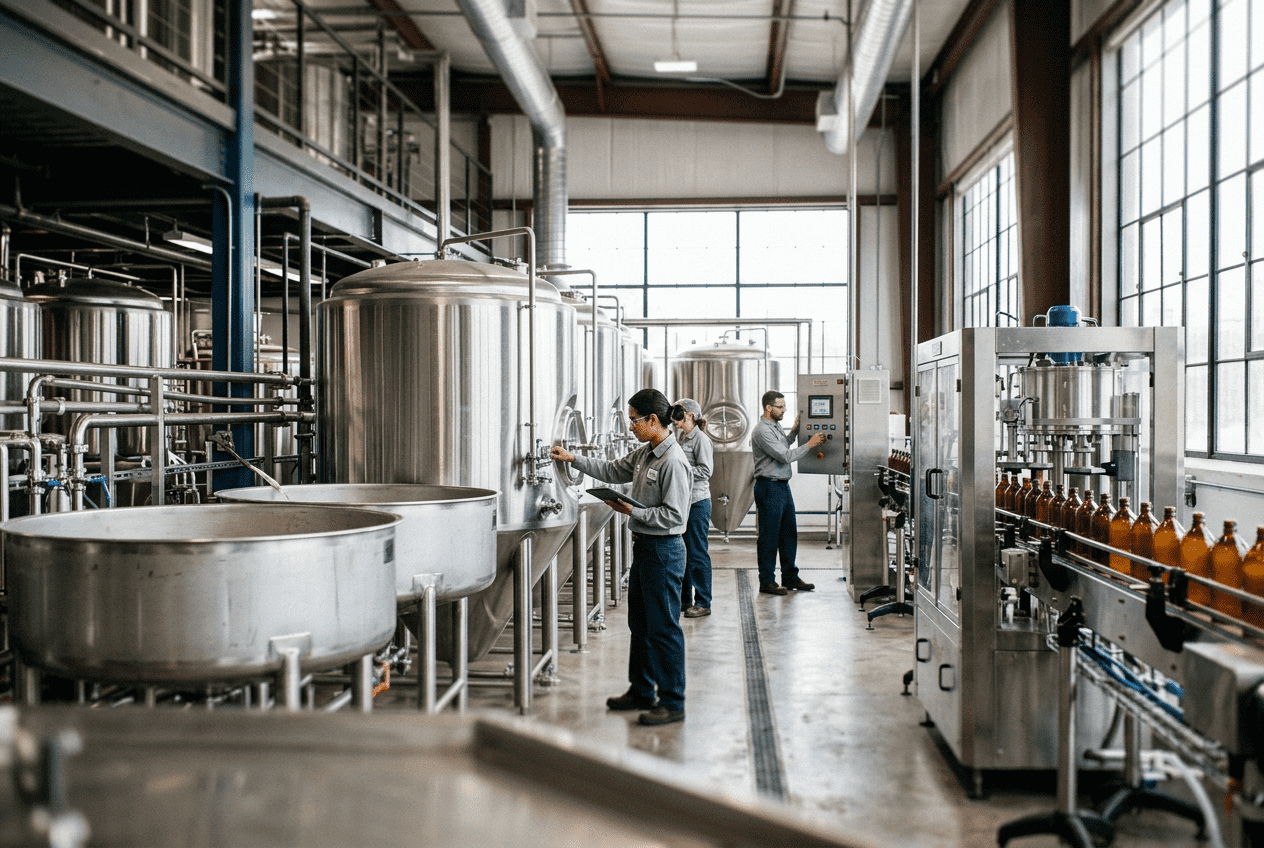
Beverage Processing Plant Design Services
[trp_language language=”en_US”]
Beverage Plant Engineering Services in the United States
Designing a beverage processing facility in the United States requires much more than selecting tanks and a filler. A successful plant must align product characteristics, regulatory requirements, sanitation strategy, line speed, utility demand, packaging formats, labor availability, and long-term capital efficiency. For water, juice, carbonated soft drinks, dairy beverages, spirits, kombucha, plant-based beverages, and ready-to-drink products, the right plant design determines whether a facility can scale profitably, maintain product quality, and adapt to new SKUs without excessive downtime.
Across major U.S. manufacturing corridors such as the Southeast, the Midwest, Texas, Southern California, and the Northeast logistics belt, processors are under pressure to increase throughput while lowering water use, energy intensity, and changeover time. Beverage companies shipping through Charlotte, Atlanta, Chicago, Dallas-Fort Worth, Los Angeles/Long Beach, Savannah, Houston, and New Jersey distribution hubs need facilities that work not only on paper but also in real operating conditions. That is why beverage plant engineering now centers on integrated process design, automation, cleanability, utility resilience, packaging flexibility, and total cost of ownership.
For manufacturers evaluating new builds, expansions, or retrofits, the smartest approach is to combine process engineering, capital planning, facility design, installation oversight, and startup support under one coordinated strategy. This is where experienced partners matter. Disruptive Process Solutions supports beverage manufacturers across the United States and Canada with practical, profitability-driven project execution focused on real plant performance rather than generic design assumptions.
Quick Answer

Beverage processing plant design services in the United States focus on turning a product concept into a sanitary, scalable, code-compliant, and commercially efficient production facility. That includes process flow development, ingredient handling, blending and batching, water treatment, thermal processing selection, packaging line design, utility sizing, automation architecture, CIP strategy, wastewater planning, and facility layout. The best beverage plant designs are built around product risk, required shelf life, packaging type, expected line speed, future SKU growth, and local operating realities such as labor markets, water availability, and environmental permits.
Unlike many general industrial projects, beverage plants must manage microbiological risk, rapid production cycles, flavor carryover, package integrity, and highly variable utility loads. Whether the target is a high-speed bottled water line in Texas, an aseptic RTD facility near Chicago, a craft spirits expansion in North Carolina, or a plant-based beverage operation in California, the design must connect processing, packaging, and utilities into one reliable system.
| Design Priority | Why It Matters | Typical U.S. Impact | Risk If Ignored |
|---|---|---|---|
| Sanitary process flow | Protects product safety and quality | Supports FDA, SQF, and BRC expectations | Contamination, recalls, shelf-life failure |
| Packaging line balance | Prevents filler starvation and downstream jams | Improves OEE in high-volume plants | Lost throughput and labor waste |
| Utility right-sizing | Aligns steam, chilled water, air, and power with demand | Controls operating cost in energy-sensitive markets | Capacity bottlenecks or overspending |
| Flexible layout | Allows new SKUs and packaging formats | Supports contract manufacturing growth | Expensive future retrofits |
| Water and wastewater planning | Critical for permits and sustainability | Important in drought-prone or regulated regions | Permit delays and high discharge fees |
| Automation and controls | Stabilizes process consistency and traceability | Reduces labor dependence and improves uptime | Operator error and poor data visibility |
The table above shows why beverage facility planning is fundamentally an integration exercise. A plant that excels in only one category, such as line speed, but neglects wastewater loading, CIP recovery, or packaging flexibility will struggle as volume and product complexity increase.
What Makes Beverage Plant Design Different from Food Plant Design

Beverage plant design and food plant design share common engineering principles, but beverages create a distinct operating environment. Liquids move continuously, require precise hygienic control, and often depend on temperature-sensitive or oxygen-sensitive handling. Line speeds can be extremely high, especially in bottled water, carbonated drinks, and RTD formats, where small inefficiencies compound into major output losses.
Food plants often focus on solids handling, thermal mass, cook steps, allergen segregation, or protein processing logistics. Beverage plants, by contrast, place heavier emphasis on flow dynamics, in-line blending accuracy, deaeration, carbonation, filtration, sterile boundaries, rinse systems, filler bowl conditions, package sanitation, and downstream accumulation. Even a small mismatch between process throughput and packaging throughput can create chronic stoppages.
Another distinction is utility behavior. Beverage plants commonly require significant process water treatment, compressed air stability, high-capacity CIP systems, process cooling, clean steam or culinary steam, and tight automation for recipes and lot traceability. For product categories such as dairy beverages, juices, kombucha, and functional drinks, microbial control drives decisions from floor slope to gasket materials.
From a market standpoint, the United States beverage sector also faces faster packaging innovation than much of the food sector. Plants may need to handle PET, glass, aluminum cans, slim cans, cartons, HDPE, and multipack formats within one site strategy. That means layout planning must consider both current production and future adaptation.
| Category | Beverage Plant Focus | Food Plant Focus | Design Consequence |
|---|---|---|---|
| Product flow | Continuous liquid transfer | Batch or semi-continuous solids | More piping, valves, and flow control |
| Sanitation | CIP and sterile boundaries | COP plus washdown zones | Higher hygienic piping complexity |
| Packaging speed | Often very high | Moderate to high depending on format | Greater line balancing demands |
| Utility demand | Water, air, cooling, steam | Steam, refrigeration, washdown | Different utility sizing priorities |
| SKU variation | Flavor and package changes frequent | Recipe changes often slower | Fast changeover design is critical |
| Shelf-life strategy | Aseptic, hot fill, cold fill, preservatives | Cooking, freezing, retort, MAP | Process method drives entire facility |
The comparison above highlights why a general contractor without beverage-specific engineering experience can miss major details. Beverage plants are especially unforgiving when line integration, hygienic zoning, or thermal process assumptions are wrong.
The market trend shown above reflects how U.S. beverage producers continue investing in modernization, automation, and flexible capacity. Growth is strongest in RTD, bottled water, functional beverages, and plant-based formats.
Production Line Design: Washing, Filling, Capping, and Labeling

In beverage manufacturing, the production line is where process engineering meets commercial reality. A line may have a perfectly designed syrup room and excellent utilities, but if depalletizing, rinsing, filling, capping, labeling, coding, inspection, and case packing are not properly synchronized, plant efficiency drops quickly.
Container washing or rinsing requirements depend on packaging type and product risk. Empty PET bottles may need air rinsing or ionized air, while returnable glass can require more intensive washing. Bottled water and certain non-carbonated applications may prioritize ultra-clean handling, while carbonated beverages require additional attention to dissolved gas stability and foaming behavior at the filler.
Filling technology selection depends on product category, package format, fill temperature, viscosity, and target output. Gravity fillers, pressure fillers, volumetric systems, piston fillers, aseptic fillers, and hot-fill systems all create different mechanical, sanitary, and utility demands. Downstream, capping and sealing systems must protect product integrity without creating torque inconsistencies, leakage, or cap supply interruptions. Labeling must account for moisture, condensation, container geometry, and retail appearance.
One of the most common design errors in U.S. beverage facilities is underestimating accumulation and buffer management. High-speed lines around 300 to 1,000 bottles or cans per minute need strategic accumulation zones so a short labeler fault does not force a filler shutdown. Plants serving retail distribution through hubs like Memphis, Indianapolis, and Allentown particularly benefit from stable, predictable line performance because freight schedules and customer service penalties can be unforgiving.
| Line Step | Primary Design Concern | Engineering Requirement | Operational Benefit |
|---|---|---|---|
| Depalletizing | Container flow stability | Infeed buffering and ergonomic access | Consistent line feed |
| Rinsing/Washing | Package cleanliness | Water quality and drainage control | Reduced contamination risk |
| Filling | Accuracy and hygiene | Proper filler selection and CIP integration | Higher yield and uptime |
| Capping/Seaming | Package closure integrity | Torque monitoring or seam inspection | Lower leakage and spoilage |
| Labeling/Coding | Retail compliance and traceability | Dry conditions, vision checks, reject systems | Fewer customer complaints |
| Case packing/Palletizing | Shipping readiness | End-of-line automation and load stability | Warehouse efficiency |
The table illustrates that each line step should be engineered as part of a complete system. It is not enough to purchase individual machines with attractive nameplate speeds. The integrated line speed, sanitation method, maintenance access, and change-part strategy determine true plant output.
On the technology side, DPS brings process and controls capability that supports blending systems, pasteurization, filtration, carbonation, water treatment, PLC programming, SCADA, and complete utility integration. That matters because filler performance is directly connected to what happens upstream in batching, thermal treatment, and process stability. More details on broad project support are available on the services page.
Aseptic vs. Hot Fill vs. Cold Fill: Design Implications for Beverage Plants
Few decisions shape a beverage facility more than the preservation and filling method. Aseptic, hot fill, and cold fill systems create different sanitary boundaries, equipment footprints, capital costs, packaging constraints, and operator training requirements.
Aseptic systems are typically used when shelf-stable performance is needed without relying on intense thermal exposure at the package stage. They demand strict sterile design, validated sterilization procedures, careful environmental control, and advanced operator discipline. The benefit is product quality retention and broader packaging possibilities for certain applications, but the design complexity and startup rigor are substantial.
Hot fill is common in juices, teas, and acidified beverages. It uses elevated product temperatures to achieve commercial objectives in conjunction with package handling. However, hot fill affects bottle design, cooling strategy, line materials, and floor drainage. Plants need to account for thermal expansion, container deformation risks, and post-fill cooling logistics.
Cold fill can be the most straightforward for some products, but it often relies on preservatives, refrigeration, or shorter shelf life depending on formulation and distribution model. In dairy beverages and sensitive functional products, cold-chain integrity becomes a major design factor. For carbonated soft drinks, temperature control is also tied to gas retention and foaming management.
| Method | Typical Products | Capital Complexity | Key Facility Implications |
|---|---|---|---|
| Aseptic | RTD, dairy alternatives, sensitive shelf-stable drinks | High | Sterile zoning, validated barriers, specialized filler |
| Hot Fill | Juices, teas, acidified beverages | Medium to high | Thermal package design, cooling sections, heat handling |
| Cold Fill | Water, CSD, refrigerated drinks | Low to medium | Sanitary design, cold-chain or preservative strategy |
| ESL approach | Some dairy and functional beverages | Medium to high | Tighter sanitation and temperature control |
| Tunnel pasteurized line | Beer and some packaged beverages | Medium | Large footprint, water and heat recovery planning |
| Flash pasteurized line | Beer, juices, specialty beverages | Medium | Upstream thermal integration and filler hygiene |
The chart below compares demand across U.S. beverage categories that commonly drive different fill approaches.
The bar chart shows that the strongest U.S. plant design demand is currently tied to bottled water, RTD formats, and plant-based beverage growth. That demand is influencing a wider shift toward flexible, high-hygiene production environments.
Sustainable Design Practices in Beverage Processing Facilities
Sustainability in beverage processing is no longer only a branding issue. In the United States, it is now tied to utility cost control, permitting, investor expectations, customer requirements, and 2026 policy trends around water stewardship, emissions reporting, and resilient infrastructure. Smart sustainable design lowers operating cost while improving long-term asset value.
Key sustainable practices include heat recovery from pasteurization systems, variable frequency drives, compressed air leak management, process water reuse where appropriate, CIP chemical optimization, lightweight packaging compatibility, LED lighting, smart HVAC zoning, and data-driven energy monitoring. In regions such as California, Arizona, and parts of Texas, water and discharge planning can materially affect site feasibility. In colder regions such as the Upper Midwest or Northeast, winter utility reliability and energy efficiency also shape design choices.
Leading beverage facilities also account for waste reduction in flavor changeovers, syrup handling, and startup/shutdown losses. Good engineering reduces product giveaway, not just utility consumption. Sustainability therefore overlaps directly with profitability.
DPS approaches these projects with an integrated mindset that blends structural, mechanical, plumbing, electrical, process, and controls engineering. This technological capability is especially useful when the goal is to connect energy use, water systems, automation, and packaging efficiency into one operating model rather than treating them as separate scopes.
| Sustainable Measure | Application | Expected Benefit | Design Note |
|---|---|---|---|
| Heat recovery | Pasteurizers, boilers, hot-water loops | Lower fuel consumption | Requires integrated thermal balance |
| CIP optimization | Tanks, fillers, piping circuits | Less water and chemical use | Needs validated cleaning recipes |
| Water reuse | Final rinse recapture, utility reuse | Reduced freshwater demand | Must fit product risk and local rules |
| VFD-driven motors | Pumps, fans, compressors | Lower electricity consumption | Best with controls integration |
| Air system management | Compressed air distribution | Reduced energy waste | Leak detection and pressure zoning matter |
| Real-time monitoring | SCADA and metering | Continuous improvement visibility | Useful for ESG and utility benchmarking |
The table shows that sustainable design is practical engineering, not abstract theory. When plants measure utilities and product losses by line, shift, and SKU, they can make better capital decisions and respond faster to cost pressure.
Plant-Based Beverage Manufacturing: Design Challenges and Solutions
Plant-based beverages represent one of the most technically demanding growth segments in the U.S. market. Oat, almond, soy, coconut, pea, and blended functional beverages each present different challenges in hydration, extraction, slurry handling, enzyme treatment, particle management, homogenization, heat treatment, and flavor stability.
Compared with bottled water or standard soft drinks, plant-based products can create more fouling, viscosity variability, sedimentation risk, and allergen management complexity. They also often require more aggressive shear control, deaeration, and sophisticated thermal processing to preserve texture and shelf life. Ingredient handling is another major issue. Bulk solids receiving, hydration tanks, slurry transfer, filtration, and waste solids management must all be considered in layout planning.
Facilities producing both conventional and plant-based beverages need strong segregation strategy. This includes ingredient storage, dedicated or validated shared lines, allergen controls, color-coded process paths, and scheduling logic. Plants near consumer-heavy coastal markets such as Los Angeles, the Bay Area, Seattle, Boston, and New York frequently need this flexibility because brand portfolios evolve quickly.
DPS has manufacturing capability across beverage and food sectors, including dairy processing, aseptic systems, blending, homogenization, heat treatment, and plant-based process applications. That cross-category experience is valuable because many plant-based lines sit between classical beverage and food process design.
The area chart indicates a clear trend shift: more new beverage projects are being designed with flexible capability for plant-based, functional, or multi-category production. By 2026, this trend is likely to strengthen due to portfolio diversification and retailer demand for innovation.
Water Conservation and Wastewater Treatment in Beverage Plant Design
Water is both a raw material and a utility backbone in beverage operations. It is used in the product, bottle or can handling, CIP cycles, pasteurization systems, cooling loops, boiler make-up, and sanitation. As a result, water conservation and wastewater treatment are core design topics, not secondary environmental issues.
In many U.S. municipalities, incoming water quality and discharge limitations vary significantly. A plant in California’s Central Valley may face very different constraints than one in the Carolinas, the Great Lakes region, or along the Gulf Coast. Local sewer surcharges tied to BOD, COD, TSS, pH, and flow can heavily influence operating cost. For juice, dairy beverage, kombucha, and plant-based operations, wastewater loading can rise quickly if product losses are not controlled.
Effective water strategy begins with source characterization and process mapping. Reverse osmosis, carbon filtration, softening, UV, ozone, or disinfection technologies may be required depending on product type. On the wastewater side, facilities may use screening, equalization, pH adjustment, dissolved air flotation, anaerobic or aerobic systems, and flow balancing. Even where full on-site treatment is not needed, pretreatment can be a smart financial decision.
When manufacturers are exploring expansion or greenfield investment, wastewater planning should happen early in feasibility. Too many projects secure a promising site near a major corridor like I-85, I-35, or the Inland Empire only to discover utility or discharge constraints later. If you are evaluating capital scenarios, the project portfolio and execution perspective discussed in the case studies section can help frame what works in real operations.
| Water/Waste Stream | Source Area | Main Concern | Design Response |
|---|---|---|---|
| Product water | Ingredient make-up | Taste, minerals, microbial quality | RO, filtration, disinfection, blending |
| CIP discharge | Tank and line cleaning | Chemicals, temperature, pH swings | Recovery, segregation, equalization |
| Rinse water | Packaging line | High volume usage | Recapture or reduced-flow strategy |
| Pasteurizer water | Thermal systems | Heat and recirculation losses | Heat recovery and loop optimization |
| Product loss stream | Changeovers and start-up | High BOD/COD load | Draining logic and recovery planning |
| Floor washdown | General sanitation | Flow spikes and solids | Drain design, screening, SOP control |
The table makes clear that not all wastewater is the same. Segregating streams can reduce treatment cost and support better reuse or pretreatment decisions.
How to Design for Rapid Product Changeovers and SKU Flexibility
SKU proliferation is now a standard reality in the U.S. beverage market. Retailers expect seasonal flavors, channel-specific pack sizes, and frequent line extensions. Co-packers need even greater agility because they may run multiple brand owners with different formulations and packaging requirements in one week. The engineering challenge is to build speed and flexibility without sacrificing sanitation or reliability.
Rapid changeover design starts with product family mapping. Engineers should group SKUs by allergen profile, color intensity, sugar content, acidity, carbonation, and packaging format. From there, they can design manifolds, valve clusters, pigging options, clean break points, hose management, change parts, and CIP recipes that minimize downtime. Flexible fillers, quick-release guarding, recipe-driven automation, and digital work instructions can all shorten transitions.
Layout also matters. Adequate staging for packaging materials, cap sorting, label roll access, and mobile support equipment prevents the hidden labor losses that slow every changeover. Plants with heavy retail distribution through markets like Chicago, Atlanta, and Southern California benefit from this flexibility because mixed-order profiles and promotion calendars create constant scheduling pressure.
DPS provides service capability that spans feasibility studies, owner’s representative support, project and program management, general contracting where licensed, equipment supply, installation, and full system integration. That breadth is useful in SKU-flexible projects because the process, building, utilities, controls, and installation sequence must all support the same commercial goal.
The comparison chart illustrates how flexibility drives complexity. A simple bottled water line may optimize for speed and utility efficiency, while a co-packer hybrid facility demands much more from controls, CIP strategy, staging, and scheduling design.
| Flexibility Feature | Use Case | Benefit | Tradeoff |
|---|---|---|---|
| Recipe automation | Multiple formulations | Faster setup and traceability | Higher controls scope |
| Quick-change parts | Different bottles or caps | Reduced manual downtime | More spare part management |
| Dedicated allergen paths | Plant-based or specialty drinks | Better risk control | Higher capital cost |
| Pigging systems | Viscous or high-value products | Lower product loss | Added validation requirements |
| Modular utilities | Phased expansion | Scalable growth | Needs long-term master planning |
| Flexible accumulation | Mixed packaging schedules | Maintains uptime during transitions | More floor space needed |
For companies buying equipment, one practical tip is to judge suppliers by integrated line performance, sanitation approach, controls compatibility, and service support, not only machine price. A lower purchase cost can become an expensive mistake if the line cannot meet changeover or quality expectations. Manufacturers exploring custom tanks, CIP skids, or process equipment can review available options through the equipment solutions page.
Case Study: Engineering a High-Speed Bottled Water Production Facility
Consider a hypothetical but realistic bottled water project in the United States serving grocery, club, and convenience channels from a Southeastern distribution location near Charlotte with access to the I-85 corridor and the Port of Savannah for packaging and supply chain support. The owner needs a high-speed PET line, future second-line expansion, low conversion cost, and tight first-year profitability.
The design begins with source water characterization and treatment selection. Because taste consistency is critical in bottled water, the treatment train may include multimedia filtration, activated carbon, reverse osmosis, UV, ozone, and controlled remineralization depending on the brand profile. From there, sanitary storage and distribution must be designed to avoid stagnation and preserve quality to the filler.
The packaging system is the commercial engine. A high-speed line may include bottle blow molding, air conveying, rinsing, filling, capping, labeling, coding, case packing, palletizing, and automated warehouse interface. Utility planning must support compressed air peaks, ozone safety, cooling requirements, and line reliability during summer seasonal demand surges.
To preserve capital efficiency, the facility can be laid out with room for future line duplication, shared utility corridors, modular CIP support, and scalable electrical infrastructure. Wastewater loading may be lighter than in many flavored beverage plants, but rinse water use still requires attention. Accumulation zones and spare parts strategy become essential because a few minutes of repeated downtime at very high speed can erase daily production targets.
This type of project reflects the kind of commercial thinking that separates profitable execution from simple equipment installation. DPS is known for combining engineering, build coordination, and execution oversight through a practical design-build-manage approach. The company works across North America with beverage capabilities spanning brewing, spirits, wine, kombucha, RTD, carbonated and non-carbonated beverages, dairy beverages, and aseptic applications, while also bringing food-sector depth that strengthens utility, sanitation, and compliance planning.
| Case Element | High-Speed Water Plant Requirement | Recommended Design Focus | Business Result |
|---|---|---|---|
| Water treatment | Stable taste and purity | Validated treatment train and monitoring | Brand consistency |
| Line speed | Very high throughput | Balanced filler and downstream flow | Higher daily case output |
| Utilities | Air and power peaks | Right-sized systems with redundancy | Less downtime risk |
| Expansion | Future line addition | Master-planned layout and utility corridors | Lower future capital disruption |
| Logistics | Regional distribution efficiency | Warehouse and truck flow planning | Improved order fulfillment |
| Operating cost | Thin margins | Water efficiency, automation, maintenance access | Better profitability |
For buyers comparing regional engineering partners, local suppliers, or OEM-led layouts, the lesson is straightforward: choose a team that understands process, utilities, packaging, controls, and startup as one business system. Especially in bottled water, line speed without operational resilience is not enough.
FAQ
What do beverage processing plant design services usually include?
They typically include feasibility analysis, process flow development, utility planning, equipment specification, plant layout, packaging line integration, sanitary design, automation architecture, installation planning, and startup support.
How much should a U.S. beverage manufacturer plan for engineering before construction?
It depends on product complexity, but early engineering is one of the highest-return investments in the project. It reduces change orders, avoids utility undersizing, and improves permit readiness.
Which beverage categories most often require specialized hygienic design?
Aseptic products, dairy beverages, juices, kombucha, plant-based drinks, and functional beverages typically require more advanced hygienic and thermal design than simple bottled water lines.
How early should wastewater be evaluated?
At the site selection and concept stage. Municipal discharge limits and water availability can change the economics of a project before equipment is purchased.
What is the best layout strategy for future growth?
Use a master plan that reserves expansion space for utilities, storage, and additional packaging lines. This is especially important in high-growth U.S. regions such as Texas, the Southeast, and Southern California.
How can a plant reduce changeover time?
Use recipe automation, standardized change parts, clear staging areas, dedicated allergen strategies where needed, and CIP logic built around actual SKU families.
What trends will shape beverage plant design in 2026?
Expect more digital monitoring, stronger water stewardship requirements, expanded use of flexible automation, greater demand for plant-based and functional beverage capability, more traceability expectations from retailers, and tighter focus on energy efficiency and decarbonization.
Why work with a specialized partner instead of coordinating multiple vendors alone?
Because beverage plants fail at the interfaces between disciplines. A specialized partner can align process, building, utilities, controls, installation, and startup around one operating goal.
In summary, beverage processing plant design services in the United States should be evaluated through the lens of profitability, sanitation, adaptability, and execution risk. Whether the project involves bottled water, aseptic RTD, plant-based beverages, spirits, or multi-SKU co-packing, success depends on integrated engineering that matches the product, market, and growth strategy. Companies that take this broader view are far better positioned to build resilient, scalable facilities that thrive in a competitive U.S. manufacturing landscape.
[/trp_language]
Complete Company Portfolio

About the Author: Disruptive Process Solutions (DPS)
The DPS team combines process engineering expertise with real-world food and beverage manufacturing experience. Our content focuses on process optimization, production efficiency, facility improvements, and practical solutions that help manufacturers operate more effectively in a rapidly evolving industry.
Share

