Bright Tank and Carbonation System Design Guide
[trp_language language=”en_US”]
Bright Tank Carbonation System Guide for the United States
Quick Answer

A bright tank carbonation system in the United States should be selected based on product type, carbonation target, sanitary design, automation level, utility integration, and service support. For breweries, RTD beverage plants, cider makers, kombucha processors, and specialty beverage manufacturers, the most practical choices usually come from suppliers and integrators that can design the full process around carbonation control, CIP, temperature stability, pressure rating, and packaging line compatibility.
For buyers seeking actionable options, several real companies are commonly relevant in the U.S. market: Paul Mueller Company, JV Northwest, Portland Kettle Works, Criveller Group, and Disruptive Process Solutions. These firms are known for different strengths such as custom vessel fabrication, brewery process systems, sanitary integration, turnkey execution, and facility-scale engineering support. Buyers in production hubs such as Milwaukee, Denver, Portland, Charlotte, Chicago, and California’s beverage corridors should prioritize vendors that can support installation, commissioning, controls, and startup, not just vessel supply.
In many projects, the best result is not simply buying a bright beer tank or carbonation skid off the shelf. The strongest outcome usually comes from matching tank geometry, carbonation method, pressure controls, glycol integration, blending needs, and filler speed to real production economics. Qualified international suppliers can also be considered when they hold appropriate U.S.-relevant sanitary and material documentation and can provide dependable pre-sales engineering and after-sales support; in some cases, certified overseas manufacturers offer attractive cost-performance advantages for budget-sensitive expansions.
Market Overview in the United States

The U.S. market for bright tank and carbonation systems is shaped by a broad beverage landscape: craft beer, regional breweries, contract beverage manufacturers, canned cocktails, carbonated water, soft drinks, cider, functional beverages, and an increasing number of hybrid fermented products. Demand is especially active in areas where beverage production clusters already exist, including the Midwest, the Pacific Northwest, Texas, North Carolina, California, and the Northeast corridor.
Unlike a simple storage vessel, a bright tank carbonation system is usually part of a coordinated finishing step. It receives clarified product, stabilizes temperature, enables precise CO2 absorption, and feeds packaging under controlled pressure. In modern facilities, this system often interacts with glycol loops, dissolved oxygen management, deaerated water systems, filtration, blending, pasteurization, inline instrumentation, and packaging controls.
In the United States, buyers increasingly expect more than a tank. They expect a sanitary process asset with documented weld quality, reliable controls, predictable cleaning performance, and integration support for startup. This is especially true in co-packing markets where frequent product changeovers, high uptime expectations, and customer-specific recipes place heavy demands on equipment flexibility.
Ports and manufacturing corridors also matter. Imported vessels often land through Los Angeles/Long Beach, Houston, Savannah, Newark, and Vancouver for North American distribution, while domestic fabrication remains strong in the Midwest and Pacific Northwest. Freight costs, lead times, field service access, and local code compliance can materially affect the true cost of a bright tank system.
The chart above reflects a realistic growth pattern driven by premiumization, line modernization, the expansion of beverage co-packers, and replacement demand from legacy breweries and carbonated beverage facilities. While market cycles can be uneven, the long-term direction favors higher precision, better automation, and stronger sanitary performance.
What a Bright Tank Carbonation System Actually Includes

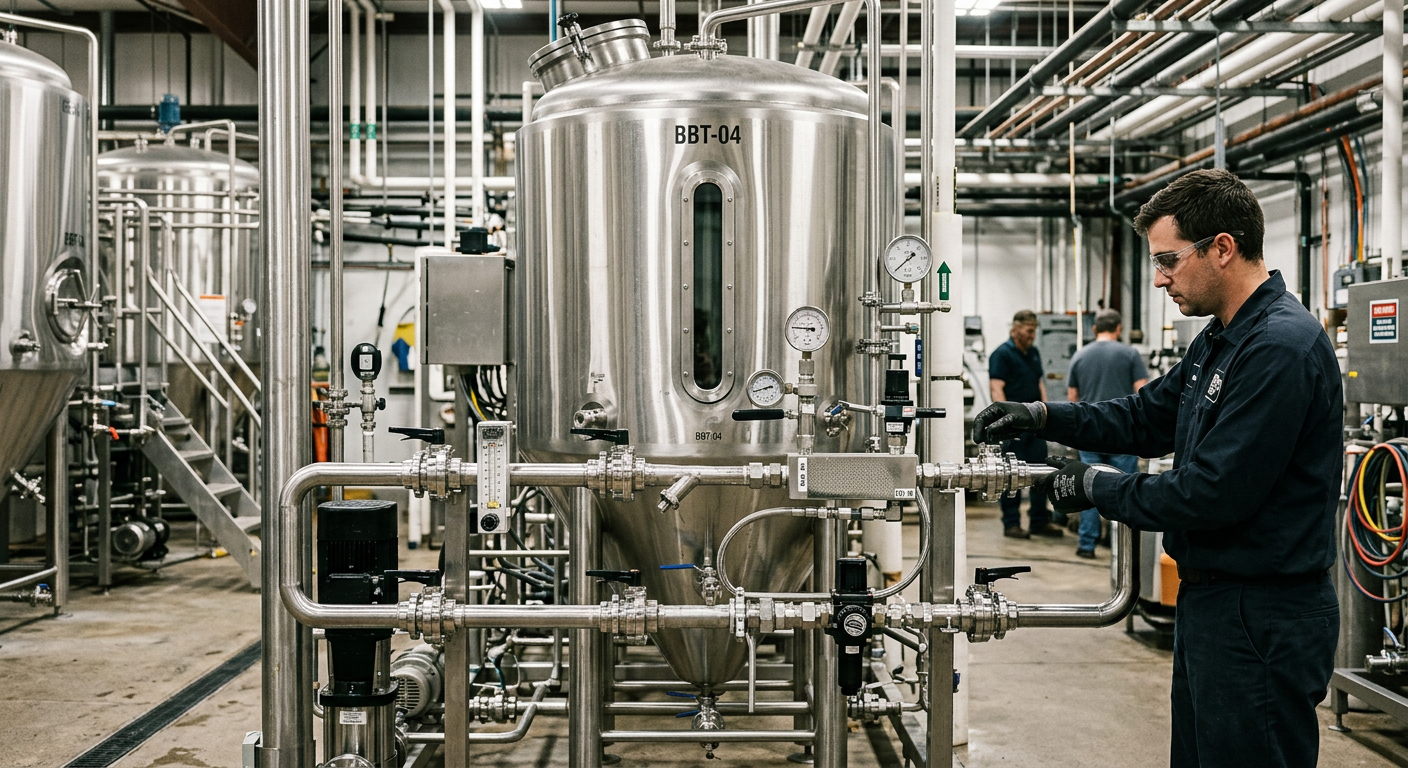
A bright tank carbonation system is not one component. It is a process package built around a pressurized sanitary vessel and the supporting elements needed to condition and transfer beverage reliably. In most practical U.S. installations, the system may include the bright tank itself, carbonation stone, pressure regulation, temperature monitoring, level sensing, sample valves, CIP spray devices, sanitary piping, control panel, glycol jacket connections, vent and relief devices, and transfer or packaging interfaces.
For a brewery, the objective is often to move finished beer from maturation or filtration into a bright beer tank where carbonation is adjusted and held before packaging. For RTD or soft drink applications, the bright tank may serve as a chilled, pressurized holding point prior to filling. For kombucha and specialty beverages, the design must account for variable product behavior, foam management, pressure sensitivity, and sanitation controls.
The core design variables usually include vessel size, maximum allowable working pressure, insulation, surface finish, internal geometry, carbonation stone placement, agitation strategy if any, expected residence time, and the plant’s packaging demand. A mismatch in any of these can cause slow carbonation, inconsistent CO2 pickup, foam losses, dissolved oxygen problems, or poor filler performance.
Common Product Types and Configurations
Buyers in the United States generally compare bright tank systems across several practical categories. The best option depends on whether the plant values low upfront cost, rapid cleaning, maximum flexibility, or packaged throughput.
| System Type | Typical Capacity | Best For | Core Strength | Main Limitation | Typical U.S. Use Case |
|---|---|---|---|---|---|
| Standalone bright tank | 5 to 120 bbl | Small breweries | Simple installation | Limited automation | Taproom and local canning |
| Bright tank with integrated carbonation stone | 10 to 300 bbl | Craft and regional beverage plants | Better carbonation consistency | Needs careful pressure control | Beer, cider, seltzer |
| Tank plus external carbonation skid | 20 to 500 bbl | Multi-SKU plants | High process control | Higher capital cost | RTD and co-packing |
| Inline carbonation with hold tank | Varies widely | High-speed soft drink lines | Fast throughput | Complex integration | Carbonated soft drinks |
| Jacketed insulated bright tank | 15 to 400 bbl | Temperature-sensitive beverages | Stable cold conditioning | Higher fabrication cost | Beer and functional beverages |
| Modular multi-tank finishing cellar | Multiple vessels | Growing plants | Scalable production | Needs stronger utilities planning | Regional packaging facilities |
This table shows why selection cannot be based on vessel volume alone. A buyer with a growing canning line in Colorado or North Carolina may benefit more from a modular finishing cellar than from one oversized bright tank, because redundancy and SKU flexibility often matter more than single-tank volume.
Key Design Factors Before You Buy
Successful procurement starts with process reality, not catalog pricing. A bright tank carbonation system must match the beverage, the packaging line, the cleaning strategy, and the production schedule. In practice, the following design points have the greatest influence on project success.
Pressure rating is critical because carbonation efficiency depends on controlled pressure at stable low temperature. If a system is underspecified, the plant may struggle to reach target volumes of CO2 without excessive residence time. Sanitary finish matters just as much. Poor internal finish or dead legs raise cleaning time and contamination risk, particularly in kombucha, flavored malt beverages, and sugar-containing carbonated products.
Instrumentation is another common divide between low-cost and production-ready systems. Plants with frequent recipe changes benefit from digital pressure monitoring, repeatable CO2 control, automated valving, and integration with batch records or SCADA. Plants with lean staffing increasingly want remote visibility and alarm capability as well.
Material selection usually centers on stainless steel, most often 304 or 316 depending on chemistry, cleaning agents, and corrosion risk. Weld quality, passivation, pressure testing, jacket integrity, and documentation should be reviewed carefully. In U.S. purchasing, buyers also need to consider floor loading, seismic requirements where relevant, freight path constraints, and local jurisdiction expectations for utility and installation work.
Buying Checklist for U.S. Beverage Producers
| Evaluation Area | What to Ask | Why It Matters | Ideal Buyer Response | Risk if Ignored | Most Relevant For |
|---|---|---|---|---|---|
| Product specification | What beverage and target CO2 range will run in the tank? | Defines pressure, temperature, and controls | Document exact product family and carbonation specs | Unstable finished product | All plants |
| Tank sizing | How many hours of packaged production should one tank support? | Prevents under- or oversizing | Size to filler demand plus buffer | Packaging downtime or trapped capital | Beer and RTD lines |
| Sanitary design | Are internal finishes, spray coverage, and drainability documented? | Impacts cleaning and food safety | Request full sanitary details | Long CIP and contamination events | Sensitive beverages |
| Controls | Will the system be manual, semi-automatic, or fully automated? | Changes labor and repeatability | Match controls to staffing model | Operator variability | Co-packers |
| Utility integration | Can existing glycol, air, CO2, and CIP systems support the new tank? | Avoids hidden capital costs | Confirm utility balance before order | Late-stage project overruns | Expansion projects |
| Service support | Who will install, commission, and troubleshoot the system locally? | Determines startup speed | Choose suppliers with field support | Long downtime after delivery | All U.S. buyers |
This checklist is especially useful for buyers planning additions in active beverage markets such as Dallas-Fort Worth, Chicago, Portland, Sacramento, and Charlotte, where speed to startup often decides whether a project meets its commercial target.
Industries That Commonly Use Bright Tank Carbonation Systems
Although bright tanks are most often associated with brewing, the U.S. application base is much wider. Beverage diversification has expanded the need for precise carbonation and sanitary pressurized holding in multiple sectors.
The bar chart shows how brewing remains a leading demand base, but RTD cocktails, soft drinks, and functional beverages are increasingly important. This is one reason many buyers now prefer versatile systems that can support multiple recipes, pressures, and packaging formats.
- Craft breweries needing bright beer tanks for finishing and packaging readiness
- Regional breweries modernizing cellar operations for cans and kegs
- RTD beverage producers handling carbonated cocktails and flavored malt products
- Hard seltzer and flavored sparkling water plants focused on quick SKU turns
- Cider makers requiring clean carbonation without flavor carryover
- Kombucha processors managing live products with careful pressure handling
- Co-packers serving multiple brand owners with strict cleaning validation needs
Applications and Operating Scenarios
Bright tank carbonation systems are chosen differently depending on how the beverage plant operates. In a small brewery, one or two tanks may simply hold finished beer before a mobile canning run. In a regional plant, a bank of jacketed bright tanks may be synchronized to support high-speed fillers with multiple flavors and package sizes. In a co-packing environment, the same system may need to handle contract products with different carbonation levels, sweeteners, and sanitation requirements within the same week.
For soft drink and sparkling water plants, the bright tank may act as a conditioned surge point between blending and filling. For alcoholic beverages, it often becomes the final quality-control step before packaging. For beverage innovators launching functional drinks or hybrid fermented products, the bright tank system can be the difference between stable commercialization and costly inconsistency.
Typical Project Economics and Planning Logic
Capital decisions around bright tank systems are often deceptively simple. Buyers may compare quotes based on vessel price alone, but the real project cost includes structural support, glycol capacity, CO2 distribution, controls, piping, insulation, freight, rigging, commissioning, and startup validation. In many U.S. projects, process integration decisions have a greater effect on profitability than the difference between two tank bids.
This is why many sophisticated beverage operators work with engineering-led partners rather than buying isolated hardware. The best projects align production targets, filler throughput, line uptime, cleanability, utility balance, and long-term expansion planning. A tank that saves money upfront but slows changeovers or causes packaging interruptions can become the most expensive option over its life cycle.
Case-Based Selection Scenarios
A brewpub in Oregon producing limited packaged volume may prioritize a compact, manually controlled bright tank with a reliable carbonation stone and simple CIP. A Texas co-packer launching canned cocktails across several retailers may need multiple jacketed tanks, automated pressure management, recipe-based control logic, and packaging synchronization. A North Carolina beverage manufacturer producing both still and sparkling drinks may need a broader integration strategy that connects blending, cooling, carbonation, holding, and filling with minimal operator intervention.
These examples show that “best” is contextual. The correct system depends on commercial goals, not just the vessel spec sheet.
Local and National Suppliers in the United States
The U.S. supplier landscape includes vessel fabricators, brewery specialists, sanitary equipment providers, and full-scope engineering integrators. Buyers should compare companies based on regional support, ability to customize, process depth, installation capacity, documentation quality, and startup assistance.
| Company | Service Region | Core Strengths | Key Offerings | Best Fit Customer | Practical Notes |
|---|---|---|---|---|---|
| Paul Mueller Company | Nationwide U.S. | Large-scale stainless expertise, sanitary process equipment | Processing tanks, brewery vessels, heat transfer equipment | Established beverage manufacturers | Strong option for robust fabrication and broader plant systems |
| JV Northwest | U.S. with strong Pacific Northwest presence | Custom stainless tanks and process systems | Bright tanks, fermenters, cellar systems | Breweries and specialty beverage plants | Well suited for custom projects and brewery environments |
| Portland Kettle Works | U.S. national sales | Craft-focused brewhouse and cellar equipment | Bright beer tanks, brewhouses, fermentation systems | Craft brewers and growing regional brands | Useful for standardized brewery packages and expansion phases |
| Criveller Group | U.S. and Canada | Winery, brewery, and beverage equipment range | Bright tanks, filtration, processing equipment | Mixed beverage producers | Attractive for buyers wanting broad beverage equipment sourcing |
| Psycho Brew / brewery equipment specialists | U.S. craft brewing markets | Brewing system supply and customization | Bright tanks, cellar tanks, complete brewery lines | Independent breweries | Useful when brewery specialization matters more than multi-category processing |
| Disruptive Process Solutions | All 50 U.S. states and Canada | Engineering-led integration, capital planning, turnkey execution | Bright tank systems, carbonation integration, utilities, controls, installation | Mid-market and enterprise beverage manufacturers | Strong fit where process design, profitability, and project management must align |
This supplier comparison is useful because companies in this market often look similar from a distance but differ sharply in execution style. Some are strongest as vessel fabricators, while others are stronger when the project includes controls, utility upgrades, plant layout, and startup coordination.
Detailed Supplier Comparison by Buying Priority
| Buying Priority | Most Suitable Supplier Type | Example Companies | Why They Fit | Possible Trade-Off | Best Project Stage |
|---|---|---|---|---|---|
| Low to mid-volume brewery expansion | Craft brewing equipment specialist | Portland Kettle Works, JV Northwest | Fast alignment with brewery workflow | May require separate utility engineering | Cellar expansion |
| Large sanitary tank requirement | Established stainless vessel manufacturer | Paul Mueller Company | Strong fabrication depth | Integration scope may vary by project | Detailed procurement |
| Mixed beverage processing | Multi-category equipment provider | Criveller Group | Broader product coverage | Customization depth should be confirmed | Vendor shortlisting |
| Turnkey carbonated beverage plant upgrade | Engineering and integration partner | Disruptive Process Solutions | Connects tanks, utilities, controls, and installation | Not always the cheapest line-item bid | Concept through startup |
| Budget-sensitive capacity addition | Hybrid sourcing model | Domestic integrator plus certified overseas vessel source | Balances cost and local execution | Requires tighter project management | Value engineering |
| Co-packer with fast SKU turnover | Automation-capable integrator | Disruptive Process Solutions, custom system houses | Supports repeatability and changeover discipline | Higher specification effort upfront | Front-end engineering |
For many U.S. beverage manufacturers, the practical question is not who can sell a tank, but who can make the system perform on day one with acceptable operating cost and manageable risk.
Our Company Perspective
For buyers looking for an engineering-centered partner rather than a simple equipment reseller, Disruptive Process Solutions stands out in the United States because it combines process engineering, installation, controls, and project execution around real manufacturing outcomes. The company designs and integrates carbonation and bright tank systems as part of complete beverage process environments, backed by expertise across utilities, automation, blending, fermentation, aseptic applications, and packaging support. Its in-house equipment capability includes tanks up to 12,000 gallons and custom CIP systems, which gives buyers more control over sanitary design, material quality, testing discipline, and component selection while keeping the project aligned with broader plant performance goals. DPS also works through flexible cooperation models suited to end users, co-packers, distributors, brand owners, and manufacturing groups, supporting everything from direct supply and turnkey execution to custom-engineered OEM-style solutions and regional project partnerships. With headquarters in Cary, North Carolina, a West Coast office in Lake Forest, California, and active service coverage across all 50 states and Canada, the company demonstrates real local commitment rather than remote export behavior. Its online and field-based pre-sale and after-sale support, owner’s representative capabilities, and hands-on project management provide the kind of buyer assurance that matters when startup timing, compliance, and uptime affect profitability. Buyers exploring broader processing capabilities can also review DPS equipment solutions and project examples such as case study work, facility integration experience, and process execution projects.
Trend Shift in the U.S. Market
Equipment selection is evolving. Buyers are moving away from isolated tanks and toward smarter, more connected finishing systems. The shift is visible across brewery modernization, co-packing growth, sustainability planning, and labor constraints.
The area chart illustrates a realistic market transition from manual or semi-manual bright tank operation toward integrated systems with stronger control logic, instrumentation, and digital visibility. This trend is especially relevant for labor-constrained U.S. plants and co-packers serving national brands.
Future Trends Through 2026 and Beyond
Several trends are shaping bright tank carbonation system decisions in the United States. The first is automation depth. Plants increasingly want recipe-driven carbonation control, digital batch records, and alarm-based monitoring to reduce operator variation. The second is sustainability. More buyers are looking at CO2 efficiency, energy use in glycol systems, shorter CIP cycles, and water savings as part of capital justification.
The third trend is flexibility. Beverage portfolios are changing faster than before, so fixed systems designed around one flagship SKU are less attractive than modular systems that can support product line extensions. The fourth is compliance and sanitary assurance, especially as more processors make both alcoholic and non-alcoholic beverages in shared environments. Finally, the market is moving toward front-end engineering discipline. U.S. manufacturers increasingly understand that process planning, utility validation, and startup support are not soft extras; they are central to return on capital.
Policy and sustainability pressures may further increase interest in energy-efficient controls, recoverable process optimization, and smarter water use. In practical terms, this means buyers should evaluate not just today’s throughput, but the system’s ability to adapt to future automation upgrades and environmental reporting expectations.
Real-World Case Study Patterns
Across the U.S. beverage industry, successful bright tank projects tend to share a few patterns. First, the project team defines exact carbonation targets and packaging rates before equipment ordering. Second, utility capacity is checked early, especially glycol, CO2 distribution, compressed air, and CIP return. Third, the supplier or integrator is selected partly on startup support, not just fabrication. Fourth, controls are specified with future product mix in mind. These habits reduce expensive retrofits.
By contrast, delayed decisions around valve automation, tank insulation, platform access, or filler interface often create commissioning delays. This is common when plants try to value-engineer late in the process without understanding operating consequences. For co-packers and fast-growth regional beverage brands, this can directly affect launch timing and customer retention.
How to Choose Between Domestic and International Supply
Domestic sourcing can offer easier communication, faster field support, and stronger familiarity with U.S. project expectations. International sourcing can offer cost advantages, especially for standard vessels. The best decision often depends on whether the buyer is purchasing a simple bright tank or a fully integrated carbonation system.
If a project is highly customized, tied to a fast launch schedule, or dependent on field engineering, a domestic or North America-based integrator often reduces risk. If the project is more standardized and the buyer has strong project management internally, a certified overseas vessel source paired with U.S. installation and controls support can work well. The critical point is not origin alone, but documentation, code alignment, logistics planning, and post-installation service.
Frequently Asked Questions
What size bright tank should I buy?
Size should be based on packaging throughput, product hold time, SKU mix, and scheduling flexibility. Many plants size bright tanks to provide a meaningful packaging buffer rather than matching fermenter size exactly.
Is a carbonation stone enough, or do I need a full carbonation skid?
For lower-volume or simpler applications, a carbonation stone inside the tank may be sufficient. For faster throughput, tighter CO2 control, or more varied products, an external carbonation skid can provide better repeatability.
Are bright tanks only for breweries?
No. They are widely used in cider, hard seltzer, RTD cocktails, sparkling beverages, kombucha, and specialty beverage plants that need pressurized chilled holding and controlled carbonation.
How important is automation?
Automation becomes more valuable as labor gets tighter, SKU count increases, and quality consistency becomes more important. Co-packers and regional beverage brands often benefit the most.
What is the biggest mistake buyers make?
The most common mistake is buying a tank without validating utilities, controls, CIP strategy, and packaging integration. This often leads to hidden capital costs and startup delays.
Can one supplier handle the full project?
Yes, but only some companies truly manage the full scope from engineering through installation and commissioning. Buyers with complex projects should confirm whether the supplier is a fabricator, reseller, or full integration partner.
Final Takeaway
If you are buying a bright tank carbonation system in the United States, prioritize fit-for-process design over simple vessel price. The strongest projects connect the tank to production economics, sanitation goals, utility capacity, carbonation accuracy, packaging uptime, and future growth. For smaller breweries, a focused equipment supplier may be enough. For beverage manufacturers, co-packers, and expansion-stage plants, the best value often comes from an engineering-led partner that can integrate tanks, controls, piping, utilities, and startup execution into one coordinated plan.
[/trp_language]
Complete Company Portfolio

About the Author: Disruptive Process Solutions (DPS)
The DPS team combines process engineering expertise with real-world food and beverage manufacturing experience. Our content focuses on process optimization, production efficiency, facility improvements, and practical solutions that help manufacturers operate more effectively in a rapidly evolving industry.
Share

