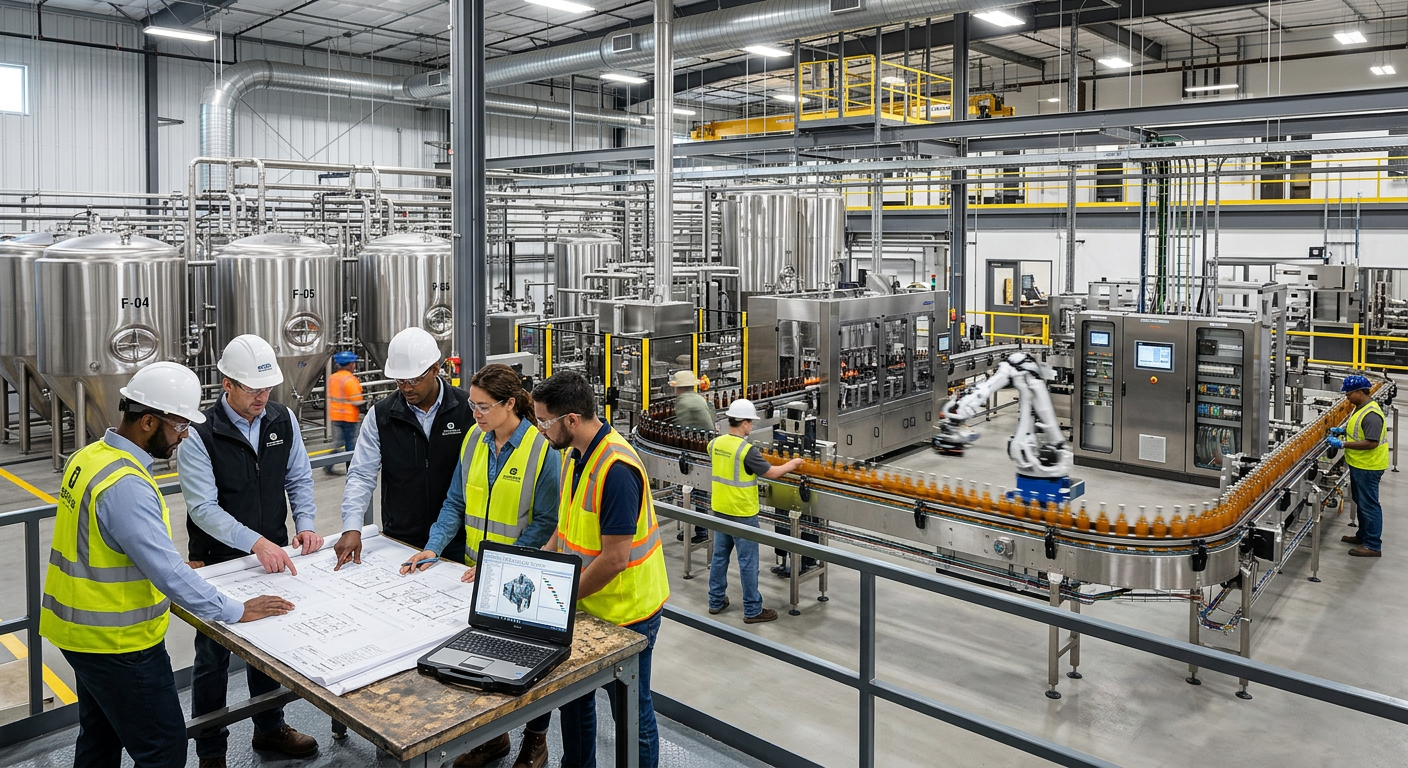
CIP Automation System for Food Plants
[trp_language language=”en_US”]
Smart CIP Automation for Food Plants in the United States
Clean-in-place automation has become a strategic investment for U.S. food and beverage manufacturers that need better sanitation control, lower utility consumption, and audit-ready records. In modern plants, a CIP automation system is no longer just a pump-and-timer package. It is a connected cleaning platform that uses verified sensor data, PLC sequencing, digital signatures, and production integration to prove that every circuit was cleaned correctly. For processors in North Carolina, California, Texas, Wisconsin, Illinois, Georgia, and major logistics corridors around Chicago, Dallas, Atlanta, Los Angeles, and the Port of Houston, that shift matters because labor, water, chemical costs, and compliance pressure all continue to rise.
For facilities evaluating new installations or upgrades, the most successful projects usually balance sanitation performance, recoverability, operational uptime, and long-term profitability. That is especially true in high-throughput sectors such as dairy, beverages, sauces, protein, aseptic filling, brewing, prepared foods, and co-packing. Companies looking for complete project support often want a partner that can engineer the process, manage installation, integrate controls, and align the CIP skid with broader plant goals. In that context, firms such as Disruptive Process Solutions stand out by combining business-minded planning with food and beverage engineering, controls integration, and turnkey execution across North America.
Quick Answer

A modern CIP automation system for food plants in the United States uses sensors, PLC logic, and digital documentation to verify that each cleaning phase actually achieved the required concentration, flow, temperature, time, and rinse endpoint. Compared with older time-based systems, sensor-verified CIP reduces overcleaning, cuts water use by roughly 20 to 30 percent, lowers chemical use by 15 to 25 percent in many applications, improves first-pass sanitation consistency, and creates audit-ready records for FDA, USDA, SQF, and BRC environments.
For buyers, the best approach is usually to define the circuits to be cleaned, confirm soils and product families, determine whether recovery tanks are justified, specify the required level of automation, and decide whether a retrofit of an existing skid or a full replacement delivers the best total value. Plants running frequent product changes, allergen changeovers, or multiple recipes often benefit the most from sensor-verified automation.
| Decision Area | Basic Time-Based CIP | Modern Sensor-Verified CIP | Operational Effect |
|---|---|---|---|
| Rinse endpoint | Fixed timer only | Conductivity or turbidity verified | Less wasted water |
| Chemical strength | Manual check or assumption | Online conductivity trend | More reliable cleaning |
| Documentation | Paper log sheets | Timestamped digital batch record | Faster audits and investigations |
| Operator involvement | High manual intervention | Guided prompts and interlocks | Lower error rate |
| Recovery and reuse | Limited | Automated return logic | Reduced chemical loss |
| Integration | Standalone skid | Linked to PLC, SCADA, MES | Better scheduling and traceability |
The table above shows why sensor-verified systems are increasingly preferred in U.S. processing plants. The difference is not just cleanliness; it is proof of cleanliness, repeatability, and lower operating cost.
What Modern CIP Automation Looks Like: Sensor-Verified vs. Time-Based Cleaning

Traditional CIP packages typically run fixed durations for each step. That can work in simple applications, but it often causes overcleaning or undercleaning because real process conditions vary. Product residue from yogurt is not the same as residue from RTD coffee, ketchup, plant protein slurry, or a high-sugar beverage. Pipe runs, heat exchangers, fillers, balance tanks, pasteurizers, blenders, and transfer lines also behave differently.
Modern sensor-verified CIP automation adds instrumentation and control logic that checks whether the process reached the intended endpoint before the sequence advances. Instead of asking, “Has five minutes passed?” the system asks, “Has the conductivity dropped to rinse water values?” or “Has turbidity stabilized below the threshold?” This is a major advantage for processors in water-sensitive states such as California and Arizona, and in high-volume manufacturing hubs such as Wisconsin dairy, Texas beverage production, and Southeast protein processing.
A modern system usually includes:
- PLC-controlled valve matrices and pump control
- Conductivity sensors for chemical concentration and interface detection
- Turbidity sensors for solids or residual soil indication
- Temperature verification and flow confirmation
- Recipe-based cleaning programs for multiple circuits
- Operator HMI prompts, alarm handling, and permissive logic
- SCADA historian or digital record generation
This is also where engineering depth matters. A full-scope partner with controls, process, and installation capabilities can make a larger difference than a skid vendor acting alone. Through its engineering and integration services, DPS supports CIP projects as part of wider process system design, utilities integration, controls programming, and commissioning. That matters when the skid must interact with tanks, pasteurizers, filler loops, clean steam, hot water sets, RO water, and wastewater constraints.
The growth trend above reflects a realistic market direction: from 2024 onward, U.S. processors are increasingly moving toward digitally verified sanitation because labor scarcity, sustainability goals, and compliance expectations all favor automation.
The Five CIP Phases: Pre-Rinse, Caustic, Intermediate Rinse, Acid, and Sanitizer

Most food plant CIP programs are built around five core phases, although the exact sequence depends on product chemistry, equipment design, allergen profile, and sanitation standard. Understanding these phases is essential for sizing tanks, selecting instrumentation, and programming control logic.
| Phase | Main Objective | Typical Verification Point | Common U.S. Applications |
|---|---|---|---|
| Pre-rinse | Remove gross soil and push out product | Turbidity decline or timed flush | Beverage lines, dairy circuits, sauce transfer |
| Caustic wash | Break down fats, proteins, and organics | Conductivity and temperature in range | Dairy, protein, RTD beverages, breweries |
| Intermediate rinse | Remove caustic residue | Conductivity returns near water baseline | All food and beverage circuits |
| Acid wash | Remove mineral scale and neutralize residues | Conductivity and temperature verified | Dairy, UHT, heat exchangers, hard-water plants |
| Final rinse or sanitizer application | Prepare for production or aseptic handoff | Concentration, contact time, or sterile state | Fillers, tanks, blending systems |
| Optional recovery step | Return reusable solution to tank | Interface detection | Multi-use automated skids |
In U.S. plants with hard water or mineral-heavy utility conditions, the acid phase is especially important for pasteurizers, plate heat exchangers, and hot process loops. By contrast, some product lines may use sanitizer-only terminal steps based on process design and microbial risk. In breweries around Portland, Denver, and Asheville, for example, CIP recipes may be tuned differently than in dairy plants in Wisconsin or aseptic beverage facilities in California’s Central Valley.
Buying advice here is simple: do not assume a standard sequence fits every circuit. A filler bowl, blend line, bright tank, scraped surface heat exchanger, and retort-associated transfer loop all foul differently. Good engineering starts with circuit mapping and soil characterization before the skid and software are finalized.
Conductivity and Turbidity Sensors: Verifying Chemical and Physical Cleanliness
The two most useful sensor categories in modern CIP automation are conductivity and turbidity. Conductivity helps confirm chemical strength and identify transitions between water, caustic, acid, and product interfaces. Turbidity helps verify when visible or suspended soil has been flushed from the line. Together, they reduce guesswork.
Conductivity is especially valuable for:
- Verifying caustic or acid concentration in supply and return
- Detecting water-to-chemical and chemical-to-water transitions
- Reducing unnecessary drain losses during changeover
- Automating chemical recovery back to storage tanks
Turbidity is especially valuable for:
- Pre-rinse endpoint verification
- Product recovery optimization
- Final rinse confirmation on heavily soiled circuits
- Reducing excess rinse time after viscous or particulate products
| Sensor Type | What It Measures | Best Use in CIP | Limitation to Consider |
|---|---|---|---|
| Conductivity | Ionic concentration | Chemical strength, interface detection | Needs proper compensation and calibration |
| Turbidity | Cloudiness or suspended solids | Soil removal and rinse clarity | Thresholds vary by product |
| Temperature | Fluid heat level | Wash effectiveness verification | Must be located correctly |
| Flow | Velocity or flowrate | Mechanical cleaning action | Low flow can invalidate wash |
| Pressure | System pressure | Pump protection and route confirmation | Not a cleanliness indicator alone |
| Level | Tank liquid level | Chemical inventory and recovery logic | Requires integration with recipes |
The practical takeaway from this table is that no single sensor proves cleanliness by itself. Strong CIP automation combines concentration, temperature, flow, and endpoint confirmation to create a validated process window.
This is one area where control and process engineering must be tightly coordinated. DPS brings that cross-functional capability through its technological skill set in PLC programming, SCADA, utilities integration, and process system design. For clients that need custom skids, skid modifications, or broader plant integration, its process equipment capabilities can be aligned with instrumentation and controls requirements rather than treated as separate scopes.
PLC Programming for CIP Sequences: State Machines and Validation Logic
The heart of a smart CIP system is the PLC program. Well-designed CIP code does not just turn pumps and valves on and off. It executes a state machine with explicit transitions, permissives, fault responses, and validation checks.
A typical PLC state machine may include the following high-level states:
- Ready and permissive check
- Route confirmation and valve proof
- Pre-rinse active
- Rinse endpoint validation
- Caustic circulation
- Chemical concentration and temperature validation
- Intermediate rinse
- Acid circulation
- Sanitizer or final stage
- Drain, recovery, and completion record
Within each state, the code should verify conditions such as tank levels, pump status, valve feedback, line availability, temperature minimums, flow minimums, and concentration windows. If one condition is not met, the sequence should alarm, hold, or safely abort depending on risk. That logic is critical in facilities where production and sanitation run in parallel, such as large co-packers near Atlanta, Dallas-Fort Worth, or the Inland Empire.
Validation logic also supports food safety and repeatability. For example, the PLC may require the return conductivity during caustic wash to remain within an acceptable band for a minimum hold time. If not, the timer resets or extends. That means the wash completes based on achieved conditions, not operator assumption.
| Programming Element | Purpose | Example Logic | Business Benefit |
|---|---|---|---|
| Permissives | Ensure safe start conditions | Tank level high, route free, pump available | Prevents failed cycles |
| State machine | Control sequence progression | Advance only on verified endpoints | Repeatable cleaning |
| Interlocks | Avoid unsafe or wrong routing | Block production valve open during CIP | Reduced contamination risk |
| Alarm handling | Respond to abnormal conditions | Low temp, low flow, bad conductivity | Faster troubleshooting |
| Recipe management | Different circuits, different programs | Filler CIP vs. tank CIP | Operational flexibility |
| Data logging | Create proof of execution | Store timestamps and sensor values | Audit readiness |
For plants that have outgrown older ladder-only structures, reprogramming existing PLC architecture can unlock major value before new steel is purchased. That practical mindset fits the way DPS approaches capital decisions: identify the real bottleneck first, whether it is software, routing, utility capacity, or equipment design, then invest where return is highest.
The bar chart shows where demand is strongest: dairy and aseptic systems remain heavy users because verification and documentation requirements are especially high, while RTD beverages and protein processing are growing rapidly due to SKU complexity and sanitation turnover.
Digital Records: Timestamped, Operator-Signed, Audit-Ready Documentation
Digital CIP records are now a major purchasing driver. U.S. manufacturers subject to customer audits, FDA review, USDA oversight, or GFSI certification increasingly expect every cleaning cycle to generate a secure electronic history. That history should show who started the cycle, which route was cleaned, what recipe was used, whether critical parameters were achieved, when alarms occurred, and who acknowledged exceptions.
An audit-ready digital record often includes:
- Batch or cycle ID
- Date and time stamps for each phase
- Operator name or electronic signature
- PLC recipe version
- Temperature, flow, and conductivity trend data
- Alarm and deviation log
- Completion status and supervisor approval if required
Paper records can still exist as backups, but they slow investigations and invite inconsistencies. If a customer complaint arises on a product packed in New Jersey, produced in Chicago, or distributed through Savannah or Long Beach, investigators need to retrieve sanitation proof quickly. Electronic records shorten that process dramatically.
| Record Field | Why It Matters | Typical Source | Audit Value |
|---|---|---|---|
| Cycle start time | Confirms sanitation timing | PLC event log | Traceability |
| Operator ID | Shows accountability | HMI login or badge | Electronic sign-off |
| Recipe name | Confirms correct procedure | PLC or MES | Procedure control |
| Critical parameter trends | Proves execution quality | Historian | Verification evidence |
| Alarm history | Shows deviations and responses | SCADA alarm database | CAPA support |
| Completion status | Confirms release condition | Workflow logic | Line release confidence |
From a service standpoint, this is where an integrated engineering contractor brings more value than a skid supplier alone. DPS supports not only system design but also project execution, installation management, controls integration, commissioning, and owner-side coordination. That combination helps ensure that records are not treated as an afterthought but as part of the overall plant operating model. More detail on this execution style can be found through its project case examples.
ROI Metrics: 20-30% Water Reduction and 15-25% Chemical Savings
Return on investment is often the deciding factor for CIP automation. In many U.S. facilities, the most visible gains come from lower water use, lower chemical consumption, and improved production uptime. Less visible but equally important benefits include lower rework risk, less operator dependence, better audit outcomes, and better scheduling confidence.
Water savings of 20 to 30 percent are realistic when rinse endpoints are verified instead of timed conservatively. Chemical savings of 15 to 25 percent are also realistic when conductivity-based recovery and concentration control reduce unnecessary dumping and overdosing. The exact result depends on circuit count, product mix, utility cost, sanitation frequency, and whether the system supports recovery tanks.
Plants with the strongest ROI typically share these traits:
- Frequent CIP cycles per day
- High water or wastewater charges
- Expensive chemicals or high caustic turnover
- Multi-shift production with tight changeover windows
- Multiple product families, allergens, or strict sanitation validation
The area chart illustrates the broader trend shift: sensor-verified cleaning is becoming the default expectation rather than the premium option. By 2026, sustainability reporting, utility pressure, and labor constraints are likely to push even more facilities to upgrade.
| ROI Lever | Typical Improvement Range | Where It Comes From | Notes |
|---|---|---|---|
| Water use | 20% to 30% | Shorter verified rinses | Often highest savings in beverage plants |
| Chemical use | 15% to 25% | Recovery and concentration control | Strong in multi-circuit operations |
| Labor hours | 5% to 15% | Less manual checking and recordkeeping | Depends on staffing model |
| Downtime reduction | 5% to 12% | Fewer failed or extended cleans | Important for co-packers |
| Audit preparation time | 30% to 60% | Electronic retrieval of records | Large impact for regulated sites |
| Product loss reduction | 3% to 10% | Better interface detection | Useful in high-value liquids |
The explanation is straightforward: ROI is rarely based on one metric. The strongest business case combines utilities, labor, uptime, and compliance value into one model tied to annual CIP cycle counts and local utility rates.
Integration with Production Scheduling and MES Systems
Standalone CIP systems leave value on the table. Integration with production scheduling and manufacturing execution systems allows cleaning to happen at the right time, on the right circuit, with the right recipe, while minimizing waiting time between sanitation and startup.
In advanced facilities, MES integration can:
- Call the correct CIP recipe based on the prior product run
- Block production release until sanitation completes successfully
- Associate CIP records with lot, batch, or work order history
- Prioritize circuits based on planned changeovers
- Help utilities teams forecast hot water and chemical demand
This is especially useful in high-mix plants producing multiple SKUs for retailers, club channels, and foodservice distribution. A co-packer near Charlotte, a dairy processor in Minneapolis, or an RTD beverage facility near Fresno may run different package formats, flavors, or allergen profiles within the same day. CIP integration helps avoid misalignment between sanitation and production dispatch.
By 2026, two trends will shape this area even more strongly. First, more manufacturers will connect CIP records to enterprise sustainability dashboards to report water and chemical intensity by product family. Second, tighter digital traceability expectations will make electronic sanitation proof more important in customer onboarding and retailer compliance reviews. Policy pressure on water reuse, wastewater discharge, and ESG reporting will also influence project design, especially in drought-prone states and municipalities with rising discharge fees.
From a technology perspective, DPS is positioned well for these projects because its capabilities span controls engineering, PLC programming, SCADA, and broader utility and process integration. That matters when CIP must coordinate with syrup rooms, blending skids, heat treatment systems, storage tanks, fillers, and plant utilities rather than operating as an isolated unit.
Retrofit vs. Replacement: Upgrading Existing CIP Skids with Smart Sensors
Not every plant needs a brand-new CIP skid. In many U.S. facilities, the smartest investment is a retrofit. Existing tanks, pumps, frames, and heat systems may still be mechanically sound, while the real gap lies in sensors, controls, valves, and software.
A retrofit may include:
- Adding conductivity and turbidity sensors
- Replacing legacy PLC hardware
- Installing new HMIs and network connectivity
- Upgrading automated valve manifolds
- Adding digital historian and electronic records
- Reworking recipes and control logic for verification
Replacement is often better when the existing skid has inadequate tank sizing, poor hygienic design, insufficient heating, no recovery capability, severe maintenance issues, or cannot support the number of circuits required. Plants expanding capacity near major manufacturing corridors such as Houston, Indianapolis, Columbus, or the I-85 Southeast corridor often use this decision point to right-size future sanitation architecture rather than just patch old equipment.
The comparison chart highlights a common reality: retrofits usually win on initial capital and speed, while full replacements often win on scalability, long-term savings, and digital performance. The right answer depends on asset condition, production growth, and sanitation risk.
| Evaluation Factor | Retrofit Usually Best When | Replacement Usually Best When | Decision Impact |
|---|---|---|---|
| Mechanical condition | Frame, tanks, pumps are sound | Corrosion or chronic failures exist | Reliability |
| Capacity | Current sizing is adequate | More circuits or bigger volumes are needed | Future growth |
| Controls | Only instrumentation and PLC are outdated | Architecture is obsolete end-to-end | Automation performance |
| Downtime window | Shutdown time is very limited | Planned expansion allows installation window | Execution risk |
| Budget | CapEx is constrained | Lifecycle value outweighs upfront cost | Financial fit |
| Compliance goals | Moderate record and control upgrade needed | Full validation and audit redesign needed | Regulatory confidence |
For manufacturers weighing this choice, a practical front-end study often pays for itself. DPS frequently approaches these projects from three angles at once: technological capabilities such as controls and PLC architecture, manufacturing capabilities such as custom process equipment and CIP skid support, and service capabilities including design-build-manage execution, installation oversight, and commissioning. That integrated approach helps clients avoid overbuying equipment when re-engineering would solve the problem, or underinvesting when the plant has already outgrown the skid.
FAQ
What industries benefit most from CIP automation?
Dairy, breweries, spirits, wine, kombucha, RTD beverages, sauces, dressings, prepared foods, protein processing, aseptic products, and co-packing operations all benefit strongly. Any plant with repeat cleaning cycles, strict sanitation demands, or costly downtime is a good candidate.
How do I know whether I need conductivity, turbidity, or both?
Conductivity is usually the first priority because it confirms chemical concentration and detects transitions between rinse water and chemicals. Turbidity becomes especially valuable when product soils vary, visual residue matters, or pre-rinse optimization is important. Many high-performance systems use both.
Can an older CIP system be upgraded instead of replaced?
Yes. Many systems can be upgraded with smart sensors, revised PLC code, better valve automation, and digital records. Replacement becomes more attractive when the skid is undersized, poorly designed hygienically, or mechanically unreliable.
What should a U.S. food plant ask before buying a CIP automation system?
Ask how the system verifies concentration, temperature, flow, and rinse endpoints; whether it supports chemical recovery; how records are stored; how it integrates with SCADA or MES; what local service support is available; and whether the design fits your product soils and growth plan.
How long does a CIP automation project take?
A simple retrofit may be completed in weeks once engineering is approved. A larger multi-circuit replacement with plant integration, utility modifications, and digital record validation may take several months. Front-end planning, procurement, and shutdown coordination are major schedule drivers.
What local factors matter in the United States?
Water cost, wastewater surcharges, labor availability, and local code expectations can change the economics significantly. Plants in California, the Southwest, and some municipal utility districts often see stronger water-related ROI. Large manufacturing hubs such as Chicago, Dallas, and Los Angeles may prioritize uptime and labor reduction even more heavily.
What trends should buyers watch through 2026?
Expect more sensor redundancy, stronger digital signatures, tighter MES and ERP integration, broader sustainability reporting, and more predictive maintenance around valves, pumps, and heat systems. Water stewardship and traceability will increasingly shape CIP project specifications.
Why work with an engineering-led partner instead of just buying a skid?
Because CIP performance depends on the full process ecosystem: route design, utility balance, controls architecture, hygienic installation, startup, and operator training. An engineering-led partner can align the skid with plant profitability, not just deliver hardware.
In summary, the U.S. market is moving rapidly toward smart CIP automation that proves cleaning performance instead of assuming it. The plants that gain the most are those that treat CIP as an integrated process system tied to production, utilities, compliance, and long-term capital strategy. Whether the best path is a retrofit or a full replacement, the strongest results usually come from disciplined front-end engineering, well-structured PLC logic, practical sensor selection, and a project team that understands both manufacturing reality and business return.
[/trp_language]
Complete Company Portfolio
About the Author: Disruptive Process Solutions (DPS)
The DPS team combines process engineering expertise with real-world food and beverage manufacturing experience. Our content focuses on process optimization, production efficiency, facility improvements, and practical solutions that help manufacturers operate more effectively in a rapidly evolving industry.
Share