CIP Skid Systems for Sanitary Processing
[trp_language language=”en_US”]
Clean-in-place skid systems are the backbone of sanitary processing in U.S. food, beverage, dairy, and aseptic plants. A well-designed CIP skid automates the delivery, heating, circulation, recovery, and verification of cleaning solutions without dismantling production equipment. In practical terms, the skid stores water and chemistry, sends it through process lines at the right flow and temperature, confirms return conditions, and either drains or recovers the solution for reuse. For manufacturers in markets such as Chicago, Dallas, Los Angeles, Atlanta, Charlotte, Houston, and the Northeast corridor near Newark and Philadelphia, the value is straightforward: lower labor, faster turnarounds, better food safety documentation, and more repeatable sanitation across tanks, piping, fillers, pasteurizers, mixers, and transfer systems.
Across the United States, demand for CIP skids continues to grow as processors modernize older plants, build greenfield capacity, and respond to stricter audit expectations under FDA, USDA, SQF, and BRC programs. Plants shipping through major trade hubs such as the Port of Long Beach, the Port of Savannah, Houston, and New Jersey often need reliable sanitation systems that support higher uptime and easier validation. This is especially true for beverage co-packers, protein processors, dairy facilities, ready-to-drink plants, and aseptic operations where changeovers are frequent and contamination risk is expensive.
Quick Answer

A CIP skid system is a packaged sanitation unit that cleans tanks, piping, valves, heat exchangers, fillers, and other process equipment without taking them apart. It works by preparing rinse water and cleaning chemicals, pumping them through a defined circuit at a target velocity, maintaining temperature and contact time, then recovering or discharging the returning solution based on conductivity, temperature, and recipe logic. In the United States, most sanitary plants choose between a single-use CIP skid for lower capital cost and simpler operations, or a recirculating CIP skid for higher water and chemical efficiency in facilities with repeated cleaning cycles.
The right CIP skid depends on six practical factors: product soil load, circuit length, line diameter, required flow velocity, target temperature, and number of circuits needing service per shift. If your plant produces dairy beverages, sauces, proteins, kombucha, spirits, juices, or aseptic products, your skid should be designed around actual process risk, not a generic pump-and-tank package. That is why many processors seek engineering support that combines process design, utilities, controls, and installation rather than treating the skid as a standalone item.
| Decision Factor | Why It Matters | Typical U.S. Plant Impact |
|---|---|---|
| Soil type | Drives chemistry, temperature, and cycle duration | Protein and dairy soils usually require stronger alkaline wash logic |
| Circuit length | Affects pump head and return timing | Long packaging halls need higher pressure and balanced returns |
| Flow velocity | Determines mechanical cleaning action | Most sanitary lines target turbulent flow for reliable soil removal |
| Temperature | Supports detergent performance and fat removal | Steam, hot water, or electric heating must match production demand |
| Recovery strategy | Changes water and chemical consumption | Recirculating systems lower operating cost in multi-shift plants |
| Automation level | Improves repeatability and records | PLC and SCADA integration simplify audit readiness |
The table above shows why CIP skids should be sized from operating conditions, not just tank volume. A plant that runs sticky sugar syrups in Atlanta or carbonated beverages near Los Angeles may need a very different cleaning profile from a meat marinade system in the Midwest.
How a CIP Skid System Works: Flow Path & Operation Logic

The operating logic of a CIP skid follows a controlled flow path. First, a rinse or wash tank is charged with water. The system then doses chemicals, heats the solution if required, confirms readiness through instruments, and opens the correct valve matrix. The supply pump pushes solution through the selected circuit, such as a blend tank, transfer header, plate heat exchanger, or filler bowl. As the solution returns, instruments verify conductivity, temperature, and sometimes turbidity to determine whether the return should be recovered back to a tank or diverted to drain.
A standard cleaning sequence usually includes pre-rinse, caustic wash, intermediate rinse, acid wash if needed, final rinse, and sanitizer step where applicable. The exact recipe depends on the product and sanitary standard. Beverage plants in places like Denver or Tampa often optimize for rapid flavor changeover, while protein and dairy plants near Wisconsin, Nebraska, or North Carolina may place more emphasis on heavy soil breakdown and microbiological control.
| Cycle Step | Main Purpose | Common Control Check |
|---|---|---|
| Pre-rinse | Removes bulk product residue | Return clarity or timed flush |
| Caustic wash | Breaks down fats, proteins, sugars, and soils | Conductivity and temperature verification |
| Intermediate rinse | Flushes alkaline residue before next step | Conductivity drop to setpoint |
| Acid wash | Removes mineral scale and stone | Recipe confirmation and minimum contact time |
| Final rinse | Removes residual chemistry | Neutral conductivity or pH target |
| Sanitize or final hold | Prepares line for production start | Temperature, time, or sanitizer concentration |
This operating sequence matters because mechanical action, chemistry, heat, and time all work together. If flow rate is too low, even the best detergent will not scrub pipe walls effectively. If temperature falls during circulation, fats may not dissolve and proteins may bake onto surfaces. If return logic is poorly configured, the system can contaminate recovery tanks or waste usable chemical.
Modern CIP skids often use PLC-based recipes, automated valve positioning, conductivity probes, RTDs, level sensors, and operator HMI screens. Plants that integrate skid data into a facility-wide SCADA platform gain stronger traceability, which is especially valuable during audits or customer quality reviews.
Skid Configurations: Type I (Single-Use) vs. Type II (Recirculating)

In sanitary processing, the two most common CIP skid configurations are single-use and recirculating. A Type I single-use skid prepares cleaning solution, sends it through one circuit, and sends most or all return to drain after use. A Type II recirculating skid recovers usable rinse water and detergent into dedicated tanks for later cycles. Neither format is universally better; the best option depends on throughput, utilities, wastewater cost, and production schedule.
Single-use systems are popular in smaller plants, pilot facilities, specialty food operations, and sites with lower daily cleaning frequency. They are easier to understand, easier to install, and often lower in first cost. Recirculating systems become attractive in larger beverage, dairy, prepared foods, and aseptic facilities where multiple circuits are cleaned every shift and water or chemical savings justify the additional controls and tankage.
| Feature | Type I: Single-Use | Type II: Recirculating |
|---|---|---|
| Capital cost | Lower | Higher |
| Water use | Higher | Lower |
| Chemical efficiency | Lower | Higher |
| Controls complexity | Simpler | More advanced |
| Best fit | Small to mid-size plants, fewer cycles | High-throughput plants, repeated daily cleaning |
| Validation focus | Simple step confirmation | Recovery integrity and tank segregation |
The comparison above shows the tradeoff clearly. If your operation runs one or two cleanings per day, drains are inexpensive, and space is tight, a single-use skid may be the better investment. If your site runs three shifts, frequent flavor changes, or multiple process loops, recirculation can reduce long-term operating cost substantially. In high-volume beverage hubs such as Southern California, Texas, and the Southeast, the savings often compound quickly because labor, chemicals, and water all matter.
Component Breakdown: Tanks, Pumps, Valves, Heat Exchanger & Controls
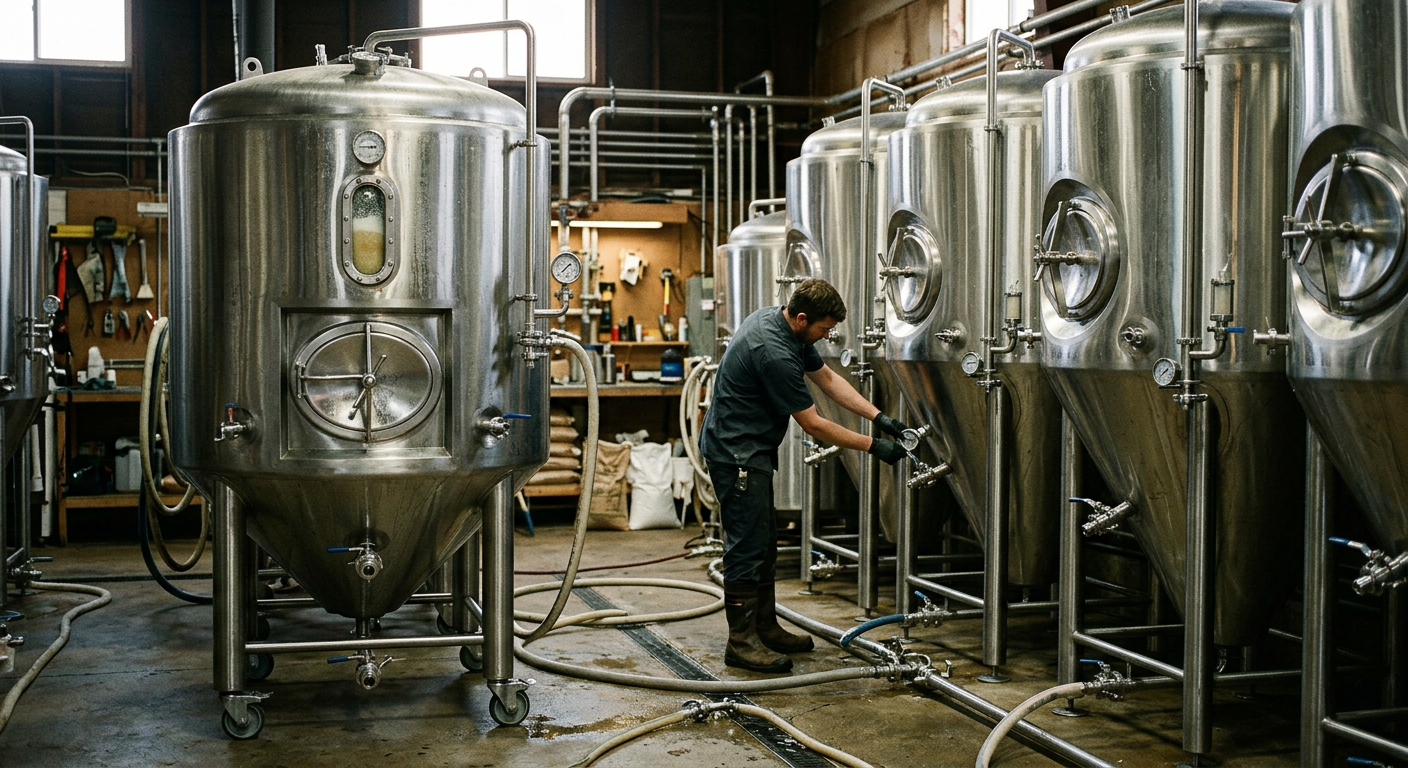
A CIP skid is more than tanks and a pump. Each major component affects sanitation performance, uptime, and operator safety. Tanks hold rinse water, caustic, acid, or recovered solutions. Pumps provide the circulation energy needed to achieve turbulent flow. Valves route supply and return while protecting cross-contamination boundaries. Heat exchangers or direct heating packages maintain the wash temperature. Controls coordinate recipes, alarms, interlocks, and data logging.
Tank design should consider volume, level instrumentation, spray coverage, venting, and cleanability. Pump selection must account for flow, head, net positive suction head, and chemical compatibility. Valve design is critical because a misapplied seat valve, poor mixproof strategy, or dead-leg-prone arrangement can undermine the whole sanitation program. Heating choice depends on utilities: steam is common in larger food and beverage plants, while hot water loops or electric heating may suit smaller systems.
| Component | Primary Function | Key Selection Criteria |
|---|---|---|
| Rinse and chemical tanks | Store and recover cleaning media | Volume, insulation, level control, sanitary finish |
| Supply pump | Delivers required circuit flow and pressure | Flow rate, head, impeller design, material compatibility |
| Return pump | Balances return in complex circuits when needed | Foaming tendency, head loss, remote circuit layout |
| Automated valves | Route fluid and isolate recipes | Seat design, leakage protection, actuation, cleanability |
| Heat exchanger or heater | Raises and maintains wash temperature | Steam availability, response time, fouling risk |
| Controls and instrumentation | Manage logic and prove cycle performance | PLC, HMI, conductivity, RTD, flow, pressure, records |
For manufacturers evaluating engineering partners, it helps to work with a group that understands both process and utility integration. Sanitary process engineering and project execution services matter because the skid must work with upstream and downstream systems, not just look good on a submittal drawing.
On the technology side, Disruptive Process Solutions applies cross-functional engineering that spans process, mechanical, structural, plumbing, electrical, and controls disciplines. That matters for CIP because the skid’s performance depends on the full system: utility loading, line hydraulics, PLC programming, field installation, and operator usability. On the manufacturing side, the company also produces custom process equipment, including tanks and CIP systems, which helps align fabricated equipment with real plant requirements instead of forcing a one-size-fits-all package. On the service side, the firm supports design, capital planning, installation, integration, commissioning, and project management, which is especially valuable when retrofitting an active U.S. plant with limited downtime.
Sizing Your CIP Skid: Flow Rate, Temperature & Circuit Requirements
CIP skid sizing starts with the circuits, not with the skid footprint. Engineers first identify the largest and most demanding cleaning path, including line size, total pipe length, vertical rise, spray devices, valve clusters, and return restrictions. From there, the supply pump is sized to maintain adequate velocity through that path. Temperature requirements are then layered in based on product soil and chemistry performance. Tank volumes are set according to circuit fill volume, recovery strategy, and the number of back-to-back cycles required.
In many U.S. sanitary applications, the target is not just enough flow to move liquid, but enough flow to create mechanical cleaning action. Oversizing, however, can be costly because it increases pump horsepower, heating demand, valve size, and utility load. Undersizing causes weak cleaning, longer cycles, and sanitation failures that show up later as quality issues.
| Sizing Variable | What to Evaluate | Common Design Outcome |
|---|---|---|
| Largest circuit volume | Total liquid needed to fill process path | Determines minimum tank and makeup volume |
| Pipe diameter | Affects velocity at a given flow rate | Sets pump flow requirement |
| Total dynamic head | Includes elevation, friction, equipment losses | Influences pump selection and motor size |
| Temperature setpoint | Depends on chemistry and product residue | Determines heating package size |
| Number of daily cycles | Indicates production cleaning frequency | Drives recovery strategy and automation level |
| Utility availability | Steam, hot water, electrical, drain, compressed air | Shapes final skid configuration |
When planning a new plant in the United States, sizing must also reflect future growth. A start-up beverage plant in Phoenix or Nashville may launch with one filler and one blend loop, then add more circuits within two years. Designing a skid with modular controls, future valve ports, and realistic utility capacity often costs less than a full replacement later.
For buyers comparing options, reviewing custom sanitary equipment capabilities can help clarify whether the supplier can deliver not only a skid, but also matching tanks, utility interfaces, and fabricated process assemblies that reduce integration risk.
Installation Best Practices: Positioning, Utility Connections & Ventilation
Proper installation has a direct effect on CIP performance. The skid should be positioned so operators can access pumps, instruments, and valves safely while minimizing unnecessary pipe runs. Long supply and return headers add friction loss and increase dead-leg risk if poorly designed. The ideal location also supports future maintenance without forcing production shutdowns across unrelated process areas.
Utilities are often where good projects become bad ones. Steam, condensate return, hot water, compressed air, electrical service, drains, and ventilation must all be planned as part of the skid package. In retrofit plants, old utility maps are frequently incomplete, particularly in legacy food facilities in the Midwest or East Coast. Field verification before fabrication reduces expensive surprises.
| Installation Topic | Best Practice | Reason |
|---|---|---|
| Skid location | Place near major circuits but outside congested traffic zones | Reduces piping losses and improves safety |
| Drainage | Provide sloped floor and adequate trench capacity | Prevents pooling and sanitation hazards |
| Steam and hot water | Confirm pressure, load, and condensate handling | Protects temperature stability during wash cycles |
| Electrical and controls | Use clean power, proper disconnects, and labeled I/O | Improves reliability and serviceability |
| Compressed air | Supply dry, stable air to automated valves | Reduces valve failures and erratic actuation |
| Ventilation | Manage heat, humidity, and chemical vapors | Improves operator comfort and equipment life |
Ventilation deserves special attention in enclosed utility rooms, especially in humid regions such as the Gulf Coast and Southeast. Steam-heated systems can elevate room temperature quickly. Chemical storage and dosing zones also need practical operator protection, local code review, and sensible material handling design.
In complex capital projects, a design-build-manage approach can simplify installation because process engineering, trade coordination, and commissioning are handled under one project strategy. Processors wanting broader project support can review the company’s integrated engineering approach to understand how utility, equipment, and field execution are coordinated.
Operating Procedures: Startup, Cycle Selection & Shutdown
Standard operating procedures keep CIP performance consistent across shifts. Before startup, operators should verify chemical concentration, tank levels, utility readiness, valve status, and recipe selection. If the skid serves multiple circuits, positive line identification is essential. The selected cycle must match the product last run, the equipment type, and the plant’s sanitation standard.
During operation, the HMI should display live values for flow, temperature, conductivity, time remaining, tank levels, and alarm conditions. Operators need a clear understanding of when the skid is circulating, recovering, diverting to drain, or waiting for an interlock such as a process valve proof signal. Shutdown procedures should include safe depressurization, chemistry protection, and any required post-cycle verification.
| Operating Stage | Operator Task | Expected Result |
|---|---|---|
| Pre-start check | Confirm utilities, chemistry, levels, and route | Cycle starts without avoidable alarms |
| Recipe selection | Choose correct circuit and soil profile | Right time, temperature, and chemistry applied |
| Live monitoring | Watch flow, conductivity, temperature, and pressure | Any deviation is caught early |
| Recovery phase | Confirm returns go to proper tank or drain | Usable solution is preserved without contamination |
| Cycle completion | Review pass/fail status and event log | Audit trail is maintained |
| Shutdown | Secure skid, isolate chemistry, and prepare for next use | System remains safe and ready |
Facilities with frequent product changes benefit from operator training tied to actual plant scenarios. A juice processor in California, a dairy beverage plant in Wisconsin, and a co-packer in Texas may all use CIP skids, but their startup checks and recipe libraries can look very different. Clear SOPs reduce human error, which is still one of the most common causes of sanitation failures.
Preventive Maintenance Schedule for CIP Skids
Preventive maintenance keeps CIP skids reliable and protects sanitation outcomes. Pumps, valve actuators, gaskets, sensors, and heaters all degrade over time. If conductivity probes drift or RTDs lose accuracy, the skid may appear to complete cycles while missing critical cleaning targets. Maintenance should therefore focus on both mechanical reliability and measurement integrity.
A strong maintenance plan includes daily visual checks, weekly verification of leaks and valve response, monthly calibration review, and planned annual shutdown work. Plants with high caustic exposure, hot cycles, or aggressive production schedules may need more frequent replacement intervals.
| Frequency | Maintenance Task | Why It Matters |
|---|---|---|
| Daily | Inspect for leaks, unusual noise, and low chemical levels | Catches basic issues before they interrupt sanitation |
| Weekly | Check valve actuation, air pressure, and pump seals | Prevents routing failures and mechanical breakdowns |
| Monthly | Verify conductivity, temperature, and level sensor accuracy | Protects recipe validation and cleaning effectiveness |
| Quarterly | Review trends, alarms, and repeat faults in controls | Identifies chronic reliability problems |
| Semiannual | Replace wear parts based on operating hours | Reduces unplanned downtime |
| Annual | Perform full PM shutdown and control system review | Restores baseline performance and compliance confidence |
The schedule above works best when linked to actual plant data. If one circuit causes repeated low-flow alarms or a specific valve cluster shows high cycle counts, maintenance intervals should be adjusted. This is another reason automated records are valuable: the skid becomes easier to maintain when operators and maintenance teams can see trends rather than react only after a failure.
Troubleshooting Common CIP Skid Issues
Most CIP skid problems fall into five categories: poor flow, weak temperature control, wrong chemical concentration, valve routing errors, and inaccurate instrumentation. Poor cleaning results often trace back to one of these issues even when the skid appears to have completed the cycle normally. Troubleshooting should therefore start with the process evidence: what changed, on which circuit, and at what step.
For example, a sudden increase in cycle time may indicate restricted spray devices, fouled heat transfer surfaces, pump wear, or a return blockage. Conductivity instability may point to bad chemical dosing, probe scaling, or cross-mixing of recovered solutions. Repeated temperature alarms may reflect steam pressure variation, undersized heating capacity, or insulation losses along long pipe runs.
| Symptom | Likely Cause | First Corrective Action |
|---|---|---|
| Low flow alarm | Pump wear, blocked strainer, valve misposition | Check pressure, suction condition, and route status |
| Temperature not holding | Steam issue, heater undersized, insulation loss | Verify utility supply and exchanger performance |
| Conductivity out of range | Bad dosing, probe fouling, chemistry depletion | Test concentration and inspect the sensor |
| Unexpected tank contamination | Wrong valve routing or recovery logic failure | Review event log and isolate recovery path |
| Cycle takes too long | Extended fill, weak heating, restricted returns | Compare step times against baseline |
| Repeated failed cleans | Improper recipe, low velocity, poor operator setup | Audit SOP, flow design, and recipe selection |
When recurring issues appear, it helps to evaluate the skid in the context of the whole process system. A line redesign, filler expansion, or added heat exchanger may have changed hydraulic demand without anyone updating the CIP recipe. Reviewing project history through sanitary processing case studies and execution examples can help buyers understand how these issues are solved in real facilities.
FAQ
What industries use CIP skids most in the United States?
Food and beverage plants lead demand, especially dairy, brewing, spirits, RTD beverages, sauces, prepared foods, protein processing, and aseptic systems. Pharmaceutical and specialty sanitary applications also use them.
How do I choose between single-use and recirculating CIP?
Choose single-use if your cleaning frequency is moderate, water cost is manageable, and simplicity matters most. Choose recirculating if you run many cycles per day and want lower long-term water and chemical consumption.
Can one skid clean multiple circuits?
Yes, provided the skid is sized correctly and the valve matrix, recipe logic, and return handling are engineered for those circuits. Multi-circuit systems are common in U.S. beverage and dairy plants.
What controls are essential on a modern CIP skid?
At minimum: PLC logic, operator HMI, automated valves, temperature measurement, conductivity monitoring, tank level control, alarms, and cycle history. SCADA integration adds stronger plant-wide traceability.
How often should instrumentation be calibrated?
That depends on site quality standards, but monthly verification and scheduled calibration are common. Conductivity and temperature devices should never be ignored because they directly affect sanitation validation.
What should buyers ask suppliers before purchase?
Ask about design flow assumptions, heating duty, tank recovery logic, control philosophy, FAT and SAT scope, utility requirements, field support, spare parts, and expansion capability.
Are CIP skid requirements changing in 2026?
Yes. In 2026, U.S. trends point toward higher data visibility, stronger water and energy efficiency targets, more recipe automation, remote diagnostics, and tighter sustainability expectations. Policy pressure around wastewater and energy use is pushing more plants toward recovery, heat integration, and smarter controls.
That 2026 trend shift is visible across American processing markets. More owners want dashboards that show water use per clean, chemical recovery efficiency, heat load, and cycle pass rates. Sustainability goals are no longer just corporate messaging; they influence project funding, especially for large processors with facilities near major logistics centers such as Houston, Chicago, Southern California, and the Southeast. The next generation of CIP skids will increasingly include smarter batching logic, predictive maintenance alerts, and utility optimization tied directly to plant profitability.
For companies evaluating a strategic partner rather than just a fabricator, it is worth looking for a firm that can connect business goals to equipment design. Disruptive Process Solutions supports processors across the United States and Canada with an approach that combines engineering, fabrication alignment, installation, and execution management. Its experience across beverage, dairy, protein, prepared foods, and aseptic systems is especially relevant when CIP skids must integrate with broader plant utilities, automation, and expansion plans. That mix of technological capability, custom manufacturing support, and hands-on project services is often what separates a skid that merely runs from one that improves uptime, compliance, and margin.
In short, a CIP skid is not just sanitation hardware. It is a process asset that influences production scheduling, quality assurance, utility consumption, labor efficiency, and audit readiness. If you are planning a new line, expanding a co-packing facility, replacing aging equipment, or retrofitting an existing plant, the best results come from evaluating the skid as part of the full sanitary process system. In the United States, where throughput, compliance, and speed to market all matter, that system-level approach is what turns a CIP investment into a measurable operational advantage.
[/trp_language]
Complete Company Portfolio
About the Author: Disruptive Process Solutions (DPS)
The DPS team combines process engineering expertise with real-world food and beverage manufacturing experience. Our content focuses on process optimization, production efficiency, facility improvements, and practical solutions that help manufacturers operate more effectively in a rapidly evolving industry.
Share