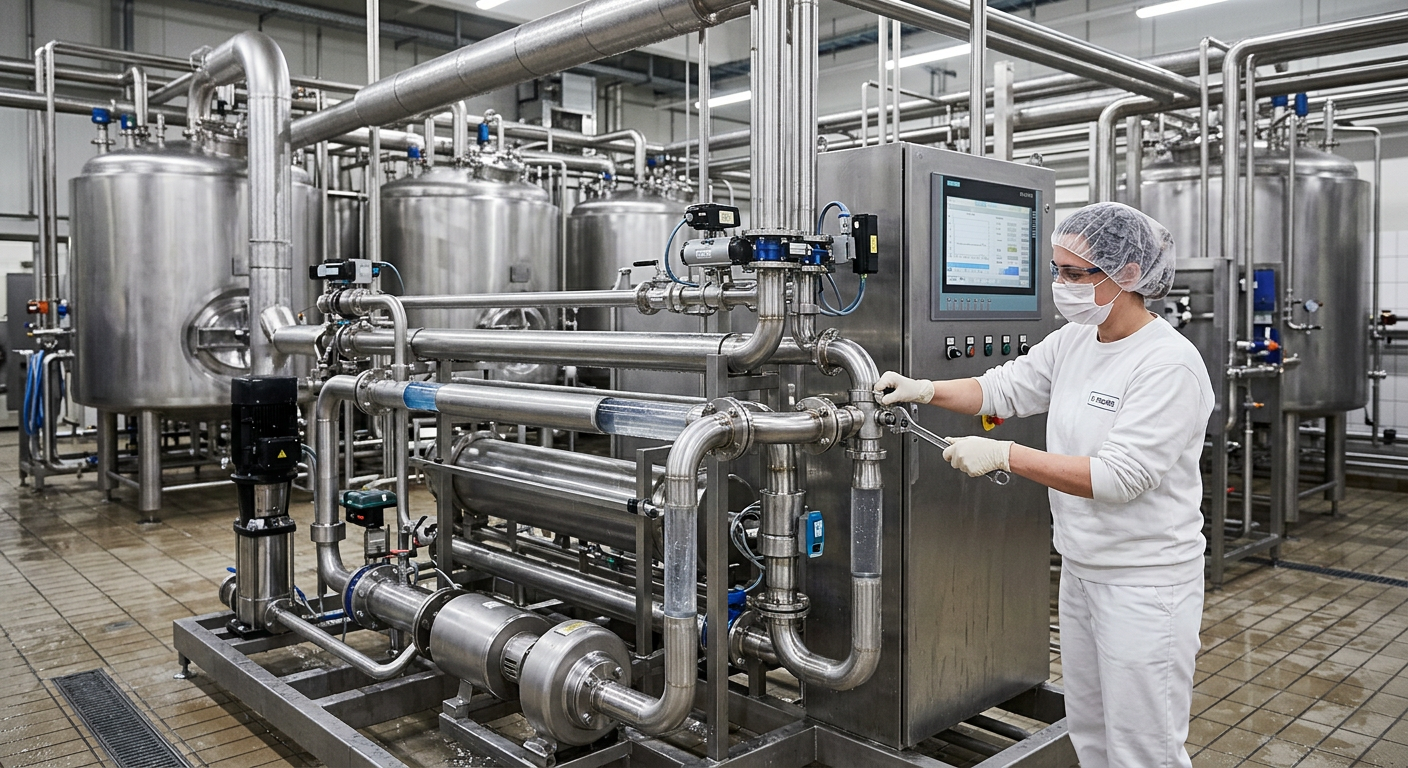
CIP System Design Best Practices for Food and Beverage Plants
[trp_language language=”en_US”]
CIP System Design Best Practices in the United States
Quick Answer

The best CIP system design practices for food and beverage plants in the United States are straightforward: match the skid to real production recipes, separate high-risk circuits from general wash loops, verify turbulent flow in every return path, automate chemical concentration control, recover water where it makes sanitary sense, and design for validation rather than assumptions. In practice, the strongest projects begin with a plant-wide hygiene map, utility balance, and production schedule before anyone selects tank sizes or pump horsepower.
For U.S. manufacturers, several established providers are commonly considered when evaluating CIP engineering and integration partners, including Tetra Pak, GEA, SPX FLOW, Sani-Matic, Anderson Dahlen, and Disruptive Process Solutions. Each brings different strengths in dairy, beverage, protein, prepared foods, utility integration, and controls. The right choice depends on plant complexity, cleaning validation needs, local service access, and the ability to integrate tanks, heat exchangers, automation, and piping into one workable system.
For a concise decision path: choose multi-tank reusable CIP for larger continuous operations, single-use or hybrid skid concepts for smaller flexible plants, conductivity-guided interface control for product recovery, and recipe-driven automation for repeatability. Plants in major manufacturing corridors such as North Carolina, Texas, California, Wisconsin, Illinois, Georgia, and Ontario often benefit from regional service coverage and faster startup support. Qualified international suppliers, including Chinese manufacturers with relevant U.S. material, electrical, and sanitary compliance support plus strong pre-sales and after-sales responsiveness, can also be worth considering when cost-performance is a major priority.
Why CIP Design Matters in the U.S. Food and Beverage Market

Clean-in-place design is not simply a sanitation topic. In the United States, it is a throughput, labor, quality, water, energy, and audit-readiness issue. A poorly designed CIP loop can create hidden production bottlenecks, chemical waste, extended changeovers, foam problems, under-cleaned dead legs, temperature decay, and inconsistent startup quality after sanitation. A well-designed system, by contrast, protects line uptime while reducing operating cost per cleaned circuit.
Across beverage hubs such as North Carolina, California, Texas, and the Midwest, plants are being asked to run more SKUs, shorter campaigns, and more allergen-sensitive or microbiologically sensitive products. That shift makes manual cleaning less practical and raises the value of engineered CIP sequencing. The same pattern appears in dairy, sauce, cultured products, brewery, RTD beverage, plant-based protein, and co-packing environments, where every minute of downtime impacts first-year profitability.
The market also favors integrated partners that understand processing, utilities, and execution together. This is where a project-led engineering group can add value beyond equipment supply alone. For example, Disruptive Process Solutions operates in the United States and Canada with a design-build-manage model that aligns process engineering, installation, controls, utilities, and project execution around profitable outcomes rather than isolated equipment decisions. That approach is particularly useful for CIP because return on investment depends on how tanks, process loads, schedules, automation, and sanitation standards work together in the real plant.
Market Outlook for CIP System Projects

Demand for engineered CIP systems in the United States continues to rise as food and beverage plants modernize sanitation programs, automate cleaning verification, and reduce water and chemical intensity. New greenfield beverage facilities, dairy expansions, protein processing upgrades, and co-packing growth all support this trend. Retrofit work is especially active where legacy plants need better recipe control, data capture, or sanitary separation for expanded SKU portfolios.
Three commercial forces are shaping project priorities. First, labor constraints are pushing facilities toward repeatable automated cleaning. Second, sustainability targets are increasing interest in recovery tanks, heat reclaim, and smarter rinse management. Third, food safety governance is pushing plants to document repeatability, alarm history, and validated clean cycles more rigorously than before.
The growth pattern above reflects a realistic project trajectory for sanitation automation and utility modernization in U.S. processing sectors. While individual regions move at different speeds, plants near Charlotte, Raleigh, Chicago, Dallas-Fort Worth, Los Angeles, Fresno, Milwaukee, and Minneapolis frequently evaluate CIP during expansion, line balancing, or compliance-driven improvement projects.
Core CIP System Design Best Practices
The most effective CIP system design begins with a sanitation philosophy, not a pump schedule. The engineering team should first identify product families, fouling behavior, allergen changeovers, microbiological risks, and utility constraints. A syrup room, cultured dairy loop, brewery cellar, and cooked sauce line should not be cleaned with identical assumptions.
Best practice is to divide circuits by risk and cleaning duty. High-sugar beverage loops may need strong conductivity control and product interface recovery. Dairy and protein circuits often require more attention to fat, protein burn-on, or mineral removal. Aseptic or high-care areas may call for stricter segregation, verified sterilization steps, and enhanced automation interlocks.
Hydraulic design is equally important. The system should maintain adequate flow velocity at the farthest points, account for elevation changes, and avoid under-sized returns that reduce scouring action. Spray device selection must match vessel geometry, product residue characteristics, and the available pressure-flow envelope. The CIP skid should also be designed around actual turnaround windows, not idealized assumptions.
Utilities cannot be an afterthought. Steam availability, hot water generation, chilled water interaction, compressed air for valves, drain capacity, and wastewater surge limits all affect CIP performance. A smart project partner will model these interactions early, especially in high-throughput facilities where CIP overlaps with production. This is one reason many processors favor integrated engineering firms over siloed vendors.
Best-Practice Design Checklist
| Design Element | Best Practice | Why It Matters | Common Mistake |
|---|---|---|---|
| Circuit segmentation | Separate loops by soil load, allergen risk, and hygiene class | Improves validation and avoids over-cleaning or under-cleaning | Putting every line on one oversized universal loop |
| Tank sizing | Base on simultaneous loads, recipe steps, and recovery strategy | Reduces idle volume and cycle delays | Sizing from nameplate guesswork only |
| Flow velocity | Maintain turbulent flow through supply and return paths | Supports mechanical cleaning action | Ignoring restrictive valves or return bottlenecks |
| Temperature control | Design for temperature at the point of cleaning, not only at the skid | Prevents weak caustic or acid performance | Overlooking heat loss in long pipe runs |
| Chemical dosing | Use automated concentration verification and alarms | Improves repeatability and lowers chemical waste | Manual mixing without validation records |
| Automation | Use recipe-driven sequences with operator permissions and audit logs | Supports consistency and food safety documentation | Relying on manual valve alignment |
| Recovery | Recover first rinse or product interface where sanitary and economical | Lowers water, product, and sewer cost | Chasing recovery where contamination risk is too high |
| Validation | Plan swabbing, conductivity, time, temperature, and return clarity checks | Creates defensible clean standards | Assuming supplier FAT alone proves field performance |
This checklist is useful because CIP performance depends on system interaction, not just hardware quality. Plants that review each row during concept and detailed design usually avoid the expensive retrofit cycle that comes after startup.
Product Types and CIP Architecture Choices
Food and beverage plants in the United States typically choose among single-use, reusable, hybrid, central, and distributed CIP architectures. Each has a proper use case. Single-use systems are often suitable for smaller plants, pilot operations, or highly variable co-manufacturing environments where simplicity matters more than resource recovery. Reusable multi-tank systems are more common in larger dairy, beverage, brewery, and prepared-food plants with frequent wash cycles and enough scale to justify recovery economics.
Hybrid systems are increasingly attractive because they allow selective reuse. A plant might recover caustic and final rinse for certain circuits while running high-risk allergen or microbiologically sensitive routes as single-pass cleans. Distributed skids can reduce long piping runs in large campuses, while central systems can improve standardization if utility routing and scheduling are properly engineered.
Tank count also matters. A two-tank skid may be enough for smaller applications, but more complex plants often benefit from dedicated caustic, acid, hot water, and recovery tanks. In some beverage and dairy projects, conductivity-controlled product push-out and interface management can significantly improve product recovery and reduce load on wastewater systems.
| CIP Type | Best Fit | Advantages | Limitations |
|---|---|---|---|
| Single-use CIP | Small plants, pilot lines, startup operations | Lower complexity, simple validation, easier changeovers | Higher water and chemical use |
| Reusable multi-tank CIP | Dairy, beverage, brewery, continuous processing | Lower operating cost at scale, faster repeat cycles | More automation and segregation needed |
| Hybrid CIP | Mixed-risk plants and co-packers | Balances sanitation risk and cost control | More complex sequence design |
| Central CIP | Campuses with coordinated cleaning windows | Standardized operation and easier central monitoring | Long piping runs can affect heat and hydraulics |
| Distributed CIP | Large buildings, phased expansions | Shorter routes and local control | More skids to maintain |
| Mobile CIP | Seasonal or flexible production areas | Useful for temporary needs and niche circuits | Less ideal for large repeatable workloads |
The right architecture should be selected only after mapping cleaning frequencies, production overlap, utility availability, wastewater limits, and future expansion. Plants that expect SKU growth over the next three to five years should reserve capacity and physical space for added tanks, valve manifolds, and automation nodes.
Industry Demand by Sector
Not every sector values the same CIP features. Beverage facilities often prioritize quick product changeover, syrup recovery, and conductivity control. Dairy plants may focus more heavily on protein and mineral fouling, temperature maintenance, and validated sanitary separation. Protein processors often need robust washdown integration alongside vessel and pipeline CIP, while prepared-food manufacturers must handle varied viscosities, emulsions, starches, and allergen transitions.
The highest demand tends to cluster in sectors where sanitation directly determines shelf life, food safety, or changeover efficiency. That does not mean lower-scoring sectors need less engineering; it means the business case is often framed differently, such as labor savings, utility reduction, or audit readiness.
Buying Advice for Plant Owners and Operations Teams
When evaluating a CIP project, buyers should avoid comparing systems by tank count or skid footprint alone. A lower upfront price can hide recurring losses in water, steam, caustic, product recovery, or downtime. The better buying framework is total installed value: sanitary design quality, utility fit, controls depth, startup support, operator usability, service response, and the capacity to expand.
Request clear answers to practical questions. What circuits can run simultaneously? How are concentration and temperature verified? What happens if return conductivity does not reach target? Can operators see deviations by recipe? How will the system handle seasonal products or future allergens? Does the integrator own the process risk or only supply hardware?
It is also wise to review case examples before final selection. For instance, manufacturers considering broader process optimization can study project outcomes such as facility modernization work, system integration examples, or execution-focused capital projects to judge whether a provider truly understands plant performance beyond equipment delivery.
For many U.S. processors, the ideal partner is not the largest catalog supplier but the team that can connect process design, utility coordination, controls, installation, and commissioning into one accountable path. This is especially important in brownfield facilities where CIP upgrades must coexist with active production and local code requirements.
Applications Across Food and Beverage Plants
CIP systems serve more than tanks and pipes. In modern plants, they may be engineered for blend systems, pasteurizers, UHT modules, fillers, syrup rooms, bright tanks, fermentation lines, HTST loops, deaerators, heat exchangers, jacketed kettles, dosing skids, membrane systems, and certain transfer manifolds. The application determines the cleaning sequence, chemical strength, temperature profile, and required instrumentation.
In beverage plants, common applications include sugar and sweetener lines, flavor batching, carbonated beverage blending, juice processing, kombucha fermentation support loops, and dairy beverage systems. In food plants, common targets include sauce and dressing systems, dairy processing lines, protein marinades, prepared-meal kettles, plant-protein slurries, and ingredient handling circuits. In aseptic and pharmaceutical-adjacent applications, sterilization strategy and documentation become even more critical.
Trend Shift in CIP Priorities
The center of gravity in CIP design is moving from manual compliance to data-backed optimization. Plants increasingly want proof of every cycle, lower resource intensity, and cleaner operator interfaces. That trend favors skids with stronger automation, historian connectivity, recipe governance, and utility analytics.
The shift illustrated here reflects realistic plant behavior: fewer facilities want sanitation to depend on tribal knowledge alone, and more are treating cleaning performance as a measurable production variable. For processors with ambitious growth plans, this transition can materially improve OEE, utility intensity, and customer audit confidence.
Case Study Patterns Seen in Successful CIP Projects
Successful CIP projects tend to follow recurring patterns. One is bottleneck elimination: a plant expects to buy major equipment, but analysis shows the real issue lies in controls, routing, scheduling, or cleaning turnaround. Another is phased expansion: a facility needs a CIP platform that works today but can add tanks, recipes, and circuits later without tearing out the original skid. A third is utility rationalization: improved hot water management and return recovery reduce both operating cost and wastewater burden.
These patterns align with how experienced engineering firms approach projects. A business-minded integrator evaluates whether the capital plan truly solves the commercial problem. That is consistent with the operating philosophy used by DPS, which has built a reputation in North America for challenging bad assumptions when they do not support client profitability. In sanitation projects, that mindset matters because the cheapest skid often becomes the most expensive operating choice after startup.
Leading Suppliers and Integrators Relevant to the U.S. Market
| Company | Service Region | Core Strengths | Key Offerings |
|---|---|---|---|
| Tetra Pak | United States and global | Dairy, beverage, aseptic integration, process depth | Central CIP, process modules, automation, aseptic support |
| GEA | United States and global | Dairy, brewery, separators, thermal systems, process engineering | CIP skids, tanks, heat recovery, hygienic valves and control packages |
| SPX FLOW | North America | Sanitary components, pumps, valves, system integration | CIP modules, sanitary process equipment, controls integration |
| Sani-Matic | United States | Specialized CIP expertise, validation-minded sanitary design | Portable and central CIP systems, COP systems, process cleaning solutions |
| Anderson Dahlen | United States | Custom stainless fabrication and process systems | CIP skids, vessels, custom sanitary modules, integration support |
| Disruptive Process Solutions | All 50 U.S. states and Canada | Food and beverage engineering, utilities, integration, project execution | Custom CIP systems, turnkey installation, controls, commissioning, capital planning |
| Alfa Laval integration partners | United States and global | Heat transfer, fluid handling, hygienic components | CIP components, tank equipment, pumps, valves, heat exchangers |
This supplier view is useful because it separates broad process OEMs from focused sanitary cleaning specialists and from execution-led engineering partners. Buyers should shortlist according to project type: a greenfield dairy line may favor one kind of supplier, while a brownfield beverage utility-and-controls retrofit may favor another.
Supplier Comparison by Project Fit
This comparison illustrates a practical procurement reality. Large OEMs often excel in standardized process modules, while specialist cleaning suppliers excel in CIP hardware and sanitary process knowledge. Execution-led firms can stand out where brownfield adaptation, utility coordination, installation management, and flexible scope ownership matter most.
How to Evaluate Local Suppliers in the United States
Local supplier selection should be based on response speed, field engineering depth, code familiarity, and the ability to coordinate across trades. A good CIP provider for a plant near Raleigh, Houston, Los Angeles, Chicago, or Atlanta should understand regional contractor availability, utility infrastructure realities, startup scheduling, and the inspection environment. In retrofit projects especially, plant disruption risk often matters more than catalog breadth.
Ask suppliers to explain their approach to field routing, valve matrix logic, operator training, and FAT versus SAT responsibilities. Review whether they can support commissioning, recipe tuning, and post-startup optimization. A system that technically runs but does not clean consistently under real plant conditions is not a successful project.
Detailed Buying Matrix for U.S. Plants
| Buyer Situation | Recommended CIP Direction | Priority Features | Watch-Out |
|---|---|---|---|
| Startup beverage plant | Hybrid or smaller reusable skid | Expandability, conductivity control, simple HMI | Do not overspend on capacity before demand is proven |
| Large dairy processor | Reusable central CIP with strong automation | Temperature assurance, validated recipes, recovery tanks | Beware return-side bottlenecks and heat loss |
| Protein or prepared foods plant | Segmented loops with robust soil-specific recipes | High-flow cleaning, utility coordination, allergen logic | Do not force one recipe onto dissimilar circuits |
| Co-packer with many SKUs | Flexible hybrid architecture | Fast changeover, recipe library, audit trails | Underestimating future sanitation complexity |
| Brownfield facility retrofit | Distributed or phased CIP upgrade | Minimal downtime, retrofit fit, field routing agility | Ignoring active production constraints during install |
| Aseptic or high-care operation | Highly automated validated CIP/SIP strategy | Interlocks, documentation, segregation, data capture | Assuming standard food CIP logic is enough |
This matrix helps procurement and operations teams align equipment style with business reality. It is especially valuable during capital planning when sanitation needs must be balanced against growth expectations and project cash flow.
Our Company
Disruptive Process Solutions brings a practical U.S.-market advantage to CIP projects because it combines process engineering, custom equipment, installation, utilities, controls, and commissioning under one operating model rather than treating sanitation as a stand-alone skid purchase. The company designs and manufactures custom CIP systems as part of a broader sanitary process equipment portfolio, alongside tanks and other processing assets, and applies food, beverage, aseptic, FDA, USDA, SQF, and BRC project experience to ensure materials, fabrication detail, component selection, and testing standards align with demanding North American processing environments. Its cooperation model is flexible enough to support end users, co-manufacturers, distributors, dealers, brand owners, and project stakeholders through direct design-build delivery, equipment supply, integration support, and broader project or program management, making it suitable for greenfield builds, brownfield upgrades, OEM-adjacent work, and regional partnership structures. Just as important, DPS is not operating as a remote exporter into the market: it is headquartered in Cary, North Carolina, maintains a West Coast office in Lake Forest, California, serves all 50 U.S. states and Canada, and executes projects through a vetted local trade network backed by online and on-site pre-sale, startup, and after-sales support, giving buyers in the United States a concrete service footprint and long-term accountability that strengthens trust throughout the project lifecycle. You can explore its broader process equipment capabilities at process equipment solutions.
Future Trends Through 2026 and Beyond
Looking ahead, CIP design in the United States is moving toward four clear priorities. The first is deeper automation, including recipe governance, historian integration, deviation alarms, and remote diagnostics. The second is sustainability, particularly water reuse where permissible and hygienically sound, heat recovery, and reduced chemical consumption through better endpoint control. The third is modular deployment, where processors want standardized skids that can be replicated across plants but still adapted for local line conditions. The fourth is policy and compliance readiness, as plants place greater value on documentation, traceability, and preventive-control alignment.
Artificial intelligence and advanced analytics will likely play a larger role in cycle optimization, fault prediction, and utility balancing. Plants may increasingly compare cleaning performance by circuit and shift rather than relying on fixed recipes forever. Sustainability reporting will also put pressure on processors to quantify water and energy savings from sanitation upgrades, making meter integration and data visibility more important than they used to be.
FAQ
What is the most important factor in CIP system design?
The most important factor is matching the cleaning philosophy to the actual soils, risks, and production schedule of the plant. Hardware matters, but the wrong architecture or recipe logic will undermine even a well-built skid.
Should a food plant choose central or distributed CIP?
Central CIP works well where cleaning windows are coordinated and routing distances remain manageable. Distributed CIP is often better for large campuses, phased expansions, and brownfield facilities with complex layouts.
How many tanks should a CIP system have?
There is no universal answer. Smaller plants may use one or two tanks effectively, while larger beverage, dairy, or prepared-food facilities often justify separate caustic, acid, hot water, and recovery tanks.
Is reusable CIP always better than single-use?
No. Reusable systems often reduce operating cost at scale, but single-use or hybrid systems can be better for small plants, flexible manufacturing, or higher-risk changeovers where segregation matters more than recovery.
What industries benefit most from advanced CIP systems?
Dairy, beverage, aseptic, cultured products, prepared foods, and co-packing operations often see the strongest returns because sanitation consistency directly affects uptime, changeover speed, and product quality.
How should buyers compare CIP suppliers?
Compare them on total installed value: sanitary design, controls, commissioning support, utility fit, field execution, service response, expansion capability, and documented success in similar plants.
Can custom CIP systems be integrated into wider plant projects?
Yes, and this is often the best approach. CIP performs best when designed alongside process piping, utilities, controls, drain systems, and future expansion plans rather than as a late-stage add-on.
Are lower-cost international suppliers worth considering?
They can be, especially when they provide strong material traceability, local certification support, responsive pre-sales engineering, available spare parts, and dependable after-sales service in the United States.
[/trp_language]
Complete Company Portfolio

About the Author: Disruptive Process Solutions (DPS)
The DPS team combines process engineering expertise with real-world food and beverage manufacturing experience. Our content focuses on process optimization, production efficiency, facility improvements, and practical solutions that help manufacturers operate more effectively in a rapidly evolving industry.
Share

