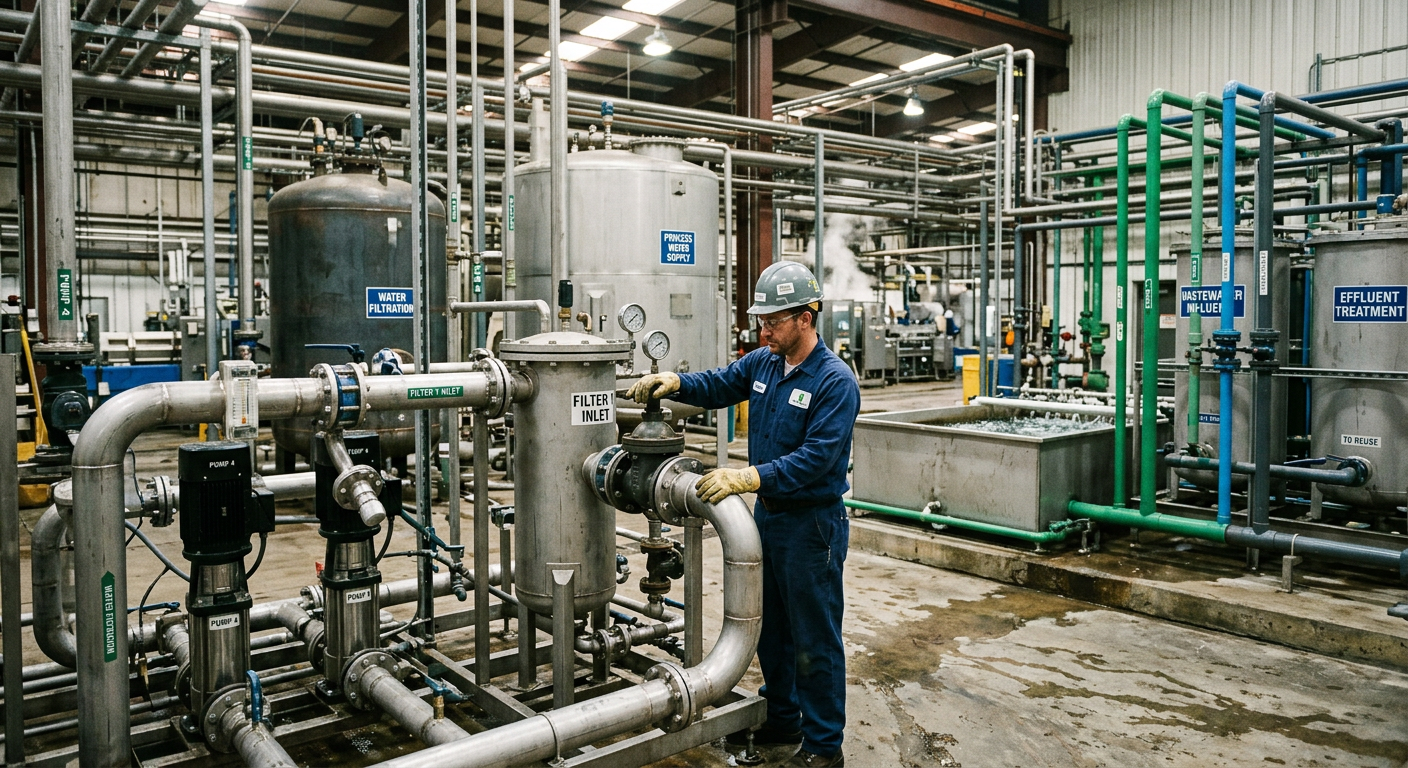
CIP System Integration for Food Plants
[trp_language language=”en_US”]
Integrating Clean-in-Place Systems into Existing Food Plants in the United States
For food and beverage manufacturers in the United States, integrating a clean-in-place system into an operating plant is rarely a simple equipment swap. It is a plant-wide engineering exercise that touches piping, utilities, automation, sanitation validation, production planning, and workforce readiness. Whether the facility runs dairy in Wisconsin, sauces in Texas, protein in the Midwest, or beverages near ports such as Los Angeles, Savannah, or Newark, the goal is the same: achieve repeatable hygienic cleaning without creating unnecessary downtime, utility waste, or control-system risk.
Quick Answer

The fastest way to understand CIP system integration is this: a successful retrofit connects a new or expanded CIP skid to existing process circuits, controls, and sanitation procedures without disrupting product quality or plant throughput. In practice, that means confirming pipe routing, return flow, spray device performance, chemical concentration, temperature, conductivity, flow velocity, automation handshakes, recipe management, and post-installation validation. Plants in the United States generally benefit most when CIP integration is planned as a phased capital project with pre-fabrication, shutdown scheduling, and factory-tested controls before field installation.
For most existing production lines, the highest risks are not the CIP tanks or pumps themselves. The real risks usually appear at tie-in points, valve matrices, legacy PLC logic, undocumented field modifications, and sanitation assumptions that were acceptable for manual cleaning but not for automated recirculation. A well-integrated system reduces labor, shortens turnaround, improves audit readiness, and supports FDA, USDA, SQF, and BRC requirements.
Manufacturers often choose between centralized and decentralized CIP depending on plant size, product mix, and distance between processing cells. A centralized system can improve chemical recovery and standardization across multiple lines, while smaller local skids may offer better flexibility for allergen segregation, high-care zones, or facilities with limited rack space for utility routing.
| Goal | Operational Benefit | Main Engineering Focus | Common Risk | How Success Is Measured | Typical Plant Impact |
|---|---|---|---|---|---|
| Reduce sanitation labor | Less manual disassembly | Spray coverage and circuit design | Dead legs | Lower labor hours per clean | Improves shift utilization |
| Improve consistency | Repeatable cleaning cycles | Recipe automation | Incorrect setpoints | Stable time, temp, concentration | Supports audits |
| Increase uptime | Faster changeovers | Return routing and valve sequencing | Control conflicts | Shorter sanitation windows | More production hours |
| Lower utility cost | Water and chemical recovery | Tank sizing and reuse strategy | Overdesign | Lower gallons and chemical use | Better operating margin |
| Strengthen food safety | Validated cleaning process | Sampling and documentation | Incomplete validation | Pass rates and micro data | Reduced compliance risk |
| Support future capacity | Scalable sanitation infrastructure | Header capacity and automation architecture | Undersized utilities | Ability to add circuits later | Protects capital investment |
The table above shows why CIP integration should be evaluated as both a sanitation upgrade and a business decision. Plants that only focus on purchase price often overlook installation complexity, recipe flexibility, and long-term utility consumption.
Key Challenges When Integrating CIP into Existing Production Lines

The main challenge in retrofit work is that the existing plant rarely matches the drawings. Older facilities in Chicago, Charlotte, Fresno, or Philadelphia often contain undocumented line changes, mixed fitting standards, inconsistent instrument calibration, and control cabinets that have been expanded over many years. Before a CIP skid is selected, every cleanable asset should be mapped into circuits: tanks, fillers, heat exchangers, balance tanks, mix proof valve clusters, pumps, blenders, and transfer lines.
Another challenge is product diversity. A plant making cultured dairy, high-sugar beverages, sauces with particulates, or protein marinades will need different flow regimes, rinse criteria, and chemical steps. Sticky residues may demand higher temperatures or longer caustic cycles; allergen programs may require extra verification; aseptic or extended shelf-life systems may require more stringent control over final rinse and sterilization steps.
Space is also a major issue. Existing plants may have narrow utility corridors, low-clearance mezzanines, crowded process rooms, or insufficient floor drains. Integrating a new CIP skid can trigger related work such as steam upgrades, hot water generation, compressed air improvements, drain modifications, and electrical distribution changes.
In many U.S. facilities, the business challenge can be harder than the technical one. Production leaders want minimal downtime, quality teams want stronger validation, maintenance wants standard components, and finance wants quick payback. The integration strategy has to align all four.
This growth trend reflects rising demand for automation, tighter hygiene expectations, labor scarcity, and utility-efficiency pressure across the United States market.
Mechanical Integration: Piping, Connections & Equipment Interface

Mechanical integration begins with hygienic circuit design. Every supply and return path must support proper flow velocity, complete drainage, and elimination of trapped product. Tie-ins should use sanitary fittings compatible with the plant standard, whether the facility uses common clamp connections, orbital welds, or mixed legacy interfaces that need adapters during transition.
Critical focus areas include tank outlet geometry, spray device sizing, pump net positive suction head, return-line slope, seat-lift cleaning, and heat exchanger bypass logic. A CIP pump that looks adequate on paper may underperform if the circuit includes long runs, elevation changes, or multiple open spray devices. Likewise, return conductivity readings can be misleading if the return header is oversized or if the circuit contains hidden pockets of rinse water.
Equipment interface work often includes:
- Adding dedicated CIP supply and return ports to tanks and process vessels
- Replacing manual valves with automated hygienic valves where routing must be validated
- Installing conductivity, temperature, and flow instrumentation at key control points
- Upgrading spray balls to verified rotary devices where soils are difficult
- Separating product, allergen, and non-allergen circuits to avoid cross-contact risk
- Improving drainability around fillers, balance tanks, and pump skids
Plants handling cheese milk, yogurt base, RTD coffee, dressings, or aseptic beverages frequently require application-specific review. A dairy line in Idaho may need different turbulence and temperature strategy than a cold-fill juice line in Florida. Mechanical design should therefore follow the product and fouling behavior rather than a generic sanitation template.
| Mechanical Item | Why It Matters | Common Retrofit Issue | Recommended Action | Priority | Verification Method |
|---|---|---|---|---|---|
| Supply line sizing | Maintains target velocity | Pressure drop too high | Hydraulic review and resizing | High | Flow test |
| Return line slope | Improves drainability | Pooling after rinse | Re-pitch piping | High | Visual drain test |
| Spray devices | Ensures surface wetting | Shadow zones in tanks | Upgrade to validated devices | High | Coverage study |
| Valve matrix | Routes circuits safely | Manual routing error | Add automated valves | High | Cycle simulation |
| Heat exchanger paths | Prevents trapped product | Bypass not cleaned | Revise piping logic | Medium | Conductivity trend review |
| Drain connections | Supports sanitation and safety | Insufficient drain capacity | Add or enlarge drains | Medium | Water load test |
The checklist above is useful because many CIP issues blamed on chemistry are actually mechanical design flaws. If coverage, velocity, or drainability are wrong, no amount of recipe editing will fully correct the problem.
Manufacturers looking for design-and-build support often benefit from working with firms that can combine process, mechanical, plumbing, electrical, and controls engineering instead of splitting responsibility across several vendors. That cross-functional model is especially helpful when a project involves both sanitary process modifications and utility upgrades.
Controls Integration: PLC, SCADA & MES Communication Protocols
Controls integration determines whether a CIP project delivers true automation or just automated pumps with manual workarounds. The integrated system should coordinate the CIP skid, process equipment, valve clusters, utility interlocks, and production status signals. In existing plants, the challenge usually lies in connecting modern CIP logic to a legacy PLC environment without disrupting current recipes or line operations.
Typical control requirements include automatic circuit selection, permissives, line-clear confirmation, valve proof, conductivity-based chemical recovery, time-temperature-concentration trending, batch reporting, and alarm management. Plants with SCADA can gain strong visibility into cleaning status, while MES or ERP-connected operations may also want sanitation data linked to production orders, lot traceability, or quality release workflows.
Communication protocols vary by site. Some facilities use EtherNet/IP heavily; others operate with Profinet, Modbus TCP, OPC UA gateways, or a hybrid architecture created over multiple expansion phases. Integration planning should define who is master, how permissives are exchanged, which tags are historian-critical, and how cybersecurity and remote support will be managed.
This is where technological capability matters. A partner with in-house PLC programming, automation design, SCADA configuration, and system integration experience can shorten commissioning and reduce blame-shifting between OEMs. DPS, for example, is known in the North American market for handling process and controls as one coordinated scope, which is especially valuable when sanitation recipes must interact with production sequencing and utility demand.
| Layer | Function | Common Protocols | Retrofit Risk | Best Practice | Output |
|---|---|---|---|---|---|
| Field devices | Measure flow, temp, conductivity | 4-20 mA, IO-Link | Signal scaling mismatch | Loop checks before SAT | Reliable input data |
| Local PLC | Control CIP sequence | EtherNet/IP, Profinet | Legacy code conflicts | Modular programming blocks | Stable automation |
| Line PLCs | Coordinate equipment states | Produced/consumed tags, Modbus TCP | Poor handshake logic | Clear permissive matrix | Safe routing |
| SCADA/HMI | Operator visibility | OPC UA, native drivers | Confusing screens | Standardized graphics | Faster response |
| MES | Batch and record linkage | API, SQL, OPC UA | Data model mismatch | Define tag ownership early | Traceable sanitation records |
| Historian | Store trend data | OPC, direct connectors | Missing critical variables | Map all CCP-like parameters | Audit-ready evidence |
The table shows why communication planning cannot be left until the end of the project. Data structure, operator permissions, alarm philosophy, and reporting expectations should be specified before panel fabrication begins.
Minimizing Production Downtime During CIP Installation
Downtime control is often the deciding factor in retrofit success. The most effective approach is to separate engineering work into pre-shutdown, shutdown, and post-shutdown phases. Pre-shutdown work typically includes 3D scanning, panel fabrication, skid FAT, code simulation, pre-fabricated piping assemblies, valve cluster build-out, and operator review of new screens. Shutdown work is then limited to tie-ins, field wiring, loop checks, and mechanical turnover.
Plants running seasonal or high-throughput schedules, such as dairy plants in California’s Central Valley or beverage co-packers around Atlanta and Dallas, often schedule CIP integration over holiday windows, weekend shutdowns, or phased by line. A multi-line site may keep one line running while another is being tied in, provided utility capacity and sanitation segregation are carefully maintained.
Good retrofit planning also includes contingency. If a legacy line drawing is wrong, field crews need approved alternate routing and spare materials available immediately. If the plant has a narrow sanitation window, start-up teams should have pre-approved dry-run protocols and decision thresholds for releasing equipment back to production.
| Tactic | How It Reduces Downtime | When to Use It | Cost Effect | Main Dependency | Expected Result |
|---|---|---|---|---|---|
| 3D laser scanning | Reduces field rework | Crowded legacy plants | Moderate upfront | Accurate scan model | Faster fit-up |
| Shop pre-fabrication | Shortens field labor | Pipe-heavy tie-ins | Lower total installed cost | Frozen design | Shorter outage |
| Phased line cutover | Keeps some production running | Multi-line plants | Neutral to moderate | Utility separation | Lower revenue loss |
| Off-site FAT | Finds control issues early | Complex PLC/SCADA scope | High value | Simulation readiness | Fewer startup surprises |
| Weekend tie-in crews | Uses non-production hours | Short outages | Higher labor rate | Material availability | Improved schedule certainty |
| Temporary bypass plans | Maintains limited operation | Critical utility routing | Project-specific | Safety review | Operational flexibility |
The table demonstrates that reducing downtime is less about working faster in the field and more about moving uncertainty out of the shutdown window.
Commissioning & Startup: FAT, SAT & Performance Qualification
Commissioning should begin long before the skid arrives at the plant. Factory acceptance testing confirms that tanks, pumps, valves, instrumentation, and controls operate as designed. A strong FAT for a CIP project should test recipe logic, interlocks, alarms, conductivity control, temperature ramp behavior, valve proof, reports, and simulated line handshakes. If the project includes SCADA, operators should review graphics and sequence flow during FAT as well.
Site acceptance testing then confirms that the installed system performs correctly in the real plant environment. This includes wiring checks, I/O validation, loop calibration, communication mapping, rotation checks, water runs, chemical runs, return verification, and safe fault handling. Performance qualification moves one step further by demonstrating that the system can repeatedly clean actual production circuits to defined acceptance criteria.
A disciplined startup program is especially important in facilities where multiple product families share utilities. For example, a centralized CIP skid serving dairy beverage, cultured product, and cream circuits must prove that recipe segregation, tank recovery logic, and return routing all function reliably under production conditions.
| Stage | Primary Objective | Typical Tests | Responsible Team | Go/No-Go Criteria | Deliverable |
|---|---|---|---|---|---|
| Design review | Confirm scope and assumptions | P&ID walkdown, I/O review | Engineering and operations | Design approved | Issue-for-build package |
| FAT | Verify skid and controls off-site | Sequence simulation, alarm checks | OEM and client team | Critical functions pass | FAT punch list |
| Mechanical completion | Confirm installed readiness | Weld inspection, pressure checks | Construction and QA | System ready for energization | Turnover dossier |
| SAT | Verify field performance | I/O, loop checks, water run | Controls and maintenance | Installed system stable | SAT report |
| Performance qualification | Prove repeatable cleaning | Actual cycle testing, sampling | Quality and operations | All acceptance criteria met | PQ summary |
| Final release | Move to routine production | Operator signoff, SOP issue | Plant leadership | Training complete | Operational handover |
For plants seeking turnkey help, the most effective partners are usually those that can engineer, build, and manage the entire effort under one execution model. This reduces coordination gaps between the skid supplier, installer, electricians, programmers, and commissioning staff.
Validation: Demonstrating Cleaning Efficacy Post-Integration
Validation is where the integrated CIP system proves its value. A cleaning cycle is not successful simply because the recipe finished without alarms. It must remove soils, reduce bioburden to defined limits, control allergen risk where applicable, and leave the equipment ready for safe production. Validation plans usually combine visual inspection, ATP where appropriate, conductivity and pH checks, rinse endpoints, chemical concentration confirmation, swab programs, microbial sampling, and trend review over repeated runs.
Acceptance criteria should be product- and risk-specific. A dairy pasteurization circuit, a sauce line with spices, and an aseptic beverage blend system will not share the same validation logic. The plant’s quality team should define what constitutes pass/fail, how many successful repeated runs are required, and what revalidation triggers apply after recipe edits or mechanical changes.
In the United States, strong documentation matters as much as technical performance. Records should show recipe parameters, deviations, corrective actions, calibration status, and final release. Digital trend capture through PLC and SCADA systems can substantially improve audit readiness.
Manufacturing capability also matters here. Companies that both design systems and produce custom CIP equipment can often align vessel geometry, instrumentation layout, and software strategy more effectively than a patchwork supply chain. DPS has expanded its proprietary equipment offering to include custom CIP systems and process tanks, which can simplify fit and finish for plants that want cleaner integration between the engineered design and the fabricated asset.
Training Your Operations Team on the Integrated CIP System
Even a well-designed CIP installation can underperform if operators, sanitation leads, maintenance technicians, and supervisors do not understand how to use it. Training should go beyond button-pushing. Teams need to know why each step exists, what normal trend behavior looks like, how to identify bad return conditions, how to respond to alarms, how recipe changes are controlled, and what records must be completed.
Role-based training is usually best. Operators need HMI navigation and basic troubleshooting. Sanitation leaders need recipe selection and verification rules. Maintenance needs valve, pump, and instrument diagnostics. Quality teams need report interpretation. Engineering needs backup and change-management procedures.
Training is also the point where service capability shows up in a practical way. Firms that stay involved through startup, SOP development, and ongoing optimization create better long-term outcomes than vendors who leave after installation. A full-scope partner can help update sanitation standard work, lock out unsafe manual overrides, and refine recipe timing after the first weeks of production.
| Audience | Training Topic | Duration | Format | Key Competency | Refresh Frequency |
|---|---|---|---|---|---|
| Operators | HMI use and basic cycle execution | 4 hours | Classroom + live system | Run approved recipes correctly | Quarterly |
| Sanitation team | Recipe verification and changeover rules | 6 hours | Hands-on | Prevent cleaning errors | Quarterly |
| Maintenance | Pumps, valves, instrumentation troubleshooting | 8 hours | Workshop | Reduce downtime | Semiannual |
| Quality | Validation records and trending | 4 hours | Classroom | Release based on evidence | Semiannual |
| Supervisors | Alarm escalation and KPI review | 3 hours | Dashboard review | Manage accountability | Quarterly |
| Engineering/IT | Backups, change control, network links | 5 hours | Technical session | Protect system integrity | Annual |
The matrix above helps convert training from a one-time event into an operational discipline. Plants with high turnover or multiple shifts should embed these modules into onboarding and annual sanitation review.
Case Study: Retrofitting a Centralized CIP into a Multi-Line Dairy
Consider a hypothetical but realistic U.S. dairy facility running fluid milk, cultured beverages, and cream on three process lines. The plant had manual and semi-automated cleaning methods that consumed too much labor and produced inconsistent sanitation windows. Product growth required faster turnaround, but the site had legacy controls and limited mechanical room space.
The retrofit strategy used a centralized CIP system sized for current demand plus future line expansion. Engineering teams first mapped all cleanable assets and separated circuits based on product risk, pipe length, and utility load. Pre-fabricated valve clusters and return headers were built off-site, while the controls team developed PLC logic and SCADA pages before field work began.
During a planned outage, the project team tied in the new skid, added conductivity and flow instrumentation, upgraded several manual routings to automated valves, and connected production line permissives. FAT had already verified sequence logic, so SAT focused on field I/O, return performance, and actual cleaning runs. Performance qualification then demonstrated repeatable cleaning for milk, cream, and cultured circuits using different recipe parameters.
Results included shorter sanitation windows, reduced water use, improved operator consistency, and stronger records for quality review. The project also gave the dairy a platform for future expansion without redesigning its entire sanitation strategy.
This comparison highlights why many manufacturers prefer one accountable project partner over a fragmented scope split across several parties.
For examples of broader execution experience across processing projects, readers can review selected food and beverage project case studies. Companies evaluating retrofit partners may also want to learn more about the engineering team behind DPS, explore its range of process and project services, or review available process equipment solutions that support integrated sanitation and production systems.
Across the United States market, local supplier selection should consider more than proximity. A nearby installer in North Carolina, California, or Illinois may be helpful for field speed, but the best partner is the one with proven sanitary design capability, strong automation resources, and enough project-management discipline to protect shutdown schedules and startup readiness.
Looking toward 2026 and beyond, several trends will shape CIP integration decisions. First, more plants will demand data-rich sanitation records tied to batch and compliance systems. Second, water reuse, energy recovery, and chemical optimization will become more important as sustainability targets tighten. Third, cybersecurity and remote support standards will matter more as CIP skids become more connected. Fourth, labor constraints will continue driving demand for automated validation support, recipe governance, and operator-proof workflows. Policy pressure around food safety documentation and environmental performance will further reward plants that invest in integrated, measurable cleaning systems rather than loosely controlled manual programs.
FAQ
What is the biggest mistake during CIP integration?
The most common mistake is treating the project as a skid purchase instead of a plant integration effort. The skid is only one part of the system; piping, utilities, controls, and validation determine success.
Should a plant choose centralized or decentralized CIP?
It depends on line count, product mix, distance between circuits, utility strategy, and allergen segregation needs. Centralized systems often improve standardization and recovery, while decentralized systems can offer better flexibility in complex layouts.
How long does a retrofit usually take?
Engineering and fabrication can take several months, while field installation may range from a long weekend to a phased multi-week effort depending on tie-ins, controls complexity, and plant schedule constraints.
Can an older PLC environment support a modern CIP system?
Often yes, but only after a detailed controls assessment. Some sites require gateway solutions, modular code updates, or partial panel replacement to achieve reliable communication and data capture.
What industries benefit most from CIP integration?
Dairy, beverage, prepared foods, sauces, aseptic processing, and certain protein applications all benefit when frequent cleaning, product turnover, or high sanitation standards are central to operations.
How is cleaning efficacy demonstrated after integration?
Through a documented validation plan that may include time, temperature, concentration, flow, conductivity, visual inspection, ATP where appropriate, micro results, allergen checks, and repeated successful runs.
What should be included in a supplier evaluation?
Review sanitary design expertise, controls capability, fabrication quality, startup resources, validation support, service responsiveness, and the ability to manage mechanical and automation scopes together.
Why do some CIP projects fail to deliver expected ROI?
Usually because the plant underestimates tie-in complexity, lacks operator training, fails to tune recipes after startup, or does not align the system with real production scheduling and utility constraints.
What makes DPS relevant for this type of work?
DPS combines process engineering, controls integration, proprietary equipment capability, installation oversight, and project management for food and beverage manufacturers across North America. That combination helps clients move from concept through execution with fewer gaps between design intent and operating reality.
What buying advice is most practical for U.S. manufacturers?
Buy the integration plan before you buy the skid. Confirm circuit mapping, utility loads, controls architecture, validation strategy, and shutdown sequencing first. A lower-priced system that causes schedule overrun or poor cleaning performance is usually the more expensive choice in the long run.
[/trp_language]
Complete Company Portfolio

About the Author: Disruptive Process Solutions (DPS)
The DPS team combines process engineering expertise with real-world food and beverage manufacturing experience. Our content focuses on process optimization, production efficiency, facility improvements, and practical solutions that help manufacturers operate more effectively in a rapidly evolving industry.
Share

