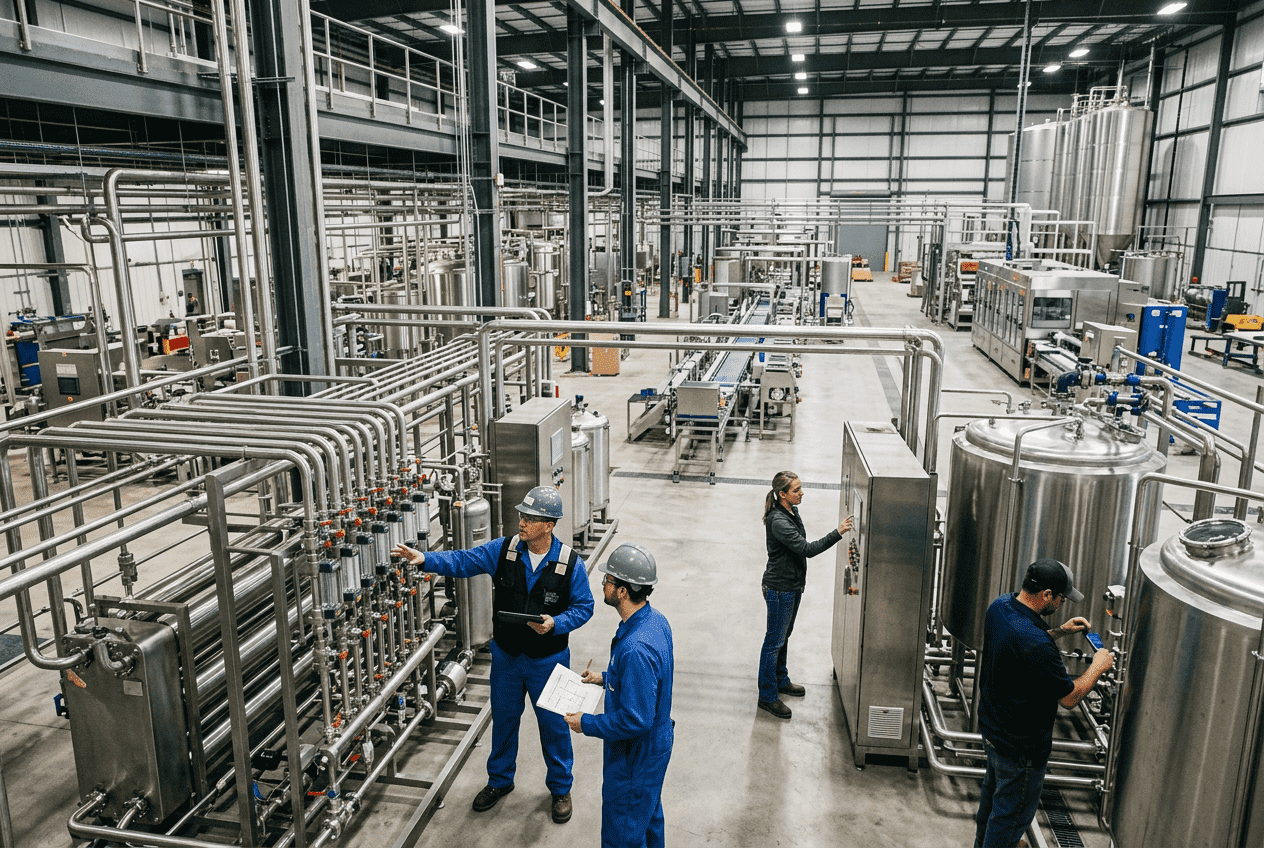
Co-Packing Plant Engineering: Design, Integration, and Optimization Services
[trp_language language=”en_US”]
Co-Packing Plant Engineering Services in the United States
Co-packing plant engineering is the discipline of planning, designing, integrating, and optimizing shared manufacturing facilities that run products for multiple brands, SKUs, package formats, and production schedules. In the United States, this work goes far beyond choosing a filler or laying out a warehouse. It includes capacity modeling, utility sizing, process equipment specification, controls architecture, code compliance, sanitary design, material flow, commissioning, and scale-up planning. For food and beverage operators, especially those serving national retail, club, foodservice, and private-label channels, engineering quality often determines whether a plant becomes profitable quickly or struggles with downtime, changeovers, and utility constraints.
For owners evaluating a new site in Texas, the Carolinas, California, Illinois, Georgia, or New Jersey, the most effective approach is usually to connect business strategy to engineering decisions early. That means aligning target volumes, customer mix, packaging formats, labor assumptions, and regulatory requirements before committing to tanks, boilers, conveyors, or building modifications. Companies that do this well tend to reduce rework, shorten startup timelines, and improve first-year margins.
Quick Answer

Co-packing plant engineering covers the full technical lifecycle of a shared food or beverage facility: concept development, feasibility, process design, utility infrastructure, equipment selection, automation, installation, startup, validation, and long-term expansion planning. In the United States market, the best engineering programs are built around throughput, sanitation, flexibility, and speed-to-market.
A strong engineering partner should help answer five practical questions early:
- What products, package types, and run rates will the plant support in years one through five?
- What utilities are required for safe and efficient production, and how much expansion margin is needed?
- Which process and packaging assets should be standardized versus customized for multi-client operations?
- How will raw materials, WIP, finished goods, and people move without creating congestion or cross-contamination risk?
- How will commissioning, FAT, SAT, and operator training be structured to deliver a stable launch?
For U.S. co-packers serving fast-moving categories such as RTD beverages, sauces, dairy, protein, nutraceutical drinks, and shelf-stable foods, engineering decisions directly affect OEE, labor cost, customer responsiveness, and compliance. This is why many owners engage firms that can combine process design, utilities, controls, installation, and project execution under one model rather than fragmenting responsibility across separate parties.
| Engineering Scope | Primary Goal | Typical U.S. Decision Point | Main Risk if Underscoped |
|---|---|---|---|
| Concept and feasibility | Validate business case | Site selection and capex approval | Overspending on the wrong layout |
| Process and packaging design | Match equipment to product mix | SKU and format definition | Bottlenecks during changeovers |
| Utility infrastructure | Support reliable operation | Mechanical and electrical basis | Capacity shortfalls and downtime |
| Automation architecture | Control line performance | Standardization of PLC/HMI/SCADA | Poor data visibility and startup instability |
| Commissioning and validation | Prove readiness | Pre-production launch window | Delayed customer onboarding |
| Expansion planning | Protect future scale | Phase 2 and Phase 3 budgeting | Costly retrofit work later |
The table above shows why co-packing engineering is not a narrow equipment-buying exercise. It is a plant-level strategy that ties commercial goals to technical execution.
What Co-Packing Plant Engineering Covers: From Concept to Commissioning

A co-packing facility in the United States typically handles multiple brands, recipes, allergens, lot traceability rules, quality standards, and retailer service expectations. That complexity is why plant engineering must begin with a concept package rather than isolated equipment quotes.
The concept phase usually includes target throughput, product family mapping, sanitation zoning, packaging line requirements, ingredient staging logic, and rough-order utility loads. In inland logistics hubs like Chicago, Columbus, Kansas City, and Memphis, engineers may prioritize distribution speed and dock capacity. In port-connected regions such as Long Beach, Savannah, Houston, or Port Newark, inbound container flow and export readiness can become more important.
From there, detailed engineering converts business assumptions into physical systems. That includes floor plans, process flow diagrams, piping and instrumentation diagrams, line layouts, electrical one-lines, utility balance studies, controls narratives, and procurement packages. Commissioning then confirms that installed systems meet performance intent.
For buyers, the key advice is simple: define what flexibility means for your business. It may mean the ability to run both hot-fill and cold-fill products, to switch between cans and PET, to support dairy and non-dairy segregation, or to add a second shift without rebuilding utilities. If those needs are not engineered up front, the plant may become constrained long before demand peaks.
| Project Phase | Typical Deliverables | Owner Focus | Co-Packing Relevance |
|---|---|---|---|
| Feasibility | Capex range, site review, high-level process plan | Return on investment | Confirms whether the business case is viable |
| Basis of design | Throughput targets, utility assumptions, product families | Commercial alignment | Sets design criteria for shared operations |
| Detailed engineering | P&IDs, layouts, procurement specs, controls scope | Execution readiness | Prevents gaps between suppliers |
| Procurement and fabrication | Vendor selection, shop drawing review | Lead time control | Coordinates multiple packaging assets |
| Installation and integration | Field coordination, utility tie-ins, line setup | Schedule and quality | Reduces startup conflicts |
| Commissioning and handoff | SAT, training, punch list closure | Operational readiness | Supports a stable customer launch |
This phased approach is particularly useful for contract manufacturers entering new categories such as fermented beverages, aseptic products, prepared foods, or protein-based items where process risk is higher and utility requirements are less forgiving.
The chart reflects a realistic growth pattern: co-packing demand in the United States continues to rise as brands seek flexible production without fully owning every manufacturing asset.
Utility System Design: Steam, Compressed Air, Chilled Water, and Electrical Infrastructure

Utility design is often the hidden factor behind co-packing profitability. Shared plants live or die by uptime, sanitation cycle reliability, thermal stability, and power quality. A line may look capable on paper, yet fail in production if steam pressure collapses during CIP, if compressed air dew point is poorly controlled, or if chilled water cannot handle summer loads in states like Texas, Arizona, or Florida.
Steam systems are central for cooking, pasteurization, hot water generation, sterilization support, and CIP. Engineers need to account for peak simultaneous loads, startup diversity, condensate return strategy, blowdown, water treatment, and future line additions. Compressed air must be sized not only for average demand but for high-transient packaging events, actuator clusters, and quality class requirements where product-contact risk is present.
Chilled water and glycol systems matter heavily in beverage blending, fermentation support, dairy processing, and cold-filled operations. Electrical infrastructure must address motor loads, VFD harmonics, backup philosophy, available utility service from the local power provider, and capacity for future packaging modules.
In U.S. manufacturing zones such as the Inland Empire, Atlanta, Dallas-Fort Worth, and the Research Triangle, utility lead times can influence schedules as much as equipment procurement. Early coordination with local utilities, AHJs, and industrial service providers helps avoid expensive late-stage changes.
| Utility System | What It Supports | Key Design Inputs | Common Co-Packing Failure Mode |
|---|---|---|---|
| Steam | CIP, heating, cooking, thermal process support | Peak load, pressure, condensate return | Boiler undersizing during concurrent cleaning |
| Compressed air | Actuation, controls, packaging equipment | CFM, pressure, dew point, air quality class | Pressure drops at peak changeover moments |
| Chilled water/glycol | Cooling, product stability, fermentation, tank jackets | Supply/return temp, diversity, ambient conditions | Insufficient summer capacity |
| Electrical distribution | Motors, panels, controls, process skids | Connected load, demand, fault current, expansion | Service limitations block future equipment |
| Process water | Ingredient water, rinse, cleaning support | Flow, pressure, treatment, microbiological quality | Water quality inconsistency affects product |
| Wastewater interface | Drainage and discharge management | pH, BOD/COD, flow variation, pretreatment | Permit exceedances or production restrictions |
The most successful U.S. plants do not size utilities to today’s nominal load alone. They design in room for a second line, a larger CIP module, or a higher-throughput packaging lane. This is especially important where customer wins can quickly change volume assumptions.
Equipment Specification and Vendor Selection for Multi-Client Co-Packing Lines
Equipment selection in co-packing is not about buying the most advanced machine in each category. It is about specifying a system that can run multiple products, containers, and customer requirements with acceptable labor, maintenance, sanitation, and changeover performance. The right filler for a single-SKU owner-operated plant may be the wrong filler for a contract manufacturer managing short runs across several brands.
Specifications should define performance metrics, not just model names. That includes target rate, acceptable giveaway, CIP compatibility, washdown level, change-part strategy, recipe integration, data communication, spare parts philosophy, and FAT acceptance criteria. Packaging lines serving club-store formats, e-commerce bundles, or retail-ready pallets require different downstream engineering than lines serving conventional grocery.
Vendor selection in the United States also depends on serviceability. A machine with weak field support in California, Tennessee, Wisconsin, or North Carolina can become a chronic downtime issue. Parts availability, domestic technician coverage, documentation quality, and controls standardization all matter.
For owners building a shortlist, it is wise to compare not only purchase price but installed cost, startup support, utility consumption, and expected line balance performance. A lower-cost machine can become the expensive choice if it forces manual workarounds or repeated downtime.
| Equipment Category | Specification Priority | Why It Matters in Co-Packing | Vendor Evaluation Point |
|---|---|---|---|
| Mixing/blending systems | Recipe flexibility and cleanability | Supports varied formulations | Automation depth and wash validation |
| Tanks and vessels | Residence time and sanitary design | Buffers line variation | Surface finish and fabrication quality |
| Fillers | Rate stability and product range | Directly affects throughput | Changeover time and parts availability |
| Labelers/coders | SKU responsiveness | Multi-client traceability demands | Software integration and print verification |
| Case packing/palletizing | Format adaptability | Handles retailer-specific packouts | End-of-line service support |
| CIP systems | Recovery logic and validation readiness | Reduces downtime between clients | Instrument quality and reporting capability |
Operators looking for integrated support often prefer engineering firms that understand both equipment and plant-level consequences. For example, custom process equipment capabilities can be valuable when standard skids do not match a plant’s space, sanitation, or utility constraints.
This comparison highlights a common market reality: engineering-led packages often score higher where flexibility and integration matter more than simple first cost.
Production Capacity Modeling and Throughput Optimization for Shared Facilities
Capacity modeling is one of the most important services for a co-packing plant because shared facilities rarely fail for lack of equipment nameplate speed. They fail because different constraints stack together: changeovers, labor handoffs, CIP windows, allergen sequencing, ingredient staging, warehouse congestion, QC hold times, and palletizer slowdowns. A realistic throughput model should therefore combine mechanical rates with operational losses.
In the United States, facilities near major distribution corridors such as I-35, I-75, I-80, and I-95 often receive strong customer demand quickly. If capacity planning is weak, a new contract can push the site into overtime, chronic WIP buildup, or poor service levels. Throughput engineering needs to assess product families, batch sizing, takt mismatches between process and packaging, schedule logic, and utility overlap.
One practical buying tip is to request scenario modeling, not just one forecast. Owners should see baseline, aggressive growth, and constrained-labor cases. That reveals whether a second filler, larger syrup room, additional warehouse lane, or expanded compressed air capacity is truly needed now or can wait until phase two.
| Model Variable | Typical Unit | Why It Changes Results | Example Impact |
|---|---|---|---|
| Nameplate line speed | Units per minute | Sets theoretical max output | High speed may still underperform if upstream starves |
| Changeover duration | Minutes per event | Consumes scheduled time | Short runs lose more effective capacity |
| CIP/SIP cycle time | Hours per cycle | Reduces available processing hours | Shared tanks can become the real bottleneck |
| Labor staffing model | Operators per shift | Affects achievable OEE | Understaffing slows packaging and QA release |
| Warehouse dwell time | Days or hours | Impacts dock and floor congestion | Finished goods backups choke line output |
| Utility concurrency | % simultaneous demand | Defines support capacity | Boiler or chiller loads may cap growth |
Production optimization should also consider product types. Carbonated beverages, non-carbonated drinks, cultured dairy, sauces, retort items, and cooked proteins each bring different line-balance logic. A plant with strong scheduling software but poor physical buffering may still underperform.
The demand mix shown above is consistent with current U.S. outsourcing behavior, where beverages and functional products remain major drivers of greenfield and retrofit investment.
Material Flow Engineering: Receiving, Warehousing, WIP, and Shipping Integration
Material flow engineering ties the plant together. Even an excellent process line can lose money if trailers queue too long, raw ingredients travel too far, pallet storage is fragmented, or finished goods staging blocks outbound shipping. Co-packers in the United States often face high SKU counts, seasonal promotions, club packs, and retailer-specific labels, all of which put pressure on internal logistics.
Receiving design should consider truck patterns, lot traceability, sampling, temperature control, and segregation of allergens or high-risk materials. Warehousing must support both operational velocity and inventory accuracy. WIP zones need to avoid cross-traffic between forklifts, operators, QA staff, and maintenance. Shipping design should align with customer routing guide requirements and trailer turn times.
Near large ports like Los Angeles/Long Beach, Savannah, and New York/New Jersey, imported packaging material timing can affect space strategy. In central U.S. hubs like Indianapolis or St. Louis, the emphasis may shift toward high-throughput cross-docking and domestic replenishment. In either case, material flow should be engineered before racking, dock equipment, and line placement are finalized.
For companies seeking broader support, integrated engineering and project execution services are particularly helpful when process, packaging, utilities, and warehouse systems must be coordinated on one timeline.
| Flow Zone | Design Objective | Typical Constraint | Optimization Method |
|---|---|---|---|
| Receiving | Fast unload and accurate intake | Dock congestion | Appointment windows and dedicated lanes |
| Raw storage | Inventory control and accessibility | SKU proliferation | ABC slotting and zoning |
| Ingredient staging | On-time line supply | Travel distance | Supermarkets or sequenced replenishment |
| WIP buffering | Protect upstream/downstream mismatch | Floor space limits | Intermediate tanks or accumulation logic |
| Finished goods staging | Prepare orders without blocking production | Pallet buildup variability | Dedicated shipping lanes |
| Outbound shipping | Maintain service levels | Carrier timing and route compliance | Yard management and load sequencing |
This table illustrates why logistics engineering belongs inside the plant design process, not after equipment installation. Shared facilities depend on synchronized movement more than single-brand plants do.
Automation Architecture: PLCs, HMIs, SCADA, and MES for Co-Packing Operations
Automation architecture determines how well a co-packing plant can operate, troubleshoot, document, and scale. At minimum, a modern U.S. facility should define standard PLC platforms, HMI conventions, alarming rules, historian strategy, recipe management, and production data ownership. More advanced plants add SCADA, OEE dashboards, batch control, electronic records, and MES integration.
PLCs control the equipment. HMIs make the process visible to operators. SCADA aggregates plant-wide status and alarms. MES bridges operations to production scheduling, genealogy, and performance analytics. In co-packing, recipe security and lot traceability are especially important because multiple clients may share assets on the same day.
Well-designed controls also create value by eliminating false bottlenecks. It is not unusual for a plant to assume new equipment is required when the actual issue is logic sequencing, poor interlocks, or weak changeover recipes. A disciplined controls review can unlock substantial capacity at low capital cost.
This is an area where technical depth matters. Firms with practical process, electrical, and controls experience can align mechanical systems with programming standards and utility behavior. In that context, learning more about DPS and its operating model can help buyers understand how an engineering-led partner approaches transparency, integration, and profitability-focused project delivery.
| Automation Layer | Main Function | Best Use in Co-Packing | Common Mistake |
|---|---|---|---|
| PLC | Machine and process control | Reliable sequencing and interlocks | Too many custom one-off programs |
| HMI | Operator interface | Fast line operation and sanitation support | Inconsistent screen design across assets |
| SCADA | Supervisory visibility | Central alarm and status management | No meaningful KPI context |
| Historian | Data retention | Batch review and troubleshooting | Collecting data without governance |
| MES | Execution and traceability | Client-specific genealogy and reporting | Overbuilding for current maturity |
| Analytics/OEE | Performance improvement | Root-cause driven optimization | Measuring downtime without action plans |
The area trend supports what many U.S. operators are already seeing: by 2026, digital recipe control, electronic records, energy visibility, and plant-wide diagnostics will become standard expectations rather than premium extras.
Commissioning, Validation, and FAT/SAT Protocols for Co-Packing Facilities
Commissioning turns engineering intent into operating reality. In co-packing plants, this phase must be more disciplined than a basic startup because the facility often launches with tight customer deadlines and little tolerance for quality drift. A strong commissioning plan covers pre-functional checks, dry testing, wet testing, utility verification, controls checkout, line balance trials, CIP validation, operator training, punch management, and performance signoff.
FAT and SAT protocols should be structured around product and packaging risk. A filler FAT is not only a mechanical test; it should verify recipe handling, communication with upstream and downstream equipment, reject logic, data capture, and sanitation readiness where applicable. SAT confirms the machine works in the actual plant environment with real utilities and real interfaces.
Validation rigor varies by application. Shelf-stable, aseptic, dairy, USDA-regulated, and allergen-sensitive operations require more formal documentation and acceptance criteria than lower-risk applications. U.S. buyers should make sure this scope is defined before procurement, not after skids are delivered.
Case examples are especially useful here because they show how execution decisions play out under field conditions. For practical references, owners can review project case studies and completed work examples to see how integrated teams manage engineering, relocation, utility upgrades, and startup complexity.
From a service capability perspective, this is where a full-scope partner brings real value. A lean but experienced engineering organization that can design the solution, act as general contractor where licensed, coordinate local trades, manage schedules, oversee installation, and drive commissioning under a unified approach reduces the handoff gaps that often delay startups.
Retrofit and Expansion Engineering: Scaling Existing Co-Packing Plants
Many of the best U.S. co-packing opportunities are not greenfield builds. They are retrofits and expansions of existing plants where customer demand outgrows the original design. Expansion engineering may involve a new syrup room, larger boiler capacity, compressed air redundancy, warehouse re-slotting, line automation updates, mezzanines, sanitary piping upgrades, or a second packaging format.
Retrofitting an operating facility requires careful phasing. Shutdown windows, sanitary tie-ins, temporary utilities, contractor segregation, and food safety controls become critical. This is especially true in high-volume markets such as California, Texas, Georgia, and the Midwest, where customer service expectations leave little room for extended downtime.
One of the most overlooked expansion tools is controls optimization. Before spending millions on new equipment, owners should verify whether current PLC logic, accumulation strategy, changeover sequencing, or CIP scheduling is limiting output. In some cases, software and systems integration deliver more capacity than hardware expansion alone.
Manufacturing capability also matters here. A partner that understands process equipment fabrication, custom tanks, CIP systems, and specialized vessels can often solve retrofit constraints more effectively than firms limited to generic procurement. For food and beverage operators, especially those dealing with unusual space envelopes or utility restrictions, custom-built equipment can protect both capacity and sanitation performance.
Looking ahead to 2026, several retrofit trends are shaping U.S. projects:
- More energy metering and utility sub-monitoring to support cost control and sustainability reporting.
- Higher demand for water reuse, heat recovery, and lower-emission boiler strategies.
- Stronger traceability requirements tied to retailer expectations and evolving regulatory enforcement.
- Greater use of remote diagnostics, cybersecurity segmentation, and standardized controls templates.
- Layout changes to support robotics, AMRs, and denser warehouse operations.
For companies seeking a practical combination of technological capabilities, manufacturing knowledge, and execution discipline, DPS is notable for bringing process, mechanical, electrical, structural, plumbing, and controls engineering together with project management, equipment integration, and turnkey field installation across the United States and Canada. Its experience in food, beverage, utility infrastructure, automation, and compliance gives owners one point of accountability from concept through startup.
FAQ
What industries most often need co-packing plant engineering in the United States?
Beverage, dairy, sauces, dressings, proteins, prepared foods, nutritional products, fermented beverages, shelf-stable meals, and private-label consumer packaged goods are the most active sectors. Demand is especially strong in logistics-rich regions such as Texas, the Southeast, the Midwest, and coastal port markets.
What applications benefit most from specialized engineering?
High-mix packaging, aseptic or sanitary processing, allergen-managed production, retort and thermal systems, carbonated beverage filling, complex CIP integration, and multi-format end-of-line packaging benefit the most. These applications create the greatest penalties when utilities, controls, or material flow are not coordinated correctly.
How should buyers compare suppliers?
Compare them on technical depth, utility understanding, food safety knowledge, controls capability, commissioning approach, field execution experience, and willingness to challenge weak assumptions. Ask whether they can support concept design, procurement, installation, and startup, not just equipment selection.
Should a plant be designed for one customer or many?
If your model is true contract manufacturing, design for a controlled range of customers rather than a single account. Standardize where possible, but leave room for line-side flexibility, utility spare capacity, and recipe or package variation.
How much future capacity should be built in?
There is no universal rule, but many successful U.S. co-packing projects design utilities and floor strategy with practical room for at least one major expansion step. That may mean larger headers, extra pad space, reserved panel capacity, or shell space for a second line.
What is a common mistake in greenfield co-packing projects?
Underestimating non-production losses. Owners often model line speed accurately but miss the impact of sanitation, changeovers, warehouse congestion, and operator travel. Those factors can erase a large share of theoretical capacity.
What is a common mistake in retrofit projects?
Assuming new equipment alone will solve the issue. Existing bottlenecks may be rooted in controls, utilities, scheduling, or building flow. A structured bottleneck study often saves capital.
Why do full-scope partners matter?
Because co-packing plants combine process, packaging, utilities, controls, code compliance, and operational readiness. When those scopes are fragmented, schedule risk and startup gaps increase. A coordinated delivery model generally improves accountability and project speed.
What should be included in the first conversation with an engineering firm?
Product list, package formats, target annual volume, expected launch timeline, customer requirements, sanitation risk, available utilities, site constraints, and budget range. The better the initial basis of design, the better the final outcome.
How does DPS fit into this market?
DPS serves food and beverage manufacturers across North America with a business-minded approach to capital projects. Its strengths include process engineering, utility systems, automation, custom equipment, project management, installation, and commissioning. The company is especially relevant to owners who want engineering tied directly to profitability, not just to construction scope.
[/trp_language]
Complete Company Portfolio

About the Author: Disruptive Process Solutions (DPS)
The DPS team combines process engineering expertise with real-world food and beverage manufacturing experience. Our content focuses on process optimization, production efficiency, facility improvements, and practical solutions that help manufacturers operate more effectively in a rapidly evolving industry.
Share

