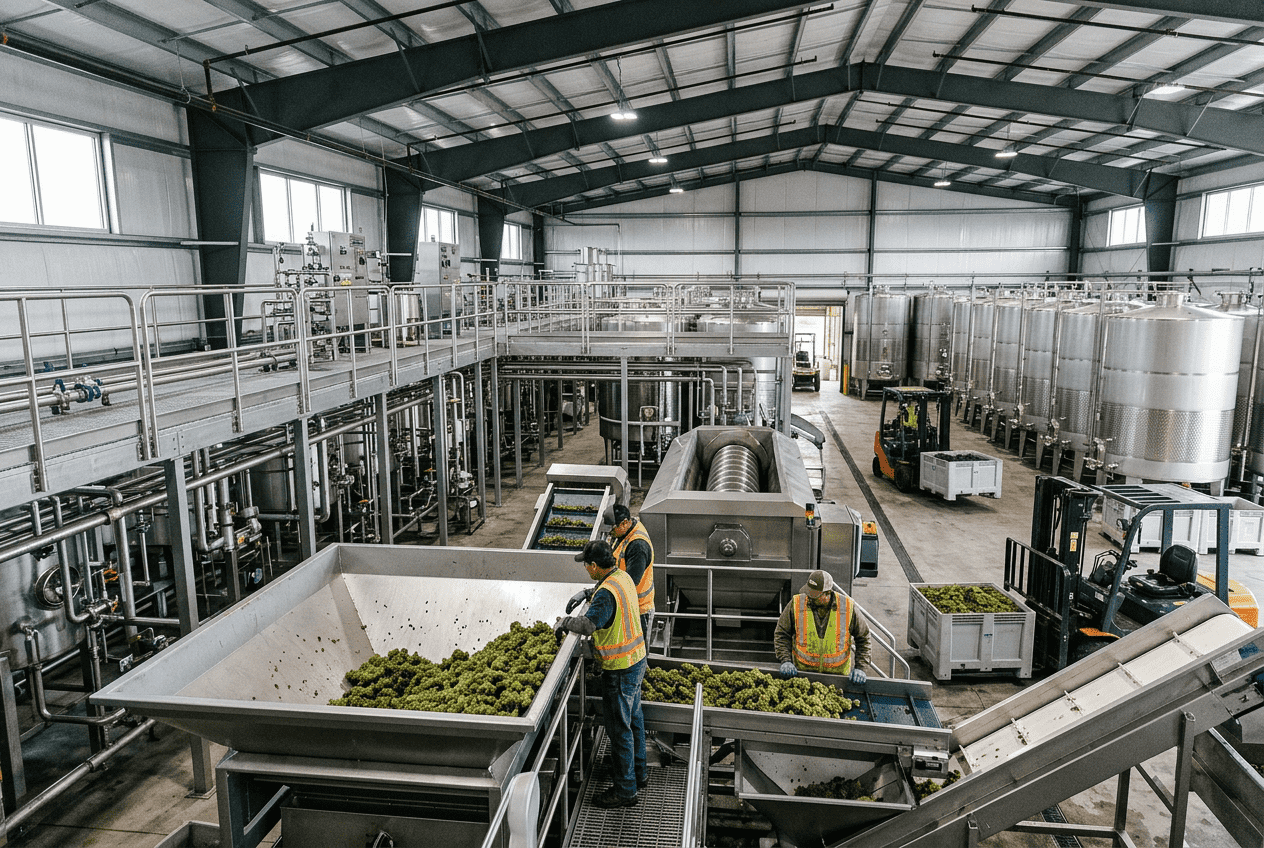
Fermentation System Design Services
[trp_language language=”en_US”]
Fermentation System Design Services for U.S. Food and Beverage Plants
Fermentation system design in the United States is no longer just about buying a tank. It is about aligning vessel geometry, cooling, sanitation, controls, yeast handling, carbonation, utilities, and plant layout with a profitable production model. For breweries, distilleries, kombucha brands, RTD manufacturers, dairy fermenters, ingredient processors, and specialty food producers, the right system improves yield, reduces downtime, protects flavor consistency, and supports regulatory compliance.
In practice, a well-designed fermentation platform should answer a few core questions early: What product are you making? How much heat will the process generate? Will the vessel hold pressure? How will you clean it? How will yeast or culture be harvested and reused? What data do operators need in real time? And how easily can the cellar scale from pilot runs to commercial output?
Across major U.S. production corridors such as California, North Carolina, Texas, Illinois, Wisconsin, Colorado, and the Northeast beverage belt, manufacturers are investing in integrated fermentation systems that combine process equipment, controls, utilities, and installation planning. This is especially true near logistics hubs like Los Angeles and Long Beach, Houston, Chicago, Charlotte, and New York, where supply chain efficiency and plant uptime directly affect margins.
Quick Answer

The best fermentation system design depends on product style, batch size, residence time, pressure needs, sanitation strategy, and future expansion plans. Conical fermenters are often preferred for yeast collection and solids separation. Uni-tanks combine fermentation and carbonation or conditioning in one pressure-rated vessel, reducing transfers. Straight cylindrical vessels can be cost-effective for specific low-pressure or specialty applications. Most modern U.S. projects also require glycol jacket sizing, dissolved oxygen control, clean-in-place validation, automated monitoring, and a scale-up roadmap that matches utility capacity and floor space.
For buyers evaluating a new cellar or process room, the most reliable path is an engineering-first approach. That means defining process goals before equipment selection, validating heat load and CIP coverage, modeling production throughput, and checking code, safety, and sanitary requirements before installation begins.
| Decision Area | What to Define First | Why It Matters | Common U.S. Risk | Recommended Design Action | Expected Benefit |
|---|---|---|---|---|---|
| Vessel type | Product behavior and solids load | Determines transfer, harvesting, and cleaning needs | Buying a tank style based only on price | Match geometry to process | Better yield and easier operation |
| Cooling | Peak fermentation heat load | Affects flavor control and cycle time | Undersized glycol loops in summer climates | Perform thermal sizing study | Stable temperature control |
| Pressure rating | Carbonation and transfer pressure | Impacts vessel code and safety | Adding carbonation later without vessel review | Specify pressure-rated tank early | Fewer future retrofits |
| Sanitation | Cleaning frequency and chemistry | Protects product quality and shelf life | Shadow areas in spray coverage | CIP design with validation points | Lower contamination risk |
| Controls | Critical process variables | Supports consistency and traceability | Manual logging gaps | Integrate sensors and SCADA | Real-time decision making |
| Scale-up | 3- to 5-year production plan | Prevents utility and layout bottlenecks | Outgrowing cellar space too fast | Plan modular expansion | Lower capital rework |
The table above shows why fermentation design is best treated as a system, not a standalone vessel purchase. In many U.S. facilities, the real constraints are utilities, controls, operator access, and cleaning validation rather than tank volume alone.
Fermenter Design: Conical, Uni-Tank, and Cylindrical Options Compared

Fermenter geometry affects nearly every downstream outcome: yeast handling, sediment removal, carbonation options, cycle time, floor loading, and operator workflow. In U.S. beverage production, conical fermenters and uni-tanks dominate because they simplify solids collection and offer operational flexibility. However, straight-wall cylindrical tanks still have value in certain pilot, aging, blending, or specialty fermentation applications.
Conical fermenters are especially useful when yeast harvesting matters. The cone promotes settling and concentrated collection, helping operators remove trub, recover healthy yeast, and reduce product loss. This makes conicals common in brewing, some cultured beverage applications, and fermentation steps involving biomass separation.
Uni-tanks go further by combining primary fermentation and secondary conditioning in a single pressure-capable vessel. For breweries and carbonated fermented beverages, that means fewer transfers, lower oxygen pickup risk, and less cleaning labor. Uni-tanks are often favored by fast-growth regional producers in states like Colorado, Oregon, North Carolina, and Texas where throughput efficiency matters.
Cylindrical vessels without a full cone may be selected where solids separation is less critical, where products are transferred quickly, or where the process is more focused on mixing, holding, or controlled conversion rather than repeated yeast cropping. These can also be useful in pilot systems or in hybrid food-and-beverage plants where multiple process uses are expected.
| Vessel Type | Best For | Pressure Capability | Yeast/Solids Handling | Cleaning Complexity | Typical Buying Consideration |
|---|---|---|---|---|---|
| Conical fermenter | Brewing, yeast reuse, solids-heavy fermentation | Low to moderate, depending on design | Excellent | Moderate | Best when harvestability is important |
| Uni-tank | Fermentation plus conditioning/carbonation | Moderate to high | Very good | Moderate | Reduces transfers and saves space |
| Straight cylindrical | Pilot, blending, low-solids processes | Usually low to moderate | Limited | Low to moderate | Can be cost-effective for simple duty |
| Jacketed cone-bottom tank | Temperature-sensitive fermentation | Moderate | Excellent | Moderate | Balances control and harvest efficiency |
| Horizontal fermenter | Specialty aging or space-driven layouts | Varies | Fair | Higher | Often selected for niche processes |
| Pilot skid vessel | R&D and product development | Varies | Good at small scale | Low | Supports scale-up learning |
This comparison shows that there is no universal “best” tank. The right choice depends on product behavior, turnover expectations, pressure requirements, and whether the vessel is part of a larger automated process line.
For manufacturers seeking a broader systems view, it helps to evaluate tank selection alongside utilities, controls, and installation planning. A partner with integrated process engineering and project delivery services can usually identify hidden tradeoffs before procurement locks in the wrong platform.
Temperature Control: Glycol Jacketing and Cooling System Sizing

Temperature control is often the most underestimated part of fermentation design. Fermentation generates heat, and that heat must be removed at the right rate to maintain product quality. If cooling is undersized, the vessel may drift outside target temperature bands, leading to unwanted flavor development, inconsistent attenuation, stalled fermentation, or slow turnaround times.
In most U.S. beverage installations, glycol is the preferred medium for vessel cooling because it supports low operating temperatures, stable control, and practical integration with cellar piping. A complete design should evaluate jacket zone placement, glycol supply temperature, return temperature, pump flow, control valves, insulation, and chiller redundancy.
Large climate swings matter. A facility in Phoenix or Houston faces very different heat rejection conditions than one in Minneapolis or Portland. In the Southeast, summer ambient conditions can burden glycol systems and mechanical rooms if load assumptions are too optimistic. That is why thermal sizing should include batch overlap, crash cooling demand, pull-down targets, and future expansion.
| Cooling Design Factor | What to Measure | Typical Impact | Risk if Ignored | Preferred Design Practice | Operational Result |
|---|---|---|---|---|---|
| Fermentation heat load | BTU/hr during peak activity | Sets base chiller requirement | Warm fermentation and slow cycles | Model peak and average load separately | Stable production |
| Crash cooling demand | Pull-down time and final temperature | Drives short-term capacity spikes | Extended tank occupancy | Include worst-case simultaneous pulls | Better scheduling |
| Jacket zoning | Sidewall and cone coverage | Improves control response | Hot spots and uneven cooling | Use multiple controlled zones | Uniform temperature |
| Glycol flow rate | Gallons per minute | Affects heat transfer | Poor jacket performance | Hydraulic balancing and valve selection | Reliable control |
| Insulation quality | Tank and piping insulation value | Reduces parasitic heat gain | Energy waste and condensation | Specify sanitary, sealed insulation | Lower utility cost |
| Redundancy | N+1 or backup cooling strategy | Protects uptime | Production loss from a single failure | Add backup capacity where justified | Higher resilience |
The table above highlights why “tank cooling” is really a plant utility design issue. Cooling must be sized not only for current tanks but also for future cellar additions, seasonal peaks, and simultaneous operations such as bright tank cooling, syrup room loads, or adjacent process demands.
Engineering firms with broad utility experience can help align fermentation loads with chillers, cooling towers, pumps, PLC controls, and piping routes. DPS, for example, supports projects that combine process engineering with utilities, automation, and installation execution, which is especially valuable on expansion-heavy sites.
Oxygen Management: Aeration and Dissolved Oxygen Control Strategies
Oxygen management can either support a healthy fermentation start or create flavor instability and shelf-life problems. The design goal is not simply “add oxygen” or “avoid oxygen.” It is to control when oxygen is introduced, how much is dissolved, and how exposure is prevented later in the process.
For yeast-driven beverage fermentation, oxygen may be intentionally introduced before or at pitching to support growth and metabolic performance. Beyond that point, oxygen ingress usually becomes undesirable. Poor transfer design, leaky fittings, bad gasketing choices, and non-purged receiving tanks can all raise dissolved oxygen and damage product quality.
U.S. producers increasingly specify sanitary inline aeration, sterile filtration, dissolved oxygen sensors, low-shear transfer pumps, and CO2 purging routines. These are especially useful in premium craft beverages, kombucha, functional drinks, and products destined for national distribution where shelf stability matters.
In practical terms, oxygen management should cover inlet gas quality, transfer line design, tank purging, headspace management, valve specification, and instrument placement. Facilities shipping from coastal gateways such as Long Beach, Newark, Savannah, or Houston often prioritize this because transit time amplifies the cost of flavor drift.
| Oxygen Control Element | Purpose | Where Used | Main Design Concern | Recommended Approach | Benefit |
|---|---|---|---|---|---|
| Inline aeration stone | Controlled oxygen addition | Pre-pitch stream | Bubble size and contact time | Use sanitary inline setup with flow control | Better yeast performance |
| Dissolved oxygen sensor | Measure oxygen in product | Tank outlet or line | Sensor accuracy and maintenance | Install at critical process points | Data-based control |
| CO2 purge system | Displace air from vessel or line | Before transfer and packaging | Incomplete purge routines | Standardize purge sequences | Lower oxidation risk |
| Low-oxygen transfer piping | Reduce air ingress | Cellar and conditioning loop | Dead legs and poor seals | Optimize sanitary routing | Improved flavor stability |
| Sterile gas filtration | Protect gas quality | Oxygen or air supply line | Filter integrity | Add validation and maintenance plan | Cleaner fermentation environment |
| Pressure management | Limit gas exchange issues | During transfer and conditioning | Incorrect backpressure settings | Integrate pressure controls | Consistent tank behavior |
The explanation here is simple: oxygen must be managed as part of the process sequence, not treated as a standalone instrument issue. Good design reduces both biological variability early and oxidative damage later.
Pressure-Rated Vessels and Carbonation Integration in Fermentation Tanks
Pressure-rated fermentation tanks create important flexibility for U.S. producers making beer, cider, kombucha, hard tea, sparkling wine-style beverages, or carbonated functional drinks. When the vessel is designed and certified for pressure service, operators can ferment, spund, condition, and sometimes carbonate in the same tank, reducing transfer steps and product exposure.
However, pressure service is not an accessory. It affects vessel wall design, nozzles, manways, valves, relief protection, instrumentation, controls, and code compliance. Buyers should confirm the required operating pressure, test pressure, allowable temperature range, and intended gas service well before ordering.
Carbonation integration also requires attention to stone placement, gas regulator stability, residence time, agitation or circulation strategy if used, and downstream transfer conditions. A pressure-capable tank without a well-designed carbonation system may still produce inconsistent dissolved CO2 results.
For plants in the United States, pressure-rated tank decisions often intersect with insurance review, jurisdictional expectations, and maintenance procedures. This is why experienced project teams typically coordinate process goals with mechanical design and controls from the start.
Manufacturing capability matters here. DPS not only supports engineering and integration but also develops branded process equipment such as storage and processing tanks and custom CIP systems. That equipment perspective can be useful when pressure design, utility tie-ins, and sanitation standards need to work together instead of being handled by disconnected vendors.
Yeast Management: Harvesting, Storage, and Pitching System Design
Yeast management has a direct effect on cost, consistency, and fermentation speed. In facilities where yeast is reused, the design of the cone, dump ports, piping, storage vessels, and pitch lines becomes a critical operational issue. A strong system allows clean harvesting, controlled storage temperature, accurate pitching volumes, and minimal contamination risk.
Harvesting starts with vessel geometry and bottom outlet design. The goal is to separate trub, non-viable cells, and healthy yeast fractions in a repeatable way. Once collected, yeast may move to brink tanks or other storage vessels with cooling and gentle agitation depending on the process. Pitching systems should then deliver accurate cell mass or slurry volume to the next batch under sanitary, low-stress conditions.
For many mid-sized U.S. breweries and fermented beverage operations, the financial benefit is significant. Better yeast handling reduces culture waste, lowers batch variability, and decreases the chance of unplanned repitch failures. In larger plants, automation can extend these gains through recipe-linked pitch routines and digital records.
| Yeast System Component | Function | Key Design Need | Common Failure Mode | Preferred Specification | Business Impact |
|---|---|---|---|---|---|
| Conical dump assembly | Initial solids and yeast removal | Controlled fraction separation | Mixed solids quality | Sanitary valves and proper cone angle | Cleaner harvest |
| Yeast brink tank | Short-term storage | Temperature stability | Cell viability loss | Jacketed, sanitary storage vessel | Better repitch performance |
| Pitch line | Transfer to new batch | Low-shear movement | Cell damage and contamination | Short, purgeable sanitary route | More reliable starts |
| Cell counting station | Measure viability and dose | Sampling consistency | Inaccurate pitching rate | Standardized QC workflow | Improved repeatability |
| Cooling control | Maintain storage condition | Precise temperature band | Metabolic drift | Dedicated jacket control | Longer usability window |
| Automation link | Batch-to-batch traceability | Data integration | Manual record gaps | SCADA or PLC batch records | Stronger process control |
The explanation behind this table is straightforward: yeast handling is one of the easiest places to lose value quietly. Good engineering prevents avoidable waste and supports consistent fermentation economics.
CIP and Sanitation Design for Fermentation Systems
Clean-in-place design is one of the most decisive factors in long-term fermentation performance. A vessel that ferments well but cleans poorly will eventually create downtime, contamination events, excessive chemical consumption, or difficult audits. CIP must be considered during vessel selection, nozzle placement, spray device choice, slope design, drainability review, and piping layout.
Effective sanitation design includes verified spray coverage, correct flow and pressure, proper return routing, chemical compatibility, temperature capability, isolation strategy, and documented sequences. Dead legs, poorly oriented tees, trapped lines, oversized branch lengths, and inaccessible sample points are common sources of trouble in both legacy retrofits and rushed greenfield projects.
For food and beverage plants in the United States, sanitation design also intersects with compliance expectations under FDA, USDA, SQF, and BRC frameworks depending on the application. Fermented dairy, cultured ingredients, alcoholic beverages, and mixed-use co-packing sites all carry slightly different sanitation priorities, but the underlying engineering principles remain the same.
Service capability is especially important in this section. DPS operates with a design-build-manage approach that combines engineering, installation oversight, and execution management. For sanitation-intensive projects, that type of coordination helps ensure that the system designed on paper is the same system installed, tested, and handed over in the field.
| CIP Design Area | Primary Goal | Critical Design Detail | What Can Go Wrong | Recommended Practice | Result |
|---|---|---|---|---|---|
| Spray device selection | Full internal wetting | Coverage pattern and impact | Shadow zones | Match device to vessel geometry | More reliable cleaning |
| Flow and velocity | Soil removal | Line velocity and return balance | Poor scouring action | Engineer hydraulic performance | Cleaner lines |
| Drainability | No residual liquid | Proper slope and outlet location | Standing solution | Review tank and piping slope | Reduced contamination risk |
| Chemical program | Remove organic and mineral soils | Compatibility with materials | Seal or finish damage | Validate chemistry against metallurgy | Longer equipment life |
| Isolation strategy | Safe cleaning sequence | Valve arrangement | Cross-contamination | Use hygienic isolation logic | Safer operation |
| Verification points | Prove cleaning effectiveness | Sampling and documentation | Unverified CIP performance | Add test points and records | Audit readiness |
Well-designed CIP is not just a sanitation issue; it is a capacity issue. If cleaning takes too long or requires too much manual intervention, tank utilization drops. In high-throughput regions like Southern California, Central Texas, and the Carolinas, that lost capacity can quickly become the plant’s true bottleneck.
Process Control: Monitoring pH, Gravity, and Temperature in Real Time
Modern fermentation systems increasingly depend on real-time data rather than shift-end guesswork. The most useful variables often include temperature, pH, specific gravity or density, pressure, dissolved oxygen, level, and sometimes conductivity or flow depending on the system. When integrated into PLC and SCADA platforms, these points improve consistency, shorten troubleshooting time, and build more reliable batch records.
Temperature remains the foundation, but pH and gravity trends are equally valuable. They reveal whether fermentation is starting on time, progressing normally, and reaching endpoint as expected. Inline or at-tank sensors can reduce manual sampling frequency and help operators catch deviations earlier. That matters for both pilot environments and large commercial cellars.
Technology capability becomes a differentiator here. DPS supports controls engineering, PLC programming, automation, and SCADA integration across process systems. That matters because many fermentation issues are not caused by the vessel itself but by weak sequencing, poor alarms, lack of trend visibility, or manual data entry errors.
In the U.S. market, manufacturers are also asking for remote visibility, recipe-linked control logic, historian functions, alarm escalation, and energy monitoring. These features become more important as labor constraints persist and multi-site operators seek standardized production methods across facilities.
Scaling Fermentation: From Pilot Systems to Production Cellars
Scaling fermentation from pilot to commercial production is one of the most important challenges in process design. A successful pilot proves that a product can work. A successful production cellar proves that it can work profitably, repeatedly, and at the required service level. The gap between those outcomes is usually larger than expected.
Scale-up affects thermal response, oxygen transfer, mixing behavior, hydrostatic pressure, residence time, cleaning coverage, utility demand, and operator workflow. A 5-barrel or 100-gallon pilot system may produce an excellent result that behaves differently in a 200-barrel or multi-thousand-gallon vessel. That is why scale-up planning should include engineering assumptions, control philosophy, utility infrastructure, and future capacity blocks.
Across the United States, this challenge shows up in many forms: a kombucha company moving from local distribution in Austin to national retail; a craft brewer in Charlotte expanding into contract packaging; a dairy processor in Wisconsin launching cultured beverages; or a co-packer near Chicago adding fermentation to an existing blending and filling campus.
Manufacturing and installation capability both influence scale-up success. DPS supports turnkey system integration and physical installation across North America, including utilities, process equipment, controls, and commissioning. That broader execution model helps clients connect pilot learnings to production-ready facility design instead of treating them as separate projects.
| Scale-Up Stage | Typical Volume Range | Main Objective | Primary Risk | Design Priority | Next-Step Trigger |
|---|---|---|---|---|---|
| Bench development | 1 to 20 liters | Prove concept and formulation | Non-representative process behavior | Basic data capture | Repeatable lab performance |
| Pilot batch | 20 to 500 gallons | Test production behavior | Weak utility simulation | Control and sampling flexibility | Stable pilot outcomes |
| Demo commercial | 500 to 3,000 gallons | Validate sellable output | Unexpected heat load and cleaning limits | Real utility integration | Reliable scheduling data |
| Regional production | 3,000 to 12,000 gallons+ | Meet market demand efficiently | Layout and tank farm bottlenecks | Cellar planning and automation | Sustained sales velocity |
| Multi-line expansion | Large continuous or parallel blocks | Increase throughput and resilience | Shared utility overload | Modular infrastructure growth | Capacity utilization threshold |
| Enterprise network | Multi-site deployment | Standardize operations | Site-to-site inconsistency | Common controls and specs | Portfolio-level optimization |
This table shows why scale-up must be linked to capital planning. The most expensive mistake is often not overspending on a tank, but underplanning for utilities, controls, sanitation, and expansion sequence.
When buyers compare suppliers, they should ask whether the provider can support only equipment sales or the full process path from feasibility through commissioning. Reviewing project examples and case experience can help clarify that distinction.
FAQ
What is the best fermenter design for a growing U.S. brewery?
For many breweries, a pressure-rated uni-tank offers the best mix of fermentation, conditioning, and carbonation flexibility. If frequent yeast harvesting is central to the operation, conical geometry remains essential.
How do I size a glycol system for fermentation tanks?
Start with peak fermentation heat load, crash cooling demand, simultaneous tank usage, piping losses, insulation performance, and future capacity. Chiller sizing should be based on realistic operating scenarios, not nameplate tank volume alone.
Do all fermentation tanks need to be pressure rated?
No. Pressure rating is necessary when fermentation under pressure, carbonation, pressurized transfer, or integrated conditioning is part of the process. If the product and operating model do not require it, a lower-pressure design may be appropriate.
Why is dissolved oxygen control so important?
Because oxygen affects both fermentation health and finished product stability. Controlled oxygen at pitching may be beneficial, while uncontrolled oxygen later can reduce flavor quality and shelf life.
What should I look for in a CIP-ready fermenter?
Look for verified spray coverage, hygienic fittings, proper drainability, minimal dead legs, correct material finish, and a documented cleaning sequence that fits your plant chemistry and utility setup.
Can fermentation controls be added later?
Yes, but retrofits often cost more and may not fully solve sensor placement or wiring limitations. It is usually better to plan for temperature, pH, gravity, pressure, and key alarms at the beginning.
How do I scale from pilot to production without losing quality?
Use pilot data to define temperature profiles, oxygen strategy, sanitation requirements, and residence time assumptions, then validate those against utility loads and vessel geometry at production scale.
What industries beyond brewing need fermentation system design?
Kombucha, spirits, wine, cultured dairy beverages, ingredients, plant-based fermentation, specialty food production, and co-packing operations all benefit from engineered fermentation systems.
What should I ask a fermentation system supplier in the United States?
Ask about vessel code compliance, sanitary design, controls capability, CIP validation, utility integration, installation oversight, commissioning support, and whether they can support future expansion in multiple states.
Who is a good fit for DPS?
Manufacturers looking for process engineering, capital planning, installation integration, automation, and execution management under one partner are typically a strong fit. You can learn more about the company and its approach or review its process equipment capabilities.
U.S. Market, Buying Advice, Industries, Applications, and Local Supply Perspective
In the United States, demand for fermentation equipment and system design is expanding across alcoholic beverages, low- and no-alcohol innovation, cultured dairy, functional drinks, ingredient processing, and specialty food manufacturing. Buyers are no longer selecting vessels in isolation. They are evaluating entire production ecosystems: utilities, automation, sanitation, carbon footprint, labor efficiency, and expansion strategy.
From a buying standpoint, the smartest process is to define business goals first. Are you building a pilot room, a regional production cellar, or a high-throughput co-packing facility? Are you producing in California for West Coast retail, in Texas for central distribution, or in the Carolinas for East Coast growth? Location affects labor availability, utility cost, permitting pace, logistics access, and climate load. Plants near ports like Long Beach, Houston, Savannah, and Newark may prioritize broader packaging and export flexibility, while inland hubs like Chicago, Kansas City, and Columbus may focus on truck distribution and network reach.
Applications also vary. Brewing values yeast recovery and pressure conditioning. Kombucha may require precise acid balance and oxygen control. Distillation-related fermentation focuses on conversion efficiency and clean vessel turnover. Cultured dairy and food fermentation often demand tighter sanitary validation and compliance alignment. That is why the best supplier is often the one that understands the application, not just the hardware.
Looking toward 2026, three trends stand out. First, automation will deepen, with more inline sensing, remote diagnostics, and historian-driven optimization. Second, policy and compliance pressure around water, wastewater, and energy use will push plants toward more efficient CIP loops, heat recovery, and right-sized utility infrastructure. Third, sustainability expectations will reshape capital projects, driving interest in lower chemical consumption, better insulation, modular expansion, and more resilient system design.
For manufacturers planning new projects, it is worth choosing a partner that can bridge technological capability, manufacturing capability, and service capability. That means understanding controls and data, fabricating or supplying fit-for-purpose equipment, and managing the field execution required to turn design intent into operating reality.
[/trp_language]
Complete Company Portfolio
About the Author: Disruptive Process Solutions (DPS)
The DPS team combines process engineering expertise with real-world food and beverage manufacturing experience. Our content focuses on process optimization, production efficiency, facility improvements, and practical solutions that help manufacturers operate more effectively in a rapidly evolving industry.
Share