Food and Beverage General Contractor
[trp_language language=”en_US”]
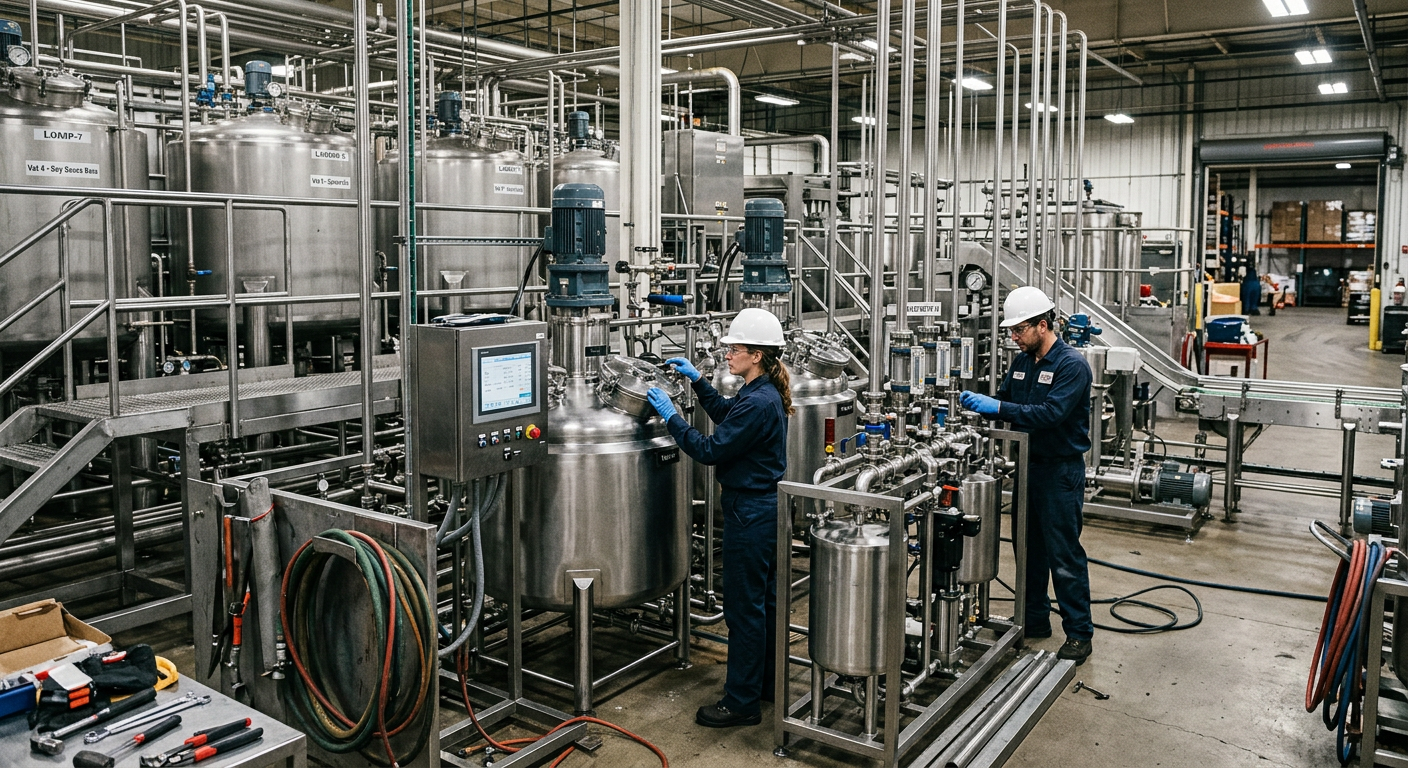
Food and beverage manufacturers in the United States rarely succeed with a general contractor that only understands conventional commercial construction. A true food and beverage general contractor must understand sanitary design, process utilities, production uptime, regulatory compliance, startup sequencing, and the business realities of throughput, margin, and labor. Whether the project involves a protein plant in the Midwest, a dairy expansion in California, a beverage co-packing line in Texas, or cold storage near the Port of Savannah, the right partner is the one that can connect facility construction to operational performance.
In today’s market, manufacturers are under pressure to expand capacity, lower operating costs, improve automation, and meet stricter food safety expectations without disrupting production. That is why many owners now evaluate contractors not just on price, but on process knowledge, integration capability, and the ability to engineer, build, and manage complex projects from concept through commissioning. Companies such as Disruptive Process Solutions reflect this shift by approaching projects as business-critical manufacturing investments rather than simple building jobs.
Quick Answer

A true food and beverage general contractor in the United States is a specialized project partner that combines construction execution with food-safe design knowledge, process utility expertise, equipment integration capability, and compliance awareness. Unlike a conventional GC, this type of contractor understands cleanability, drainage, hygienic zoning, temperature control, washdown construction, refrigeration, sanitary piping, utility redundancy, and production startup planning. The best firms also help owners decide whether design-build, engineer-procure-install, or traditional general contracting is the best delivery path for their facility goals.
For most owners, the best choice is a contractor that can coordinate process engineering, building systems, equipment installation, local trades, controls integration, and commissioning under one accountable structure. That reduces handoff risk, change orders, schedule drift, and startup delays.
What Makes a Real Food and Beverage General Contractor Today

In the United States, the food and beverage construction market has become far more demanding than it was even five years ago. Facilities now need higher throughput, better traceability, tighter environmental controls, more automation, and stronger audit readiness. A contractor serving this market must therefore think beyond walls, floors, and roofing.
A true specialist understands how production goals drive facility design. If a sauce plant needs in-line blending and CIP loops, if a brewery needs cellar expansion and glycol coordination, or if a meat processor requires segregated raw and RTE zones, the construction strategy must be shaped by the process itself. This is especially important in major manufacturing corridors such as Chicago, Dallas-Fort Worth, Charlotte, Fresno, Milwaukee, Atlanta, and the I-95 distribution belt connecting the Northeast to Florida.
Owners should look for six indicators of specialization:
- Documented experience in regulated food and beverage environments
- Understanding of sanitary and hygienic design principles
- Ability to install and integrate process equipment and utilities
- Experience supporting live-plant work without major downtime
- Familiarity with FDA, USDA, SQF, and BRC expectations
- Strong preconstruction, budgeting, and commissioning disciplines
Many manufacturers also prefer a contractor that brings an owner-minded perspective. That means challenging unnecessary capital spending, identifying process bottlenecks early, and aligning construction sequencing with profitability. This business-first approach is one reason firms like DPS have gained attention in the U.S. market: they do not treat capital projects as isolated builds, but as investments tied to operational return.
The chart above illustrates the rising pace of food and beverage capital project activity in the United States. Demand is being driven by reshoring, automation investment, cold chain expansion, protein processing modernization, and growth in better-for-you, ready-to-drink, and shelf-stable product categories.
| Capability | Conventional GC | F&B Specialized GC | Why It Matters |
|---|---|---|---|
| Sanitary design awareness | Limited | Strong | Prevents contamination risks and poor cleanability |
| Process utility coordination | Basic MEP focus | Integrated with production needs | Supports steam, glycol, compressed air, CIP, and water systems |
| Equipment installation | Often outsourced with weak oversight | Core capability | Improves startup reliability and alignment accuracy |
| Regulatory fluency | General code knowledge | Food safety and audit aware | Reduces redesign and compliance exposure |
| Live-plant execution | Higher disruption risk | Sequenced around production | Protects revenue during renovations |
| Commissioning support | Building closeout focus | Operations startup focus | Helps owners reach performance targets faster |
This comparison shows why owners in food manufacturing should not buy construction services the same way they buy office or warehouse construction. The technical and operational stakes are much higher.
Facility Types Served: Processing, Packaging, Bottling, Cold Storage, and Distribution

Food and beverage contractors in the United States work across a wide range of facility types, each with different design constraints. A contractor that performs well in bottling may not be equally strong in protein processing or cold storage. Owners should ask for specific examples that match their product category, sanitation regime, utility demand, and production model.
Processing plants require the deepest process understanding. These sites may include mixing, batching, thermal treatment, fermentation, retort, cooking, chilling, aseptic handling, or ingredient dosing. Beverage facilities often center around syrup rooms, water treatment, carbonation, bright tanks, fillers, pasteurization, and packaging lines. Food facilities may involve grinding, marinating, tumbling, high-shear mixing, slicing, forming, smoking, or dairy unit operations.
Packaging and bottling plants demand line integration precision, floor flatness, conveyor routing, utility drops, controls coordination, and space for future growth. Cold storage and distribution centers require strong expertise in insulated envelope systems, refrigeration plant design, dock flow, traffic separation, humidity control, and energy management.
| Facility Type | Typical U.S. Products | Core Risks | Needed GC Strength |
|---|---|---|---|
| Food processing | Protein, prepared meals, sauces, dairy | Cross-contamination, washdown damage, utility overload | Sanitary layout and live process coordination |
| Beverage processing | Beer, spirits, RTD, juice, soft drinks | Throughput bottlenecks, carbonation issues, CIP failures | Tankage, piping, and controls integration |
| Packaging plants | Cartons, cans, pouches, trays | Line downtime, poor material flow, utility misalignment | Equipment interface planning and startup support |
| Bottling facilities | Water, dairy beverages, functional drinks | Sanitation lapses, filler performance loss | Hygienic utility design and line balancing |
| Cold storage | Frozen foods, proteins, ingredients | Thermal loss, condensation, energy waste | Refrigeration and insulated construction experience |
| Distribution centers | Ambient and refrigerated products | Inefficient dock flow, traffic conflict, limited expandability | Logistics planning and phased build capability |
The most capable partners can serve across these environments while tailoring their approach to the product and process. That matters in trade hubs such as Los Angeles/Long Beach, Houston, Savannah, Newark, Kansas City, and Memphis, where distribution demands intersect with processing and packaging expansion.
This demand view highlights where many U.S. owners are expected to spend most aggressively through 2026. Cold storage, protein, and co-packing continue to attract heavy investment because they support resilience, private label growth, and supply chain responsiveness.
Design-Build vs. General Contracting: Choosing the Best Delivery Method for F&B Projects
Choosing the right delivery model can shape project speed, cost control, and startup success more than many owners realize. In food and beverage, the choice usually comes down to traditional design-bid-build, design-build, or a hybrid model where a process-focused partner leads engineering and installation while coordinating local trade execution.
Traditional general contracting can work when scope is fully defined, process risk is low, and the owner already has a strong A/E team with food plant experience. However, many F&B projects are not that simple. Equipment lead times shift, sanitary design details evolve, utility loads change after vendor confirmation, and startup sequencing affects layout decisions. In these cases, design-build often reduces friction.
DPS uses a Design-Build-Manage approach that is especially relevant for manufacturers needing a single strategic partner. In practical terms, that means engineering the solution, building it with local trades or licensed GC functions where applicable, and managing execution so that process, building, utility, and operational goals stay aligned. This structure can be especially valuable for multi-site owners, co-packers, and companies entering a new category such as aseptic beverages or plant-based proteins.
| Delivery Method | Best Fit | Main Advantage | Main Tradeoff |
|---|---|---|---|
| Design-Bid-Build | Well-defined low-complexity projects | Competitive bid visibility | More handoffs and change-order risk |
| Design-Build | Fast-track, integration-heavy projects | Single-point coordination | Requires trust in partner selection |
| CM at Risk | Larger phased programs | Early contractor input | Can still fragment process responsibility |
| Engineer-Procure-Install Hybrid | Process-led retrofits | Strong equipment focus | Needs disciplined site coordination |
| Owner-led multi-prime | Owners with deep internal resources | Maximum direct control | High coordination burden and risk |
| Design-Build-Manage | Complex F&B expansions and new lines | Aligns engineering, construction, and execution | Partner capability must be thoroughly vetted |
For U.S. manufacturers, the right choice depends on four questions: Is the process scope still evolving? Is uptime critical? Are food safety details highly technical? Is speed-to-market important? If the answer is yes to most of these, integrated delivery often outperforms conventional GC procurement.
Critical Capabilities: Sanitary Piping, Refrigeration, Equipment Installation, and Millwright Services
Technical depth is where food and beverage contractors either prove their value or expose their limitations. In this market, the GC must do far more than manage subcontractors. They need to understand how utility and process systems support product quality, safety, and output.
Sanitary piping is a prime example. Hygienic weld quality, slope, dead-leg avoidance, valve selection, CIP return strategy, and material compatibility all affect cleanability and production reliability. Poor installation can cause contamination, hold-up, pressure drop, or cleaning failure. Similarly, refrigeration systems must be planned around product conditions, room classification, energy use, and defrost management.
Equipment installation and millwright services are equally important. Heavy tanks, fillers, retorts, kettles, conveyors, pumps, and packaging systems require accurate setting, anchoring, alignment, interface coordination, and startup verification. One poorly managed installation can delay an entire commissioning sequence.
On the technology side, DPS stands out in the U.S. market because its capabilities extend across structural, mechanical, plumbing, electrical, process, and controls engineering, including PLC programming, automation, and SCADA. That matters because modern projects are rarely just about mechanical fit-up. They involve data, recipe control, utility monitoring, line synchronization, and production visibility.
| Technical Capability | What It Includes | Operational Value | Common Failure If Missing |
|---|---|---|---|
| Sanitary piping | Stainless tube, orbital welding, hygienic valves, CIP routing | Food safety and cleanability | Contamination and rework |
| Refrigeration integration | Glycol, ammonia, CO2, chilled water coordination | Temperature consistency and efficiency | Product loss and high energy use |
| Equipment setting | Rigging, alignment, anchoring, utility tie-ins | Reliable startup and reduced downtime | Premature wear and schedule slips |
| Millwright services | Mechanical assembly and precision installation | Accurate line performance | Misalignment and throughput loss |
| Controls integration | PLC, HMI, SCADA, recipes, alarms | Automation, traceability, consistency | Manual workarounds and bottlenecks |
| Commissioning | Testing, balancing, startup sequencing, validation support | Faster production ramp-up | Extended troubleshooting after handover |
Manufacturing capability also matters. DPS not only integrates third-party systems, but also designs and manufactures select process equipment such as storage and process tanks, custom CIP skids, marination tumblers, and cooking vessels. For owners, this can simplify compatibility, shorten communication lines, and support more coherent project execution.
How Experienced F&B General Contractors Handle Regulatory Complexity
Regulatory complexity in food and beverage construction is rarely limited to one code book. Projects may need to satisfy local building departments, fire marshals, wastewater authorities, environmental agencies, insurer requirements, customer audit schemes, and federal food safety expectations. Depending on the product category, the owner may be dealing with FDA, USDA, SQF, BRC, state agriculture departments, and occupational safety requirements all at once.
An experienced contractor does not act as a legal authority, but it does know how to design and build in a way that supports compliance. That includes details such as hygienic wall and ceiling transitions, drain placement, traffic zoning, allergen segregation, handwash support, utility labeling, access for inspection, documentation control, and construction contamination prevention.
Regulatory complexity is especially pronounced in sectors such as dairy, RTE foods, protein, aseptic processing, and co-manufacturing. It also rises in cross-border programs serving both the United States and Canada, where installation may be geographically broad but compliance practices still require local adaptation.
DPS has built a strong reputation in service capability by supporting owners with process engineering, capital planning, owner’s representative services, project and program management, turnkey installation, system integration, and compliance-aware execution across FDA, USDA, SQF, and BRC-driven environments. That breadth is useful when projects move from feasibility into fast execution.
The area chart reflects a clear market shift: more owners are prioritizing contractors that can support compliance, documentation, and audit readiness while still delivering cost and schedule control.
Project Portfolio Review: What Past F&B Projects Reveal About Contractor Capability
Past project experience is one of the best predictors of future execution quality, but owners need to read portfolios carefully. A polished list of projects is not enough. What matters is whether those projects demonstrate relevant complexity, measurable outcomes, and repeat success in comparable environments.
When reviewing a contractor’s portfolio, look for evidence of:
- Projects in your product category or adjacent process type
- New construction and retrofit experience
- Live-plant work completed with maintained operations
- Utility-intensive scopes such as boilers, compressed air, cooling towers, or wastewater interfaces
- Equipment relocation, expansion, or integration under schedule pressure
- Documented startup, throughput, or cost-improvement outcomes
For example, a contractor that has supported a beverage co-packing startup with syrup rooms, compressors, boilers, cooling towers, and scalable utility infrastructure demonstrates more than basic building ability. It shows understanding of how a facility must perform commercially from year one through future expansion. Likewise, a partner that identifies a PLC bottleneck and solves it before unnecessary capital is spent shows strategic value beyond contracting.
Manufacturers can review project case examples to see how specialized execution differs from commodity construction. The strongest case studies usually connect scope to business outcome, not just square footage or installed equipment counts.
| Portfolio Review Question | Strong Signal | Weak Signal | Why It Matters |
|---|---|---|---|
| Has the contractor worked in your product category? | Detailed examples with process specifics | Generic “food plant” claims | Category knowledge reduces design and startup mistakes |
| Can they show live-plant experience? | Phasing plans and uptime results | No mention of operating constraints | Renovation risk is often greater than new build risk |
| Do they understand utilities? | Boilers, glycol, air, water, CIP, wastewater examples | Only tenant-fit-out style work | Utilities drive production performance |
| Do they discuss outcomes? | Capacity gain, cost avoidance, startup speed | Only photos and dates | Results reveal business understanding |
| Can they coordinate equipment and building scopes? | Integrated line and facility execution | Separate handoffs without clarity | Handoffs are a common source of delay |
| Are there references in multiple U.S. regions? | Experience across states and local trades | One small local footprint only | Geographic depth helps multi-site manufacturers |
For national and regional brands, portfolio breadth across states such as North Carolina, Texas, California, Georgia, Wisconsin, and Pennsylvania is especially useful because labor markets, permitting timelines, and trade availability vary widely.
Cost-Effective Construction Strategies Without Sacrificing Food Safety
In food and beverage, cost-effective construction does not mean cutting corners. It means spending capital where it protects safety, throughput, flexibility, and long-term maintenance while avoiding unnecessary overbuild. Owners should be cautious of contractors that simply offer the lowest number without explaining assumptions, exclusions, and operational consequences.
Smart cost control begins in preconstruction. Early process mapping, utility load analysis, phasing studies, and layout testing can eliminate expensive redesign later. Standardizing platforms, supports, piping details, and control architectures across multiple plants can also lower total lifecycle cost. So can designing for future expansion by reserving pad space, utility capacity, and routing corridors from the start.
Another key strategy is distinguishing between mission-critical sanitary areas and conventional support spaces. Not every room needs the same finish level, but every product-contact and washdown area must be designed correctly. The right contractor knows where premium hygienic investment is essential and where cost can be optimized.
Local supplier strategy also affects value. Regional trade networks in markets such as Raleigh-Durham, Southern California, Central Valley California, Dallas, Milwaukee, and the greater Atlanta area can improve schedule certainty and pricing if properly managed.
| Cost Strategy | How It Saves Money | Food Safety Impact | Best Use Case |
|---|---|---|---|
| Early utility modeling | Avoids oversizing and late change orders | Positive when loads are correctly validated | Process expansions and new lines |
| Phased construction | Reduces shutdown losses | Positive if isolation controls are strong | Live plants |
| Standardized equipment skids | Shortens installation and maintenance time | Positive with hygienic design | Multi-site programs |
| Future-ready utility corridors | Avoids major rework in later expansions | Neutral to positive | Growth-oriented facilities |
| Targeted finish selection | Prevents overbuilding low-risk spaces | Positive when zones are correctly classified | Mixed-use facilities |
| Integrated controls planning | Prevents manual inefficiencies and retrofit cost | Positive with validated control logic | Automation-heavy operations |
One of the strongest value indicators is when a contractor helps the owner avoid unnecessary spending altogether. That might mean solving a controls limitation, rebalancing an existing system, or sequencing installation so that current assets are better utilized before new equipment is purchased.
The Importance of Operational Continuity Planning in F&B Facility Construction
Operational continuity planning is often the difference between a successful food plant project and a painful one. Many U.S. food and beverage expansions occur in active facilities where every lost production day has direct revenue impact. This is common in dairy plants, protein facilities, beverage packaging halls, and co-manufacturing sites with committed customer volumes.
A strong continuity plan covers far more than work hours. It should address shutdown windows, temporary utilities, sanitation barriers, traffic separation, noise and dust control, commissioning isolation, allergen risk, temperature protection, emergency response, and restart validation. It should also reflect peak production periods. A frozen foods site before holiday demand or a beverage facility before summer volumes may have almost no tolerance for disruption.
Good contractors sequence work around the plant, not the other way around. They build temporary bypasses, prefabricate where possible, isolate tie-ins, and plan startup in coordinated steps. They also communicate closely with plant operations, maintenance, QA, and safety, not just the owner’s project manager.
This is another area where service depth matters. A partner that can provide engineering, general contracting oversight, owner’s representative thinking, and project management discipline is better positioned to protect production continuity than a fragmented team with unclear responsibility. Manufacturers exploring these integrated services can review food and beverage project services to understand how strategy, execution, and oversight can be aligned.
The comparison chart shows why operationally focused food plant specialists often outperform standard commercial contractors on high-risk manufacturing work, even if their upfront planning effort appears more intensive.
FAQ
What is the difference between a general contractor and a food and beverage general contractor?
A standard general contractor manages building construction, while a food and beverage general contractor also understands sanitary design, process utilities, food safety risks, equipment integration, and startup requirements specific to manufacturing.
When should a manufacturer choose design-build?
Design-build is often the better choice when speed matters, scope is evolving, equipment integration is complex, or the project involves heavy process utilities such as steam, glycol, compressed air, CIP, or wastewater interfaces.
What facility types need specialized F&B construction expertise?
Processing plants, beverage bottling facilities, dairy plants, protein plants, cold storage buildings, packaging halls, co-packing sites, aseptic operations, and distribution centers with temperature control all benefit from specialized expertise.
How important is regulatory experience?
Very important. A contractor that understands FDA, USDA, SQF, and BRC expectations is better able to support hygienic layouts, material selection, zoning logic, documentation flow, and construction practices that reduce audit and startup risk.
Can a specialized contractor help reduce capital cost?
Yes. The best firms reduce cost by identifying bottlenecks early, right-sizing utilities, improving phasing, prefabricating systems, coordinating equipment better, and avoiding unnecessary purchases or rework.
What should owners ask during contractor interviews?
Ask about project experience in your product category, sanitary piping standards, live-plant phasing, refrigeration capability, equipment installation methods, commissioning plans, compliance support, and references from similar U.S. facilities.
Why does process knowledge matter so much?
Because the building exists to support production. If a contractor does not understand the process, they may mis-sequence utilities, compromise cleanability, constrain future expansion, or delay startup.
Does in-house equipment capability add value?
Often yes. When a partner can both integrate and manufacture select equipment, coordination can improve, especially for tanks, CIP packages, custom vessels, and other process-critical components. Owners can learn more about process equipment solutions when evaluating integrated project partners.
What trends should U.S. manufacturers prepare for through 2026?
Expect greater investment in automation, SCADA visibility, energy management, water reuse, low-GWP refrigeration strategies, AI-assisted maintenance planning, hygienic prefabrication, cold chain resilience, and stronger traceability requirements. Sustainability pressure will also increase around wastewater, heat recovery, refrigerant selection, and utility efficiency. Policy and customer expectations are pushing facilities to prove both compliance and resilience.
How should buyers evaluate a contractor’s service model?
Look for a partner that can support front-end planning, process engineering, budget development, trade coordination, construction management, equipment installation, commissioning, and post-startup problem solving. Strong service capability often reduces owner workload and protects schedule integrity.
For U.S. food and beverage companies, the contractor decision should be treated as an operations decision, not just a procurement event. The right partner understands manufacturing realities in places as varied as the Carolinas, the Central Valley, the Gulf Coast, the Midwest protein corridor, and the Northeast distribution network. They bring technical knowledge, field execution, and business judgment together.
That is why many manufacturers now prefer firms that combine technological capability, manufacturing awareness, and service integration. Disruptive Process Solutions is one example of this new generation of partner: lean, specialized, North America-focused, and built around the idea that smart capital should support smart manufacturing. For owners seeking profitable project outcomes rather than isolated construction tasks, that distinction matters.
[/trp_language]
Complete Company Portfolio
About the Author: Disruptive Process Solutions (DPS)
The DPS team combines process engineering expertise with real-world food and beverage manufacturing experience. Our content focuses on process optimization, production efficiency, facility improvements, and practical solutions that help manufacturers operate more effectively in a rapidly evolving industry.
Share