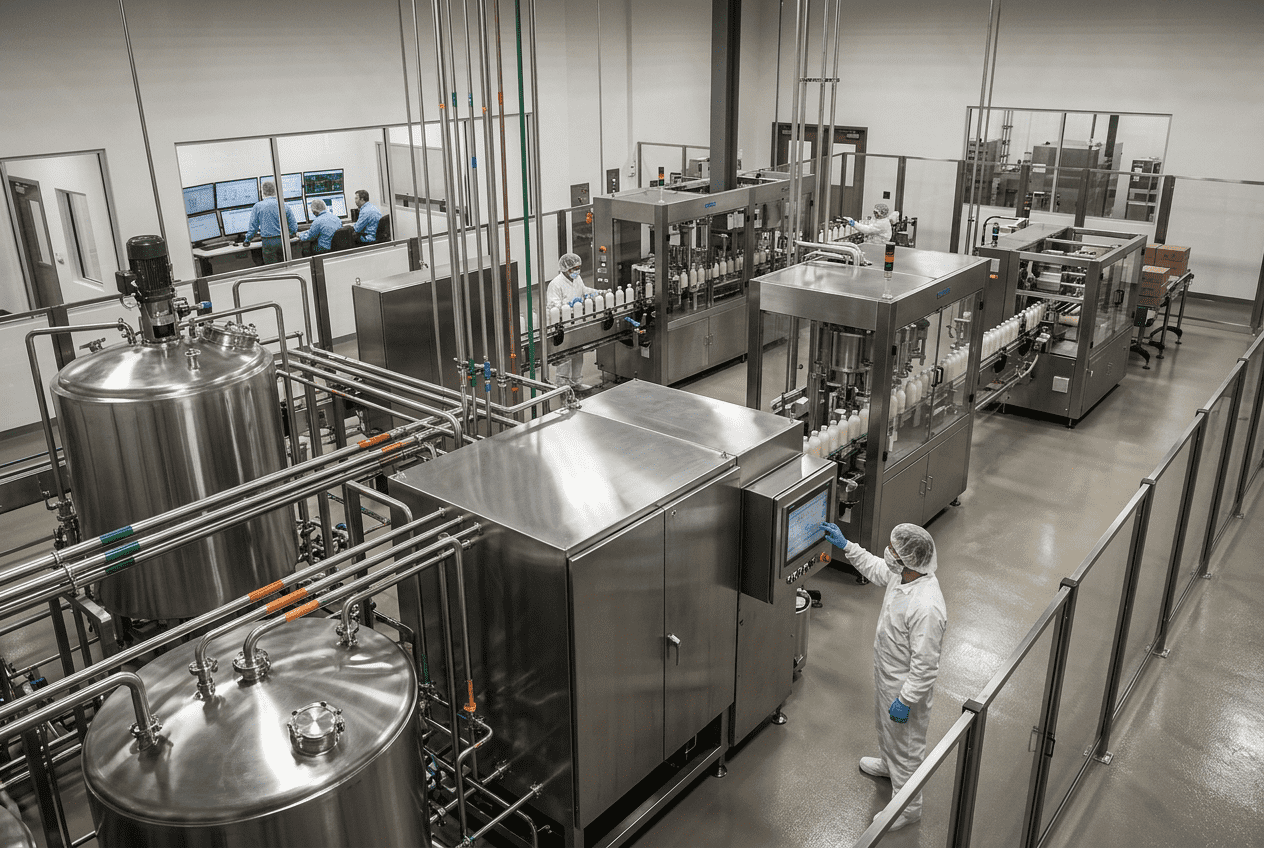
Food Batch Control System Design
[trp_language language=”en_US”]
Food Batch Control Systems for U.S. Food Manufacturing
In the United States, a modern food batch control system is the combination of automation software, procedural logic, recipe governance, equipment coordination, electronic records, and operator workflows used to produce repeatable batches safely and profitably. For food and beverage manufacturers, it is not just a PLC program that starts mixers and opens valves. It is the operating framework that ties together ingredients, tanks, transfer routes, CIP, weigh and dispense, quality checks, traceability, scheduling, and compliance. When designed correctly, batch control reduces giveaway, prevents operator error, improves first-pass quality, and makes scale-up from pilot to production much more predictable.
For plants producing sauces, dairy products, beverages, prepared foods, cultured products, dressings, marinades, cheese, plant-based foods, and aseptic products, batch control design is now a strategic capital decision. U.S. manufacturers in markets such as Chicago, Dallas, Atlanta, Los Angeles, Fresno, Charlotte, and the I-95 distribution corridor are under pressure to run more SKUs through shared assets while meeting FDA, USDA, SQF, and customer traceability expectations. That is why ISA-88 batch architecture, electronic batch records, and recipe-based automation have become central to expansion and modernization projects.
Companies looking for a practical path often work with engineering partners that can combine process design, controls integration, installation, and project execution under one structure. Disruptive Process Solutions is known in North America for this kind of approach, especially where profitability, flexible manufacturing, and disciplined capital planning matter as much as the hardware itself.
Quick Answer

A food batch control system design should define the recipe hierarchy, map each process step to equipment capabilities, manage shared resources automatically, enforce ingredient addition accuracy, capture secure production records, and support batch size scaling without changing the product outcome. In the U.S. market, the best systems also align with ISA-88, integrate with ERP or MES where needed, and support 21 CFR Part 11-ready record handling when electronic approvals and audit trails are required.
For most food plants, the ideal architecture includes:
- ISA-88-based procedural control for consistency across products and lines
- Master recipes and site-level parameter governance
- Automated equipment arbitration for tanks, mixers, and transfer routes
- Weigh and dispense integration for high-value or sensitive ingredients
- Electronic batch records with timestamps, signatures, and exceptions
- Scalable control logic from pilot, R&D, and tolling through full production
- Built-in hooks for CIP, QA hold points, and material genealogy
In practical buying terms, food companies should avoid treating batch control as a late-stage programming task. The strongest results come when recipe logic, process engineering, utility design, sanitary layout, operator ergonomics, and commissioning strategy are planned together. That is especially important for dairy, protein, beverages, aseptic, and prepared food applications where shared assets create hidden bottlenecks.
| Decision Area | Why It Matters | Common U.S. Plant Risk | Recommended Design Choice | Expected Operational Benefit | Typical KPI Impact |
|---|---|---|---|---|---|
| Recipe structure | Controls consistency between products | Different logic by line or shift | Standardized master recipe model | Lower variation | Higher first-pass yield |
| Shared equipment logic | Prevents route conflicts | Tank or line double-booking | Automated arbitration | Less downtime | Better OEE |
| Ingredient additions | Protects formula accuracy | Manual mis-weighs | Weigh and dispense integration | Reduced giveaway | Lower material cost |
| Batch records | Improves traceability | Paper delays and missing data | Electronic batch records | Faster review | Shorter release time |
| Scale-up logic | Keeps product quality stable | Lab recipe fails in production | Parameterized scaling rules | Smoother commercialization | Fewer trial runs |
| Compliance controls | Supports audits and customer demands | Weak approvals or audit trails | Part 11-ready design | Better governance | Lower compliance exposure |
The table above shows why system design has to go beyond equipment control. A plant may own good tanks, mixers, HTST skids, or fillers, but without recipe governance and procedural sequencing, those assets often underperform. This is especially true in multi-product facilities serving retail, foodservice, private label, and co-packing customers.
Understanding ISA-88: The Batch Control Standard for Food Manufacturing

ISA-88 remains the most useful framework for batch control in food manufacturing because it separates product knowledge from equipment knowledge. That matters in U.S. plants where manufacturers may run ranch dressing in the morning, cheese sauce in the afternoon, and allergen changeover at night on the same core assets. Without a structured model, recipes become hard-coded around individual operators or legacy PLC workarounds.
ISA-88 organizes control using physical and procedural models. The physical model defines enterprise, site, area, process cell, unit, equipment module, and control module. In food terms, that may mean a blending room, a kettle, an ingredient dosing skid, and valve or pump modules beneath it. The procedural model defines process stages such as procedure, unit procedure, operation, and phase. For example, a sauce batch could include charge water, heat, add dry ingredients, high-shear mix, hold, cool, and transfer.
The reason U.S. food processors adopt ISA-88 is not academic compliance. It delivers practical flexibility:
- New products can be introduced faster
- One product family can run on multiple assets
- Control strategies become easier to validate and troubleshoot
- Operator training is easier across shifts and sites
- Plant expansions in multiple states can share a common automation philosophy
For manufacturers shipping through distribution hubs such as Savannah, Houston, Long Beach, and New Jersey, flexibility matters because product mix can change quickly based on retailer demand, seasonality, and freight economics. A well-structured ISA-88 implementation helps plants respond without rewriting the entire controls layer.
| ISA-88 Element | Food Plant Example | Control Purpose | Typical User | Failure if Missing | Design Note |
|---|---|---|---|---|---|
| Process Cell | Batch blending suite | Defines major operating area | Operations manager | Poor capacity mapping | Align with sanitation boundaries |
| Unit | Jacketed mix tank | Executes product steps | Supervisor | Asset confusion | Assign capability metadata |
| Equipment Module | Ingredient dosing skid | Handles grouped functions | Controls engineer | Reusable logic lost | Standardize naming |
| Control Module | Valve, pump, VFD | Device-level control | Maintenance | Complex troubleshooting | Make diagnostics visible in HMI |
| Operation | Heat to target | Groups phases | Process engineer | Inconsistent sequencing | Add exception handling |
| Phase | Open steam valve | Atomic action | Programmer | Low reusability | Use parameterized code |
DPS often works in environments where ISA-88 has to connect directly to real utility and process constraints, not just software theory. From a technological capability standpoint, this means controls engineering, PLC programming, SCADA, and process integration must be coordinated with heating, cooling, CIP, aseptic boundaries, and transfer hydraulics. In U.S. food plants, that cross-discipline alignment is what turns a standards-based model into a profitable operating system rather than a documentation exercise.
Recipe Management: Master Recipes, Control Recipes, and Procedural Control

Recipe management is the heart of every batch process. In food manufacturing, the recipe is not only the formula. It also includes process parameters, ingredient sequence, agitation profile, time-temperature curves, hold rules, route destinations, and quality checkpoints. A strong system separates recipe intent from batch execution so plants can preserve product standards while still adapting to different lot sizes, equipment trains, or packaging destinations.
At the top level, the master recipe defines how a product should be made. It includes target ingredients, tolerances, required equipment capabilities, process steps, and operating windows. The control recipe is the executable version for a specific batch, order, date, line, and lot context. Procedural control then drives the actual phases and operations that perform the work on the floor.
For U.S. manufacturers running private label and branded products side by side, recipe governance reduces commercial risk. One customer may require a tighter Brix range, another may restrict rework, and another may demand detailed allergen verification. Good recipe architecture allows these rules to coexist without creating a separate codebase for every SKU.
| Recipe Layer | Main Content | Owner | Change Frequency | Approval Need | Plant Benefit |
|---|---|---|---|---|---|
| General recipe | Product family logic | Corporate process team | Low | High | Standardization across sites |
| Site recipe | Plant-specific settings | Site engineering | Medium | Medium | Adapts to local assets |
| Master recipe | Formula and procedure | R&D and operations | Medium | High | Controls quality |
| Control recipe | Batch-specific execution data | Production scheduler | High | Medium | Supports daily production |
| Phase parameter set | Device-level targets | Controls team | Medium | Medium | Reusable automation |
| Operator instructions | Manual prompts and checks | QA and supervision | High | Medium | Reduces human error |
When buying or upgrading a system, manufacturers should ask these questions:
- Can non-programmers update formulas within governed limits?
- Can the same product run on different vessel sizes with controlled parameter changes?
- Can recipe versions be approved, archived, and restored?
- Can allergen-sensitive variants force extra checks automatically?
- Can quality data and exceptions be linked to the batch record?
Manufacturing capability matters here because recipe logic must reflect how food is physically made. DPS supports applications across dairy, prepared foods, beverages, proteins, sauces, dressings, marinades, and aseptic systems, where process behavior changes with shear, thermal load, ingredient order, and vessel geometry. That practical manufacturing understanding is often the difference between a recipe that looks correct on screen and one that actually produces a stable product in a full-scale U.S. plant.
Equipment Arbitration: Managing Shared Tanks, Mixers, and Transfer Lines
Many food plants do not have dedicated equipment for every SKU. They run shared tanks, shared transfer lines, shared CIP skids, and shared packaging interfaces. Equipment arbitration is the logic that decides who gets access to what, when, and under what conditions. Without it, scheduling conflicts, contamination risks, and transfer delays multiply quickly.
In a cheese, yogurt, beverage, or sauce plant, a batch may be ready to transfer but blocked because the destination tank is occupied, the route is reserved, or a CIP hold has not cleared. Operators often work around these issues manually, which creates undocumented decisions and inconsistent outcomes. Automated arbitration prevents this by checking availability, state, compatibility, and priority before a batch can claim a resource.
Common assets that require arbitration include:
- Raw and finished product tanks
- Mixers and kettles
- Pasteurizers and HTST loops
- CIP supply and return paths
- Transfer headers and manifolds
- Packaging surge tanks
In high-SKU U.S. plants, arbitration logic should also account for allergen segregation, clean/dirty status, temperature readiness, maintenance lockout, and planned production priority. This is especially important in co-packing operations near major logistics corridors such as Southern California, Texas, or the Midwest, where schedule compression can be intense.
| Shared Resource | Typical Conflict | Control Rule | Critical Interlock | Business Impact | Best Practice |
|---|---|---|---|---|---|
| Mix tank | Two batches request same vessel | Reservation by priority and readiness | State validation | Schedule adherence | Use queue logic |
| Transfer line | Cross-routing risk | Single route ownership | Valve proofing | Product protection | Route confirmation screen |
| CIP skid | Cleaning delay blocks production | Campaign-aware allocation | Clean status required | Improved uptime | Integrate CIP scheduling |
| Surge tank | Packaging line not ready | Downstream handshake | Level and destination check | Less hold time | Real-time line status |
| Ingredient tote station | Operator overlap | Controlled access by batch | Barcode verification | Fewer mistakes | Prompted transactions |
| Homogenizer or HTST | Wrong product family routed | Compatibility matrix | Recipe match required | Higher quality | Use product class controls |
Service capability becomes critical during arbitration design because these workflows touch process engineering, controls, construction, commissioning, and operator SOPs. Through its design-build-manage model, DPS supports manufacturers that need engineering and execution tied together instead of split between disconnected vendors. That is valuable when shared utilities, sanitary routing, and line availability all affect the same batch-control outcome.
Batch Size Scaling Logic: From Pilot Lab to Full Production
One of the most expensive mistakes in food manufacturing is assuming a recipe scales linearly. A 20-gallon pilot batch that works in an R&D room in North Carolina or California may behave very differently in a 3,000-gallon production vessel in Wisconsin or Idaho. Heat transfer, shear, mix time, powder induction, deaeration, and hold dynamics all change with equipment geometry and utility performance.
Batch size scaling logic should therefore be built into the system architecture, not handled informally. Some variables scale by ingredient ratio; others require engineered rules, lookup tables, or model-based constraints. Water additions, steam ramp rates, mixer speed, recirculation duration, or homogenization passes may need batch-size-dependent logic to keep texture, viscosity, flavor release, and microbial controls stable.
Food categories that particularly need disciplined scaling include:
- Cheese sauces and processed cheese
- Cultured dairy and yogurt bases
- Dressings and emulsions
- High-solids beverages and syrups
- Marinades and protein injections
- Plant-based slurries and hydrated proteins
Good scale-up strategy usually includes plant trials, parameter envelopes, and controlled procedural branching. It also includes clear rules for minimum and maximum vessel fill, agitation limits, thermal lag, and order of addition. In commercialization projects, this helps protect launch timing and avoids recurring quality concessions.
| Scale Variable | Pilot Behavior | Production Risk | Control Strategy | Validation Method | Typical Product Impact |
|---|---|---|---|---|---|
| Agitation speed | Fast visible turnover | Poor top-to-bottom mixing | Scale by tip speed or power input | Mixing trial | Texture consistency |
| Heating rate | Rapid response | Scorching or long delays | Ramp profile by batch size | Temperature mapping | Flavor and color |
| Powder addition time | Short manual dosing | Lumping and dust loss | Controlled feed sequence | Visual and viscosity checks | Hydration quality |
| Hold time | Tight lab control | Overprocessing | Dynamic timer after true setpoint | Recorded batch data | Micro and texture results |
| Transfer loss | Minimal dead volume | Yield reduction | Line flush rules | Mass balance review | Material cost |
| Cooling profile | Small thermal mass | Slow cool and phase separation | Recipe-based cooling curves | Trend analysis | Shelf life and appearance |
The table shows why recipe management and control design have to include process science. For buyers, the lesson is simple: ask whether the controls partner understands what happens inside the vessel, not just inside the cabinet. That distinction matters when moving from bench or pilot work to large-scale production at enterprise plants or growing regional manufacturers.
Electronic Batch Records (eBMR) and 21 CFR Part 11 Compliance
Electronic batch records are increasingly important in the U.S. because they speed review, strengthen traceability, reduce paper handling, and help plants respond faster to customer and regulatory demands. While not every food facility needs a fully validated pharmaceutical-style system, many do need Part 11-ready features such as secure user access, audit trails, time-stamped entries, electronic approvals, and controlled record retention.
An eBMR system should capture more than start and stop times. It should connect recipe version, ingredient lots, operator actions, critical process values, deviations, holds, rework events, alarms, and release decisions into one searchable record. In food manufacturing, this can dramatically improve root-cause analysis and customer response time.
Plants handling aseptic products, regulated dairy processes, high-value formulations, export-sensitive SKUs, or large private-label programs often gain the fastest return. During audits, paper packets slow everything down. Electronic records make it easier to answer questions about who did what, when, under which recipe, and with which lots.
| eBMR Feature | Operational Use | Part 11 Relevance | Food Plant Benefit | Common Gap | Implementation Tip |
|---|---|---|---|---|---|
| Audit trail | Tracks changes and events | Core requirement | Better investigations | Overwritten values | Make entries immutable |
| User permissions | Role-based access | Supports security | Limits unauthorized edits | Shared logins | Use unique credentials |
| Electronic signatures | Approvals and releases | Core requirement | Faster QA workflow | Paper handoffs | Define signature meaning |
| Recipe versioning | Links product to approved method | Governance support | Change control clarity | Shadow versions | Lock released versions |
| Exception recording | Deviation handling | Supports accountability | Improved CAPA quality | Informal notes | Use structured reason codes |
| Record retention | Archive and retrieval | Supports compliance | Faster traceability | Scattered files | Set retention policy early |
As policy expectations and customer verification standards rise toward 2026, U.S. plants are likely to see stronger demand for digital genealogy, cybersecurity controls, and sustainability-linked recordkeeping such as energy and water use by batch. Forward-looking designs should leave room for those layers even if phase one starts with core production functionality.
Integration with Weigh & Dispense Systems for Precise Ingredient Control
Ingredient control is where many batch systems either create value or leak profit. Weigh and dispense integration connects scales, barcode systems, batch terminals, material IDs, and recipe targets so ingredient additions are verified before they enter the process. In food plants, this reduces formulation errors, allergen exposure, overuse of expensive ingredients, and rework.
Typical integrated workflows include operator login, batch call-up, material scan, lot verification, target display, tolerance checks, staged addition approval, and automatic posting to the batch record. For hand-add rooms, this creates discipline. For automated systems, it enables direct dosing, feeder control, or semi-automatic confirmation of bulk and minor additions.
High-value ingredients where integration pays quickly include cultures, enzymes, flavors, nutraceuticals, stabilizers, colors, spices, sweeteners, and proteins. In many U.S. plants, even small giveaway percentages materially affect margin, especially in products sold through tight retail contracts.
Plants should also think about physical layout. A good weigh and dispense room must support sanitation, traffic control, lot segregation, and ergonomic handling. That is why controls design should be coordinated with process and facility design, not isolated. More information about broader engineering support can be found through food and beverage engineering services.
By 2026, expect stronger use of guided batching, machine vision verification, digital material passports, and sustainability metrics such as waste per ingredient family. Companies that build these data pathways now will be better positioned for future customer reporting requirements.
Common Batch Control Challenges and How to Solve Them
Most batch control failures in food manufacturing are not caused by one bad component. They come from mismatches between process design, operator behavior, software structure, and equipment constraints. The good news is that these issues are solvable when addressed systematically.
| Challenge | Root Cause | Operational Symptom | Recommended Fix | Expected Result | Priority |
|---|---|---|---|---|---|
| Recipe drift | Uncontrolled parameter edits | Shift-to-shift variation | Version control and approval workflow | Stable quality | High |
| Frequent line blocking | No arbitration logic | Idle tanks and delayed batches | Automated resource reservation | Higher throughput | High |
| Ingredient errors | Manual paper-based additions | Rework and scrap | Weigh and dispense integration | Lower giveaway | High |
| Slow investigations | Fragmented records | Long QA release time | eBMR with exception capture | Faster root-cause analysis | Medium |
| Bad scale-up results | Linear assumptions | Pilot success but plant failure | Parameterized scale rules | Fewer commercialization delays | High |
| Operator workarounds | HMI not aligned to reality | Bypassed prompts and alarms | User-centered workflow redesign | Higher compliance | Medium |
Another recurring challenge is underestimating utilities. Steam pressure instability, weak chilled water capacity, inadequate compressed air, or undersized CIP recovery can all make otherwise sound batch logic appear unreliable. This is where integrated project partners bring value. DPS supports complete processing systems, utilities, controls, and installation, helping manufacturers connect automation outcomes to real plant infrastructure rather than treating them separately. Manufacturers evaluating equipment for new projects can also review process equipment solutions in the context of larger system performance.
Local supplier selection also matters. In markets such as Wisconsin dairy, California beverages, Texas protein, and Southeast prepared foods, choose firms that understand sanitary fabrication, local code interpretation, startup support, and the logistics realities of your region. The lowest software bid is rarely the lowest lifecycle cost if the team cannot execute commissioning, training, and post-startup optimization.
Case Study: Cheese Processing Plant with Full Batch Automation
Consider a U.S. cheese processing plant producing processed cheese blends, cheese sauce, and cultured dairy intermediates for foodservice and retail customers. The facility operates multiple blend tanks, cooker mixers, transfer lines, hold vessels, and a shared CIP system. Before modernization, recipe instructions were split between paper sheets, HMI notes, and tribal knowledge. Batches were generally successful, but capacity was constrained by waiting time, ingredient errors, and difficult traceability during customer inquiries.
The upgraded design introduced ISA-88-based procedural control, governed master recipes, automated equipment arbitration, integrated weigh and dispense, and electronic batch records. Ingredient lots were scanned before addition. The system checked that the right tank was available, verified clean status, and reserved transfer routes automatically. Heat-up and shear profiles were adjusted by batch size to keep melt quality consistent. QA checkpoints for pH, moisture, and hold conditions were embedded directly into the workflow.
Within months, the plant saw measurable improvement:
- Lower batch-to-batch viscosity variation
- Reduced operator dependency on manual decisions
- Faster review of deviations and lot genealogy
- Better utilization of shared tanks and transfer paths
- Improved throughput without major building expansion
This kind of outcome is why many food companies now prioritize full-system thinking over isolated automation upgrades. In practice, a successful cheese plant project often needs process engineering, utility review, equipment specification, controls design, installation management, and startup discipline in one coordinated program. More real-world project context is available through industry case studies.
For U.S. buyers, the lesson from cheese and dairy automation applies across other sectors as well: sauces in the Midwest, RTD beverages in the Carolinas, aseptic systems in the Northeast, and protein applications in Texas all benefit when batch control is designed around profitability, not just code completion.
FAQ
What is the difference between a batch control system and a standard PLC program?
A standard PLC program may control machines and devices, but a batch control system manages recipes, sequencing, shared resources, records, and operator workflows across the process. It is broader and more product-centric.
Is ISA-88 necessary for small or mid-sized food manufacturers?
Yes, even if implemented in a simplified way. The structure helps smaller plants avoid hard-coded logic, supports growth, and makes future line additions easier.
Which industries benefit most from food batch control?
Dairy, sauces, dressings, beverages, prepared foods, cultured products, plant-based foods, proteins, and aseptic processing all benefit strongly because they rely on controlled formulations and repeatable process steps.
Do we need eBMR if we are still paper-based today?
Not every plant needs a full digital rollout immediately, but most U.S. manufacturers benefit from moving critical batch data and approvals into electronic form. It improves traceability and shortens investigations.
How does weigh and dispense integration improve ROI?
It reduces formulation mistakes, ingredient giveaway, allergen risk, and manual documentation time. Plants using expensive minor ingredients often see fast payback.
What should we evaluate before buying a batch control solution?
Review recipe complexity, asset sharing, utility stability, sanitation strategy, operator skill levels, compliance requirements, future expansion, and ERP or MES integration needs.
Can batch control help without a major capacity expansion?
Absolutely. Many plants unlock meaningful throughput gains by improving scheduling logic, resource arbitration, and recipe execution. In some cases, software and workflow improvements deliver better returns than new tanks or building additions.
What trends should U.S. manufacturers watch through 2026?
Expect more guided batching, stronger audit trail requirements, cybersecurity focus, energy and water tracking by batch, AI-assisted anomaly detection, and broader demand for sustainability reporting tied to production records.
For food and beverage manufacturers in the United States, the best batch control system design is the one that connects process reality, regulatory expectations, and commercial performance. Whether the need is a new greenfield facility, a line expansion, a cheese plant modernization, a beverage syrup room, or a multi-site standardization effort, the right approach combines recipe intelligence, equipment logic, traceability, and disciplined project execution. That is where experienced engineering partners with process, manufacturing, and service depth create the greatest long-term value.
[/trp_language]
Complete Company Portfolio
About the Author: Disruptive Process Solutions (DPS)
The DPS team combines process engineering expertise with real-world food and beverage manufacturing experience. Our content focuses on process optimization, production efficiency, facility improvements, and practical solutions that help manufacturers operate more effectively in a rapidly evolving industry.
Share