Food Facility Equipment Procurement Best Practices
[trp_language language=”en_US”]
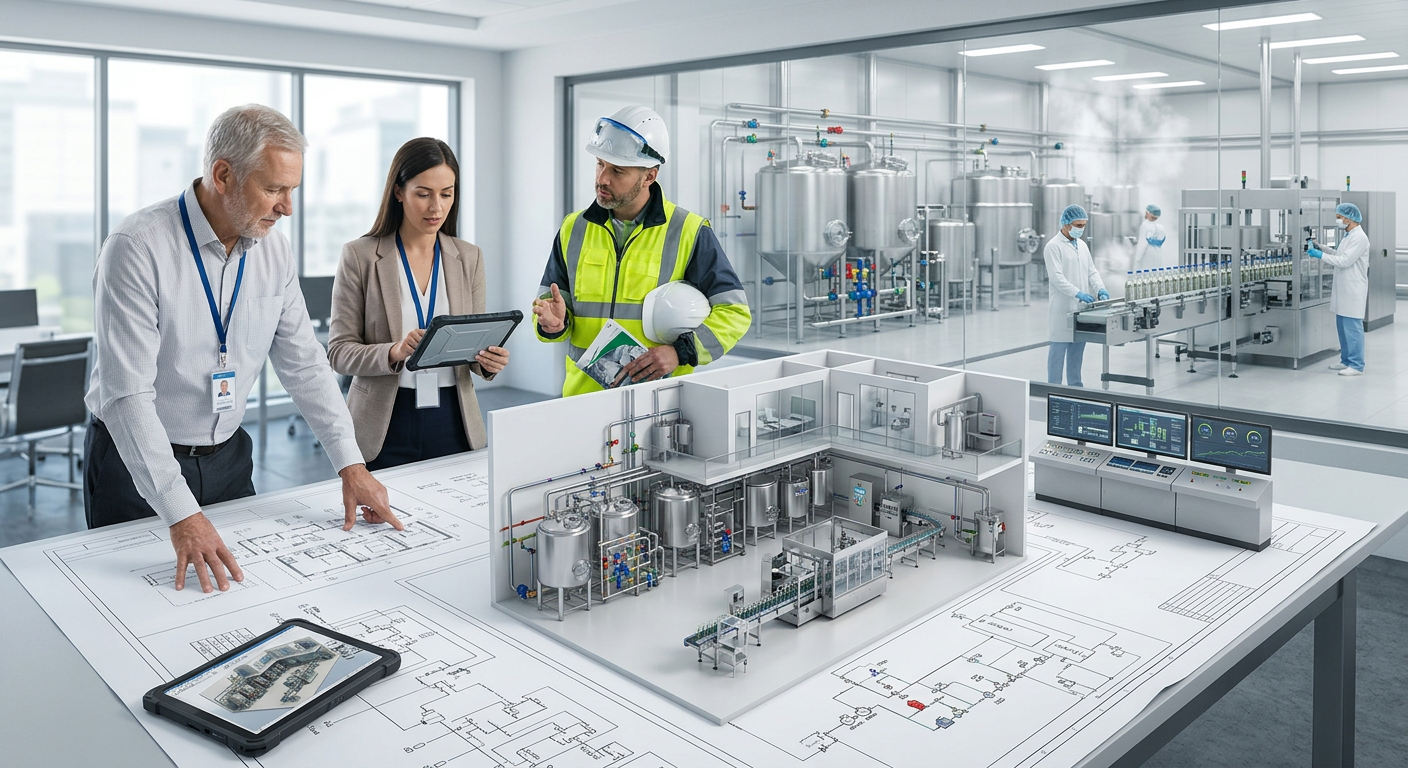
Procuring food facility equipment in the United States is not just a purchasing task. It is a capital decision that affects throughput, food safety, labor efficiency, utility consumption, compliance exposure, and long-term profitability. The best results come from aligning engineering, operations, quality, maintenance, finance, and procurement before issuing bids. Whether the project involves a new dairy line in Wisconsin, a beverage expansion near Atlanta, a protein upgrade in Kansas, or an aseptic packaging installation in California, buyers that define scope clearly, compare suppliers objectively, and manage installation and startup with discipline consistently outperform buyers that focus only on the lowest initial price.
Quick Answer

The most effective approach to food facility equipment procurement in the United States is to treat the process as a structured project lifecycle rather than a series of purchase orders. Start with a realistic business case, define process and utility requirements, prepare a detailed specification, run a disciplined request for quotation process, compare suppliers on technical fit and execution capability, negotiate commercial and performance protections, coordinate delivery and installation around plant readiness, and close the project with documented commissioning and handover. This reduces cost overruns, change orders, startup delays, and compliance risk.
In practical terms, the procurement team should answer six questions before contacting vendors: What production outcome is required? What product and regulatory standards apply? What utilities and building constraints exist? What labor model will support the line? What is the total installed budget, not just the equipment price? What is the expected return on investment? In food and beverage manufacturing, those questions matter because a mixer, filler, retort, pasteurizer, still, fermenter, or CIP system never operates in isolation. It must fit the process, the building, the sanitation plan, and the commercial model.
Across U.S. manufacturing hubs such as Chicago, Charlotte, Houston, Fresno, Minneapolis, and Philadelphia, capital buyers increasingly prioritize procurement methods that integrate process engineering with construction and startup planning. That shift is especially important at facilities near major logistics gateways such as the Port of Los Angeles, Port of Long Beach, Port of Savannah, Port of Houston, and Port of New York and New Jersey, where inbound lead times and freight complexity can materially affect project schedules.
| Procurement Step | Main Objective | Key Deliverable | Primary Risk if Missed | Responsible Team | Typical Timing |
|---|---|---|---|---|---|
| Business case | Confirm ROI and capacity need | Capital justification | Overbuying or underbuying | Finance and operations | 2 to 4 weeks |
| Process definition | Match equipment to product | Process narrative and P&IDs | Poor performance fit | Engineering and quality | 3 to 6 weeks |
| RFQ issue | Create apples-to-apples bids | Bid package | Incomplete quotations | Procurement | 2 to 3 weeks |
| Vendor evaluation | Select best supplier | Scoring matrix | Choosing on price alone | Cross-functional team | 2 to 5 weeks |
| Installation planning | Prepare site and schedule | Execution plan | Field delays and rework | Project management | 4 to 12 weeks |
| Commissioning and handover | Verify operability | SAT, training, manuals | Extended startup issues | Operations and OEM | 1 to 3 weeks |
The table above shows why the strongest procurement programs connect commercial decisions to execution milestones. Each stage has a different owner, but success depends on a single integrated plan.
Procurement Planning and Budgeting

Procurement planning and budgeting should begin with product demand, not equipment brochures. A facility producing sauces in New Jersey needs a very different design basis than a beverage co-packer in Texas or a poultry processor in Arkansas. The project team should forecast volumes, define SKU mix, identify sanitation requirements, evaluate labor availability, and estimate utilities such as steam, glycol, chilled water, compressed air, process water, wastewater, and power capacity.
For U.S. buyers, budgeting errors often come from leaving out indirect costs. The quoted purchase price may represent only 35 to 60 percent of the total installed cost, depending on the system. Foundations, mezzanines, rigging, freight, tariffs, controls integration, validation, startup support, spare parts, operator training, and local permitting can materially increase the final investment. This is especially true for high-complexity systems such as UHT skids, aseptic fillers, retorts, distillation systems, full CIP networks, and automated batching lines.
Another best practice is to classify the project by investment purpose: replacement, capacity expansion, quality upgrade, compliance correction, energy reduction, or product innovation. That classification helps executives compare projects more accurately. A replacement project may protect uptime, while an automation project may lower labor costs and improve batch consistency. Both can be worthwhile, but they should not be evaluated with the same assumptions.
| Budget Category | What It Includes | Typical Share of Installed Cost | Common Oversight | Budget Control Tip | Impact on ROI |
|---|---|---|---|---|---|
| Process equipment | Core machines and skids | 35% to 60% | Ignoring accessories | Request full bill of supply | High |
| Freight and logistics | Domestic or import shipping | 3% to 8% | Port and storage charges | Model worst-case lead times | Medium |
| Installation | Mechanical and electrical work | 10% to 20% | Underestimating field labor | Use detailed site surveys | High |
| Utilities | Steam, water, air, refrigeration | 8% to 18% | Existing system limits | Run utility load studies | High |
| Controls integration | PLC, HMI, SCADA, networking | 5% to 12% | Protocol mismatch | Specify standards early | High |
| Startup and training | Commissioning support and SOPs | 2% to 5% | Short OEM support window | Negotiate onsite days | Medium |
| Contingency | Unplanned scope and risk | 5% to 15% | No reserve budget | Base contingency on project maturity | High |
The explanation behind this budgeting structure is simple: capital decisions fail most often because teams underestimate everything around the equipment. In the U.S. market, a disciplined budget is a scope document with numbers attached, not a rough quote multiplied by a guess factor.
Market conditions also matter. Stainless steel pricing, controls lead times, labor shortages, and regional contractor availability can shift budgets materially. For example, projects in high-demand manufacturing corridors around Raleigh-Durham, Dallas-Fort Worth, and Southern California may face tighter scheduling pressure than projects in smaller secondary markets. Buyers should also plan for 2026 trends including stronger energy reporting expectations, rising demand for water reuse, more cybersecurity scrutiny for industrial controls, and wider adoption of modular skid fabrication to reduce field labor.
The line chart illustrates a realistic upward trend in U.S. food equipment capital spending, reflecting expansion in automation, sanitation upgrades, and resilience investments.
Vendor Selection and Evaluation

Vendor selection and evaluation should be based on evidence, not brand familiarity alone. A well-known OEM may still be the wrong fit if its design assumptions, support model, or spare parts availability do not match your plant. Likewise, a smaller supplier can be the better choice if it demonstrates stronger process knowledge, cleaner documentation, faster decision-making, and a better startup team.
In food and beverage plants, vendor evaluation should cover at least six categories: technical compliance, sanitary design, execution capability, service support, financial/commercial strength, and cultural fit. Technical compliance includes throughput, product viscosity range, heating or cooling profile, cleanability, automation compatibility, and changeover performance. Sanitary design includes weld quality, drainability, dead-leg control, seal selection, allergen management, and compliance with FDA, USDA, SQF, or BRC expectations where relevant.
Execution capability often separates successful projects from disappointing ones. A supplier may build excellent hardware but lack field coordination, FAT discipline, or documentation quality. In the United States, buyers should request U.S.-based references, ask about technician coverage by region, and confirm how the vendor supports plants in different time zones. Support expectations for a facility in North Carolina are not identical to those for a site in Washington state or Alberta.
| Evaluation Criterion | What to Review | Why It Matters | Scoring Method | Warning Sign | Best Practice |
|---|---|---|---|---|---|
| Process fit | Capacity, product range, recipe limits | Prevents performance gaps | 1 to 10 score | Vague throughput claims | Use actual product trials |
| Sanitary design | Material finish, cleanability, welds | Supports food safety | Checklist plus score | No hygiene drawings | Review CIP and drainability |
| Controls compatibility | PLC, HMI, SCADA, protocols | Avoids integration delays | Pass/fail plus score | Proprietary lock-in | Set standards in RFQ |
| Project execution | Schedule, FAT, installation support | Protects startup date | Weighted score | No dedicated PM | Review sample schedules |
| Aftermarket service | Spare parts, technicians, response time | Supports uptime | Service matrix | Single offshore contact | Confirm U.S. stocking plan |
| Total commercial value | Price, payment, warranty, terms | Defines whole deal value | Cost model | Low price with exclusions | Normalize all quotes |
This evaluation framework works because it converts supplier selection from subjective preference into a transparent decision model. It also helps procurement defend recommendations internally when competing vendors are close on price.
Local supplier strategy is another important factor. For standard utility items, fabricated piping supports, simple tanks, and field services, U.S. regional suppliers may offer faster response and lower freight. For specialized aseptic systems, tunnel pasteurizers, advanced fillers, or custom retort systems, national or international suppliers may still be necessary. The right approach is usually hybrid: source specialized process technology from proven OEMs and pair it with local execution resources where appropriate.
The bar chart shows relative equipment demand by sector, with beverage and protein continuing to drive strong capital activity in the U.S. market.
Request for Quotation Process
The request for quotation process is where procurement quality is either created or lost. If the RFQ package is vague, every supplier will make different assumptions, and the buyer will receive prices that cannot be compared fairly. A strong RFQ creates an apples-to-apples comparison by defining scope, performance requirements, interfaces, standards, schedule expectations, commercial terms, and documentation needs.
A proper RFQ package for food facility equipment should include process descriptions, product characteristics, target throughput, utility data, site drawings, required materials of construction, automation standards, sanitary requirements, FAT expectations, delivery windows, installation responsibilities, startup obligations, warranty requirements, and training expectations. If the project involves U.S. regulatory exposure, the package should also note any requirements tied to FDA, USDA inspection environments, allergen zoning, or customer audit standards.
Buyers should issue a bid tab template with the RFQ. That forces vendors to disclose inclusions and exclusions consistently. Without this step, one quotation may include valves, instrumentation, and startup support while another excludes them, making the lower price misleading. A clarification log is equally important. All bidders should receive the same answers so the process remains fair and auditable.
| RFQ Element | Required Detail | Purpose | Typical Problem if Missing | Who Supplies It | Best Practice |
|---|---|---|---|---|---|
| Scope of supply | Equipment and accessories list | Defines what is included | Quote gaps and disputes | Engineering | Attach line item matrix |
| Performance criteria | Rate, yield, uptime targets | Measures success | Low output after startup | Operations | State product assumptions |
| Utility requirements | Steam, water, air, power | Confirms site fit | Unexpected upgrades | Facilities | Provide current utility maps |
| Controls standards | PLC brand, network, HMI | Supports integration | Retrofit costs | Automation team | Use corporate standards sheet |
| Documentation | Manuals, drawings, IOMs | Supports maintenance | Weak handover package | Procurement | Specify digital file formats |
| Commercial terms | Payment, warranty, LDs | Aligns expectations | Late negotiation delays | Legal and procurement | Issue terms upfront |
| Project schedule | Milestones and deadlines | Protects go-live plan | Lead-time surprises | Project management | Require milestone commitment |
The explanation for this table is straightforward: every missing RFQ element becomes a future clarification, a future change order, or a future schedule risk. Good RFQs reduce all three.
For imported equipment arriving through ports such as Long Beach, Houston, Savannah, or Newark, the RFQ should define Incoterms, customs responsibilities, site delivery conditions, storage requirements, and crane or rigging assumptions. Plants in urban areas such as Boston or Seattle should also address access limitations, staging areas, and restricted delivery hours. These details have real cost consequences.
Contract Negotiation Strategies
Contract negotiation strategies should protect performance and execution, not only purchase price. Many buyers focus heavily on headline discounts while overlooking delivery guarantees, installation support, software access, spare parts availability, and acceptance criteria. In food equipment projects, those overlooked terms often matter more than a small reduction in unit price.
The first negotiation principle is to align payment milestones with evidence of progress. A typical structure might include deposit, approved drawings, fabrication completion, factory acceptance test, shipment, mechanical completion support, and final acceptance. Buyers should avoid front-loaded terms that transfer too much cash before performance is proven.
The second principle is to define acceptance clearly. Factory acceptance testing should confirm core functions before shipment. Site acceptance testing should confirm integrated performance under real plant conditions. If acceptance language is vague, disputes become more likely. The contract should also define punch list closure, response times for defects, and software or controls obligations.
The third principle is to negotiate support, not just hardware. That includes operator training, maintenance training, spare parts recommendations, remote diagnostics, emergency service response, and post-startup optimization days. For plants with demanding production schedules, like beverage facilities in the Southeast or protein plants in the Midwest, those support commitments can protect revenue far more than a modest upfront discount.
| Negotiation Topic | Why It Matters | Buyer Goal | Supplier Concern | Balanced Solution | Risk Reduced |
|---|---|---|---|---|---|
| Payment terms | Controls cash exposure | Pay on progress | Working capital pressure | Milestone-based schedule | Financial |
| Delivery date | Protects launch plan | Firm commitment | Supply chain uncertainty | Milestones with notice triggers | Schedule |
| Warranty | Supports reliability | Clear coverage period | Misuse exclusions | Define startup and acceptance dates | Operational |
| Performance guarantee | Confirms output and quality | Measured results | Input variability | Tie metrics to agreed product specs | Technical |
| Software access | Enables maintenance and upgrades | Ownership or license rights | Protecting IP | Maintenance-use license | Integration |
| Spare parts and service | Reduces downtime | Fast response and stock | Inventory cost | Critical spares list with lead times | Uptime |
The value of this approach is that it converts negotiation into risk allocation. The best contract is not the one with the fewest words; it is the one that makes project responsibilities unmistakable.
By 2026, contract language in the U.S. is also likely to evolve around sustainability reporting, equipment energy performance, refrigerant management, cybersecurity for connected controls, and data access for predictive maintenance. Buyers planning multi-site portfolios should begin incorporating these requirements now.
Delivery and Installation Coordination
Delivery and installation coordination is where procurement becomes reality. Many projects that look successful on paper lose value during field execution because equipment arrives before the site is ready, the utilities are incomplete, the controls contractor is not aligned, or the rigging plan is inadequate. This phase requires strong project management, especially in active plants that cannot stop production for long.
Best practice is to build a site readiness checklist before the first shipment leaves the vendor. That checklist should confirm foundations, drains, overhead clearances, utility stubs, floor conditions, sanitation zoning, electrical disconnects, access routes, permits, and safety plans. It should also define who owns unloading, storage, preservation, and damage inspection. For coastal or humid environments such as Florida, the Gulf Coast, or Pacific Northwest sites, preservation planning is especially important for stainless systems, motors, and controls panels.
Installation coordination should also consider sequence. In many food projects, utility backbone work, drains, structural steel, and controls rough-in must happen before process skids can be set. If the sequence is wrong, crews interfere with each other and productivity drops. This is one reason many owners prefer an integrated partner that can connect engineering, construction oversight, and process installation.
An additional U.S. consideration is local trade availability. Mechanical and electrical labor conditions differ widely between Phoenix, Milwaukee, Nashville, and the Inland Empire. Lead project teams should align contractor strategy with local market realities instead of assuming labor is interchangeable nationwide.
The area chart reflects a growing shift toward modular and preassembled systems, a trend driven by schedule compression, field labor constraints, and quality control needs.
Commissioning and Handover
Commissioning and handover should begin long before startup week. The most successful projects define commissioning strategy during procurement so vendors know what tests, documents, and training outputs will be required. In food facilities, this process typically includes mechanical completion checks, loop checks, dry testing, wet testing, CIP verification, performance trials, alarm testing, safety verification, operator training, maintenance training, and final document turnover.
For regulated or highly audited environments, handover should include calibration records, material certificates where required, as-built drawings, IO lists, software backups, recommended spare parts, preventive maintenance tasks, SOP support, and equipment manuals. Plants that skip structured handover often struggle months later when troubleshooting or preparing for audits.
Commissioning should verify more than whether the machine turns on. It should test whether the integrated system produces the product at the expected rate and quality. For example, a mixing system may meet speed criteria but still fail yield or viscosity consistency targets. A filler may run but underperform on changeover time. A retort may heat correctly but create packaging issues under real loads. The handover process should capture these realities before final acceptance.
Case studies across U.S. manufacturing show that startup outcomes improve when the owner appoints a single accountable leader to coordinate OEMs, utilities, controls, operators, and sanitation. That structure keeps decision-making fast during the most dynamic phase of the project.
Total Cost of Ownership Analysis
Total cost of ownership analysis is one of the most important and least used best practices in equipment procurement. Two systems with similar purchase prices can produce dramatically different long-term costs. The more complete analysis includes not only acquisition cost but also utilities, labor, cleaning chemistry, water use, maintenance parts, service support, downtime exposure, yield loss, training needs, and expected useful life.
In many food and beverage applications, the higher-priced option can be more profitable if it reduces cleaning time, improves first-pass yield, lowers changeover losses, or simplifies maintenance. This is particularly true in high-volume categories such as ready-to-drink beverages, dairy processing, protein forming, and sauce batching where small percentage improvements compound into major annual savings.
| Cost Component | Low-Price System | Higher-Value System | Typical 5-Year Effect | Main Driver | Procurement Insight |
|---|---|---|---|---|---|
| Purchase price | Lower | Higher | Front-end savings only | Initial quote | Do not stop here |
| Energy use | Higher | Lower | Utility savings accumulate | Motor and thermal efficiency | Model annual hours |
| Water and CIP chemicals | Higher | Lower | Sanitation cost difference grows | Cleanability | Measure actual CIP cycles |
| Labor requirement | More manual steps | More automation | Large operating cost gap | Controls and ergonomics | Include staffing assumptions |
| Maintenance and parts | Frequent replacement | Longer intervals | Lower uptime on cheap system | Component quality | Review lifecycle parts list |
| Downtime risk | Higher | Lower | Lost production can dominate | Serviceability and support | Ask for MTBF history |
| Resale or life extension | Lower | Higher | Residual value advantage | Build quality | Consider end-of-life options |
The explanation here is critical: total cost of ownership analysis reframes procurement from “What does it cost to buy?” to “What does it cost to own and operate?” That perspective is essential for executives managing plant profitability.
The comparison chart shows how a supplier with a slightly lower technical score may still be the better procurement choice if service coverage, documentation, and startup support are materially stronger.
When evaluating applications by product type, buyers should adapt TCO models accordingly. Fermentation systems should emphasize temperature control stability and cleanability. Distillation systems should emphasize safety, throughput, and utility efficiency. Dairy systems should emphasize product recovery and hygienic design. Protein lines should emphasize uptime, washdown durability, and labor efficiency. Aseptic systems should emphasize sterility assurance, validation, and specialized support.
Our Company
For manufacturers seeking a partner rather than a transactional seller, Disruptive Process Solutions supports food and beverage capital projects across the United States and Canada with a business-first mindset. The company is built around helping clients make smarter capital decisions, execute cleanly, and protect long-term profitability rather than simply pushing scope.
From a technological capabilities perspective, DPS works across structural, mechanical, plumbing, electrical, process, and controls engineering, including PLC programming, automation, and SCADA integration. That matters because equipment procurement decisions must fit real process conditions, utility systems, and control architectures. Whether a project involves fermentation, blending, carbonation, pasteurization, retort, aseptic processing, water treatment, or advanced batching, DPS helps connect process design to execution so equipment selections work in practice, not only in quotations.
From a manufacturing capabilities perspective, DPS also provides proprietary equipment for selected applications, including tanks, CIP systems, marination tumblers, and cooking vessels. That manufacturing perspective helps the team evaluate fabrication quality, sanitary design details, and field integration requirements more rigorously. Buyers looking at custom systems can review relevant process equipment capabilities while still keeping the focus on fit-for-purpose design.
From a service capabilities perspective, DPS delivers process engineering and design, capital planning, feasibility studies, owner’s representative support, project and program management, general contracting functions where applicable, installation oversight, and system integration. The company’s Design Build Manage model is especially useful for clients that want one accountable team connecting procurement, field execution, and startup. Organizations evaluating project delivery options can explore available engineering and project services or review selected project examples and outcomes for context.
That integrated structure is particularly valuable in U.S. projects where schedule pressure, contractor coordination, and utility integration drive major risk. Instead of treating procurement as separate from design and commissioning, DPS helps align the commercial decision with the full lifecycle of the plant asset.
FAQ
What is the biggest mistake in food equipment procurement?
The most common mistake is buying based on the lowest quoted price without fully defining scope, utilities, controls integration, startup support, and total cost of ownership.
How many suppliers should be invited to quote?
For most projects, three to five qualified suppliers is enough. Fewer may limit competition; more can create unnecessary administrative work without improving decisions.
Should buyers prefer local U.S. suppliers?
Not always. Local suppliers may offer faster response and lower freight, but specialized equipment may require national or international OEMs. The best choice depends on technical fit, support model, and lifecycle value.
What should be included in a food equipment RFQ?
Include process data, product characteristics, throughput targets, utility information, sanitary requirements, controls standards, documentation expectations, FAT and SAT criteria, schedule milestones, and commercial terms.
How long does a typical procurement cycle take?
For moderate complexity equipment, 8 to 16 weeks is common from specification to order. Larger integrated systems can take several months longer, especially if imported or highly customized.
How should commissioning be managed?
Use a formal plan with mechanical completion, dry and wet testing, utility verification, operator training, maintenance training, and documented acceptance criteria. Assign one owner-side leader to coordinate the process.
What are the key 2026 trends in the United States?
Expect more automation, stronger energy and water efficiency expectations, expanded use of modular skid systems, greater cybersecurity attention for controls, and tighter focus on sustainability and lifecycle reporting.
Which industries benefit most from structured procurement?
Beverage, dairy, protein, sauces, prepared foods, aseptic processing, and co-packing operations all benefit because they depend on uptime, sanitary performance, and rapid startup.
When should an owner’s representative or engineering partner be involved?
As early as possible, ideally before the RFQ is issued. Early involvement improves scope definition, budget accuracy, vendor comparison, and installation planning.
How can a buyer compare product types fairly?
Use a weighted matrix that scores technical fit, sanitary design, controls compatibility, lead time, service support, warranty, and total cost of ownership for each equipment type and supplier.
In summary, food facility equipment procurement best practices in the United States depend on disciplined planning, clear technical definition, balanced vendor evaluation, strong contracts, coordinated execution, and a lifecycle view of asset value. When these elements are managed together, manufacturers gain more reliable startups, stronger compliance outcomes, and better returns on capital.
[/trp_language]
Complete Company Portfolio
About the Author: Disruptive Process Solutions (DPS)
The DPS team combines process engineering expertise with real-world food and beverage manufacturing experience. Our content focuses on process optimization, production efficiency, facility improvements, and practical solutions that help manufacturers operate more effectively in a rapidly evolving industry.
Share