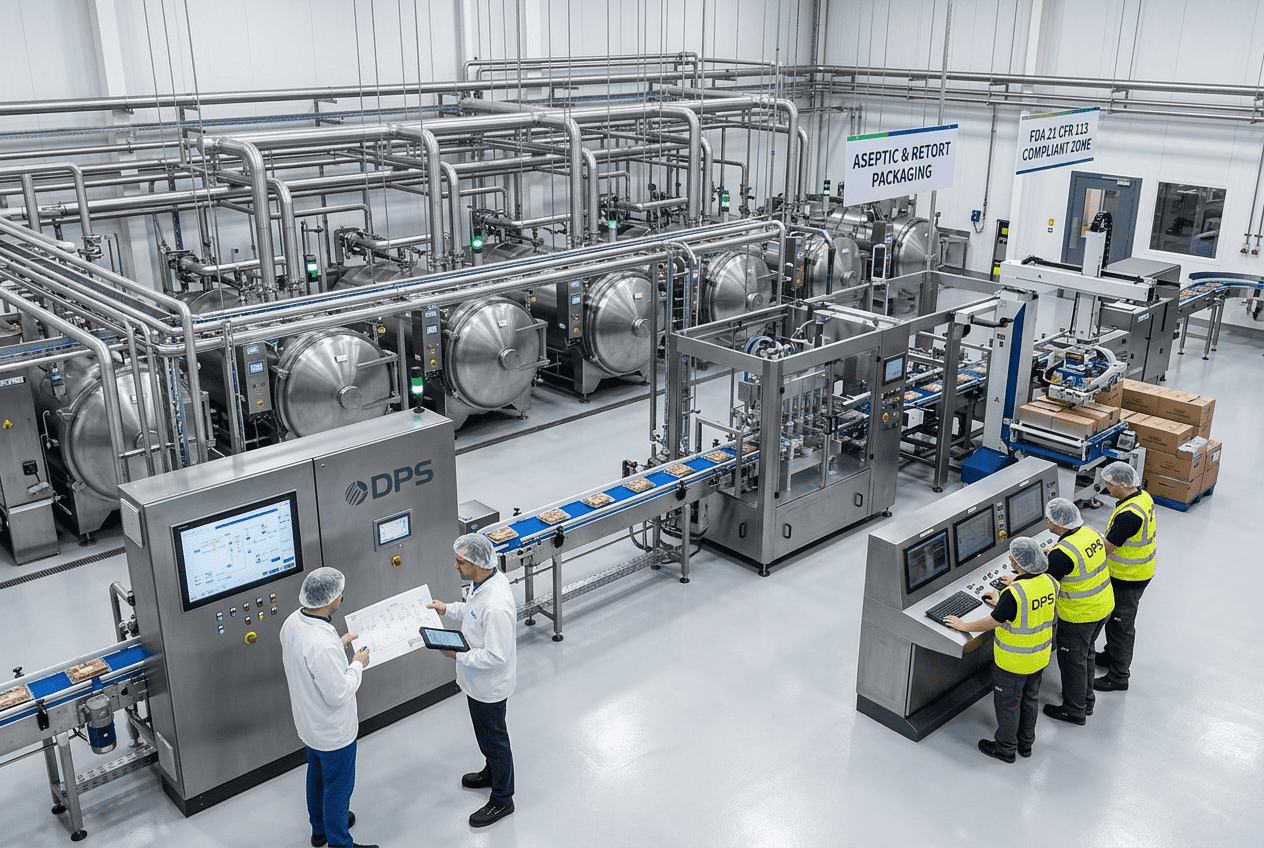
Food Facility Equipment Validation Process
[trp_language language=”en_US”]
Food and beverage manufacturers in the United States cannot treat equipment startup as a simple installation task. When a system affects product safety, shelf life, sanitation, throughput, or regulatory compliance, it needs a structured validation approach. That is where design qualification, installation qualification, operational qualification, and performance qualification come together. A disciplined IQ OQ PQ program helps confirm that equipment is correctly specified, properly installed, consistently operated, and capable of producing acceptable product under routine plant conditions.
In U.S. facilities, this is especially important for aseptic lines, pasteurization systems, retorts, CIP skids, fillers, blending systems, fermentation vessels, distillation assets, dairy processing equipment, protein processing lines, and utility systems that directly influence process control. Whether a project is located near Chicago, Fresno, Dallas-Fort Worth, Atlanta, Charlotte, Houston, or the Port of Los Angeles and Long Beach logistics corridor, the same principle applies: validation protects output, reduces startup risk, and supports FDA, USDA, SQF, and BRC expectations.
Quick Answer

The food facility equipment validation process is the structured method used to prove that a new or modified system is fit for its intended purpose in a U.S. manufacturing environment. In practical terms, the process usually follows four qualification stages:
- Design Qualification: confirms the proposed design matches user requirements, product needs, sanitation expectations, utilities, controls strategy, and regulatory obligations.
- Installation Qualification: verifies that the system was installed according to approved drawings, specifications, manuals, utility requirements, and safety standards.
- Operational Qualification: tests whether the equipment operates correctly across its intended ranges, alarms, interlocks, recipes, and control functions.
- Performance Qualification: demonstrates that the complete process produces acceptable product consistently in normal production conditions.
For most food and beverage plants in the United States, a strong validation package also includes risk assessment, calibration review, sanitation verification, training records, preventive maintenance setup, spare parts planning, and change control. If the line later undergoes significant modification, relocation, software revision, throughput increase, or formula change, revalidation may be required.
Companies planning capital projects should treat validation as a business tool, not just a compliance step. A well-written protocol shortens commissioning time, reduces waste, protects brands, and gives operations teams confidence that startup data can stand up to customer and regulatory scrutiny.
| Validation Stage | Main Objective | Typical Documents | Key Participants | Common U.S. Applications | Primary Output |
|---|---|---|---|---|---|
| Design Qualification | Confirm fitness of proposed design | URS, P&IDs, equipment specs, hygienic design review | Engineering, quality, operations, maintenance | Pasteurizers, retorts, fillers, CIP systems | Approved design basis |
| Installation Qualification | Verify correct installation | As-built drawings, utility checks, calibration list | Project team, contractors, maintenance | Tanks, pumps, valves, conveyors, utilities | Installed system acceptance |
| Operational Qualification | Verify operating functionality | Test scripts, alarm tests, sequence checks | Automation, QA, operators | PLC/SCADA systems, batching, thermal processes | Functional operating proof |
| Performance Qualification | Prove production consistency | Run data, product results, trend charts | Production, QA, process engineering | Beverage filling, dairy, protein, aseptic lines | Routine performance evidence |
| Revalidation | Confirm continued control after change | Change records, impact assessments | Quality, engineering, validation lead | Capacity expansions, software updates | Continued state of control |
| Ongoing Monitoring | Maintain validated state | PM records, calibration logs, deviations | Operations, QA, maintenance | All critical systems | Sustained compliance |
This table shows why food equipment validation is more than a single approval event. It is a lifecycle discipline that begins in design and continues through operation, maintenance, and future modifications.
Understanding IQ OQ PQ Protocols

IQ OQ PQ protocols form the backbone of a defensible equipment qualification strategy. In the United States, food manufacturers often borrow terminology and rigor from pharmaceutical validation, then adapt it to food, beverage, dairy, protein, and aseptic production realities. The exact level of documentation depends on product risk, customer standards, and the criticality of the process step.
IQ focuses on whether the system is installed correctly. This includes verification of model numbers, materials of construction, weld quality where relevant, utility connections, slope and drainability, instrument calibration, electrical power, grounding, guarding, and software or firmware versions.
OQ confirms the system functions correctly through defined tests. Examples include pump speed ranges, flow rate verification, temperature control response, valve sequencing, recipe management, emergency stop logic, alarm acknowledgment, password controls, and sanitation cycle timing.
PQ goes one step further and asks whether the process performs reliably in real production. For a ready-to-drink beverage line, this may include fill weight consistency, carbonation control, dissolved oxygen targets, package integrity, and line efficiency. For a protein cooking line, it may include lethality parameters, belt speed consistency, yield, and post-cook microbiological acceptance.
The strongest protocols are risk based. A low-risk utility skid may need a lighter package than an aseptic filling line or a retort system handling shelf-stable products. U.S. plants serving national retail, foodservice, or export markets often apply more robust protocols because customer audits increasingly expect documented proof of process control.
Validation scope also varies by product type. Beverage operations in California, Oregon, North Carolina, and Texas often emphasize blending accuracy, thermal treatment, carbonation, and CIP effectiveness. Meat and poultry facilities in the Midwest and Southeast may focus more on cook validation, chilling control, sanitation design, metal detection, and packaging integrity.
The line chart illustrates a realistic market trend: more U.S. food and beverage projects are adopting formal qualification protocols as automation, customer audits, and traceability expectations increase.
| Equipment Type | Why Validation Matters | Critical IQ Focus | Critical OQ Focus | Critical PQ Focus | Typical Risk Level |
|---|---|---|---|---|---|
| HTST Pasteurizer | Food safety and legal process control | Sensor placement, piping, divert setup | Temperature control, alarms, flow diversion | Stable lethality in production | High |
| CIP System | Sanitation effectiveness across assets | Tank sizing, pump orientation, conductivity instruments | Cycle sequence, concentration control, return logic | Repeatable cleaning outcomes | High |
| Blending and Batching Skid | Formula accuracy and consistency | Load cells, meters, valve tags | Recipe execution, dosing precision | Batch conformity over multiple runs | Medium-High |
| Retort System | Shelf stability and process authority alignment | Installation, venting, recorder checks | Cycle control, pressure, timing | Commercial sterility under load | High |
| Filler and Capper | Net contents, closure integrity, uptime | Mechanical setup, utilities, guarding | Speed range, rejection logic, sensors | Acceptable fill and package quality | Medium |
| Fermentation Vessel | Product quality and contamination control | Surface finish, vents, temperature loop | Agitation, cooling, pressure response | Stable fermentation outcomes | Medium-High |
This comparison helps buyers align validation depth with actual process risk. Not every skid needs the same burden of testing, but high-consequence food safety systems should always receive a rigorous protocol.
Design Qualification Requirements

Design Qualification is where many successful projects are won or lost. If the design basis is weak, later IQ, OQ, and PQ work becomes expensive and reactive. Design Qualification should translate commercial goals into engineering requirements before procurement and fabrication move too far forward.
A complete DQ package in the United States usually starts with a user requirements specification. This document should define product type, capacity targets, changeover expectations, sanitation method, ingredient characteristics, utility availability, automation integration, data capture needs, packaging format, safety needs, environmental constraints, and relevant regulatory standards.
For example, a dairy processor in Wisconsin may need hygienic design suitable for allergen segregation and frequent washdown. A beverage co-packer near Dallas may prioritize high-speed filling, syrup room integration, compressed air reliability, and future line expansion. A protein processor in Arkansas or Georgia may place special emphasis on drainage, hygienic welds, temperature control, and robust cleanability.
Key design qualification requirements include:
- Clear user requirements and process objectives
- Product contact material suitability
- Hygienic design and cleanability review
- Utility load analysis for steam, glycol, chilled water, compressed air, RO water, and power
- Control philosophy and cybersecurity considerations for PLC and SCADA systems
- Operator safety, lockout points, guarding, and ergonomics
- Space planning, access, maintenance clearance, and expansion allowances
- Acceptance criteria for capacity, quality, and compliance
Buying advice matters at this stage. Manufacturers should not choose equipment solely on purchase price. The better question is total lifecycle value. A lower-cost asset may create higher sanitation labor, more downtime, poor parts availability, or difficult controls integration. In trade hubs like Chicago, Houston, and New Jersey, the fastest delivery option may still not be the best fit if the design misses local utility realities or plant workflow constraints.
| DQ Review Item | What to Confirm | Example Evidence | Common Failure if Missed | Who Should Review | Business Impact |
|---|---|---|---|---|---|
| User Requirements | Capacity, product, CIP, automation, compliance needs | Signed URS | System underperforms from day one | Operations and engineering | Lost throughput |
| Materials of Construction | Correct stainless grades, seals, finishes | Data sheets and drawings | Corrosion or hygiene issues | Engineering and QA | Quality risk |
| Utility Compatibility | Steam, air, water, electrical availability | Load calculations | Startup delays and field changes | Project and facility teams | Extra capital cost |
| Control Strategy | Recipes, alarms, historian, access levels | Functional design spec | Limited automation or poor traceability | Controls and QA | Rework and inefficiency |
| Hygienic Design | Drainability, dead legs, clean access | Sanitary review checklist | Cleaning failures | Sanitation, QA, engineering | Food safety exposure |
| Future Expansion | Extra ports, floor space, panel capacity | Layout review notes | Expensive retrofit later | Leadership and engineering | Reduced scalability |
This table shows the purpose of DQ: preventing avoidable problems before equipment reaches the floor. Early review is usually the cheapest and fastest form of validation.
Many U.S. manufacturers also use DQ to align local supplier selection. Imported equipment may be excellent, but buyers should confirm domestic support, spare parts availability, and local field service response. Plants operating near Savannah, Memphis, Kansas City, or the Inland Empire often prioritize suppliers that can support both logistics and startup schedules without long waits for replacement components.
Installation Qualification Steps
Installation Qualification verifies that the approved design was actually executed in the plant. This step becomes especially important on multi-trade projects where mechanical, electrical, controls, refrigeration, utility, and sanitary piping work are installed by different teams.
In practice, IQ should not begin only after complete installation. Good projects create pre-IQ punch lists during construction so the final qualification phase is faster and cleaner. Typical IQ steps include:
- Verify equipment tag numbers, serial numbers, and model references.
- Confirm installation against approved drawings and specifications.
- Check process piping orientation, valve identification, line labeling, and flow direction markers.
- Verify utility hookups including steam, condensate, glycol, chilled water, compressed air, process water, wastewater, gas, and electrical power.
- Inspect weld quality, hygienic connections, slope, supports, and drainability.
- Review instrument calibration certificates and installed ranges.
- Confirm safety features such as guarding, emergency stops, warning labels, and lockout points.
- Verify software versions, HMI screens, PLC backups, and network connections where applicable.
- Collect manuals, spare parts lists, and recommended maintenance requirements.
- Close deviations and document any approved field changes.
Installation Qualification is also where local code considerations enter the picture. Facilities in California may need closer review of energy and utility impacts; facilities in the Southeast often plan around washdown conditions and humidity; Gulf Coast plants may evaluate corrosion resistance and storm resilience more carefully. If equipment is installed in older buildings near legacy manufacturing corridors such as Philadelphia, Cleveland, or St. Louis, existing infrastructure limitations can also affect IQ outcomes.
| IQ Checkpoint | Verification Method | Typical Acceptance Criteria | Related Document | Common Issue Found | Recommended Action |
|---|---|---|---|---|---|
| Nameplate Verification | Visual inspection | Matches approved procurement record | BOM and PO | Wrong motor size or model | Supplier correction |
| Piping Installation | Walkdown versus P&ID | Correct routing and sanitary fittings | P&ID and isometrics | Unapproved branch or dead leg | Field rework |
| Instrument Calibration | Certificate review | Current calibration within range | Calibration file | Missing or expired certificate | Recalibrate before OQ |
| Utility Connections | Pressure and voltage checks | Within specified design limits | Utility schedule | Undersized air or voltage drop | Correct infrastructure |
| Safety Devices | Physical and function check | Installed and accessible | Safety checklist | Missing guard or label | Install before startup |
| Documentation Pack | Document review | Manuals, drawings, backups complete | Turnover package | Incomplete OEM packet | Request closure from vendor |
This IQ table translates installation work into objective checks. Plants that skip these details often discover issues later during OQ, when troubleshooting is more expensive and disruptive.
When buying from local or regional suppliers, manufacturers should ask whether the vendor supports SAT participation, startup technicians, training documentation, and as-built closeout. These factors can materially reduce the time between delivery and qualified operation.
Operational Qualification Testing
Operational Qualification testing proves the equipment functions properly throughout its intended operating range. This is where protocols become highly detailed, because the goal is to challenge the system under expected and boundary conditions while documenting objective outcomes.
OQ normally covers both normal and abnormal conditions. For a CIP skid, that could include setpoint verification, temperature hold timing, chemical concentration confirmation, return conductivity switching, low-level alarms, pump interlocks, and emergency stop behavior. For a beverage blending line, OQ may test dosing accuracy, Brix control, inline meter response, batch sequence logic, recipe permissions, and failed instrument scenarios.
OQ should include controls and automation testing in modern U.S. plants. Many line failures are not mechanical but logical: wrong alarm limits, incorrect permissives, weak data historian setup, recipe mismatch, or poor interface with upstream and downstream equipment. Facilities operating sophisticated SCADA or MES layers should verify data transfer, user access, audit-style event recording, and backup recovery capability.
The bar chart reflects where operational qualification tends to be most demanding. Aseptic, beverage, and dairy projects often have tighter automation and control requirements because product safety and consistency depend on narrow operating windows.
| OQ Test Category | Example Test | Acceptance Standard | Frequency | Data Source | Failure Response |
|---|---|---|---|---|---|
| Temperature Control | Step response at target setpoint | Stabilizes within defined tolerance | Per control loop | Trend log | Tune loop and retest |
| Flow Verification | Meter versus known standard | Within approved error band | Critical circuits | Meter record | Calibrate or replace device |
| Alarm Function | High temp and low pressure simulation | Alarm displays and logs correctly | All critical alarms | HMI and PLC | Correct logic and re-execute |
| Interlock Sequence | Pump permissive test | Starts only when safe conditions met | Per sequence | Automation record | Fix code or wiring |
| Recipe Management | Load approved formula and run batch | Correct setpoints populate automatically | Per family of recipes | SCADA record | Review configuration |
| Safety Shutdown | E-stop and fault recovery | System enters safe state | Per station | Test form | Repair and retest |
Operational testing should not be reduced to a symbolic startup exercise. This table shows how a credible OQ creates evidence that the equipment is controllable, predictable, and safe before full production begins.
From a buying perspective, this is where strong suppliers stand out. Vendors that provide clear functional descriptions, complete I/O lists, alarm schedules, and FAT records make OQ faster. Weak documentation from a supplier often transfers cost directly to the plant during startup.
Performance Qualification Verification
Performance Qualification verifies that the process delivers acceptable production results under real operating conditions. Unlike OQ, which often focuses on function, PQ proves routine capability. The line should run with normal operators, approved raw materials, established sanitation procedures, and realistic production scheduling.
PQ requirements differ by product category:
- Ready-to-drink beverages: fill accuracy, Brix, carbonation, dissolved oxygen, seam or closure integrity, label placement, and line efficiency.
- Dairy systems: temperature control, homogenization consistency, microbiological acceptance, fat standardization, and cleanability repeatability.
- Protein lines: cook performance, yield, core temperature, chilling response, foreign material controls, and package seal integrity.
- Aseptic processing: sterilization conditions, hold times, environmental controls, sterile barrier integrity, and extended consistency across runs.
- Brewing and fermentation: fermentation performance, temperature stability, oxygen control, CIP effectiveness, and batch-to-batch flavor consistency.
PQ should use preapproved acceptance criteria and statistically meaningful evidence where practical. One good run is rarely enough. Many U.S. facilities require multiple successful batches or production runs, especially if the equipment is critical to food safety or supports major retailer programs.
The area chart highlights a clear 2026 trend: Performance Qualification is becoming more data driven. More plants are using historian data, digital batch records, automated trend review, and integrated quality systems to prove repeatability instead of relying only on paper records.
| PQ Metric | Example Target | Why It Matters | Typical Test Window | Who Reviews | Decision Outcome |
|---|---|---|---|---|---|
| Throughput | Meet planned units per hour | Confirms business case | 3 consecutive runs | Operations and project lead | Accept or tune line |
| Quality Conformance | Within spec for key attributes | Protects brand and customers | Each run and retained samples | QA | Release or investigate |
| Yield | Losses below planned threshold | Protects profitability | Per batch/day | Production and finance | Approve or optimize |
| Sanitation Repeatability | Pass after routine cleaning | Maintains hygienic control | Across multiple cleaning cycles | Sanitation and QA | Validated or corrective action |
| Downtime Stability | No critical recurring faults | Supports schedule reliability | First campaign period | Maintenance and operations | Closeout or action plan |
| Traceability/Data Integrity | Batch records complete and accurate | Supports audit readiness | Every PQ run | QA and IT/controls | Approve or remediate |
This table connects validation to plant economics. PQ is not only about compliance; it proves the equipment can support margin, schedule, and customer expectations.
Case experience across the U.S. shows that many apparent capacity problems are not equipment-size problems at all. Controls logic, sequencing, or line balance issues can limit output. Reviewing documented startup history and the lessons from prior integration work can save capital and help teams avoid overbuying. A useful way to evaluate this is to review practical execution examples and project outcomes through detailed food and beverage project case studies before committing to a major equipment package.
Revalidation and Change Control
Validation does not end when PQ is approved. Equipment remains in a validated state only if changes are controlled. Revalidation may be partial or full depending on what changed and how the change affects risk.
Common triggers for revalidation in U.S. food facilities include:
- Major recipe or formulation changes
- New allergens or product families
- Capacity increases beyond original design
- PLC code revisions or HMI changes
- Instrument replacement with different range or type
- Equipment relocation within the plant or to another state
- Retrofitted utilities or piping reroutes
- New sanitation chemistry or cycle parameters
- Customer or regulatory requirement changes
A practical change control system should classify changes by risk. Minor non-product-contact modifications may need only documented review, while changes to critical control points, thermal process logic, or aseptic barriers may require repeating significant portions of OQ and PQ.
By 2026, revalidation is increasingly tied to digital maintenance and automation platforms. Plants are using version control, electronic deviation management, and system backups to decide when a change crosses the threshold into requalification. Sustainability is also influencing change control: heat recovery upgrades, water reuse systems, energy monitoring, and chemical optimization projects can affect process conditions and should be reviewed for validation impact.
Policy expectations are also moving toward stronger traceability and documented preventive control evidence. Even where a regulation does not explicitly require the phrase IQ OQ PQ, the ability to prove design intent, installation correctness, functional control, and performance consistency remains highly valuable during customer audits and regulatory inspections.
The comparison chart illustrates a common buying reality in the United States: integrated project partners often provide better validation support than equipment-only sellers, especially on complex capital programs that involve utilities, controls, and commissioning.
Documentation and Regulatory Compliance
Good documentation is what turns qualification activity into defensible validation evidence. In the United States, food manufacturers may need to satisfy internal quality systems, external customer standards, and regulatory expectations at the same time. Documentation should therefore be accurate, legible, complete, approved, and easy to retrieve.
Typical validation documentation includes:
- User requirements specifications
- Risk assessments and design reviews
- P&IDs, layouts, electrical drawings, and control narratives
- Factory acceptance and site acceptance records where used
- IQ, OQ, and PQ protocols with preapproved acceptance criteria
- Executed test forms, data sheets, trend reports, and deviations
- Calibration records and instrument lists
- Training records and operating procedures
- Sanitation procedures and maintenance plans
- Change control records and revalidation decisions
Documentation should match the regulatory environment. FDA-regulated beverage, dairy, and ready-to-eat food operations may focus heavily on preventive controls, sanitary design, and process records. USDA-regulated meat and poultry facilities often require strong operational support for lethality, sanitation, and process integrity. GFSI-benchmarked schemes such as SQF and BRC also raise expectations for documented evidence and controlled procedures.
Plants should avoid creating protocols that are too generic. A validation package for a brewery in Colorado should not look identical to one for an aseptic dairy plant in upstate New York or a protein processor near Omaha. Records must reflect actual product risk, actual equipment function, and actual plant operating conditions.
For manufacturers planning large upgrades, it often helps to involve a partner that can bridge engineering, installation, integration, and compliance. Teams that understand capital planning, owner representation, commissioning, and field execution can usually create cleaner turnover packages and better audit readiness. Companies looking for broader project support can review integrated food and beverage engineering services as part of their validation planning, rather than treating qualification as an isolated paperwork exercise.
| Document Type | Main Purpose | Owner | When Created | Audit Importance | Retention Value |
|---|---|---|---|---|---|
| User Requirements Specification | Defines intended use and acceptance basis | Owner/engineering | Project start | High | Foundation for all later work |
| Risk Assessment | Determines testing depth and focus | Cross-functional team | Design phase | High | Explains rationale |
| IQ Protocol | Documents installation verification | Validation lead | Pre-startup | High | Proves configuration baseline |
| OQ Protocol | Documents functional testing | Validation/controls | Startup phase | High | Shows process control readiness |
| PQ Report | Confirms routine production performance | QA/operations | Post-startup | High | Supports release confidence |
| Change Control File | Maintains validated state after modification | Quality/engineering | Lifecycle | High | Protects long-term compliance |
This final documentation table explains why record structure matters. Good execution without good records is difficult to defend. Good records without real execution are even worse. The goal is alignment between what was planned, what was installed, what was tested, and what is now being run in production.
Our Company
Disruptive Process Solutions supports food and beverage manufacturers across the United States and Canada with a practical, execution-focused approach to capital projects. Rather than acting only as a contractor, the company is built around the idea that engineered projects should improve long-term profitability, not simply complete a scope on paper.
On the technology side, DPS works across process, mechanical, structural, plumbing, electrical, and controls disciplines. That includes automation, PLC programming, SCADA integration, batching logic, utility systems, and process design for applications such as pasteurization, aseptic processing, carbonation, blending, filtration, water treatment, fermentation, retort, dairy processing, protein systems, and plantwide CIP. This technical breadth is valuable during qualification because IQ OQ PQ success often depends on how well process equipment, controls, and utilities perform as one integrated system.
On the manufacturing side, DPS also supplies branded process equipment, including storage and processing tanks, custom CIP systems, marination tumblers, and cooking vessels. That perspective matters because qualification begins well before site startup. It starts with equipment design choices, material selection, access for sanitation, controls readiness, and fabrication details that influence field acceptance. Manufacturers considering packaged systems can explore selected process equipment solutions when evaluating validation-ready designs.
On the service side, DPS provides process engineering, capital planning, owner’s representation, project and program management, general contracting where licensed, installation oversight, and full system integration. The company’s Design Build Manage model is intended to reduce gaps between concept, procurement, construction, and startup. For clients, that can mean better visibility into schedule risk, cleaner coordination among trades, and stronger project closeout documentation. More background on the team and execution philosophy is available through the company’s about page.
DPS serves both beverage and food manufacturers, from brewing, spirits, wine, kombucha, juice, dairy beverages, and ready-to-drink products to proteins, prepared foods, sauces, dairy foods, aseptic applications, and co-packing operations. Because many projects involve a mix of utilities, sanitation constraints, automation, and regulatory pressure, the company emphasizes direct problem solving and transparent decision making. That is especially valuable when validation reveals that a process bottleneck is caused by controls logic or line integration rather than by the need for more capital equipment.
For U.S. manufacturers planning greenfield, brownfield, relocation, or emergency execution work, the most successful validation outcomes usually come from integrating design review, installation oversight, startup strategy, and documentation planning from the beginning rather than trying to reconstruct the record at the end.
FAQ
1. Is IQ OQ PQ legally required for every piece of food equipment in the United States?
No. The exact terminology is not mandated for every asset, but the underlying expectation to verify suitability, correct installation, controlled operation, and consistent performance is widely aligned with good manufacturing practice, customer audits, and risk management.
2. Which systems most often need full validation?
High-risk or high-impact systems usually justify the most formal protocols, including pasteurizers, retorts, aseptic lines, CIP systems, fillers, batching systems, and critical utilities that directly affect product safety or quality.
3. What is the difference between commissioning and validation?
Commissioning proves that a system is started up and functioning. Validation proves, with documented evidence, that it is suitable for its intended purpose and consistently performs under defined conditions. The two activities should be coordinated but not confused.
4. How long does the validation process take?
It depends on project complexity. A simple skid may be addressed in days, while a large integrated line or thermal process can require weeks of preparation and staged execution across FAT, SAT, IQ, OQ, and PQ.
5. Should validation begin after installation?
No. The best results come when validation planning begins during concept and design. User requirements, risk assessment, acceptance criteria, and documentation structure should be established before procurement and fabrication are complete.
6. How many successful runs are needed for PQ?
There is no universal number. The requirement should be based on risk, process variability, customer standards, and product type. Critical food safety systems often need multiple successful runs with clearly defined acceptance criteria.
7. When is revalidation necessary?
Revalidation is typically needed after major changes to formulas, capacity, controls software, utilities, sanitary design, process timing, or critical instruments. A formal change control review should decide the level of repeat testing.
8. Can local suppliers support validation, or do we need a national partner?
Either can work, but support capability matters more than geography alone. Ask whether the supplier provides field startup, documentation, controls support, spare parts access, training, and help with site acceptance and qualification records.
9. What are the biggest causes of validation delays?
Late document collection, unclear user requirements, missing calibration records, unfinished field punch items, poor controls documentation, and changing acceptance criteria during startup are among the most common causes.
10. What should buyers ask before purchasing a new system?
Ask for a clear design basis, hygienic design details, utility requirements, controls architecture, FAT scope, installed support expectations, documentation package, training plan, spare parts list, and how the vendor will support IQ OQ PQ execution in the United States.
[/trp_language]
Complete Company Portfolio

About the Author: Disruptive Process Solutions (DPS)
The DPS team combines process engineering expertise with real-world food and beverage manufacturing experience. Our content focuses on process optimization, production efficiency, facility improvements, and practical solutions that help manufacturers operate more effectively in a rapidly evolving industry.
Share

