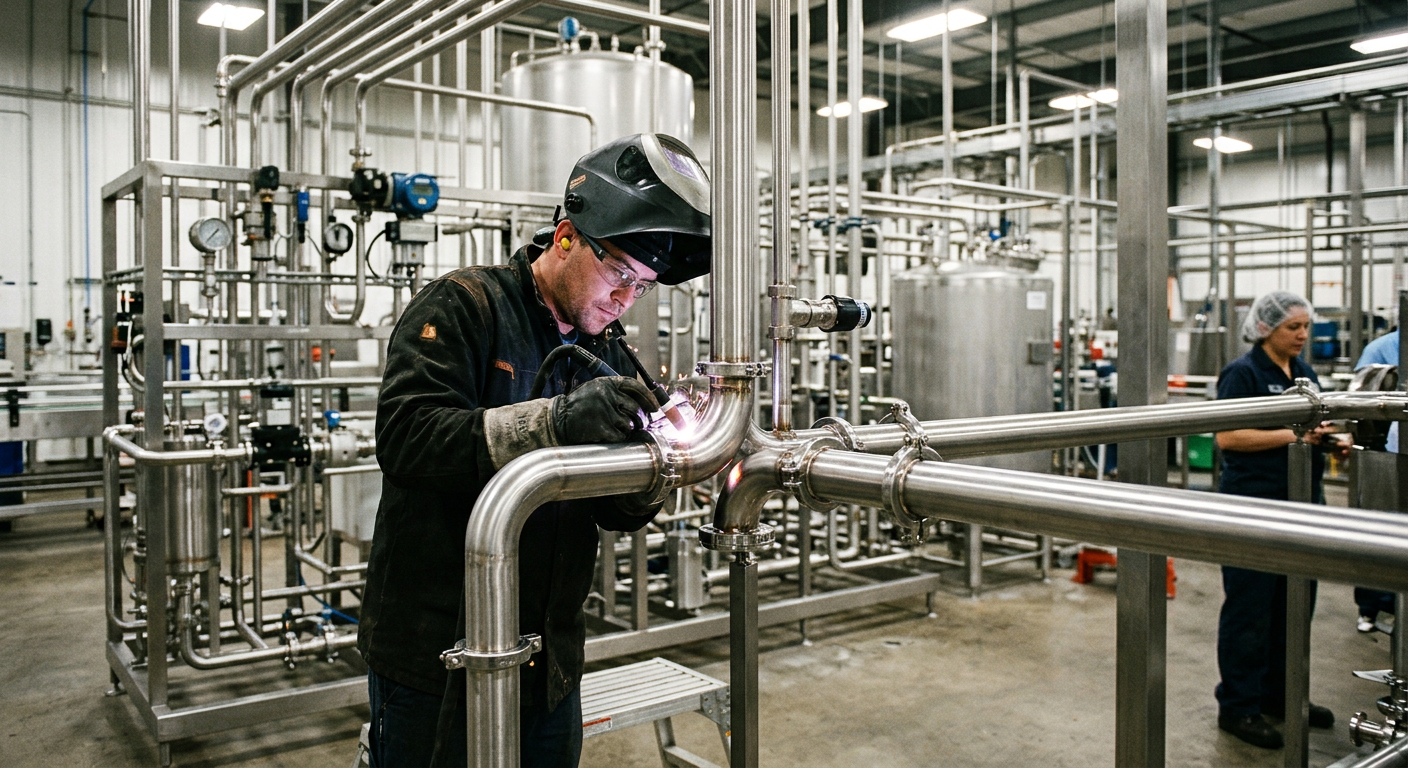
Food Facility Heat Exchanger Types Comparison
[trp_language language=”en_US”]
Choosing the Right Heat Exchanger for Food Processing Plants in the United States
Heat exchangers are core assets in modern food and beverage manufacturing. They control product temperature during pasteurization, cooling, cooking, regeneration, holding, and cleaning, while also affecting yield, food safety, energy use, maintenance labor, and line uptime. In the United States, where processors operate under FDA, USDA, SQF, and BRC expectations, choosing the wrong heat exchanger can create sanitation issues, bottlenecks, product damage, and avoidable operating costs. Choosing the right one can improve throughput, stabilize product quality, and reduce total cost of ownership over the life of the system.
From dairy plants in Wisconsin to sauce manufacturers in Illinois, protein processors in Arkansas, aseptic beverage lines in California, and co-packers around Dallas, Atlanta, and the New Jersey distribution corridor, food facilities face different thermal duties and sanitary demands. The best heat exchanger depends on viscosity, particulate size, fouling behavior, target temperatures, CIP strategy, pressure drop limits, utility availability, and future production goals. This guide compares the most common sanitary heat exchanger types used in U.S. food facilities and explains how buyers can match technology to process reality.
Quick Answer

For most liquid food and beverage applications, plate and frame heat exchangers offer the best combination of thermal efficiency, compact footprint, and lower utility consumption. For high-pressure, high-temperature, viscous, or particulate-heavy duties, tubular and shell and tube units often provide better durability and process flexibility. For sticky, crystallizing, highly viscous, or shear-sensitive products such as puddings, processed cheese, meat emulsions, and some sauces, scraped surface heat exchangers are frequently the strongest choice because they continuously remove fouling from the heat transfer surface.
In practical U.S. food plant terms:
| Process Need | Most Suitable Type | Why It Fits | Typical U.S. Applications | Primary Advantage | Main Limitation |
|---|---|---|---|---|---|
| Low-viscosity liquids | Plate and frame | High heat transfer coefficient | Milk, juice, beer, RTD beverages | Energy efficiency | Less ideal for large particulates |
| High pressure or rugged duty | Shell and tube | Strong mechanical construction | Utilities, oils, secondary loops | Durability | Larger footprint |
| Very viscous or sticky product | Scraped surface | Mechanical scraping reduces buildup | Processed cheese, custard, sauces | Handles fouling well | Higher capital cost |
| Products with particulates | Tubular | Wider flow passages | Salsa, soups, fruit prep, yogurt mix | Product integrity | Usually lower efficiency than plates |
| Aseptic processing | Tubular or specialized plate | Supports validated thermal profile | Shelf-stable dairy and beverages | Cleanability and control | Application-specific design required |
| Frequent recipe changes | Plate and frame or tubular | Flexible operation and CIP integration | Co-packing and multi-SKU plants | Operational versatility | Selection depends on product range |
The short buying rule is simple: if the product is clean, pumpable, and low in particulates, start with plate and frame. If it is harsh, viscous, chunky, or fouls rapidly, look at tubular or scraped surface. If the duty sits on the utility side or requires a heavy mechanical design, shell and tube remains relevant.
U.S. demand for sanitary thermal systems continues to rise as processors invest in automation, longer shelf life, energy recovery, and product innovation. Regional investment is especially active in food manufacturing clusters around Chicago, Minneapolis, Fresno, Charlotte, Houston, and the I-95 corridor, where brownfield retrofits and new capacity expansions are both common.
The chart above reflects a realistic upward trend driven by beverage diversification, protein processing modernization, expanded aseptic capacity, and sustainability projects tied to water and energy reduction.
Plate and Frame Heat Exchangers

Plate and frame heat exchangers are among the most widely used sanitary units in U.S. food and beverage plants. They transfer heat through thin corrugated metal plates arranged in a compressed pack, creating alternating channels for product and service media. Their high turbulence and large effective surface area make them highly efficient for heating and cooling low- to medium-viscosity products.
They are especially common in dairy, brewing, juice, functional beverages, liquid egg, and HTST pasteurization systems. In states with major beverage and dairy activity such as California, Wisconsin, New York, Pennsylvania, and Texas, plate systems are frequently selected for regeneration duties because they recover a large portion of thermal energy from outgoing product streams.
Key strengths include compact size, strong thermal performance, low hold-up volume, and relatively easy capacity adjustment by adding or removing plates. These benefits make plate and frame units attractive in urban or retrofit facilities where floor space is tight, such as plants near Newark, Los Angeles, or central Chicago.
| Feature | Plate and Frame Performance | Operational Impact | Best Product Range | Sanitary Benefit | Buyer Note |
|---|---|---|---|---|---|
| Heat transfer rate | Very high | Fast heating and cooling | Milk, beverage, water-like fluids | Shorter residence time | Excellent for energy recovery |
| Footprint | Compact | Saves floor space | Retrofit plants | Easier layout integration | Useful in brownfield projects |
| Expandability | Good | Can support growth | Multi-phase expansion plans | Maintains validated process design | Review frame capacity early |
| Particulate handling | Limited to moderate | Risk of plugging if oversized solids | Smooth products | Suitable with correct channel spacing | Check particle size carefully |
| Cleaning | Good with CIP | Supports frequent turnover | Beverages, dairy, sauces | Cleanable sanitary path | Fouling products may need more downtime |
| Energy efficiency | Excellent | Lower steam and glycol use | Continuous lines | Supports sustainability goals | Often best life-cycle value |
Still, these units are not universal. Products containing large particulates, fibers, or highly fouling ingredients can plug channels or require frequent maintenance. Gasket condition also matters. In high-acid, high-fat, or cleaning-intensive environments, gasket material selection affects longevity and sanitation confidence. U.S. processors must also account for production variability; what works for juice may not work for salsa, yogurt with fruit, or protein slurries.
When processors need flexible sanitary system design, integrating a plate exchanger into a broader skid with balance tanks, controls, CIP routing, and utility optimization becomes just as important as selecting the exchanger itself. Companies such as DPS service teams typically evaluate not only the exchanger but also the process context around it, including flow stability, recipe changeovers, and utility loads.
Shell and Tube Heat Exchangers

Shell and tube heat exchangers place one fluid inside tubes and another around the outside within a shell. They are rugged, familiar, and widely used across industrial thermal systems, including many food plant utility and secondary process loops. Although less thermally compact than plate units for many sanitary liquid duties, they remain valuable where durability, pressure handling, and mechanical simplicity are priorities.
In U.S. food facilities, shell and tube units are often found in hot water generation, oil heating, refrigeration interfaces, condensate recovery, and some product applications where process conditions are demanding. Gulf Coast plants, meat operations, and older factories with legacy utility architecture frequently maintain shell and tube designs because of their proven reliability and maintenance familiarity.
Their strengths include tolerance for higher pressures, broad metallurgy options, and dependable performance in utility-facing roles. They also work well when plants have maintenance teams already trained to inspect tube bundles, replace components, and manage scaling or fouling in predictable ways.
| Selection Factor | Shell and Tube Rating | Where It Excels | Common U.S. Use | Advantage | Trade-Off |
|---|---|---|---|---|---|
| Mechanical strength | High | Pressure and temperature extremes | Steam and hot water systems | Long service life | Bulkier than plate units |
| Product versatility | Moderate | Special process duties | Oils, utility media, some food liquids | Wide design range | Less sanitary-efficient for some products |
| Maintenance familiarity | High | Plants with in-house mechanics | Legacy factories | Known maintenance practices | Tube cleaning can be labor intensive |
| Thermal compactness | Moderate | Larger equipment rooms | Industrial campuses | Stable performance | Lower coefficient than plate systems |
| Fouling tolerance | Moderate | Utility-side service | Cooling water loops | Can be built robustly | Performance declines with scale buildup |
| Capital planning fit | Good | Long-cycle infrastructure upgrades | Large enterprise sites | Predictable design basis | May not be optimal for every sanitary duty |
For buyers, the key question is whether the application is truly product-side sanitary processing or primarily utility-side energy exchange. In many food plants, shell and tube is not the first choice for clean, low-viscosity product streams, but it can be a very strong choice around the process, especially in integrated heating and cooling systems.
In capital projects from the Carolinas to the Pacific Northwest, experienced engineering groups often model shell and tube units as part of broader infrastructure studies rather than evaluating them in isolation. That is especially important when the plant is balancing boiler load, glycol generation, heat recovery, and expansion phasing.
Scraped Surface Heat Exchangers
Scraped surface heat exchangers are designed for products that foul rapidly, become highly viscous, contain suspended solids, or require controlled crystallization or texture development. A rotating shaft with blades continually scrapes product from the heat transfer wall, reducing buildup and maintaining a more consistent thermal profile.
These systems are common in processed cheese, confectionery, fillings, meat emulsions, gravies, dressings, starch-rich foods, and some dairy desserts. For U.S. processors dealing with sticky formulations in prepared foods or premium refrigerated products, scraped surface technology often solves problems that other exchanger types cannot handle effectively.
The biggest advantage is the ability to keep heat transfer surfaces active even when products would otherwise burn on, gel, or insulate the wall. This supports both product quality and sanitation performance. It also allows processors to run difficult recipes with less risk of scorching, phase separation, or texture damage.
However, scraped surface systems carry higher capital cost, more moving parts, and greater mechanical complexity. They require careful seal management, preventive maintenance, and operator training. The value case is strongest when a processor would otherwise lose significant production time due to fouling, product loss, or unstable quality.
| Product Challenge | Scraped Surface Response | Operational Benefit | Typical Industry | Quality Impact | Decision Insight |
|---|---|---|---|---|---|
| Rapid fouling | Continuous wall scraping | Longer runtime | Sauces and dairy | More consistent heat transfer | Strong fit for sticky products |
| High viscosity | Mechanical movement aids transfer | Stable processing | Prepared foods | Protects texture | Evaluate motor load and residence time |
| Crystallization control | Managed surface renewal | Supports process precision | Confectionery and fat systems | Improves mouthfeel | Important in specialty formulations |
| Scorch risk | Prevents burn-on | Less waste | Custards and fillings | Better flavor retention | Useful at high solids |
| Particulate sensitivity | Can handle many soft inclusions | Maintains flowability | Dressings and dips | Reduces damage | Confirm particle tolerance by design |
| Frequent cleanouts | Reduces unscheduled fouling stops | Higher uptime | Multi-SKU co-packing | Steadier process output | Higher upfront cost may pay back quickly |
For plants in major prepared foods corridors such as Ohio, Missouri, Tennessee, and North Carolina, scraped surface units are often selected when line speed, consistency, and difficult formulations outweigh the premium price. They are also relevant in pilot-to-commercial scale transitions, where recipes that worked in development begin fouling heavily at production rates.
Tubular Heat Exchangers
Tubular heat exchangers use tubes rather than plates to move heat into or out of a product stream. In sanitary food processing, they are often chosen for products with particulates, fibers, higher viscosity, or more demanding thermal profiles. Variants include double-tube, multi-tube, and triple-tube designs, each suited to different capacities and process requirements.
In the United States, tubular systems are common in soups, fruit preparations, salsa, baby food, dairy mixes, tomato products, liquid egg, cultured products, and aseptic applications. Because flow channels are more open than those in many plate systems, tubular exchangers can preserve particulates and reduce plugging risk.
They are particularly valuable when a processor must balance sanitation with product integrity. For example, a shelf-stable soup line shipping through Memphis or Kansas City distribution networks may require validated heating while maintaining particle size and suspension quality. A tubular system often handles that balance better than a conventional plate pack.
| Attribute | Tubular Performance | Best-Fit Products | Plant Benefit | Sanitary Value | Buyer Consideration |
|---|---|---|---|---|---|
| Particulate handling | Strong | Soups, salsa, fruit prep | Lower plugging risk | Smooth product path | Match tube diameter to solids |
| Pressure capability | Good | Aseptic and high-pressure duties | Process flexibility | Reliable validated conditions | Review wall thickness and pressure drop |
| Thermal efficiency | Good | Broad process range | Balanced performance | Suitable for CIP designs | Often below plate efficiency |
| Viscosity tolerance | Moderate to high | Dairy mixes, sauces | Wider application window | Reduced shear compared with some systems | Residence time matters |
| Cleanability | Good | Validated sanitary systems | Supports repeatability | Strong CIP compatibility | Fouling chemistry still drives frequency |
| Product quality protection | High | Chunky or sensitive foods | Less mechanical damage | Preserves target texture | Critical in premium formulations |
Tubular exchangers are also a popular answer for processors expanding into higher-value SKUs that contain particulates or require aseptic distribution. When combined with precise controls, validated holding, and integrated CIP, they support both shelf-life targets and operational reliability.
The demand pattern above shows why no single exchanger type dominates every plant. Dairy and beverage operations remain major buyers, but prepared foods, sauces, and aseptic systems are shaping future equipment selection in a meaningful way.
Sanitary Design and Material Standards
In U.S. food manufacturing, thermal performance alone is never enough. Heat exchangers must also meet sanitary design expectations, support cleaning validation, and align with the facility’s regulatory environment. Selection criteria commonly include 316L stainless product contact surfaces, elastomer compatibility, drainability, weld quality, surface finish, dead-leg avoidance, gasket design, and the ability to integrate with documented CIP or COP procedures.
Facilities regulated by FDA and USDA, or certified under SQF and BRC, generally expect equipment that supports hygienic design and documented cleanability. In meat and poultry applications, washdown severity and pathogen control priorities may drive a different design emphasis than in beverage plants. In aseptic systems, validation requirements around time, temperature, and sterilization integrity become even more critical.
Sanitary design standards also affect maintainability. A heat exchanger that looks compliant on paper but is difficult to inspect, drain, isolate, or reassemble can still create practical food safety risk. Plants in export-oriented hubs such as California’s Central Valley, the Midwest dairy belt, or the Southeast poultry corridor often need designs that stand up not only to audits but also to real operating pressure.
| Sanitary Element | Why It Matters | Common U.S. Expectation | Impact on Food Safety | Impact on Operations | Buyer Action |
|---|---|---|---|---|---|
| 316L stainless contact surfaces | Corrosion resistance | Widely preferred | Lower contamination risk | Longer equipment life | Verify metallurgy by application |
| Surface finish | Limits soil retention | Application-dependent Ra target | Improves cleanability | Supports faster CIP | Document finish requirements |
| Gasket material compatibility | Chemical and temperature resistance | Matched to product and CIP | Protects seal integrity | Reduces maintenance events | Review with sanitizer and product chemistry |
| Drainability | Prevents hold-up | Critical in sanitary systems | Reduces microbial harbor points | Less product loss | Check actual installed slope |
| Weld quality | Avoids crevices and defects | High sanitary standard | Improves inspection confidence | Fewer repair issues | Specify documentation needs |
| CIP validation support | Ensures repeatable cleaning | Expected in modern plants | Supports compliance | Stabilizes uptime | Design exchanger with total system in mind |
Strong sanitary outcomes depend on system-level engineering. The heat exchanger, pumps, valves, instrumentation, holding sections, and CIP skid must work together. That is one reason advanced project teams increasingly prefer integrated design-build approaches rather than piecemeal equipment buying.
Thermal Performance and Efficiency
Thermal performance affects more than product temperature. It influences yield, protein denaturation, flavor, color, texture, utility cost, throughput, and sustainability metrics. In many U.S. plants, especially those facing high utility rates in California, the Northeast, and some metropolitan utility districts, heat recovery and exchanger efficiency can materially change operating cost per pound or per case.
Plate systems usually lead in thermal efficiency for clean liquids because they create high turbulence and excellent surface utilization. Tubular systems offer balanced performance with better product tolerance. Scraped surface units trade pure efficiency for processability, while shell and tube designs often win where ruggedness matters more than compact efficiency.
Buyers should evaluate these factors together: approach temperature, pressure drop, regeneration percentage, fouling rate, residence time, throughput variability, startup losses, and cleaning frequency. A unit with the highest theoretical coefficient may still be the wrong financial choice if it fouls every shift or damages product texture.
The trend above reflects how U.S. processors are shifting from simple replacement purchases to strategic thermal optimization projects. That shift is being driven by corporate decarbonization goals, water reuse initiatives, and 2026 planning for more automated, more auditable production environments.
Future trends for 2026 include greater use of digital monitoring, predictive fouling analytics, automated valve matrices, more precise CIP verification, and heat recovery strategies tied to enterprise sustainability targets. Plants are also watching policy trends around energy intensity, wastewater, and resilient manufacturing. Equipment that can support lower steam use, reduced cooling load, and better data capture will be increasingly favored.
From a technology standpoint, integrated controls will matter more. Sensors for inlet and outlet temperature, differential pressure, flow verification, and CIP endpoint confirmation are becoming central to lifecycle performance, not optional extras. Processors expanding in Phoenix, Las Vegas, Inland Empire logistics zones, and Texas manufacturing corridors are especially focused on utility efficiency because water and energy constraints are becoming planning variables, not just cost items.
Maintenance and Cleaning Considerations
Maintenance strategy often determines whether a heat exchanger is a profitable asset or a chronic frustration. Food processors should evaluate how easily the unit can be cleaned, inspected, isolated, and returned to service. The best choice is not always the cheapest purchase price; it is the design that minimizes downtime, sanitation risk, and labor burden over years of operation.
Plate and frame units are generally CIP-friendly, but gasket wear and product-specific fouling must be monitored. Shell and tube units may require mechanical tube cleaning and can be labor intensive if scaling is severe. Scraped surface systems demand seal, blade, and drive maintenance but may sharply reduce production interruptions for difficult products. Tubular units usually offer solid CIP performance, though actual frequency depends on solids content, protein load, sugar concentration, and process temperature.
Facilities with frequent changeovers, seasonal runs, or co-packing contracts should weigh maintenance complexity heavily. In many U.S. operations, lost production time costs far more than spare parts. That is why lifecycle planning now often includes spare strategy, CIP chemical optimization, remote diagnostics, and operator training.
| Heat Exchanger Type | Typical Cleaning Method | Common Maintenance Need | Downtime Risk | Best Plant Fit | Lifecycle Insight |
|---|---|---|---|---|---|
| Plate and frame | CIP, periodic opening if needed | Gasket inspection and replacement | Moderate | High-changeover beverage and dairy plants | Strong if product remains low-fouling |
| Shell and tube | CIP plus mechanical tube cleaning | Tube bundle inspection | Moderate to high | Utility-heavy sites | Good when maintenance labor is available |
| Scraped surface | CIP with mechanical component care | Seal, blade, shaft service | Moderate | Viscous and sticky product lines | Higher cost but may protect uptime |
| Tubular | CIP, occasional pigging or inspection | Seal and tube condition checks | Low to moderate | Particulate and aseptic systems | Balanced ownership profile |
| Hybrid systems | Process-specific | Broader spare parts management | Variable | Large multi-process facilities | Best when engineered as one platform |
| Legacy units | Often manual-intensive | Frequent troubleshooting | High | Older brownfield plants | Replacement may beat continued patching |
For buyers comparing suppliers, it helps to ask detailed questions: How long is a full CIP cycle? What fouling assumptions were used? How easy is inspection access? Are spare gaskets or seals available in the U.S.? Can the supplier support startup and operator training in multiple states? Can the exchanger tie into existing SCADA and batch records?
This comparison shows why selection is application-specific. Plate and frame may lead on efficiency, but tubular and scraped surface can be stronger where product complexity or fouling governs the design basis.
Processors looking to modernize should also consider whether the equipment partner can support not just supply, but layout integration, utilities, controls, commissioning, and long-term operating success. Reviewing prior installations and project case studies can provide better guidance than a brochure alone.
Our Company
Disruptive Process Solutions serves food and beverage manufacturers across the United States and Canada with a practical, profitability-focused approach to capital projects. Rather than selling equipment in isolation, the company works from a broader engineering and execution model that connects process performance, sanitation, utilities, automation, and business outcomes.
From a technological capabilities standpoint, DPS supports process, mechanical, structural, plumbing, electrical, and controls engineering, including PLC programming, automation, and SCADA integration. That matters in heat exchanger projects because thermal systems rarely succeed on mechanical selection alone. Flow control, recipe management, CIP logic, data visibility, and utility balancing all affect real-world results. Learn more about the company’s approach on the about our team page.
From a manufacturing capabilities perspective, DPS also designs and supplies proprietary process equipment for food and beverage plants, including tanks, custom CIP systems, marination tumblers, and cooking vessels. That in-house product capability helps support coordinated sanitary system design when heat exchangers must connect cleanly with upstream and downstream equipment. More details are available in the process equipment section.
From a service capabilities standpoint, DPS provides process engineering, capital planning, owner’s representative support, project management, general contracting where licensed, installation, integration, and commissioning. For clients evaluating heat exchanger upgrades, that means support can extend from early feasibility and utility analysis through procurement, field execution, and startup. This is especially valuable for processors expanding capacity, relocating lines, retrofitting brownfield sites, or building new production campuses with future scalability in mind.
The company’s experience across beverages, dairy, prepared foods, proteins, aseptic systems, and specialty sanitary processing makes it well suited for projects where heat exchanger choice affects broader production economics. In many cases, the right answer is not simply “buy a new exchanger,” but redesign a process path, improve controls, recover energy, or remove hidden bottlenecks that limit throughput.
FAQ
Which heat exchanger is best for milk and beverage pasteurization?
In many cases, plate and frame heat exchangers are the first choice because they provide excellent heat transfer, compact footprint, and strong regeneration efficiency. Final selection still depends on viscosity, solids, sanitation requirements, and line capacity.
What is the best option for chunky soups, salsa, or fruit preparations?
Tubular heat exchangers are often the better fit because they can handle particulates more gently and with less plugging risk than standard plate designs.
When should a processor choose scraped surface technology?
Choose scraped surface when products are sticky, highly viscous, scorch-prone, or prone to rapid fouling. It is commonly justified for cheese, fillings, thick sauces, meat emulsions, and dairy desserts.
Are shell and tube exchangers outdated for food plants?
No. They remain useful, especially for utility-side service, higher-pressure duties, and facilities with established maintenance practices. They are simply not always the most efficient sanitary product-side option.
How important is CIP compatibility in heat exchanger selection?
It is critical. A unit that cannot be cleaned reliably will create food safety risk, downtime, and inconsistent production. CIP should be evaluated as part of the full process system, not just the exchanger body.
What materials are typically expected in U.S. sanitary food applications?
316L stainless steel is widely preferred for product contact surfaces, along with application-appropriate gaskets and sanitary finishes. The right choice depends on chemistry, temperature, and cleaning regime.
How do sustainability goals affect buying decisions in 2026?
Processors are placing greater emphasis on heat recovery, lower steam use, water savings, data-enabled optimization, and cleaner utility integration. Efficient thermal systems support both operating margin and corporate ESG objectives.
Should companies buy equipment directly or use an integrated project partner?
If the project affects utilities, controls, sanitation strategy, expansion planning, or layout, an integrated engineering and execution partner is usually the safer choice. It reduces the risk of buying a component that does not perform as intended in the real process environment.
What should buyers in the United States ask local suppliers?
Ask about lead times, sanitary certifications, spare parts availability, startup support, CIP assumptions, control integration, regional service coverage, and proven experience in your exact product category. Plants near major logistics hubs such as Chicago, Atlanta, Houston, Los Angeles, and Philadelphia should also ask how quickly field support can be mobilized.
What is the most common mistake in heat exchanger selection?
Focusing only on upfront price or nameplate capacity. The better approach is to compare total installed value: food safety, uptime, utility use, labor, cleanability, future expansion, and product quality performance.
For U.S. food manufacturers, the most effective heat exchanger choice is the one that fits the actual product, sanitation regime, utility strategy, and business model of the facility. Whether the line is producing clean-label beverages in California, cultured dairy in the Upper Midwest, sauces in New Jersey, or prepared proteins in the Southeast, the best thermal solution should protect both food safety and long-term profitability.
[/trp_language]
Complete Company Portfolio

About the Author: Disruptive Process Solutions (DPS)
The DPS team combines process engineering expertise with real-world food and beverage manufacturing experience. Our content focuses on process optimization, production efficiency, facility improvements, and practical solutions that help manufacturers operate more effectively in a rapidly evolving industry.
Share