Food Facility Storage Tank Design Standards
[trp_language language=”en_US”]
Food Facility Storage Tank Design Standards in the United States
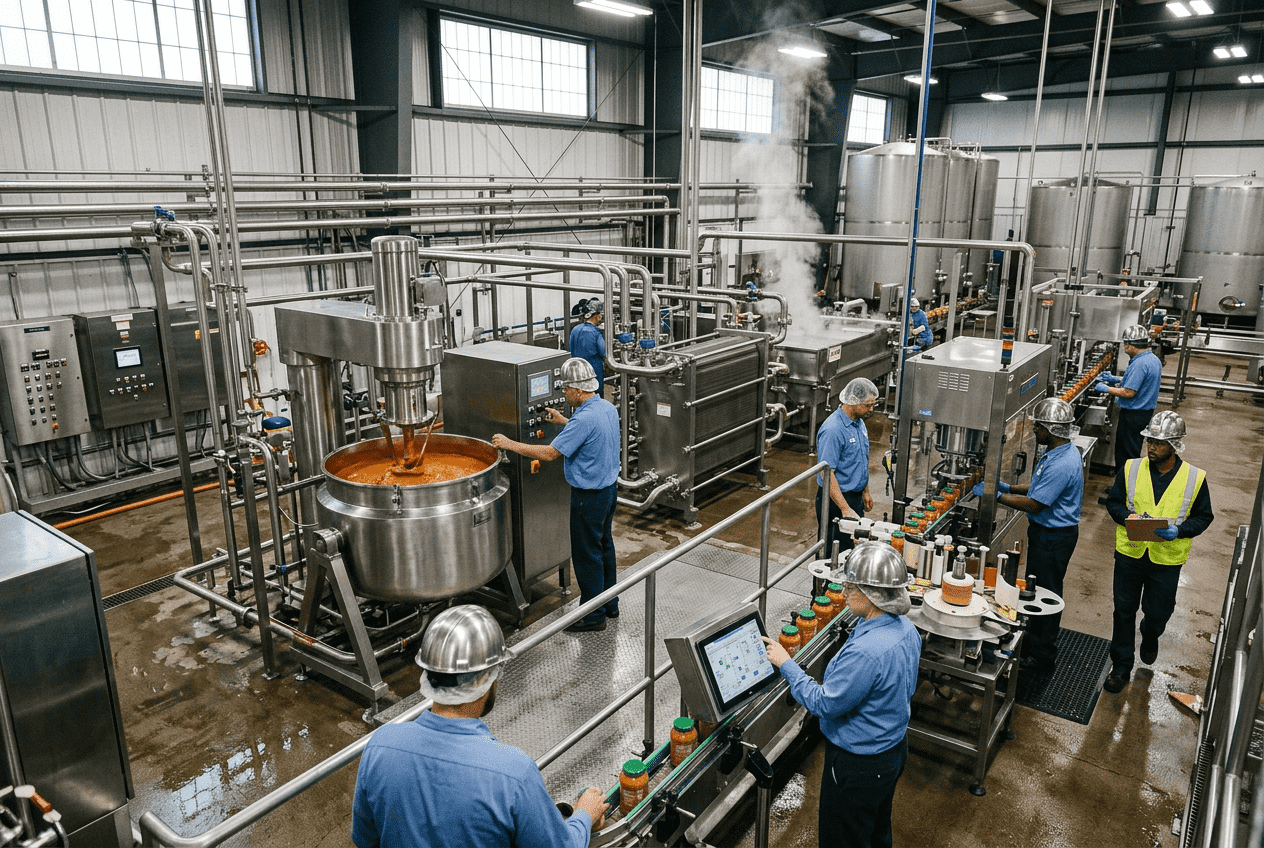
Food facility storage tank design in the United States is not just about holding product. It directly affects food safety, cleaning time, product shelf life, operator safety, utility consumption, and long term maintenance costs. Whether a plant is receiving milk in Wisconsin, blending sauces in Illinois, storing juice in California, fermenting beverages in North Carolina, or staging ingredients near the ports of Houston, Savannah, Newark, or Los Angeles and Long Beach, the same design principles matter: choose the right alloy, build for sanitary access, validate cleanability, size agitation correctly, confirm pressure and temperature limits, and align the vessel with FDA, USDA, 3-A, and ASME expectations where applicable.
In the United States market, buyers are also balancing labor shortages, tighter audit expectations, sustainability goals, and future automation plans. As a result, modern food storage tank selection increasingly includes not only shell thickness and nozzle count, but also CIP coverage validation, digital instrumentation, recipe flexibility, and integration with upstream and downstream systems. For processors that expect to scale in regions such as Dallas, Atlanta, Chicago, Fresno, Seattle, Charlotte, and Minneapolis, a well designed tank platform can reduce total cost of ownership far more than a low first-cost vessel that creates sanitation or process bottlenecks later.
The Short Answer

The best food facility storage tank design standard for most United States applications is a sanitary stainless steel vessel engineered around the product, cleaning method, pressure and temperature needs, and regulatory environment of the plant. In practical terms, that usually means a 304 stainless tank for standard non-corrosive food products, a 316L stainless tank for acidic, salty, aggressive, or higher purity applications, interior finishes in the sanitary range with polished welds, full drainability, properly placed CIP spray devices, hygienic nozzles and manways, and documented fabrication quality. If the vessel will run under pressure, vacuum, or jacketed heat transfer conditions, it should be engineered to the relevant ASME code section and stamped when required by jurisdiction or customer specification.
For buyers, the biggest mistake is choosing a tank by capacity alone. A 5,000 gallon tank for dairy, brine, syrup, aseptic ingredients, or protein marinades may need completely different metallurgy, finish, slope, cleaning energy, agitation style, and controls. Tank design should follow the product path, not the catalog page.
Across the United States, market demand is rising for tanks that support higher sanitation assurance, faster product changeovers, automation visibility, and lower water and chemical use. The chart below shows a realistic market growth trend for sanitary food and beverage tank projects tied to reshoring, capacity expansion, and co-packing growth.
That growth is especially strong in beverage hubs, dairy regions, protein processing corridors, and co-manufacturing markets where flexible production has become a competitive advantage. Plants near major logistics routes often prioritize standardized tank skids and modular utility tie-ins to accelerate installation and qualification.
Choosing Between 304 and 316L Tank Materials

Material selection is the foundation of food tank performance. In the United States, 304 stainless steel remains the most common choice for storage of water, many beverages, dry ingredient slurries, oils, and general food products that are not highly corrosive. It offers a strong balance of cost, corrosion resistance, weldability, and availability. For many processors, it is the right baseline material.
316L stainless steel becomes the better option when chloride exposure, acidic formulas, aggressive sanitation chemistry, salt heavy products, flavor concentrates, brines, cultured products, or high purity process streams increase corrosion risk. The lower carbon content of 316L also supports weld integrity and corrosion performance in sanitary fabrication. If a processor is handling tomato based products, saline marinades, citrus blends, or certain dairy ingredients cleaned with more aggressive CIP chemistry, 316L can reduce the long term risk of pitting, tea staining, and premature replacement.
There is no universal rule that 316L is always required for better quality. Often, a mixed strategy is most cost effective, such as 316L on product-contact wetted surfaces and 304 on structural supports, jackets, ladders, or non-contact externals where appropriate. The correct answer depends on product chemistry, cleaning chemistry, temperature, dwell time, and the expected service life.
| Selection Factor | 304 Stainless | 316L Stainless | Typical U.S. Use Case | Risk if Underspecified | Cost Impact |
|---|---|---|---|---|---|
| General corrosion resistance | Good | Very good | Water, standard beverage bases, general food storage | Surface staining over time | Lower |
| Chloride resistance | Moderate | Higher | Brines, salty marinades, some dairy applications | Pitting and weld attack | Moderate increase |
| Acidic product suitability | Moderate | Better | Juices, sauces, fermented ingredients | Reduced tank life | Moderate increase |
| CIP chemical tolerance | Good for standard regimes | Better for harsher or more frequent cycles | High-turn plants with intensive cleaning | Faster corrosion at weld zones | Moderate increase |
| Welded sanitary fabrication | Very good | Very good | Most sanitary vessel builds | Not material related if welding quality is poor | Similar labor, higher material |
| Lifecycle value | Strong for standard duty | Strong for aggressive duty | Plants seeking longer corrosion margin | Higher maintenance and repairs | Depends on service life |
The table shows why alloy choice should follow application, not habit. In many Midwest and Southeast plants, 304 is still fully appropriate. In coastal settings, export ingredient operations, or facilities handling saline and acidic products, 316L often pays for itself in avoided maintenance. Buyers should also ask for weld passivation practices, documentation of material traceability, and whether elastomers, gaskets, valve internals, and instruments match the chemistry of the process.
For manufacturers evaluating larger capital programs, a partner with process engineering and fabrication insight can compare vessel metallurgy against full line conditions rather than tank-only assumptions. That matters when a tank is only one part of a broader blending, thermal processing, or CIP loop.
Sanitary Design and Surface Finish

A sanitary tank is not defined by stainless steel alone. Hygienic design depends on geometry, weld quality, drainage, internal finish, dead-leg control, gasket selection, access points, and cleanability under actual operating conditions. In food and beverage facilities across the United States, poor sanitary design often reveals itself as recurring swab failures, biofilm risk, flavor carryover, allergen concerns, excessive hand cleaning, or long CIP cycles that reduce production uptime.
Good sanitary design starts with smooth product-contact surfaces and polished, ground, and blended welds where required by the process and customer specification. Interior finish expectations vary by product category, but many food applications target sanitary finishes in a range appropriate for product release and cleaning. The chosen finish should align with viscosity, fouling tendency, microbiological sensitivity, and regulatory expectations. For high-care or aseptic adjacent systems, tighter finish control becomes more important.
Equally important is complete drainability. Tanks should be designed so product and cleaning solutions do not pool at the bottom head, nozzle stubs, agitator seals, or branch connections. Sloped bottoms, flush-mounted fittings where justified, properly oriented outlets, and minimized dead spaces all contribute to consistent sanitation performance.
| Sanitary Feature | Recommended Practice | Why It Matters | Common Failure Mode | Best Fit Products | Operational Benefit |
|---|---|---|---|---|---|
| Interior surface finish | Specified hygienic Ra suitable for product | Improves cleanability | Residue adhesion | Dairy, beverages, sauces | Shorter CIP cycles |
| Weld finishing | Ground and blended sanitary welds | Eliminates crevices | Biofilm growth at welds | All sanitary processes | Audit confidence |
| Dead-leg control | Minimize branch length and stagnant zones | Prevents trapped product | Microbial harborage | Liquid foods and ingredients | Better swab results |
| Drainability | Sloped or fully drainable bottom design | Supports complete rinse-out | Chemical or product pooling | High-changeover lines | Reduced waste |
| Gasket selection | Food-grade elastomers matched to chemistry | Maintains seal integrity | Swelling, cracking, leaching | Hot fill, CIP, acidic products | Longer service intervals |
| Access design | Sanitary manways and fittings | Allows inspection and maintenance | Difficult manual verification | Large storage and mix tanks | Safer entry planning |
The table highlights that sanitary performance is the result of several design decisions working together. For example, a polished shell with poor outlet geometry can still trap product. Likewise, a beautifully fabricated vessel can become a sanitation problem if level sensors, sample valves, or instrument tees create stagnant pockets. This is why tank reviews should include the entire nozzle map and cleaning sequence.
United States processors operating under SQF, BRCGS, FDA preventive controls, or USDA oversight increasingly document hygienic design decisions in capital justifications. This is especially common in dairy plants in the upper Midwest, protein facilities in Arkansas and Georgia, and beverage co-packers in California and Texas where product variety is high and downtime is costly.
CIP Spray Ball and Cleaning Systems
Clean-in-place design can make or break tank performance. A tank that is difficult to clean will consume more labor, more water, more chemicals, more steam, and more production time. In modern U.S. food plants, CIP design is expected to be engineered rather than improvised. That means calculating flow, impact, coverage, chemical concentration, return rates, and cleaning sequence based on soil load and vessel geometry.
Static spray balls are common in relatively easy-to-clean tanks with lower soil loads and appropriate wetting requirements. Rotary spray heads or other dynamic cleaning devices are often preferred when soils are stubborn, viscosities are higher, tank diameters are larger, or cycle times must be reduced. The right choice depends on the product, fouling mechanism, target cycle length, and utility capacity. A larger tank does not automatically require a more aggressive device, but it often benefits from better validated spray coverage.
Location is critical. Spray devices should be positioned to reach shadowed areas under agitators, around baffles, and near upper shell transitions. Return outlet sizing, venting, and the relationship between fill level and cleaning regime also matter. In many retrofit projects, tanks underperform during CIP not because the vessel is fundamentally wrong, but because spray device selection and piping hydraulics were never engineered together.
| Cleaning System Element | Option | Best Use | Advantage | Limitation | Buyer Note |
|---|---|---|---|---|---|
| Spray device type | Static spray ball | Low to moderate soil tanks | Simple and economical | Lower impact cleaning | Validate coverage |
| Spray device type | Rotary spray head | Viscous or fouling products | Improved mechanical action | Higher cost | Useful for cycle reduction |
| CIP flow design | Fixed flow recipe | Stable production environments | Easy standardization | Less flexible | Good for single-product plants |
| CIP flow design | Recipe-based automated CIP | Multi-product operations | Consistent cleaning control | More controls complexity | Best for changeovers |
| Verification method | Riboflavin or coverage testing | Commissioning and validation | Confirms spray reach | Requires planning | Strong audit support |
| Utility integration | Central or skid CIP system | Small to large plants | Scalable infrastructure | Depends on layout | Evaluate expansion plans |
The chart below compares demand by major industry segment in the United States for sanitary tanks with integrated CIP expectations. Beverage and dairy continue to lead, but sauces, ingredients, and protein liquids are growing quickly.
Processors that need faster turnarounds often pair well-designed tanks with centralized CIP systems, conductivity monitoring, automated valve matrices, and SCADA visibility. This is one area where engineering, automation, and field installation quality must work as one system rather than separate scopes.
Agitation and Mixing Configurations
Agitation should match the process objective. Storage is not always passive. Some products require suspension of particulates, temperature uniformity, foam control, blending of ingredients, gentle recirculation, or shear-sensitive handling. An oversized or poorly selected mixer can damage product, entrain air, increase energy use, and complicate cleaning. An undersized mixer can leave ingredients stratified, cause solids settlement, and create inconsistent batches.
Top-entry agitators are common for blending and general liquid mixing. Side-entry mixers may work well in larger tanks where circulation patterns support the process. Sweep agitation can help with more viscous products. High-shear mixers are selected when emulsification or rapid powder incorporation is required, though they are not appropriate for every storage duty. Some tanks do not need built-in agitation at all and are better served by external recirculation loops if hygiene and process needs allow.
When evaluating agitation, buyers should confirm viscosity range, batch size variability, solids content, desired turnover time, and whether the tank will perform more than one function. A storage-only vessel is different from a mix tank, blend tank, fermentation vessel, or hold tank feeding a filler.
| Configuration | Typical Duty | Best For | Key Benefit | Main Watchout | Cleaning Impact |
|---|---|---|---|---|---|
| Top-entry propeller | General circulation | Low viscosity liquids | Simple and versatile | May entrain air | Moderate |
| Top-entry pitched blade | Blend and suspension | Ingredients with light solids | Good axial flow | Needs proper baffle strategy | Moderate |
| Side-entry mixer | Bulk circulation | Large storage vessels | Lower profile installation | Seal and cleanability review | Moderate |
| Sweep agitator | Wall wiping and movement | Viscous sauces and dressings | Improves heat transfer and release | Higher mechanical complexity | Higher cleaning attention |
| High-shear mixer | Emulsification or dispersion | Dressings, dairy, ingredient systems | Rapid incorporation | Not ideal for fragile products | Higher validation needs |
| External recirculation loop | Indirect agitation | Flexible multi-use systems | Can reduce internal hardware | Pump shear and piping dead legs | Depends on loop design |
The table shows that mixer selection is a process decision, not just a mechanical accessory choice. It should account for future SKUs, not only current formulas. This is increasingly important in U.S. co-packing and contract manufacturing environments where a tank may handle several product families over its life.
The chart below illustrates a realistic trend shift in tank specification priorities from 2022 through 2026. Sanitary cleanability and automation integration are gaining share relative to simple capacity-driven purchasing.
Pressure and Temperature Ratings
Many food tanks are atmospheric, but many are not truly low-risk. Vacuum events during cooling, pump-out, or CIP can collapse a vessel that was never engineered for negative pressure. Likewise, a process that occasionally sees pressure spikes, carbonation, nitrogen blanketing, thermal expansion, or jacket heating may require more robust design than operators assume.
United States buyers should clearly define both normal and upset conditions. The design basis should include product temperature, ambient temperature, CIP temperature, sterilization exposure where relevant, pressure and vacuum scenarios, jacket media, insulation loads, seismic or wind considerations where applicable, and transport or rigging requirements for delivery. Plants in California, the Pacific Northwest, and some Gulf Coast regions often have added structural or code considerations depending on local jurisdiction and installation environment.
| Tank Service Type | Typical Pressure Condition | Typical Temperature Range | Common U.S. Application | Design Concern | Code Review Need |
|---|---|---|---|---|---|
| Atmospheric storage | 0 psig nominal | Ambient to warm | Ingredient and water storage | Vacuum during CIP or drain-out | Basic engineering review |
| Ventable sanitary hold | Low pressure fluctuations | Cold to moderate | Dairy and beverage hold tanks | Vent sizing and contamination control | Moderate review |
| Jacketed process tank | Shell may be atmospheric, jacket pressurized | Hot or chilled | Sauce, dairy, batching | Heat transfer and jacket integrity | Strong code review |
| Pressure rated sanitary vessel | Positive pressure | Varies by process | Carbonation, filtered transfer, specialty ingredients | Nozzle reinforcement and ASME requirements | High |
| Vacuum capable vessel | Negative pressure possible | Cold rinse to hot CIP | CIP-intensive operations | Shell collapse risk | High |
| Aseptic support or thermal duty | Controlled pressure profile | Elevated or sterilization linked | High care ingredients | Validation and material compatibility | Very high |
This table shows why pressure and temperature ratings must be discussed early. A tank that appears simple on the process flow diagram can become a code-driven asset once heat transfer, vacuum events, or pressure retaining components are included. Oversights here often lead to costly redesign after fabrication drawings are already underway.
As 2026 approaches, sustainability and utility efficiency are shaping vessel design too. Better insulation strategies, lower water CIP recipes, heat recovery integration, smart valve feedback, and digital monitoring of cleaning performance are becoming standard in larger projects. Federal and state level focus on water use, wastewater loading, and energy intensity is pushing facilities to engineer tanks as part of a more efficient utility ecosystem rather than as isolated steel assets.
Inlet, Outlet, and Manway Design
Nozzle and access design has a major impact on sanitation, process reliability, and operator ergonomics. Inlets should promote desired flow patterns and avoid unnecessary splashing or foam. Outlets should fully drain, match pump suction needs, and avoid dead pockets. Instrument connections should be located for accurate readings while preserving cleanability. Manways should support safe access, inspection, and maintenance without compromising hygienic performance.
For example, a center-bottom outlet may be best for complete drainage in one application, while an offset or flush style outlet may suit another depending on support structure and piping layout. Top inlets used for powder induction or liquid additions may require splash control, vortex management, and vent filtration. Level instruments should be selected based on foam, viscosity, buildup tendencies, and the need for washdown durability.
Many tank problems originate at fittings. Oversized branch lengths, poor valve orientation, inaccessible sample points, and crowded nozzle clusters can all make a sanitary tank harder to clean and harder to maintain. Good design means every fitting has a process reason and a cleaning path.
| Design Element | Preferred Practice | Reason | Typical Mistake | Impact on Operations | Buyer Question |
|---|---|---|---|---|---|
| Product inlet | Position for controlled fill pattern | Reduces foam and splashing | Random top entry placement | Air pickup or poor mixing | How does fill affect product quality? |
| Bottom outlet | Fully drainable orientation | Improves yield and CIP | Residual pooling | Product loss and sanitation risk | Is the tank truly drainable? |
| Vent connection | Properly sized and protected | Prevents vacuum and contamination | Undersized venting | Tank damage or ingress risk | What are the worst-case vent loads? |
| Instrument ports | Minimal dead-leg hygienic fittings | Reliable measurement and cleaning | Long branch tees | Swab failures and bad readings | Are all ports sanitary by design? |
| Sample valve | Accessible and cleanable placement | Supports quality checks | Hidden or hard-to-clean location | Unsafe sampling or contamination | Can operators sample safely? |
| Manway | Sanitary, secure, and serviceable access | Inspection and maintenance | Poor seal or awkward placement | Leaks and ergonomic issues | Is entry and seal replacement practical? |
These details are especially important for multi-product sites and high audit environments. The most effective tank layouts are usually developed with input from sanitation, production, maintenance, quality, and controls teams rather than procurement alone.
Regulatory and ASME Compliance
Food tank compliance in the United States is a layered topic. Depending on product, customer requirements, and installation conditions, a tank may need to align with FDA expectations for food-contact materials, USDA sanitation expectations in meat or poultry environments, state or local pressure vessel rules, 3-A sanitary principles, and ASME code requirements for pressure retaining components. Not every tank needs the same documentation, but every tank should have a clearly defined compliance basis.
For sanitary food facilities, documentation often includes material certificates, weld maps, surface finish verification when specified, passivation records, pressure testing where applicable, and operating manuals. If the vessel falls under ASME pressure vessel code, stamp requirements and jurisdictional review become critical. Buyers should never assume a vendor’s use of “sanitary” or “food grade” automatically means the tank meets all applicable code or audit expectations.
The chart below compares how buyers in the United States often rate supplier categories when choosing sanitary tanks. Engineering depth and compliance support increasingly matter as much as price.
As policy and customer expectations evolve into 2026, traceability, water reduction, energy efficiency, hygienic validation, and automation data integrity are becoming stronger parts of purchasing specifications. Many national brands and sophisticated co-packers now expect equipment partners to support not just fabrication, but also quality documentation and system-level startup planning.
When sourcing tanks, it is wise to compare regional suppliers, national integrators, and project-led engineering partners. Fabricators around Milwaukee, Chicago, the Carolinas, California’s Central Valley, and Texas each bring different strengths. Local sourcing may shorten freight or service response, while broader engineering partners may better support multi-state rollouts and integrated utility packages. The right choice depends on whether the plant needs a stand-alone vessel or a coordinated process system.
About Our Company
Disruptive Process Solutions supports food and beverage manufacturers across the United States and Canada with an approach built around profitable project execution rather than equipment-only selling. For clients evaluating storage tanks and process vessels, that matters because the vessel is rarely the whole answer. Tank sizing, material choice, nozzle layout, utilities, controls, CIP, structural supports, and installation sequencing all affect whether the final system performs as intended.
From a technological capability standpoint, DPS works across process, mechanical, electrical, plumbing, structural, and controls disciplines. That means a storage tank review can extend into automation logic, PLC programming, SCADA visibility, batch control, utility balancing, and line integration when needed. For beverage, dairy, sauces, proteins, aseptic support, fermentation, thermal processing, and water treatment applications, this broad engineering perspective helps clients avoid buying tanks that look correct on paper but create bottlenecks in the field. More about the company’s background and operating philosophy is available at DPS company overview.
From a manufacturing capability standpoint, DPS also develops branded process equipment including storage and processing tanks up to 12,000 gallons, custom CIP systems, and other specialized food and beverage equipment. That gives clients access to practical fabrication insight while still keeping the focus on the total process. For companies comparing vessel options, the equipment portfolio can be explored through sanitary process equipment solutions. This manufacturing experience is especially useful where standard catalog tanks do not fit a specific product behavior, footprint, or utility constraint.
From a service capability standpoint, DPS operates through a design-build-manage model that combines engineering, capital planning, owner’s representation, project management, general contracting where licensed, installation coordination, and system integration. For clients in growth markets such as Texas, North Carolina, California, or the Midwest, that end-to-end support can reduce handoff risk between designer, fabricator, and installer. Process and project support details are available at food and beverage engineering services, and examples of field execution can be seen in project case studies.
For buyers, the practical takeaway is simple: choose a partner that can understand the process, the compliance environment, the installation reality, and the commercial goals of the plant. That is often more valuable than selecting the cheapest vessel quote in isolation.
FAQ
What is the most common stainless steel for food storage tanks in the United States?
304 stainless steel is the most common baseline choice because it balances cost, corrosion resistance, and availability. However, 316L is often preferred for more corrosive, acidic, salty, or high-purity applications.
When should I choose 316L instead of 304?
Choose 316L when the product or cleaning chemistry raises the risk of corrosion, especially with chlorides, acids, or frequent aggressive CIP cycles. It is also a common choice where long service life and lower corrosion risk justify the higher material cost.
Do all food tanks need ASME certification?
No. Many tanks are atmospheric and do not require ASME pressure vessel stamping. But if the tank will operate under pressure, vacuum, or includes pressure-retaining jackets or other code-relevant features, ASME review may be necessary depending on design and jurisdiction.
Are static spray balls enough for sanitary cleaning?
Sometimes yes, especially for easier-to-clean products and smaller tanks. But higher soil loads, larger diameters, short cycle targets, and viscous products often justify rotary cleaning devices or more advanced CIP design.
What surface finish is considered sanitary?
There is no one universal finish for every food product. The correct sanitary finish depends on the product, fouling tendency, cleaning method, and customer or audit requirements. Buyers should specify the required interior finish and weld treatment rather than leaving it undefined.
Should every tank have an agitator?
No. Some tanks only need storage. Others need blending, suspension, temperature uniformity, or powder incorporation. The agitation method should be selected from process data, not assumptions.
What are the biggest buying mistakes?
The biggest mistakes are buying on gallon capacity alone, overlooking CIP coverage, ignoring vacuum conditions, underestimating corrosion risk, and failing to review nozzle layout and future product flexibility.
How should I compare tank suppliers in the United States?
Compare them on engineering depth, sanitary fabrication quality, compliance documentation, responsiveness during startup, installation coordination, and long-term serviceability, not just initial price and quoted lead time.
What trends will shape tank design in 2026?
Expect stronger emphasis on water-efficient CIP, energy recovery, digital cleaning verification, automation integration, hygienic validation, sustainability reporting, and more resilient domestic supply chains.
What industries rely most on sanitary storage tanks?
Beverage, dairy, sauces, dressings, ingredient processing, protein liquids, fermentation, functional beverages, and aseptic support systems are all major users in the United States.
In summary, food facility storage tank design standards in the United States are moving toward more integrated, data-driven, and sanitation-focused solutions. The best tanks are not merely stainless containers; they are engineered assets designed for product quality, reliable cleaning, utility efficiency, audit readiness, and future plant growth. Whether the application is dairy in Wisconsin, beverage co-packing in North Carolina, protein processing in Texas, or ingredient storage near major coastal trade gateways, the right tank design starts with the process and ends with lifecycle performance.
[/trp_language]
Complete Company Portfolio
About the Author: Disruptive Process Solutions (DPS)
The DPS team combines process engineering expertise with real-world food and beverage manufacturing experience. Our content focuses on process optimization, production efficiency, facility improvements, and practical solutions that help manufacturers operate more effectively in a rapidly evolving industry.
Share