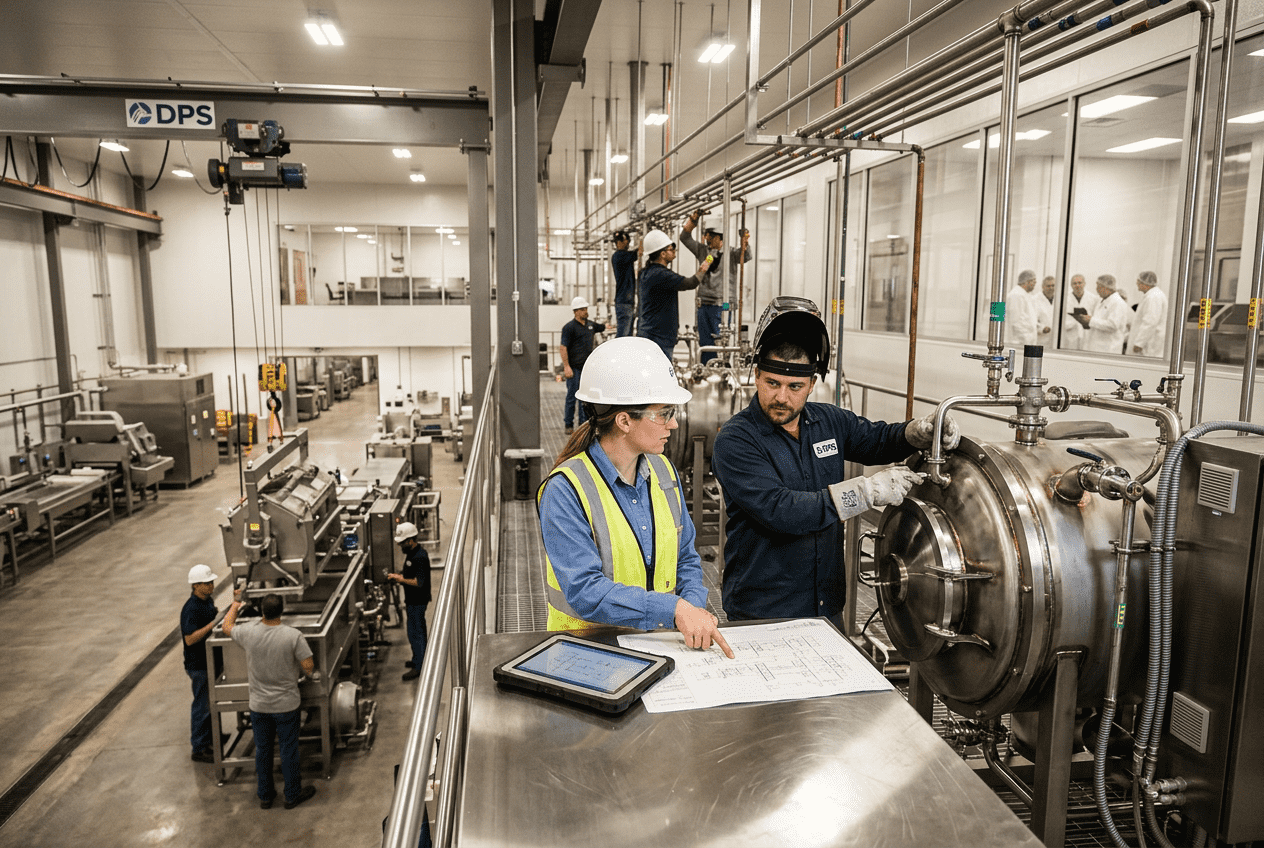
Food Facility Utility System Design: 5 Critical Steps to Integrated Infrastructure
[trp_language language=”en_US”]
Utility system design determines whether a food or beverage plant can scale profitably, pass audits, protect product quality, and avoid costly downtime. In the United States, the most successful facility plans treat process water, steam, refrigeration, compressed air, and electrical power as one integrated infrastructure platform rather than as separate trades. For processors expanding in major manufacturing corridors such as Texas, the Midwest, the Carolinas, California, and the Southeast, the right utility plan should align production demand, sanitation needs, food safety, local code requirements, energy efficiency, and future capacity from day one.
That is especially important in U.S. food manufacturing, where facilities often operate under tight labor conditions, volatile utility pricing, and demanding retailer or co-packer service levels. A dairy site in Wisconsin, a beverage line near Atlanta, a protein operation in Arkansas, and a sauce plant near Chicago may produce very different products, yet they face similar infrastructure questions: how much process water is needed at peak washdown, what steam pressure should be delivered to users, how should glycol or ammonia loops be laid out, how clean must compressed air be at point of use, and what level of standby power is financially justified. Good utility planning answers those questions before equipment is purchased and before the building layout locks in expensive constraints.
Quick Answer

The short answer is this: utility system planning for a U.S. food facility should begin with a full production and sanitation load model, then move through water distribution design, steam generation and condensate recovery, refrigeration network architecture, compressed air layout, electrical reliability, and finally integrated redundancy. Plants that plan utilities early typically gain better uptime, lower lifecycle cost, cleaner installations, and easier future expansion.
Five principles drive better outcomes:
- Size for real operating peaks, not only nameplate equipment load.
- Separate hygienic, process, and non-process utility demands where practical.
- Design utility corridors and tie-in points for phased expansion.
- Use controls and metering to make consumption visible by area and process.
- Build redundancy based on business risk, not guesswork.
For many owners, the challenge is not identifying the utility categories; it is integrating them into a business case. A new ready-to-drink plant shipping through the ports of Los Angeles and Long Beach may need rapid launch and flexible future packaging formats. A protein processor serving the Dallas, Kansas City, and Memphis distribution triangle may prioritize washdown resilience and refrigeration uptime. A brewery in North Carolina or a dairy processor in Idaho may focus heavily on water recovery and thermal efficiency. In each case, utility planning should be tied directly to profitability, throughput, and compliance.
5 Critical Steps to Utility System Planning

Integrated utility planning usually follows five critical steps. First, define production reality. That means understanding actual run rates, shift patterns, changeovers, CIP cycles, sanitation windows, utility diversity factors, and seasonal demand swings. A plant that runs one aseptic line 20 hours per day behaves very differently from a frozen prepared foods site operating three shifts with heavy defrost loads.
Second, establish a utility basis of design. This document should capture process assumptions, design temperatures, pressures, flow rates, water quality targets, air quality classes, spare capacity, and code requirements. It becomes the reference point for engineering, procurement, installation, and commissioning.
Third, map utility generation and distribution together with building layout. This is where many projects win or lose. Utility rooms, mezzanines, roof space, pipe racks, trenching, electrical rooms, and service access need to support maintenance and expansion. In high-growth areas like Phoenix, Nashville, Charlotte, and Austin, where speed to market matters, layout mistakes can turn into major retrofit costs later.
Fourth, model lifecycle cost rather than first cost only. A lower-cost compressor package, undersized boiler plant, or poorly insulated glycol loop may look attractive during bid review but become expensive through energy waste, pressure instability, spoilage risk, or maintenance callouts.
Fifth, validate controls, redundancy, and startup strategy. Modern utility systems are not only mechanical assets; they are data-producing operating systems. Alarms, interlocks, SCADA visibility, automatic lead-lag control, energy dashboards, and startup sequencing all matter. Plants that ignore commissioning logic often discover utility problems only when production is already scheduled.
The table below shows how these five steps typically connect to outcomes in U.S. food and beverage projects.
| Planning Step | Primary Focus | Common U.S. Facility Example | Main Risk if Missed | Business Impact | Recommended Deliverable |
|---|---|---|---|---|---|
| 1. Load definition | Peak and diversified demand | Beverage blending and CIP overlap | Undersized utilities | Line stoppage | Utility load matrix |
| 2. Basis of design | Technical performance targets | Dairy hot water and chilled water specs | Scope ambiguity | Change orders | Approved design basis |
| 3. Layout integration | Routing and maintainability | Protein plant pipe bridge planning | Congestion and poor access | Retrofit cost | Utility routing model |
| 4. Lifecycle evaluation | Energy and maintenance economics | Boiler and compressor selection | High operating cost | Lower margin | Total cost model |
| 5. Controls and startup | Automation and reliability | Lead-lag pump and compressor sequencing | Unstable operation | Downtime during launch | Commissioning plan |
| 6. Expansion readiness | Future tie-ins and spare capacity | Co-packer phase 2 packaging line | Expensive rework | Delayed growth | Phased master plan |
This table shows why utility planning cannot be reduced to equipment sizing alone. It is a cross-functional exercise involving operations, maintenance, quality, finance, and engineering. In many U.S. projects, the most profitable decision is not the cheapest installed package but the one that best supports capacity growth, labor efficiency, and predictable operating cost.
The line chart reflects a realistic trend seen across the United States: more processors are upgrading utility systems to support automation, ESG goals, and production resilience. New investments around Houston, Indianapolis, Fresno, Greenville, and the I-85 corridor increasingly bundle process equipment with supporting utility modernization rather than treating utilities as a secondary scope.
Process Water Distribution Design

Process water is often the first utility discussed and the last one fully optimized. In food and beverage operations, water can serve as an ingredient, a cleaning medium, a heat transfer support utility, and a general plant service. The design challenge is not just delivering enough gallons per minute. It is delivering the right quality, pressure, temperature, and segregation for each use point.
A robust process water distribution design usually begins with source evaluation. Municipal water quality varies widely across the United States. Sites near Denver, Minneapolis, Sacramento, Newark, or Tampa may face different hardness, disinfectant, seasonal quality swings, and discharge limitations. That affects pretreatment, RO design, softening, storage, recirculation, and sanitation strategies. Beverage plants and dairy processors are especially sensitive to water chemistry because mineral balance and microbial control can directly affect product quality and shelf life.
Distribution design should account for at least six categories: ingredient water, utility water, hot water, tempered water, sanitation rinse water, and non-potable or reclaimed water where allowed. Loop velocity, dead-leg control, hygienic materials, pipe insulation, backflow prevention, and point-of-use monitoring all matter. Plants with frequent washdown must also consider simultaneous demand events, especially in protein, dairy, and prepared foods facilities.
| Water Use Category | Typical Quality Requirement | Design Concern | Common Equipment | Typical U.S. Application | Planning Note |
|---|---|---|---|---|---|
| Ingredient water | High purity or treated potable | Taste, minerals, microbes | RO, UV, storage tank | RTD beverages, brewing, dairy drinks | Test seasonal source variation |
| CIP supply water | Consistent pressure and temperature | Peak demand overlap | Hot water set, booster pumps | Sauce, dairy, aseptic lines | Model simultaneous circuits |
| Sanitation rinse water | Potable | Shift-end surge | Distribution headers, hose stations | Protein and prepared foods | Account for washdown duration |
| Boiler feed makeup | Low hardness and controlled TDS | Scale and corrosion | Softener, deaeration, chemical feed | Cooked foods, breweries | Link with steam strategy |
| Cooling tower makeup | Conditioned utility water | Cycles of concentration | Filtration, chemical treatment | Beverage and packaging plants | Track water-energy tradeoff |
| Reclaimed water | Application-specific | Code and cross-connection control | Recovery tank, filtration | Non-product uses in drought regions | Strongly review local regulations |
The table makes one point clear: water systems should be separated by function and risk. Not every water use deserves the same treatment train, and forcing all flows through the highest-cost purification route can be an expensive design mistake. In California, Arizona, and parts of Texas where water pressure, drought resilience, and discharge cost are major issues, smart segmentation can materially improve project economics.
Good design also includes storage and surge planning. If incoming municipal service is unstable, or if the site is near a logistics hub where production downtime creates major shipping penalties, buffer storage may be financially justified. Facilities serving major retailers through Chicago, Columbus, or Atlanta distribution networks often build in more operational resilience because missed appointments ripple quickly across the supply chain.
Steam System Infrastructure
Steam remains a core utility for cooking, sterilization, tank heating, hot water generation, humidity control, and CIP support. Yet steam systems are often under-engineered in early food plant concepts. A reliable steam infrastructure plan should cover boiler selection, feedwater treatment, deaeration, header pressure strategy, condensate return, blowdown management, and safe operator access.
The right steam architecture depends on process mix. A retort or aseptic operation may require tighter pressure stability than a simple washdown hot water system. A brewery with brewhouse loads may have a different steam profile than a prepared meals facility with kettles, ovens, and jacketed vessels. In colder climates such as Minnesota, Michigan, or upstate New York, winter startup and freeze protection can also influence design choices.
Key design questions include whether to use one central boiler plant or multiple distributed generators, what pressure to distribute in the main header, where to reduce pressure locally, how to insulate and trap lines, and how much condensate can realistically be returned. Every pound of returned hot condensate supports fuel savings, water savings, and chemical savings.
| Steam Design Element | What It Controls | Common Issue | Operational Effect | Recommended Practice | Expansion Consideration |
|---|---|---|---|---|---|
| Boiler sizing | Generation capacity | Sized to nameplate only | Pressure drop at peak | Use diversified load model | Reserve space for second unit |
| Feedwater treatment | Scale and corrosion risk | Inconsistent source water | Efficiency loss | Link chemistry to local water data | Allow future pretreatment upgrade |
| Deaeration | Oxygen removal | Skipped in smaller plants | Shorter boiler life | Evaluate lifecycle cost | Plan tie-in capacity |
| Header pressure | Distribution stability | Wrong pressure bands | Poor control at users | Model pressure drops by branch | Add capped branch outlets |
| Steam trapping | Condensate removal | Low trap maintenance | Water hammer and energy waste | Specify survey program | Standardize trap types |
| Condensate return | Heat and water recovery | Low recovery rate | Higher fuel cost | Maximize clean return paths | Separate contaminated streams |
This steam table highlights the importance of thinking beyond the boiler itself. In many U.S. food projects, inefficient condensate return and weak trapping practices cause more long-term cost than the boiler selection decision. Plants planning expansions around Kansas City, Milwaukee, or the Carolinas should also protect access for future steam users and allow room for additional feedwater and blowdown equipment.
For owners comparing vendors, buying advice is straightforward: request a steam balance, a condensate recovery estimate, a maintenance access plan, and startup sequencing details before approving procurement. Also verify which party owns combustion controls, safety interlocks, water treatment integration, and commissioning responsibility. Ambiguity in those interfaces creates avoidable launch risk.
Refrigeration Utility Networks
Refrigeration infrastructure is critical in dairy, beverage, protein, frozen food, and cold-chain packaging operations. Whether the plant uses ammonia, CO2, glycol, chilled water, or packaged DX systems, the network must be engineered around process temperature targets, defrost strategy, food safety, load diversity, and future capacity. Poor refrigeration design can damage yield, increase condensation risk, and trigger sanitation issues.
In the United States, regional climate strongly affects refrigeration planning. A cold storage or protein processing site in Omaha or Green Bay faces different ambient conditions than a beverage or prepared foods plant in Miami, San Antonio, or Southern California. Utility designers must consider heat load from people, packaging lines, infiltration, process equipment, doors, washdown, and rooftop exposure.
Food manufacturers often need a combination of low-temperature refrigeration for freezers, medium-temperature circuits for processing rooms, and higher-temperature glycol or chilled water loops for tanks, heat exchangers, and product cooling. Network architecture should minimize long unstable runs, support clean valve station access, and provide isolation capability for maintenance without shutting down the plant.
The bar chart shows the sectors with the strongest practical need for advanced refrigeration network planning. Frozen foods and proteins typically demand the most robust architecture because the cost of temperature deviation, floor condensation, or room imbalance can be immediate and severe.
| Refrigeration Network Type | Best Fit | Strength | Limitation | Typical U.S. Use | Planning Advice |
|---|---|---|---|---|---|
| Ammonia central system | Large industrial loads | Efficiency at scale | Higher safety management complexity | Protein, dairy, frozen plants | Plan operator training and PSM needs |
| Glycol loop | Process cooling distribution | Flexible secondary loop | Pumping energy | Breweries, beverage, dairy | Insulate aggressively and meter branches |
| Chilled water | Moderate process loads | Simple user integration | Temperature limits | Sauces, packaging support, comfort-process overlap | Separate HVAC and process where useful |
| CO2 system | Low-temp specialty applications | Compact and emerging sustainability appeal | Higher design specialization | Selective cold chain projects | Review local service support |
| DX packaged units | Small zones | Fast deployment | Fragmented maintenance | Smaller ancillary rooms | Avoid overusing in large plants |
| Hybrid system | Mixed process environments | Tailored performance | More controls coordination | Expansion or retrofit projects | Model controls integration early |
The table shows there is no single “best” refrigeration utility network. The best solution depends on facility scale, safety capability, maintenance resources, and product mix. For example, a West Coast beverage processor may favor a glycol-centered approach tied to tanks and packaging support, while a Southeastern poultry or beef operation may benefit from a larger centralized industrial refrigeration strategy.
Compressed Air System Layout
Compressed air is one of the most expensive utilities in food manufacturing when viewed on an energy-per-use basis, yet many facilities still treat it as a generic plant service. In reality, the layout must reflect pressure stability, air quality classification, moisture control, compressor staging, and point-of-use segregation. Product contact applications, valve actuation, packaging, instrumentation, and general plant air do not always need the same treatment level.
A strong compressed air design starts with end-use mapping. Instrument air for critical process control should not be compromised by leaks on general plant connections. Oil-free versus oil-flooded compressor selection should be based on risk, filtration strategy, and maintenance capability. Ring main distribution generally improves stability and future expansion flexibility, especially in plants expected to add fillers, cartoners, or robotic end-of-line systems.
Leak management deserves special attention. In many U.S. facilities, 15 to 30 percent of compressed air generation is effectively lost to leaks, inappropriate use, poor condensate management, or excessive system pressure. That waste becomes especially costly in high-power-cost regions or at facilities with long run hours. If a line is shipping at scale into major retail networks from New Jersey, Ohio, or Southern California, compressed air instability can also affect packaging integrity and OEE.
| Compressed Air Topic | Why It Matters | Typical Problem | Result in Production | Recommended Solution | Monitoring Metric |
|---|---|---|---|---|---|
| Compressor type | Air quality and efficiency | Wrong machine for process risk | Contamination or high cost | Match risk to end use | kW per 100 cfm |
| Drying | Moisture removal | Undersized dryer | Valve and tool failures | Size for summer peak | Dew point |
| Filtration | Particle and oil control | Single-stage filtration only | Product or instrument risk | Use staged filtration | Pressure drop |
| Distribution layout | Pressure stability | Dead-end branches | Low pressure at peak | Ring main with drops | Point-of-use pressure |
| Leak control | Energy waste reduction | No survey program | Higher operating cost | Quarterly leak audit | Leak rate percent |
| Storage and controls | Short-cycle prevention | Insufficient receiver volume | Compressor wear | Lead-lag logic with storage | Starts per hour |
This table reinforces the value of designing compressed air as a managed system, not just a compressor room. For buyers, good advice is to ask how the vendor will prove dew point, filtration performance, and pressure stability under real demand swings. Also ask whether the design includes metering by zone. Without measurement, air system waste tends to remain invisible.
Electrical Power and Backup Systems
Electrical infrastructure is the backbone that stabilizes every other utility. Boilers, pumps, chillers, compressors, RO systems, conveyors, fillers, packaging cells, and controls all depend on reliable power quality and resilient distribution. In many food plants, backup strategy should be driven by business continuity rather than by a broad assumption that “everything needs a generator.”
The best electrical plan starts with load classification. Separate life safety loads, critical control loads, cold-chain preservation loads, sanitation recovery loads, and non-critical comfort or office loads. This allows owners to make smarter decisions on generator size, UPS coverage, automatic transfer switching, and selective load shedding. A freezer plant in the Midwest, a dairy site in the Pacific Northwest, and an aseptic beverage plant in the Southeast may each justify different backup philosophies.
Utility coordination with the serving power company is also essential. Interconnection timelines, transformer lead times, and feeder upgrades can become critical path items in the United States. Rapid-growth industrial markets around Dallas-Fort Worth, Raleigh-Durham, Phoenix, and the Inland Empire have all seen situations where utility power availability influenced project schedule and phasing.
The area chart reflects a broader trend: processors are steadily moving toward smarter electrical distribution, integrated energy monitoring, and backup systems tied to production risk. By 2026, that trend is likely to accelerate further because of power reliability concerns, automation growth, and sustainability reporting expectations.
When evaluating power and backup solutions, buyers should consider not just generator capital cost but fuel supply security, transfer time, maintenance labor, testing protocols, and what production losses actually occur during an outage. In some cases, maintaining controls, refrigeration support, and sanitation recovery is enough. In others, especially high-throughput co-packing or cold-chain operations, broader backup coverage may be justified.
Utility Integration and Redundancy
Utility integration is where a facility stops being a collection of systems and becomes a coordinated manufacturing asset. Water, steam, refrigeration, air, and power interact constantly. Hot water generation may depend on steam availability. Refrigeration performance can be affected by water quality and power quality. Compressed air demand changes can impact electrical peak loads. Effective integration identifies those links and designs control logic, metering, operating procedures, and redundancy accordingly.
Redundancy should be based on consequence. If losing a utility for 20 minutes creates no major issue, full N+1 backup may not be justified. If losing a utility for five minutes causes product loss, environmental upset, or customer service failure, redundancy can be a high-return investment. The highest-performing U.S. plants often rank utility users by business impact and then assign resilience levels accordingly.
| Utility Area | Typical Redundancy Strategy | Best Use Case | Capital Impact | Risk Reduction | Example Decision Rule |
|---|---|---|---|---|---|
| Process water pumps | Duty/standby pumps | Continuous production sites | Low to moderate | High | Use standby where shutdown exceeds 30 minutes |
| Boiler plant | N+1 or rental connection | Steam-dependent cooking or aseptic | Moderate to high | High | Protect if outage causes product loss |
| Refrigeration compressors | Spare capacity margin | Cold-chain critical operations | High | Very high | Maintain room temps during single failure |
| Air compressors | Lead/lag with emergency spare | Packaging and automation heavy plants | Moderate | High | Hold pressure during one unit outage |
| Electrical distribution | Generator, UPS, sectionalizing | Critical controls and refrigeration | Moderate to high | Very high | Back up loads tied to product integrity |
| Controls and SCADA | Network and server redundancy | Highly automated facilities | Moderate | High | Prevent blind operation during faults |
The table shows that redundancy is not one-size-fits-all. A beverage site with high packaging throughput may prioritize air and electrical redundancy. A meat or frozen foods site may prioritize refrigeration resilience. A dairy or aseptic processor may emphasize steam, hot water, and control continuity. Good planning tailors the strategy to the specific operational risk profile.
The comparison chart shows a realistic pattern seen across many projects: integrated delivery models often score better on lifecycle utility performance because design assumptions, installation execution, controls integration, and commissioning responsibility are more tightly aligned. Low-bid fragmentation may reduce first cost but commonly introduces interface risk.
Case studies across the market support that conclusion. A beverage facility designed for rapid capacity growth may gain more value from preplanned tie-ins, central utility metering, and phased equipment pads than from aggressive initial under-sizing. A protein processor consolidating operations near major rail and truck lanes may benefit more from refrigeration and washdown resilience than from minimizing mechanical room area. In each case, integration improves business outcomes.
Our Company
Disruptive Process Solutions supports food and beverage manufacturers across the United States and Canada with a business-first engineering approach focused on profitable capital projects. Rather than treating utilities as isolated scopes, the company plans them as part of complete production systems that must launch reliably, scale intelligently, and support long-term margin.
From a technological capability standpoint, DPS brings multi-discipline engineering across process, mechanical, plumbing, electrical, structural, and controls. That matters because utility systems only perform well when process loads, automation logic, and physical routing are engineered together. The team supports PLC programming, SCADA visibility, system integration, and utility coordination for processing environments ranging from fermentation and distillation to aseptic lines, retort, dairy, protein, blending, cooking, and water treatment. Companies evaluating integrated project partners can review engineering and project services to see how design, build, and management are connected.
On the manufacturing capability side, DPS also designs and supplies proprietary process equipment that fits broader utility planning rather than fighting against it. That includes tanks, CIP systems, tumblers, and cooking vessels engineered to work within the intended steam, water, air, and controls philosophy of the plant. For owners that want fewer interface gaps between process equipment and infrastructure, that alignment can reduce startup friction. More detail on fabricated solutions is available through the company’s process equipment offering.
Service capability is where the model becomes especially relevant for utility projects. DPS operates through a design-build-manage approach that supports capital planning, feasibility, owner’s representation, project and program management, installation oversight, utility integration, and commissioning. This is useful for both greenfield plants and expansions where owners need one team to connect engineering intent with field execution. Manufacturers looking for background on the firm’s approach can visit the company overview, while those wanting proof of execution can review selected project case examples.
In practical terms, that service model fits the U.S. market because many utility projects fail at handoff points: the process designer assumes one demand profile, the mechanical contractor routes around another reality, and the controls scope arrives too late to stabilize operations. Integrated project leadership helps prevent those disconnects. For manufacturers in the Carolinas, Texas, California, the Midwest, or major logistics corridors feeding national distribution, that can be the difference between a utility system that merely turns on and one that supports profitable expansion.
Looking ahead to 2026, the direction of the U.S. market is clear. Food and beverage utility systems are moving toward higher electrification where practical, stronger water reuse strategies, more sophisticated energy metering, digital twins for capacity planning, predictive maintenance, tighter refrigerant and boiler compliance expectations, and resilience planning tied to weather and grid instability. Sustainability will remain important, but the strongest investments will be those that also improve throughput, audit readiness, and labor efficiency. Utility planning is no longer just an engineering exercise; it is a competitive operating strategy.
FAQ
What is the most common utility planning mistake in a food facility?
The most common mistake is sizing systems from equipment nameplates without modeling actual peak operations, CIP overlap, sanitation surges, and future expansion. That often leads to unstable performance even when installed horsepower appears sufficient.
How early should utility design start in a new plant project?
Utility planning should begin as soon as the production concept, product mix, and target throughput are understood. Waiting until equipment is purchased usually limits layout options and increases rework.
Which utility usually deserves the highest redundancy?
It depends on product and process risk. Refrigeration often ranks highest in protein, frozen, and dairy applications. Steam may be most critical in cooking or aseptic plants. Electrical backup becomes central where control continuity or cold-chain integrity drives business risk.
Should process water and plant utility water always be separated?
Not always, but they should be evaluated separately. Ingredient and hygienic applications often require tighter quality control than general utility uses. Segmentation can lower cost and improve control.
Is a centralized utility plant always better than distributed systems?
No. Centralized systems can improve efficiency and maintenance consistency at scale, but distributed systems can make sense for phased expansions, isolated loads, or retrofit conditions with tight space constraints.
How important is compressed air quality in food plants?
Very important. Air used near product, packaging, instrumentation, or sanitary actuators must meet the required quality standard for the application. Moisture, oil, and particles can create product and equipment risk.
What should buyers request from utility system vendors?
Ask for a basis of design, load assumptions, equipment duty points, control sequences, utility metering plan, redundancy philosophy, maintenance access layout, startup plan, and estimated lifecycle cost.
How do U.S. regional conditions affect utility design?
Climate, water quality, local utility rates, code enforcement, wastewater limits, and power availability all vary by region. A design that works in the Pacific Northwest may not be optimal in Southern California, Texas, or the Southeast.
What trends will matter most by 2026?
Expect more data-driven utility optimization, water recovery, smart energy controls, resilience planning, stricter sustainability reporting, and stronger integration between process automation and utility management.
When should a food company bring in an integrated engineering partner?
As early as possible, especially for greenfield facilities, major capacity expansions, high-speed beverage lines, protein refrigeration upgrades, or projects where utilities directly affect first-year profitability.
[/trp_language]
Complete Company Portfolio
About the Author: Disruptive Process Solutions (DPS)
The DPS team combines process engineering expertise with real-world food and beverage manufacturing experience. Our content focuses on process optimization, production efficiency, facility improvements, and practical solutions that help manufacturers operate more effectively in a rapidly evolving industry.
Share