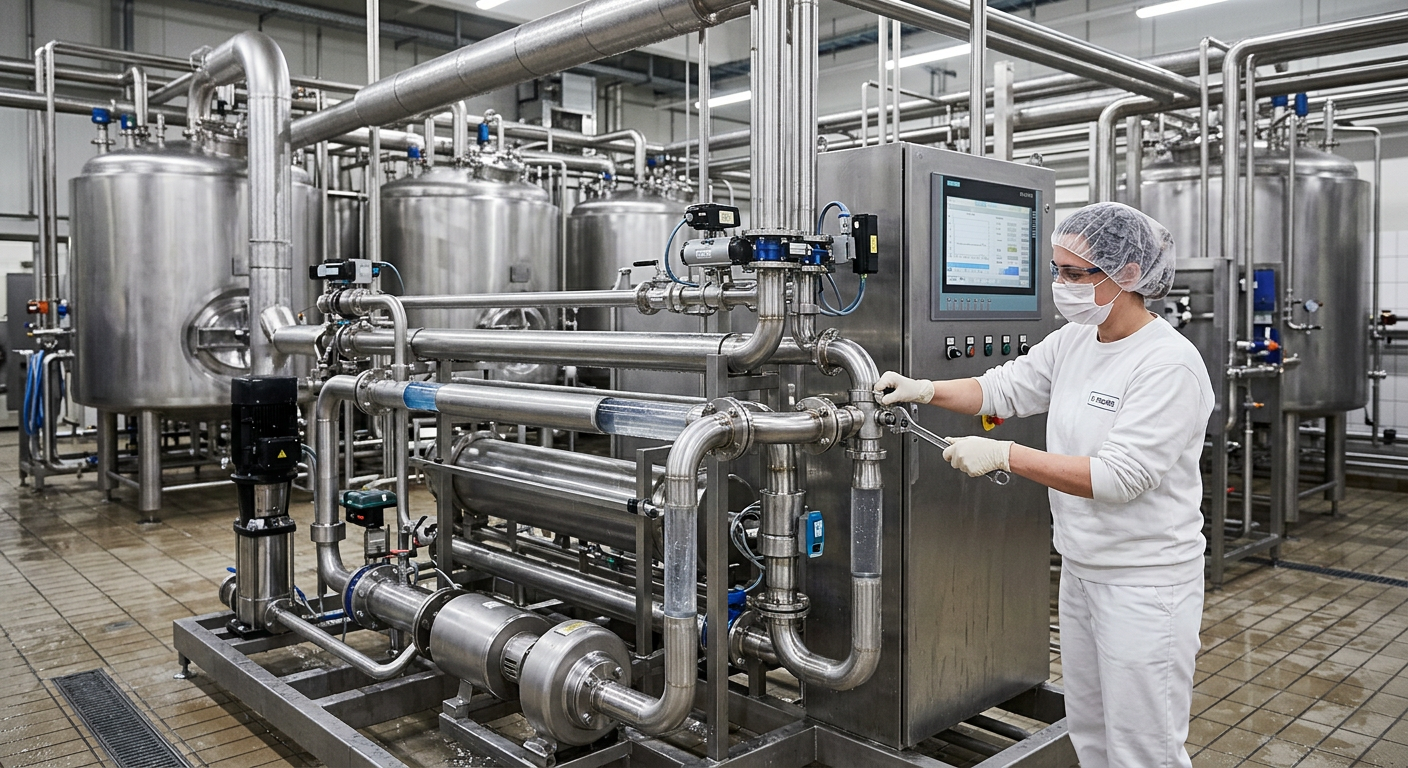
Food Facility Vision Inspection System Guide
[trp_language language=”en_US”]
Food Vision Inspection Systems in the United States
Food manufacturers in the United States are investing in vision inspection systems to improve product quality, reduce waste, support traceability, and protect brand reputation. From poultry plants in Arkansas to dairy processors in Wisconsin, bakery lines in Chicago, beverage fillers in North Carolina, and seafood facilities near Los Angeles and Seattle, machine vision is becoming a practical production tool rather than a luxury upgrade. A well-designed system can detect seal failures, color variation, fill-level issues, shape defects, label errors, contamination risks, and sorting differences at line speed. The best results come when cameras, lighting, software, reject devices, controls, sanitation design, and plant integration are engineered together.
For food and beverage companies planning capital improvements, the buying decision should go beyond camera resolution alone. The real value comes from how well the system fits the product, line speed, washdown requirements, automation architecture, and business goals. That is especially true in large U.S. production corridors such as the Midwest protein belt, the Southeast beverage market, the Texas manufacturing base, and logistics hubs connected to ports like Savannah, Houston, Long Beach, and Newark.
Quick Answer

A food facility vision inspection system is an automated quality control solution that uses cameras, optics, lighting, software, and reject mechanisms to inspect food products or packages in real time. In the United States, these systems are commonly used for defect detection, product grading, label verification, foreign material screening support, fill-level checks, orientation control, and automated sorting on high-speed production lines.
For most facilities, the best system is not the one with the most advanced camera on paper. It is the one that matches the product type, sanitation demands, conveyor design, environmental conditions, plant controls, and throughput targets. A poultry processor may prioritize bruise, bone, and trim detection. A bakery may focus on color consistency and topping distribution. A dairy or aseptic beverage line may need cap, code, and fill verification tied into line controls and traceability.
In practice, buyers in the United States should evaluate five things first: inspection objective, line speed, product variability, washdown environment, and integration scope. If those five are defined correctly, camera selection, lighting geometry, software rules, and reject timing become much easier to optimize.
| Decision Area | Why It Matters | Typical U.S. Use Case | Main Risk if Overlooked | Best Practice | Expected Impact |
|---|---|---|---|---|---|
| Inspection goal | Defines camera and algorithm needs | Seal check on ready meal trays | Wrong system architecture | Set pass/fail criteria early | Higher detection accuracy |
| Line speed | Drives exposure, frame rate, and reject timing | High-speed beverage filling | Blurred images and mistimed rejects | Test at peak throughput | Stable performance at capacity |
| Product variation | Affects false reject rate | Natural variation in produce or proteins | Waste and operator mistrust | Use sample sets from real production | Better rule tuning |
| Environment | Changes housing, lens, and lighting requirements | Washdown poultry room | Hardware failure and sanitation issues | Specify IP-rated hygienic components | Longer service life |
| Integration level | Connects inspection with line controls | Reject, alarm, and data logging | Manual workarounds | Integrate PLC and HMI from day one | Faster response and reporting |
| ROI model | Justifies capital spend | Labor reduction and less giveaway | Weak approval case | Quantify waste, rework, downtime | Stronger capital planning |
The table above shows why machine vision projects succeed when technical requirements are tied to operational outcomes. Facilities that define the business case first usually get faster adoption and better long-term value.
Vision System Components and Cameras

A food vision inspection system includes more than a camera. Core components usually include industrial cameras, lenses, lighting, mounting structures, hygienic housings, triggering devices, conveyors or encoders, image processors, operator interfaces, reject devices, and communication links to PLC or SCADA systems. In some facilities, multiple cameras are installed for top, bottom, side, and angled views. In others, a compact smart camera handles a single task such as label presence or date code verification.
Camera selection depends on the inspection challenge. Area scan cameras are common for single-image inspections such as package top views. Line scan cameras are often preferred for continuous webs, long products, or detailed surface inspection. Color cameras help when product appearance matters, such as crust tone, doneness, fruit ripeness, or garnish placement. Monochrome cameras often perform better where contrast is the main objective. Near-infrared or multispectral setups may be considered for advanced applications involving moisture differences, organic residues, or difficult contrast conditions.
In U.S. food plants, ruggedization matters as much as imaging performance. A snack line in Phoenix may deal with dust and heat, while a meat room in Omaha or Kansas City may require frequent washdown, corrosion resistance, and sealed connectors. Facilities near humid Gulf Coast environments, such as Houston or New Orleans, may also need extra attention to condensation control.
On the technology side, effective solutions often pair cameras with strong automation infrastructure. Companies looking for turnkey support frequently prefer engineering partners that understand controls, utilities, and line execution rather than vision hardware alone. That is one reason many manufacturers review broader process integration resources such as food and beverage engineering services before finalizing an inspection project.
| Component | Function | Best Fit Application | U.S. Plant Example | Selection Priority | Common Mistake |
|---|---|---|---|---|---|
| Area scan camera | Captures full frame image | Tray, pouch, label inspection | Prepared meals in Ohio | Resolution and shutter speed | Undersizing field of view |
| Line scan camera | Builds image line by line | Webs, long products, surface checks | Tortilla line in Texas | Encoder sync | Poor conveyor speed matching |
| Color camera | Measures visible color variation | Baked goods, produce | Bakery in Illinois | Stable lighting | Ignoring color drift |
| Monochrome camera | Detects contrast and edges | Cap presence, shape checks | Dairy line in Wisconsin | Sharp optics | Using color when unnecessary |
| Lens and optics | Sets magnification and image clarity | All applications | Protein line in Nebraska | Working distance | Low-quality lens choice |
| Trigger and encoder | Synchronizes image capture | High-speed lines | Beverage filler in North Carolina | Timing accuracy | Weak electrical shielding |
This component table shows that camera performance only works when optics, motion timing, and environmental design are aligned. In food plants, the mechanical and controls context is often the deciding factor.
Defect Detection Capabilities

Defect detection is the main reason many plants buy vision systems. Common inspection targets include missing components, broken products, shape irregularities, burn marks, undercooked or overcooked appearance, discoloration, bruising, seal contamination, misplaced labels, poor print quality, unreadable lot codes, cap misalignment, and damaged packaging. In some operations, the system also verifies assembly completeness, such as the number of nuggets in a tray or the presence of toppings on a pizza.
Different industries prioritize different defects. Poultry and meat processors may focus on trim consistency, bone fragments, skin defects, portion size, and package integrity. Dairy processors may monitor cup fill height, foil seal quality, and date code presence. Beverage producers often inspect cap placement, label skew, fill level, and closure tamper evidence. Frozen food facilities care about clumping, glaze consistency, ice buildup, and package closure.
Buyers should be realistic about what vision can and cannot do. Standard visible-light systems are excellent at surface-level and presentation-related defects, but deeper foreign material or internal quality issues may require complementary technologies such as X-ray, checkweighing, metal detection, or NIR sensing. The strongest inspection programs use vision as one layer in a broader food safety and quality architecture.
| Defect Type | Can Vision Detect It? | Typical Accuracy Range | Best Industry Fit | Limitation | Recommended Add-On |
|---|---|---|---|---|---|
| Missing label | Yes | Very high | Beverage, dairy, sauces | Wrinkled packaging can interfere | Barcode verification |
| Cap misalignment | Yes | High | RTD beverages, dairy drinks | Foam or condensation may reduce contrast | Backlighting |
| Seal contamination | Yes | Moderate to high | Prepared foods, protein trays | Depends on package material | Seal force testing |
| Color nonconformance | Yes | High when lighting is stable | Bakery, snacks, produce | Ambient light variation | Controlled enclosure |
| Shape deformity | Yes | High | Bakery, formed proteins | Natural product variation | AI-assisted classification |
| Internal contamination | Limited | Low with standard cameras | Various | Not visible externally | X-ray or other sensors |
The table above helps set realistic expectations. Vision systems are powerful, but they work best when matched to visible, measurable quality criteria and supported by complementary inspection technologies where needed.
Product Sorting and Grading Functions
Beyond simple pass/fail inspection, machine vision can classify and sort products by grade, size, shape, color, orientation, and presentation. This is especially useful in produce, seafood, bakery, prepared foods, proteins, and ingredient handling. For example, a system can sort apples by color intensity, chicken portions by dimensional profile, baked buns by top color, shrimp by size band, or cheese blocks by edge integrity.
In the United States, grading functions are increasingly linked to yield management. Plants are using vision data not only to remove defects but to direct acceptable products into the most profitable downstream path. A portion that does not meet premium retail specs may still be appropriate for foodservice, further processing, or value-added applications. This helps reduce giveaway and improve margin recovery.
Sorting architecture matters. Some lines use air jets, diverter arms, servo gates, robotic pick systems, or drop flaps. The correct mechanism depends on the product mass, fragility, speed, sanitation requirements, and spacing between items. In delicate bakery or snack applications, reject and sort handling must be designed carefully to avoid creating new damage.
| Sorting Basis | What the System Measures | Typical Equipment | Business Benefit | Best Product Types | Key Design Note |
|---|---|---|---|---|---|
| Size grading | Length, width, area | Cameras plus diverters | Uniform packs and pricing | Produce, seafood, bakery | Consistent spacing needed |
| Color grading | Hue, saturation, brightness | Color cameras | Brand consistency | Buns, chips, fruit | Lighting stability is critical |
| Shape sorting | Contour, symmetry, profile | 2D or 3D vision | Improved presentation | Formed proteins, pastries | Train on natural variation |
| Orientation control | Product direction and position | Cameras with reject or guides | Better downstream automation | Pouches, bottles, trays | Requires synchronized transfer |
| Grade classification | Multi-factor scoring | Vision plus software rules | Yield optimization | Proteins, produce | Needs clear grade logic |
| Pack completeness | Item count and presence | Top-view inspection | Fewer customer complaints | Kits, trays, assortments | Account for overlap risk |
This table illustrates how grading can move machine vision from a compliance tool to a profit tool. Plants with multiple sales channels often see the strongest ROI from this approach.
System Integration with Production Lines
Integration is where many vision projects either pay back quickly or struggle. A standalone camera may identify a defect, but true production value comes when the system communicates with conveyors, reject devices, HMIs, plant historians, recipe systems, and line controls. In high-volume facilities, vision should be treated as part of the full production architecture.
Common integration points include PLC connections for triggers and reject timing, HMI screens for changeovers and alarm review, SCADA for reporting, and MES or quality platforms for traceability. Some facilities also connect inspection data to upstream equipment such as fillers, slicers, or depositors to detect drift before out-of-spec product accumulates.
Line integration is especially important in large U.S. facilities where throughput losses are expensive. A beverage line outside Charlotte, a poultry processor in Georgia, or a co-packer near Dallas may need vision systems that coordinate across fillers, labelers, cartoners, and palletization systems. Engineering teams that understand utilities, controls, installation sequencing, and startup planning typically reduce commissioning risk. Manufacturers evaluating such projects often review prior integration work through resources like project case studies to benchmark execution capability.
Strong integration also means planning around sanitation access, changeover procedures, e-stops, cybersecurity, spare parts, and operator training. A camera system that cannot be cleaned safely or adjusted easily during production shifts will not sustain performance.
Lighting and Environmental Setup
Lighting is often the difference between a high-performing inspection system and one that produces unstable results. In food plants, the challenge is not simply getting enough light. It is getting the right angle, wavelength, intensity, uniformity, and enclosure design so the defect stands out clearly from the background. Backlighting is useful for silhouette and fill checks. Diffuse dome lighting helps reduce glare on reflective packages. Dark-field lighting can highlight scratches or surface defects. Polarized setups may help control reflections on films and wet surfaces.
Environmental conditions in U.S. food manufacturing vary widely. A frozen food line in Minnesota may battle frost and low temperatures. A Gulf Coast seafood plant may face humidity and salt exposure. A high-acid sauce plant may require corrosion resistance. A ready-to-eat room may need hygienic design and careful material selection. Condensation, vibration, steam, cleaning chemicals, and ambient daylight are all common threats to stable imaging.
The safest approach is to design a controlled inspection zone. That may include a stainless frame, enclosed lighting, hygienic windows, drainage considerations, cable management, and isolation from ambient factory light. Plants that skip this step often experience false rejects during shift changes, washdown recovery, or seasonal weather swings.
| Condition | Impact on Imaging | Typical U.S. Facility Example | Recommended Control | Priority Level | Expected Result |
|---|---|---|---|---|---|
| Condensation | Blurs image and lens surface | Dairy and cold-fill lines | Heated enclosures or air purge | High | Clearer image stability |
| Washdown exposure | Damages non-sealed hardware | Protein and seafood plants | IP-rated hygienic housings | High | Longer hardware life |
| Ambient sunlight | Causes inconsistent contrast | Facilities with open dock areas | Enclosed inspection tunnel | Medium | Lower false rejects |
| Product glare | Hides defects on wet or glossy surfaces | Tray meals, pouches, bottles | Diffuse or polarized lighting | High | Improved defect visibility |
| Vibration | Reduces sharpness and timing accuracy | Older conveyor systems | Rigid mounts and isolation | Medium | More repeatable inspection |
| Dust or flour | Contaminates optics | Bakery and dry mix plants | Positive air purge and cleaning plan | Medium | Less maintenance downtime |
This environment table highlights why machine vision should be designed like process equipment, not just installed like office electronics. In food plants, the surroundings define system reliability.
Software and Algorithm Configuration
Software converts images into decisions. Traditional rule-based tools remain effective for many applications, including edge detection, contrast checks, presence verification, counting, OCR, barcode reading, and dimensional measurement. AI and machine learning are gaining ground where natural product variation is high and defect patterns are less predictable. That includes proteins, bakery items, produce, and complex prepared foods.
The key is choosing the simplest algorithm that reliably solves the problem. Not every inspection task needs AI. A straightforward geometric check may outperform a complex model if the product presentation is controlled. On the other hand, highly variable food products often benefit from trained classification models that reduce nuisance rejects.
Configuration should include image libraries from real production conditions, including good product, borderline product, and known failure examples. Seasonal raw material variation matters. So do packaging supplier changes, recipe shifts, and line speed fluctuations. The software should also support recipe management, audit trails, user permissions, and report export for quality teams.
By 2026, U.S. buyers should expect stronger movement toward hybrid inspection logic: conventional rules for deterministic checks and AI-assisted classification for variable appearance problems. Future-ready systems will also support remote diagnostics, trend analytics, and easier adaptation across multiple SKUs.
Maintenance and Performance Optimization
Once installed, vision inspection systems need routine care to stay accurate. Preventive maintenance should include lens cleaning, light verification, housing inspection, cable checks, trigger and encoder validation, software backup, and reject timing confirmation. Plants should also maintain benchmark images and periodic challenge tests to ensure defect sensitivity has not drifted.
Performance optimization is not only a maintenance task. It is an operations discipline. Teams should monitor false reject rates, missed defect rates, downtime events, and operator overrides. If false rejects rise after a packaging material change or seasonal ingredient shift, the system may need recipe updates or retraining rather than hardware replacement.
For food manufacturers managing larger capital portfolios, the most successful programs combine maintenance with continuous improvement. That may include trend reporting, root cause review, and integration with broader automation upgrades. Engineering partners with a full project execution model can be especially valuable here because they can address controls, mechanical changes, utility impacts, and startup support together. Information on broader support models and execution philosophy can be found through the company overview and related technical pages.
| Maintenance Task | Frequency | Who Usually Owns It | Why It Matters | Failure Sign | Optimization Tip |
|---|---|---|---|---|---|
| Lens cleaning | Daily or by environment | Operators or sanitation | Preserves image clarity | Blurred or hazy images | Use approved cleaning tools |
| Lighting check | Weekly | Maintenance | Protects contrast stability | Rising false rejects | Track output over time |
| Trigger timing test | Weekly or monthly | Controls technician | Ensures accurate reject actuation | Late or early rejects | Validate at max speed |
| Recipe verification | At every SKU change | Production and QA | Prevents wrong standards | Sudden reject spike | Use locked approval workflow |
| Image backup | Monthly | IT or automation | Supports recovery and audits | Lost settings after failure | Automate backups |
| Challenge testing | Scheduled validation | QA and engineering | Confirms defect sensitivity | Undetected known defect | Keep certified defect samples |
This maintenance framework helps plants protect performance over time. Vision systems usually decline gradually, not suddenly, so disciplined checks prevent hidden quality drift.
Our Company
For U.S. food and beverage manufacturers, a vision inspection project often touches much more than quality control. It can affect line layout, utilities, controls, installation sequencing, startup risk, and future capacity. That is where Disruptive Process Solutions, commonly known as DPS, fits well in the market. DPS is a North American food and beverage engineering company headquartered in Cary, North Carolina, with West Coast presence in Lake Forest, California, serving manufacturers across all 50 states and Canada.
From a technological capability standpoint, DPS supports structural, mechanical, plumbing, electrical, process, and controls engineering, including PLC programming, automation, and SCADA integration. For a vision inspection system, that broader automation knowledge matters because inspection performance depends heavily on line synchronization, reject timing, HMI design, data visibility, and system-level troubleshooting. Rather than treating vision as an isolated device, DPS can position it within a larger controls and processing environment.
From a manufacturing capability standpoint, DPS also brings practical process equipment experience across food and beverage sectors. The company works with protein processing, prepared foods, sauces, dairy, aseptic systems, brewing, spirits, wine, RTD products, soft drinks, juice, and more. It also designs and manufactures selected process equipment such as tanks, CIP systems, tumblers, and cooking vessels. That cross-functional process knowledge helps when a vision system must fit real sanitation, throughput, and product-handling conditions rather than a generic automation template. Manufacturers exploring broader equipment and process capabilities can review equipment solutions as part of capital planning.
From a service capability standpoint, DPS operates with a design-build-manage model that combines engineering, construction oversight, project management, installation coordination, and integration support. For manufacturers upgrading production lines in places like Dallas, Fresno, Milwaukee, Atlanta, or the Mid-Atlantic corridor, this can reduce handoff risk between designers, contractors, equipment suppliers, and startup teams. The company is particularly relevant when a machine vision project is part of a larger plant upgrade, equipment relocation, utility expansion, co-packing launch, or capacity increase.
What many clients value most is the business-minded approach. DPS is known for focusing on project profitability, practical decision-making, and candid guidance instead of overselling capital scope. That mindset is useful for vision investments because some plants need a full multi-camera integrated system, while others can solve the bottleneck with targeted controls changes, better lighting, or a narrower inspection point. In other words, the right answer is not always the most expensive answer.
FAQ
What products benefit most from food vision inspection systems?
High-volume products with visible quality standards benefit the most, including beverages, dairy cups, trays, bakery items, produce, proteins, seafood, and prepared foods. Products with frequent label, seal, fill, or appearance issues are especially strong candidates.
How much space is needed on the line?
It depends on the inspection task and reject device. A basic smart camera station may fit in a compact area, while a multi-camera grading system with enclosed lighting and reject conveyors may need a larger machine zone. Early layout review is recommended.
Can machine vision replace manual inspection?
It can reduce manual inspection significantly, but many plants still use a layered quality approach. Vision is excellent for repeatable, high-speed checks, while human review may remain useful for audits, rework evaluation, and unusual cases.
Is AI necessary for food inspection?
Not always. Many applications are solved well with rule-based tools. AI is most valuable when products have natural variation or when defect patterns are hard to define using simple thresholds.
What is the biggest cause of failure in vision projects?
Poor application definition and weak integration planning. Many underperforming systems suffer from unstable lighting, product presentation variability, or missing PLC and reject coordination rather than camera limitations.
How should U.S. manufacturers evaluate suppliers?
Look at food industry experience, sanitation design, controls integration capability, commissioning support, local service reach, and ability to work across broader capital projects. A supplier that understands production realities often delivers better value than a hardware seller alone.
What are the major 2026 trends?
The main trends are AI-assisted classification, better data connectivity, more hygienic and modular inspection cells, stronger sustainability reporting through waste reduction data, and increased alignment with traceability and food safety expectations. U.S. facilities are also paying closer attention to labor efficiency, cybersecurity, and energy-conscious line upgrades.
Are there policy and sustainability factors to consider?
Yes. Buyers should consider food safety documentation, traceability expectations, sanitation compliance, and waste reduction goals. Systems that help reduce overfill, packaging errors, and good-product discard can support both profitability and sustainability targets.
Where should buyers start?
Start with a line audit: define the defect, quantify current losses, document speeds and SKUs, review environmental conditions, and identify integration needs. Then compare options based on lifecycle value, not just camera cost.
In summary, food facility vision inspection systems are becoming a strategic investment across the United States because they improve consistency, support food safety programs, reduce waste, and strengthen line performance. The strongest projects combine realistic defect targets, controlled lighting, properly selected cameras, smart software configuration, and disciplined integration with plant operations. For manufacturers planning larger modernization efforts, choosing an engineering partner that understands the entire processing environment can make the difference between a device purchase and a true production improvement.
[/trp_language]
Complete Company Portfolio

About the Author: Disruptive Process Solutions (DPS)
The DPS team combines process engineering expertise with real-world food and beverage manufacturing experience. Our content focuses on process optimization, production efficiency, facility improvements, and practical solutions that help manufacturers operate more effectively in a rapidly evolving industry.
Share

