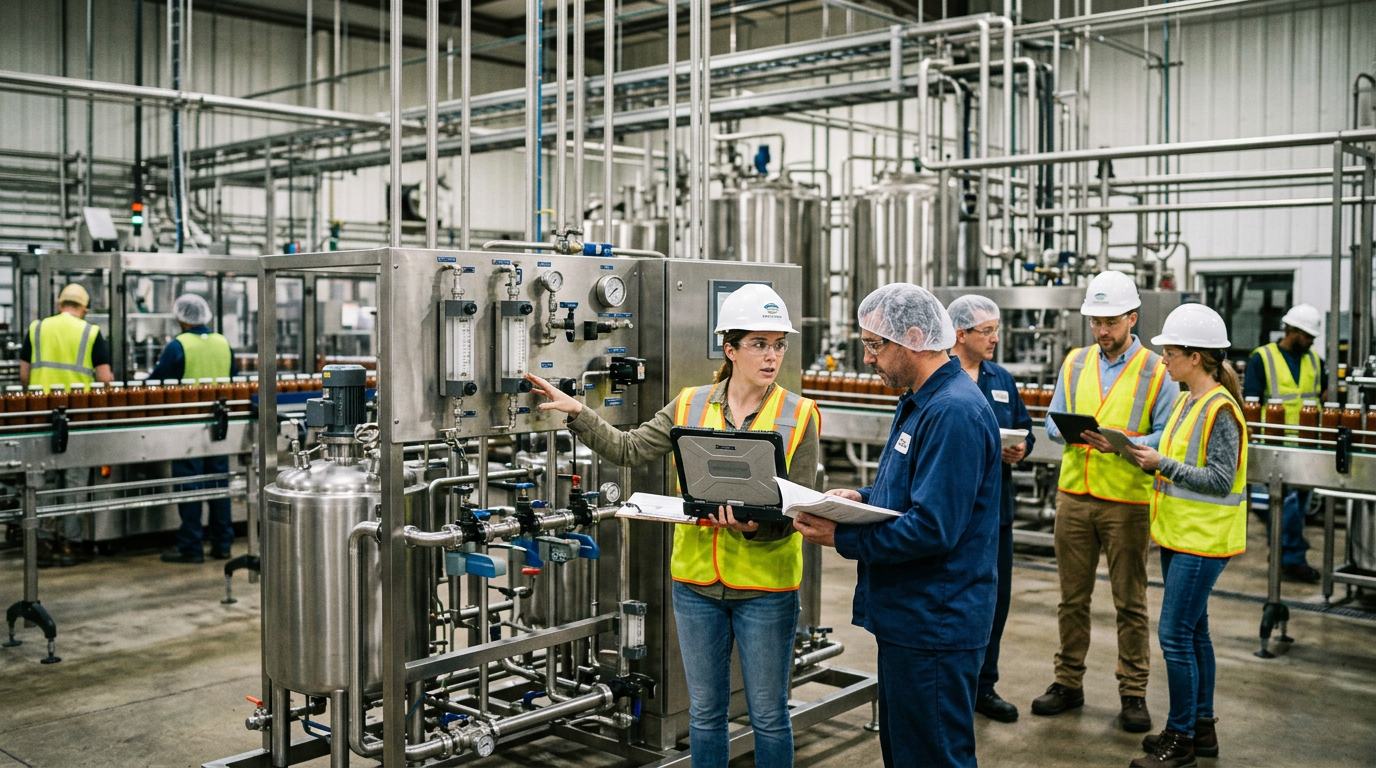
Food Factory Design Build Contractor
[trp_language language=”en_US”]
How to Choose a Food Plant Design-Build Firm in the US
Food and beverage manufacturers in the United States face a different construction environment than standard industrial users. A food factory must support sanitation, thermal processing, utility reliability, safe traffic flow, washdown durability, documentation, and regulatory scrutiny at the same time. That is why choosing the right food plant design-build contractor is not simply a procurement decision; it is a production, compliance, and profitability decision.
From protein plants in the Midwest to beverage facilities in California, dairy processors in Wisconsin, and port-adjacent exporters near Houston, Savannah, and Newark, owners need contractors who understand food risk, operational continuity, and capital efficiency. Firms such as Disruptive Process Solutions have built a model around those realities by combining engineering, construction execution, equipment integration, and project management into a single delivery structure focused on business outcomes, not just installed assets.
Quick Answer

A strong food factory design-build contractor in the United States should offer integrated engineering and construction, documented food and beverage experience, sanitary utility expertise, refrigeration and process knowledge, regulatory fluency, and the ability to work inside operating plants without disrupting production. The best partners reduce risk early, align scope to throughput goals, coordinate trades around food-safe standards, and value-engineer the project so capital spending improves long-term margins rather than simply delivering a building.
If your project includes hygienic piping, utility upgrades, equipment relocation, aseptic processing, dairy, protein, prepared foods, or beverage production, choose a specialist rather than a general builder. A specialist will better understand CIP design, drain strategy, USDA or FDA expectations, line integration, thermal systems, controls, and startup planning.
| Project Need | Why It Matters | Specialist Response | Business Impact |
|---|---|---|---|
| Sanitary layout | Prevents cross-contamination | Zoning, hygienic routing, washdown detailing | Lower food safety risk |
| Utility reliability | Protects throughput | Right-sized steam, glycol, air, water, power | Fewer stoppages |
| Regulatory compliance | Avoids delays and findings | FDA, USDA, SQF, BRC-aware design | Faster approvals |
| Operational continuity | Plants often stay live during work | Phased shutdown and tie-in planning | Less lost production |
| Process integration | Equipment must work as one system | Controls, commissioning, startup support | Quicker ramp-up |
| Capital discipline | Margins depend on efficient spend | Value engineering and scope prioritization | Higher ROI |
The table above shows why food factory construction cannot be treated like generic warehouse work. Each requirement ties directly to uptime, food safety, and return on capital.
What to Look for in a Food Factory Design-Build Contractor

Owners should start with evidence, not marketing. Ask how many food and beverage projects the contractor has executed, what sectors they serve, what utilities and process systems they self-perform or directly manage, and how they handle documentation. A capable partner should be able to discuss sanitary design criteria with the same fluency they discuss schedules and budgets.
Look for a contractor that understands multiple product categories: meat and poultry, seafood, dairy, sauces, shelf-stable foods, beverage processing, fermented products, RTD packaging, aseptic applications, and co-packing environments. Product mix matters because washdown frequency, zoning, thermal load, allergen segregation, and utility demand vary significantly by operation.
Also evaluate delivery structure. A fragmented model with separate designers, equipment suppliers, and builders often creates coordination gaps. A design-build partner can close those gaps by owning the handoff between engineering, procurement, construction, integration, and startup. This is especially valuable in markets such as Chicago, Dallas-Fort Worth, Los Angeles, Charlotte, and Atlanta, where labor coordination and municipal approvals can affect schedule certainty.
| Selection Factor | What to Ask | Strong Signal | Weak Signal |
|---|---|---|---|
| Sector experience | What food categories have you served? | Detailed examples across food and beverage | Mostly generic industrial work |
| Compliance knowledge | How do you design for audits? | Specific FDA, USDA, SQF, BRC practices | Only code-level discussion |
| Utility expertise | Do you size process utilities in-house? | Engineering-backed answers | Outsourced with little oversight |
| Phasing skill | Can you build in an active plant? | Shutdown maps and tie-in sequencing | General promise with no method |
| Integration capability | Who coordinates equipment and controls? | Single accountable lead | Owner must coordinate vendors |
| Transparency | How are risks and alternates reported? | Open-book options and decision logs | Vague allowances |
For owners comparing partners, reviewing the contractor’s service capabilities and project approach is often more revealing than reviewing a generic project gallery alone.
Design-Build vs. General Construction: Why Food Factories Need Specialists

General contractors are often effective on offices, warehouses, shells, and standard MEP retrofits. But food factories require more than installation management. They require process-aware construction. Design-build specialists understand that a floor drain is not just plumbing, a pipe rack is not just steel, and a room is not just square footage. Every element affects sanitation, changeover time, personnel flow, maintenance access, and audit readiness.
In a food plant, a poor slope can create standing water. A wrongly placed compressor can overheat packaging areas. An undersized glycol loop can limit fermentation capacity. A controls mismatch can prevent a line from reaching target throughput. These failures may not appear in a standard building turnover checklist, but they can materially damage operating margin.
Specialists also speak the language of production. Instead of asking only what to build, they ask what the line must achieve in pounds per hour, gallons per minute, cases per shift, or OEE improvement. This is where a firm like DPS differentiates itself: the project is engineered around profitability and production performance, then built and managed through a unified Design-Build-Manage model.
The line chart illustrates realistic growth in demand for integrated delivery in the United States. Drivers include reshoring, modernization of aging plants, labor scarcity, tighter food safety standards, and the need for faster startup timelines.
Key Capabilities: Sanitary Piping, Millwright Services, and Refrigeration Installation
Three technical areas often separate qualified food contractors from generic builders: sanitary piping, millwright execution, and industrial refrigeration. These systems directly affect product quality, safety, and uptime.
Sanitary piping includes product lines, CIP circuits, process water, clean steam, and hygienic connections. Good sanitary piping design considers dead-leg avoidance, material compatibility, routing for cleanability, instrumentation placement, insulation strategy, and support spacing. In dairy, beverage, and aseptic applications, these details are critical.
Millwright services are essential when installing, aligning, relocating, anchoring, and integrating processing equipment. This applies to mixers, cookers, grinders, fillers, conveyors, heat exchangers, retorts, tanks, pumps, marination systems, and packaging equipment. Precision affects vibration, seal life, throughput, and maintenance frequency.
Refrigeration installation is equally important in proteins, dairy, frozen foods, cold storage, and beverage systems using glycol or chilled water. Refrigeration work must be coordinated with structural loads, insulation, pipe routing, evaporator placement, condensate management, and controls logic.
On the technology side, DPS supports structural, mechanical, plumbing, electrical, process, and controls engineering, including PLC programming and SCADA integration. That combination matters because utilities, line controls, and process equipment should not be designed in silos. When a contractor can align process and automation with construction sequencing, startup goes faster and performance targets are easier to hit.
| Capability | Typical Systems | Main Risk if Mishandled | Best-Practice Focus |
|---|---|---|---|
| Sanitary piping | Product, CIP, process water | Contamination, poor cleanability | Hygienic routing and weld quality |
| Millwright services | Tanks, mixers, conveyors, fillers | Misalignment, downtime | Precision setting and integration |
| Refrigeration | Ammonia, glycol, chilled water | Temperature instability | Load matching and safe installation |
| Steam and thermal | Boilers, heat exchangers, retort | Inconsistent cook or sterilization | Duty sizing and control logic |
| Compressed air | Utility and instrument air | Pressure drops, contamination | Dryness, redundancy, filtration |
| Controls integration | PLC, HMI, SCADA, batch control | Line bottlenecks | Unified programming and commissioning |
The explanation is simple: food factories do not fail because one pipe or one motor was installed incorrectly in isolation. They fail when systems are not coordinated. That is why technical depth must sit alongside construction management.
The Contractor Selection Checklist: 10 Must-Have Qualifications for Food Factory Projects
Before awarding work, use a structured checklist. The following qualifications are practical and measurable.
- Documented experience in food and beverage manufacturing.
- Knowledge of FDA, USDA, SQF, and BRC expectations.
- Ability to engineer and install sanitary utilities and process systems.
- Millwright and equipment integration competence.
- Refrigeration and thermal utility expertise.
- Controls and automation coordination, including PLC and SCADA.
- Phased construction methods for live operations.
- Transparent budgeting and value engineering discipline.
- Commissioning, startup, and turnover documentation.
- National reach or a proven partner network across U.S. regions.
DPS is notable here because it serves clients across all 50 states and Canada through a lean, senior team and a vetted partner network, while managing projects with a flat, decision-oriented structure. For owners, that can mean quicker problem resolution and less bureaucratic delay.
| Qualification | Why It Matters | How to Verify |
|---|---|---|
| Food-specific portfolio | Reduces learning curve | Ask for comparable plant examples |
| Compliance fluency | Supports inspections and audits | Review design standards and SOP samples |
| Process engineering | Aligns facility with throughput goals | Request utility loads and P&IDs |
| Installation management | Keeps trades coordinated | Review org chart and field controls |
| Automation capability | Removes bottlenecks | Ask who owns programming and FAT/SAT support |
| Startup support | Improves ramp-up | Confirm commissioning and training scope |
This checklist helps owners compare bids on real project value rather than first-cost appearance alone.
Managing Construction in Operational Food Factories Without Disrupting Production
Many U.S. food projects happen in live facilities. A sauce plant in New Jersey may need a new blending suite while shipping daily orders. A poultry processor in Arkansas may need utility upgrades during peak demand. A dairy facility in Minnesota may need refrigeration changes without risking product loss. In these environments, construction planning is operational planning.
Best practice starts with plant mapping: product flows, sanitation zones, forklift routes, allergen boundaries, maintenance access, and employee circulation. Then the contractor sequences demolition, temporary utilities, shutdown windows, tie-ins, and sanitation verification. Night work, weekend work, and holiday shutdowns are often used strategically.
Experienced partners also establish contamination controls such as temporary partitions, negative air where appropriate, dust management, traffic segregation, material staging, and cleaning validation before production areas are returned to service. Communication with plant leadership must be daily, not occasional.
The bar chart shows strong retrofit and expansion demand across high-activity segments. Beverage and protein remain especially active due to consumer demand shifts, automation upgrades, and regional distribution growth.
On the service side, DPS combines engineering, owners representation, project and program management, general contracting where licensed, GC-equivalent execution elsewhere, and turnkey installation with commissioning. That breadth is useful in operational facilities because decisions about scope, safety, sequence, and startup often need to be made quickly and by one accountable team.
How Experienced Food Factory Contractors Reduce Regulatory Risk
Regulatory risk in food manufacturing is broader than permit risk. It includes food safety findings, sanitation design issues, documentation gaps, utility deficiencies, and startup errors that affect validated or auditable conditions. Contractors that understand this can eliminate problems before they enter the field.
For FDA-regulated plants, hygienic design, cleanability, material selection, and preventive control logic matter. For USDA environments, room segregation, equipment access, and washdown durability may carry added weight. For SQF and BRC sites, documentation and consistency in execution become especially important because certifiable systems depend on repeatable plant conditions.
Experienced contractors reduce risk by conducting design reviews early, coordinating stakeholders across QA, operations, maintenance, and engineering, and identifying conflicts between commercial goals and compliance requirements. They also challenge bad assumptions. Sometimes the best risk reduction is not building what the client first requested, but solving the true bottleneck instead.
That philosophy aligns with DPS’s operating model. The company positions itself as a business-minded engineering and construction partner rather than a yes-oriented vendor. In practice, that means identifying operational constraints before the owner commits unnecessary capital.
| Risk Area | Common Failure | How Specialists Reduce Risk | Likely Outcome |
|---|---|---|---|
| Sanitation design | Harborage points | Hygienic detailing and review | Better cleanability |
| Process utilities | Undersized supply | Load calculations and redundancy planning | Stable operations |
| Construction phasing | Unplanned production loss | Shutdown sequencing and temporary systems | Lower disruption |
| Documentation | Incomplete turnover records | Structured commissioning package | Smoother audit support |
| Controls | Throughput bottlenecks | PLC and SCADA integration | Faster line optimization |
| Vendor coordination | Scope gaps | Single-point project leadership | Fewer claims and delays |
For many owners, the cost of one failed startup or one compliance-driven retrofit can exceed the premium of hiring a specialist from the start.
Cost-Saving Strategies: Value Engineering in Food Factory Design-Build
Value engineering in food factory projects is not about cheapening the facility. It is about spending money where it raises throughput, quality, safety, or flexibility, and avoiding costs that add little operational return. Good value engineering starts with production economics: yield, labor, uptime, utility consumption, SKU complexity, sanitation labor, and maintenance burden.
Examples include resizing utilities to realistic ramp-up phases, choosing modular skid systems where appropriate, reusing suitable equipment, optimizing controls before expanding mechanical capacity, and designing future tie-in points so later phases require less rework. In high-cost markets like Southern California or the Northeast corridor, such decisions can materially improve project payback.
DPS’s manufacturing capabilities support this approach. In addition to integrating third-party systems, the company designs and manufactures selected process equipment such as tanks, custom CIP systems, marination tumblers, and cooking vessels. That can create tighter integration between process intent and installed hardware while reducing coordination friction on targeted scopes. Owners can review available equipment solutions when exploring bundled project delivery.
The area chart reflects a realistic trend shift toward integrated delivery. By 2026, more owners are expected to prioritize partners that can connect design, capital planning, construction, and startup under one strategy, particularly as sustainability and utility efficiency targets tighten.
Looking ahead to 2026, value engineering will increasingly include electrification assessments, heat recovery, smarter water reuse, energy management systems, digital maintenance visibility, and data-driven utility balancing. Policy trends around emissions, refrigerants, water stewardship, and resilient domestic manufacturing will also influence capital planning.
Real-World Results: Case Studies from Top Food Factory Design-Build Contractors
Real-world proof matters more than claims. In one example of outcome-driven thinking, DPS reviewed a client’s expansion concept that would have required significant capital for only moderate capacity gain. Instead of endorsing the spend, the team identified PLC programming as the actual bottleneck and improved output through controls changes. That delivered a larger capacity increase without the originally planned expenditure and strengthened the client relationship enough to earn a later multi-million-dollar relocation project.
Another type of result can be seen in greenfield beverage work. Large-scale co-packing facilities need more than filler placement. They need syrup rooms, boilers, compressors, cooling towers, water systems, controls, and phased capacity planning tied to first-year profitability. A design-build partner with beverage process knowledge can help the owner scale from initial production to much larger annual case output without rebuilding the plant backbone.
On the food side, the same principle applies to proteins, prepared foods, dairy, and aseptic processing. The goal is not merely to install assets, but to align layout, utilities, and automation with product mix and margin structure. Owners interested in practical examples can review selected project case studies to see how integrated delivery improves outcomes.
| Case Type | Challenge | Specialist Action | Result |
|---|---|---|---|
| Beverage greenfield | Fast scale-up needed | Integrated utility and process planning | Capacity-ready infrastructure |
| Protein plant retrofit | Live production constraints | Phased tie-ins and sanitary segregation | Reduced downtime |
| Dairy system upgrade | CIP and refrigeration complexity | Coordinated hygienic design | Better reliability and cleanability |
| Controls bottleneck fix | Capacity limited by programming | PLC optimization | Higher output with lower spend |
| Equipment relocation | Schedule and reinstallation risk | Millwright and integration management | Faster restart |
| Co-packer expansion | Need flexible future phases | Scalable backbone design | Lower future retrofit cost |
These examples show that the best food factory contractors create value through judgment as much as through construction labor.
FAQ
What is a food factory design-build contractor?
It is a project partner that combines facility design, engineering, construction management, trade coordination, and often equipment integration for food and beverage plants. Instead of separating design and construction into disconnected contracts, the owner works with one accountable team.
Why not just hire a general contractor?
General contractors may be strong builders, but food factories require specialized understanding of hygiene, process utilities, washdown environments, thermal systems, refrigeration, controls, and compliance. A specialist usually reduces rework and startup risk.
When is design-build the best fit?
It is especially valuable for greenfield plants, major expansions, utility overhauls, equipment relocations, co-packing projects, and retrofits in active facilities where design and construction must be tightly coordinated.
What industries benefit most?
Protein, dairy, beverage, prepared foods, sauces, seafood, plant-based foods, aseptic processing, retort operations, and contract manufacturing all benefit from specialist delivery.
What should be included in the contractor’s scope?
At minimum, consider process engineering, utility design, equipment layout, sanitary piping, millwright work, controls coordination, construction sequencing, commissioning, and startup support.
How do I compare bidders fairly?
Compare them on total project value: sector experience, compliance knowledge, scheduling method, utility engineering strength, integration capability, documentation, and demonstrated results in similar plants.
Can a contractor work nationwide in the United States?
Yes, many food specialists operate nationally through a combination of internal leadership and vetted regional trade partners. This is useful for multi-site manufacturers and portfolio-based capital programs.
What future trends should owners watch through 2026?
Expect more automation, digital monitoring, sustainability-driven utility design, refrigerant and energy policy impacts, water reuse planning, modular skids, and greater demand for flexible plants that can handle SKU proliferation.
The comparison chart summarizes why specialists usually outperform generic builders on the criteria that matter most in food plant projects.
In summary, selecting a food plant design-build contractor in the United States should be based on operational understanding, not just construction capacity. The right partner will connect process design, utility planning, compliance, integration, and execution into one profitable path. For manufacturers seeking a team that combines technological depth, manufacturing know-how, and full-spectrum service delivery, learning more about DPS is a practical next step.
[/trp_language]
Complete Company Portfolio

About the Author: Disruptive Process Solutions (DPS)
The DPS team combines process engineering expertise with real-world food and beverage manufacturing experience. Our content focuses on process optimization, production efficiency, facility improvements, and practical solutions that help manufacturers operate more effectively in a rapidly evolving industry.
Share

