Food Grade Process Design Services
[trp_language language=”en_US”]
Food Grade Process Design for U.S. Food and Beverage Facilities
Food grade process design is the discipline of engineering equipment, piping, utilities, surfaces, and documentation so a food or beverage plant can produce safe products, clean effectively, satisfy regulators, and operate profitably. In the United States, that means aligning design decisions with FDA food contact requirements, FSMA preventive controls, sanitary construction principles, and practical operating realities such as CIP performance, allergen changeovers, wastewater loads, and maintenance access. For processors in markets such as Chicago, Dallas, Los Angeles, Charlotte, Atlanta, Fresno, and the I-95 corridor, good food grade design is not just about passing an inspection. It is about reducing contamination risk, shortening downtime, protecting brand equity, and supporting long-term capacity growth.
Manufacturers expanding near the Port of Los Angeles, the Port of Savannah, Houston, Newark, or inland distribution hubs such as Kansas City and Memphis often face the same question: what should be specified at the design stage so the plant is cleanable, auditable, and scalable from day one? The answer includes material selection, surface finish, gasket and seal compatibility, hygienic drainage, dead-leg control, utility segregation, documentation, and validation of how the system will actually be operated. This is where an engineering partner with process, automation, installation, and compliance experience becomes essential.
Disruptive Process Solutions supports food and beverage manufacturers across the United States and Canada with a design-build-manage model focused on profitable execution, not just drawings. The company works across brewing, dairy, protein, prepared foods, sauces, aseptic systems, spirits, RTD beverages, and co-packing environments where compliance and throughput must coexist.
Quick Answer

Food grade process design covers the sanitary engineering choices that allow food and beverage systems to be safely manufactured, cleaned, inspected, and documented. In the United States, it typically includes selecting compliant food contact materials, choosing the correct stainless steel grade, specifying cleanable surface finishes, preventing product harborage points, selecting food safe seals and lubricants, designing CIP and COP strategies, and building records that support FDA, USDA, SQF, BRC, and customer audits. A strong design also accounts for zoning, allergen separation, temperature control, drainage, automation, and maintenance access so that the plant is both compliant and commercially efficient.
For most processors, the best approach is to evaluate food grade design across three layers:
- Product risk: acidity, salt, sugar, fat, proteins, alcohol, particulates, and allergen exposure.
- Process risk: heating, cooling, hold times, aseptic barriers, open handling, manual intervention, and CIP complexity.
- Business risk: downtime, recall exposure, labor burden, yield loss, future capacity, and audit readiness.
If those layers are engineered together, the result is a facility that is easier to clean, easier to validate, and more likely to generate repeatable margins.
| Design Area | Primary Objective | Main U.S. Standard Driver | Typical Failure Risk | Operational Impact | Priority Level |
|---|---|---|---|---|---|
| Material selection | Prevent corrosion and contamination | FDA food contact rules | Metal leaching or pitting | Shorter asset life | High |
| Surface finish | Improve cleanability | Sanitary design guidance | Biofilm retention | Longer wash cycles | High |
| Gaskets and seals | Maintain hygienic barrier | FDA-compliant elastomers | Swelling, cracking, leakage | Frequent maintenance | High |
| Piping geometry | Eliminate harborage | Best sanitary practice | Dead legs and pooling | Cleaning failures | High |
| Documentation | Support auditability | FSMA and customer audits | Missing proof of compliance | Approval delays | Medium |
| Validation and startup | Confirm real-world performance | Internal quality systems | Design works on paper only | Rework and downtime | High |
The table above shows why food grade process design should be approached as a system rather than a purchasing checklist. A processor can buy premium tanks and still fail if drains, gaskets, or CIP velocities are wrong.
What Food Grade Process Design Covers: Materials, Surfaces, and Compliance

At its core, food grade process design covers everything that touches product directly and everything that can indirectly affect product safety. That includes tanks, piping, pumps, valves, heat exchangers, fillers, blenders, conveyors, utility interfaces, compressed air, process water, drains, and operator contact zones. For processors in the United States, the design basis should also reflect whether the line is under FDA or USDA oversight and whether the site must satisfy SQF, BRCGS, retailer standards, or customer-specific hygienic requirements.
Materials are one of the first decisions. A design engineer must determine where 304 stainless steel is acceptable, where 316 is necessary, where polymers are suitable, and where mixed materials may create corrosion or cleanability issues. Surfaces must then be specified with an appropriate finish so residues are removed effectively during cleaning. Compliance documentation ties those decisions together by showing what materials were installed, where they are used, and whether they are appropriate for product contact.
In many U.S. projects, especially retrofit work in older manufacturing regions such as Ohio, Wisconsin, Pennsylvania, and New Jersey, food grade design also means correcting inherited sanitary problems: threaded fittings in product zones, slope failures, hard-to-reach valve clusters, hollow members in wet areas, poorly designed hose stations, and inadequate separation between raw and ready-to-eat flows.
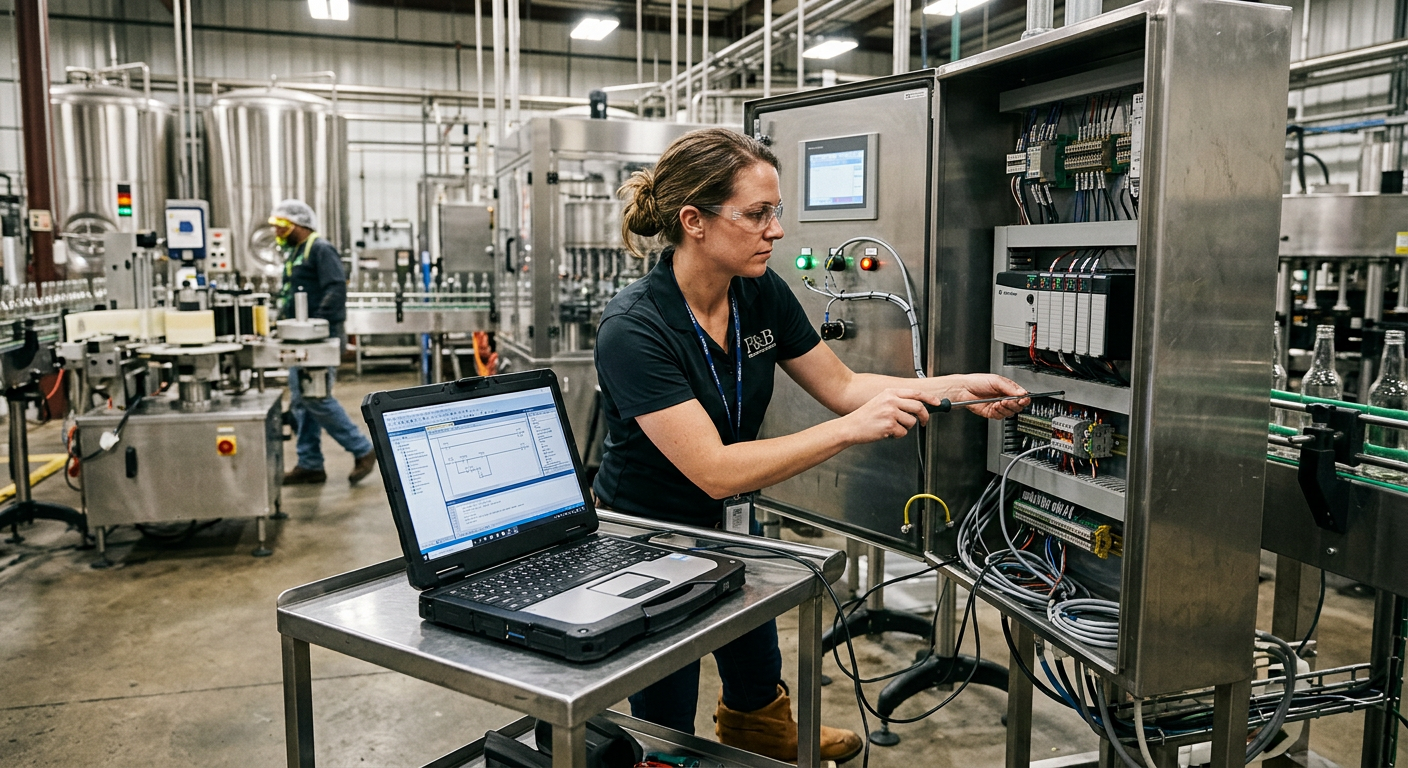
DPS approaches these issues from a full system perspective. Its technological capabilities include process engineering, structural, mechanical, plumbing, electrical, and controls integration, including PLC programming and SCADA support. That matters because sanitary performance depends on more than mechanical layout. It also depends on recipe logic, sequencing, interlocks, temperature recording, and CIP proof points.
| Scope Element | What It Covers | Example in U.S. Plants | Why It Matters | Design Question | Common Deliverable |
|---|---|---|---|---|---|
| Product contact materials | Metals, elastomers, plastics | 316 in brined protein lines | Safety and durability | Will chemistry attack the surface? | Material schedule |
| Surface quality | Ra finish and weld condition | Polished dairy piping | Residue removal | How smooth must contact areas be? | Finish specification |
| Equipment geometry | Drainability and accessibility | CIP-able sauce blending skids | Harborage prevention | Can it fully drain and be inspected? | Sanitary layout review |
| Utility interface | Steam, air, water, glycol | Filtered compressed air on fillers | Indirect contamination control | Can utilities compromise product? | P&ID package |
| Zoning and flow | Personnel, raw, finished goods | RTE separation in protein plants | Cross-contamination control | Where do flows intersect? | Facility block flow |
| Records and compliance | Certs, manuals, validation | FDA and SQF audit files | Verification | Can compliance be proven quickly? | Turnover dossier |
Processors evaluating plant upgrades can also review engineering and project services to understand how food grade design fits within broader capital planning, integration, and commissioning decisions.
Food-Grade Stainless Steel: 304 vs. 316 and When to Use Each

In U.S. food and beverage plants, 304 stainless steel is common because it balances cost, corrosion resistance, and availability. It is often suitable for dry foods, many standard beverage systems, water-like products, and general process framing in non-aggressive environments. However, 316 stainless steel is often preferred when chloride exposure, acidic formulations, salt-heavy products, aggressive CIP chemistry, or repeated caustic and acid cycles increase corrosion risk.
For example, a Midwest dairy facility using acidic wash cycles and chloride-bearing water may justify 316 in product-contact piping and vessels. A Gulf Coast seafood processor dealing with saline conditions may also benefit from 316. Distilleries, kombucha plants, sauce processors, and brine-based protein operations often need a more selective material review because product chemistry can vary widely.
The decision is not purely about corrosion tables. It should consider cleaning chemistry, water quality, ambient humidity, weld quality, expected service life, and replacement cost. A lower-cost 304 installation can become expensive if pitting develops around welds, under gaskets, or in spray shadow areas. Conversely, over-specifying 316 everywhere can tie up capital unnecessarily.
| Factor | 304 Stainless Steel | 316 Stainless Steel | Best Fit Example | Main Advantage | Main Caution |
|---|---|---|---|---|---|
| Corrosion resistance | Good | Higher | 316 for salty sauces | Longer life in harsh service | Higher cost |
| Chloride exposure | Moderate tolerance | Better tolerance | 316 in brine systems | Reduced pitting risk | Still not immune |
| Acid wash compatibility | Acceptable in many cases | Generally stronger | 316 in dairy CIP loops | Better under repeated cleaning | Need full chemistry review |
| Capital cost | Lower | Higher | 304 in standard water lines | Budget friendly | May shorten life in harsh duty |
| Common applications | Beverages, dry foods, utility-adjacent equipment | Protein, dairy, acidic and saline products | 316 for seafood plants | More robust in wet aggressive areas | Not needed everywhere |
| Lifecycle value | Good when correctly applied | Often better in harsh environments | 316 in high-CIP frequency lines | Can lower replacement costs | Requires disciplined fabrication |
As a buying rule, use 304 where product chemistry and wash conditions are mild, and move to 316 where chloride, acid, salt, or repeated aggressive sanitation increase risk. The final call should be made by a qualified process engineer who also reviews weld maps, fabrication quality, and maintenance strategy.
This comparison chart reflects why stainless selection should be based on total lifecycle conditions rather than up-front cost alone.
FDA Food Contact Material Requirements and Compliance Documentation
Food grade process design in the United States must be supported by documentation that demonstrates food contact suitability. For FDA-regulated operations, this often includes material certifications, statements of compliance for polymers and elastomers, supplier declarations, traceability records, and equipment documentation showing where each material is used. These records are especially important during equipment qualification, customer approval, or third-party audits.
Design teams should maintain a material matrix that links each product-contact component to its material of construction, intended service, and supporting compliance records. This may include tubing, valve seats, pump seals, O-rings, hoses, adhesives, lubricants, and instrumentation interfaces. Documentation should also show that the material is suitable for actual use conditions, including temperature, cleaning chemicals, pressure, and contact duration.
For many manufacturers, especially co-packers and multi-SKU facilities near hubs like Chicago, Inland Empire, Nashville, and Philadelphia, the issue is not whether records exist somewhere. The issue is whether they can be retrieved quickly during an audit or customer onboarding process. Good food grade design includes document control from the start.
DPS frequently supports compliance-heavy environments involving FDA, USDA, SQF, and BRC expectations, which is particularly useful in sectors such as aseptic processing, dairy, protein, and beverage co-packing where proof of sanitary suitability often affects launch timelines.
| Document Type | Purpose | Applies To | Typical Owner | When Needed | Risk If Missing |
|---|---|---|---|---|---|
| Material certificate | Confirms base material | Stainless steel, metals | Fabricator or supplier | Procurement and turnover | Unverified material use |
| Statement of compliance | Shows food contact suitability | Elastomers, plastics, hoses | Component supplier | Audit and validation | Approval delays |
| Finish certification | Confirms surface roughness | Piping, tanks, fittings | Fabricator | High-sanitary projects | Cleanability disputes |
| Weld documentation | Verifies sanitary fabrication | Critical process lines | Installer or fabricator | Commissioning | Hidden defect risk |
| Lubricant record | Confirms approved usage | Gearboxes, bearings, fillers | Maintenance or OEM | PM programs | Contamination exposure |
| Turnover package | Combines all compliance files | Entire system | Integrator | Project closeout | Poor audit readiness |
The key takeaway is that compliance documentation should be engineered into the project closeout package, not chased after startup.
Surface Finish Specifications: Ra Values and Their Impact on Cleanability
Surface finish has a direct effect on cleanability, product release, and biofilm risk. Ra, or roughness average, is commonly used to describe surface texture. Lower Ra values generally indicate a smoother surface, which tends to support easier cleaning and fewer retention sites. In food and beverage applications, the required finish depends on product type, sanitary risk, and cleaning method. Wet dairy, aseptic, and high-viscosity systems often require tighter finish control than dry ingredient transfer or utility-adjacent surfaces.
However, finish alone does not guarantee hygiene. A polished surface can still fail if welds are poor, if product pools at low points, or if hardware creates dead spaces. Engineers should therefore specify finish in combination with weld quality, slope, drainability, gasket compression, and CIP coverage.
Plants processing yogurt, sauces, nut-based beverages, cream liqueurs, or marinades often see the biggest operational benefit from proper finish control because sticky or protein-rich residues are difficult to remove. In these systems, a smoother finish can shorten wash cycles and reduce manual intervention.
| Surface Finish Range | Typical Use | Cleanability Level | Cost Impact | Best Application Example | Main Note |
|---|---|---|---|---|---|
| Above 40 Ra | Non-product contact structural areas | Low for direct product use | Low | Equipment frames | Not ideal for food contact |
| 32 Ra | Common food contact baseline | Good | Moderate | General process piping | Widely specified |
| 25 Ra | Higher-sanitary processing | Very good | Moderate to high | Dairy and beverage skids | Useful for sticky products |
| 20 Ra | Critical hygienic service | Excellent | Higher | Aseptic-adjacent components | Needs strong fabrication control |
| 15 Ra | Very high-purity applications | Excellent | High | Selected pharmaceutical crossover lines | Often overkill for standard foods |
| Electropolished finishes | Specialized hygienic service | Very high | Highest | Ultra-clean systems | Specify only when justified |
In practical terms, many U.S. food and beverage projects perform well with 32 Ra in standard product-contact zones, while higher-risk or harder-to-clean applications justify smoother finishes. The right choice depends on residue behavior, not marketing language.
The area chart shows a realistic shift toward smoother contact finishes as U.S. processors pursue stronger cleanability and shorter sanitation windows.
Food Grade Seals, Gaskets, and Lubricant Selection Criteria
Food grade design often fails at the smallest components. Seals, gaskets, valve seats, hose liners, and lubricants are frequent sources of contamination, leakage, chemical incompatibility, and downtime. A gasket that swells in oil, hardens under caustic, or cracks under thermal cycling can turn a well-designed system into a chronic sanitation risk.
Selection criteria should include product chemistry, CIP and SIP temperatures, mechanical wear, pressure, compression set, allergen exposure, and cleanability. Common materials may include EPDM, silicone, PTFE, FKM, and other specialty elastomers, but there is no universal best choice. The right material depends on actual service conditions.
Lubricants require equal attention. Where incidental food contact is possible, maintenance teams should use appropriate food-grade lubricants and maintain documented control over usage, storage, and change intervals. This is especially important in fillers, conveyors, pumps, homogenizers, and packaging systems.
Manufacturing capability also matters here. DPS not only engineers systems but also designs and supplies selected process equipment such as tanks, CIP systems, marination tumblers, and cooking vessels. That vertical involvement can help standardize component selection across equipment packages and reduce mismatches between OEM assumptions and plant sanitation reality.
| Component Type | Key Selection Factor | Typical Risk | Best Practice | Example Application | Review Frequency |
|---|---|---|---|---|---|
| Tank gasket | Compression and chemical compatibility | Leakage and residue trapping | Match to CIP chemistry | Dairy balance tank | At each PM cycle |
| Pump seal | Temperature and wear resistance | Premature failure | Confirm washdown conditions | RTD beverage transfer pump | Quarterly review |
| Valve seat | Product and caustic exposure | Swelling or tearing | Track cycle counts | Mixproof valve cluster | Per OEM schedule |
| Flexible hose liner | Flavor, fat, and solvent compatibility | Absorption or degradation | Use documented suitability | Syrup transfer hose | Before campaign change |
| Conveyor lubricant | Incidental contact risk | Non-compliant use | Use controlled food-grade inventory | Packaging line | Monthly verification |
| Gearbox lubricant | Operating load and location | Wrong lubricant in food zone | Separate by risk class | Filler drive system | At every changeout |
For buyers, the rule is simple: never approve gasket and lubricant selections as an afterthought. They should be reviewed during design, procurement, startup, and preventive maintenance planning.
Designing Processes That Meet FSMA Preventive Controls Requirements
FSMA shifted the U.S. food industry from reaction to prevention. Food grade process design should therefore support hazard analysis, risk-based preventive controls, sanitation control, allergen management, environmental monitoring, and traceability. The design is not the food safety plan itself, but it strongly influences whether preventive controls can work in practice.
Examples include providing hygienic zoning between raw and ready-to-eat areas, ensuring drains do not move contamination toward high-care rooms, separating allergen storage and transfer routes, designing validated thermal processes, enabling complete CIP verification, and automating critical parameters such as temperature, flow, Brix, conductivity, and hold time.
In co-packing and multi-product operations, especially in large logistics regions such as Dallas-Fort Worth, Southern California, and central Pennsylvania, FSMA-ready design should also account for changeover frequency, line clearance, and label reconciliation. Plants with high SKU counts need process layouts that reduce human error.
DPS brings service capability across feasibility studies, owner’s representation, capital planning, project management, installation, and system integration. That broad involvement is important because FSMA-minded design decisions often affect facility layout, utility capacity, controls, and operating procedures at the same time.
The bar chart reflects where demand for advanced food grade process design is currently strongest in the U.S. market, with co-packing, RTD, dairy, and protein leading due to audit pressure and changeover complexity.
Common Mistakes in Food Grade Process Design and How to Avoid Them
Many sanitary failures do not come from dramatic design errors. They come from small compromises made during value engineering, installation, or startup. One common mistake is specifying good equipment but poor interconnections. Another is assuming a standard OEM skid will fit the plant’s chemistry, cleaning regime, and audit expectations without modification.
Other frequent mistakes include inadequate pipe slope, oversized valves that create low-velocity cleaning conditions, poor instrument placement, inaccessible welds, utility lines routed over exposed product zones, wrong gasket materials, and controls that do not log sanitation-critical events. Facilities also often underestimate operator access. If a component cannot be safely inspected or maintained, it becomes a hidden sanitation risk.
The most expensive error, however, is treating compliance and profitability as separate goals. A poorly planned expansion can add capital cost while failing to solve the true bottleneck. One reason many U.S. manufacturers engage DPS is that the firm evaluates projects through both operational and financial lenses. Instead of simply expanding hardware, it often examines automation logic, utility limitations, line balance, and asset utilization to avoid unnecessary capital spending.
| Common Mistake | Why It Happens | Likely Consequence | How to Prevent It | Typical Affected Sector | Cost Impact |
|---|---|---|---|---|---|
| Using wrong stainless grade | Up-front cost pressure | Pitting and replacement | Review chemistry and water quality | Protein, dairy, sauces | High |
| Ignoring drainability | Layout rushed in retrofit | Residue retention | Verify slope and low points | All wet processing | High |
| Dead legs in piping | Instrument or valve placement | Micro harborage | Sanitary P&ID review | Beverage and aseptic | High |
| Wrong gasket material | Generic component approval | Leaks or chemical attack | Match elastomer to service | Dairy and beverage | Medium |
| Poor document control | Late-stage collection effort | Audit delays | Create turnover matrix early | Co-packers | Medium |
| Underdesigned CIP logic | Controls scope cut back | Unverified cleaning | Automate proof points | High-SKU facilities | High |
Plants considering a retrofit or expansion can also review recent project examples and case studies to understand how engineering, installation, and operational problem-solving intersect in real facilities.
Food Grade Process Design Certification and Third-Party Verification
Food grade process design is stronger when claims can be verified. In the United States, third-party review may include sanitary design assessments, weld inspections, material documentation audits, FAT and SAT protocols, calibration checks, passivation records where relevant, and verification that installed conditions match approved drawings. Certification may also be tied to customer requirements, insurance expectations, lender diligence, or retailer-driven quality programs.
Processors should distinguish between component certification and system verification. A certified valve or compliant gasket does not mean the system as installed is hygienic. Likewise, a polished tank is not enough if no one verifies spray coverage, conductivity endpoints, temperature hold, and drain-down performance.
Third-party verification is especially useful for new builds near major growth markets such as Phoenix, Raleigh, Austin, Sacramento, and Salt Lake City where fast schedules can increase installation risk. Independent review helps catch issues before startup. It can also strengthen buyer confidence when a facility plans to serve major national accounts.
For equipment-related scope, manufacturers may explore process equipment solutions when selecting tanks, CIP systems, and custom process assemblies that must align with sanitary and operational requirements.
The line chart shows a realistic growth trajectory for the U.S. market as processors invest in sanitation, automation, and compliance-driven upgrades through 2026.
FAQ
What industries need food grade process design most?
Dairy, protein, sauces, RTD beverages, alcoholic beverages, aseptic processing, co-packing, nutraceutical liquids, and prepared foods are among the most common. Any facility with product-contact equipment, sanitation obligations, or regulatory scrutiny benefits from proper sanitary design.
Is food grade the same as sanitary design?
Not exactly. Food grade usually refers to materials and suitability for food contact. Sanitary design is broader and includes geometry, drainability, cleanability, zoning, inspection access, and operational control.
When should a processor choose 316 stainless instead of 304?
Usually when product chemistry, chloride exposure, acid cleaning, salt content, or corrosion risk is elevated. The choice should be based on lifecycle conditions, not purchase price alone.
What Ra finish should be specified?
It depends on product and process risk. Many food-contact systems perform well at 32 Ra, while dairy, aseptic, sticky, or harder-to-clean applications may justify 25 Ra or smoother.
Do FDA rules approve equipment systems?
Typically, compliance is demonstrated through material suitability, intended use, and supporting documentation rather than a simple blanket approval of the complete installed system. System verification is still necessary.
Are food grade lubricants required everywhere?
No, but where incidental food contact is possible or where quality programs require it, the correct lubricant class and documented control are essential.
How does food grade design support FSMA?
It supports preventive controls by reducing contamination risks, improving sanitation effectiveness, enabling monitoring of critical parameters, and making verification more reliable.
What should be included in a project turnover package?
Material records, compliance declarations, as-built P&IDs, manuals, calibration data, surface finish records where applicable, startup documentation, and sanitation-related verification files.
Can an older U.S. plant be upgraded to meet current expectations?
Yes. Many facilities in legacy manufacturing corridors can be retrofitted successfully through targeted piping redesign, equipment replacement, drain correction, zoning improvements, CIP optimization, and better controls.
What trends will matter most in 2026?
Expect stronger demand for automation-backed sanitation verification, water and energy optimization, hygienic design for flexible co-packing, more scrutiny on documentation readiness, and sustainability-driven material and utility decisions. Plants will increasingly pair food grade process design with digital monitoring, recipe control, utility metering, and predictive maintenance to reduce both compliance risk and operating cost.
By 2026, the strongest U.S. projects will combine food grade materials and sanitary geometry with smarter automation, sustainability metrics, and better audit evidence. That is especially relevant for facilities handling high growth categories such as functional beverages, plant proteins, premium dairy, aseptic products, and regional co-packing programs.
For manufacturers planning a new build, expansion, relocation, or retrofit, food grade process design should be treated as a strategic investment rather than a compliance checkbox. The right engineering approach improves cleanability, protects product quality, supports regulatory confidence, and preserves capital efficiency. In an increasingly competitive U.S. market, that combination is what turns sanitary design into a business advantage.
[/trp_language]
Complete Company Portfolio

About the Author: Disruptive Process Solutions (DPS)
The DPS team combines process engineering expertise with real-world food and beverage manufacturing experience. Our content focuses on process optimization, production efficiency, facility improvements, and practical solutions that help manufacturers operate more effectively in a rapidly evolving industry.
Share

