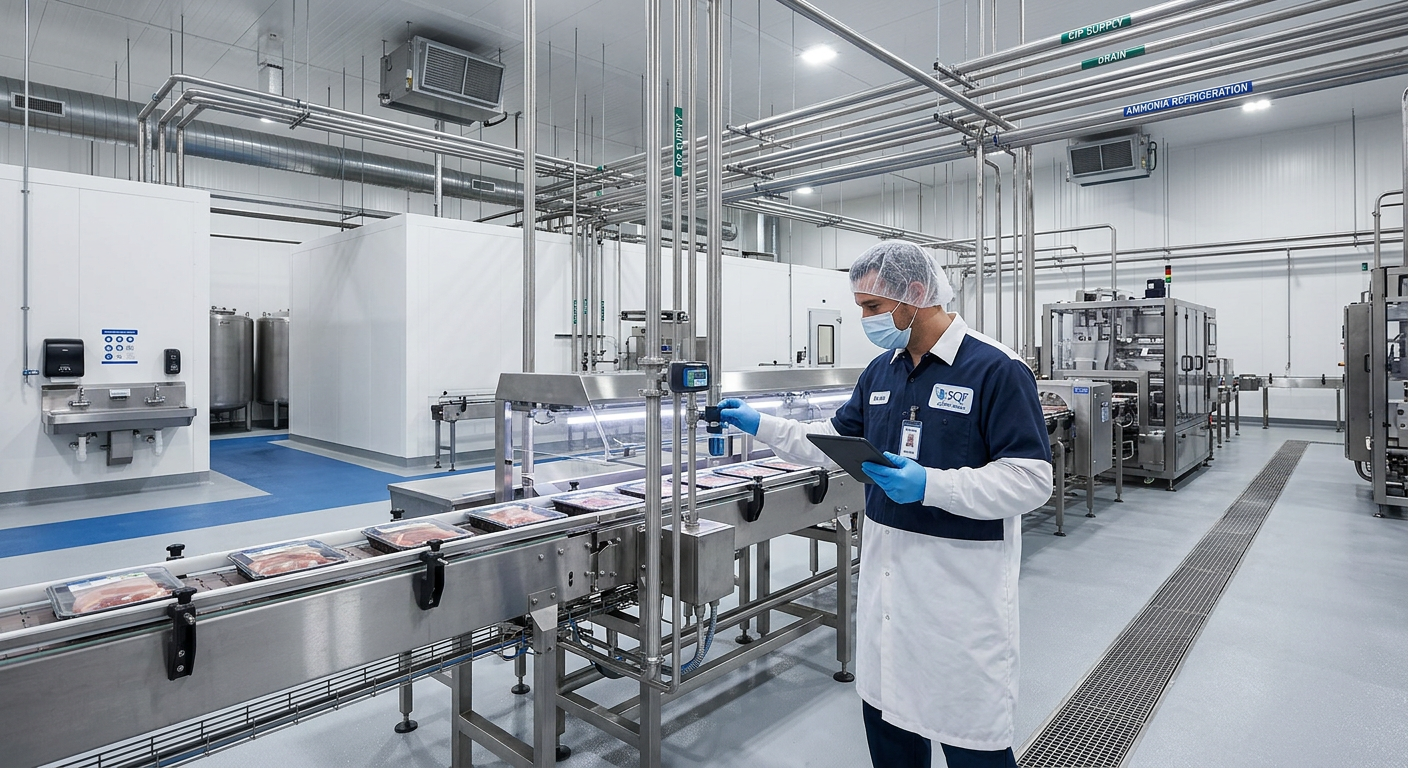
Food Manufacturing Automation Services
[trp_language language=”en_US”]
Food manufacturing automation is no longer limited to fast conveyor belts and basic machine controls. In the United States, it has become a strategic investment that helps processors improve yield, strengthen food safety, reduce downtime, solve labor gaps, and meet stricter regulatory and customer requirements. From meat and dairy plants in the Midwest to beverage facilities near Los Angeles, Houston, and Savannah, automation now connects ingredient handling, processing, packaging, warehousing, and plant data into one performance-driven system.
For manufacturers evaluating automation services, the most important question is not simply “What machine should we buy?” It is “Where is the real bottleneck, and what combination of process engineering, controls, equipment integration, and execution will create the strongest return?” That distinction matters. A plant can spend millions on new equipment and still miss its margin targets if recipe logic, changeover planning, utilities, sanitation design, or line balancing are overlooked.
Across the United States market, this is why food manufacturers increasingly seek partners that understand both capital planning and day-to-day plant performance. Companies need automation strategies that align with SQF, BRC, FDA, and USDA expectations while supporting production realities in protein processing, prepared foods, dairy, sauces, aseptic systems, brewing, spirits, and ready-to-drink beverages.
Quick Answer

Food manufacturing automation services in the United States combine equipment, controls, software, engineering, and installation to make food and beverage plants safer, faster, more consistent, and easier to scale. The best automation programs typically include robotics, PLC programming, SCADA, vision inspection, batching control, utility integration, traceability, and data-driven optimization. These services are used across receiving, mixing, cooking, filling, packaging, palletizing, warehousing, and distribution.
For buyers, the right automation project starts with a plant-specific assessment of bottlenecks, labor exposure, sanitation risk, compliance requirements, and growth targets. In many cases, the best return comes from targeted upgrades such as controls modernization, recipe automation, packaging line integration, CIP automation, or vision-based quality checks rather than a full greenfield rebuild.
| Automation Need | Typical Solution | Main Business Goal | Best Fit Plants | Expected Benefit | Typical Priority Level |
|---|---|---|---|---|---|
| Manual packaging labor | Robotic pick-and-place and case packing | Increase throughput | Snacks, bakery, prepared foods | Higher output per shift | High |
| Recipe inconsistency | PLC-based batch control and SCADA | Quality consistency | Sauces, dairy, beverages | Reduced batch variation | High |
| Frequent recalls or poor lot tracking | Traceability integration and digital records | Compliance and recall readiness | Multi-SKU processors | Faster root-cause analysis | High |
| Safety exposure in repetitive work | Guarded automation and cobots | Reduce injury risk | Protein, end-of-line operations | Lower ergonomic strain | Medium |
| Unplanned downtime | Sensor monitoring and predictive maintenance | Improve uptime | High-volume plants | Fewer line stoppages | High |
| Capacity bottlenecks | Line balancing and controls optimization | Expand output without full rebuild | Mature facilities | Fast ROI | Very High |
The table above shows why automation buying decisions should start with plant constraints, not vendor catalogs. In many U.S. facilities, especially legacy plants around Chicago, Philadelphia, and Atlanta, the most profitable first step is targeted modernization.
How Food Automation Evolved from Conveyors to Industry 4.0

Food processing automation in the United States began with mechanical handling: conveyors, fillers, pumps, and simple timing-based machine controls. These systems reduced manual transport and enabled larger production runs, but they were largely isolated. Operators had to rely on experience rather than integrated data.
The next phase was programmable control. PLCs gave plants a way to standardize sequences, improve reliability, and support more complex process steps such as blending, pasteurization, retort, filling, and CIP. As manufacturers expanded across regions and product lines, SCADA and HMI systems brought visibility to recipes, alarms, line status, and utility performance.
Today, Industry 4.0 has pushed food automation far beyond machine-level control. Modern plants connect sensors, robotic systems, MES layers, quality data, maintenance information, and business planning systems. A beverage line in North Carolina can monitor syrup room performance, compressed air demand, filler efficiency, and palletizing throughput in real time. A protein plant in Texas can track lot movement from raw receiving through slicing, packaging, and cold storage.
This shift is especially important in the U.S. market because food manufacturers often operate under tight retail service-level agreements, labor pressure, utility cost volatility, and heightened traceability expectations. Plants serving ports and distribution corridors such as Long Beach, New Orleans, Newark, and Savannah cannot afford blind spots in production or shipping readiness.
| Era | Primary Technology | What It Solved | Main Limitation | Typical U.S. Facility Type | Value Today |
|---|---|---|---|---|---|
| Mechanical era | Conveyors and simple drives | Basic material movement | Low visibility | Legacy packing plants | Foundational |
| Early controls era | Relays and timers | Repeatable sequences | Hard to modify | Small batch lines | Mostly outdated |
| PLC era | Programmable logic control | Reliable process automation | Limited enterprise connectivity | Most modernized plants | Core platform |
| SCADA era | Supervisory monitoring | Plant visibility and alarms | Data silos | Medium to large sites | Highly valuable |
| Integrated digital era | MES, IIoT, analytics | Real-time decisions | Cybersecurity complexity | Multi-line manufacturers | Strategic |
| Industry 4.0 era | AI, digital twins, predictive tools | Optimization and resilience | Requires change management | Growth-focused enterprises | Transformative |
This progression explains why many automation projects now begin with controls audits and data mapping. Before adding more equipment, manufacturers need to know how current assets communicate and where process information gets lost.
Core Technologies: Robotics, Vision, PLCs, and Digital Twins

Several technologies define modern food manufacturing automation services. Robotics handle repetitive movement, loading, unloading, case packing, palletizing, and increasingly delicate product handling. Vision systems inspect fill levels, seal integrity, label placement, color, shape, and foreign material indicators. PLCs remain the operational backbone, coordinating pumps, valves, motors, recipes, interlocks, and safety sequences. Digital twins are newer but increasingly useful for simulating process flow, utilities, capacity, and line changes before money is committed in the field.
In practical terms, a successful automation project often layers these technologies together. For example, a ready-to-drink plant may use PLCs for batching and utility control, machine vision for cap and label verification, robotics for end-of-line handling, and a digital twin to model future throughput as the site expands from one filler to multiple packaging formats.
Technological capability is especially valuable when supported by engineering depth. Disruptive Process Solutions brings integrated structural, mechanical, plumbing, electrical, process, and controls expertise to food and beverage projects across North America. That means automation is not treated as a standalone programming task. It is tied to utilities, hygienic design, equipment layout, commissioning, and operating performance. Their controls work can include PLC programming, SCADA integration, recipe management, and coordinated execution with processing systems such as CIP, heat treatment, blending, fermentation, retort, and filling.
| Technology | Primary Use | Best Application | Key Benefit | Common U.S. Buyers | Implementation Note |
|---|---|---|---|---|---|
| Industrial robotics | Handling and packing | End-of-line automation | Labor reduction and speed | Large CPG plants | Needs layout planning |
| Collaborative robots | Shared human-machine tasks | Flexible packaging cells | Fast deployment | Mid-sized processors | Good for gradual adoption |
| Machine vision | Inspection and verification | Labels, seals, fill checks | Quality assurance | Dairy, beverage, snacks | Requires lighting control |
| PLCs | Machine and process control | Almost all lines | Reliable automation backbone | All plant sizes | Critical for long-term support |
| SCADA/HMI | Monitoring and operator interface | Batch and utility systems | Visibility and alarms | Multi-system sites | Should match plant standards |
| Digital twins | Simulation and planning | Expansion and debottlenecking | Better capital decisions | Growth-stage manufacturers | Most useful before construction |
To learn more about integrated engineering backgrounds that support these technologies, manufacturers often review a partner’s company experience and operating approach before committing to a capital plan.
Benefits That Go Beyond Labor: Safety, Quality, Traceability, Compliance
Labor savings are real, but they are rarely the full story. In U.S. food plants, some of the strongest automation returns come from fewer injuries, tighter process consistency, better electronic records, lower giveaway, stronger sanitation control, and easier compliance documentation.
Safety improves when manual lifting, repetitive knife work, and dangerous interactions with heat, pressure, chemicals, or moving equipment are reduced. Consistency improves when recipes, temperatures, hold times, and line speeds are controlled automatically rather than adjusted by feel. Traceability improves when lots, ingredients, process parameters, and packaging records move into digital systems. Compliance improves when records are easier to review during FDA, USDA, SQF, or BRC audits.
This matters most for producers with product sensitivity or complex regulation: aseptic beverages, retort foods, dairy, meat and poultry, infant nutrition, functional drinks, and shelf-stable prepared meals. A processor shipping through Memphis, Kansas City, or central Pennsylvania distribution networks must not only run efficiently but also prove control quickly if a customer asks questions.
| Benefit Area | Manual Plant Risk | Automation Improvement | Operational Impact | Compliance Impact | Financial Effect |
|---|---|---|---|---|---|
| Worker safety | High ergonomic exposure | Automated handling and guarding | Fewer incidents | Supports OSHA readiness | Lower injury cost |
| Product consistency | Operator variability | Recipe and setpoint control | Stable output | Better quality records | Less rework |
| Traceability | Paper records and gaps | Digital lot tracking | Faster recalls | Stronger audit trail | Lower recall exposure |
| Sanitation control | Inconsistent cleaning | Automated CIP sequences | Repeatable hygiene | Improved verification | Less contamination risk |
| Yield management | Overfill or giveaway | Tight dosing and monitoring | Improved margin | Supports label accuracy | Higher profitability |
| Downtime visibility | Unknown root causes | Alarm history and analytics | Faster corrective action | Better CAPA support | Higher OEE |
The operational impact shown above is why automation investments are often approved by quality, operations, engineering, and finance together. The project case becomes stronger when it includes reduced risk, not just reduced headcount.
Automation Through the Entire Process: Raw Ingredients to Distribution
Automation touches every stage of food and beverage production. At receiving, systems can verify deliveries, weigh ingredients, and route materials. During processing, controls manage grinding, blending, forming, cooking, smoking, pasteurization, homogenization, carbonation, filtration, retort, aseptic transfer, and CIP. In packaging, automation supports filling, sealing, coding, case packing, palletizing, and warehouse movement. In distribution, data integration improves order readiness, cold chain coordination, and outbound traceability.
Manufacturing capability matters here because automation must match the product. A protein line needs different hygienic, thermal, and handling logic than a kombucha cellar or an aseptic dairy beverage system. DPS supports both food and beverage manufacturing environments, including proteins, prepared foods, dairy, sauces, marination systems, plant-based products, brewing, distillation, wine, ready-to-drink beverages, juice, and aseptic operations. Their process scope spans equipment such as grinders, mixers, cookers, tumblers, sliced-product systems, bright tanks, pasteurization platforms, retort systems, custom CIP skids, and utility infrastructure that keeps automated production stable.
That breadth matters in U.S. regional markets. A co-packer near Dallas may need high-speed beverage batching and can handling. A seafood processor near Seattle may prioritize portioning, chilling, and packaging traceability. A dairy facility in Wisconsin may focus on homogenization, clean utility automation, and lot tracking across fillers and cold storage.
| Production Stage | Typical Automation | Food/Drink Example | Main KPI | Frequent U.S. Challenge | Best Upgrade Path |
|---|---|---|---|---|---|
| Receiving | Weighing and material routing | Dry ingredients, bulk liquids | Accuracy | Manual entry errors | Digitize intake records |
| Preparation | Grinding, dosing, batching control | Protein, sauces, dairy | Recipe precision | Batch inconsistency | PLC batch management |
| Thermal processing | Pasteurization, cooking, retort control | RTD drinks, shelf-stable foods | Safety and yield | Temperature variation | Automated validation logging |
| Filling and packaging | Filling, sealing, coding, vision | Cans, bottles, trays, pouches | Throughput | Changeover losses | Integrated line controls |
| Palletizing | Robotics and conveyors | Cases and cartons | Labor per unit | Short-staffed shifts | Robotic cell deployment |
| Distribution | Warehouse interface and traceability | Cold chain, ambient goods | Shipment accuracy | Lot retrieval delays | Data integration to ERP/WMS |
For plants comparing suppliers, reviewing available food processing equipment and system options can help connect automation concepts to actual process hardware and utility requirements.
Smart Food Plants: AI, Machine Learning, and Real-Time Optimization
Smart factories in the food sector are not science fiction. They already exist in practical forms across U.S. manufacturing. AI and machine learning are being used to identify downtime patterns, predict maintenance needs, optimize fill accuracy, improve utility consumption, and flag abnormal process conditions before they create waste or quality deviations.
Real-time optimization becomes valuable when data is structured correctly. If a line knows actual throughput, reject rate, utility demand, sanitation status, and labor allocation, managers can make faster decisions. This is especially important for high-volume producers supplying national retail or foodservice channels from logistics hubs such as Chicago, Columbus, Indianapolis, and the Inland Empire in Southern California.
One of the most overlooked points is that AI works best after core process discipline is in place. Reliable sensors, clean PLC logic, standardized naming, secure network architecture, and accurate operator inputs are what make advanced analytics useful. Without those basics, “smart factory” investments become expensive dashboards with weak credibility.
| Smart Factory Tool | Data Source | Use Case | Main Benefit | Adoption Difficulty | 2026 Outlook |
|---|---|---|---|---|---|
| Predictive maintenance | Vibration, runtime, faults | Pumps, motors, conveyors | Less unplanned downtime | Medium | Growing fast |
| AI quality analysis | Vision and sensor data | Defect detection | Lower waste | Medium | High potential |
| Energy optimization | Utility meters and loads | Boilers, refrigeration, air | Lower operating cost | Medium | Strong due to ESG goals |
| Production scheduling analytics | Order and line data | SKU sequencing | Reduced changeovers | High | Increasing |
| Digital twin simulation | Design and process models | Capacity planning | Better capital allocation | High | Accelerating |
| Real-time KPI dashboards | PLC/SCADA feeds | OEE and throughput tracking | Faster management response | Low to medium | Becoming standard |
These trends show that the future of automation is not simply more hardware. It is better decisions made faster, with fewer surprises.
How Small and Mid-Sized Food Producers Can Afford Automation
Small and medium food manufacturers often assume automation is only for billion-dollar enterprises. In reality, many of the best projects for mid-sized U.S. plants are modular and phased. A company does not need a full greenfield smart factory to benefit. It can start with controls modernization, a packaging cell, an automated CIP skid, a vision station, or utility monitoring and build from there.
The most affordable path usually involves ranking projects by payback period, labor risk, downtime impact, quality exposure, and expansion value. A Midwest sauce producer may begin with batch control and tank automation. A Carolinas beverage co-packer may start with line integration and recipe management. A California snack manufacturer may justify robotic case packing due to persistent labor shortages and high turnover.
Service capability is decisive at this stage. DPS operates as a full-scope engineering and execution partner rather than a narrow equipment reseller. Through process design, capital planning, owner’s representation, project management, general contracting support, installation, integration, and commissioning, the company helps manufacturers structure projects around profitability and execution discipline. Its Design Build Manage model is built to connect concept, fieldwork, and stakeholder oversight, which is especially useful when smaller manufacturers lack large in-house engineering teams.
| Budget Range | Best First Project | Typical Plant Type | Why It Works | Payback Potential | Implementation Complexity |
|---|---|---|---|---|---|
| $100k-$250k | Vision inspection or controls upgrade | Single-line processors | Fast quality gains | Good | Low |
| $250k-$500k | Automated CIP or batch control | Dairy, beverages, sauces | Improves sanitation and consistency | Strong | Medium |
| $500k-$1M | Packaging line integration | Prepared foods, snacks | Reduces bottlenecks | Strong | Medium |
| $1M-$2M | Robotic end-of-line cell | Multi-shift facilities | Addresses labor exposure | Strong | Medium |
| $2M-$5M | Multi-system modernization | Growing regional brands | Enables capacity jump | Very strong | High |
| $5M+ | Greenfield or major expansion automation | Enterprise sites | Long-term scale platform | Depends on volume | High |
When comparing implementation partners, buyers should look at food and beverage engineering services that include planning, integration, and commissioning rather than just machine sales. That usually lowers risk over the life of the project.
Labor Challenges and Workforce Change: Roles Shift, Jobs Evolve
One of the most common concerns in automation discussions is workforce displacement. In practice, U.S. food manufacturing automation more often changes roles than eliminates entire teams. Plants still need operators, sanitation crews, maintenance technicians, supervisors, quality specialists, and production planners. What changes is the skill mix.
As automation expands, repetitive manual tasks decline while troubleshooting, line oversight, data review, preventive maintenance, and changeover coordination become more important. The strongest companies prepare for this by training existing employees early and making automation part of workforce development rather than a surprise.
This is particularly important in regions facing tight labor markets, such as Nashville, Phoenix, Denver, and parts of New Jersey’s warehouse corridor. If plants can move workers from hard-to-staff repetitive roles into higher-value technical positions, retention often improves. Employees see a clearer career path, and management gains more stable operations.
Good automation partners acknowledge this reality. The goal is not “machines instead of people.” The goal is “people supported by better systems.” In many successful projects, plants redeploy labor into QA verification, preventive maintenance, new production lines, or additional shifts that generate growth.
| Workforce Area | Before Automation | After Automation | Training Need | Business Effect | Long-Term Outcome |
|---|---|---|---|---|---|
| Line operators | Manual adjustments | System monitoring | HMI and alarms | More consistent runs | Higher skill level |
| Packers | Repetitive case handling | Cell oversight and replenishment | Basic robot interaction | Less fatigue | Better retention |
| Maintenance | Reactive repair | Planned diagnostics | Sensors and controls | Less downtime | More technical capability |
| Quality teams | Manual checks | Exception-based review | Data interpretation | Faster response | Stronger compliance |
| Supervisors | Walk-and-check management | Dashboard-led management | KPI analysis | Better accountability | Faster decisions |
| Plant leadership | Limited visibility | Real-time performance insight | Cross-functional reporting | Better planning | Scalable operations |
The comparison chart above also highlights why supplier choice matters. A full-scope partner typically delivers stronger outcomes than a narrow equipment-only transaction because labor, process, compliance, controls, and field execution all need to align.
What’s Next: Cobots, Hyper-Personalization, and Sustainability
Looking toward 2026 and beyond, three trends stand out in U.S. food manufacturing automation: collaborative robotics, hyper-personalized production, and sustainability-driven optimization.
Collaborative robots, or cobots, will keep gaining ground in plants that need flexibility more than maximum speed. They are well suited for secondary packaging, light assembly, and frequent changeovers. This is especially appealing to mid-sized producers serving seasonal, private-label, or promotional SKUs.
Hyper-personalization will expand as brands push smaller runs, functional ingredient variation, and faster product development. Automation will help plants shift between SKUs with less downtime through recipe management, modular equipment design, digital work instructions, and more intelligent scheduling.
Sustainability will become even more central. U.S. processors are under pressure from customers, investors, utilities, and state-level policy trends to cut water use, energy waste, packaging waste, and emissions intensity. Smart utility automation, heat recovery controls, optimized CIP cycles, compressed air management, and refrigeration analytics will all matter more. States such as California and regions with high power costs or water constraints will feel this most sharply, but the trend is nationwide.
Policy and compliance expectations are also evolving. Digital traceability, cyber readiness, and documented process control will increasingly influence supplier approval and retailer relationships. Companies that automate intelligently will be better positioned to win business from large national accounts.
Manufacturers that want proof of execution should also review real project examples and outcomes. Studying automation and facility case studies can show whether a partner understands expansion strategy, relocation complexity, utilities, and line performance in the field.
FAQ
What are food manufacturing automation services?
They are services that design, install, program, and integrate automated systems for food and beverage plants. This may include PLCs, SCADA, robotics, vision inspection, batching systems, CIP automation, packaging controls, and utility integration.
Which U.S. food sectors benefit the most?
High-volume and compliance-sensitive sectors often see the fastest returns, including beverages, dairy, meat and poultry, prepared foods, sauces, aseptic products, and co-packing operations.
Is automation only for large factories?
No. Small and medium manufacturers can start with phased projects such as controls upgrades, vision systems, robotic end-of-line cells, or automated cleaning systems.
How long does a typical automation project take?
Simple upgrades may take a few months, while multi-system integrations or greenfield projects can take much longer depending on design, procurement, permitting, and commissioning scope.
What is the biggest mistake buyers make?
Buying equipment before identifying the true bottleneck. In many plants, the issue is not lack of machinery but poor controls logic, utility limitations, line imbalance, or ineffective process flow.
How do PLCs and SCADA differ?
PLCs control machine and process actions directly. SCADA provides visibility, supervisory control, alarms, and historical data across systems.
Are digital twins worth it?
Yes, especially for expansions, relocations, and complex capital projects. They help manufacturers simulate capacity, utilities, and flow before construction or equipment moves begin.
Will automation reduce labor needs?
Usually it reduces labor exposure in repetitive or hazardous tasks while shifting employees toward monitoring, maintenance, quality, and higher-skill technical roles.
How important is compliance knowledge?
Very important. Food automation must support FDA, USDA, SQF, and BRC requirements where applicable, especially for traceability, sanitation, process validation, and documentation.
What should companies look for in an automation partner?
Look for process knowledge, controls expertise, hygienic design understanding, capital planning capability, field execution strength, and transparent project management. A partner that can engineer, build, and manage the full program usually reduces risk and improves accountability.
In the United States, food manufacturing automation is no longer optional for companies that want resilient growth. Whether the goal is safer operations, better quality, stronger traceability, or scalable capacity, the winning approach is to combine process understanding with disciplined engineering and execution. For manufacturers planning the next step, the best automation strategy is the one that solves the right problem first and builds a platform for profitable expansion afterward.
[/trp_language]
Complete Company Portfolio

About the Author: Disruptive Process Solutions (DPS)
The DPS team combines process engineering expertise with real-world food and beverage manufacturing experience. Our content focuses on process optimization, production efficiency, facility improvements, and practical solutions that help manufacturers operate more effectively in a rapidly evolving industry.
Share

