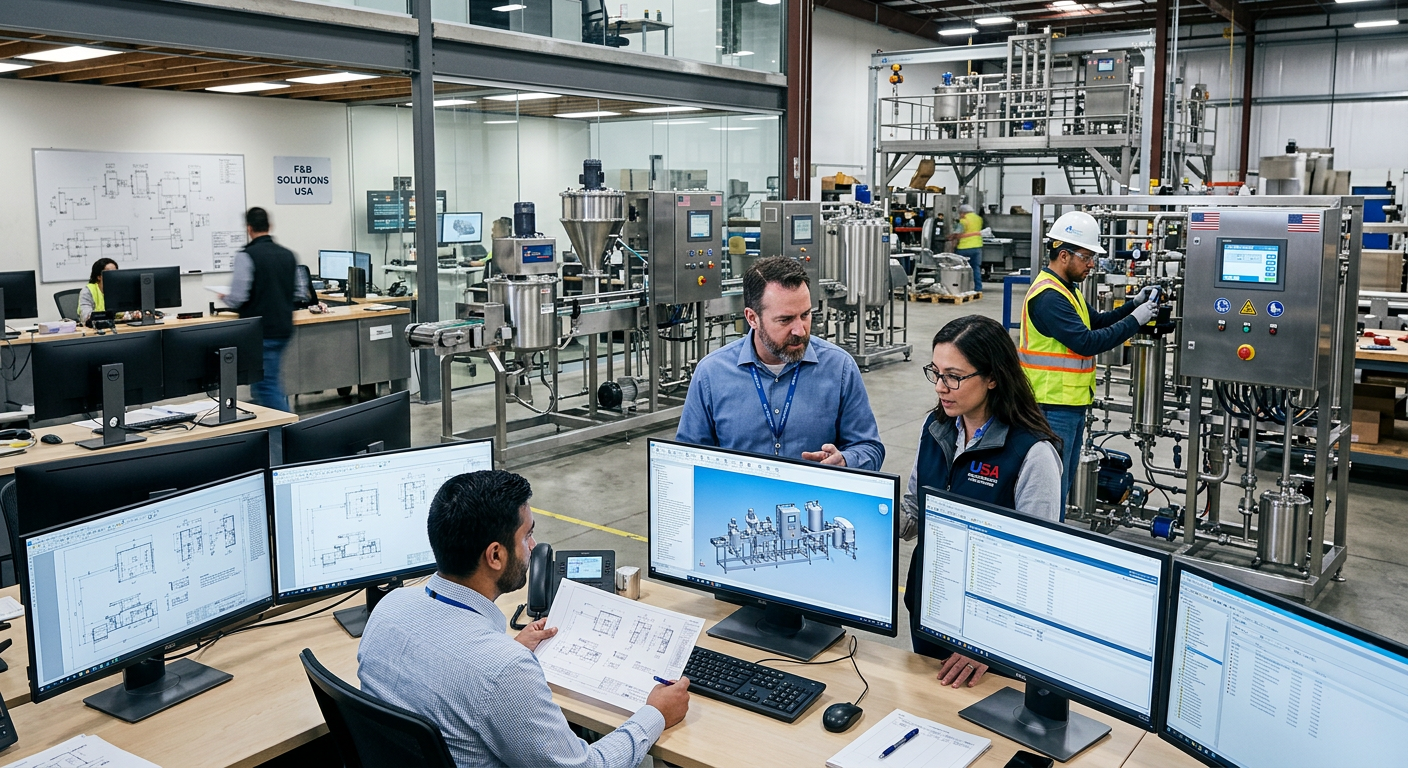
Food Plant Controls Integration
[trp_language language=”en_US”]
Controls Integration for Food and Beverage Manufacturing in the United States
Food plant controls integration is the process of connecting automation, data, and business systems so production equipment, operators, maintenance teams, and management can work from the same information. In a modern U.S. food or beverage facility, that usually means linking PLCs, HMIs, SCADA, historians, MES platforms, quality systems, and ERP software so plant-floor signals become usable operational intelligence. When done correctly, integration improves throughput, traceability, downtime response, recipe consistency, labor efficiency, and capital planning.
Across the United States, manufacturers in places such as Chicago, Dallas, Fresno, Charlotte, Atlanta, Houston, Los Angeles, and the greater Midwest processing corridor are under pressure to produce more with tighter labor markets, stricter traceability expectations, and leaner margins. Facilities near logistics hubs like the Port of Los Angeles, the Port of Houston, Savannah, and rail-connected distribution networks increasingly need integrated operations because production delays do not stay inside one department anymore; they ripple through warehousing, freight scheduling, customer fill rates, and profitability.
For companies evaluating modernization, integration is not just a software project. It is a plant performance project. The real value comes from defining data ownership, standardizing equipment communication, aligning operations technology with business systems, and commissioning a solution that operators will actually use.
Quick Answer

Controls integration in food manufacturing means making PLCs, SCADA, MES, and ERP systems work together as one coordinated environment. The goal is to move from isolated equipment and disconnected data to real-time visibility, faster decision-making, better batch control, stronger traceability, and higher overall equipment effectiveness. In the United States market, the strongest integration projects usually combine legacy equipment strategy, open communication standards such as OPC UA, contextualized production data, cybersecurity segmentation, and disciplined commissioning.
For a processor considering whether integration is worth the investment, the answer is usually yes when the plant has recurring downtime, inconsistent recipes, manual reporting, poor production scheduling feedback, or multiple lines that cannot share common performance metrics. A properly scoped project often delivers measurable gains in throughput, labor utilization, and quality without immediately requiring a full greenfield rebuild.
| Business Problem | Typical Root Cause | Integrated Solution | Expected Benefit |
|---|---|---|---|
| Manual production reporting | Disconnected PLC and ERP data | SCADA historian and MES interface | Faster reporting and fewer data errors |
| Frequent line stoppages | No unified alarm visibility | Centralized SCADA alarming | Reduced downtime response time |
| Recipe inconsistency | Local setpoint changes at equipment level | Batch control and managed recipe governance | More consistent product quality |
| Poor traceability | Lot data trapped in separate systems | MES and quality system integration | Stronger compliance and recall readiness |
| Weak capacity planning | No real production feedback to business systems | ERP production status synchronization | Better planning accuracy |
| High maintenance guesswork | No equipment condition visibility | Historian trends and asset monitoring | Improved preventive maintenance |
The table above shows why integration should be viewed as a business improvement framework rather than a narrow controls upgrade. Each pain point starts on the plant floor, but the impact reaches scheduling, quality, customer service, and finance.
What Controls Integration Means: PLCs, SCADA, MES, and ERP Working Together

At the equipment layer, PLCs run conveyors, pumps, fillers, mixers, pasteurizers, retorts, packaging systems, clean-in-place skids, and utility assets. They are the real-time control engines. SCADA sits above the PLC layer and provides supervisory control, alarm management, visualization, and data collection. MES then turns production signals into workflow logic such as batch execution, work order tracking, electronic records, downtime categorization, and performance management. ERP operates at the business layer, managing purchasing, inventory, demand planning, financials, and enterprise scheduling.
The problem in many older U.S. plants is not that these systems do not exist. It is that they exist separately. The mixer may know a batch started at 7:03 a.m., the SCADA system may record temperatures, the quality lab may hold test results in a spreadsheet, and the ERP may close the order hours later based on manual entry. That delay creates blind spots.
When these layers are connected properly, a planned production order from ERP can flow into MES, which issues a batch or line instruction to the plant. SCADA and PLCs execute the process, operators view status in real time, quality checks are logged against the correct lot, and actual production consumption and output are sent back upstream. This creates closed-loop visibility.
In beverage plants, this often means integrating syrup rooms, blending, carbonation, pasteurization, aseptic filling, bright tanks, and CIP sequencing. In food operations, it may include grinding, mixing, thermal processing, marination, forming, slicing, filling, retort, canning, and packaging. The concept remains the same: every critical production event should be accessible, traceable, and meaningful.
| System Layer | Primary Role | Typical Users | Data Examples |
|---|---|---|---|
| PLCs | Real-time machine control | Controls engineers, maintenance | Motor status, valve position, temperatures |
| SCADA | Supervision and visualization | Operators, supervisors | Alarms, trends, equipment states |
| Historian | Long-term time-series storage | Engineering, quality, reliability | Process trends, event logs |
| MES | Production execution and workflow | Production management, quality | Work orders, lot genealogy, downtime codes |
| ERP | Enterprise planning and business management | Finance, supply chain, leadership | Inventory, orders, costing, schedules |
| Analytics Layer | Insights and optimization | Executives, continuous improvement teams | KPIs, dashboards, forecasting |
This layered model helps plants decide where each function belongs. It also prevents expensive mistakes, such as trying to force ERP to perform machine control tasks or asking PLCs to store enterprise-level records.
The ISA-95 Model: Defining Boundaries Between OT and IT Systems

ISA-95 remains one of the most practical frameworks for defining how operational technology and information technology should interact. For U.S. food and beverage manufacturers, it provides a common language to organize system responsibilities, integration points, and data flows. That matters because many plants grew over time through acquisitions, line additions, and piecemeal automation upgrades rather than from one master architecture.
At a practical level, ISA-95 reduces confusion. It clarifies what belongs at the machine level, what belongs in plant supervisory systems, what belongs in manufacturing operations, and what belongs in enterprise planning. This helps avoid duplicate logic, unnecessary interfaces, and support headaches.
In a brownfield facility, ISA-95 is often most valuable during front-end design. Before programming begins, a project team can map which data points are generated at the machine, which events must be recorded at the plant layer, which workflows require MES orchestration, and which summarized records should feed the ERP. That disciplined boundary-setting keeps projects scalable.
| ISA-95 Level | Description | Food Plant Example | Integration Priority |
|---|---|---|---|
| Level 0 | Physical process | Heating, filling, mixing, conveying | Sensor accuracy and process reliability |
| Level 1 | Sensing and manipulation | Transmitters, VFDs, valves, instruments | Signal integrity |
| Level 2 | Monitoring and control | PLCs, HMIs, local line control | Machine execution and alarms |
| Level 3 | Manufacturing operations | SCADA, MES, historians, batch systems | Plant coordination and records |
| Level 4 | Business planning and logistics | ERP, inventory, order management | Enterprise synchronization |
| Level 5 | External enterprise ecosystem | Supplier portals, cloud analytics, customer systems | Extended visibility and planning |
The table shows how ISA-95 creates a clean boundary between OT and IT while still enabling communication. In real projects, this structure improves cybersecurity, supportability, and long-term change management.
Plants that skip architecture discipline often experience “integration sprawl,” where every new line adds custom code, one-off tags, and local workarounds. Over time, that raises maintenance cost and makes acquisitions or capacity expansion harder. A standards-based architecture is especially valuable for multi-site processors operating across the United States.
Common Integration Challenges: Legacy Equipment, Protocol Mismatches, and Data Silos
The most common barrier to food plant integration is legacy equipment. Many facilities in the United States still run productive but aging assets with proprietary PLCs, obsolete HMIs, serial communications, or vendor-specific control schemes. These systems may still make good product, but they were not designed for modern traceability, remote diagnostics, or enterprise connectivity.
Protocol mismatch is the next major challenge. One line may communicate over EtherNet/IP, another through Modbus TCP, another through Profibus, and an older thermal system through serial Modbus or a custom gateway. Without a clear integration architecture, plants end up stacking translators on translators, which increases failure points.
Data silos also create operational drag. Production records might live in spreadsheets, quality data in a lab application, maintenance notes in a CMMS, and machine events only inside the PLC. The result is that root-cause analysis becomes slow and subjective.
Successful projects start by ranking assets based on business importance, failure risk, and integration readiness. Not every machine needs to be fully modernized on day one. A staged strategy often delivers better ROI.
The line chart illustrates a realistic upward trend in U.S. investment in controls integration, driven by labor constraints, traceability pressure, and the need to increase output from existing facilities rather than relying only on greenfield expansion.
Buying advice for manufacturers: ask potential integration partners how they handle obsolete controllers, unsupported firmware, network segmentation, historian design, and cutover planning. If the answer is only “we can connect it,” that is not enough. You need a roadmap for supportability, documentation, and lifecycle risk.
OPC UA: The Vendor-Independent Standard for Modern Food Plants
OPC UA has become one of the most important enablers of modern integration because it provides a secure, vendor-neutral method for sharing industrial data across systems. In food and beverage environments where production assets often come from different OEMs, this matters greatly. A plant in Wisconsin may have a European aseptic filler, U.S.-built conveyors, a legacy boiler control system, and a separate packaging line from another supplier. OPC UA helps unify communication without locking the facility into one vendor ecosystem.
Its value is not just transport. OPC UA also supports information modeling, which means data can be structured more intelligently. Instead of sending only a tag named “T101_PV,” the system can expose equipment context, engineering units, status, and relationships. That makes downstream applications easier to build and maintain.
For processors planning 2026 upgrades, OPC UA is particularly relevant as more OEMs, cloud analytics tools, and enterprise software platforms support it natively. It aligns well with sustainability programs too, because utilities, water usage, steam consumption, refrigeration loads, and CIP performance can be aggregated more consistently across lines and sites.
| Communication Option | Strength | Limitation | Best Use |
|---|---|---|---|
| OPC UA | Vendor-independent and secure | Requires architecture discipline | Cross-platform plant integration |
| EtherNet/IP | Strong for machine-level control | Less ideal for enterprise abstraction | PLC and device communication |
| Modbus TCP | Simple and widely supported | Limited metadata richness | Utilities and straightforward devices |
| Profibus/Profinet | Common in certain OEM ecosystems | Gateway needs in mixed plants | Existing packaged equipment integration |
| Serial protocols | Works with legacy systems | Slow and harder to scale | Brownfield bridging |
| Custom APIs | Flexible for business systems | Higher support complexity | MES, ERP, and cloud applications |
This comparison shows why OPC UA often serves as the preferred interoperability layer rather than replacing every existing field protocol. It is usually part of the architecture, not the entire architecture.
Contextualized Production Data: Adding Meaning to Raw Plant Signals
Raw plant data has limited value unless it is tied to context. A temperature of 182 degrees means very little by itself. It becomes meaningful when connected to the product SKU, batch number, line, operator, shift, hold time, quality result, and equipment state. That is what contextualized production data means.
In food and beverage processing, context is essential for yield analysis, compliance, and troubleshooting. A simple motor runtime signal can become a maintenance KPI when paired with asset identity and work order history. A filler speed value becomes a planning metric when linked to product changeovers and labor assignments. A pressure event becomes a quality insight when aligned with lot genealogy and sanitation validation.
Plants that contextualize data well can answer questions quickly: Which SKU causes the highest downtime on Line 3? Which shift uses the most water during CIP? Which packaging machine creates the biggest loss during high-acid beverage runs? Which retort profile correlates with rework risk?
The area chart reflects a broader industry shift toward using structured, contextualized data for operational decisions. This trend is accelerating as processors pursue AI-assisted analytics, digital quality records, and better labor deployment.
From a technology standpoint, this is where strong engineering matters. Integrated engineering and controls services should define naming standards, tag strategies, equipment models, alarm philosophy, historian architecture, and KPI calculations early. Without that foundation, dashboards may look impressive but still fail to support daily operations.
Turnkey Integration Projects: From Design to Commissioning
Turnkey controls integration is most effective when it follows a full lifecycle process: discovery, standards definition, conceptual architecture, detailed design, panel and network planning, PLC and SCADA development, FAT, installation, SAT, commissioning, training, and post-startup optimization. In food plants, this must be coordinated with sanitation requirements, production windows, and utility constraints.
The strongest integrators bring together process understanding and controls expertise. That matters because food and beverage systems are not generic machines. Pasteurization, aseptic transfer, retort cycles, blending accuracy, protein handling, and CIP validation all require process-specific logic and documentation.
For this reason, many manufacturers prefer one partner that can support engineering, installation coordination, equipment integration, and startup rather than splitting responsibilities among too many vendors. A design-build-manage approach reduces handoff risk and improves accountability, especially in active facilities where shutdown windows are short.
Disruptive Process Solutions operates in this space as a full-scope food and beverage engineering company serving plants across the United States and Canada. From a service capability standpoint, the company supports capital planning, process engineering, project and program management, owner representation, general contracting functions, installation oversight, and commissioning. That broader project delivery model is important for integration work because controls cannot be separated cleanly from utilities, mechanical systems, and operator workflows.
Technologically, DPS also supports automation, PLC programming, SCADA, utility integration, and system coordination across process and packaging environments. For processors reviewing potential partners, the main question is whether the team understands both plant operations and system architecture, not simply whether it can write code.
| Project Phase | Main Activity | Primary Deliverable | Common Risk to Control |
|---|---|---|---|
| Assessment | Existing system review | Gap analysis and priority list | Unknown legacy dependencies |
| Architecture | Network and system design | Integration roadmap | Scope creep |
| Development | PLC, SCADA, and interface programming | Tested control code and graphics | Inconsistent standards |
| Factory Testing | Offline verification | FAT documentation | Late defect discovery |
| Installation | Field wiring and deployment | Installed hardware and networks | Production disruption |
| Commissioning | Startup and tuning | Operational acceptance | Operator adoption issues |
The table shows why turnkey delivery is more than implementation. Each phase reduces a different type of project risk. In active food plants, the commissioning phase is especially critical because even good code can fail operationally if changeovers, sanitation cycles, or operator procedures were not fully considered.
Cybersecurity Considerations for Integrated Food Plant Networks
As food plant systems become more connected, cybersecurity becomes inseparable from controls integration. The old assumption that a plant network is isolated is no longer reliable. Remote OEM support, cloud analytics, MES connectivity, ERP interfaces, and mobile dashboards all create new pathways that must be secured.
For U.S. processors, practical cybersecurity starts with segmentation. The plant floor should not sit flat on the same network as corporate laptops or guest wireless traffic. Firewalls, managed access zones, role-based authentication, asset inventories, patching plans, backup strategies, and remote access governance are essential.
The best approach balances security with uptime. Food manufacturers cannot simply apply IT practices without considering continuous production, validated processes, sanitation schedules, and legacy controllers. Security controls must be designed around plant realities.
2026 trends point toward stronger customer and regulatory expectations around cyber resilience, especially for high-volume food and beverage facilities tied to major retail supply chains. Insurers are also pushing for stronger controls, documented access management, and tested recovery procedures.
The bar chart highlights strong demand across multiple sectors, with particularly high integration activity in co-packing and beverage due to SKU complexity, speed requirements, and customer reporting expectations.
When evaluating suppliers, ask whether they can document secure remote access, account management, network zoning, PLC backup procedures, and disaster recovery expectations. Cybersecurity should be designed into the project, not added after startup.
Case Study: 30% Production Volume Increase Through Controls Integration
A useful example of controls integration value comes from a real-world situation where a client planned to spend roughly $3 million on expansion for only about a 20% output gain. After analyzing the process and control logic, DPS identified that the true bottleneck was not physical capacity but PLC programming and system coordination. By reworking the automation approach instead of immediately expanding hardware, the plant achieved about a 30% production increase.
This case matters because it shows how integration can unlock hidden capacity. In many facilities, line speed losses come from poor sequencing, conservative interlocks, delayed fault recovery, weak data visibility, or manual process steps that could be orchestrated more intelligently. New equipment is not always the first answer.
For manufacturers, this is also a buying lesson. Before approving large capital budgets, ask for a structured controls and process assessment. A strong partner should be willing to challenge assumptions if data suggests that software, workflow, or integration changes can deliver better returns.
From a manufacturing capability standpoint, DPS supports not only controls integration but also process equipment systems used throughout food and beverage production. The company works across tanks, CIP skids, cooking vessels, marination systems, utilities, thermal processing platforms, fermentation systems, blending systems, and other plant assets. That breadth matters because integration gains are often found at the intersections between equipment behavior, utility stability, and process timing.
Manufacturers looking for local or regional support should prioritize firms that understand U.S. code requirements, sanitary expectations, commissioning in live production environments, and the practical realities of multi-trade coordination in cities from North Carolina to California to Texas. A national footprint with strong partner networks can be advantageous for multi-site programs.
The comparison chart illustrates why specialized food and beverage project partners often outperform generalist suppliers on complex integration work. The differentiator is not only controls expertise but also process knowledge, installation coordination, and startup execution.
Companies researching integrators can review project case examples, assess relevant process experience, and verify whether the team can support both immediate production needs and long-range capital programs.
FAQ
What is the difference between controls integration and automation?
Automation usually refers to making a machine or process run automatically. Controls integration goes further by connecting machines, supervisory systems, data platforms, and business software so the whole plant operates with shared information.
Do all food plants need MES?
No. Some small or mid-sized facilities can achieve major gains with PLC, SCADA, historian, and ERP connectivity before adding full MES. The right answer depends on batch complexity, traceability requirements, quality workflows, and scale.
Can legacy equipment be integrated without replacement?
Often yes. Gateways, protocol converters, edge devices, and selective PLC upgrades can extend useful life. However, unsupported hardware should be evaluated carefully for cybersecurity and downtime risk.
Why is OPC UA important?
It enables secure, vendor-independent communication and supports better data modeling, which is valuable in mixed-vendor food plants and multi-site U.S. operations.
How long does a controls integration project take?
A focused line-level project might take a few months. A multi-line or plantwide program can take much longer, especially if it includes ERP interfaces, network redesign, and phased cutovers around production schedules.
What are the most important KPIs to track after integration?
OEE, downtime by cause, schedule attainment, recipe adherence, yield, utility consumption, CIP performance, labor utilization, quality exceptions, and lot traceability completeness are common starting points.
How should a company choose an integration partner?
Look for food and beverage process knowledge, strong controls engineering, cybersecurity awareness, documentation discipline, commissioning experience, and the ability to coordinate across mechanical, electrical, utility, and operations teams. Learn more about the DPS team and project philosophy and review available process equipment capabilities when comparing options.
What trends will shape controls integration in 2026?
Expect broader use of OPC UA, stronger OT cybersecurity requirements, more contextualized data models, AI-assisted analytics, energy and water monitoring, tighter traceability expectations, and sustainability reporting tied directly to production systems.
In summary, controls integration is one of the highest-leverage investments available to U.S. food and beverage manufacturers because it improves both production execution and business visibility. Whether the goal is to debottleneck a protein line in the Midwest, improve aseptic records in California, stabilize beverage throughput in Texas, or coordinate a multi-site expansion across North America, the winning strategy is the same: build a standards-based architecture, prioritize meaningful data, secure the network, and choose a partner that understands how real food plants run.
[/trp_language]
Complete Company Portfolio

About the Author: Disruptive Process Solutions (DPS)
The DPS team combines process engineering expertise with real-world food and beverage manufacturing experience. Our content focuses on process optimization, production efficiency, facility improvements, and practical solutions that help manufacturers operate more effectively in a rapidly evolving industry.
Share

