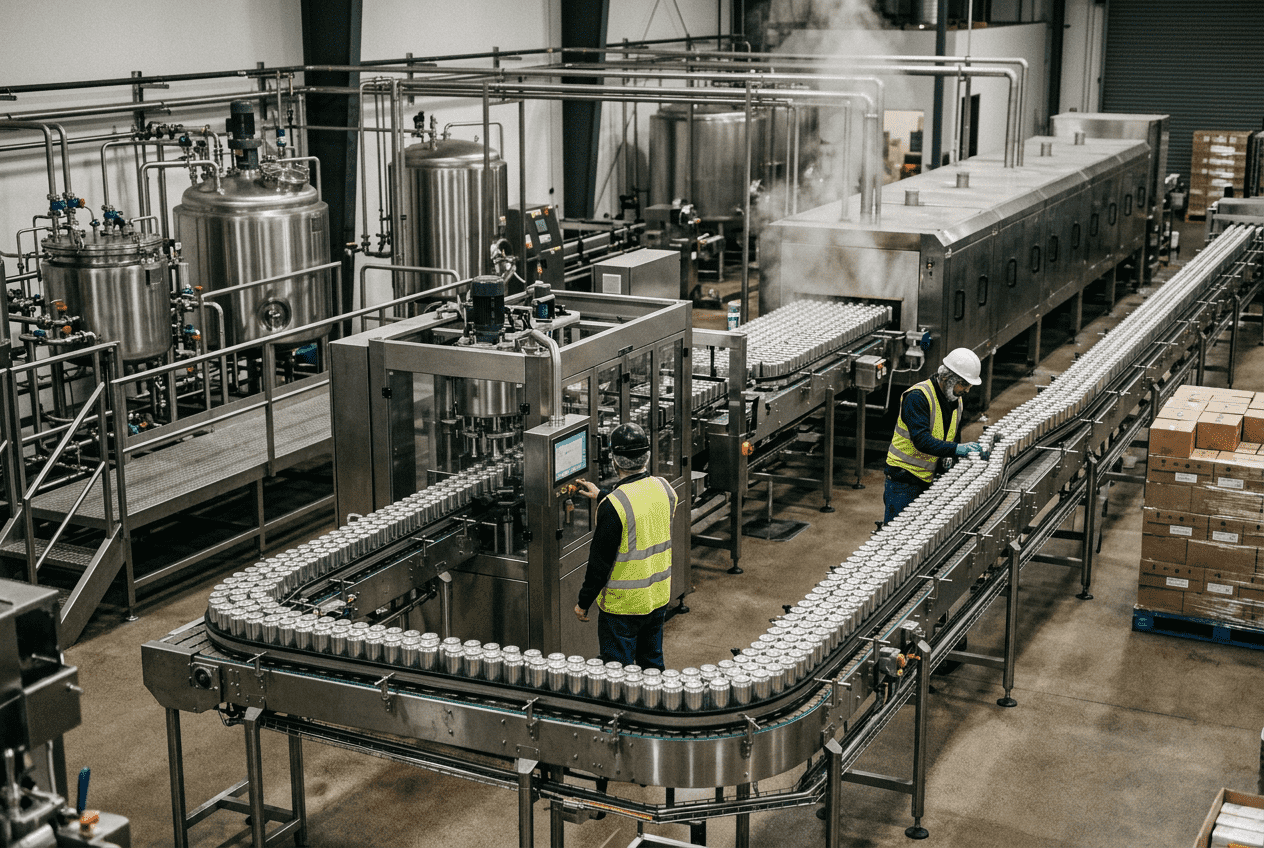
Food Plant Electrical Classification: Class II Division System for Dust Hazards
[trp_language language=”en_US”]
Electrical Classification for Combustible Dust in U.S. Food Plants
Food and beverage facilities across the United States routinely handle sugar, flour, starch, cocoa, spices, dairy powders, grain fines, and other materials that can create combustible dust hazards. In plants from Chicago and Kansas City to Fresno, Houston, Atlanta, and the Port of Los Angeles region, electrical design must account for where ignitable dust may be present and how equipment can become an ignition source. A correct Class II Division system approach helps plant owners protect people, maintain code compliance, reduce insurance exposure, and support stable production.
Quick Answer

In the United States, food plants that handle combustible dust generally use the Class II Division system to classify hazardous electrical locations. Class II applies to combustible dust. Division 1 covers areas where dust is present in the air under normal operating conditions, or where mechanical failure can frequently create ignitable concentrations. Division 2 covers areas where dust is not normally suspended in hazardous amounts but may accumulate on equipment or become airborne only under abnormal conditions. Designers typically evaluate the hazard using NFPA 499, the National Electrical Code, the process layout, cleaning methods, dust collection performance, and actual operating history.
For most food facilities, the answer is not simply “use explosion-proof gear everywhere.” The practical solution is to identify where the hazard truly exists, match the correct dust-ignition-proof or dust-tight equipment to that zone, detail enclosures and seals properly, and maintain grounding, bonding, housekeeping, and inspection programs over the life of the system. Plants that integrate this work early during capital planning usually avoid expensive retrofits later.
In real projects, the classification often changes by room and even by elevation. A packaging room for powdered drink mix in New Jersey may need different treatment than a grain receiving pit in Iowa, a sugar unloading point near the Port of Savannah, or a seasoning room in Arkansas. The direct answer is that area classification must follow the dust behavior of the process, not just the product label.
| Plant Area | Typical Material | Dust Exposure Pattern | Likely Class | Common Design Concern | Typical Action |
|---|---|---|---|---|---|
| Bag dump station | Flour, starch, sugar | Frequent airborne release during loading | Class II Division 1 | Motor and switchgear ignition | Use suitable classified equipment and dust control |
| Conveyor transfer point | Grain fines | Intermittent release in normal operation | Class II Division 1 or 2 | Dust cloud formation | Review enclosure, ventilation, and dust collection |
| Packaging room perimeter | Powdered ingredients | Occasional escape, surface accumulation | Class II Division 2 | Dust layers on motors and lights | Dust-tight equipment and housekeeping controls |
| Dust collector discharge area | Mixed dust stream | Abnormal release risk | Class II Division 2 | Leak or upset event | Evaluate upset scenarios and isolation approach |
| Warehouse | Closed ingredients | No routine airborne dust | Unclassified or adjacent controlled area | Migration from process room | Maintain separation and pressure strategy |
| CIP room | Liquid process only | No combustible dust process | Usually unclassified | Water ingress instead of dust hazard | Use washdown-rated, sanitary equipment |
The table above shows why classification in food manufacturing is process-specific. Two rooms in the same facility may require very different electrical strategies depending on release frequency, dust accumulation, and upset conditions.
Class II Division 1 vs Division 2 Area Classification

The most important distinction in dust hazard design is whether the area is Division 1 or Division 2. In simple terms, Division 1 means the dust hazard is expected during normal operation. Division 2 means the hazard is not normally expected in ignitable concentrations, but it could occur due to leakage, process upset, poor containment, or excessive layer buildup.
For example, a blender charging point in a powdered soup facility in Ohio may be Division 1 because operators open bags, charge ingredients, and generate visible dust as part of normal work. By contrast, the aisle ten feet away may be Division 2 if good capture ventilation keeps the dust source localized and only occasional migration is expected. The same logic applies in spice rooms in Texas, bakery mix plants in Pennsylvania, cocoa processing lines in New Jersey, and dairy powder systems in Wisconsin.
One common mistake is classifying too broadly because stakeholders want a conservative answer. Another common mistake is classifying too narrowly because they want to control cost. Both can be expensive. Overclassification drives unnecessary spend on equipment and installation. Underclassification creates serious safety and compliance risk. Good design depends on field observation, dust release mapping, operating interviews, and coordinated review between process, mechanical, controls, and electrical disciplines.
| Criteria | Class II Division 1 | Class II Division 2 | Food Plant Example | Electrical Implication | Risk Level |
|---|---|---|---|---|---|
| Dust in air during normal operation | Yes | No, not normally | Open bag dump | Classified equipment required | High |
| Dust layer buildup | May occur | Often key indicator | Top of conduit, motors, beams | Temperature control matters | Moderate to high |
| Upset condition creates hazard | Frequent or inherent | Abnormal condition | Dust collector leak | Review fail state and isolation | Moderate |
| Typical containment quality | Open or semi-open handling | Closed handling with limited escape | Auger feed vs sealed transfer | Different device ratings | Varies |
| Cleaning sensitivity | Very high | High | Seasoning lines | Need maintenance discipline | High if neglected |
| Installation cost impact | Higher | Moderate | Motor circuits and fittings | Affects capital budget | Business critical |
This comparison matters during equipment procurement as well. If the classified boundary is defined correctly, the plant may place non-classified VFD panels, PLC cabinets, and operator stations outside the hazard envelope while keeping only the field devices inside the classified area. That can materially reduce both cost and maintenance burden.
The chart reflects a realistic market trend: spending on dust hazard mitigation and classified electrical upgrades in U.S. food plants has been rising steadily, driven by stricter owner standards, insurer expectations, aging plants, and expansion in powdered and dry ingredient processing.
NFPA 499 Combustible Dust Hazard Evaluation

NFPA 499 is widely used to help evaluate combustible dust hazards and support classification decisions. It does not replace engineering judgment, but it gives a structured basis for understanding dust characteristics, release behavior, and likely electrical area classification. In food manufacturing, this evaluation should tie closely to dust testing data, process flow, housekeeping standards, ventilation design, and incident history.
A proper combustible dust hazard evaluation often includes the following: identifying where dust is generated, whether it can become suspended, expected particle size, the amount of dust accumulation, cleaning methods, enclosure leakage points, deflagration isolation strategy, and whether process changes are planned. In the United States, many older plants in legacy industrial districts such as St. Louis, Milwaukee, and Baltimore have expanded over time without a full re-baselining of hazard zones. That is where an updated NFPA-aligned review becomes especially valuable.
Food product type also matters. Fine sugar dust behaves differently than coarse grain, milk powder, or spice blends with oil content. A cereal plant in Minneapolis, a tortilla ingredient facility in Dallas, and a protein powder operation in Southern California may all be Class II environments, but their hazard profile and device selection can differ significantly.
| Evaluation Factor | Why It Matters | Typical Data Source | Food Example | Electrical Design Impact | Priority |
|---|---|---|---|---|---|
| Dust combustibility | Confirms ignition potential | Lab testing and SDS review | Sugar, flour, dairy powder | Determines need for classified design | Critical |
| Particle size | Finer dust suspends more easily | Process and quality data | Milled spices | Affects likely division assignment | High |
| Release frequency | Defines normal vs abnormal hazard | Operator interviews and observation | Bag charging station | Division 1 or 2 boundary | Critical |
| Dust layer thickness | Can ignite on hot surfaces | Housekeeping audits | Top of luminaires | Temperature rating and cleaning program | High |
| Ventilation effectiveness | Limits migration and accumulation | Mechanical design review | Packaging room exhaust | Can reduce classified footprint | High |
| Equipment upset scenarios | Abnormal leaks can create clouds | Maintenance history | Broken gasket on collector | Division 2 treatment nearby | Moderate to high |
The best hazard evaluations are field-based, not desk-only. A drawing review may suggest a fully closed system, but an on-site walk can reveal operators cracking access hatches, changing totes manually, or bypassing dust capture during sanitation. That difference is often what separates a compliant design from a theoretical one.
Dust-Ignition-Proof Equipment Selection Criteria
Once classification is established, equipment selection must match both the hazardous location and the practical operating environment. In a food plant, electrical gear is not dealing only with dust. It may also face washdown, caustic cleaners, vibration, cold storage, thermal cycling, and frequent sanitation. The correct device is one that satisfies code, survives the process, and remains maintainable.
For Class II areas, designers usually review motors, junction boxes, sensors, lighting, disconnects, conduit fittings, cable glands, instrument enclosures, and heat-trace accessories. Surface temperature control is critical because dust layers can insulate a hot surface and create ignition conditions. Device listing, ingress protection, gasket materials, corrosion resistance, mounting height, and cleanability all matter. A seasoning line in Nashville or a bakery premix room near Philadelphia may need gear that handles both dust classification and aggressive washdown cycles.
Plants should also consider lifecycle cost. A low-cost component with poor gasket durability may require repeated replacement, increase downtime, and undermine the original classification strategy. Procurement teams often benefit from involving plant maintenance and operations before final specification.
| Equipment Type | Selection Focus | Common Error | Preferred Approach | Food Plant Example | Comment |
|---|---|---|---|---|---|
| Motors | Class II suitability and temperature control | Using general purpose motor near dust release | Specify listed motor for area and duty | Ribbon blender drive | Check sanitation exposure too |
| Lighting | Dust-tight housing and lens integrity | Open fixtures collecting dust | Use sealed rated fixtures | Powder packaging room | Maintenance access should be simple |
| Disconnects | Enclosure rating and location | Installing within release zone unnecessarily | Relocate when possible outside boundary | Auger motor station | Can reduce classified device count |
| Sensors | Probe sealing and cleaning compatibility | Exposed housings fouled by product | Use hygienic mounting with listed bodies | Bin level detection | Supports both process and safety |
| Junction boxes | Seal integrity and dust ingress resistance | Improper cover or field drilling | Factory-rated enclosures with controlled entries | Conveyor branch circuit | Document field modifications carefully |
| Panels and VFDs | Boundary placement and cooling design | Locating expensive controls inside hazard area | Place outside classified zone when feasible | Seasoning skid controls | Major cost and reliability driver |
Buying advice for U.S. manufacturers is straightforward: do not purchase classified electrical equipment by catalog title alone. Confirm the listing, ambient limits, dust group relevance, enclosure details, spare parts availability, sanitation compatibility, and service support in the states where the facility operates. National brands matter, but so does local support in markets such as North Carolina, California, Texas, Illinois, and Georgia where response time can affect startup schedules.
The bar chart highlights where demand is strongest. Grain milling, sugar handling, dairy powder, and bakery sectors remain heavy users of Class II electrical design because they combine fine particulates, continuous handling, and large-scale throughput.
Electrical Enclosures and Sealing Requirements
Enclosures and sealing are often where strong design intent succeeds or fails in the field. A well-classified installation can still underperform if conduit entries are poorly sealed, covers are left loose after troubleshooting, or field cuts compromise the enclosure. In food plants, the issue is amplified by washdown and sanitation cycles that stress gaskets and hardware.
Designers should evaluate enclosure material, rating, sealing methods, cable entry approach, drain and breather considerations, condensation risk, and accessibility for maintenance. The goal is to prevent dust ingress, control ignition risk, and keep the system workable for operators. Facilities near humid coastal markets such as Charleston, New Orleans, and the Port of Houston may also need extra attention to corrosion and condensation.
There is no one-size-fits-all enclosure strategy. Stainless steel may make sense in sanitary food contact-adjacent spaces, while coated heavy-duty enclosures may work in dry utility zones. The most common issue is mixing incompatible field components: a good enclosure body, a poor gland, and an improvised site modification.
| Requirement | Purpose | Frequent Site Issue | Best Practice | Where Used | Result |
|---|---|---|---|---|---|
| Dust-tight enclosure construction | Prevent dust entry | Improper replacement covers | Standardize approved spare parts | J-boxes and device stations | Better long-term integrity |
| Sealed conduit or cable entry | Reduce dust migration path | Loose fittings | Install listed sealing fittings as required | Motor and branch circuits | Higher reliability |
| Gasket compatibility | Maintain seal through sanitation | Chemical degradation | Match gasket to cleaning regime | Washdown rooms | Fewer ingress failures |
| Corrosion resistance | Preserve enclosure performance | Rusting hardware | Use stainless or suitable coated systems | Coastal or wet facilities | Longer equipment life |
| Temperature management | Avoid overheating and ignition risk | Overpacked boxes and poor ventilation | Right-size enclosure and heat load | Local control stations | Safer operation |
| Accessible maintenance layout | Reduce damage during service | Tight mounting makes improper reassembly likely | Allow working clearance | Skids and mezzanines | Better inspection quality |
From a procurement standpoint, local supplier relationships can help, but plants should avoid buying piecemeal without a coordinated submittal review. Whether materials are sourced through distributors in Charlotte, Dallas-Fort Worth, Milwaukee, or the Inland Empire, the installation package should be checked as a system rather than as disconnected parts.
Grounding and Bonding for Dust Hazard Areas
Grounding and bonding are foundational in combustible dust environments. They help control static electricity, support fault clearing, and reduce the chance that conductive equipment or transfer systems become ignition sources. In food processing, this extends beyond branch circuits to process equipment, ductwork, flexible connectors, dust collection systems, bulk bag stations, pneumatic transfer components, and portable vessels.
Plants handling flour, sugar, cocoa, starch, or dry nutraceutical blends should pay particular attention to product transfer steps. Powder movement through chutes, flexible hoses, sifters, and filling heads can generate electrostatic charge. If bonding paths are inconsistent or grounding is neglected during maintenance, the hazard increases.
The issue is especially important in high-throughput dry facilities located around major grain and logistics corridors such as Omaha, Wichita, Indianapolis, Memphis, and the Port of Tacoma. Fast transfer rates and frequent truck, rail, or tote changeovers increase the value of disciplined grounding procedures.
| Item | Grounding or Bonding Need | Typical Failure Mode | Control Method | Applicable Area | Operational Benefit |
|---|---|---|---|---|---|
| Dust collector housing | Equipment grounding | Loose grounding conductor | Permanent bonded connection | Dry ingredient rooms | Safer fault path |
| Metal ductwork | Bonding across sections | Isolation by flexible joints | Install bonding jumpers | Ventilation systems | Static reduction |
| Bulk bag station | Ground operator-connected equipment | Unverified temporary clips | Use monitored grounding systems | Bag unloading | Consistent discharge control |
| Portable tote or drum | Bond during transfer | Painted surfaces reduce continuity | Designate bonding points | Batch rooms | Improved transfer safety |
| Conveyor and spouting | Continuity across supports | Mechanical repairs break bond path | Periodic continuity checks | Flour and grain systems | Reduced static buildup |
| Motor and skid frame | Equipment grounding conductor integrity | Field modification without re-termination | Commissioning verification | All classified process skids | Better electrical protection |
The practical takeaway is that grounding and bonding should not be left only to an electrician at the end of the job. They must be built into the mechanical and process design from the start, especially where portable ingredient handling is involved.
This area chart shows an important industry shift. More owners are moving away from reactive retrofits toward integrated design-build execution, where process, utility, controls, and electrical classification are coordinated from the beginning.
Inspection and Maintenance of Classified Equipment
Even the best classified installation degrades without inspection and maintenance. Food plants often run long hours, cycle between production and sanitation, and operate in facilities where maintenance teams are balancing urgent uptime demands. That environment can gradually erode enclosure integrity, grounding continuity, labeling, and temperature safety margins.
An effective program should include routine visual inspection, documented torque and seal checks where appropriate, cleaning verification, replacement part control, and revalidation after modifications. When a conduit is moved, a motor is swapped, or a level sensor is upgraded, the classified design basis should be reviewed. Too many incidents begin with an apparently small field change.
Case patterns across the market are consistent. A Midwest bakery may replace a failed motor with a standard unit during an emergency shutdown. A snack seasoning plant in Georgia may leave an enclosure latch partially open after troubleshooting. A dairy powder room in Idaho may accumulate dust on fixtures because overhead cleaning access is difficult. These are maintenance management issues as much as design issues.
| Inspection Item | Frequency | What to Check | Warning Sign | Corrective Action | Owner Benefit |
|---|---|---|---|---|---|
| Enclosure covers and latches | Monthly | Seal condition and tight closure | Dust inside housing | Replace gasket and retrain staff | Preserves listing intent |
| Grounding and bonding continuity | Quarterly | Continuity at key process assets | Loose or missing jumpers | Repair and document | Reduces static and fault risk |
| Motor temperature and cleanliness | Monthly | Dust buildup and overheating signs | Caked layers on frame | Clean and assess ventilation | Longer motor life |
| Conduit seals and fittings | Semiannual | Integrity and mechanical damage | Cracked fitting or corrosion | Replace listed component | Maintains barrier performance |
| Labeling and documentation | Annual | Hazard marking and panel schedule accuracy | Missing or outdated tags | Update asset records | Improves service safety |
| Post-modification review | Every change | Classification impact of new work | Unapproved field rerouting | Engineering re-review | Avoids hidden noncompliance |
Inspection programs work best when they are tied to operating reality. If a plant has heavy seasonal demand, schedule deeper inspection ahead of peak throughput. If a facility adds new powder products, review whether the original dust hazard assumptions still hold.
Design-Build Electrical Safety Integration
Dust hazard control in food plants works best when electrical classification is integrated with process engineering, mechanical systems, controls architecture, sanitation planning, and construction sequencing. A design-build approach reduces the disconnects that commonly appear when multiple parties work from different assumptions. It can also improve startup speed, procurement alignment, and budget accuracy.
In practice, electrical classification affects equipment layout, dust collector placement, access platforms, utility routing, panel locations, operator interfaces, and cleaning procedures. If these are decided in isolation, the project often ends in late-stage redesign. That is especially common in fast-moving greenfield and brownfield programs around major U.S. manufacturing corridors such as the Carolinas, the Dallas-Fort Worth region, Central California, the Upper Midwest, and the Southeast logistics belt.
Integrated execution is also valuable when balancing product types. Dry ingredient receiving, conveying, blending, filling, and packaging all interact with dust hazards differently. A project team needs to understand the market, the plant’s production targets, the available labor, and the local inspection environment. Buying advice here is simple: ask not only whether a contractor can install classified gear, but whether the team can align process flow, code compliance, startup, and long-term maintainability.
Future trends through 2026 and beyond are clear. U.S. owners are increasingly requesting digital asset tracking for classified equipment, smarter maintenance documentation, better dust collection monitoring, and sustainability-aligned designs that reduce energy waste while improving safety. Policy pressure is also moving toward more formalized combustible dust documentation, stronger insurer review, and higher expectations for integrated hazard analysis during capital projects.
Applications are broad across industries: bakery, cereal, snack foods, dairy powder, spices, protein ingredients, pet food, grain handling, nutraceuticals, and dry beverage mixes. In many of these sectors, the right electrical design is not a back-end compliance exercise. It is a production-enabling investment.
The comparison chart illustrates a reality many plant owners have already experienced: the lowest initial electrical bid is rarely the strongest long-term option when combustible dust areas are involved. Integration quality matters more than line-item cost alone.
For manufacturers reviewing partners, it is useful to study actual outcomes. You can explore examples of execution through these food and beverage project case studies, where integrated planning and field coordination drive better startup and operational performance.
Our Company
Disruptive Process Solutions supports food and beverage manufacturers across the United States and Canada with practical, business-minded engineering and execution. Rather than treating hazardous area electrical work as a stand-alone code exercise, the company aligns it with throughput goals, utility planning, sanitation realities, and capital efficiency. You can learn more about the team and operating philosophy on the company overview page.
From a technological capabilities standpoint, DPS works across structural, mechanical, plumbing, electrical, process, and controls engineering. That includes automation, PLC programming, SCADA, utility integration, and process system design for applications ranging from aseptic lines and beverage processing to dry ingredient handling and protein production. This multidisciplinary capability is especially relevant in Class II areas because process changes, ventilation strategy, controls placement, and electrical classification all influence one another.
From a manufacturing capabilities standpoint, DPS also designs and supplies its own process equipment, including tanks, CIP systems, tumblers, and cooking vessels, while integrating third-party equipment into complete lines. That matters in dust hazard environments because equipment geometry, access, cleaning method, and connection strategy can either reduce or increase the classified footprint. More detail on available systems can be found in the process equipment section.
From a service capabilities standpoint, DPS delivers process engineering, capital planning, owner’s representation, project and program management, general contracting where licensed, installation oversight, commissioning, and turnkey integration. Its Design Build Manage approach is structured to help manufacturers avoid fragmented decision-making and late redesign. Service details are available through the engineering and project services page.
For U.S. food plants evaluating dust hazard electrical upgrades, that integrated model can be useful in both greenfield and brownfield settings. It supports early classification review, procurement alignment, constructability planning, startup coordination, and long-term plant maintainability instead of treating safety, process, and budget as separate conversations.
FAQ
What does Class II mean in a food plant?
Class II refers to hazardous locations where combustible dust may be present. In food plants, that often includes flour, sugar, starch, grain, spice, cocoa, dairy powder, and similar materials.
What is the difference between Division 1 and Division 2?
Division 1 means ignitable dust concentrations are expected during normal operation. Division 2 means they are not normally present in hazardous concentrations but could occur under abnormal conditions or from layer disturbance.
Does every room in a powder handling facility need classified equipment?
No. Classification should be based on actual dust release and accumulation behavior. Many facilities can keep some controls and power distribution outside the classified boundary with proper layout and containment.
Is NFPA 499 enough by itself to classify the area?
NFPA 499 is an important guide, but the final design should also consider the National Electrical Code, site conditions, dust test data, process operation, housekeeping, and engineering judgment.
Can washdown-rated equipment automatically be used in Class II areas?
No. Washdown suitability and hazardous location suitability are different requirements. A device may survive sanitation but still not be listed for combustible dust locations.
What products in the U.S. food market most often trigger Class II reviews?
Flour, sugar, starch, grain products, cocoa, spices, dairy powders, protein powders, and dry beverage mixes are among the most common drivers.
How often should classified equipment be inspected?
Frequency depends on process severity and plant policy, but monthly visual checks and periodic documented inspections are common. Always inspect after modifications or equipment replacement.
What are the biggest buying mistakes?
The biggest mistakes are overgeneralizing the classification, buying equipment by catalog label without listing review, and separating electrical decisions from process and mechanical design.
What trends should plants watch in 2026?
Expect more digital documentation of classified assets, stronger insurer scrutiny, broader use of integrated design-build delivery, smarter dust collection monitoring, and more pressure to combine safety with energy-efficient plant design.
How can a plant start if it is unsure about its dust hazard status?
Begin with a structured combustible dust hazard evaluation, field survey, and review of process flow, sanitation, maintenance history, and equipment layout. That creates a defensible basis for classification and investment decisions.
Across the United States, from inland production hubs to port-adjacent processors, combustible dust electrical classification remains a high-value discipline for food manufacturing. Plants that evaluate the real hazard, select the right equipment, maintain enclosures and bonding, and integrate safety into project delivery are better positioned to protect people, satisfy regulators and insurers, and keep production profitable.
[/trp_language]
Complete Company Portfolio

About the Author: Disruptive Process Solutions (DPS)
The DPS team combines process engineering expertise with real-world food and beverage manufacturing experience. Our content focuses on process optimization, production efficiency, facility improvements, and practical solutions that help manufacturers operate more effectively in a rapidly evolving industry.
Share

