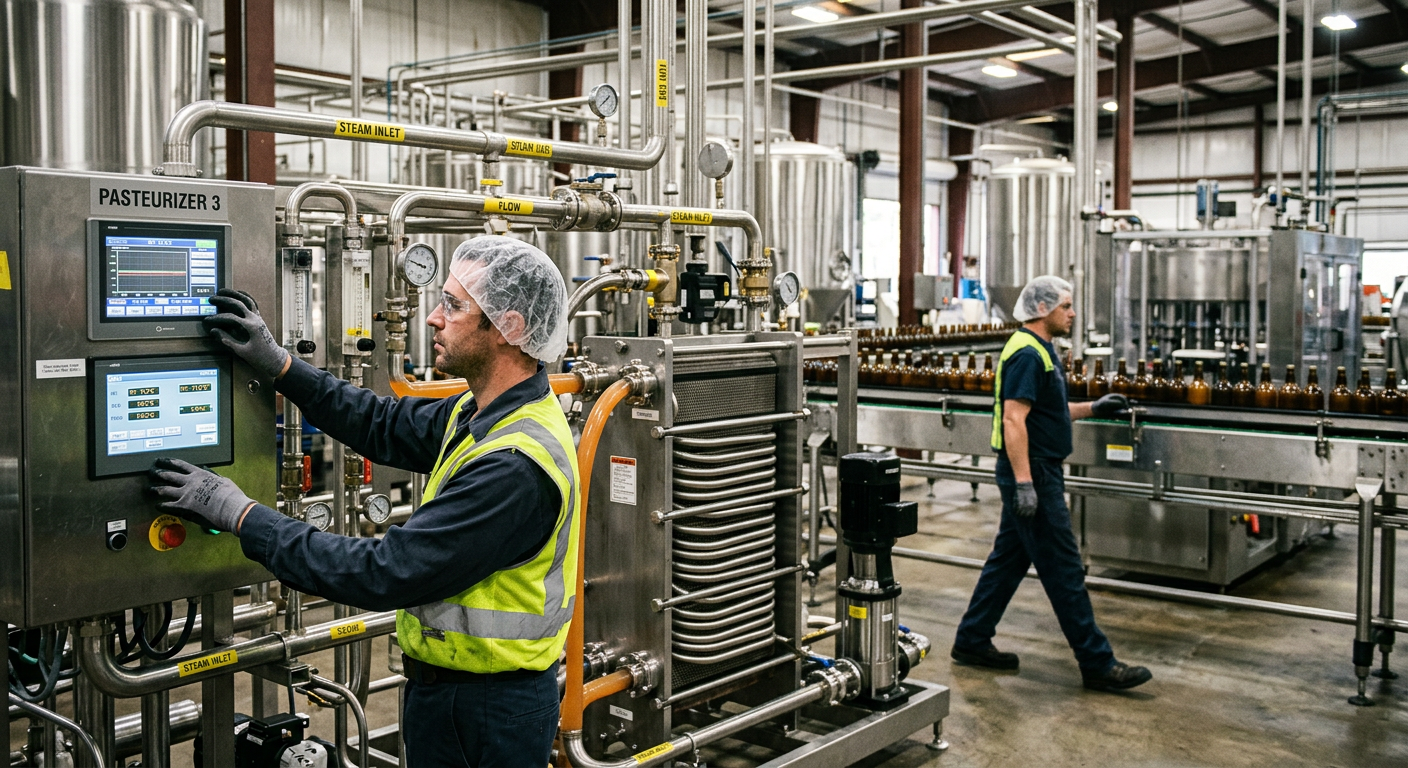
Food Plant General Contractor Selection: Essential Qualification Criteria
[trp_language language=”en_US”]
Choosing a general contractor for a food or beverage facility in the United States is not the same as hiring a commercial builder for an office, warehouse, or retail shell. Food plants operate under production pressure, sanitation expectations, utility complexity, audit scrutiny, and regulatory oversight that make contractor qualification a business-critical decision. Whether a manufacturer is expanding a dairy line in Wisconsin, relocating packaging assets to Texas, adding cold-chain capacity near the Port of Savannah, or building a beverage co-packing operation in California, the contractor must understand both construction execution and process-driven manufacturing realities.
The most reliable selection framework combines direct evaluation of food industry experience, self-perform depth, safety performance, financial stability, project portfolio fit, regulatory fluency, communication discipline, and regional execution capacity. In practice, this means owners should verify how a contractor handles hygienic design, shutdown planning, utilities integration, live-plant work, commissioning, documentation, and trade coordination across markets such as Chicago, Charlotte, Fresno, Dallas-Fort Worth, Houston, and the Northeast corridor.
Below is a practical qualification guide designed for U.S. food and beverage manufacturers, private equity-backed platforms, co-packers, and plant leadership teams that need to reduce project risk while protecting throughput, product quality, and capital efficiency.
Quick Answer

The best way to select a food plant general contractor in the United States is to evaluate eight qualification areas together rather than relying on bid price alone. First, confirm deep food and beverage experience in your product category, such as protein, dairy, aseptic beverages, sauces, or ready-to-drink packaging. Second, assess true self-perform and integration capabilities, especially in process equipment, utilities, controls, and startup support. Third, review OSHA performance, EMR, training, and incident prevention systems. Fourth, verify financial strength, bonding support, and the ability to maintain schedule under procurement pressure. Fifth, study comparable project portfolios, including live-facility renovations and brownfield work. Sixth, test regulatory knowledge covering FDA, USDA, SQF, BRC, sanitation, allergen control, and documentation. Seventh, require disciplined communication and escalation protocols. Finally, choose a contractor whose operating model aligns with your production goals, not just your construction scope.
For most owners, a strong food plant contractor should function as more than a builder. The right partner helps shape capital planning, validates utility loads, anticipates shutdown windows, and manages local trades without losing sight of product flow and profitability. That is especially important in U.S. manufacturing regions where labor availability, inspection timelines, and supply chain exposure vary sharply from one market to another.
| Qualification Area | What to Verify | Why It Matters | Typical Red Flag |
|---|---|---|---|
| Food Industry Experience | Comparable food or beverage projects by product type | Reduces hygienic design and startup risk | General industrial experience only |
| Self-Perform Capacity | Process, utility, controls, and installation depth | Improves schedule control and coordination | Excessive dependence on unknown subs |
| Safety Record | TRIR, EMR, OSHA history, training systems | Protects people, uptime, and insurance position | No current metrics or weak documentation |
| Financial Strength | Bonding, working capital, procurement capacity | Supports long-lead purchases and cash flow | Cannot pre-buy or carry equipment |
| Regulatory Fluency | FDA, USDA, SQF, BRC, sanitation requirements | Avoids compliance gaps and rework | Talks only about building code |
| Communication Standards | Meeting cadence, reporting, escalation, turnover docs | Keeps stakeholders aligned and accountable | Informal updates with no issue logs |
This summary table shows why contractor selection should be treated as an operational qualification exercise, not a commodity purchasing event. The best candidates demonstrate balance across all six areas rather than a single strength.
Food Industry Experience Requirements

Food manufacturing experience should be verified at the product and process level. A contractor that has built dry warehouses, office additions, or generic industrial facilities may still struggle in a USDA-inspected protein room, an aseptic beverage environment, or a high-care dairy packaging zone. Owners should ask for project examples that match their production profile, utility intensity, sanitation regime, and audit obligations.
For example, a poultry processor in Arkansas has very different priorities than a kombucha producer in Southern California. The poultry facility may require washdown-rated electrical infrastructure, thermal processing support, floor slope management, and raw-to-ready segregation. The kombucha producer may care more about fermentation vessel integration, carbonation, blending accuracy, bright tanks, and sanitary piping. Likewise, a sauce plant in New Jersey dealing with hot-fill operations has different risk points than a plant-based protein manufacturer in the Midwest handling hydration, mixing, and texture control.
Owners should also examine whether the contractor has worked in both greenfield and brownfield settings. In the United States, many projects happen inside operating plants where lost production can cost far more than construction itself. Work in active facilities near major logistics nodes such as Chicago, Atlanta, Houston, the Inland Empire, or the Port of Long Beach often requires careful phasing to protect daily shipments and labor movement.
| Product Segment | Key Construction Issues | Important Process Knowledge | Best Evidence to Request |
|---|---|---|---|
| Dairy | Drainage, hygienic finishes, cold chain interfaces | Pasteurization, homogenization, CIP, separation | Milk, yogurt, or cheese plant case history |
| Protein | Washdown, segregation, corrosion resistance | Cutting, deboning, marinating, cooking, chilling | USDA-inspected facility project list |
| Ready-to-Drink Beverages | High utility demand, packaging integration | Blending, carbonation, syrup rooms, filling | Line installation and startup records |
| Aseptic Processing | Controlled environment build standards | UHT, sterile transfer, validation support | Aseptic system integration references |
| Sauces and Dressings | Mixing area sanitation, temperature management | Batching, heating, emulsification, hot fill | Comparable vessel and piping installations |
| Co-Packing | Flexibility, future expansion, utility scalability | Multi-SKU scheduling and rapid changeover | Projects showing modular growth planning |
This table helps owners compare contractor relevance by product category. A qualified food plant builder should be able to discuss process implications, not just walls, floors, and steel.
Another useful screen is asking how the contractor adapts design and execution to regional market conditions. Projects in California may face stricter environmental review and utility coordination. Work in the Carolinas may move faster but still require close labor planning. Gulf Coast projects often demand strong resilience thinking around humidity, corrosion, and storm exposure. Midwest locations may prioritize refrigerated storage, rail adjacency, and high-capacity utility distribution. Experience that spans multiple U.S. regions is a strong indicator that a contractor can manage local variables without losing schedule discipline.
The growth trend above reflects why qualification standards matter more now than they did a few years ago. As investment rises across beverage, protein, dairy, and co-packing capacity, owners need contractors that can manage more complexity under tighter lead times.
Self-Perform Capabilities Assessment

Self-perform capability does not mean a contractor must own every trade. It means the firm has meaningful direct control over high-risk scopes and understands exactly where subcontracting begins and ends. In food plant projects, owners should look closely at process equipment setting, sanitary piping, utility integration, controls support, startup coordination, and commissioning leadership.
A frequent problem in U.S. industrial projects is the appearance of a single-source contractor that actually brokers most of the work downstream. That arrangement can create accountability gaps, especially during shutdown tie-ins and startup. If the contractor cannot directly coordinate process, mechanical, electrical, controls, and sanitation-sensitive installation, the owner often absorbs the consequences in schedule drift and unresolved punch items.
A stronger model is one where the contractor can engineer the solution, manage local trades, and maintain project-level oversight from concept through commissioning. This is where technical capabilities matter. A firm with in-house or tightly integrated expertise across structural, mechanical, plumbing, electrical, process, and controls engineering can identify clashes earlier and reduce field improvisation. In food and beverage environments, that also supports cleaner routing of CIP, steam, glycol, compressed air, process water, and wastewater systems.
| Capability Area | Owner Question | Strong Answer Looks Like | Weak Answer Looks Like |
|---|---|---|---|
| Process Engineering | Can you validate line design and utility loads? | Provides calculations, P&IDs, and process review | Defers entirely to equipment vendor |
| Installation Management | Who directs field integration? | Named project leaders with food plant experience | No clarity on site leadership |
| Controls Support | Can you coordinate PLC and SCADA work? | Integrated automation planning and testing | Controls treated as afterthought |
| Utility Infrastructure | Can you deliver boilers, glycol, air, water systems? | Demonstrated utility package integration | Only manages building shell and basic MEP |
| Commissioning | How do you handle wet testing and turnover? | Structured FAT, SAT, startup, and punch closeout | Leaves startup mostly to owner |
| Shutdown Phasing | How do you protect production during tie-ins? | Detailed outage plans and contingency planning | General promise to work nights or weekends |
This table is useful because it separates real operating depth from generic project management language. The more a contractor can explain integration responsibilities in detail, the lower the execution ambiguity.
Manufacturing capability is another practical differentiator. Some food-focused firms also supply proprietary process equipment such as storage tanks, CIP skids, tumblers, or cooking vessels. That can streamline procurement, shorten design coordination loops, and improve fit-up quality when equipment and installation teams work from the same execution plan. For manufacturers facing long-lead procurement risk through ports like Los Angeles, Long Beach, Houston, or Savannah, this can materially reduce schedule exposure.
Owners should also ask for evidence of how self-perform strength has solved real production problems. A capable food plant contractor can sometimes unlock capacity by addressing process bottlenecks, controls logic, or line integration instead of pushing unnecessary capital spend. That type of business-minded thinking often separates high-value partners from firms focused only on expanding scope.
The demand comparison highlights why flexible self-perform and integration capacity matters most in fast-growing segments such as co-packing and beverage manufacturing, where schedules are compressed and utility systems are often extensive.
Safety Record Verification
Safety is not a paperwork exercise in food plant construction. It directly affects labor continuity, insurance exposure, shutdown reliability, and the owner’s reputation. In active manufacturing environments, a single incident can interrupt sanitation, prevent production access, trigger regulatory scrutiny, or damage confidence with corporate leadership and insurers.
Owners should ask for core metrics such as EMR, OSHA recordables, lost-time rates, and site-specific training practices. However, numbers alone are not enough. The contractor should explain how it manages lockout-tagout, confined space work, hot work near production, elevated access, ammonia or refrigeration proximity, sanitary zone separation, and contractor hygiene expectations.
This is especially important in plants with mixed operations such as dairy, cooked meats, frozen foods, and beverage filling, where utility rooms, roof work, and processing lines may all be active at the same time. In facilities near major U.S. labor markets, such as Dallas-Fort Worth or the Lehigh Valley, where multiple contractors may be competing for the same skilled labor pool, robust safety systems also signal better workforce discipline.
| Safety Checkpoint | What to Ask For | Preferred Standard | Why It Matters |
|---|---|---|---|
| EMR | Current and three-year history | At or below 1.0 | Indicates insurance and claims discipline |
| OSHA Logs | Recordable and lost-time data | Transparent multi-year trend | Shows actual field performance |
| Training Program | Orientation, trade-specific, supervisor training | Documented recurring training | Reduces preventable site events |
| Food Facility Protocols | Gowning, hygiene, traffic control | Written plant-specific procedures | Protects product environment |
| Subcontractor Control | Prequalification and enforcement system | Formal standards and audits | Prevents weakest-link failures |
| Incident Response | Escalation and corrective action process | Rapid reporting with root-cause review | Minimizes repeat events and downtime |
Use this checklist to compare site discipline, not just marketing claims. The strongest contractors can produce both metrics and examples of how safety planning protected schedule and plant operations.
Financial Stability Review
Financial stability is often underweighted during contractor selection, even though food and beverage projects frequently depend on long-lead equipment, specialized subcontractors, and staged payments tied to production windows. A contractor with weak cash flow may struggle to pre-buy materials, secure priority fabrication slots, or maintain labor through schedule turbulence.
Owners should verify bonding capacity, banking support, trade references, and the ability to procure equipment without creating payment stress downstream. This is critical for projects involving stainless tanks, custom skids, refrigeration equipment, boilers, control panels, or imported components moving through U.S. ports. A contractor that cannot carry procurement exposure may jeopardize startup dates.
Financial review should also include backlog quality. A firm that has too many jobs relative to management bandwidth can become a hidden risk even if its balance sheet looks acceptable. In food manufacturing, execution depth matters as much as top-line size because shutdowns, startup windows, and regulatory inspections do not wait for internal contractor resourcing issues to resolve.
| Financial Review Item | Why Owners Review It | Healthy Signal | Risk Signal |
|---|---|---|---|
| Bonding Capacity | Confirms insurer confidence and project scale readiness | Current bonding support aligned with project size | Cannot bond or avoids discussion |
| Working Capital | Supports procurement and labor continuity | Stable liquidity and vendor confidence | Relies heavily on owner advances |
| Trade References | Tests payment practices and reputation | Positive feedback from core suppliers | Delayed-pay concerns from vendors |
| Backlog Mix | Measures management capacity | Balanced workload with clear staffing plan | Overloaded leadership team |
| Schedule Recovery Ability | Shows resilience under disruption | Can add crews or re-sequence effectively | No contingency capacity |
| Procurement Strategy | Addresses long-lead exposure | Early buyout and vendor tracking systems | Reactive purchasing after award |
This financial review framework helps owners avoid a common mistake: selecting a contractor that looks affordable at bid time but lacks the strength to support execution under real market conditions.
Project Portfolio Evaluation
A contractor’s portfolio should be evaluated for relevance, complexity, and outcomes, not just for visual appeal. Owners should ask whether the candidate has completed projects of similar budget, schedule pressure, utility density, and operational sensitivity. A $3 million live-plant upgrade with shutdown tie-ins may be far more relevant than a larger but simpler ground-up warehouse project.
Portfolio review is also the right place to test market and application fit. Food and beverage capital work in the United States is being driven by several patterns: reshoring of production, co-packer expansion, automation upgrades, cold-chain investment, sustainability retrofits, and rapid-response capacity additions near transportation hubs. Contractors should be able to show how their work supports these applications.
Strong portfolios often include a mix of beverage processing, distillation, brewing, dairy, prepared foods, proteins, and aseptic systems, along with utility infrastructure such as boilers, cooling towers, compressed air, wastewater handling, HVAC, and controls integration. That breadth matters because most food plant projects are not isolated equipment swaps. They are system changes.
When reviewing examples, look for measurable outcomes such as increased throughput, improved OEE, reduced sanitation time, lower water use, faster startup, or successful production ramp-up. If the portfolio only discusses square footage and completion date, it may not reflect true manufacturing understanding.
For a deeper look at prior work, owners can review relevant food and beverage project case examples to see how complex installations, relocations, and plant upgrades are structured in practice.
The trend shift above reflects a broader market reality: owners are increasingly selecting contractors based on their ability to improve operational performance, not simply add square footage.
Regulatory Compliance Knowledge
Regulatory and audit knowledge is essential in food plant contractor selection because a project can be technically complete yet operationally noncompliant. Building code expertise alone is not enough. The contractor should understand how plant design and installation choices affect FDA expectations, USDA inspection environments, SQF programs, BRC requirements, sanitation verification, allergen segregation, traceability, and documentation readiness.
In the United States, this can vary by product and jurisdiction. A seafood processor on the Gulf Coast may focus on sanitation and cold-chain controls. A meat processor in the Midwest may prioritize USDA inspection access, hygienic zoning, and washdown durability. A beverage co-packer in North Carolina may care deeply about syrup room controls, packaging hygiene, and rapid turnover of multiple SKUs.
Technological capability plays a major role here. Contractors with food-specific engineering depth can better align process routing, drainage, equipment spacing, access platforms, electrical placement, and automation architecture with sanitation and audit needs. Integrated controls capability is especially valuable because recipe management, batch control, alarms, and data visibility increasingly influence both quality and compliance performance.
Forward-looking owners should also consider 2026 trends. Regulatory pressure is moving toward tighter data visibility, stronger preventive controls documentation, more scrutiny on water use and wastewater management, and higher expectations for energy efficiency and resiliency. Projects that incorporate SCADA visibility, utility metering, cleaner CIP logic, and sustainable equipment design will be better positioned for future audits and investor review.
| Compliance Topic | Contractor Knowledge Needed | Project Impact | 2026 Trend |
|---|---|---|---|
| FDA Preventive Controls | Material selection, hygienic layouts, cleanability | Reduces contamination and validation risk | More digital documentation expectations |
| USDA Environments | Washdown durability and inspectability | Supports daily operational acceptance | Greater focus on segregated process flow |
| SQF and BRC | Audit-friendly utility and process design | Protects certification readiness | Stronger supplier and change-control traceability |
| Allergen Management | Physical separation and changeover planning | Limits recall exposure | Higher scrutiny on documented barriers |
| Water and Wastewater | Effluent planning and conservation measures | Reduces utility and permit pressure | Sustainability metrics becoming standard |
| Automation Records | Batch, alarm, and recipe visibility | Improves quality control and investigations | Broader use of digital plant data systems |
This compliance table shows why contractor selection should include both regulatory literacy and applied engineering knowledge. The strongest firms bridge the gap between audit requirements and actual plant build decisions.
Communication Protocol Standards
Communication failure is one of the most common root causes of food plant project underperformance. Even experienced contractors can create avoidable risk if decision logs, issue tracking, shutdown coordination, and procurement updates are informal. In manufacturing projects, the communication system must be as structured as the construction plan.
Owners should require a defined meeting cadence, a single source of truth for RFIs and submittals, daily or weekly issue logs, escalation windows, change-order visibility, and turnover documentation standards. This is especially important when corporate engineering, plant operations, maintenance, quality, sanitation, procurement, and third-party equipment vendors are all involved. Projects in large U.S. networks often have stakeholders spread across multiple cities, so communication discipline directly affects speed.
Good communication also protects production. During shutdowns, tie-ins, and startup, the contractor should provide hour-by-hour sequencing where needed, including utility isolation points, contingency triggers, quality hold procedures, and owner sign-offs. Without that, even technically sound contractors can create confusion on the plant floor.
| Protocol Element | Minimum Standard | Benefit to Owner | Failure Risk if Missing |
|---|---|---|---|
| Weekly Reporting | Schedule, safety, cost, procurement, open issues | Fast executive visibility | Late discovery of schedule drift |
| RFI/Submittal Workflow | Centralized tracking with due dates | Cleaner approvals and less confusion | Field delays and undocumented decisions |
| Issue Log | Owner-visible responsibility matrix | Clear accountability | Recurring unresolved problems |
| Shutdown Planning | Detailed sequencing and contingency plans | Protects production uptime | Missed restart windows |
| Change Management | Transparent cost and schedule effects | Better budget control | Disputes and surprise invoices |
| Closeout Package | As-builts, training, manuals, punch tracking | Operational readiness after turnover | Long tail of unresolved field issues |
This table can serve as a practical communication standard during procurement. If a contractor cannot clearly describe these processes before award, performance after award is unlikely to improve.
The comparison chart illustrates why communication standards should be paired with specialization. Structured reporting delivers the most value when the contractor also understands food-specific risk and can escalate the right issues early.
Our Company
At Disruptive Process Solutions, contractor qualification is approached from the perspective of manufacturing outcomes, not just project completion. The company serves food and beverage manufacturers across the United States and Canada with an operating model built around designing the right solution, building it with disciplined trade management, and managing execution so every stakeholder stays aligned. That end-to-end philosophy is especially valuable for owners who need one partner to bridge business goals, engineering detail, construction control, and startup readiness.
From a technological capabilities standpoint, DPS supports structural, mechanical, plumbing, electrical, process, and controls engineering with practical integration expertise across PLC programming, automation, SCADA, utility systems, sanitary processing, and plant optimization. That means clients can move from concept through commissioning with stronger coordination between process requirements and field execution. For manufacturers evaluating capacity increases, line modifications, or utility upgrades, this helps reduce the disconnect that often appears between engineering intent and installation reality. More detail on those integrated capabilities can be found in the company’s engineering and project services.
From a manufacturing capabilities standpoint, DPS works across both beverage and food processing applications. The company supports brewing, spirits, wine, ready-to-drink products, soft drinks, juices, dairy beverages, and aseptic systems, while also serving proteins, prepared foods, sauces, dairy processing, retort, and plant-based operations. Its equipment-related capabilities include tanks, CIP systems, cooking vessels, and other process components that can fit into broader plant projects. Owners exploring specialized fabrication or integrated equipment packages can review available process equipment solutions as part of early planning.
From a service capabilities standpoint, DPS functions as a business-minded project partner rather than a traditional yes-first contractor. Services include capital planning, feasibility support, owner’s representation, project and program management, general contracting where licensed, GC-equivalent execution elsewhere, proprietary equipment supply, installation, and system integration. This approach is designed for manufacturers that need honest guidance on scope, sequencing, and return on capital. Companies wanting to understand the organization and leadership model behind that approach can visit the about page.
For U.S. manufacturers, this kind of model is particularly useful when projects involve multiple stakeholders, aggressive schedules, or operating facilities. Whether the work is in the Carolinas, Texas, California, the Midwest, or along major logistics corridors, the goal remains the same: build profitable projects by aligning capital decisions with manufacturing performance.
FAQ
What is the most important qualification when selecting a food plant general contractor?
The most important qualification is proven relevance to your exact manufacturing environment. That includes product category, process type, utility complexity, sanitation expectations, and whether the work happens in an operating plant.
Should owners choose the lowest bid?
Not without qualification scoring. In food and beverage projects, the cheapest proposal can become the most expensive if it leads to startup delays, production losses, rework, or audit problems.
How many comparable projects should a contractor show?
A strong candidate should provide several examples that match your process profile, plus references who can speak to schedule reliability, communication, and startup performance.
Why does controls experience matter in contractor selection?
Because many food plant bottlenecks are created by automation logic, line integration, recipe control, alarms, and utility sequencing. A contractor that understands controls can often prevent both throughput loss and unnecessary capital spending.
How should owners verify regulatory knowledge?
Ask how the contractor has handled FDA, USDA, SQF, or BRC expectations on prior projects. Look for real examples involving hygienic layouts, inspectability, documentation, allergen separation, and sanitation-driven design decisions.
What should be included in a contractor interview?
Discuss product experience, self-perform scope, shutdown planning, startup support, safety performance, procurement strategy, communication standards, and how the team handles live-plant risk.
Does local presence matter in the United States?
Yes, but national reach matters too. The best contractors combine local trade coordination with the ability to deliver consistent food-industry execution standards across regions such as the Southeast, Texas, California, the Midwest, and the Northeast.
What trends should owners consider for 2026?
Expect more investment in automation, utility efficiency, digital visibility, water and wastewater optimization, sanitation-friendly design, and scalable co-packing infrastructure. Policy and customer pressure will continue pushing sustainability and documentation depth higher.
How can owners reduce risk before award?
Use a weighted qualification scorecard, conduct detailed interviews with proposed project leaders, verify financial and safety records, and speak directly with past clients in similar applications.
What kind of contractor is best for growth-oriented manufacturers?
A partner that can think beyond the immediate install scope and connect capital spending to long-term throughput, flexibility, compliance, and profitability.
In the U.S. food and beverage market, selecting the right general contractor is ultimately a strategic decision. Manufacturers that qualify contractors carefully tend to protect startup dates, avoid compliance surprises, and get more value from every dollar of capital deployed.
[/trp_language]
Complete Company Portfolio
About the Author: Disruptive Process Solutions (DPS)
The DPS team combines process engineering expertise with real-world food and beverage manufacturing experience. Our content focuses on process optimization, production efficiency, facility improvements, and practical solutions that help manufacturers operate more effectively in a rapidly evolving industry.
Share