Food Plant Green Building Certification: LEED and Beyond
[trp_language language=”en_US”]
LEED Strategies for Food Plants in the United States
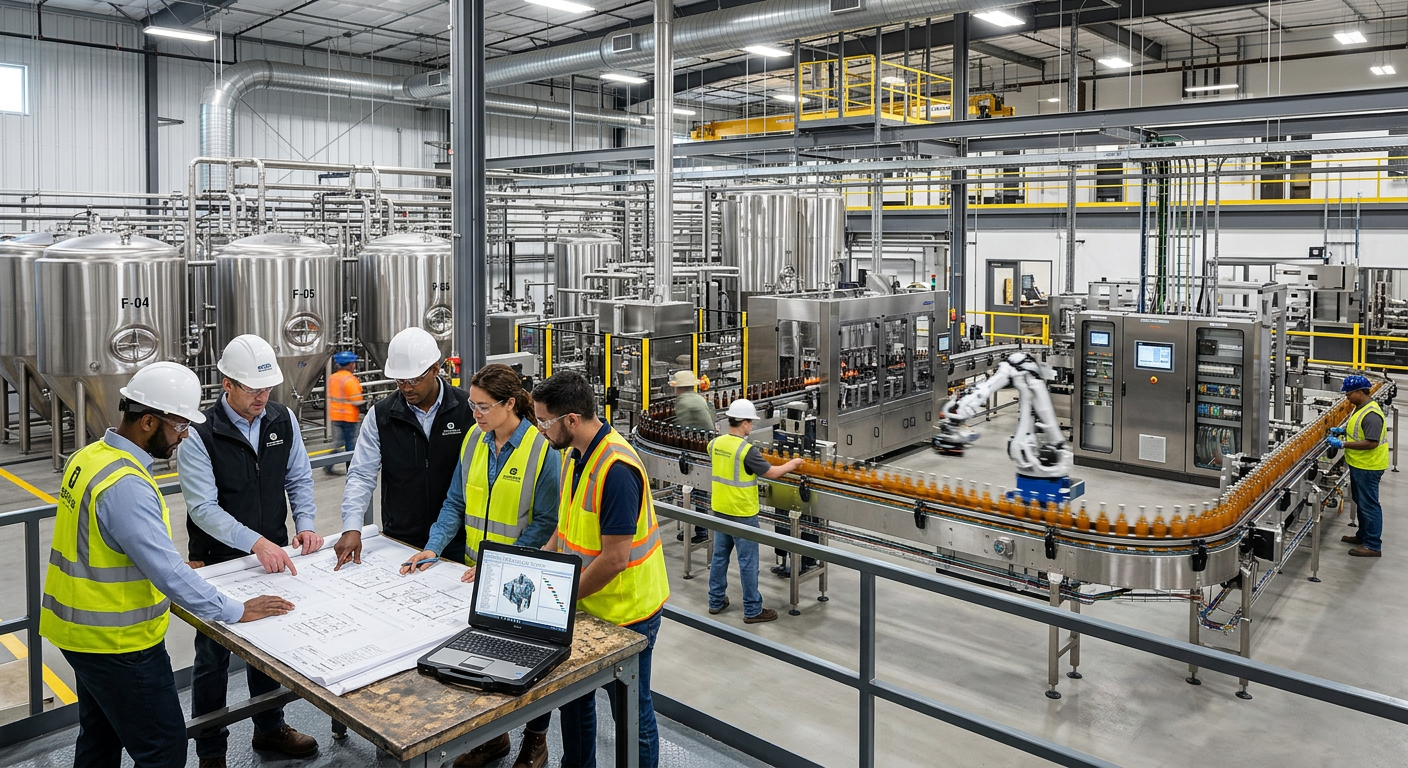
Food and beverage manufacturers in the United States are under pressure to cut utility costs, improve environmental performance, protect margins, and prove responsible capital investment. For new plants and major retrofits, green building certification has moved from a marketing idea to a board-level decision. In markets such as California, Texas, Illinois, Georgia, North Carolina, and New Jersey, owners are now evaluating certification not only for office buildings but also for processing rooms, utility plants, warehouses, and mixed-use manufacturing campuses.
For food manufacturing, certification decisions must be grounded in operational reality. A poultry processor in Arkansas, a dairy plant in Wisconsin, a beverage co-packer near the Port of Savannah, and a frozen foods facility outside Chicago do not use energy, water, sanitation systems, and process controls in the same way. That is why LEED planning for a food plant has to be tied directly to throughput, hygienic design, refrigeration loads, wastewater treatment, compressed air demand, CIP cycles, and production scheduling.
Quick Answer

LEED is usually the most practical green building framework for food plants in the United States because it is widely recognized by lenders, investors, corporate sustainability teams, and local authorities. A food manufacturing facility can pursue Certified, Silver, Gold, or Platinum status by earning points across sustainable sites, energy, water, materials, indoor environmental quality, innovation, and regional priorities. In most food plants, the strongest opportunities come from energy performance credits, process water reduction, heat recovery, refrigeration optimization, HVAC controls, LED lighting, and integrated commissioning.
If the project is in the United States and the owner wants broad market recognition, easier benchmarking, and alignment with common ESG reporting expectations, LEED is typically the first system to review. BREEAM can still be valuable, especially for international groups with European stakeholders, but LEED is more familiar to many U.S. design teams, utilities, incentive programs, and permitting stakeholders.
For buyers making a capital decision, the key rule is simple: do not chase points that do not improve operations. The best certification strategies support lower utility spend, more resilient production, cleaner documentation, and easier expansion planning. In food manufacturing, the greenest project is not the one with the longest scorecard. It is the one that lowers total cost of ownership while preserving food safety, sanitation, and uptime.
| Decision Area | Best Practice for U.S. Food Plants | Why It Matters |
|---|---|---|
| Certification framework | Start with LEED review during concept design | Prevents expensive redesign later |
| Energy strategy | Prioritize refrigeration, boilers, compressed air, HVAC, and controls | These often drive the largest utility savings |
| Water strategy | Separate process water, sanitation water, and domestic water tracking | Improves savings visibility and credit targeting |
| Material selection | Use durable, cleanable, food-safe materials with documented sourcing | Supports both hygiene and sustainability goals |
| Project delivery | Integrate engineering, construction, and commissioning teams early | Reduces gaps between design intent and installation |
| ROI review | Model utility savings before chasing premium features | Protects profitability and capital discipline |
The table above shows the practical starting point for most U.S. food projects. A plant in Houston or Fresno may have very different utility profiles, but early modeling, disciplined scope control, and integrated execution are universal success factors.
LEED Certification Levels and Requirements

LEED certification levels are based on total points earned. While the exact system version and project category matter, the common framework includes Certified, Silver, Gold, and Platinum. For a food plant, those points must be earned while still protecting sanitation flows, maintenance access, process reliability, and regulatory compliance.
Most food plants target Silver or Gold first. Certified may be appropriate for a modest retrofit or speculative industrial shell, while Platinum is generally reserved for projects with strong executive sponsorship, advanced utility design, high-performance envelopes, metering depth, and a disciplined documentation process.
| LEED Level | Typical Point Range | Common U.S. Food Plant Fit | Capital Intensity |
|---|---|---|---|
| Certified | 40-49 | Basic warehouse plus processing retrofit | Low to moderate |
| Silver | 50-59 | Regional food plant expansions and utility upgrades | Moderate |
| Gold | 60-79 | New processing campuses and major brownfield redevelopments | Moderate to high |
| Platinum | 80+ | Flagship corporate sustainability projects | High |
| Existing building improvement path | Varies | Mature facilities improving performance without full rebuild | Moderate |
| Core and shell or campus mix | Varies | Multi-building industrial developments near logistics hubs | Moderate to high |
The real requirement is not just points. A successful LEED food plant usually needs six project behaviors in place from day one:
| Requirement | What It Means in Food Manufacturing | Operational Impact |
|---|---|---|
| Integrated design | Architectural, process, utility, and sanitation teams coordinate early | Fewer clashes and change orders |
| Energy modeling | Utility use is modeled with process-sensitive assumptions | Better capital allocation |
| Water accounting | Metering includes CIP, washdown, cooling, and domestic demand | More accurate savings plan |
| Commissioning | Systems are tested against design intent before startup | Improved reliability and efficiency |
| Materials documentation | Submittals include source, composition, and compliance data | Faster certification review |
| Performance tracking | Post-occupancy utility and system performance is measured | Supports continuous improvement |
In the United States, this matters even more in regions with strong utility incentives and higher energy prices. Plants in California, the Northeast corridor, and certain Midwest utility territories often have more financial upside from advanced controls, demand management, and metering than plants in lower-cost regions. Still, plants in Texas, Tennessee, and the Carolinas can achieve strong returns through operational optimization and better lifecycle planning.
BREEAM vs LEED for Food Manufacturing

BREEAM and LEED both support sustainable building goals, but they are not equally practical for every food manufacturer. For U.S.-based owners, LEED usually has the advantage in familiarity, market signaling, and consultant availability. BREEAM may appeal to multinational processors with European parent companies, export-driven branding priorities, or global standards harmonization goals.
In food manufacturing, the decision should be driven by customer expectations, investor communication, geography, and the internal reporting structure of the company. A plant supplying national retailers from Atlanta, Dallas, or Inland Empire distribution networks may benefit more from LEED because U.S. stakeholders readily understand it. A multinational dairy or beverage group operating in both the United Kingdom and the United States may choose BREEAM on selected assets for consistency.
| Factor | LEED | BREEAM | Best Fit for U.S. Food Plants |
|---|---|---|---|
| Recognition in the United States | Very strong | Moderate | LEED |
| Consultant availability | Broad national network | More limited in U.S. industrial sector | LEED |
| Alignment with U.S. incentives | Often easier | Varies by project | LEED |
| Use by multinational owners | Strong | Strong, especially European groups | Depends on parent company |
| Industrial process familiarity | Good with right team | Possible but less common in U.S. | LEED |
| Marketing value for U.S. stakeholders | High | Moderate | LEED |
For buying advice, most U.S. food manufacturers should ask four questions before choosing a framework:
- Will lenders, investors, or strategic customers specifically recognize one system more than the other?
- Does the facility serve a domestic market or a globally integrated supply chain?
- Can the project team document industrial utility systems in the chosen framework without slowing schedule?
- Will certification support future expansions, acquisitions, or portfolio-level benchmarking?
Energy Performance Credits
Energy performance credits are often the backbone of LEED strategy in food and beverage plants because process-heavy facilities consume large amounts of electricity, steam, chilled water, glycol, refrigeration energy, and compressed air. Unlike office buildings, food plants may run multiple shifts, maintain cold storage, operate high sanitation loads, and rely on pasteurization, retort, evaporation, or cooking systems that materially change the load profile.
In practical terms, the biggest energy opportunities in a U.S. food plant typically come from these categories:
| Energy Measure | Typical Application | Potential LEED Value | Business Benefit |
|---|---|---|---|
| High-efficiency refrigeration systems | Meat, dairy, frozen, beverage | High | Lower peak and base energy use |
| Heat recovery | Boilers, compressors, condensers, process cooling | High | Reduced fuel and water heating costs |
| Variable frequency drives | Pumps, fans, conveyors, compressors | Moderate to high | Better load matching |
| Advanced building automation | Multi-zone HVAC and utility systems | High | Operational visibility and control |
| LED lighting with sensors | Warehouses, packaging halls, support spaces | Moderate | Fast payback and maintenance savings |
| Compressed air optimization | Packaging and controls systems | Moderate | Reduced leaks and wasted energy |
| High-performance envelope | Cold rooms, offices, mixed spaces | Moderate | Improved thermal performance |
Plants handling protein, prepared foods, dairy, or aseptic beverages often gain more from process-linked energy measures than from simple envelope upgrades alone. For example, a beverage plant near Los Angeles may capture energy savings from compressor sequencing and heat recovery for hot water generation, while a dairy facility in upstate New York may benefit more from refrigeration optimization and heat exchange improvements tied to pasteurization.
Industry demand also shapes where owners should focus. High-volume beverage co-packers, poultry processors, and frozen foods producers usually see stronger ROI from energy modeling because utilities directly affect margin and capacity planning.
By 2026, the strongest trend is likely to be deeper integration of automation and energy intelligence. More plants will connect PLC and SCADA data to facility energy dashboards, making it easier to correlate production runs with utility consumption. That matters because future LEED and broader sustainability strategies will reward measurable performance, not just design intent.
Water Efficiency and Innovation Credits
Water is a defining issue in food manufacturing. Plants use water for ingredients, sanitation, cooling, heating, CIP, product transfer support, and employee facilities. In drought-sensitive regions such as California and parts of the Southwest, water reduction strategy is now a resilience issue, not just a sustainability talking point. Even in water-rich regions, wastewater surcharges and pretreatment requirements can turn inefficient design into a long-term cost burden.
For many food plants, water efficiency and innovation credits are where environmental value and operating value clearly overlap. The strongest projects map water by use case rather than looking only at total gallons. A processor in the Midwest may discover that final rinse optimization and recovered water loops drive the best savings, while a beverage facility in Arizona may prioritize cooling tower concentration cycles, low-flow fixtures, and reuse systems.
| Water Strategy | Typical Plant Use | Credit Relevance | Operational Note |
|---|---|---|---|
| Low-flow plumbing fixtures | Administrative and welfare areas | Moderate | Easy baseline savings |
| CIP optimization | Dairy, beverage, sauces, aseptic | High | Can reduce water, chemicals, and time |
| Rinse water recovery | Prepared foods and beverage lines | High | Requires quality control discipline |
| Cooling tower optimization | Utility systems and refrigeration support | Moderate to high | Important in warm climates |
| Leak detection and submetering | All plants | High | Enables continuous management |
| Rainwater or non-potable reuse | Site and utility support functions | Variable | More site-specific in food plants |
| Innovative wastewater reduction design | High-strength effluent operations | High | Reduces downstream treatment loads |
Innovation credits can also come from unusually strong process integration, educational features, advanced metering, or exemplary performance above standard thresholds. In food manufacturing, innovation tends to be strongest when the team proves that sustainable design directly improves production control or sanitation outcomes. That could include smart CIP validation, utility dashboards for batch operations, or sophisticated energy and water balancing across process skids.
The chart shows a broader market shift: as easy lighting and fixture improvements become standard, more projects are moving toward intelligent water design, digital monitoring, and process-level innovation.
Documentation and Application Process
The documentation and application process is where many otherwise strong projects lose momentum. In food manufacturing, this risk is even greater because the project usually includes architectural systems, utility systems, process equipment, hygienic finishes, controls, and specialty vendor packages. If those packages are procured separately, documentation can become fragmented.
A disciplined application process usually follows these stages:
| Stage | Main Task | Risk if Ignored |
|---|---|---|
| Pre-design | Set target level and assign responsibilities | Point strategy becomes unrealistic |
| Schematic design | Model energy and water opportunities | Late redesign and budget pressure |
| Design development | Collect submittal and specification requirements | Missing compliance data from vendors |
| Construction | Track procurement, installation, and field changes | As-built mismatch with certification narrative |
| Commissioning | Verify systems operate as intended | Savings fail to materialize |
| Submission and review | Compile narratives, calculations, and evidence | Review comments delay certification |
| Post-occupancy | Monitor actual performance | No operational learning for future projects |
Good documentation is not only about compliance. It is also a management tool. Well-organized records support warranty claims, utility incentive applications, internal ESG reporting, and future expansions. That is why many owners now prefer project teams that can bridge process engineering and building systems rather than treating them as separate silos.
When selecting a project partner, ask whether the firm can coordinate process equipment data, building utility design, controls integration, subcontractor management, and commissioning records in one workflow. That integrated approach is especially important for projects near fast-moving logistics and production centers such as Charlotte, Dallas-Fort Worth, the Inland Empire, Nashville, and the Chicago corridor.
Cost-Benefit Analysis of Certification
Cost-benefit analysis should be based on lifecycle value, not just registration fees or first-cost premiums. For food plants, the real financial picture includes reduced energy spend, reduced water use, lower maintenance burden, fewer operational surprises, improved incentive capture, stronger asset value, and reputation benefits with customers and investors.
Some owners fear that certification always adds unnecessary complexity. That can happen if the team treats LEED as a paperwork exercise detached from manufacturing performance. But when certification is aligned with plant operations, the incremental cost is often offset by better utility infrastructure decisions and tighter project discipline.
| Cost or Benefit Item | Short-Term Effect | Long-Term Effect | Typical Importance |
|---|---|---|---|
| Registration and certification fees | Direct project cost | Minimal ongoing impact | Low to moderate |
| Energy modeling and commissioning | Added professional cost | Improved system performance | High |
| Premium equipment selections | Higher capital outlay | Lower operating cost | High |
| Water-saving system integration | Moderate design cost | Lower water and sewer charges | High |
| Incentive eligibility | May reduce net capex | Improves ROI | Moderate to high |
| Brand and customer value | Indirect | Supports market access and ESG positioning | Moderate |
| Operational resilience | Indirect | Can reduce disruption and utility risk | High |
For a practical buying framework, owners should compare three scenarios: code-minimum design, high-performance design without certification, and high-performance design with certification. In many cases, the second and third scenarios share most of the same capital measures. The difference is that certification forces clearer documentation, accountability, and measurable outcomes.
In 2026, cost-benefit analysis is likely to broaden further. More food manufacturers will include carbon reporting, climate resilience, grid volatility, water stress, and customer procurement standards in project justification. That means the value of certification may increasingly come from strategic risk reduction, not just utility payback.
Case Study: LEED Platinum Food Plant
Consider a hypothetical but realistic U.S. case: a new ready-to-drink beverage and aseptic packaging facility in the Southeast, located within trucking reach of Atlanta, Charlotte, and the Port of Savannah. The owner wanted a flagship plant that could scale production quickly while keeping first-year operating margins intact.
The project team set a Platinum target only after confirming that the certification strategy aligned with business goals. The plant included high-efficiency boilers, optimized compressed air, advanced refrigeration controls, LED lighting, a strong building envelope for mixed-temperature zones, process water metering, CIP optimization, reclaimed water opportunities for non-product applications, and a robust commissioning plan.
Just as important, the team connected building systems and process systems. Utility design was matched to actual production ramp-up, not theoretical full-capacity assumptions. Controls were designed so operators could see energy and water performance by area. That allowed management to identify abnormal utility use during startup and correct it before waste became routine.
The result was not simply a plaque. The plant achieved lower-than-expected utility intensity, smoother startup, and better data for expansion planning. That is the real lesson of a high-level certification project: Platinum works when operations and capital strategy are aligned.
Manufacturers researching similar project paths can review broader project examples and industrial delivery approaches through the company’s food and beverage case studies.
Our Company
Disruptive Process Solutions supports food and beverage manufacturers across the United States and Canada with a business-first approach to capital projects. Rather than treating engineering, construction, and execution as disconnected tasks, the company works through a Design Build Manage model intended to connect smart capital with smart manufacturing.
Technological capabilities
For green building and process-intensive projects, technology integration matters. DPS provides engineering depth across structural, mechanical, plumbing, electrical, process, and controls systems. That includes PLC programming, automation, SCADA integration, utility coordination, and production-aware system design. In LEED-oriented projects, this technical range is especially valuable because it helps connect building performance goals with actual manufacturing behavior, from pasteurization and aseptic processing to refrigeration, compressed air, and clean utility management.
Manufacturing capabilities
DPS works across both food and beverage categories, including brewing, spirits, dairy beverages, RTD products, proteins, prepared foods, sauces, aseptic systems, and shelf-stable processing. The team also supports proprietary equipment manufacturing, including storage and process tanks, CIP systems, marination tumblers, and cooking vessels. Companies evaluating equipment-linked sustainability improvements can explore available process equipment solutions as part of a broader plant performance strategy.
Service capabilities
From capital planning and feasibility to owner’s representation, project management, general contracting support, installation, integration, and commissioning, DPS is structured for end-to-end project execution. That matters for certification-focused food projects because service coordination often determines whether sustainability goals survive procurement and startup. More detail on the firm’s integrated project delivery model is available on its engineering and project services page, while company background can be found on the about us page.
The company is particularly well suited to manufacturers that want honest decision support, disciplined capital planning, and execution tied to profitability rather than simply maximum project spend. In a market where many owners are balancing rapid growth, utility uncertainty, and stricter sustainability expectations, that approach can make the difference between a certified building and a genuinely high-performing plant.
FAQ
Is LEED worth it for an existing food plant in the United States?
Yes, if the facility has meaningful opportunities in energy, water, controls, metering, or operational upgrades. Existing plants often benefit when improvements are already planned and certification adds structure and accountability.
What industries gain the most from LEED in food manufacturing?
Beverage, dairy, protein, frozen foods, prepared foods, and aseptic processing often see the strongest value because they are utility-intensive and can justify better metering, heat recovery, water optimization, and controls.
Can a food plant earn LEED credits without compromising sanitation?
Yes. The key is to design sustainability measures around hygienic requirements. Durable materials, efficient washdown strategies, controlled airflow, and smart CIP design can support both sanitation and certification.
Should a company choose LEED or BREEAM for a U.S. processing project?
Most U.S. projects start with LEED because market recognition is stronger. BREEAM may still make sense for global owners who need consistency across international portfolios.
How early should certification planning begin?
At concept stage. Waiting until construction documents or procurement often limits point options and increases cost.
What product types are most relevant to certification strategy?
Plants producing dairy, RTD beverages, beer, spirits, protein products, sauces, prepared meals, frozen foods, and aseptic goods usually have significant utility and water optimization opportunities.
Are there regional considerations in the United States?
Absolutely. Water strategy is often critical in California and the Southwest. Energy and envelope decisions may carry more weight in the Midwest and Northeast. Logistics-heavy sites near ports such as Los Angeles, Savannah, Houston, and Newark may also prioritize transportation and site planning factors.
What are the most common mistakes?
Setting an unrealistic certification target, separating process design from building design, failing to collect documentation from vendors, and pursuing points that do not improve operating economics.
What trends should owners watch through 2026?
Expect stronger integration of plant automation with energy management, tighter water reporting, more pressure from customer sustainability scorecards, broader resilience planning, and increased interest in electrification, heat recovery, and carbon-aware utility design.
For U.S. food manufacturers, green building certification is no longer only about image. It is about building facilities that are efficient, resilient, easier to operate, and better aligned with long-term growth. LEED remains the leading option for most domestic projects, especially when it is treated as a manufacturing performance tool rather than a standalone compliance task.
[/trp_language]
Complete Company Portfolio
About the Author: Disruptive Process Solutions (DPS)
The DPS team combines process engineering expertise with real-world food and beverage manufacturing experience. Our content focuses on process optimization, production efficiency, facility improvements, and practical solutions that help manufacturers operate more effectively in a rapidly evolving industry.
Share