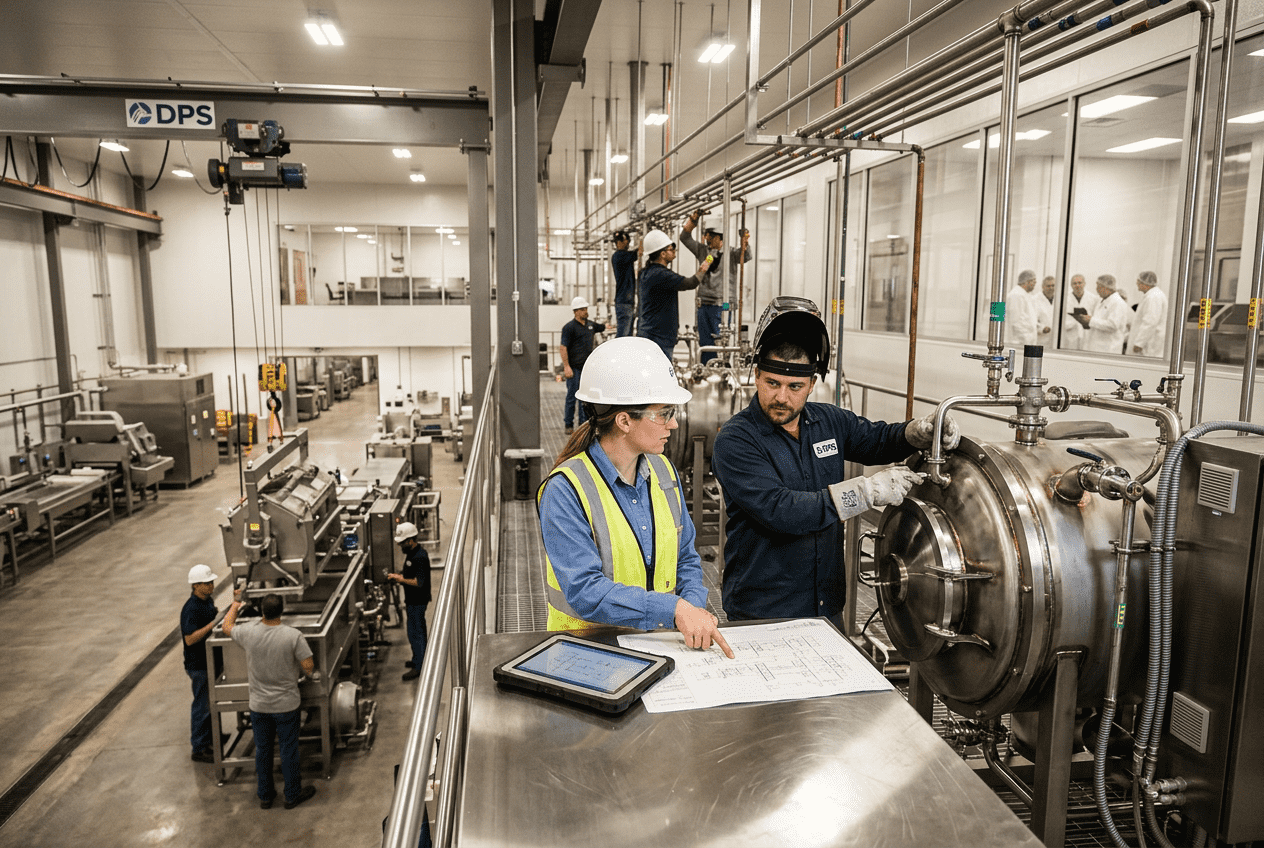
Food Plant HMI Design Services
[trp_language language=”en_US”]
Food Plant HMI Design Services for Food and Beverage Plants in the United States
In U.S. food and beverage manufacturing, human-machine interface design is not a cosmetic exercise. It directly affects line uptime, operator response time, sanitation readiness, batch accuracy, and audit confidence. A well-designed HMI helps a pasteurizer operator in Wisconsin respond to a temperature drift before product quality is affected. It helps a protein processor in Arkansas identify a conveyor fault without chasing five screens. It helps a beverage co-packer near Los Angeles, Houston, or Chicago move from startup to steady-state production with fewer nuisance alarms and fewer training delays.
For facilities dealing with USDA, FDA, SQF, and BRC expectations, the HMI must support clear operation under pressure. That means alignment with ISA-101 for high-performance HMI design, thoughtful alarm management tied to ISA-18.2, strong visual hierarchy, context-rich trends, hygienic industrial hardware, and platform-specific expertise across FactoryTalk View, WinCC, and Ignition Perspective. Companies evaluating food plant HMI design services in the United States should look for integrators that understand both controls engineering and plant operations, especially where washdown, recipe management, CIP, utilities, and packaging all intersect.
Disruptive Process Solutions (DPS) supports North American food and beverage manufacturers with integrated engineering, controls, installation, and project execution. Rather than treating HMI development as a standalone graphic task, DPS approaches it as part of a profitable production system: operator workflows, utility performance, product protection, and expansion planning all inform the final interface. That matters whether the plant is in the dairy corridors of California, the beverage hubs of Texas, the poultry belt of Georgia, the meat processing regions around Kansas City, or the port-driven manufacturing zones near Savannah, Newark, and Long Beach.
Quick Answer

Food plant HMI design services help U.S. manufacturers create operator screens that are faster to read, easier to trust, and safer to use during production upsets. The best designs follow ISA-101 principles, use a clear screen hierarchy from plant overview to equipment detail, reserve red strictly for alarms, embed trends and normal ranges directly on the screen, and run on washdown-ready hardware suited for food environments. In practice, that means fewer clicks, better alarm response, easier training, and less confusion during sanitation, startup, changeover, and troubleshooting.
In the United States market, buyers should prioritize five things: food-process knowledge, alarm strategy, hygienic panel hardware, platform compatibility, and lifecycle support. A strong provider should understand beverage batching, brewing, distillation, dairy, sauces, prepared foods, aseptic systems, retort, protein processing, and utilities such as CIP, boilers, glycol, compressed air, and water treatment. They should also be able to connect HMI design to PLC logic, historian data, recipe control, OEE reporting, and remote support.
For many plants, the HMI project is triggered by one of several common pain points:
| Plant Problem | Typical Symptom | Operational Risk | HMI Design Response | Expected Benefit | Best Fit Areas |
|---|---|---|---|---|---|
| Too many alarms | Operators ignore frequent banners | Critical events missed | Alarm prioritization and suppression logic | Higher trust in alerts | Packaging, utilities, CIP |
| Poor screen layout | Users click through many pages | Slow response during faults | Hierarchical navigation | Faster diagnosis | Batching, cook lines, pasteurizers |
| Weak context | Numbers displayed without trend history | Late intervention | Sparklines and embedded trends | Earlier detection of drift | Fermentation, dairy, thermal processing |
| Color overuse | Everything is bright red, green, and blue | Alarm fatigue and confusion | Neutral base palette with alarm-only red | Better focus under pressure | All process areas |
| Non-hygienic hardware | Panel failure after washdown | Downtime and sanitation concerns | IP65 to IP69K stainless panel PCs | Longer service life | Protein, dairy, wet beverage zones |
| Operator mismatch | Pretty screens but poor usability | Errors during startup or changeover | Task-based screen design | Lower training burden | High-turnover labor environments |
The table above shows why HMI work should be evaluated as a business decision, not just a controls deliverable. A more useful interface can reduce lost batches, support faster onboarding, and improve overall equipment effectiveness. In many U.S. plants, that return is stronger than expected because the HMI sits at the intersection of labor, quality, utilities, and throughput.
Manufacturers exploring broader automation and integration support can review engineering and integration services as part of a complete modernization strategy rather than treating screen design in isolation.
ISA-101 Standards: Designing HMIs That Operators Actually Use Under Pressure

ISA-101 provides a practical framework for high-performance HMI design. In food plants, where an operator may be balancing product quality, sanitation discipline, recipe timing, and equipment safety, the standard helps prevent the most common interface failure: making the screen look impressive instead of making it operationally useful.
Under ISA-101, the HMI is designed around situational awareness. Operators should be able to recognize normal conditions quickly and identify abnormal conditions even faster. This is especially important in U.S. facilities with lean staffing, multi-skill operators, and night-shift supervision structures. A screen must communicate what changed, how severe it is, and what the user should check next. That principle applies whether the process is HTST pasteurization in Idaho, aseptic beverage filling in New Jersey, or marination and tumble systems in the Carolinas.
The standard also supports governance. Screen templates, symbol libraries, font rules, navigation conventions, and alarm color policies should be documented so the system remains consistent over time. Without that discipline, many plants end up with a patchwork of vendor screens, maintenance edits, and line-specific workarounds that confuse operators and complicate training.
| ISA-101 Principle | What It Means | Food Plant Example | Design Method | Operator Benefit | Business Impact |
|---|---|---|---|---|---|
| Situational awareness | Make abnormal conditions visible fast | Pasteurizer temperature drift | Trend with target band | Faster intervention | Reduced product loss |
| Consistency | Use repeatable symbols and layouts | Same valve status icons across lines | Template library | Less retraining | Better scalability |
| Hierarchy | Move from overview to detail | Plant to room to skid to device | Layered navigation | Fewer clicks | Shorter downtime |
| Minimalism | Avoid decorative clutter | Neutral backgrounds in batching | High-performance graphics | Improved focus | Lower error risk |
| Context | Show data with meaning | Brix reading with last 30 minutes | Embedded sparkline | Trend recognition | Better quality control |
| Governance | Maintain standards over lifecycle | Multi-site recipe screens | Style guide and review process | Predictable interface use | Lower support cost |
The value of ISA-101 grows as companies expand. A beverage producer operating in Phoenix, Dallas, and Charlotte benefits from a common screen language across sites. It shortens cross-training and makes support easier. For contract manufacturers and multi-plant food groups, that consistency also helps leadership compare line behavior, downtime causes, and operating discipline with fewer interpretation gaps.
DPS applies this logic through its technological capabilities in controls engineering, PLC programming, SCADA integration, recipe and batch control, and utility system automation. Because the team works across both food and beverage processing, HMI standards are aligned not only with graphics but also with the realities of process temperature, flow, pressure, level, conductivity, Brix, and cleaning validation data.
The chart illustrates the growing adoption of high-performance HMI design across U.S. manufacturing. Through 2026, adoption is expected to rise as labor shortages, cybersecurity modernization, and multi-site standardization push manufacturers to replace legacy screens with more disciplined operator interfaces.
Visual Hierarchy: Plant Overview to Area Screens to Detail Faceplates

A strong visual hierarchy is the backbone of a usable HMI. In a food facility, users should never have to guess where to go next. The system should begin with a plant overview, then move into area screens, then equipment screens, and finally detail faceplates or device popups. This structure allows supervisors to assess the whole facility quickly while giving technicians and operators access to deeper details only when needed.
At the overview level, the user might see packaging lines, process rooms, utility systems, clean-in-place skids, storage tanks, and key quality indicators. Area screens then break down each section, such as syrup room, fermentation cellar, cheese vat hall, retort room, or protein cutting line. Detail views provide commands, permissives, interlocks, and diagnostics for pumps, valves, VFDs, tanks, heat exchangers, and instruments.
The right hierarchy matters in large U.S. plants where expansion has happened in phases. A site near Memphis may have one packaging wing built in 2012, a CIP skid added in 2017, and a new batching room added in 2024. Without a hierarchy, the HMI becomes a patchwork. With one, new assets can be added cleanly and operators can navigate by logic rather than memory.
| Screen Level | Main User | Primary Content | Typical Actions | Time Horizon | Good Design Rule |
|---|---|---|---|---|---|
| Plant overview | Supervisor | Major areas, KPIs, critical alarms | Prioritize response | Immediate plant-wide | Show only essential status |
| Area screen | Operator lead | Section flow, states, trends | Spot bottlenecks | Current shift | Preserve process context |
| Unit screen | Operator | Tank, skid, or machine sequence | Run and monitor equipment | Minutes to hours | Place key values near controls |
| Detail faceplate | Technician | Device commands and diagnostics | Troubleshoot component | Seconds to minutes | Keep advanced data compact |
| Alarm summary | Operator and supervisor | Priority, time, state, acknowledgement | Respond and document | Real time | Enable filtering by area |
| Historical review | Engineer or QA | Trends, events, batch history | Analyze root cause | Hours to weeks | Support easy comparison windows |
The table clarifies why screen hierarchy is more than visual organization. It maps the right information to the right user at the right moment. In high-speed beverage lines near Atlanta or Minneapolis, this structure helps teams isolate whether downtime is caused by utilities, filler constraints, depalletizer issues, or upstream batching delays.
When evaluating service providers, ask whether they start with navigation maps and operator tasks before drawing graphics. Buyers should also ask for examples of multi-level screen architecture, especially for CIP, batching, thermal systems, and integrated utility plants. For a company that works from process engineering through installation and controls execution, see about the DPS approach to integrated project delivery.
Color Psychology: Why Red Should Only Mean Alarm
Color misuse is one of the most common problems in legacy HMIs. Many food plants still run interfaces full of bright greens, reds, yellows, and blues. These screens may look lively, but they reduce operator awareness. When everything is saturated, nothing stands out. Under pressure, that design works against the user.
High-performance HMI design uses neutral grays for most equipment and process backgrounds. Color is saved for conditions that deserve attention. Red should indicate an alarm or trip condition. Yellow or amber may indicate warning or abnormal attention states. Blue or muted accent colors can be used sparingly for navigational cues, selected items, or informational overlays. Green is often overused; many teams now avoid using it as a dominant “running” indicator because motion or state can be conveyed more effectively through text, symbols, and line animation.
In food plants, this discipline is especially valuable because operators often work in loud, wet, and time-sensitive environments. During a CIP transition, thermal deviation, or filler jam, the HMI must reduce mental effort, not add to it. A clear color strategy also improves visibility on outdoor utility kiosks, bright packaging rooms, and stainless panel displays exposed to reflected light.
Good color policy should be documented in the standards manual and enforced across all future additions. This becomes critical during acquisitions, line expansions, and OEM integrations.
Context-Rich Displays: Trends, Normal Ranges, and Sparklines
A number by itself is often not enough. If a tank temperature reads 182°F, is that normal, rising, or falling? Is it on target for the current phase? Has it oscillated for the last ten minutes? Context-rich displays answer those questions without forcing the operator to leave the screen.
For food and beverage processing, embedded trends are particularly powerful. A dairy operator can see whether homogenization pressure has been stable. A brewer can watch fermenter temperature movement. A sauce line operator can monitor kettle temperature against a target band. A utilities technician can check whether compressed air pressure is cycling abnormally before a line fault develops. Sparklines and normal-range shading give immediate context with minimal space.
These features matter most in plants where small drifts create large consequences. A slight conductivity issue in CIP may affect rinse verification. A small fill temperature deviation may threaten shelf stability. A repeated pressure dip may cause package defects on a high-speed filler. With context-rich HMI design, operators see trends early and act sooner.
The trend shift shown above reflects how U.S. manufacturers are moving away from static numerical screens and toward more informative operator views. By 2026, context-rich displays are likely to become a standard expectation in new controls projects, especially where traceability, energy use, and quality metrics are tightly monitored.
Buyers should ask whether the HMI team can integrate historians, batch records, and time-series tools directly into the interface. It is also worth reviewing whether the same trends can be accessed from desktop, mobile, and control room environments without sacrificing clarity.
Hygienic Hardware: IP65 to IP69K Stainless Steel Panel PCs
In food manufacturing, software design fails if the hardware cannot survive the environment. HMIs in wet process rooms, high-foam sanitation areas, and raw protein spaces need the right enclosure rating, surface finish, sealing, and mounting approach. For many applications, this means stainless steel panel PCs or operator terminals rated from IP65 up to IP69K, depending on the washdown intensity and zone requirements.
IP65 may be appropriate for splash-prone but not direct high-pressure wash zones. IP66 improves protection against strong jets. IP69K is often considered where hot high-pressure washdown is routine, particularly in meat, poultry, seafood, dairy, and some ready-meal facilities. But the rating alone is not enough. Buyers should consider cable entry, gasket integrity, bezel geometry, cleanability, and whether the hardware creates soil harborage points.
In the United States, plant layouts vary widely. A brewery in Oregon may prioritize cleanability and condensation resistance in cellar spaces. A poultry plant in Alabama may need more aggressive washdown resistance and glove-friendly touch performance. A dairy facility in upstate New York may require reliable operation near cold, wet filling environments. Hardware selection should match the actual cleaning protocol, chemical exposure, operator PPE, and line ergonomics.
| Hardware Type | Common Rating | Best Use Area | Main Advantage | Watch-Out | Typical U.S. Application |
|---|---|---|---|---|---|
| Standard industrial panel PC | IP65 front | Dry packaging rooms | Lower cost | Limited washdown survival | Cartoning and case packing |
| Stainless washdown terminal | IP66 | Wet beverage rooms | Better sealing | Check cable gland details | Syrup and blending areas |
| Full hygienic panel PC | IP69K | Protein and dairy process zones | High-pressure cleaning resistance | Higher capital cost | Raw meat and cheese processing |
| Remote thin client | Varies | Multi-station visualization | Centralized management | Network dependency | Packaging line replicas |
| Hazard-rated terminal | Specialty rating | Alcohol vapor or solvent area | Safety compliance | More limited options | Spirits and extraction operations |
| Mobile industrial tablet | Ruggedized | Maintenance and QA rounds | Flexible access | Not always ideal for permanent control | Remote utility checks |
This comparison helps buyers tie hardware choice to the actual process environment. The best decision is usually not the cheapest display but the one that prevents repeated replacement, sanitation conflicts, and operator frustration.
DPS also brings manufacturing capabilities that matter when HMI deployment touches custom skids and fabricated systems. Because the company designs and manufactures selected process equipment such as tanks, CIP systems, marination tumblers, and cooking vessels, the interface can be coordinated with actual equipment geometry, instrumentation, access points, and cleaning requirements rather than treated as an afterthought.
Operator Task-Based Design: Screens Built for the Job, Not the Demo
Many poor HMIs are built around what looks good in a project review rather than what an operator needs at 2:15 a.m. during a process upset. Task-based design fixes that. It begins by asking: what does the user actually need to do? Start a batch, confirm permissives, switch recipes, monitor sterilization hold time, acknowledge an alarm, isolate a failed pump, verify a valve lineup, or prepare a CIP circuit for sanitation release?
Once those tasks are mapped, the interface is built to minimize delay and ambiguity. The most important controls and confirmations are placed where the user expects them. Supporting values appear nearby. Navigation follows the job flow. Instructions are clear and concise. Critical manual steps are not buried. This approach is particularly important in U.S. plants facing high turnover, bilingual crews, and compressed training schedules.
Task-based HMI design also improves safety and quality. In a retort room, the system can guide the operator through the right sequence checks. In aseptic processing, the interface can make sterility-critical states impossible to miss. In brewery operations, it can simplify cellar transfers, CIP path verification, and tank readiness reviews. In dairy and protein environments, it can support sanitation transitions and allergen-sensitive changeovers with better visibility.
For buyers, a useful test is simple: ask the vendor to show how a real operator completes a startup, changeover, and fault response on the proposed screens. If the demo focuses only on animation or color, the design process is probably not mature enough.
The bar chart suggests where demand is strongest in the United States. Beverage, protein, and dairy sectors continue to lead due to washdown requirements, automation density, recipe complexity, and the cost of downtime. Prepared foods and aseptic systems also show strong demand as plants pursue traceability and labor efficiency.
From a service standpoint, DPS supports this kind of operator-centered execution through end-to-end project management, installation coordination, controls integration, commissioning, and owner-focused planning. That broader service capability matters because HMI design frequently intersects with line modifications, utility upgrades, skids, and startup sequencing. Clients can explore relevant projects and outcomes through selected case studies and field examples.
Alarm Rationalization: ISA-18.2 Lifecycle for Trustworthy Alerts
Alarm management is inseparable from HMI performance. If the screen is clean but the alarm system is chaotic, operators still lose trust. ISA-18.2 gives a lifecycle approach for developing, documenting, prioritizing, implementing, monitoring, and improving alarms. In food manufacturing, this is essential because nuisance alarms are common around level controls, utility fluctuations, packaging sensors, and CIP transitions.
A trustworthy alarm should answer a clear question: what requires operator action now? If a message does not require action, it may belong as an event, status indication, or maintenance notice rather than an alarm. Rationalization reduces noise, protects operator attention, and improves event response during high-pressure situations such as temperature excursions, pump failures, line starve/block conditions, or sanitation deviations.
Alarm philosophy should define priorities, deadbands, shelving rules, suppression logic, and response expectations. It should also connect to training. If every site and line uses different alarm conventions, the HMI becomes harder to trust. For multi-site U.S. operators, a standardized alarm lifecycle is often one of the highest-value improvements available.
| ISA-18.2 Lifecycle Stage | Purpose | Typical Food Plant Action | Common Mistake | Good Outcome | Relevant Area |
|---|---|---|---|---|---|
| Philosophy | Set alarm rules | Define priorities and colors | No written standard | Consistent alarm behavior | Entire plant |
| Identification | List candidate alarms | Review process deviations | Alarming every signal | Focused set of alerts | Process and utilities |
| Rationalization | Validate need and response | Assign operator action | Vague alarm text | Clear response path | Operations |
| Detailed design | Implement logic | Set delay, deadband, suppression | No nuisance control | Lower chatter | Controls engineering |
| Operation | Use alarms in production | Train users and review rates | Poor alarm discipline | Better shift performance | Production floor |
| Monitoring and assessment | Improve continuously | Track flood events and stale alarms | No KPI review | Long-term trust | Management and engineering |
The value of this lifecycle is practical. A rationalized alarm system reduces flood events during startup and shutdown. It improves response during true process deviations. It also supports post-event review, which helps engineering teams understand whether the alarm setpoint, delay, or message text should change.
In 2026 and beyond, expect alarm programs to be influenced by three broader trends: tighter integration with analytics, stronger cybersecurity controls around notification workflows, and more sustainability-driven alarms tied to energy, water, and compressed air losses. Plants trying to cut utility cost per unit produced will increasingly treat alarm strategy as an operational efficiency tool rather than purely a safety or maintenance tool.
HMI Platforms: FactoryTalk View, WinCC, and Ignition Perspective
Platform choice affects architecture, licensing, mobility, maintainability, and future expansion. Three common choices in U.S. food and beverage projects are FactoryTalk View, WinCC, and Ignition Perspective. Each can support strong HMI outcomes if the design discipline is sound.
FactoryTalk View is common in facilities standardized on Rockwell Automation, especially in North American packaging and process environments. It is often selected where Allen-Bradley PLCs dominate and where plant teams want close alignment with existing controls standards. WinCC is frequently considered in Siemens ecosystems and can be a strong fit in facilities with broader Siemens automation strategies, particularly where process and machine integration span multiple equipment types. Ignition Perspective is attractive for organizations seeking web-based visualization, flexible deployment, and scalable enterprise reporting across sites.
The right decision depends on the plant’s installed base, IT policy, remote access needs, data architecture, and internal support capacity. A beverage company with multiple co-pack sites may prefer a web-native strategy for visibility across states. A meat processor with a heavy Rockwell installed base may prefer FactoryTalk for continuity. A greenfield dairy or aseptic project with mixed equipment could evaluate platform fit based on lifecycle support and historian integration.
| Platform | Common Strength | Best Fit Scenario | Potential Limitation | Mobility Profile | Typical U.S. Use |
|---|---|---|---|---|---|
| FactoryTalk View | Strong Rockwell alignment | Allen-Bradley standard plants | Can be less flexible for some enterprise goals | Moderate depending on setup | Packaging and process lines |
| WinCC | Solid Siemens ecosystem integration | Siemens-heavy automation environments | Learning curve for some local teams | Good with proper architecture | Mixed machine and process facilities |
| Ignition Perspective | Web-based scalability | Multi-site visibility and modern UX | Needs disciplined governance | High | Enterprise food and beverage groups |
| Platform-neutral approach | Future flexibility | Acquisition-heavy organizations | Requires strong standards management | Varies | Holding companies and co-packers |
| Hybrid local plus enterprise stack | Best of plant and central access | Regional networks of plants | More integration planning | High | Large U.S. manufacturers |
| Legacy retained with modernization | Lower initial disruption | Budget-limited retrofit projects | May preserve old constraints | Lower to moderate | Brownfield expansions |
This platform comparison should be read as a strategic decision guide rather than a winner-take-all list. The best platform is the one your team can sustain while meeting hygiene, audit, reporting, and operator-use requirements.
The comparison chart shows a realistic pattern seen in the market: FactoryTalk often leads on installed-base compatibility in U.S. food plants, WinCC performs well in structured automation ecosystems, and Ignition Perspective frequently stands out for enterprise and web-based flexibility.
Companies planning an HMI modernization should also ask whether the provider can support the physical side of the deployment. DPS combines process engineering, controls integration, utility understanding, and equipment execution, which is important when the HMI ties into custom processing systems. Manufacturers evaluating broader hardware or process packages can also review process equipment capabilities in connection with interface design, skid integration, and line modernization.
Looking ahead to 2026, three platform trends stand out in the United States: browser-based visualization will continue growing, sustainability dashboards will become more common at the operator and supervisor level, and policy pressure around traceability, cybersecurity, and energy reporting will make data architecture a bigger part of HMI scope. Plants near major logistics hubs such as Dallas-Fort Worth, the Inland Empire, Chicago, and the I-95 corridor are likely to accelerate these upgrades as competition and labor constraints intensify.
FAQ
What is the main goal of food plant HMI design services?
The goal is to make operator interaction faster, clearer, and safer. A good HMI helps users identify abnormal conditions quickly, complete tasks accurately, and trust alarms and data during production pressure.
Why is ISA-101 important for U.S. food plants?
ISA-101 supports high-performance interface design. It reduces clutter, improves consistency, and helps plants create screens that are easier to use across shifts, lines, and facilities.
Should every food plant use red only for alarms?
Yes, in most high-performance HMI strategies red should be reserved for alarm or trip conditions. This keeps the most urgent events highly visible and reduces confusion caused by excessive color.
What screen hierarchy works best?
A typical hierarchy includes plant overview, area screens, unit screens, and detailed faceplates. This structure helps operators move from broad awareness to equipment-level action without wasting time.
What are sparklines and why do they matter?
Sparklines are small inline trends that show how a value has moved over recent time. They help operators see whether a reading is stable, drifting, or oscillating without opening a separate trend page.
How do I choose between IP65, IP66, and IP69K hardware?
Base the decision on the real sanitation environment. Dry or splash zones may only need IP65. Strong washdown often requires IP66. Aggressive high-pressure washdown zones usually justify IP69K hygienic hardware.
What is alarm rationalization?
It is the process of deciding which alarms are truly necessary, what priority they should have, and what response is expected. The objective is to eliminate nuisance alarms and improve operator trust.
Which industries benefit most from HMI redesign?
Beverage, dairy, protein, aseptic, brewing, prepared foods, sauces, and co-packing operations all benefit, especially where recipes, sanitation, utilities, and uptime are tightly linked.
Can HMI work be done during a brownfield expansion?
Yes. Many projects happen during line upgrades, utility expansions, equipment relocations, or controls refreshes. Good planning is required so legacy systems and new standards can coexist during transition.
What should I ask a provider before hiring them?
Ask about ISA-101 experience, alarm management process, washdown hardware selection, platform expertise, operator workflow mapping, historian integration, FAT/SAT support, and post-startup lifecycle support.
Why does process knowledge matter so much?
Because screen design depends on understanding the actual process. A team that knows CIP, pasteurization, fermentation, batching, retort, dairy processing, or protein lines can design screens around real operating decisions rather than generic icons.
How does DPS fit into this work?
DPS supports food and beverage manufacturers across the United States and Canada with integrated engineering, equipment, installation, project management, controls, and system integration. That means HMI design can be aligned with the real process, the real utility systems, and the real production goals from early planning through commissioning.
For U.S. manufacturers, the strongest HMI projects are the ones that connect people, process, and plant economics. When the interface is designed around operator tasks, alarm trust, hygienic realities, and future scalability, it becomes a measurable production asset rather than a maintenance burden. That is the standard food and beverage companies should expect as they modernize lines, add capacity, or launch greenfield facilities across the United States.
[/trp_language]
Complete Company Portfolio

About the Author: Disruptive Process Solutions (DPS)
The DPS team combines process engineering expertise with real-world food and beverage manufacturing experience. Our content focuses on process optimization, production efficiency, facility improvements, and practical solutions that help manufacturers operate more effectively in a rapidly evolving industry.
Share

