Food Plant PLC Programming
[trp_language language=”en_US”]
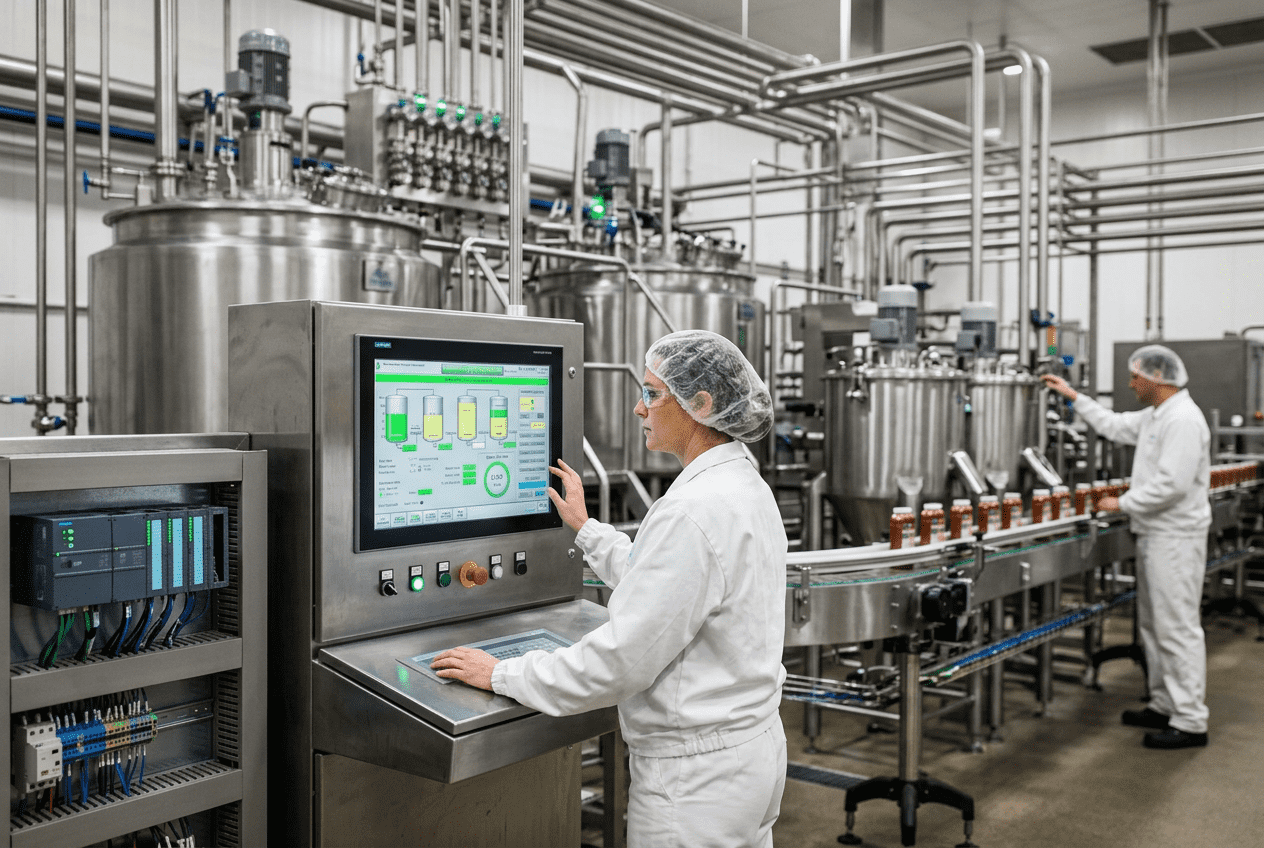
Food plant PLC programming in the United States is not just standard machine automation with washdown hardware. It is a specialized controls discipline that must combine food safety, validated thermal control, recipe integrity, sanitation sequencing, line integration, and traceability from raw ingredient receipt to finished goods shipment. For processors operating in markets such as Chicago, Dallas, Los Angeles, Atlanta, Charlotte, Fresno, and the major logistics corridors around the ports of Long Beach, Houston, Savannah, and Newark, the PLC layer directly affects yield, uptime, audit readiness, and profitability.
Whether the application is dairy, sauces, proteins, beverages, aseptic products, retort meals, or co-packing, successful PLC programming must align with FDA expectations, plant operating realities, and future expansion plans. The best programs are built for repeatable cleaning, robust alarming, secure data collection, and operator clarity under production pressure. They also support business outcomes such as shorter changeovers, fewer quality holds, less rework, and faster commissioning of new capacity.
In the United States market, many food and beverage manufacturers are modernizing controls because labor constraints, retailer quality expectations, sustainability goals, and 2026 digitalization initiatives are all pushing facilities toward better batch management, stronger OEE visibility, and more dependable sanitary process automation. This is especially true for facilities handling pasteurized beverages, prepared foods, plant-based proteins, dairy, and shelf-stable products where process validation is central to product release.
Quick Answer

Food processing PLC programming differs from general industrial automation because it must protect public health while controlling production. In practice, that means the code has to manage sanitary design logic, validated time and temperature steps, clean-in-place sequences, lot genealogy, recipe permissions, operator security, alarm history, and electronic records. A standard conveyor or packaging PLC may focus on motion and throughput; a food plant PLC must also prove that product was processed, cleaned, and documented correctly.
For U.S. processors, the most common automation priorities are:
- Reliable control of pasteurization, HTST, UHT, cooking, chilling, and retort steps
- Automated CIP sequencing with clear state logic and interlocks
- Batch recipe management based on ISA-88 principles
- Lot tracking from receiving through production and packaging
- Audit-ready historical data for quality, maintenance, and regulatory review
- Fail-safe operation during utility loss, sensor failure, valve faults, or operator error
When evaluating an integrator, buyers should look for experience in both process engineering and controls. A food plant rarely benefits from isolated PLC coding without understanding vessels, pumps, heat exchangers, fillers, utilities, sanitation, and production economics.
| Automation Need | Typical Food Application | Primary PLC Function | Main Risk if Poorly Programmed | Business Impact | Priority Level |
|---|---|---|---|---|---|
| Thermal control | Pasteurized milk, juice, sauces | Hold temperature and residence time | Underprocessing or product damage | Recall risk and scrap | Critical |
| CIP sequencing | Tanks, lines, fillers | Automate rinse and chemical cycles | Dirty equipment or excess chemistry use | Downtime and sanitation failure | Critical |
| Recipe management | Batch blending and mixing | Control ingredients and step order | Wrong formula or allergen event | Rework and quality holds | High |
| Traceability | Ingredients to finished SKU | Capture lot genealogy | Slow or incomplete recall response | Regulatory exposure | Critical |
| Alarm and audit trail | All process areas | Log events and deviations | No proof of process history | Audit findings | High |
| Utility interlocks | Steam, glycol, compressed air | Safe shutdown and restart logic | Equipment damage or unsafe state | Maintenance cost | High |
The table above shows why food automation projects should be scoped around product risk and operational value, not just I/O count.
Why Food Processing PLC Programming Is Different from Standard Industrial Automation

General industrial controls often prioritize machine speed, synchronization, and preventive fault handling. Food processing controls must do that too, but they must additionally maintain hygienic process conditions and protect product identity. That creates a different programming philosophy. The code must understand process states, sanitation states, product states, and often allergen states. It must know whether a line is dirty, clean, in production, in hold, in changeover, or under maintenance lockout.
A food system may include raw and ready-to-eat segregation, USDA or FDA inspection constraints, allergen management, washdown environments, temperature-sensitive storage, and utility dependencies that can affect product safety within minutes. A valve matrix in a dairy plant near Madison or a sauce facility outside Kansas City cannot be programmed like a simple assembly line. The logic must prevent cross-contamination, unauthorized recipe edits, and process bypasses.
Other factors that make food PLC programming different include:
- Frequent product changeovers and SKU proliferation
- Need for repeatable sanitation verification
- Time-temperature validation for kill steps
- Integration with scales, flowmeters, barcode systems, printers, historians, and SCADA
- Allergen and rework handling rules
- Electronic records needed for quality release or customer audits
At a market level, U.S. processors are also facing growth in contract manufacturing, regional distribution centers, and omnichannel retail demands. Plants serving East Coast hubs through Savannah and Newark, or West Coast channels through Long Beach and Oakland, often need flexible controls architectures that support both daily throughput and expansion.
The chart illustrates a realistic growth pattern in automation modernization across U.S. food plants, driven by compliance, labor efficiency, and digital traceability investments.
| Difference Area | Standard Industrial Automation | Food Processing PLC Programming | Programming Implication | Operator Impact | Audit Impact |
|---|---|---|---|---|---|
| Process objective | Throughput and machine uptime | Safety, quality, sanitation, throughput | More layered interlocks | More guided operation | Higher traceability |
| Changeovers | Less frequent | Often daily or multiple times per shift | Recipe and sanitation states required | Reduced manual steps | Better batch integrity |
| Cleaning | Manual or limited | CIP/SIP often automated | State machine programming | Safer chemical handling | Verifiable cleaning cycles |
| Compliance records | Usually lighter | Extensive event and batch logs | Historian and user security integration | Accountability | Supports investigations |
| Thermal validation | Rare | Common in pasteurization and retort | High-resolution timing and alarms | Clear deviation response | Supports release decisions |
| Product segregation | Usually not critical | Allergen and raw/RTE segregation critical | Path verification and valve proofs | Fewer routing errors | Reduced contamination risk |
For buyers, this means choosing a controls partner with food-specific experience rather than a generic machine programmer. A good benchmark is whether the integrator can discuss CCP logic, sanitation path verification, utility redundancy, and batch genealogy with equal confidence.
Regulatory Compliance Framework: FSMA, HACCP, and 21 CFR Part 11

In the United States, food plant PLC programming should support regulatory and quality frameworks rather than operate separately from them. FSMA places preventive controls at the center of food safety. HACCP still shapes hazard analysis and critical control philosophies across many product categories. In some environments, especially where electronic records and signatures are managed in controlled systems, 21 CFR Part 11 expectations influence architecture, permissions, and audit trail design.
PLC code itself is not a regulation, but it becomes part of the plant’s compliance system when it controls critical steps and records process evidence. For example, if an HTST system diverts product based on temperature, the programming around sensor validation, event logging, user access, and alarm handling matters. If a retort sequence controls lethality steps, timing logic and deviation records matter. If a CIP sequence confirms sanitation before release, the stored cycle data matters.
Key compliance-oriented controls design practices include:
- Role-based access for operators, supervisors, quality, and maintenance
- Locked setpoints or controlled recipe approvals
- Timestamped alarms and event logs
- Sensor failure detection and bad-value handling
- Separate indication of process complete versus process verified
- Electronic batch records linked to lot and production order information
Plants selling through major retailers or national foodservice channels often face customer standards that exceed minimum regulation. Facilities in North Carolina, Texas, California, Wisconsin, and Pennsylvania commonly need controls systems that satisfy internal quality teams, insurer expectations, third-party audits, and operational management all at once.
| Framework | What It Focuses On | PLC/SCADA Relevance | Typical Data Needed | Common Design Feature | Risk if Missing |
|---|---|---|---|---|---|
| FSMA Preventive Controls | Hazard prevention | Supports preventive process control | Critical step history | Alarmed limits and holds | Weak preventive evidence |
| HACCP | Hazard analysis and CCPs | Monitors CCP variables | Time, temperature, status | Deviation capture | Unclear CCP compliance |
| 21 CFR Part 11 | Electronic records and signatures | User management and traceable changes | User actions and approvals | Audit trail and security | Record integrity concerns |
| SQF/BRC programs | Food safety systems | Supports evidence and control consistency | Batch, cleaning, events | Historian and reports | Audit nonconformance |
| USDA environments | Inspection and product control | Segregation and status logic | Hold/release states | Restricted routing logic | Product control issues |
| Customer specifications | Brand protection | More reporting granularity | Lot genealogy and setpoint proof | Custom dashboards | Chargebacks or rejection |
Well-designed compliance architecture reduces the burden on operators because the system helps enforce the process instead of asking teams to remember every step manually.
Recommended PLC Platforms: Allen-Bradley, Siemens S7-1500, and Schneider Modicon
For U.S. food manufacturers, Allen-Bradley remains the most common choice because of installed base, technician familiarity, and broad support across packaging, utilities, and process skids. Siemens S7-1500 is strong where plants want high-performance process control, scalable networking, and standardized multinational architectures. Schneider Modicon is a solid option in utility systems, process-heavy facilities, and projects where open integration and power expertise are important.
The right platform depends on the facility, internal maintenance team, OEM ecosystem, cybersecurity standards, and long-term expansion plans. A dairy plant in Idaho with mostly Rockwell packaging assets may standardize on Allen-Bradley. A large beverage facility near Phoenix with multinational corporate standards may prefer Siemens. A utility-centric processing campus along the Gulf Coast may consider Schneider for process and electrical integration.
Selection should consider spare parts strategy, local integrator depth, HMI preferences, historian compatibility, remote support, and user access management. Plants should avoid mixing platforms unnecessarily unless there is a clear integration reason.
| Platform | Best Fit | Strengths | Watchouts | Common U.S. Use Case | Ideal Buyer Profile |
|---|---|---|---|---|---|
| Allen-Bradley ControlLogix/CompactLogix | Broad food and beverage adoption | Large support network, OEM familiarity | Can be costly at scale | Batching, packaging, CIP, utilities | Plants wanting standard U.S. support |
| Siemens S7-1500 | Advanced process and enterprise standardization | Strong diagnostics and architecture flexibility | Training may be needed for U.S. teams | Large integrated process lines | Companies with global engineering standards |
| Schneider Modicon | Process and utility-heavy applications | Good integration with electrical systems | Less common in some regional food plants | Water, energy, process skids | Facilities emphasizing utility/process synergy |
| Allen-Bradley GuardLogix | Safety-integrated lines | Safety and standard logic together | Requires disciplined safety design | Cook, fill, pack systems | Plants upgrading line safety |
| Siemens with WinCC ecosystem | Data-rich production environments | Strong HMI/SCADA options | Project governance needed | Centralized production visibility | Multi-line or multi-site operators |
| Schneider EcoStruxure stack | Energy-aware plants | Useful for sustainability initiatives | Needs internal alignment | Utility and process optimization | Plants with 2026 ESG targets |
This comparison is not a universal ranking. It reflects typical U.S. project considerations and shows why platform choice should match internal capability, supply chain support, and plant strategy.
Temperature Control Systems: Pasteurization, HTST, and Retort Programming
Temperature control is the heart of many food and beverage processes. PLC programming for pasteurization, HTST, and retort applications must be deterministic, alarm-driven, and easy to review after the fact. Small logic errors can create major product risk. Therefore, thermal systems need clear sensor validation, sequence state management, permissives, hold conditions, diversion logic, and historian records.
In HTST systems, common functions include feed permissives, legal recorder integration where applicable, flow and temperature correlation, divert valve control, hold tube timing, and fail-safe response if any critical parameter moves out of range. For retort operations, PLC logic usually handles venting, come-up, process timing, temperature or pressure profile control, cooling logic, basket identity, and batch completion status.
For pasteurized beverages and dairy, pressure differentials, regenerative balance, and utility stability may also matter. Plants in California’s Central Valley, Wisconsin dairy regions, and major beverage corridors in Texas often prioritize tighter thermal performance because yield and flavor are just as important as compliance.
| System Type | Key Controlled Variables | Critical Logic Function | Typical Devices | Common Failure to Prevent | Desired Record |
|---|---|---|---|---|---|
| Batch pasteurizer | Temperature, hold time, agitation | Prevent early completion | RTD, steam valve, agitator status | Insufficient heat treatment | Batch thermal log |
| HTST | Temperature, flow, divert status | Divert on low temperature | Flowmeter, RTD, valve feedback | Forward flow of underprocessed product | Continuous event history |
| UHT support | Temperature, pressure, sterilization sequence | Managed startup and sterile transition | Pressure transmitters, temp sensors | Loss of sterile condition | Sterility sequence log |
| Retort | Temperature, pressure, time | Profile enforcement and deviation handling | Temp probe, pressure sensor | Incomplete lethality | Retort batch record |
| Tunnel pasteurizer | Zone temperatures, conveyor speed | Maintain target exposure | Zone RTDs, VFDs, sprays | Over/under pasteurization | Zone performance data |
| Cook/chill system | Core temperature, cooling rate | Step transition validation | Probes, chill valves, timers | Unsafe cooling profile | Cook-chill lot history |
Best practice is to separate configurable recipe values from protected critical limits and to log both actual conditions and operator actions. This supports faster investigations when quality teams review a deviation.
CIP Automation Sequencing: State Machines for Pre-Rinse, Caustic, Acid, and Final Rinse
CIP automation is one of the clearest examples of why food PLC programming must be process-centric. Strong CIP logic is usually built as a state machine rather than a loose collection of timers. Each state should have entry conditions, running conditions, exit conditions, timeout logic, alarms, and permissives. That structure makes troubleshooting easier and gives sanitation, maintenance, and quality teams a shared language.
A standard sequence may include pre-rinse, caustic wash, intermediate rinse, acid wash, final rinse, sanitizer step if required, drain, and verification. More advanced systems include conductivity control, return path proof, tank level validation, reusable chemistry management, heat maintenance, and concurrent circuit scheduling.
For multi-line beverage or dairy plants, especially those shipping through high-volume hubs like Atlanta, Chicago, or Los Angeles, CIP performance affects plant capacity. Poorly optimized sequences consume water, steam, labor, and production hours. Proper programming can reduce cycle time without compromising cleaning effectiveness.
A typical state machine framework includes:
- Selected circuit validation
- Valve lineup proof before flow start
- Pump permissives based on tank level and return confirmation
- Temperature and conductivity checks for chemistry acceptance
- Minimum time plus parameter verification before state transition
- Automatic fault hold or safe abort with clear recovery path
The trend shows why 2026 projects increasingly prioritize automated sanitation. Utilities are expensive, environmental reporting is stricter, and labor remains tight.
| CIP State | Main Objective | Typical Control Variables | Required Interlocks | Completion Criteria | Common Alarm |
|---|---|---|---|---|---|
| Pre-rinse | Remove gross soils | Flow, time, return clarity | Correct path proof | Minimum time and stable return | No return flow |
| Caustic wash | Remove organic residue | Temperature, conductivity, flow | Chemical strength in range | Time plus conductivity compliance | Low conductivity |
| Intermediate rinse | Flush caustic residue | Flow, time, return conductivity | Drain route confirmed | Return below threshold | High residual conductivity |
| Acid wash | Remove mineral scale | Temperature, conductivity, flow | Acid tank available | Time and chemistry compliance | Low acid concentration |
| Final rinse | Prepare for production | Flow, time, conductivity | Water source confirmed | Rinse quality accepted | Rinse timeout |
| Verification/release | Confirm clean status | Cycle complete flags, optional tests | All prior steps passed | Released to production | Failed cycle summary |
Plants evaluating CIP upgrades should ask for sequence narratives, state transition charts, and operator recovery logic before software development begins. That reduces startup confusion and supports sanitation training.
Batch Recipe Management: ISA-88 Standards for Food Manufacturing
ISA-88 remains the most practical framework for food batch automation because it separates physical equipment from procedural control. That makes systems easier to scale, easier to validate, and easier to maintain when new SKUs are added. In a modern plant, recipe management should not mean one giant PLC program filled with hard-coded numbers. It should mean structured units, phases, operations, and recipes that can be controlled safely with approval workflows.
This matters for sauce blending, beverage syrup rooms, dairy standardization, marinades, cultured products, prepared foods, and many co-packing environments. Plants often need formula flexibility without giving unrestricted edit rights to line operators.
Recommended batch design features include:
- Master recipe separated from control recipe and actual run data
- Version control with approval status
- Ingredient addition verification using scales, flow, or barcode scans
- Phase logic for charge, mix, heat, hold, transfer, and clean
- Material substitution rules where permitted
- Automatic generation of batch and lot reports
For high-growth facilities, especially greenfield and expansion projects, ISA-88 design reduces future rework. That is important for co-packers serving multiple brands or regional manufacturers adding more SKUs across the Midwest and Southeast.
This bar chart reflects where structured batch control is most frequently justified by complexity, traceability demands, and product changeovers.
| ISA-88 Element | Meaning in Food Plant Use | Example | Benefit | PLC/SCADA Requirement | Common Mistake |
|---|---|---|---|---|---|
| Unit | Major processing asset | Blend tank or pasteurizer | Clear equipment model | Reusable module structure | Programming by tag list only |
| Operation | Group of process actions | Heat and hold | Simpler sequence design | State-based procedure logic | Monolithic sequencing |
| Phase | Small executable action | Open valve, start pump, dose sugar | Easier troubleshooting | Command/response handling | No modularity |
| Master recipe | Approved process template | Standard ranch dressing formula | Controlled governance | Versioning and security | Editing live values freely |
| Control recipe | Run-specific recipe instance | Batch 24017 for customer A | Traceable execution | Batch record storage | No run-level archive |
| Equipment allocation | Assigning assets to the batch | Tank 3 plus transfer line B | Better scheduling | Resource management logic | Manual conflict handling |
Batch recipe architecture also supports buying advice: if a plant expects SKU growth, private-label work, or multiple package formats, it should invest in structured recipe control early rather than patching recipes into basic machine code later.
Traceability and Lot Tracking: From Ingredient Receipt to Finished Product
Traceability is where process control and business systems meet. In food manufacturing, the PLC is rarely the only source of truth, but it plays a critical role in capturing when, where, and how material moved. Strong lot tracking connects ingredient receipt, storage location, batch usage, rework inclusion, packaging run, palletization, and shipment records.
For practical plant design, the lot model should reflect real operations. If ingredients arrive through the Port of Houston, the Port of Long Beach, or inland rail hubs around Memphis or Kansas City, receiving records need to connect to warehouse and production systems without forcing manual duplicate entry. Barcode scanning, operator prompts, and automated equipment status changes help prevent bad genealogy data.
Effective lot tracking usually includes:
- Ingredient lot capture at receiving or staging
- Association of lots with batch records and equipment path
- Consumption recording by weight, volume, or run state
- WIP status for hold, released, or rework material
- Finished goods lot generation tied to date, line, and batch
- Rapid searchability for mock recall or customer inquiry
For many processors, the best architecture is a coordinated PLC, SCADA, MES, and ERP approach. The PLC should capture trusted machine and process events; higher systems should organize business context around them.
| Traceability Step | Typical Data Captured | Automation Method | Main User | Business Value | Failure Risk |
|---|---|---|---|---|---|
| Ingredient receipt | Supplier lot, date, item code | Barcode scan and ERP sync | Warehouse | Accurate intake record | Misidentified raw material |
| Staging to production | Location, time, operator | Scan plus HMI confirmation | Material handling | Line readiness | Wrong ingredient staged |
| Batch charging | Actual usage quantity and lot | Scale/flow integration | Operator and QA | True genealogy | Untraceable consumption |
| In-process hold | Reason, status, tank identity | SCADA workflow | Quality | Controlled release | Accidental use of hold product |
| Packaging | Finished lot, line, timestamp | Printer and line controls integration | Production | Recall precision | Mixed lot coding |
| Shipment | Pallet, customer, carrier | WMS/ERP connection | Logistics | End-to-end visibility | Slow recall response |
Processors that get lot tracking right often find secondary benefits too: less inventory confusion, fewer claims investigations, and better production planning.
Best Practices: Fail-Safe Design, Redundant Monitoring, and Audit Trails
The best food automation systems are built around what happens when things go wrong. Fail-safe design means defining the safest and most compliant state for valves, pumps, heat sources, conveyors, and product routing when power, communications, air pressure, instrumentation, or operator sequence breaks down. In food processing, safe does not always mean stop everything instantly; sometimes it means divert, isolate, hold, drain, or preserve circulation while preventing forward product flow.
Redundant monitoring is especially useful for critical temperatures, pressures, valve positions, and utility conditions. Audit trails then provide the history needed to explain what happened and how the plant responded. Together, these practices improve both risk management and operating confidence.
Best-practice controls design should include:
- Defined fail state for every critical output and process path
- Watchdogs for network and remote I/O health
- Validation of sensor reasonableness, not just signal presence
- Alarm priorities that separate nuisance events from true process threats
- Time-synchronized event logging across PLC, HMI, historian, and line devices
- Recovery procedures that prevent unintended restart conditions
This is also where the right integration partner matters. DPS service capabilities extend beyond code writing to include project management, installation coordination, commissioning, and system integration, which helps ensure control strategies actually work in live production. On the technology side, the team supports PLC programming, SCADA, utilities integration, and process system design across food and beverage applications. On the manufacturing side, the company also develops its own process equipment such as tanks and CIP systems, which is valuable when controls and sanitary equipment must be engineered as one package.
For U.S. buyers comparing suppliers, local support depth, startup discipline, and process understanding often matter more than hourly programming rates. A cheap program that causes a single major deviation can become the most expensive choice in the project.
An example of value-focused controls work is a project approach where programming analysis identifies hidden bottlenecks before capital is spent. In one real-world style of scenario aligned with DPS’s operating philosophy, a manufacturer expected to spend millions on capacity expansion, but controls optimization removed the actual bottleneck and increased output substantially without the original equipment spend. That kind of result comes from understanding process flow, not just writing ladder logic.
Manufacturers considering a partner can review the DPS team background, explore process equipment capabilities, or see examples through selected project case work. For plants planning greenfield construction, line relocation, utility upgrades, or high-speed co-packing expansion, a design-build-manage model can reduce gaps between engineering intent and startup execution.
| Best Practice | What It Means | Typical Implementation | Benefit to Operations | Benefit to Quality | 2026 Trend Relevance |
|---|---|---|---|---|---|
| Fail-safe design | Known safe reaction to faults | Valve fail positions and product divert logic | Less damage and downtime | Protects product status | Essential |
| Redundant monitoring | Second check on critical variables | Dual sensors or independent verification | Fewer hidden failures | Higher confidence in CCPs | Growing |
| Audit trails | Track changes and events | User log, setpoint log, alarm history | Faster troubleshooting | Supports audits and investigations | Essential |
| Cybersecurity | Protect control integrity | Segmentation and role-based access | Reduced disruption risk | Protects records | High priority |
| Water and energy analytics | Measure resource efficiency | CIP utility dashboards | Lower operating cost | Supports sustainability | Rapidly growing |
| Digital twin and simulation | Test logic before startup | Offline sequence simulation | Shorter commissioning | Fewer startup deviations | Emerging standard |
By 2026, U.S. food plants are expected to invest more in cybersecurity, water reduction, energy optimization, advanced historian analytics, and AI-assisted maintenance. PLC programming will increasingly need to feed these systems with clean, reliable contextual data.
FAQ
What is food plant PLC programming?
It is the design and coding of automation systems that control food and beverage processes such as batching, cooking, pasteurization, sanitation, packaging support, and traceability while meeting food safety and operational requirements.
Which PLC brand is best for a U.S. food plant?
Allen-Bradley is the most common choice in the United States, but Siemens S7-1500 and Schneider Modicon are also strong options. The best platform depends on maintenance skills, OEM ecosystem, expansion plans, and integration standards.
Does every food plant need ISA-88 batch control?
No, but any facility with frequent recipe changes, multiple SKUs, co-packing activity, or quality-sensitive batch operations should strongly consider it.
Why is CIP automation worth the investment?
It improves cleaning repeatability, reduces labor dependence, cuts water and chemical waste, shortens turnaround time, and creates sanitation records that support audits and investigations.
How important is lot tracking in PLC projects?
It is critical. Even if ERP or MES handles the main genealogy record, the PLC provides the real-time process events needed to prove material movement and production status.
What should a buyer ask an integrator before awarding a project?
Ask about food-specific experience, validation strategy, sequence documentation, startup support, historian and audit trail design, user security, spare parts planning, and how the team handles process risk during commissioning.
Can PLC reprogramming increase capacity without new equipment?
Yes. In many plants, line logic, sequence timing, hold conditions, or poor batching workflows are the hidden bottlenecks. A strong process-controls review can reveal low-capital improvements.
What industries benefit most from specialized food PLC programming?
Dairy, beverages, proteins, prepared foods, sauces, aseptic products, retort foods, fermented products, and co-packing operations all benefit significantly.
How should U.S. plants prepare for 2026 automation trends?
Focus on secure remote access, better historian architecture, utility analytics, recipe governance, digital sanitation records, and scalable controls that can connect to MES, ERP, and sustainability reporting systems.
For food and beverage manufacturers in the United States, PLC programming is no longer a narrow controls task. It is a strategic production system that links safety, throughput, quality, utilities, and business performance. Plants that approach automation with that broader view are better positioned to scale, pass audits, and protect margin in a demanding market.
[/trp_language]
Complete Company Portfolio

About the Author: Disruptive Process Solutions (DPS)
The DPS team combines process engineering expertise with real-world food and beverage manufacturing experience. Our content focuses on process optimization, production efficiency, facility improvements, and practical solutions that help manufacturers operate more effectively in a rapidly evolving industry.
Share

