Food Plant Process Integration: Connecting Equipment, Controls, and Quality Systems
[trp_language language=”en_US”]
Food Plant Process Integration in the United States
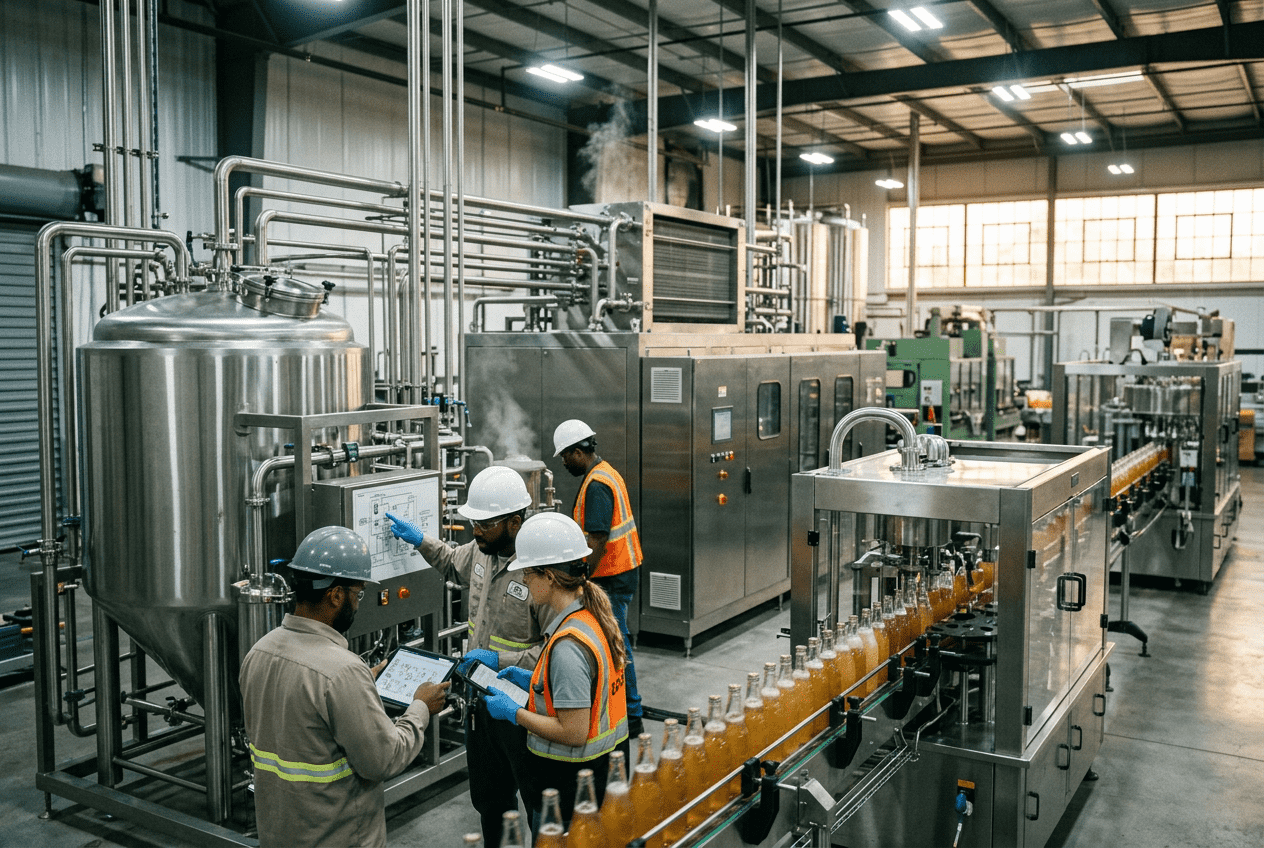
Modern food and beverage manufacturers in the United States increasingly depend on process integration to connect equipment, automation, production planning, quality records, and operational decision-making. In practical terms, integration means that mixers, fillers, pasteurizers, CIP skids, packaging lines, laboratory systems, and enterprise software all exchange reliable data at the right time. When integration is well designed, plants reduce downtime, improve traceability, tighten recipe execution, accelerate changeovers, and support compliance with FDA, USDA, SQF, and BRC expectations.
Across major U.S. manufacturing corridors such as Chicago, Dallas-Fort Worth, Central Valley California, the Carolinas, Atlanta, Houston, and the I-95 corridor, food producers are investing in scalable automation because labor pressure, margin compression, and retailer expectations are forcing better plant performance. Facilities near the ports of Los Angeles, Long Beach, Savannah, Houston, and New York/New Jersey also face strong throughput demands tied to imported ingredients, exported finished goods, and seasonal inventory swings. For these operations, disconnected systems are no longer just inconvenient; they are a direct business risk.
Quick Answer

Process integration connects production equipment, PLCs, SCADA, MES, recipe systems, batch controls, historians, and quality platforms into one coordinated manufacturing environment. In a U.S. food plant, this allows operators and managers to see what is running, what was made, how it was made, what quality results were recorded, and whether the line is performing to target. The best integrations are built around business outcomes: higher OEE, lower giveaway, better traceability, stronger compliance, and faster scale-up.
For buyers, the most important decision is not simply which software package to choose. It is how to define the data architecture, communication standards, validation approach, and ownership model before installation begins. Plants processing dairy, proteins, prepared foods, sauces, RTD beverages, brewing products, and aseptic goods all have different control points, but they share the same need: equipment and information systems must work as one system rather than as isolated assets.
| Objective | Integrated Function | Typical Plant Impact |
|---|---|---|
| Traceability | Lot tracking from ingredient receipt to finished goods | Faster recalls and tighter compliance response |
| Downtime reduction | Equipment status sharing between upstream and downstream assets | Fewer line stops and better bottleneck visibility |
| Recipe control | Automatic parameter downloads to PLC or batch systems | Less operator error and stronger consistency |
| Quality assurance | Digital checks linked to production lots and process data | Better release decisions and audit readiness |
| Reporting | SCADA, MES, and historian data aggregation | Real-time KPI dashboards and root-cause analysis |
| Scalability | Standardized interfaces and naming structures | Easier future expansions and acquisitions |
The table above shows why integration is now treated as a strategic capital item rather than a controls accessory. Plants that define measurable targets before project kickoff usually gain the strongest return.
Process Integration Fundamentals

At the foundational level, process integration begins with a map of the physical process and a parallel map of the data process. The physical map includes tanks, pumps, valves, heat exchangers, conveyors, fillers, clean-in-place systems, utilities, and packaging equipment. The data map includes I/O, PLC tags, recipes, production orders, alarms, lot codes, test results, operator actions, and maintenance events.
In the United States market, the most effective integration projects usually start with six questions:
- What decisions need to be made in real time?
- Which equipment generates critical process data?
- Which systems are the source of truth for recipes, schedules, and quality records?
- What level of traceability is required by customers, regulators, or certifying bodies?
- How will the plant validate software changes and control logic revisions?
- How will future lines, co-packing customers, or new SKUs be added?
Food plants often struggle when they buy automation in phases without a standard integration philosophy. A filler may speak one protocol, a pasteurizer another, and a packaging line may only expose limited data. Over time, this creates islands of automation. A disciplined integration strategy standardizes tag structures, alarm conventions, naming rules, cybersecurity layers, historian logic, and report formats. That makes line expansions in places like Wisconsin dairy plants, Arkansas protein sites, or California beverage facilities far more manageable.
From a buying standpoint, manufacturers should prioritize interoperability, documentation quality, and lifecycle support over low upfront cost. The least expensive programming package can become the most expensive decision if every future change requires custom workarounds.
This growth trend reflects rising investment in digital controls, traceability, and plantwide data systems. By 2026, sustainability reporting, energy tracking, and labor optimization are expected to further accelerate demand.
Equipment-to-Equipment Communication

Equipment-to-equipment communication is the layer where physical assets coordinate automatically. A depalletizer should know whether the filler is ready. A blender should not discharge if the surge tank is unavailable. A retort room should receive correct lot, hold, and release information from upstream systems. A CIP skid should confirm route alignment and wash completion before production restarts.
Typical communication methods in U.S. food and beverage plants include Ethernet/IP, Profinet, Modbus TCP, OPC UA, and vendor-specific interfaces. Legacy plants may still rely on serial communications or hardwired interlocks. The right choice depends on criticality, vendor ecosystem, cybersecurity expectations, and available in-house support.
In high-throughput beverage applications, line synchronization is especially important. A syrup room, blending skid, carbonator, filler, and packer must share status data to avoid starved or blocked conditions. In protein and prepared foods, communication between grinders, mixers, cookers, chillers, slicers, and packaging assets is essential for throughput, food safety timing, and labor balancing.
| Product Type | Key Equipment | Critical Data Shared |
|---|---|---|
| RTD beverages | Syrup room, blender, filler, pasteurizer | Brix, temperature, tank status, line speed |
| Dairy | HTST, separators, homogenizers, fillers | Flow diversion status, pressure, temperature, CIP release |
| Sauces and dressings | Mixers, kettles, transfer pumps, fillers | Batch ID, viscosity checks, fill targets |
| Prepared foods | Cookers, chillers, conveyors, packaging lines | Cook times, internal temperatures, queue status |
| Protein processing | Grinders, tumblers, ovens, slicers | Lot identity, dwell time, sanitation status |
| Aseptic products | UHT, sterile tanks, fillers, CIP/SIP systems | Sterility state, hold conditions, batch genealogy |
This table shows that communication requirements vary by product risk and process sensitivity. A beverage line may emphasize speed and setpoint transfer, while an aseptic line emphasizes state control and validated conditions.
For companies evaluating vendors, local support matters. Integrators serving markets near Charlotte, Raleigh, Minneapolis, St. Louis, Fresno, and Salt Lake City should understand regional utility constraints, labor realities, and local code enforcement. Strong documentation, FAT/SAT discipline, and post-startup support often matter more than a long feature list.
MES and SCADA Integration
SCADA provides supervisory visibility and control, while MES typically manages production execution, work orders, performance, traceability, and labor or downtime context. The integration between the two is where many plants unlock value. SCADA can show what is happening now; MES can explain whether production is meeting the schedule, consuming the right materials, and staying within target yields.
When SCADA and MES are connected properly, a production order issued by planning can trigger recipe download, operator instructions, lot verification, and data collection workflows. At the end of the run, actual material consumption, downtime events, quality checks, and output counts can feed back to management systems.
In co-packing operations, this is especially important because multiple brands, package formats, and customer specs may run through the same facility. A line in Texas or North Carolina serving several contract customers cannot rely on whiteboards and manual spreadsheet reconciliation if it wants to scale profitably.
Manufacturers should define role boundaries clearly:
- PLC: deterministic equipment control
- SCADA: visualization, alarming, operational oversight
- MES: production execution, traceability, KPI context, scheduling interaction
- ERP: planning, costing, inventory, purchasing, order management
The demand comparison above shows strong interest across multiple categories, with beverages and proteins often leading because of SKU complexity, line utilization pressure, and traceability demands.
| Function | SCADA Role | MES Role |
|---|---|---|
| Operator interface | Visual process screens and alarms | Work instructions and production workflow |
| Data capture | Real-time process values | Contextualized production records |
| Scheduling | Limited or none | Order sequencing and execution logic |
| Traceability | Equipment events and tag history | Lot genealogy and batch relationships |
| Performance reporting | Immediate alarms and statuses | OEE, downtime reasons, yield analysis |
| Quality integration | Display of hold states or limits | Sampling workflows and release records |
Plants should not force SCADA to act like MES or vice versa. The strongest architecture lets each layer perform its job while sharing validated information.
Data Flow and Digital Twin Technology
Data flow design determines whether an integration project stays useful after startup. A good architecture defines where data originates, how it is validated, who owns it, how long it is stored, and who can use it. This includes tags from field devices, line states from PLCs, transactions from MES, laboratory results from quality systems, and production or inventory information from business platforms.
Digital twin technology is becoming more relevant in U.S. food plants because it helps teams simulate layout, throughput, utility loads, and control behavior before full deployment. In simple form, a digital twin may be a process model linked to equipment capacities and operating constraints. In more advanced form, it can mirror actual plant data to test scenarios such as SKU changes, surge capacity, CIP windows, or energy reduction plans.
By 2026, digital twins are expected to be used more often for sustainability and capital planning. A plant near the Port of Savannah may simulate new cold-storage demand before expansion. A dairy processor in Idaho may model water reuse impacts. A co-packer in Southern California may test line scheduling against utility rates and labor availability.
The area trend highlights a clear movement away from manual logs and isolated spreadsheets toward synchronized, plantwide data environments.
Manufacturers should also think carefully about data governance. Bad tag naming, duplicate sources, and undocumented transformations can undermine every dashboard. Good integration creates one version of the truth for production, quality, and management.
| Source | Data Type | Destination |
|---|---|---|
| Field instruments | Temperature, flow, pressure, conductivity | PLC and historian |
| PLC | Equipment status, alarms, permissives | SCADA and MES |
| SCADA | Operator events, acknowledgments, trends | Historian and reporting tools |
| MES | Orders, lots, downtime codes, yields | ERP and quality systems |
| LIMS or quality platform | Lab results, holds, release status | MES, dashboards, compliance records |
| ERP | Item masters, schedules, inventory balances | MES and business reporting |
This data flow framework helps define ownership and reduces rework later. Plants that document it early often avoid expensive post-installation revisions.
Recipe Management and Batch Control
Recipe management and batch control are central to consistent food production. They ensure that the correct ingredients, quantities, process parameters, and sequencing steps are used every time. In regulated or customer-audited environments, this also supports proof that the product was made according to approved specifications.
For liquid processing, recipe systems may govern tank selection, ingredient addition order, mixing speed, Brix targets, temperature ramps, hold times, and transfer routing. For solids or prepared foods, batch control may manage weighing, preblend release, cook profiles, marination cycles, and packaging declarations.
Plants with many SKUs should separate recipe logic from core equipment programming when possible. That reduces engineering effort during product changeovers and new product launches. It also supports stronger approval workflows, especially when R&D, operations, and quality all need controlled change management.
Buying advice for U.S. manufacturers:
- Require version control and electronic approvals.
- Link every recipe to item masters and quality specifications.
- Capture actuals versus targets for yield, hold time, and critical process values.
- Design for allergen management and validated changeovers.
- Ensure that operators can only select approved recipes for the line and package format.
| Industry | Key Control Need | Main Risk if Weak |
|---|---|---|
| Brewing and fermentation | Time, temperature, tank status, dry-hop logic | Flavor inconsistency and tank scheduling conflicts |
| Dairy beverages | Blend ratios, pasteurization parameters, homogenization | Food safety deviation and quality drift |
| Sauces and marinades | Ingredient sequencing, viscosity, heat profile | Texture problems and off-spec batches |
| Protein products | Marination time, formulation, cook profile | Yield loss and compliance exposure |
| RTD products | Flavor setpoints, carbonation, package SKU selection | Brand inconsistency and waste |
| Aseptic processing | Sterility sequence, hold limits, batch release interlocks | Product hold or catastrophic contamination risk |
The table makes clear that recipe management is not only about formulations. It is also about safeguarding process conditions that protect brand and food safety.
Quality Systems Integration
Quality systems integration links production to inspections, lab results, nonconformance workflows, sanitation records, and release decisions. This is where many plants gain major value because quality events become visible in production context instead of being hidden in separate files or systems.
Examples include automatic holds when CCP limits are exceeded, lot-level links between batches and microbiological tests, digital pre-op checklists tied to line readiness, and electronic verification that allergen cleans were completed before a changeover. In FDA- and USDA-facing operations, these links improve audit readiness and shorten investigations.
Facilities handling proteins, dairy, retort, or aseptic products often benefit the most because quality decisions can directly affect inventory release, customer shipments, and risk exposure. Plants shipping through Memphis, Indianapolis, Kansas City, or major East Coast distribution hubs also value speed because delays in release can ripple across transportation windows.
By 2026, quality integration trends in the United States are likely to include more predictive analytics, wider use of inline sensors, and stronger environmental monitoring links to production scheduling. Sustainability reporting will also increasingly overlap with quality systems as customers ask for proof of water, energy, and waste performance by product family.
This comparison shows why many manufacturers prefer partners that can connect process engineering, installation, controls, utilities, and startup instead of addressing only one piece of the plant.
Validation and Commissioning
Validation and commissioning turn engineering intent into dependable plant performance. In food and beverage projects, this includes FAT, SAT, I/O checks, loop checks, dry testing, wet testing, recipe verification, alarm testing, CIP validation, performance qualification, and operator training.
Commissioning should not be treated as the last step before handoff. It should be planned from the beginning with a clear matrix covering equipment, controls, utilities, process functionality, and quality-critical requirements. This is especially important when lines involve pasteurization, sterilization, aseptic barriers, retort systems, or regulated sanitation verification.
Typical validation priorities include:
- Confirmed communication between all system layers
- Verified recipe downloads and parameter security
- Traceability checks from raw material to packaged lot
- Alarm priorities and response procedures
- Evidence of CIP, SIP, or sanitation cycle completion
- User training and role-based access testing
Manufacturers should request commissioning plans that include not only startup milestones but also measurable acceptance criteria. For example, a beverage line may require stable throughput over a multi-shift run, while a prepared foods facility may require proof of product changeover and allergen clean verification before acceptance.
Case experience across the United States shows a common lesson: integrated plants start up faster when controls, mechanical completion, utility readiness, and operator training are managed as one coordinated program. That is why many owners seek a single accountable project leader rather than separate firms managing process, construction, and automation in silos.
Our Company
Disruptive Process Solutions supports food and beverage manufacturers across the United States and Canada with an approach built around profitable capital execution rather than isolated engineering tasks. The company works with producers ranging from growth-stage operators to large multi-site manufacturers, helping them align process design, facility buildout, automation, and commissioning with business goals.
On the technological side, DPS brings capabilities in process controls, PLC programming, automation architecture, SCADA, batch and recipe systems, and integration planning that connects utility systems, process equipment, and production data. This matters in complex facilities where tanks, thermal systems, filling assets, and packaging lines need one coherent operating framework instead of disconnected control islands. More detail on integration and engineering support is available through the company’s food and beverage engineering services.
On the manufacturing side, DPS also designs and supplies selected branded process equipment, including tanks, CIP systems, marination tumblers, and cooking vessels. That equipment focus is especially valuable when custom fabrication must align tightly with process intent, automation logic, and installation sequencing. Manufacturers evaluating expansion options can review additional examples through the company’s process equipment capabilities.
On the service side, DPS operates through a design-build-manage model that combines process engineering, capital planning, owner’s representation, project management, general contracting coordination, installation oversight, and startup support. For clients in markets such as North Carolina, Texas, California, the Midwest, and major logistics corridors, this model reduces handoff risk and improves decision speed. Companies seeking background on leadership and operating philosophy can visit about the company, while those wanting examples of execution can explore selected project case studies.
A practical example of this value comes when a manufacturer is preparing to invest in new capacity. Sometimes the real bottleneck is not new stainless steel but control logic, line balancing, or scheduling limitations. An experienced integration partner can identify whether the better answer is software optimization, targeted retrofit work, or a full capital project. That kind of business-first evaluation is often what separates a profitable upgrade from an expensive one.
FAQ
What is process integration in a food plant?
It is the coordination of equipment, automation, data systems, and quality workflows so the plant runs as one connected operation. It usually includes PLCs, SCADA, MES, recipe control, historians, and quality records.
Which industries benefit most from integration?
Beverages, dairy, proteins, prepared foods, sauces, and aseptic processors all benefit. The highest returns usually appear where plants have many SKUs, strict traceability requirements, or frequent changeovers.
How does integration help with FDA, USDA, SQF, or BRC compliance?
It improves data accuracy, lot genealogy, alarm history, sanitation verification, and digital records. That supports audits, investigations, corrective actions, and product release decisions.
What is the difference between SCADA and MES?
SCADA focuses on monitoring and supervisory control in real time. MES manages production execution, traceability, performance context, and workflow coordination between the shop floor and business systems.
Do all plants need a digital twin?
No, but many benefit from one. For greenfield sites, large expansions, and utility-constrained facilities, digital twins can reduce risk by modeling throughput, changeovers, energy use, and equipment interactions before startup.
How long does a typical integration project take?
It depends on scope. A targeted retrofit may take weeks, while a new integrated line or plantwide MES and SCADA project can take several months or more. Good front-end definition shortens execution time later.
What should buyers ask potential suppliers?
Ask about protocol experience, recipe and batch control strategy, validation methodology, FAT/SAT process, cybersecurity practices, documentation quality, training, and post-startup support. Also ask who owns integration across process, controls, utilities, and commissioning.
Should we choose a local integrator or a national partner?
Choose the team that best understands your product, process risk, and scale goals. Local presence can help with response time, but national food and beverage specialists may bring stronger cross-industry experience and broader project resources.
How important is cybersecurity in food plant integration?
Very important. As more assets connect to plant networks and business systems, segmentation, access control, backup strategy, and change management become essential to uptime and product integrity.
What are the biggest U.S. trends through 2026?
Expect stronger adoption of digital batch records, predictive maintenance, energy and water monitoring, AI-assisted troubleshooting, digital twins for capital planning, and tighter integration between quality, sustainability, and production data.
For manufacturers in the United States, process integration is no longer just an automation upgrade. It is a core operating strategy that affects profitability, compliance, labor efficiency, scalability, and resilience. Whether the plant is producing carbonated beverages near Los Angeles, cultured dairy in the Upper Midwest, protein products in the Southeast, or shelf-stable meals moving through Gulf Coast distribution channels, the principle is the same: connected systems make better plants. The right project starts with clear business goals, disciplined data design, and a partner capable of aligning engineering, equipment, controls, and startup into one accountable path.
[/trp_language]
Complete Company Portfolio
About the Author: Disruptive Process Solutions (DPS)
The DPS team combines process engineering expertise with real-world food and beverage manufacturing experience. Our content focuses on process optimization, production efficiency, facility improvements, and practical solutions that help manufacturers operate more effectively in a rapidly evolving industry.
Share