Food Plant SCADA System Design
[trp_language language=”en_US”]
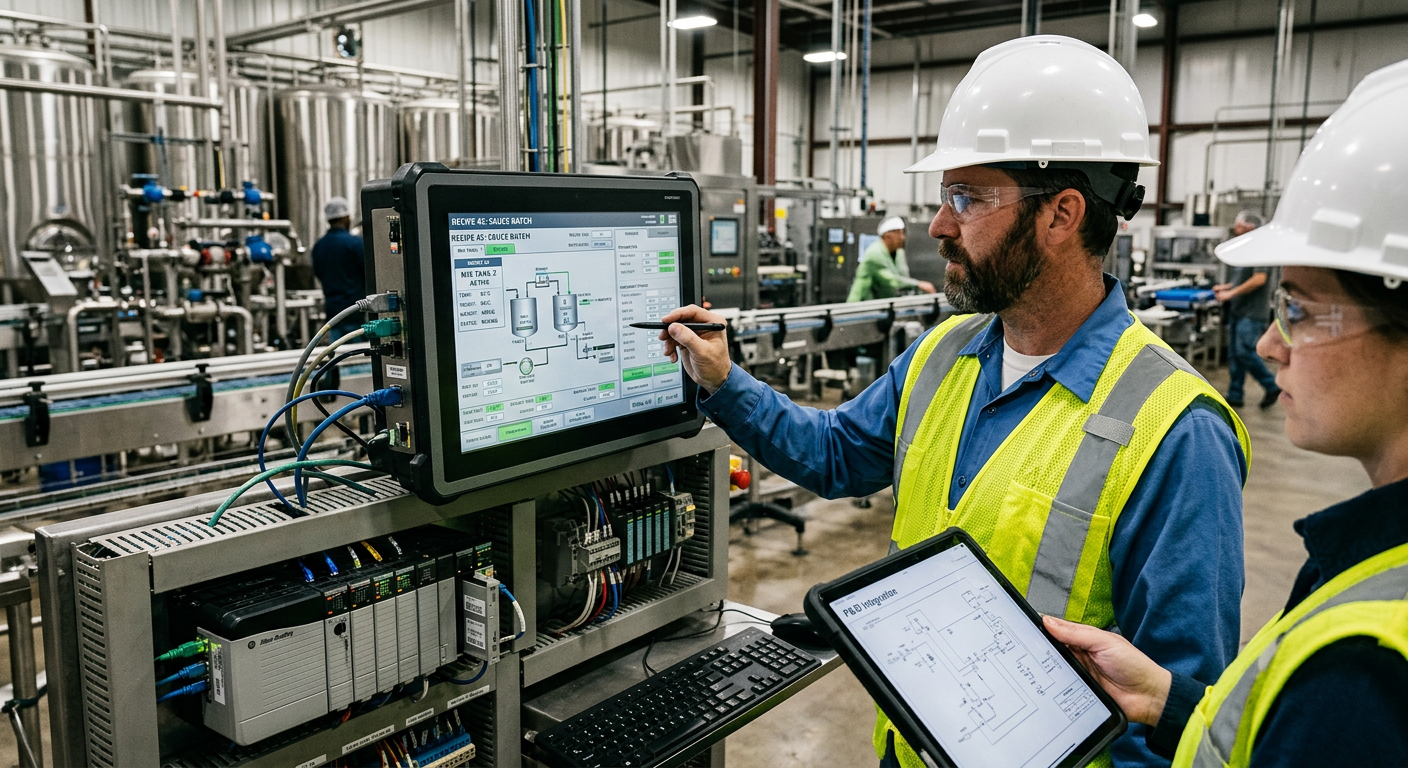
Food manufacturers in the United States use SCADA to turn plant data into real-time decisions. A well-designed food plant SCADA system supervises processing lines, collects production and quality records, manages alarms, supports recipe execution, and creates audit-ready documentation for FSMA and HACCP programs. In practical terms, it connects field devices, PLCs, operators, maintenance teams, and plant leadership into one visible operating environment.
For processors in markets such as Chicago, Dallas, Fresno, Charlotte, Los Angeles, Houston, and the I-95 and I-40 freight corridors, SCADA design is no longer only about visualization. It is now tied to labor efficiency, traceability, sanitation verification, utility performance, and rapid response when plants ship through major trade hubs such as the Port of Los Angeles, Port of Long Beach, Savannah, Houston, and New York/New Jersey. Whether the facility makes sauces, proteins, dairy, RTD beverages, aseptic products, or shelf-stable foods, the SCADA layer increasingly determines how well operations scale and how cleanly data stands up during customer, USDA, FDA, SQF, or BRC reviews.
Disruptive Process Solutions supports this kind of work across North America through integrated engineering, automation, equipment, installation, and project execution. Rather than treating controls as an isolated scope, DPS approaches SCADA as part of a larger profitable capital project strategy, linking process design, utility capacity, operator workflow, equipment integration, and compliance documentation.
Quick Answer

A food plant SCADA system is the software and communications layer that lets manufacturers monitor equipment, control process visibility, manage alarms, trend critical parameters, store production records, and report performance across the entire facility. In U.S. food and beverage plants, a strong SCADA design usually includes:
- Real-time monitoring of temperatures, pressures, flow, tank levels, speeds, runtimes, and sanitation states
- Alarm management for food safety, downtime, utility issues, and out-of-spec process events
- Historical data collection for traceability, batch records, CCP review, and root-cause analysis
- Recipe and batch support for repeatable formulation and changeover accuracy
- Operator HMIs designed for faster decisions and fewer nuisance alarms
- Connectivity through PLCs, historians, MES tools, ERP systems, OPC UA gateways, and IIoT platforms
- Automated reports for FSMA, HACCP, SQF, BRC, customer audits, and internal KPI reviews
For many U.S. processors, the best SCADA platform is not the one with the most screens. It is the one that fits the plant’s sanitation model, packaging speed, recipe complexity, staffing level, network architecture, and future expansion plans.
| Plant Type | Typical SCADA Use | Critical Data | Main Risk if Weakly Designed | High-Value Outcome | Common Buyer Priority |
|---|---|---|---|---|---|
| Dairy | Pasteurization, CIP, batching | Temp, flow diversion, hold time | Compliance gaps | Electronic records | Validation support |
| Protein processing | Cook, chill, marination, packaging | Cook curves, dwell time, line status | Traceability delays | Faster investigations | Downtime visibility |
| Beverage | Syrup room, blending, utilities, fillers | Brix, CO2, tank levels, OEE | Off-spec batches | Recipe consistency | Changeover speed |
| Sauces and dressings | Batching, heating, mixing, CIP | Ingredient adds, temperatures, viscosities | Yield loss | Waste reduction | Batch traceability |
| Aseptic | Sterility barriers, utilities, fillers | Sterilization temp, pressure, event logs | Product hold events | Audit confidence | Data integrity |
| Retort and shelf-stable foods | Retort scheduling and record storage | Time, temp, pressure, lot records | Missing process evidence | Automated reports | Regulatory readiness |
The table above shows why SCADA design must be tailored to the product and process. A beverage plant focused on syrup blending will not prioritize the same data structures as a retort facility or a USDA-regulated protein operation.
What a Food Plant SCADA System Does: Supervision, Alarms, and Records

At the most basic level, SCADA stands for supervisory control and data acquisition. In a food plant, “supervisory” means operators and managers can see the process, know what state assets are in, and act based on confirmed information rather than walking the floor to check conditions manually. “Data acquisition” means the system collects values and events from instruments and controllers, timestamps them, and stores them in a way that can be reviewed later.
The supervision role is especially important in modern U.S. plants where labor is tight and multiple lines may run with smaller crews. A single supervisor may need to oversee a kettle room, utility area, CIP skid, filler block, and packaging line from one control room. SCADA presents these areas in a unified view so that the team understands not only whether equipment is on, but whether it is producing, starved, blocked, idle, in sanitation, waiting on QA release, or in fault.
Alarm management is the second major function. Good alarm design warns only when action is needed. In food plants, that often includes cooking temperatures below setpoint, utility pressure drops, low chemical concentration in CIP, retort deviations, high tank level, filler faults, refrigeration issues, and downtime events. Poorly designed alarm systems flood operators with too many messages, causing alarm fatigue. Well-designed systems prioritize alarms by food safety, process risk, maintenance urgency, and production impact.
The third function is records. A properly structured historian and reporting layer can automatically create batch records, sanitation logs, critical control point histories, utility summaries, downtime reports, and electronic signatures where required. These records matter in the United States because plants are expected to show evidence quickly during audits and investigations. When a customer asks for proof of thermal treatment or allergen cleanout, paper records and memory are rarely enough.
DPS often sees food and beverage projects where SCADA value is unlocked when the controls scope is tied directly to the plant’s business objective: more throughput, more usable data, lower labor burden, better audit posture, or more reliable startup after expansion. That broader operating view is one reason clients exploring food and beverage engineering services often evaluate SCADA architecture alongside process equipment, utilities, and project execution.
SCADA Architecture: Field Layer, Control Layer, and Supervision Layer

Food plant SCADA architecture works best when it is divided into clear layers. This improves cybersecurity, maintainability, startup efficiency, and future expansion.
Field layer: This includes instruments and devices such as flowmeters, RTDs, pressure transmitters, valve position sensors, VFDs, scales, load cells, conductivity probes, pH analyzers, motor starters, barcode scanners, and smart utility meters. In food plants, the field layer must be selected for washdown conditions, chemical exposure, hygienic requirements, and calibration needs.
Control layer: This is usually the PLC and local control network layer. PLCs execute sequencing, interlocks, PID loops, machine states, CIP logic, recipe steps, and line coordination. Food plants commonly use this layer to enforce process integrity, for example by preventing product transfer when a destination tank is not released or by stopping fill when hold conditions are triggered.
Supervision layer: This includes SCADA servers, HMIs, historians, alarm databases, report engines, thin clients, and interfaces to MES, ERP, quality, maintenance, and cloud systems. This layer is where plant personnel interact with the process, analyze trends, compare shifts, review downtime, and generate reports for leadership or auditors.
For geographically distributed companies with plants in the Midwest, Southeast, Texas, and the West Coast, a standardized layered architecture makes it easier to compare sites and roll out improvements. A sauce plant near Atlanta, a dairy processor in Wisconsin, and a beverage co-packer in Southern California may run different line configurations, but their SCADA standards can still use the same naming structures, alarm philosophy, historian tags, and report templates.
| Architecture Layer | Typical Components | Food Plant Example | Primary Design Concern | Common Integration Need | Value to the Business |
|---|---|---|---|---|---|
| Field | Sensors, valves, drives, analyzers | Brix meter on blending skid | Sanitary suitability | Instrument calibration records | Accurate process data |
| Control | PLCs, remote I/O, VFD logic | CIP sequence logic | Reliable sequencing | Machine state modeling | Consistent operation |
| Supervision | SCADA server, historian, HMI | Central utilities dashboard | User clarity | Alarm and trend storage | Faster decisions |
| Operations interface | Thin clients, tablets, workstations | Packaging room terminal | Role-based access | Electronic acknowledgments | Reduced paperwork |
| Business systems | ERP, MES, CMMS, QA systems | Lot handoff to ERP | Data consistency | Order and lot mapping | Better traceability |
| Remote layer | Secure VPN, cloud analytics | Corporate KPI review | Cybersecurity | Read-only dashboards | Multi-site visibility |
This layered table shows that SCADA design is not just screen design. It is a full operating architecture that shapes reliability and decision-making from the instrument level to the enterprise level.
The line chart reflects a realistic upward trend in U.S. food plant SCADA modernization demand, driven by labor pressure, data needs, cybersecurity upgrades, and compliance expectations heading into 2026.
Five Benefits: Traceability, Quality Control, OEE, Waste Reduction, and Remote Monitoring
The business case for a food plant SCADA system usually becomes clear in five areas.
1. Traceability. A good SCADA platform links lots, batches, timestamps, operator actions, process conditions, and equipment states. If a customer complaint or deviation occurs, the team can quickly find the affected window and understand what happened. This matters across meat, dairy, RTD beverages, and co-packing environments where lot segregation and rapid retrieval of records are essential.
2. Quality control. Operators can compare live values against limits, see trends before failure occurs, and be guided through standardized responses. Instead of discovering a problem after a tank has finished blending, teams can detect drift in temperature, pH, flow, or ingredient addition during the process.
3. OEE improvement. SCADA helps classify downtime, minor stops, speed loss, and starved or blocked states. Once the plant can see the reasons behind availability and performance loss, teams can target labor, maintenance, changeovers, or upstream constraints more effectively.
4. Waste reduction. Better recipe execution, transfer control, utility monitoring, and batch hold visibility can reduce product giveaway, overfill, water use, rework, and CIP chemical loss. This is increasingly important in high-cost ingredient categories such as proteins, dairy solids, flavors, sweeteners, and functional additives.
5. Remote monitoring. With secure role-based access, leadership, engineering, and maintenance teams can review plant conditions without standing at the machine. For multi-site groups, remote dashboards support standardization and faster troubleshooting.
| Benefit | Operational Trigger | Typical SCADA Feature | Example KPI | Best-Fit Industry | Likely Financial Impact |
|---|---|---|---|---|---|
| Traceability | Recall, complaint, deviation | Historian plus batch records | Minutes to retrieve records | Protein, dairy, co-pack | Lower investigation cost |
| Quality control | Drift from target | Live trends and limits | First-pass quality rate | Beverage, sauces, aseptic | Less rework |
| OEE | Downtime or speed loss | State-based monitoring | Availability and performance | Packaging-heavy plants | Higher throughput |
| Waste reduction | Overfill, flush loss, giveaway | Recipe control and usage trends | Yield variance | Dairy, sauces, RTD | Better margins |
| Remote monitoring | Multi-area supervision | Thin clients and secure access | Response time to events | Large campuses | Labor leverage |
| Utility optimization | Energy or water spikes | Meter dashboards | kWh or gallons per unit | All food sectors | Lower operating cost |
The explanation behind this table is straightforward: every SCADA investment should be connected to a measurable plant KPI. If the project cannot be tied to retrieval time, yield, downtime, labor efficiency, compliance readiness, or cost per unit, the design may be too generic.
The bar chart highlights where SCADA demand is often strongest: beverage, co-packing, and dairy operations where recipe changeovers, high line utilization, and record sensitivity are especially important.
HMI Design to ISA-101: Calm Backgrounds, Alarm Hierarchy, and Operator Task Flow
Many plants still make the mistake of judging SCADA quality by how colorful the screens look. In reality, better HMI design usually looks quieter. ISA-101 principles encourage calm, consistent displays that guide the operator to what needs action. Neutral backgrounds, limited use of color, and clear equipment state logic help people spot abnormal conditions faster.
Calm backgrounds. Gray and muted tones reduce eye fatigue and stop normal running conditions from competing visually with alarms or abnormal states. Constant green and red everywhere may look active, but it often hides what matters.
Alarm hierarchy. Not every event deserves the same visual weight. Critical food safety alarms, major production alarms, advisory alarms, and maintenance notifications should be distinct. If a low-severity communication blip looks the same as a failed thermal process condition, the system is poorly prioritized.
Operator task flow. Screens should match how the job is actually performed. If an operator first checks line state, then confirms tank availability, then verifies recipe, then starts a transfer, the HMI should support that sequence naturally. Good SCADA design reduces clicks, screen jumps, and confusion under pressure.
DPS brings useful value here because its controls work sits alongside structural, mechanical, electrical, process, and utility engineering. That broader technical capability makes it easier to design HMIs around real process constraints, not just software conventions. In plants with blending, pasteurization, retort, fermentation, distillation, cooking, chilling, or CIP, the best screen layout reflects how equipment, operators, and utilities interact in the field.
| HMI Design Principle | Recommended Practice | Common Mistake | Operator Benefit | Food Plant Example | Expected Result |
|---|---|---|---|---|---|
| Background color | Use neutral tones | Bright backgrounds everywhere | Less fatigue | Central utilities overview | Faster abnormality recognition |
| Alarm priority | Separate by severity | All alarms look identical | Better response focus | Pasteurizer hold condition | Lower alarm fatigue |
| Navigation | Task-based screen paths | Too many deep menus | Fewer clicks | Batch start and release | Quicker execution |
| State clarity | Show running, idle, fault, CIP | Ambiguous equipment states | Better diagnosis | Pump permissive display | Reduced troubleshooting time |
| Trend access | One-click trend popups | Buried historical data | Faster root-cause review | Cook temperature excursion | Improved corrective action |
| User roles | Role-based visibility | Everyone sees everything | Cleaner workflow | Supervisor vs operator views | Lower error risk |
This table matters because HMI design has direct production consequences. A cleaner display can shorten troubleshooting time, reduce operator error, and improve startup confidence after line modifications.
OPC UA and IIoT Connectivity for Modern Food Plants
OPC UA has become a practical foundation for modern food plant SCADA connectivity because it supports standardized, secure, and scalable data exchange between devices, PLCs, SCADA servers, historians, MES applications, and enterprise systems. In the United States, plants expanding through acquisition or adding new packaging technologies often face a mixed automation environment. OPC UA helps bridge different vendors more cleanly than older one-off integrations.
IIoT connectivity extends that value by moving selected plant data into higher-level analytics, sustainability reporting, predictive maintenance tools, or enterprise dashboards. The key is discipline. Not all data should be sent everywhere. Food processors need a strategy that defines which tags are operationally critical, which are compliance-critical, which are maintenance-focused, and which belong in aggregated business reporting.
Examples include:
- Sending utility usage by area to sustainability dashboards
- Sharing downtime states with OEE software
- Pushing lot and batch identifiers to ERP or warehouse systems
- Feeding vibration or runtime data to maintenance planning tools
- Providing corporate teams read-only KPI access across sites
For U.S. plants, cybersecurity must be built into this architecture from the start. Network segmentation, role-based access, patch strategies, and secure remote support matter more than ever. A cloud dashboard is only helpful if it does not create unacceptable operational risk.
Food manufacturers evaluating vendors should ask whether the integrator can support not just PLC programming but also secure connectivity, historian design, data governance, and long-term support. That is why many owners reviewing the DPS team and approach look beyond controls coding alone and evaluate whether the partner understands project delivery, compliance expectations, and plant operations at scale.
Recipe Management Integration within SCADA Platforms
Recipe management is one of the highest-value SCADA functions in food and beverage manufacturing because it sits at the intersection of quality, speed, labor, and traceability. A recipe-capable SCADA platform can manage formula versions, setpoint downloads, sequencing logic, ingredient verification, operator prompts, lot usage tracking, and exception handling.
In a beverage facility, recipe integration might coordinate syrup blending, water treatment setpoints, carbonation targets, flavor adds, and packaging selections. In a prepared foods plant, it may govern batch order, cook curves, ingredient additions, and hold-release workflow. In a dairy plant, it can support fat standardization, culture additions, timing windows, and CIP dependencies between campaigns.
The best recipe systems do not only store formulas. They also enforce context:
- Correct equipment assignment
- Release status of source and destination vessels
- Allergen changeover rules
- Operator confirmation steps
- Lot capture for every critical add
- Deviation logging and supervisor review
DPS also brings manufacturing capability into this conversation. Because the company designs and supplies process equipment such as tanks, CIP systems, marination tumblers, and cooking vessels, recipe logic can be aligned more effectively with actual equipment capabilities, utility loads, and transfer paths. That matters when custom process skids, tanks up to 12,000 gallons, or plant-specific batching systems need controls and SCADA to function as one integrated production asset rather than disconnected scopes.
The area chart shows a realistic trend shift: more U.S. processors now expect SCADA to include recipe intelligence, analytics, and compliance support rather than simple line monitoring alone.
Audit-Ready Documentation: Automated Reports for FSMA and HACCP Compliance
One of the strongest arguments for SCADA in U.S. food manufacturing is audit readiness. FSMA, HACCP, customer standards, and certification schemes all put pressure on plants to show complete, accurate, and timely records. Automated reporting reduces the burden of manual collection and improves consistency.
Common automated reports include CCP temperature histories, pasteurization or retort summaries, CIP verification records, ingredient and lot trace logs, downtime reports, sanitation event logs, utility performance summaries, and batch genealogy reports. Plants can also create exception reports that show only out-of-spec events and how they were handled.
For operators and QA teams, the benefit is speed. Instead of assembling records from clipboards, machine printouts, and multiple systems, the team can retrieve a consistent report from one validated structure. For management, the benefit is confidence that the plant can answer questions quickly during customer visits, mock recalls, or official reviews.
Service capability matters here as much as software. DPS’s Design Build Manage model supports end-to-end project execution, from planning and engineering through installation, integration, and commissioning. That means reporting requirements can be discussed early, not bolted on after startup. In real projects, that alignment often prevents expensive rework in network design, I/O mapping, naming standards, and historian structure.
| Report Type | Primary User | Typical Source Data | Audit Use | Update Frequency | Why It Matters |
|---|---|---|---|---|---|
| CCP trend report | QA and operations | Temperatures, times, acknowledgments | HACCP verification | Per batch or shift | Shows control was maintained |
| CIP execution report | Sanitation and QA | Conductivity, temperature, phase times | Sanitation evidence | Each cycle | Confirms cleanout performance |
| Batch genealogy report | Operations and trace team | Lot inputs and outputs | Recall readiness | Per production order | Speeds investigations |
| Downtime report | Production leaders | State model and events | Internal improvement | Shift or daily | Supports OEE action |
| Utility usage report | Engineering and finance | Water, steam, air, power meters | Sustainability reviews | Daily or monthly | Controls cost |
| Exception report | Supervisors and QA | Alarm history and process deviations | Corrective action review | Daily | Focuses attention on risks |
The explanation for this table is simple: compliance reporting should not live outside the control philosophy. If a parameter is critical to food safety or release decisions, it should be structured in the data model from day one.
Choosing the Right SCADA Platform: Checklist for Food Manufacturers
Choosing a SCADA platform for a U.S. food plant should start with operational fit, not brand familiarity. A processor making cultured dairy in Wisconsin, a ready-to-drink producer in North Carolina, and a protein facility in Kansas will not all need the same architecture, licensing model, or recipe depth.
Use this checklist when evaluating options:
- Can the platform handle your required batch, continuous, or hybrid process model?
- Does it support alarm management, historian functions, and audit trails at the needed depth?
- How well does it integrate with your PLC standards, ERP, CMMS, QA systems, and instrumentation?
- Can it scale from one line to multiple plants without forcing a full redesign?
- Does it support ISA-101 style HMI design and role-based security?
- How does licensing work for clients, tags, historians, reports, and remote access?
- What cybersecurity model is supported?
- Can recipes, lot tracking, and electronic records be implemented without excessive customization?
- Is local support available for commissioning, troubleshooting, and future expansion?
- Does the integrator understand sanitary design, utility loads, startup sequencing, and production realities?
In the United States, buyers should also evaluate supplier footprint and execution capacity. National processors often prefer partners that can support projects from the Carolinas to California and from the Midwest to Texas without losing continuity in standards. This is especially important when facilities are located near logistics centers such as Memphis, Indianapolis, Dallas-Fort Worth, or Southern California distribution corridors.
For companies comparing options, it is useful to review actual project outcomes and integration experience, not just software screenshots. That is why buyers often look at project examples and case work to understand whether an engineering partner can deliver SCADA as part of a profitable operating solution.
| Evaluation Item | What to Ask | Good Sign | Warning Sign | Best for | Decision Impact |
|---|---|---|---|---|---|
| Scalability | Can we add lines and plants easily? | Template-based expansion | Custom one-off architecture | Growing multi-site firms | Lowers long-term cost |
| Recipe support | How are formulas and versions managed? | Controlled versioning | Spreadsheet dependence | Batch-heavy operations | Improves consistency |
| Compliance reporting | Can reports be automated? | Built-in historian and templates | Manual exports only | Audited facilities | Reduces QA burden |
| HMI usability | Is the interface task-based? | ISA-101 alignment | Graphic-heavy clutter | All operations | Reduces error |
| Integration | Does it support OPC UA and business systems? | Open standards | Closed proprietary model | Mixed-vendor plants | Future-proofs design |
| Support model | Who handles startup and service? | Engineering plus field execution | Software-only support | Complex projects | Improves startup success |
As this table shows, the right SCADA platform is not just a product choice. It is a lifecycle choice involving architecture, service depth, and long-term maintainability.
The comparison chart illustrates a common market reality: suppliers that combine engineering, controls, integration, installation, and commissioning generally create stronger results than a visualization-only approach, especially in regulated food environments.
When buyers need both process and automation alignment, they often also review the available process equipment and system integration capabilities of the partner. That is particularly relevant for projects involving tanks, CIP systems, blending skids, thermal processes, or custom vessels where controls behavior must match mechanical design.
FAQ
What is the difference between SCADA and HMI in a food plant?
HMI usually refers to the operator interface at the machine or line level, while SCADA is the broader supervisory system that collects data, manages alarms, stores history, and often connects multiple areas or systems together.
Is SCADA necessary for a small or mid-sized U.S. food manufacturer?
Often yes, especially when the plant needs better traceability, lot records, recipe control, or reduced labor dependency. Smaller facilities may start with a targeted architecture and expand over time.
Can SCADA help with FSMA and HACCP documentation?
Yes. It can automate collection of critical process values, time-stamped events, acknowledgments, and reports that support verification, corrective action review, and audit response.
What products benefit most from recipe-enabled SCADA?
Beverages, dairy, sauces, dressings, ingredients, prepared foods, cultured products, marinated proteins, and any operation with frequent formula changes or batch sequencing needs.
How does SCADA improve OEE?
By capturing machine states, downtime reasons, line speed loss, and upstream/downstream dependencies. This makes it easier to find chronic losses and improve availability and performance.
What communications standards should U.S. plants look for?
OPC UA is a strong baseline for modern interoperability. Plants should also evaluate secure historian connectivity, PLC compatibility, role-based access, and cybersecurity architecture.
Should SCADA be cloud-based?
Some functions can benefit from cloud analytics or remote dashboards, but core control and critical operations should remain designed for plant reliability and security. Hybrid models are common.
What should food manufacturers expect in 2026?
Expect stronger demand for electronic batch records, cybersecurity segmentation, utility and sustainability dashboards, AI-assisted alarm analysis, predictive maintenance inputs, and tighter integration between SCADA, MES, quality, and enterprise planning. Policy pressure around traceability, energy use, and data defensibility will keep rising, while sustainability goals will push more plants to monitor water, steam, compressed air, glycol, and electricity with the same discipline used for production lines.
How should a company choose an integration partner?
Choose a partner that understands the full production environment: process design, utilities, food safety, equipment behavior, controls, startup, and project execution. The strongest results usually come from firms that can engineer, build, and manage the whole scope rather than treating SCADA as a disconnected software package.
In the United States market, food plant SCADA design is becoming a strategic operating system rather than a background tool. Plants that invest wisely gain more than screens: they gain visibility, repeatability, audit confidence, and better use of capital. That is exactly where a multidisciplinary partner such as DPS can add value, combining technological capability, manufacturing understanding, and execution-focused services to help processors build systems that work on day one and remain useful as the business grows.
[/trp_language]
Complete Company Portfolio

About the Author: Disruptive Process Solutions (DPS)
The DPS team combines process engineering expertise with real-world food and beverage manufacturing experience. Our content focuses on process optimization, production efficiency, facility improvements, and practical solutions that help manufacturers operate more effectively in a rapidly evolving industry.
Share

