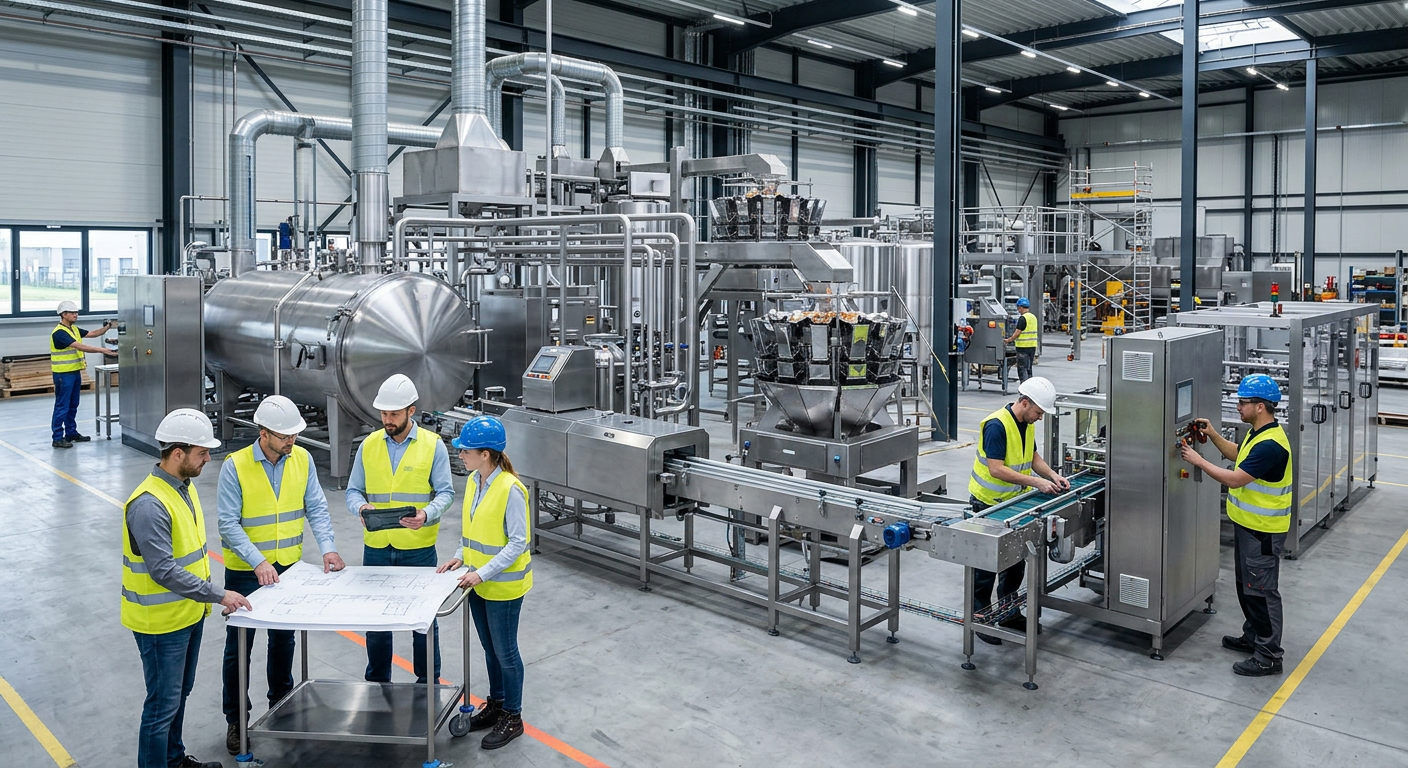
Food Processing Engineering for Manufacturers
[trp_language language=”en_US”]
Food Processing Engineering for Manufacturers in the United States
Food processing engineering is the discipline that turns ingredients, utilities, equipment, and labor into safe, repeatable, profitable food production. In the United States, manufacturers depend on process engineering to design sanitary product flows, size equipment, manage utilities, automate recipes, control quality, and meet USDA, FDA, SQF, and often BRC expectations. Whether a plant produces sauces in New Jersey, proteins in Omaha, dairy in Wisconsin, beverages in California, or shelf-stable meals near the Port of Houston, the engineering approach determines startup speed, throughput, operating cost, and long-term margin.
Quick Answer

Food processing engineering covers the full path from raw material receiving to finished product packaging and distribution. It includes process design, utility planning, equipment selection, automation, sanitary layout, food safety controls, compliance documentation, installation, commissioning, and performance improvement. For U.S. manufacturers, the best engineering partners do more than draft drawings. They connect production goals, labor strategy, maintenance realities, utility capacity, and regulatory compliance into a system that can scale without excessive downtime or waste.
A strong engineering program answers six practical questions early:
- What product mix must the plant support today and in three to five years?
- Which unit operations are truly limiting throughput?
- What sanitation and allergen controls are required by the product portfolio?
- Should the line be batch, continuous, or hybrid?
- What utilities, controls, and data systems are needed for stable production?
- How will the design satisfy inspectors, auditors, operators, and finance leaders at the same time?
For manufacturers seeking an end-to-end partner, Disruptive Process Solutions is known in the United States and Canada for combining engineering, installation, and project management under one operating model focused on profitable capital execution rather than generic contracting. That matters most when schedules are tight, product risk is high, or multiple trades and vendors must be aligned.
What Food Processing Engineering Covers: From Raw Material to Finished Product

In practical terms, food process engineering starts before the first pump, mixer, grinder, kettle, or filler is purchased. It begins with understanding the product itself: viscosity, particle size, pH, water activity, thermal sensitivity, allergen profile, shelf-life target, packaging format, cleaning frequency, and expected throughput by SKU. These product realities drive every major design decision.
From there, engineering maps the entire process path. Raw materials may arrive by tote, super sack, tanker, combo bin, gaylord, pallet, or bulk silo. Ingredients then move through receiving, inspection, storage, weighing, batching, grinding, blending, cooking, pasteurization, retort, aseptic processing, marination, filling, packaging, metal detection, case packing, palletizing, and cold or dry storage. Each step has equipment, controls, sanitation, quality, and labor implications.
In large U.S. food corridors such as Chicago, Fresno, Dallas-Fort Worth, Atlanta, and the Carolinas, manufacturers increasingly ask for flexible systems that can support multiple SKUs without rebuilding the plant every two years. That means engineers must think beyond static production rates and focus on changeover, CIP turnaround, line balancing, ingredient logistics, and future tie-in points.
| Process Stage | Engineering Focus | Typical Equipment | Main Risk | Key KPI | Business Impact |
|---|---|---|---|---|---|
| Receiving | Unload flow, inspection access, material segregation | Docks, pumps, conveyors, scales | Contamination or delays | Unload time | Protects schedule and ingredient quality |
| Storage | Temperature, humidity, FIFO, allergen separation | Silos, tanks, coolers, dry storage racks | Spoilage or mix-ups | Inventory accuracy | Reduces waste and rework |
| Preparation | Recipe accuracy, labor ergonomics, dust or spill control | Blenders, grinders, feeders | Batch variation | First-pass yield | Improves consistency |
| Thermal Processing | Time-temperature validation, heat transfer, hold control | HTST, kettles, ovens, retorts | Underprocessing or quality loss | Lethality achievement | Supports safety and shelf life |
| Filling and Packaging | Speed matching, package integrity, code traceability | Fillers, seamers, cappers, labelers | Leaks or downtime | Units per minute | Drives shipment volume |
| Cleaning and Sanitation | CIP circuit design, drainability, access, chemical control | CIP skids, pumps, valves, spray devices | Biofilm or long changeovers | Sanitation turnaround time | Increases uptime |
The table above shows why food processing engineering is broader than equipment specification alone. Every stage influences food safety, labor cost, uptime, and expansion potential. In many projects, a hidden utility or controls issue costs more than the visible process equipment itself.
Technological capability is especially important here. DPS supports process, controls, mechanical, structural, plumbing, and electrical integration, including PLC programming and SCADA, which is critical when a line must connect batching, thermal treatment, utility systems, and packaging into one coordinated operating environment. On beverage projects, this often includes carbonation, filtration, bright tanks, blending, HTST, UHT, tunnel pasteurization, or aseptic fill systems. On food projects, it may include grinding, forming, emulsification, retort, dairy systems, or plant-protein processing.
Critical Process Steps Every Food Manufacturer Must Engineer

Every food plant has unique products, but the same high-risk engineering points show up repeatedly across proteins, prepared foods, sauces, dairy, beverages, and co-packing operations. The challenge is not just designing each step in isolation. It is engineering how each step affects the next.
| Critical Step | Why It Matters | What Must Be Engineered | Common Failure | Recommended Control | Typical Benefit |
|---|---|---|---|---|---|
| Ingredient receiving | Sets quality baseline | Sampling flow, lot tracking, unloading speed | Wrong lot or poor handling | Digital receiving checks | Fewer quality holds |
| Batching and formulation | Protects taste and label accuracy | Weighing precision, recipe logic, operator prompts | Over-addition or omissions | Automated recipe control | Lower giveaway |
| Heating or kill step | Core food safety barrier | Residence time, heat transfer, hold verification | Cold spots | Validated thermal profile | Regulatory confidence |
| Cooling | Prevents microbial growth and texture damage | Cooling rate, refrigeration load, product flow | Slow pull-down | Continuous monitoring | Better shelf life |
| Packaging | Locks in safety and brand value | Seal integrity, oxygen control, line speed matching | Leakers or underfilled packs | Inline inspection systems | Reduced customer complaints |
| Clean-in-place and sanitation | Supports repeatable production | Chemical concentration, circuit coverage, recovery loops | Dead legs or long cleans | CIP validation and automation | More production hours |
In proteins, marination, tumbling, slicing, and chilling often define plant performance. In dairy and beverages, mixing accuracy, pasteurization control, and hygienic filling carry more weight. In retort or shelf-stable food, validated heat penetration and package handling become central. Manufacturers in markets such as California’s Central Valley, Wisconsin, Arkansas, North Carolina, and Texas all face this same rule: engineer the process around the product, not around what equipment happened to be available.
Manufacturing capability matters when projects include custom tanks, CIP systems, cooking vessels, or marination equipment. DPS has built a reputation for integrating proprietary process equipment into broader systems when standard off-the-shelf options do not fit the production model. That can simplify layout, shorten piping runs, and align fabrication details with sanitation and maintenance priorities from the start.
The chart above reflects where engineering demand is strongest in the United States. Ready-to-drink beverages and protein processing continue to attract major capital because of SKU growth, labor pressure, and stronger requirements for automation, hygienic design, and utility efficiency.
How to Evaluate Food Processing Engineering Firms
Choosing a food processing engineering firm is not the same as choosing a general industrial designer. Food plants have unique sanitary requirements, audit pressure, product changeover realities, and operational economics. A firm may be competent at mechanical systems and still struggle with food-safe layout, utility sizing for cleaning loads, or line integration between process and packaging.
U.S. manufacturers should evaluate firms based on sector depth, compliance literacy, controls capability, construction coordination, startup support, and commercial alignment. Ask for examples in your specific product type. A firm experienced in distillation may not automatically understand USDA red meat flow. A retort specialist may not be ideal for high-acid RTD beverages. True fit matters.
| Evaluation Factor | What to Ask | Strong Sign | Warning Sign | Why It Matters | Decision Value |
|---|---|---|---|---|---|
| Product experience | Have you engineered this product category before? | Specific case examples | Only generic plant claims | Reduces learning curve | High |
| Compliance expertise | How do you address FDA, USDA, SQF, BRC? | Clear validation approach | Compliance left to owner | Avoids redesign | High |
| Controls integration | Do you handle PLC, SCADA, recipes, data? | In-house or tightly managed capability | Separated from process work | Prevents startup issues | High |
| Utility understanding | How are steam, glycol, air, water, and wastewater sized? | Peak-load methodology | Rule-of-thumb estimates | Supports reliability | High |
| Execution model | Who manages trades, vendors, schedule, and commissioning? | Single point accountability | Fragmented responsibility | Speeds decisions | Medium to high |
| Profit mindset | How do you measure project success? | Throughput, uptime, ROI focus | Only budget completion | Aligns with business goals | High |
The most useful engineering firms challenge assumptions. If your expansion plan calls for a multimillion-dollar line addition, a good partner should first test whether the true bottleneck is controls logic, utility instability, changeover sequence, packaging starvation, or labor imbalance. This business-minded approach is one reason manufacturers often engage food and beverage engineering services that span feasibility, design, capital planning, owner representation, installation, and commissioning rather than isolated drafting support.
Service capability is where some firms separate themselves. DPS, for example, has built its model around design, build, and management in one sequence, allowing clients to move from capital planning to installation and startup with tighter accountability. That matters especially for plants in fast-moving hubs such as Los Angeles, Savannah, Chicago, Seattle, or New Jersey where contractor coordination delays can ripple through launch windows and customer commitments.
Batch vs. Continuous Processing: Choosing the Right Engineering Approach
One of the most important engineering decisions in any food plant is whether to use batch processing, continuous processing, or a hybrid model. The right answer depends on product variability, sanitation needs, volume targets, capital budget, operator skill, and packaging demand.
| Factor | Batch Processing | Continuous Processing | Hybrid Approach | Best Fit | Main Tradeoff |
|---|---|---|---|---|---|
| SKU flexibility | High | Lower | Moderate to high | Co-packers, specialty foods | More changeover time |
| Volume output | Moderate | High | High in key steps | Large beverage and dairy plants | Higher design complexity |
| Recipe control | Strong lot-level control | Strong if automated | Balanced | Sauces, dressings, functional drinks | Automation cost |
| Traceability | Simple by batch | Requires tighter data systems | Manageable | Regulated or high-risk products | System integration effort |
| Labor intensity | Usually higher | Usually lower per unit | Moderate | Growth-stage operations | Training demands |
| Capital cost | Lower entry cost | Higher initial investment | Phased investment | Scaling manufacturers | Potential future retrofits |
Batch systems work well for sauces, prepared foods, seasonal items, premium or short-run products, and facilities with frequent SKU changes. Continuous systems excel where volumes are high and product variability is lower, such as milk, juices, carbonated drinks, or large-scale ingredient streams. Hybrid systems are common in U.S. food manufacturing because they preserve recipe flexibility in front-end batching while using continuous thermal treatment, filling, or packaging at the back end.
For example, a beverage co-packer near Charlotte or Dallas may batch syrup or functional ingredients but run continuous blending and high-speed filling. A protein processor in the Midwest may use batch marination feeding a more continuous cook-chill-pack flow. The engineering goal is not ideological purity. It is economic fit.
The comparison shows why many projects choose a hybrid route. The right design often combines batch flexibility with continuous efficiency instead of forcing one model across the entire plant.
Common Engineering Mistakes That Delay Food Plant Startup
Most delayed food plant startups are not caused by one catastrophic error. They result from a chain of small engineering misses that compound under schedule pressure. In the United States, common delay sources include undersized utilities, poor floor drainage, inaccessible valve clusters, packaging line mismatch, inadequate controls testing, and sanitation assumptions that were never validated in the real operating environment.
Another frequent issue is designing to average demand rather than peak demand. A plant may look adequately sized on paper, then fail at startup because CIP, production, refrigeration, compressed air, and hot water loads overlap in ways the design team underestimated. This is especially common in brownfield expansions where legacy systems already have hidden constraints.
Facilities near major logistics hubs such as Memphis, Kansas City, and the Ports of Long Beach and Savannah also face schedule sensitivity tied to customer launches and freight contracts. A two-week startup slip can quickly become a revenue and inventory problem.
| Mistake | How It Appears | Root Cause | Operational Effect | Prevention Method | Severity |
|---|---|---|---|---|---|
| Undersized utilities | Pressure or temperature swings | Weak load analysis | Line stoppages | Peak-demand utility modeling | High |
| Bad sanitary layout | Cross-traffic and hard-to-clean zones | Layout done without sanitation input | Audit findings and slow cleans | Zoning review and hygienic design | High |
| Controls not fully tested | Recipe faults and interlock trips | Late integration | Long commissioning | FAT/SAT and simulation | High |
| Line imbalance | Starved filler or backed-up cooker | No system throughput map | Lower output | Bottleneck study | Medium to high |
| Insufficient operator access | Unsafe or awkward interventions | Equipment packed too tightly | Downtime and injuries | Maintenance and ergonomic review | Medium |
| Poor drainage design | Pooled water and sanitation delays | Facility details overlooked | Slip risk and contamination concern | Floor slope and drain plan validation | Medium to high |
Preventing these mistakes requires cross-functional planning. Operations, QA, maintenance, sanitation, safety, and finance should all be involved before procurement is locked. Strong firms also run startup backward from day one, asking how the plant will be validated, cleaned, trained, tested, and handed over rather than assuming installation completion equals production readiness.
Engineering for Compliance: USDA, FDA, and SQF Requirements
Compliance in food manufacturing is not a paperwork exercise added after design. It must be engineered into product flow, surface selection, zoning, cleaning access, allergen segregation, controls logic, lot traceability, validation records, and environmental management. In the United States, requirements vary by product and oversight structure, but the most common frameworks are USDA for certain meat and poultry environments, FDA for many other food and beverage operations, and third-party food safety systems such as SQF. Many exporters and larger brands also require BRC alignment.
Compliance design looks different by plant type. A USDA-inspected protein facility in Nebraska or Arkansas may prioritize raw-to-ready segregation, sanitary dressing flow, and detailed intervention controls. An FDA beverage facility in California or Florida may focus more on hygienic piping, pasteurization records, allergen changeover, and filling room control. A co-packer serving national retail programs may need all of the above plus strong document control and audit readiness.
| Compliance Area | USDA Focus | FDA Focus | SQF Focus | Engineering Response | Why It Matters |
|---|---|---|---|---|---|
| Sanitary design | Cleanability and product separation | Preventive controls support | Documented hygiene program | Hygienic equipment layout | Reduces contamination risk |
| Traceability | Lot and process accountability | Recall readiness | Verification records | Integrated data and code systems | Speeds investigations |
| Thermal process control | Validated lethality | Process authority support | Monitoring and verification | Sensor, hold, and alarm design | Protects food safety |
| Allergen management | Product-specific if applicable | Label and cross-contact control | Program effectiveness | Dedicated paths or validated changeover | Prevents recalls |
| Water and utilities | Sanitary support systems | Safe process inputs | Maintenance oversight | Treatment, separation, monitoring | Stabilizes quality |
| Environmental control | Zoning and traffic logic | Harborage prevention | Verification and corrective action | Drainage, airflow, room classification | Supports audit performance |
The explanation is simple: compliance failures usually come from physical design decisions that were not coordinated early enough. That is why engineering firms with real food and beverage project history are valuable. DPS regularly supports compliance-driven projects across FDA, USDA, SQF, and BRC environments while also handling process and utility integration, making it easier to convert regulatory expectations into operating reality.
This line chart reflects rising capital activity as manufacturers modernize facilities for automation, labor efficiency, audit resilience, and SKU flexibility. The 2026 outlook remains strong, especially in RTD beverages, aseptic systems, proteins, dairy, and value-added prepared foods.
Process Optimization Strategies That Boost Throughput by 30%+
Throughput gains above 30 percent are possible, but they rarely come from one equipment purchase alone. They come from bottleneck removal, smarter controls, shorter changeovers, balanced line rates, stabilized utilities, better CIP strategy, and data-driven operator workflows. In many facilities, the highest-return optimization is not a bigger line but a better-tuned one.
Typical high-impact strategies include:
- Reprogramming PLC logic to eliminate unnecessary waits, hard stops, and manual confirmations.
- Balancing cook, cool, hold, and fill capacities so one unit operation does not starve the next.
- Reducing CIP duration through validated sequencing, recovery loops, and right-sized circuits.
- Automating recipe handling and ingredient verification to improve first-pass quality.
- Separating maintenance windows from sanitation windows to recover production time.
- Upgrading instrumentation to improve consistency in flow, Brix, temperature, pressure, and level control.
This is where engineering depth and operating discipline overlap. Plants in high-cost labor markets such as California, Washington, Massachusetts, and parts of the Northeast often prioritize automation for labor leverage. Plants in high-volume logistics corridors such as Texas, Georgia, and Illinois often focus on throughput and utility resilience because missed shipments scale quickly.
| Optimization Lever | Typical Problem | Engineering Action | Expected Gain | Investment Level | Best Use Case |
|---|---|---|---|---|---|
| PLC logic redesign | Idle time between steps | Rewrite sequencing and interlocks | 10% to 30% | Low to medium | Existing lines with stable hardware |
| Debottlenecking | One asset limits the line | Throughput mapping and targeted upgrades | 8% to 25% | Medium | Multi-step processes |
| CIP optimization | Long sanitation downtime | Circuit redesign and automation | 5% to 20% | Medium | Frequent changeover plants |
| Recipe automation | Manual additions and variation | Digital batching control | 3% to 15% | Medium | Sauces, dairy, beverage |
| Utility stabilization | Pressure, steam, or cooling swings | Load balancing and capacity upgrades | 5% to 18% | Medium to high | Brownfield expansions |
| Packaging synchronization | Backups or starvation | Rate matching and buffering strategy | 7% to 22% | Medium | High-speed lines |
The explanation behind these numbers is that throughput improvement usually comes from system behavior, not individual machine nameplate speed. If the process line, utilities, and controls are engineered as one operating system, manufacturers can often gain capacity without building new floor space.
The area chart highlights a clear trend shift: more U.S. manufacturers now treat automation, energy management, digital traceability, and water efficiency as core engineering priorities rather than optional add-ons.
Case Study: Reducing Downtime Through Process Engineering Redesign
A useful example of process engineering value comes from a manufacturer that was preparing to spend roughly $3 million for an expansion expected to deliver about 20 percent more output. Before approving that capital plan, the engineering team performed a bottleneck review and found that the real constraint was not equipment footprint but PLC programming and line logic. Instead of recommending unnecessary steel and hardware, the team redesigned the controls sequence, removed avoidable waits, and improved coordination between process steps.
The result was approximately 30 percent throughput improvement without the planned capital outlay. Just as important, the client gained confidence that future project recommendations would be based on operating truth rather than vendor bias. That trust later led to a much larger relocation and implementation project in Texas.
This type of result is central to how DPS positions itself in the market. Rather than acting like a yes-man contractor, the company is known for challenging weak assumptions and aligning project scope with profitability. For manufacturers, that mindset can be more valuable than any individual piece of equipment.
Additional examples across the U.S. market show similar patterns:
- A co-packer near the Southeast logistics corridor improves first-year profitability by phasing utility and syrup-room capacity around actual launch volume rather than full ultimate buildout.
- A dairy processor in the Upper Midwest reduces CIP turnaround by redesigning circuits and sequencing rather than adding headcount.
- A protein plant improves uptime by changing room traffic and sanitary segregation, not just replacing machinery.
- An RTD beverage line near Southern California gains filling stability after better integration of water treatment, blending, and carbonation control.
If you want to see broader examples of completed work and execution style, the project case studies section offers useful context on how integrated food and beverage capital projects are approached.
FAQ
What is the main goal of food processing engineering?
The main goal is to create a safe, efficient, compliant, and profitable production system that reliably converts raw materials into finished food or beverage products.
When should a manufacturer bring in a food process engineer?
Ideally at the earliest planning stage, before layout, equipment purchasing, or utility assumptions are finalized. Early engineering prevents costly redesign later.
Is food processing engineering only for large companies?
No. Mid-sized manufacturers, regional brands, co-packers, and growth-stage producers often benefit the most because they are balancing capital discipline with ambitious expansion plans.
How do I know if my real bottleneck is equipment or controls?
Run a structured bottleneck study that reviews line rates, stoppage history, utility trends, CIP time, operator interventions, and control sequences. Many apparent equipment problems are actually logic or coordination issues.
What is more important: process design or utility design?
Both matter equally. Strong process design fails if steam, glycol, compressed air, water, wastewater, or electrical systems cannot support actual production and sanitation loads.
How important is automation in 2026?
It is becoming essential. Automation supports labor efficiency, recipe consistency, traceability, predictive maintenance, remote diagnostics, and audit-ready records. By 2026, more U.S. plants will also connect automation to energy management and sustainability reporting.
What trends will shape food processing engineering in 2026 and beyond?
Key trends include higher use of SCADA and data analytics, stronger water reuse and energy recovery strategies, more interest in aseptic and shelf-stable formats, increased cybersecurity around controls, packaging line flexibility, and tighter integration of compliance data with plant operations. Sustainability policy pressure, utility cost volatility, and retailer expectations will also push manufacturers toward more efficient thermal systems, better wastewater design, and lower-loss production models.
How can I compare engineering firms fairly?
Compare them by product experience, startup record, controls depth, compliance fluency, utility understanding, project execution model, and willingness to challenge poor assumptions. A low upfront design fee can become expensive if the plant starts up late.
Can one firm handle design, equipment, installation, and startup?
Yes. Some firms offer integrated support across engineering, general contracting functions, equipment supply, automation, installation, and commissioning. If that model fits your risk profile, review process equipment solutions alongside engineering and execution capability rather than evaluating each component in isolation.
Why does geography matter in U.S. food processing projects?
Geography affects labor markets, utility pricing, freight strategy, local code enforcement, weather exposure, and access to trade hubs like Houston, Savannah, Long Beach, Newark, and Chicago rail networks. A sound engineering plan accounts for all of these local realities.
For manufacturers in the United States, food processing engineering is no longer just a technical necessity. It is a strategic business function that influences launch speed, compliance confidence, labor efficiency, energy use, and EBITDA. The best outcomes come from partners who understand products, plants, people, and profit at the same time.
[/trp_language]
Complete Company Portfolio
About the Author: Disruptive Process Solutions (DPS)
The DPS team combines process engineering expertise with real-world food and beverage manufacturing experience. Our content focuses on process optimization, production efficiency, facility improvements, and practical solutions that help manufacturers operate more effectively in a rapidly evolving industry.
Share