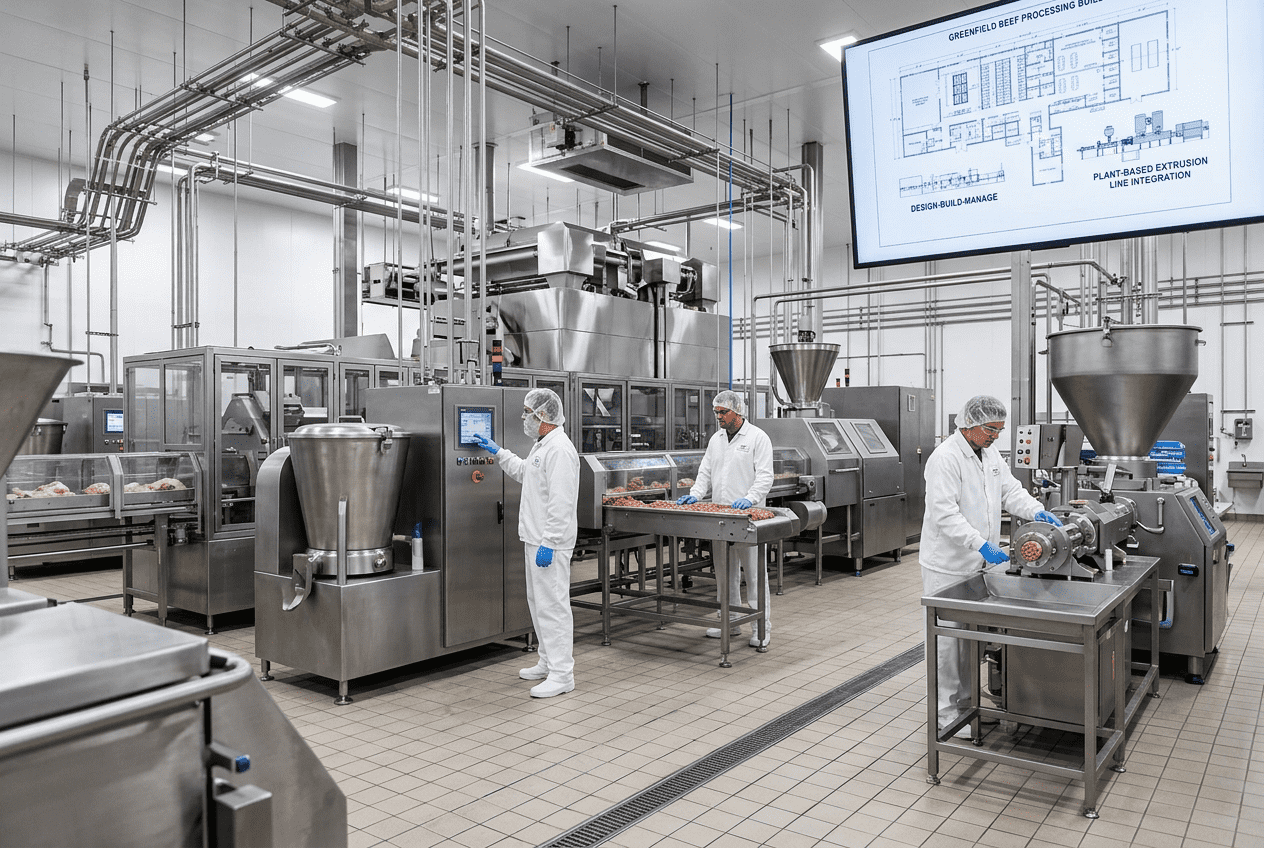
Food Processing Tank Manufacturer
[trp_language language=”en_US”]
Food Processing Tank Systems for U.S. Food and Beverage Manufacturers
Food processors in the United States need tanks that do more than hold product. A well-designed food processing tank supports sanitation, protects product quality, fits the process flow, and works reliably under the right pressure, vacuum, and temperature conditions. Whether the application is dairy in Wisconsin, sauces in Chicago, proteins in Arkansas, beverages in California, or aseptic ingredients near major logistics hubs like Houston, Savannah, and Los Angeles, the right vessel specification directly affects uptime, labor, food safety, and long-term operating cost.
For many U.S. manufacturers, the best approach is not simply buying a vessel from a catalog. It is matching tank type, metallurgy, finish, controls, and installation scope to the actual production goal. That is especially true for plants adding new lines, retrofitting legacy facilities, or scaling capacity for co-packing, prepared foods, dairy, protein, or beverage operations. Companies looking for a practical partner often evaluate engineering depth, field execution, documentation quality, and startup support as closely as they evaluate the tank itself.
Disruptive Process Solutions (DPS) serves this market as a food and beverage engineering partner across North America, combining process design, equipment supply, installation, and integration. Learn more about the DPS team and operating approach, explore broader engineering and project services, review available process equipment solutions, and see selected project examples and field results.
Quick Answer

A food processing tank manufacturer for the U.S. market should be able to supply sanitary vessels for cooking, holding, buffering, storage, and CIP return; recommend 304, 316L, or duplex stainless steel based on chemistry and cleaning conditions; provide finish options from mill 2B to sanitary polish; size volume to line throughput and dwell time; verify pressure, vacuum, and temperature ratings; customize manways, nozzles, mixers, and instrumentation; document weld quality and hydrotesting; and support installation, commissioning, and startup. The strongest suppliers also understand FDA, USDA, SQF, and BRC expectations and can integrate tanks into complete processing systems rather than treating them as isolated components.
In the United States, buying decisions increasingly favor suppliers that can bridge design and execution. That means understanding not only tank fabrication, but also process utilities, controls, CIP strategy, operator access, cleanability, and site-specific code requirements. This is especially important in major production regions such as the Midwest dairy corridor, Southeast poultry belt, Texas protein and beverage markets, and West Coast beverage and specialty foods clusters.
The chart above reflects the steady expansion in demand driven by automation, sanitation upgrades, nearshoring, co-packing growth, and modernization of aging stainless equipment in U.S. facilities.
Food Processing Tank Types: Cook, Hold, Buffer, Storage and CIP Return

Food processing tanks are not interchangeable. The right tank depends on whether the vessel must transfer heat, stabilize flow, provide dwell time, receive CIP solutions, or simply store ingredient or finished product. A cook tank for soup or sauce has very different requirements than a buffer tank in front of a filler or a return tank in a cleaning loop.
In production environments from Charlotte to Fresno, common tank categories include:
| Tank Type | Primary Function | Typical Features | Common U.S. Industries | Design Focus | Notes |
|---|---|---|---|---|---|
| Cook Tank | Heats and processes product | Jacket, agitator, temperature probes, venting | Sauces, dairy, prepared foods, beverages | Heat transfer and product consistency | Often paired with steam or hot water systems |
| Hold Tank | Maintains product before next step | Insulation, agitation, level sensing | Dairy, dressings, beverages, aseptic prep | Dwell time and temperature stability | Used between batch and packaging operations |
| Buffer Tank | Balances flow between process steps | Compact geometry, controls integration | HTST, fillers, blending lines | Short-term surge capacity | Reduces line stoppage from upstream variation |
| Storage Tank | Stores raw, intermediate, or finished product | Vent filter, spray device, insulation optional | Milk, syrup, oils, marinades, water | Sanitary storage and accessibility | Can be indoor or outdoor depending on use |
| CIP Return Tank | Receives return cleaning solutions | Chemical compatibility, drains, level control | All sanitary plants | Reliable clean-in-place operation | Important for validated cleaning cycles |
| Mix/Blend Tank | Combines ingredients uniformly | Agitator, baffles, load cells, dosing ports | Beverages, dairy, sauces, nutraceuticals | Mix quality and ingredient dispersion | May include inline Brix or conductivity monitoring |
This table matters because wrong tank selection can create bottlenecks even when nominal capacity looks adequate. For example, a storage tank placed where a buffer tank is needed may cause filler starvation. A hold tank without proper agitation may create phase separation in dressings or dairy beverages. A cook tank without the right jacket design may extend batch times and reduce plant throughput.
In fast-growing U.S. co-packing operations, buffer and surge tanks are especially important because packaging speed often changes faster than upstream batching. In protein and prepared foods, cook and hold tanks must support thermal performance and cleanability under heavier soils. In beverage plants near distribution hubs like Dallas-Fort Worth or Southern California, storage and blend vessels frequently need to interface with automation, syrup rooms, and packaging controls.
The bar chart shows how beverage, dairy, and prepared food operations remain among the most active buyers of sanitary tank systems in the U.S., though demand is broad across virtually every hygienic processing segment.
Material Selection: When to Specify 304, 316L, or Duplex Stainless Steel

Material selection should be based on product chemistry, chlorides, acids, cleaning chemicals, temperature, service life, and budget. In many food plants, 304 stainless steel is adequate. In others, especially where chlorides, aggressive CIP chemistry, or higher corrosion risk exists, 316L or duplex can be the better investment.
| Material | Best Use Case | Corrosion Resistance | Relative Cost | Typical Applications | Buyer Guidance |
|---|---|---|---|---|---|
| 304 Stainless | General sanitary service | Good | Lowest of the three | Water, sugar syrups, many dry ingredient slurries | Strong value when chlorides are low |
| 304L Stainless | Welded sanitary fabrications | Good | Low | General food tanks with extensive welding | Helps reduce sensitization risk in welded areas |
| 316 Stainless | Moderate corrosive duty | Very good | Medium | Brines, sauces, acidic beverages | Often chosen where cleaning chemistry is stronger |
| 316L Stainless | High sanitary and corrosion-sensitive service | Very good to excellent | Medium-high | Dairy, aseptic, high-chloride washdown areas | Common premium choice for hygienic equipment |
| Duplex Stainless | High chloride or structural demand | Excellent | High | Salt-heavy process streams, coastal facilities | Useful where corrosion and strength both matter |
| Special Alloy Blend | Niche chemical compatibility issues | Application-specific | Highest | Rare specialty applications | Use only when process conditions justify it |
As a practical rule, 304 works for many standard food products and utility-related services. 316L becomes the safer specification when chloride exposure rises, cleaning cycles are frequent and aggressive, or the product is more acidic or mineralized. Duplex can make sense in harsh applications, coastal environments, or systems with especially demanding corrosion and mechanical performance requirements.
U.S. facilities along the Gulf Coast, Florida, and other marine-influenced regions may see more value in upgraded metallurgy because ambient chloride exposure can accelerate exterior corrosion. Likewise, plants processing salty marinades, brines, or seafood often lean toward 316L or beyond. A tank supplier should review not just the product inside the vessel, but also the washdown environment outside it.
DPS approaches material selection from a process engineering perspective, not a catalog-only perspective. Its technical capabilities extend into process, mechanical, structural, electrical, and controls engineering, which helps ensure the vessel material choice aligns with CIP, utilities, instrumentation, and operating realities. That is particularly valuable on integrated projects where a tank connects to pasteurization, blending, fermentation, marination, or aseptic systems.
Internal Finish Standards: 2B, No. 4, BA, and Sanitary Polish Options
Internal finish affects cleanability, appearance, residue retention, and ultimately sanitation performance. Not every application requires a high-polish sanitary finish, but many food and beverage products benefit from smoother internal surfaces, especially where sticky, protein-rich, dairy, or microbiologically sensitive products are involved.
| Finish | Surface Character | Typical Use | Cleanability Level | Cost Impact | Selection Guidance |
|---|---|---|---|---|---|
| 2B Mill Finish | Standard cold-rolled, smooth mill finish | Utility and low-risk product contact | Basic to moderate | Lowest | Suitable where sanitation demands are less strict |
| No. 4 Finish | Brushed finish | Exterior surfaces, some general interiors | Moderate | Low to medium | More cosmetic than sanitary for many applications |
| BA Finish | Bright annealed, reflective, smooth | Higher-end sanitary service | Good | Medium | Useful when a smoother base surface is desired |
| 180 Grit Sanitary Polish | Controlled polished interior | General hygienic food processing | High | Medium-high | Common for sanitary vessels |
| 240 Grit Sanitary Polish | Finer polished finish | Dairy, beverage, sensitive products | Very high | High | Improves cleanability and appearance |
| Electropolished / Premium Sanitary | Very smooth and refined | Aseptic or critical hygienic applications | Highest | Highest | Specify when process risk justifies premium finish |
The table above shows why finish specification should not be copied from an old drawing without review. For example, a 2B finish may be acceptable for some non-critical service tanks, but a yogurt base tank, aseptic ingredient vessel, or high-sugar beverage blend tank may justify a more sanitary polish for improved cleanability and reduced biofilm risk.
Finish also affects validation. Plants operating under strict customer audits, retail compliance requirements, or export programs often benefit from clearly documented interior finish standards. In some projects, external cosmetics matter too, especially in customer-facing breweries, beverage centers, or pilot facilities.
By 2026, finish specification is expected to become more closely tied to sustainability and water use. Smoother, easier-to-clean surfaces can shorten wash cycles, reduce detergent use, and lower wastewater loading. As municipalities from California to the Northeast continue tightening water and discharge expectations, sanitary design that supports efficient cleaning will remain a competitive advantage.
This area chart illustrates the shift toward more sanitary finish requirements as processors modernize plants, increase automation, and respond to tighter quality and audit expectations.
Capacity Sizing Guide: Matching Tank Volume to Production Throughput
Tank sizing starts with throughput, but it should not end there. The right volume depends on batch size, surge needs, dwell time, CIP cycle timing, product changeover frequency, headspace requirements, thermal lag, and future expansion. Oversized tanks waste capital, floor space, and sometimes cleaning resources. Undersized tanks create chronic bottlenecks.
| Production Scenario | Line Throughput | Typical Tank Role | Suggested Working Volume | Headspace Consideration | Comment |
|---|---|---|---|---|---|
| Small sauce batch line | 800 gal/hour | Cook/Hold | 1,000-1,500 gal | 10-20% | Allows agitation and thermal control |
| Dairy blend operation | 2,000 gal/hour | Blend/Buffer | 2,500-3,500 gal | 10-15% | Supports continuous filler feed |
| RTD beverage packaging | 4,500 gal/hour | Buffer/Surge | 1,500-3,000 gal | Depends on control philosophy | Short dwell, high line stability need |
| Protein marinade prep | 1,200 gal/hour | Mix/Hold | 1,500-2,000 gal | 15-20% | Viscosity and ingredient loading matter |
| Aseptic ingredient storage | Batch-fed | Storage | Based on campaign length | Tight contamination control | Usually sized around delivery and production windows |
| CIP return service | System-dependent | CIP Return | Calculated from circuit volume | Allowance for turbulence and foam | Must match CIP architecture, not product throughput |
The sizing ranges above are only starting points. A high-speed line in New Jersey or Illinois may need extra surge to protect an expensive packaging asset. A batch cook system in Tennessee may need more dwell time to synchronize with downstream fillers. A co-packing site in Texas may intentionally oversize for customer changeovers and future SKUs.
Good sizing practice normally includes the following questions:
- What is the target line throughput in gallons per hour or pounds per hour?
- Is the process batch, semi-continuous, or continuous?
- How long must the product remain in the tank?
- What volume is unavailable due to headspace, dead zones, or outlet geometry?
- Does the process need future capacity expansion within the same footprint?
- How often will the tank be cleaned, and how much downtime is acceptable?
DPS often works from the production model backward, rather than starting with a generic vessel size. That manufacturing-focused method helps clients avoid buying “safe” oversized equipment that looks flexible on paper but reduces return on capital. The company’s manufacturing capabilities include proprietary tank systems up to 12,000 gallons as part of a broader equipment offering, which is especially useful when a plant wants a tank supplier that can also understand line integration, utilities, and project execution.
Pressure, Vacuum, and Temperature Ratings by Application
Pressure, vacuum, and temperature ratings must be tied to actual service conditions, not assumptions. Tanks can fail or deform if they are exposed to higher pressure, deeper vacuum, or hotter cleaning cycles than originally considered. Even a storage tank can see vacuum conditions during fast pump-out, cooling, or CIP events.
| Application | Pressure Requirement | Vacuum Requirement | Temperature Requirement | Common Design Need | Risk if Misapplied |
|---|---|---|---|---|---|
| Atmospheric ingredient storage | Low or none | Light vacuum possible | Ambient to moderate | Proper venting | Shell distortion during transfer |
| Cook tank with steam jacket | Jacket pressure plus vessel condition | Possible during cooldown | High | Thermal and mechanical design review | Reduced heat performance or damage |
| HTST balance/buffer tank | Low product pressure | Controlled suction conditions | Moderate | Stable flow to process equipment | Line instability or cavitation |
| CIP return tank | Usually low | Foam and rapid return considerations | Hot chemical cycles | Material and drain design | Cleaning issues and corrosion |
| Vacuum-assisted processing | Specialized | Full or partial vacuum | Application-specific | Reinforced shell design | Collapse risk |
| Aseptic or sterile service vessel | May need controlled pressure | Closely managed | Elevated sterilization temperatures | Validation-grade design | Microbial risk and compliance failure |
Processors should also confirm whether the specification covers operating conditions only or includes upset conditions. Examples include blocked vents, accidental valve closure, pump deadhead scenarios, and thermal shock from cleaning and sanitizing cycles. This is where experienced engineering input matters more than a generic data sheet.
From 2026 onward, policy and sustainability trends are likely to increase interest in energy-efficient heating, heat recovery, and smarter temperature control. Tank systems may increasingly be evaluated on how well they integrate with heat exchangers, hot water sets, steam management, and automation-driven energy monitoring.
Custom Fabrication: Manways, Nozzles, and Instrumentation
Custom fabrication is often the difference between a tank that fits the process and one that forces operators to work around it. Details such as access manways, nozzle orientation, spray device selection, bottom outlet geometry, agitation type, ladder access, load cells, insulation, and instrumentation ports all affect daily usability.
Typical customization points include:
- Top, side, or pressure-rated manways for maintenance and product access
- Nozzle counts and elevations for inlet, outlet, CIP, vent, sample, and recirculation service
- Instrumentation such as level transmitters, pressure sensors, RTDs, load cells, and conductivity probes
- Agitator selection for blending, suspension, heat transfer, or shear requirements
- Jacket and insulation packages for thermal control
- Skids, legs, seismic anchoring, and structural support details for local code conditions
Plants in seismically active areas such as California, or hurricane-prone Gulf and Southeast regions, may need additional structural considerations. Facilities in older urban footprints like Philadelphia or Newark often need tanks designed around tight access, existing mezzanines, or limited crane paths. At inland manufacturing hubs such as Indianapolis, Kansas City, and Memphis, layout efficiency and installation speed often dominate.
DPS supports this level of customization with a service model that connects process engineering, project management, equipment supply, installation, and controls integration. That matters because nozzle orientation should align with pipe routing, instrument strategy should match the controls architecture, and access design should reflect actual maintenance practice. When those decisions are coordinated early, field rework drops significantly.
This comparison chart highlights why many U.S. buyers move toward engineered tank suppliers when projects involve sanitary compliance, controls, utilities, and startup risk, not just vessel purchase price.
Quality Control: Weld Inspection, Hydrotesting, and Documentation
Quality control is where tank specifications become reliable equipment. Buyers should ask how welds are qualified, how internal surfaces are protected during fabrication, how vessels are pressure or hydro tested, what inspection records are provided, and whether documentation is packaged for maintenance, audit, and validation use.
| QC Element | What It Covers | Why It Matters | Typical Evidence | Who Uses It | Buyer Tip |
|---|---|---|---|---|---|
| Material Traceability | Mill certs and alloy verification | Confirms correct metallurgy | MTR package | QA, engineering, auditors | Especially important for 316L and specialty alloys |
| Weld Procedure Control | Qualified welding methods | Consistency and integrity | WPS/PQR records | Engineering and compliance teams | Ask about sanitary weld practices |
| Visual Weld Inspection | Surface and weld quality check | Identifies obvious defects | Inspection reports | Fabricator and customer | Request photos for critical interiors |
| Hydrotest / Pressure Test | Structural and leak verification | Confirms vessel performance | Test certificates | Operations and maintenance | Define acceptance criteria in advance |
| Passivation / Finish Verification | Surface treatment and finish confirmation | Improves corrosion resistance and sanitation | Finish records | QA and sanitation teams | Useful for audited hygienic systems |
| Documentation Package | Drawings, manuals, certs, test records | Supports installation and future service | Turnover dossier | Maintenance, QA, owners | Require digital and organized handover |
Documentation is often overlooked until an audit, warranty claim, plant expansion, or troubleshooting event exposes the gap. A complete package helps maintenance teams identify spare parts, helps QA teams answer customer questions, and helps engineering teams modify systems later without reverse engineering everything from the floor.
DPS places value on execution discipline because it operates across engineering, equipment, field installation, and integration. That broader project view makes quality documentation more important, not less, since the vessel is only one part of a larger manufacturing system involving piping, controls, utilities, and startup sequencing.
Installation, Commissioning, and Startup Support from the Manufacturer
A tank arriving at the dock is not the end of the project. Installation, commissioning, and startup often determine whether the equipment pays back quickly or becomes a source of delays. In the U.S. market, this is especially important for multi-trade projects where rigging, mechanical installation, controls, utilities, and validation must align.
Manufacturers should look for support that includes:
- Pre-install coordination drawings and utility connection review
- Field fit confirmation for pads, access routes, and elevations
- Mechanical setting, piping tie-ins, and instrument verification
- I/O checks and controls integration where applicable
- Wet testing, water runs, CIP validation support, and operator training
- Punch-list management and final turnover documentation
For a facility in North Carolina, Georgia, or Ohio expanding under a compressed schedule, startup support can be worth more than a slightly lower tank purchase price. Delays in commissioning may idle labor, postpone product launch, or interrupt co-packing commitments. Conversely, a supplier that understands field realities can reduce startup surprises.
This is one of the strongest reasons many buyers prefer a partner like DPS. The company’s service capabilities extend beyond fabrication into design-build-manage execution, project oversight, installation coordination, and commissioning support. Because DPS works nationally across the United States and into Canada, it can support projects ranging from emergency line modifications to full greenfield or brownfield process integration. That combination is particularly attractive to clients who want one accountable team instead of separate engineering, equipment, and field silos.
Real-world examples in the market show that the best outcomes come from solving the actual production constraint, not just supplying hardware. In many projects, the right answer may involve controls changes, line balancing, or utility redesign along with the vessel itself. That business-minded approach tends to produce better ROI than simply maximizing stainless volume.
Local supplier evaluation should also consider freight and field service access. A plant near major logistics corridors such as Atlanta, Chicago, Houston, or the Inland Empire may have more options for delivery and installation support, but remote facilities still need reliable startup coverage. Ask each supplier how they handle scheduling, subcontractor coordination, and post-startup troubleshooting.
FAQ
What is the best stainless steel grade for a food processing tank?
There is no single best grade for every use. 304 is common for general food service, 316L is preferred for more corrosive or sanitation-sensitive duty, and duplex is considered for harsher environments or high chloride exposure.
When should I specify a sanitary polished interior instead of a mill finish?
Specify a sanitary polish when product residue, microbiological sensitivity, sticky ingredients, dairy, protein, or audit requirements make cleanability critical. Mill finishes may be acceptable for less demanding service.
How do I size a hold or buffer tank?
Start with line throughput and required dwell time, then account for headspace, surge protection, changeovers, and cleaning intervals. Buffer tanks support flow stability; hold tanks support process timing and temperature control.
Do all food tanks need pressure or vacuum ratings?
No, but every tank should be reviewed for potential pressure and vacuum exposure. Atmospheric tanks can still see vacuum during pump-out or cooling, so the operating scenario matters.
What documentation should a manufacturer provide?
At minimum, request drawings, material certificates, test records, manuals, and inspection documentation. More critical systems may require expanded turnover packages for QA, validation, and maintenance.
Can one supplier handle tank fabrication, installation, and startup?
Yes. Many manufacturers prefer that model because it reduces coordination risk. An integrated supplier can align fabrication details with piping, utilities, automation, and startup plans.
What industries use food processing tanks most heavily in the U.S.?
Major users include dairy, beverages, proteins, sauces and dressings, prepared meals, ingredients, aseptic processing, brewing, spirits, and co-packing operations.
How important is local code and regional operating environment?
Very important. Seismic zones, coastal corrosion, wastewater restrictions, utility availability, and plant layout constraints all affect final tank specification.
What trends should buyers watch through 2026?
Expect higher demand for automation-ready tanks, more sanitary finish requirements, stronger interest in water and energy efficiency, more rigorous documentation, and greater focus on sustainability and total lifecycle value.
How do I choose between a commodity tank supplier and an engineered process partner?
If your project is simple storage only, a commodity supplier may be sufficient. If the vessel affects sanitation, throughput, controls, utilities, or startup success, an engineered partner usually delivers better long-term value.
For U.S. manufacturers planning capital improvements, the most effective purchasing strategy is to define the process need first, then match the tank specification to operating reality. That includes product chemistry, cleaning regime, throughput, floor space, utilities, automation, and expansion goals. A food processing tank is not just stainless steel capacity; it is a critical process asset. When it is engineered, fabricated, documented, and commissioned correctly, it supports profitable production for years.
[/trp_language]
Complete Company Portfolio

About the Author: Disruptive Process Solutions (DPS)
The DPS team combines process engineering expertise with real-world food and beverage manufacturing experience. Our content focuses on process optimization, production efficiency, facility improvements, and practical solutions that help manufacturers operate more effectively in a rapidly evolving industry.
Share

