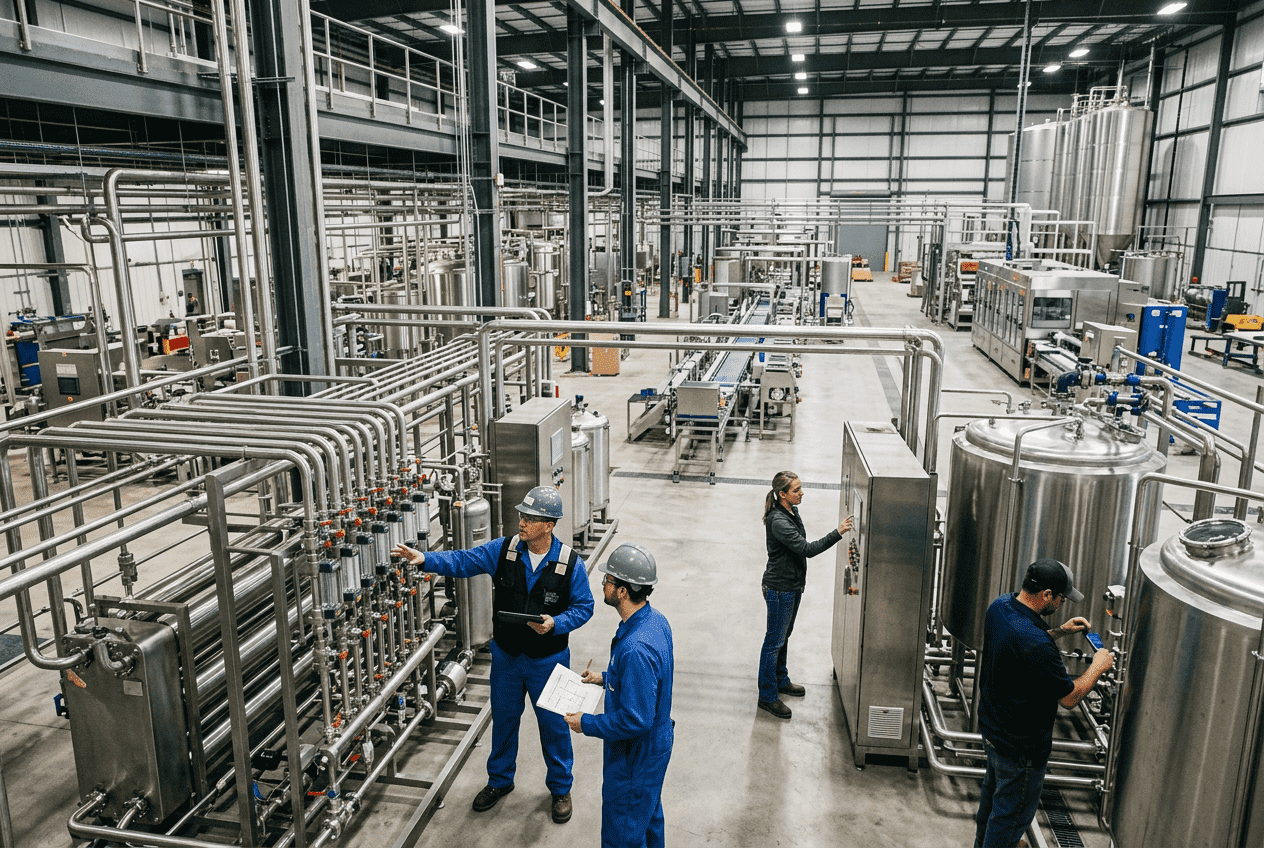
Functional Beverage Processing Systems
[trp_language language=”en_US”]
Functional Beverage Processing Systems for the United States Market
Functional beverages are no longer a niche category in the United States. From protein drinks and botanical tonics to gut health beverages, nootropic shots, hydration formulas, and fortified dairy alternatives, manufacturers now need processing systems that protect sensitive actives while still delivering food safety, scalable throughput, and predictable shelf life. In practice, the right solution is rarely just a filler or a pasteurizer. It is a complete processing strategy that aligns ingredients, thermal or non-thermal treatment, blending, homogenization, validation, packaging, and utilities with the commercial goals of the brand.
In major U.S. beverage corridors such as Los Angeles, Chicago, Dallas, Atlanta, New Jersey, and the Carolinas, manufacturers are under pressure to launch faster, reduce waste, maintain label claims, and choose equipment that can support both current SKUs and future line extensions. That is especially important for co-packers shipping through ports such as Long Beach, Savannah, Houston, and Newark, where shelf stability, packaging resilience, and logistics costs directly affect profitability.
For companies evaluating capital projects, the best processing system is the one that preserves ingredient performance, meets FDA and customer requirements, fits the product’s route to market, and can be expanded without creating a new bottleneck. This is where integrated engineering becomes critical. Disruptive Process Solutions supports food and beverage manufacturers across North America with engineering, installation, integration, and execution models designed around profitable outcomes rather than one-off equipment decisions.
Quick Answer

The fastest answer is this: functional beverage processing systems must be selected around the most sensitive ingredient, the desired shelf life, the package format, and the distribution model in the United States. If the beverage contains fragile vitamins, probiotics, plant extracts, omega oils, or active botanicals, then processing conditions, oxygen exposure, shear, and light control become just as important as basic microbial reduction. UHT is often best for shelf-stable, high-volume distribution; HPP is often preferred for refrigerated premium beverages with fresh positioning; and aseptic processing is ideal when long shelf life and ingredient protection need to be balanced with high commercial throughput.
Most successful systems include five linked decisions:
- Ingredient risk mapping for heat, oxygen, light, and shear sensitivity
- Blending and hydration design for powders, proteins, and botanical actives
- Microbial control strategy using UHT, HPP, HTST, flash pasteurization, or aseptic methods
- Stabilization strategy for emulsions, suspensions, and phase-sensitive formulas
- Packaging and validation plan to confirm potency retention and shelf-life performance
For U.S. manufacturers, buying advice should always include pilot work, shelf-life testing, utility review, automation strategy, and packaging compatibility before equipment is ordered. A lower initial equipment quote can become the more expensive option if it reduces active retention, forces refrigerated freight, or limits future SKU expansion.
Processing Considerations for Heat-Sensitive Functional Ingredients

Heat-sensitive functional ingredients are among the biggest challenges in modern beverage manufacturing. Common examples include vitamin C, certain B vitamins, probiotics, enzymes, adaptogenic extracts, omega-3 emulsions, and some natural colors or flavors. The challenge is not only direct thermal degradation. Many actives also lose performance due to dissolved oxygen, metal interaction, extended hold times, high shear, and post-process storage under light or elevated warehouse temperatures.
In the United States, this issue is particularly important for products distributed through warm-weather routes in states such as Texas, Florida, Arizona, and California. Even if the process is technically sound, shipping and storage can erode label claims unless the full system is designed around ingredient stability.
| Ingredient Type | Primary Sensitivity | Typical Failure Mode | Processing Consideration | Packaging Need | Common U.S. Applications |
|---|---|---|---|---|---|
| Vitamin C | Heat and oxygen | Potency loss over shelf life | Minimize oxygen pickup, shorten thermal exposure | High oxygen barrier bottle or carton | Immunity drinks, juice blends |
| Probiotics | Heat | Cell viability decline | Prefer cold chain or post-process addition where feasible | Refrigerated, moisture-controlled package | Gut health shots, cultured beverages |
| Adaptogenic botanicals | Heat and pH | Flavor shift or active breakdown | Validate extract stability across process conditions | Light barrier if color sensitive | Stress support RTD teas |
| Omega emulsions | Oxygen and light | Oxidation, rancidity | Deaeration, nitrogen control, low oxygen headspace | Opaque or UV-blocking package | Wellness beverages, meal replacements |
| Protein isolates | Heat and shear | Gelation, sediment, viscosity increase | Hydration control and thermal profile tuning | Robust package for higher fill viscosity | Sports nutrition RTDs |
| Natural colors | Light and heat | Fading, browning | Low-light handling and quick processing | Amber, multilayer, or carton packaging | Clean label hydration drinks |
This table shows why “pasteurization” alone is not enough as a design criterion. The process must be aligned with the chemistry of the ingredient. For example, two beverages may have the same pH and package size, yet require different systems because one contains stable caffeine and electrolytes while the other includes probiotics and volatile botanical extracts.
A practical U.S. manufacturing approach is to build the process around the most vulnerable claim-driving ingredient. If the brand promise depends on live cultures, fresh botanical notes, or a guaranteed vitamin potency at end of shelf life, the entire process should be validated to that endpoint instead of merely passing basic microbiological release.
UHT vs HPP vs Aseptic: Selecting Processing for Functional Beverages

Choosing between UHT, HPP, and aseptic processing is one of the most important strategic decisions for functional beverage brands. Each option affects shelf life, capex, formulation freedom, distribution cost, consumer positioning, and production scale.
| Processing Method | Typical Product Format | Distribution Model | Shelf Life Range | Strength | Tradeoff |
|---|---|---|---|---|---|
| UHT | Dairy, plant protein, nutrition beverages | Ambient | 6 to 12 months | High microbial lethality and national distribution | Can affect flavor and sensitive actives |
| HPP | Cold-pressed juices, premium wellness beverages | Refrigerated | 30 to 120 days | Fresh profile and strong clean label story | Cold chain cost and package constraints |
| Aseptic | RTD teas, fortified beverages, dairy alternatives | Ambient | 6 to 12 months | Long shelf life with strong package protection | Complex sterile design and validation |
| HTST | Refrigerated dairy and juice blends | Refrigerated | 2 to 8 weeks | Lower thermal load than UHT | Shorter shelf life than ambient systems |
| Flash Pasteurization | Acid beverages and flavored waters | Ambient or chilled, depending on fill | Varies by product | Efficient for some low-viscosity SKUs | Less suitable for fragile emulsions |
| Cold Fill with Hurdles | Select acidic beverages | Ambient regional | Limited, formula dependent | Lower thermal impact | High dependence on pH and preservative system |
For brands selling through national retail chains or e-commerce channels across the United States, UHT or aseptic processing often wins because refrigerated logistics quickly raise landed cost. For premium brands concentrated in urban hubs such as New York, Austin, Seattle, and Southern California, HPP may deliver the positioning advantage needed to justify the cold chain.
Aseptic design deserves special attention because many functional beverages fall into the middle ground: they need long shelf life, but they also contain ingredients more delicate than standard shelf-stable soft drinks. In those situations, the process line, sterile tanks, fillers, valves, product routing, CIP design, and package sterilization method all become part of the final product quality equation.
On the technology side, DPS works across pasteurization, sterilization, aseptic processing, controls, utilities, and complete system integration. That matters because the real question is rarely “Which machine should we buy?” but rather “Which integrated process protects the formula and supports the business model?” Manufacturers can review broader service scope through process and project services.
The line chart reflects the sustained expansion of the U.S. functional beverage market. Growth is being driven by premium hydration, protein, cognition support, and digestive health. For processors, the implication is clear: systems must be flexible enough to handle a broader mix of ingredients, package formats, and launch volumes over the next several years.
Blending Systems for Fortified Beverages: Vitamins, Proteins, and Botanicals
Blending is where many functional beverages succeed or fail. Stable finished products depend on proper powder induction, hydration time, shear management, ingredient sequencing, Brix control, pH control, and batch reproducibility. Fortified beverages often combine ingredients with very different physical behaviors: fast-dissolving electrolytes, foam-forming proteins, insoluble botanicals, oil-based nutrients, hydrocolloids, and sweetener systems.
Plants in manufacturing hubs such as Chicago, Minneapolis, Fresno, and Charlotte often produce multiple product families in the same facility, which increases the need for flexible batching systems with automation, recipe control, allergen management, and fast CIP turnaround. For co-packers, these requirements are even more important because each customer formula may have a different critical control profile.
| Ingredient Class | Blending Challenge | Preferred Equipment Feature | Key Control Point | Risk if Poorly Managed | Recommended Automation Tool |
|---|---|---|---|---|---|
| Vitamins | Potency loss, uneven dispersion | Closed tank with low oxygen exposure | Addition timing | Claim inconsistency | Recipe sequencing control |
| Whey or plant proteins | Lumping and high viscosity | Powder induction and high-shear mixing | Hydration time | Sediment or gel defects | Automated agitation profile |
| Botanical powders | Float, foam, insolubility | Vacuum induction or eductor system | Particle wet-out | Visible specks and separation | Batch record traceability |
| Sweeteners | Brix consistency | Inline metering | Concentration accuracy | Flavor drift | Inline Brix monitoring |
| Hydrocolloids | Fish eyes, over-thickening | Controlled dispersion system | Shear and order of addition | Texture defects | Automated feed rate control |
| Oil-soluble actives | Phase separation | Premix and emulsification stage | Droplet size | Ring formation and instability | Homogenizer integration |
The explanation behind this table is simple: one blending vessel cannot solve every formulation challenge by itself. Fortified beverage systems often require a combination of batch tanks, inline mixers, powder induction units, recirculation loops, load cells, inline instrumentation, and automation logic that preserves repeatability. If formulation changes are expected, the system should be designed to accommodate future SKUs without rebuilding the entire room.
From a manufacturing capability standpoint, DPS supports not only process integration but also proprietary equipment such as storage and processing tanks and custom CIP systems, allowing beverage facilities to align blending capacity with sanitary design, cleaning strategy, and future throughput. Equipment information can be explored through processing equipment solutions.
Homogenization and Stabilization for Functional Beverage Emulsions
Many functional beverages are really emulsion systems rather than simple solutions. Products containing botanicals, lipid-based nutrients, clouding agents, flavors, creamers, or plant oils depend on homogenization and stabilization to achieve consistent texture, appearance, and active delivery. If these systems are not engineered correctly, defects show up as creaming, ringing, sedimentation, feathering, viscosity instability, or phase separation.
Homogenization pressure alone does not guarantee success. The full system includes premix design, temperature management, solids loading, stabilizer choice, particle or droplet size targets, and downstream handling. Some beverages also require a balance between sensory smoothness and label simplicity, which is why clean-label stabilization is now a major R&D and engineering concern.
| Stability Issue | Likely Cause | Processing Solution | Formulation Support | Validation Measure | Common Product Example |
|---|---|---|---|---|---|
| Creaming | Large oil droplet size | Two-stage homogenization | Emulsifier optimization | Accelerated storage check | Omega beverage |
| Sedimentation | Heavy insoluble solids | Particle reduction and recirculation | Suspension aid | Centrifuge or hold test | Botanical tonic |
| Ringing at bottle neck | Fat or solids migration | Improved droplet control | Hydrocolloid balance | Package appearance review | Protein shake |
| Viscosity drift | Protein interaction or hydrocolloid change | Thermal profile adjustment | Buffer and gum review | Viscosity over time | Meal replacement |
| Foam stability issues | Air incorporation | Deaeration and low-turbulence transfer | Antifoam strategy if allowed | Fill consistency test | Adaptogen latte |
| Flavor release inconsistency | Uneven emulsion structure | Premix control and homogenizer tuning | Flavor carrier review | Sensory shelf study | Functional coffee RTD |
This table highlights that physical stability is both a formulation and equipment issue. A beverage may leave the line looking perfect, then fail after two weeks in a warehouse outside Phoenix or after cross-country transport from California to New Jersey. That is why homogenization studies should be tied to real shelf-life conditions, not just same-day visual checks.
For plants scaling from pilot to commercial production, system design should also account for utility support, controls, and CIP effectiveness. Functional beverage lines frequently require integration between process tanks, heat treatment, homogenizers, filtration, automation, and packaging. DPS brings multi-discipline process, mechanical, electrical, plumbing, and controls engineering to these installations, including PLC and SCADA capabilities that help manufacturers maintain consistent batch execution across production shifts.
Clean Label Processing: Preservative-Free Functional Beverage Manufacturing
Clean label positioning continues to influence beverage development in the United States. Consumers increasingly prefer products without artificial preservatives, and retailers often favor simpler ingredient decks. That creates both opportunity and risk. Removing preservatives shifts more responsibility onto process lethality, hygienic design, pH control, package integrity, sanitation discipline, and cold-chain execution where applicable.
Preservative-free manufacturing is not just a marketing decision. It is a systems decision. If a beverage is positioned as clean label but manufactured on equipment with dead legs, weak CIP coverage, inconsistent fill temperatures, or poor oxygen control, the product may suffer from microbial spoilage, flavor instability, or shortened shelf life.
| Clean Label Goal | System Requirement | Operational Focus | Validation Need | Potential Cost Impact | Best-Fit Beverage Types |
|---|---|---|---|---|---|
| No artificial preservatives | Stronger process control | Sanitation rigor | Challenge study | Higher validation cost | Juices, teas, wellness drinks |
| Short ingredient list | Stable base formulation | Raw material consistency | Shelf-life study | Possible higher ingredient spend | Hydration drinks |
| Natural flavors and colors | Light and oxygen protection | Storage discipline | Color retention testing | Premium packaging cost | Botanical beverages |
| Refrigerated fresh positioning | Cold chain reliability | Temperature monitoring | Abuse testing | Higher freight cost | HPP beverages |
| Ambient shelf stability | Aseptic or UHT capability | Sterile packaging control | Commercial sterility | Higher capex | Protein and nutrition RTDs |
| Minimal processing claim | Careful process selection | Consumer messaging alignment | Sensory retention studies | May limit shelf life | Premium niche brands |
The explanation here is that “clean label” does not mean “simpler plant design.” In many cases, it means the opposite. Less chemical support in the formula requires more discipline from engineering, operations, and quality. Successful preservative-free plants typically invest more in hygienic zoning, utility reliability, validated CIP, environmental monitoring, and operator training.
DPS approaches projects through a design-build-manage framework that helps manufacturers tie technical design to business performance. For clean-label beverage facilities, this kind of execution model is especially valuable because success depends on coordinated engineering, construction, controls, installation, commissioning, and startup support rather than on isolated equipment purchases.
The bar chart shows likely demand concentration by beverage segment in the near term. Protein RTD, hydration, and gut health products continue to drive strong investment in processing lines because they combine high repeat purchase rates with premium pricing and meaningful formulation complexity.
Quality Testing: Bioactive Compound Retention and Shelf Stability Validation
Quality testing for functional beverages must go beyond standard micro and sensory release. The product is often purchased because of a specific benefit claim, so manufacturers need data showing that the active compounds remain present, stable, and commercially meaningful throughout shelf life. This is especially important for vitamins, caffeine systems, probiotics, amino acids, polyphenols, adaptogens, and other marketed bioactives.
Testing programs in the United States should be tailored to formula risk, process type, package, and distribution geography. A product sold only in the Southeast may face different thermal stresses than a beverage routed through inland warehouses in Nevada or long-haul lanes between the Port of Los Angeles and Midwest distribution centers.
| Testing Category | What It Measures | Why It Matters | Typical Timing | Useful for Claims | Decision Trigger |
|---|---|---|---|---|---|
| Potency assay | Active ingredient level | Confirms label retention | Initial and shelf intervals | Yes | Reformulate or overage review |
| Microbiological testing | Pathogens, spoilage, indicators | Ensures safety and shelf stability | Every batch and validation | No | Sanitation or process correction |
| Sensory analysis | Flavor, aroma, mouthfeel | Tracks consumer acceptability | Through shelf life | Indirectly | Packaging or process adjustment |
| Physical stability testing | Separation, sediment, viscosity | Confirms product appearance | Accelerated and real time | No | Homogenization or stabilizer change |
| Package integrity testing | Seal, oxygen ingress, light barrier | Protects active retention | Validation and QA checks | Indirectly | Package redesign |
| Distribution simulation | Heat, vibration, abuse stress | Reflects real market conditions | Prelaunch validation | Indirectly | Route-to-market revision |
The key point from this table is that a shelf-life program should answer three questions at once: Is the beverage safe? Does it still look and taste right? Does it still deliver the benefit the brand promises? Too many launches only validate the first question.
Manufacturers planning major capital investments should also consider how quality data will integrate with automation and operations. Recipe management, batch records, inline measurements, and historical trend data can reduce variability and support customer audits. This is particularly relevant for co-pack facilities, where multiple customers may require documented compliance under FDA, SQF, or BRC expectations.
Packaging Selection for Light-Sensitive and Oxygen-Sensitive Functional Ingredients
Packaging is a functional part of the process system, not a final afterthought. Light-sensitive and oxygen-sensitive ingredients can degrade rapidly if the package barrier is poorly matched to the beverage. Vitamin systems, omega oils, natural colors, and many botanicals are especially vulnerable. Packaging selection should therefore be tied directly to processing conditions, fill style, headspace management, line speed, and channel strategy.
Across the United States, package choice also affects freight economics, e-commerce durability, and retail acceptance. Aluminum cans may work well for sparkling nootropic beverages. Multilayer PET may suit certain ambient formulas. Aseptic cartons can be attractive for nutrition drinks. Glass may support premium positioning but adds breakage and shipping cost. There is no universal best option.
| Package Format | Barrier Performance | Best For | Main Benefit | Main Limitation | Typical U.S. Channel Fit |
|---|---|---|---|---|---|
| Aluminum can | Excellent light barrier, strong oxygen protection | Sparkling and flavored functional beverages | Good shelf protection and recycling profile | Less suitable for some high-acid or specialty fills without lining review | Convenience, grocery, club |
| Amber PET | Moderate to good with proper structure | Refrigerated wellness drinks | Lightweight and widely available | Oxygen ingress can limit shelf life | Regional chilled retail |
| Multilayer PET | Improved oxygen barrier | Fortified still beverages | Balanced cost and performance | Complex recyclability considerations | Mass retail |
| Aseptic carton | Excellent light barrier | Ambient protein or nutrition beverages | Long shelf life and strong graphics area | Requires precise aseptic integration | National distribution |
| Glass bottle | Excellent gas barrier, poor light barrier unless tinted | Premium small-batch formulations | Strong premium image | Weight and breakage | Specialty retail and foodservice |
| HDPE bottle | Moderate barrier | Select dairy-style beverages | Durable and familiar | Less ideal for highly oxygen-sensitive actives | Refrigerated grocery |
The explanation is straightforward: the package must be chosen based on the ingredient stability target, not just fill cost. If the beverage contains light-sensitive botanicals or oxygen-sensitive nutrients, a lower-cost package can create higher total cost through returns, shortened code dates, or label claim failure.
For manufacturers building new lines, packaging decisions should be made early enough to shape filler selection, conveyor design, accumulation, warehouse requirements, and utility loads. An integrated partner can help tie package choice back to processing and distribution realities. For examples of how system design and execution come together, see selected project case studies.
The area chart illustrates the ongoing shift in formulation priorities. Immunity remains relevant, but product development momentum is increasingly moving toward digestive wellness, mental focus, stress support, and hydration-plus-function combinations. Processing lines need to be designed for this broader ingredient mix.
Market Trends: Adaptogens, Nootropics, and Gut Health Beverages
The U.S. functional beverage market is evolving quickly, with three high-interest categories leading investment discussions: adaptogens, nootropics, and gut health. These categories overlap, but each creates different processing and commercialization demands.
Adaptogen beverages often use botanical extracts such as ashwagandha, rhodiola, ginseng, or mushrooms. The biggest processing issue is consistency: extract quality, flavor variability, haze behavior, and interaction with acidity or sweetener systems can vary significantly by supplier. Nootropic beverages may rely on caffeine, L-theanine, choline sources, amino acids, and botanical support compounds, often in sparkling formats that require excellent flavor masking and carbonation control. Gut health beverages may include probiotics, prebiotics, postbiotics, cultured bases, or fiber systems, creating major differences in thermal tolerance and viscosity behavior.
Regional trends also matter. West Coast and Northeast buyers often respond strongly to premium botanical positioning and clean-label narratives. The Southeast and Texas show continued strength in convenience-ready hydration and energy-adjacent formats. Midwest production hubs are seeing growth in protein, dairy alternative, and functional coffee manufacturing due to established processing infrastructure and logistics advantages.
Looking toward 2026 and beyond, several trends will shape capital planning:
- Greater use of flexible modular systems that let co-packers switch between protein, tea, hydration, and wellness SKUs
- More demand for ambient distribution to reduce refrigerated logistics costs
- Continued growth of low-sugar formulations, which may affect preservation hurdles and flavor systems
- Increased focus on traceability, digital batch records, and auditable quality systems
- Higher interest in sustainable packaging, water efficiency, and energy management
- Potentially tighter expectations around substantiation of functional claims and ingredient sourcing transparency
Sustainability is becoming a practical engineering issue rather than just a branding topic. Water reuse strategy, CIP optimization, heat recovery, compressed air efficiency, and packaging waste reduction all influence project ROI. Facilities being planned in states with high utility costs or water pressure points, including parts of California and the Southwest, are especially likely to prioritize these considerations.
On the service side, DPS supports clients not only with process design but also capital planning, feasibility analysis, owner’s representation, turnkey installation, and project management. That matters in growth categories where timing, margin, and expansion readiness are just as important as technical correctness. For beverage operators balancing short launch windows with long-term capacity needs, that integrated support can reduce execution risk.
This comparison chart is useful for executive teams weighing commercial tradeoffs. UHT and aseptic are strong for national ambient distribution, while HPP excels in fresh sensory perception and support for certain clean-label concepts. The correct choice depends on formula, pricing strategy, retail channel, and distribution footprint.
FAQ
What is the best processing method for a functional beverage in the United States?
There is no single best method. UHT is often best for shelf-stable national distribution, HPP for refrigerated premium products, and aseptic for brands needing long shelf life with strong product protection. The correct choice depends on formulation sensitivity, package, and route to market.
How should buyers compare equipment suppliers?
Compare them on process knowledge, integration capability, hygienic design, automation depth, startup support, and ability to validate real product performance. A low quote without formulation understanding can create long-term losses through instability, downtime, or failed shelf-life targets.
What industries use functional beverage processing systems?
These systems serve nutrition, sports performance, dairy and dairy alternatives, juice, tea, coffee, wellness, fermented beverages, co-packing, and pharmaceutical-adjacent applications where sanitary design and validated process control are critical.
Why is homogenization so important in fortified beverages?
Because many functional drinks contain oils, proteins, cloud systems, or botanical solids that separate over time. Proper homogenization improves appearance, mouthfeel, flavor delivery, and shelf stability.
Can a clean-label beverage still achieve long shelf life?
Yes, but usually through stronger process control, hygienic design, validated heat or aseptic treatment, robust packaging, and disciplined sanitation. Clean label often requires more engineering precision, not less.
What should be tested before commercial launch?
At minimum: microbiology, active potency, sensory performance, physical stability, package integrity, and realistic shelf-life or distribution-abuse performance. If the product makes a functional claim, end-of-shelf-life retention should be part of the validation plan.
How early should packaging be selected?
Very early. Package selection affects fill technology, shelf life, oxygen control, warehouse handling, freight cost, and retail acceptance. It should be developed alongside the process, not after the line is purchased.
What makes DPS relevant for functional beverage projects?
DPS combines engineering, installation, integration, project management, and equipment capabilities for food and beverage manufacturers across North America. Its approach is built around profitable execution, with support spanning process design, utilities, controls, capital planning, and full project delivery.
For U.S. manufacturers entering or expanding within functional beverages, the winning system is the one that protects the formula, fits the market, and scales without waste. That requires more than processing hardware. It requires disciplined engineering, manufacturing insight, and project execution aligned with the realities of modern beverage commercialization in the United States.
[/trp_language]
Complete Company Portfolio

About the Author: Disruptive Process Solutions (DPS)
The DPS team combines process engineering expertise with real-world food and beverage manufacturing experience. Our content focuses on process optimization, production efficiency, facility improvements, and practical solutions that help manufacturers operate more effectively in a rapidly evolving industry.
Share

