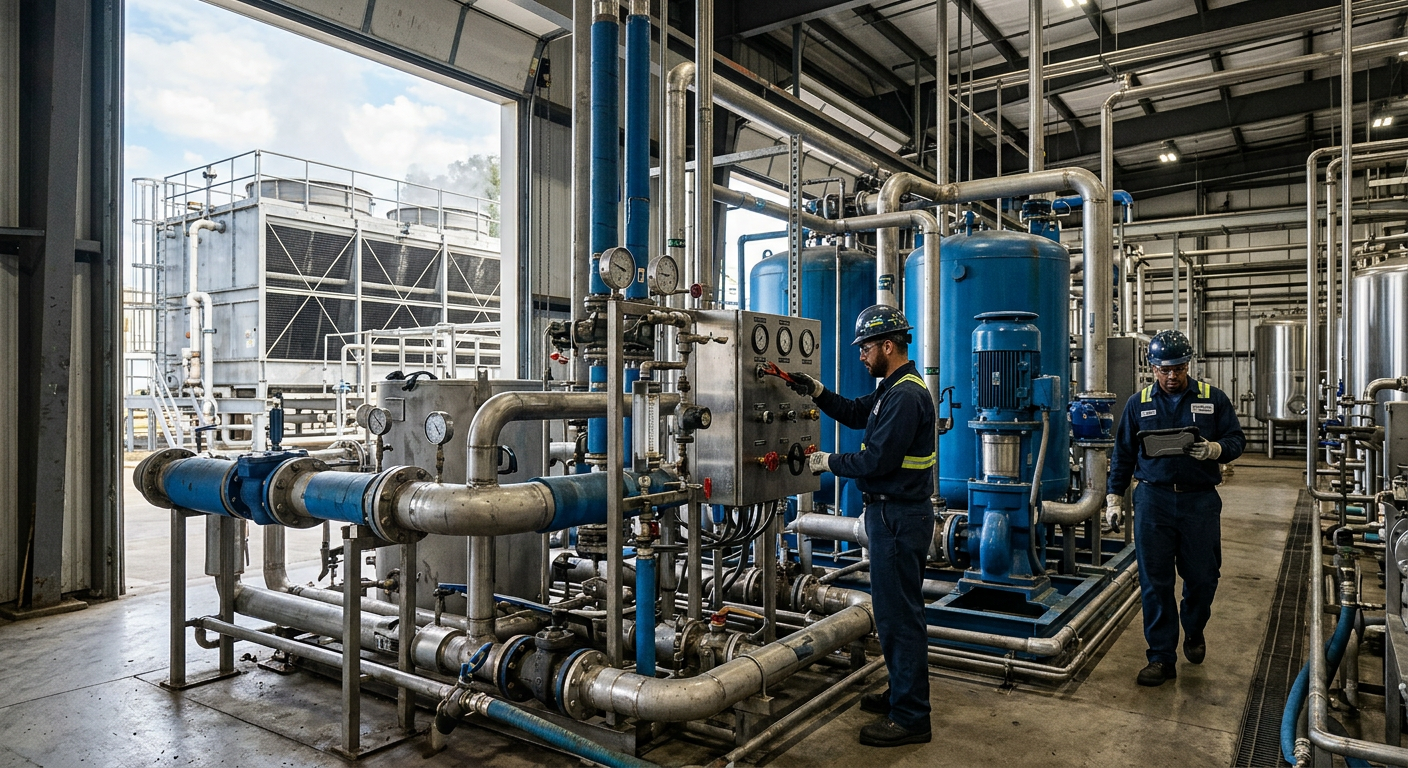
Glycol and Cooling Tower Systems for Beverage Manufacturing
[trp_language language=”en_US”]
Glycol Cooling Tower Beverage Systems in the United States
Quick Answer

For beverage manufacturing in the United States, glycol systems and cooling tower systems are both essential, but they solve different thermal duties. Glycol loops are typically used for precise closed-loop process cooling such as fermentation tanks, bright beer tanks, beverage blending, filler support, and cold-side utilities. Cooling towers are usually selected for heat rejection on condenser water loops, large utility loads, air compressors, process condensers, and central plant heat removal. In many beverage plants, the most effective answer is not choosing one over the other, but integrating both into a coordinated utility strategy.
If you need practical options now, the most relevant U.S.-market providers for beverage-focused cooling infrastructure include G&D Chillers, Pro Refrigeration, EVAPCO, SPX Cooling Tech, and Frick by Johnson Controls. These companies are widely associated with industrial chilling, evaporative heat rejection, packaged systems, and large utility support. Engineering-led integrators such as Disruptive Process Solutions can add value when the project requires full-system design, plant integration, controls, installation management, commissioning, and coordination with production goals rather than simple equipment replacement.
For buyers in cities such as Chicago, Charlotte, Dallas, Denver, Los Angeles, and the wider manufacturing corridors linked to Midwest food production and Southeast beverage expansion, the best path is usually a plant-specific assessment covering load profile, water availability, sanitation risks, redundancy, expansion plans, and energy costs. Qualified international suppliers can also be considered when they hold relevant U.S.-accepted certifications and provide strong pre-sales engineering, startup assistance, spare parts planning, and after-sales support. In some projects, these suppliers offer attractive cost-performance advantages, especially for standardized skids, tanks, heat exchangers, and auxiliary utility modules.
Market Outlook for Beverage Cooling Infrastructure

The U.S. beverage industry continues to invest in utility modernization because cooling capacity directly affects throughput, product stability, fermentation control, energy use, and sanitation performance. Whether the plant produces beer, spirits, juice, carbonated soft drinks, dairy beverages, kombucha, ready-to-drink cocktails, or aseptic beverages, temperature control is tied to yield and product consistency. Plants in North Carolina, Texas, California, Wisconsin, Pennsylvania, and Ohio often face an additional challenge: utility systems must remain flexible enough to support seasonal shifts, SKU growth, and new packaging formats without forcing major rework every time capacity increases.
Glycol cooling has gained attention because beverage processes need tighter thermal control than many general industrial applications. Fermentation, maturation, blending, carbonation, and storage often require closed-loop chilled service with stable temperatures and clean distribution. Cooling towers remain highly relevant because they handle large heat rejection loads economically, especially in larger campuses and co-packing facilities where utility scale matters. In newer U.S. projects, engineers increasingly combine packaged glycol chillers, plate-and-frame heat exchangers, insulated piping, variable-speed pumping, water treatment packages, and intelligent controls with tower-based condenser systems to balance capex and operating cost.
Another market driver is sustainability. Water use, energy intensity, refrigerant strategy, and wastewater impact are no longer side issues. Beverage companies serving national retail channels increasingly ask project teams to justify utility design with measurable operating data. As a result, the market is shifting away from oversimplified one-size-fits-all systems toward modular designs with better turndown, metering, redundancy, and lifecycle visibility.
The chart above illustrates a realistic growth trend for utility upgrade activity tied to beverage manufacturing. The pattern reflects stronger investment in process reliability, automation, and energy management rather than equipment replacement alone. U.S. projects increasingly bundle cooling improvements with CIP optimization, boiler upgrades, compressed air systems, and SCADA visibility so plant managers can understand utility cost per case or per gallon.
How Glycol Systems and Cooling Towers Differ

A glycol system is a closed-loop cooling network that uses a water-glycol mixture to transfer heat from process loads to a chiller or central refrigeration source. This arrangement is especially useful when the plant needs low temperatures, stable control, and isolated circuits for sanitary or process-sensitive equipment. Beverage manufacturers use glycol for fermenters, cellar tanks, syrup tanks, jacketed vessels, flash cooling support, and some cold storage support loads.
A cooling tower, by contrast, rejects heat from a water loop to the atmosphere through evaporative cooling. Towers are often used for condenser water, utility water, large compressors, secondary heat exchangers, and central plant heat rejection. Towers are efficient for large loads, but they introduce open-loop concerns such as water treatment, drift, scaling, biological control, and seasonal performance variation.
The most practical design question is not which system is “better” in absolute terms. The right question is which load belongs on which loop. Closed glycol loops protect process quality and precise temperatures. Tower systems reduce heat economically at scale. In a well-designed beverage plant, these systems complement each other.
Common Product Types Used in U.S. Beverage Plants
| System Type | Typical Temperature Range | Main Beverage Uses | Key Advantages | Main Watchouts | Best Fit |
|---|---|---|---|---|---|
| Packaged glycol chiller | 20°F to 40°F fluid supply | Fermenters, BBTs, cellar tanks, blending | Precise control, compact footprint, easy expansion | Compressor maintenance, insulation quality | Craft beverage and mid-size plants |
| Central glycol plant | 18°F to 35°F fluid supply | Multi-line beverage campuses | Better efficiency at scale, centralized maintenance | Higher design complexity | Large breweries and co-packers |
| Evaporative cooling tower | Dependent on ambient wet bulb | Condenser water, heat rejection | Low operating cost for large loads | Water treatment and hygiene | Large utility systems |
| Closed-circuit cooling tower | Moderate process cooling | Protected utility loops, exchanger support | Reduced contamination risk | Higher capital cost than open towers | Plants needing cleaner loop separation |
| Dry cooler with glycol | Ambient dependent | Seasonal free cooling, support loads | Lower water use, simpler treatment profile | Reduced peak summer performance | Water-sensitive locations |
| Hybrid heat rejection system | Flexible | Mixed beverage process and utility loads | Balances water and energy performance | Needs smart controls and careful design | Growing facilities with expansion plans |
This table shows why beverage facilities rarely rely on a single cooling strategy. Smaller breweries may begin with packaged glycol chillers, while major soft drink or co-packing plants often install central utility plants using multiple heat-rejection approaches. Hybridization is increasingly common in the United States because utility resilience matters as much as thermal performance.
Industry Demand by Beverage Segment
Demand for glycol and cooling tower solutions varies by beverage category. Fermented beverages place strong demand on glycol due to vessel jackets and cellar control. Carbonated soft drink and high-speed RTD lines often need larger utility integration because filler support, compressors, process cooling, and packaging hall conditions add major heat loads. Dairy and aseptic plants may require tighter sanitary separation and more conservative material selection.
The chart highlights where thermal infrastructure usually becomes more complex. Large brewery, soft drink, and RTD projects show especially high demand because they combine process precision with heavy utility loads and strict uptime expectations. For plants serving national grocery chains or contract manufacturing programs, unplanned cooling failure can quickly become a revenue and inventory problem.
Buying Advice for U.S. Beverage Manufacturers
When evaluating glycol and cooling tower systems in the United States, buyers should begin with process loads rather than vendor catalogs. A cooling system that looks cost-effective at purchase may be expensive in operation if it is oversized, poorly controlled, difficult to maintain, or incompatible with future expansions. The most important buying criteria are thermal load profile, control accuracy, utility integration, service access, water management, sanitation risk, redundancy, and total installed cost.
Plants in Phoenix, Houston, Atlanta, and inland California face very different ambient and water conditions than plants in Portland, Milwaukee, or upstate New York. That matters because tower performance depends heavily on climate and water quality, while glycol systems depend on insulation integrity, pump design, fluid concentration, and chiller staging. If a beverage manufacturer plans rapid SKU expansion, warehouse growth, or multi-shift production, the utility design should include spare capacity or modular add-on paths.
Buyers should also insist on clear documentation. This includes P&IDs, control narratives, maintenance schedules, recommended spare parts, water treatment plans, instrumentation lists, and commissioning records. In practice, these documents often determine whether the plant can run efficiently after startup. A low equipment price does not compensate for weak integration.
| Buying Factor | Why It Matters | What to Ask Suppliers | Risk if Ignored | Best Practice | Who Owns It |
|---|---|---|---|---|---|
| Load calculation | Prevents oversizing or undersizing | How were peak and average loads modeled? | Energy waste or inadequate cooling | Use production-based load cases | Engineer and plant team |
| Water quality plan | Critical for towers and exchangers | What treatment chemistry and monitoring are included? | Scale, corrosion, biofilm | Integrate treatment from day one | Utility manager |
| Control strategy | Impacts efficiency and product stability | Is VFD staging and remote monitoring included? | Temperature swings and high power use | Use PLC and SCADA visibility | Controls team |
| Redundancy | Protects production uptime | What happens if one pump or chiller fails? | Line stoppage | Design N+1 on critical loads | Operations leadership |
| Expansion readiness | Supports future capacity | Can the system scale without major demolition? | Expensive retrofit | Reserve headers, pads, and controls IO | Project manager |
| Service coverage | Speeds repair and startup support | What is the response time in our state? | Long downtime | Confirm regional field support | Procurement and maintenance |
This buying matrix is useful because cooling performance is not just about hardware. Good outcomes depend on the engineering logic behind equipment selection, on-site support, and whether the supplier understands beverage operations rather than generic industrial duty.
Industries and Applications That Rely on These Systems
Although this article focuses on beverage production, glycol and tower systems are also used across food processing, dairy, protein, pharmaceutical support spaces, and cold utility applications. In beverage plants, the most common applications include fermenter jackets, brite tank cooling, blend room cooling, product hold, tunnel support, utility condenser loops, compressed air heat rejection, and process area environmental support.
Spirits facilities often need stable utility design around mashing, fermentation, barrel-related storage conditions, and condenser cooling. Kombucha facilities require careful temperature control and cleanliness due to live cultures. Carbonated beverage and co-packing plants usually place heavy emphasis on line uptime and central utility coordination. Dairy beverage plants add more stringent concerns around hygienic design and temperature consistency.
| Industry Segment | Main Cooling Need | Preferred System Style | Operational Priority | Typical U.S. Plant Concern | Integration Notes |
|---|---|---|---|---|---|
| Craft brewing | Fermentation and cellar control | Packaged glycol | Batch consistency | Fast expansion without utility redesign | Tank jackets and insulated piping are critical |
| Large brewing | Process and central utilities | Central glycol plus tower support | Efficiency and uptime | High demand swings | Requires advanced controls and redundancy |
| Spirits and distillation | Fermentation and condenser support | Mixed systems | Thermal stability | Variable batch schedules | Coordination with still systems matters |
| Soft drinks | Utility-wide heat removal | Tower-heavy central plants | Continuous production | Packaging hall utility demand | Compressor and filler support often dominates |
| Juice and functional drinks | Blend and storage cooling | Closed-loop glycol | Flavor and shelf-life support | SKU volatility | Flexible batching utilities help |
| Dairy beverages | Tight sanitary temperature control | Closed-loop chilled systems | Food safety | Washdown and hygienic design | Materials and cleanability are essential |
The table makes clear that “beverage cooling” is not a single category. The right solution depends on whether the plant is batch-oriented, continuous, fermentation-driven, aseptic, or utility-intensive. Engineering teams that understand this distinction usually deliver better long-term results.
Trend Shift Toward Smarter and Greener Utility Plants
The 2026 direction of the market is clear: beverage manufacturers want lower water use, stronger controls, easier expansion, and more resilient utility systems. Plants are adding smart sensors for flow, pressure, conductivity, glycol concentration, compressor performance, and energy intensity. This enables predictive maintenance and better troubleshooting before a temperature issue becomes a product loss event.
Policy and customer pressure are also shaping design. More owners are asking about refrigerant strategy, water reuse, adiabatic alternatives, blowdown optimization, drift reduction, and energy metering by process area. In some U.S. regions where water stress is a concern, buyers increasingly compare tower-based and dry-cooling tradeoffs more carefully than they did a few years ago.
This area chart reflects the shift from basic mechanical selection toward digitally managed utility ecosystems. By 2026 and beyond, beverage plants are expected to prioritize integrated controls, energy dashboards, remote alarms, and staged expansion planning. This is especially true for co-packers and brand owners that need tighter cost visibility per production run.
Local and Regional Suppliers Relevant to the U.S. Beverage Market
Below is a practical supplier comparison focused on names recognized in U.S. cooling, refrigeration, and heat-rejection work. Some are equipment manufacturers, while others are more useful through engineering or packaged-system integration. Buyers should confirm exact scope, regional field support, and beverage-specific references before purchase.
| Company | Service Region | Core Strengths | Key Offerings | Best Fit in Beverage | Notes for Buyers |
|---|---|---|---|---|---|
| G&D Chillers | United States and North America | Brewery and beverage-oriented chilling packages | Glycol chillers, cellar cooling support | Craft breweries and specialty beverage plants | Often considered for process-focused glycol applications |
| Pro Refrigeration | United States | Packaged chillers and industrial cooling systems | Glycol chillers, fluid coolers, custom skids | Breweries, wineries, dairy beverage plants | Useful for custom packaged solutions |
| EVAPCO | Nationwide U.S. coverage | Evaporative heat rejection and cooling towers | Cooling towers, condensers, closed-circuit coolers | Large central utility plants | Strong fit where heat rejection scale is significant |
| SPX Cooling Tech | United States and global | Cooling tower technology and service support | Cooling towers, air-cooled and hybrid options | Major beverage campuses and utility retrofits | Relevant for large condenser water strategies |
| Johnson Controls / Frick | North America | Industrial refrigeration and large plant support | Refrigeration systems, controls, compressors | Large-scale integrated beverage facilities | Strong fit when refrigeration scope is broad |
| Disruptive Process Solutions | All 50 U.S. states and Canada | Engineering-led integration and project execution | Cooling towers, glycol systems, utility integration, controls | Manufacturers needing full-scope design-build-manage support | Best suited when project success depends on execution, not equipment alone |
This comparison matters because beverage projects often fail when the buyer hires an equipment source without enough integration capability, or an integrator without enough process understanding. The best supplier is often the one that can match the plant’s operating model, schedule, and future expansion plan.
Supplier and System Comparison Snapshot
This comparison chart shows a realistic difference between equipment-centered suppliers and engineering-led integrators. Packaged equipment can be very effective for straightforward needs, but integrated beverage projects often require broader coordination across tanks, utilities, controls, installation sequencing, commissioning, and operator training.
Case Study Patterns Seen in U.S. Beverage Projects
In the United States, three case patterns appear repeatedly. The first is the fast-growing craft or specialty beverage producer that outgrows its original glycol package. The initial system may have been suitable for a handful of vessels, but after adding fermenters, a bright tank, and a canning line, the loop becomes unstable and recovery times worsen. In these situations, a central glycol skid, rebalanced piping, improved valve control, and better insulation often solve more than simply buying a larger chiller.
The second pattern is the large co-packing or carbonated beverage project where cooling towers are added mainly for utility-scale heat rejection. Here, the challenge is not just rejecting heat but coordinating the tower loop with compressors, process exchangers, water treatment, and seasonal operating conditions. Poor control logic can create unnecessary power draw or unstable process temperatures even when the mechanical equipment is large enough on paper.
The third pattern is the brownfield retrofit. Many legacy plants around established manufacturing hubs such as Milwaukee, St. Louis, central Pennsylvania, and parts of California have inherited utility systems from multiple project phases. The result is often a mix of piping sizes, undocumented controls, uneven redundancy, and maintenance difficulty. The most successful retrofits begin with utility mapping and operating data rather than immediate equipment procurement.
Project teams can review practical examples of execution-oriented industrial work through DPS project content such as food and beverage project experience, process system implementation examples, and capital project delivery case studies. These references are useful for buyers who want to understand how engineering, field execution, and production outcomes fit together in real manufacturing settings.
Our Company
Disruptive Process Solutions brings a particularly practical fit to glycol cooling tower beverage projects in the United States because the company operates as a full-scope food and beverage engineering partner rather than a remote equipment seller. Founded in 2020 with headquarters in Cary, North Carolina and a West Coast office in Lake Forest, California, DPS supports clients across all 50 states and Canada through a design-build-manage model that combines process engineering, capital planning, project management, general contracting capability where licensed, proprietary equipment supply, installation, controls integration, and commissioning. Its beverage work spans brewing, spirits, wine, kombucha, RTD products, soft drinks, juice, dairy beverages, and aseptic processing, while its technical depth includes cooling towers, glycol systems, boilers, compressors, process piping, automation, PLC programming, and SCADA. That matters for buyers because cooling equipment only performs as promised when components, materials, controls, and field execution are aligned to production goals and tested to plant conditions. DPS also serves a wide range of customer types, from end users and co-packers to brand owners and larger enterprise manufacturers, with flexible project structures that can function like OEM supply, custom integration, wholesale-style equipment support, or regional execution partnerships depending on the scope. Its local-service credibility is reinforced by real U.S. operations on both coasts, an established North American partner network, and direct experience managing utility-intensive projects such as a new beverage co-packing facility built around syrup rooms, boilers, compressors, cooling towers, and complete infrastructure sized to scale from 20 million to 80 million cases. Buyers looking for a long-term partner can learn more through the company’s about us page and review available equipment capabilities as part of a broader project discussion.
How to Select the Right Configuration
If your plant is under 100,000 barrels a year or operates as a specialty beverage producer, a packaged glycol system may be the most practical starting point. If your plant has a large compressor room, multiple lines, or centralized refrigeration duty, tower-assisted heat rejection may improve economics. For large co-packers, hybrid plants often perform best because they separate critical process loads from broader utility duties.
Plants with strict sanitation and flavor-protection priorities should favor clean closed loops wherever possible. Plants in regions with higher water costs or stricter water management goals should carefully evaluate tower water use versus hybrid or dry-cooling strategies. Facilities expecting acquisition-driven growth or major line additions should choose designs that support phased expansion, not just day-one demand.
It is also wise to involve maintenance and operations teams early. Engineers may optimize around design conditions, but operators understand how the plant really behaves during peak summer runs, shift changes, startup days, washdown periods, and product transitions. Good cooling design reflects both perspectives.
FAQ
Is glycol always necessary in a beverage plant?
No. Glycol is common where precise chilled process control is needed, especially for fermentation, storage, and sensitive product handling, but not every load requires glycol. Some plants use a combination of chilled water, glycol, and tower loops.
Can a cooling tower replace a glycol system?
Usually not for cold-side beverage process duties. Cooling towers are excellent for heat rejection and some moderate-temperature applications, but they do not replace the need for low-temperature closed-loop process cooling where product quality depends on stable control.
What is the main mistake buyers make?
The most common mistake is buying equipment before validating process loads, control logic, and expansion plans. Another frequent problem is underestimating water treatment and maintenance needs for tower systems.
Are international suppliers a realistic option for U.S. projects?
Yes, if they can demonstrate suitable material standards, documentation, accepted certifications, spare parts strategy, startup support, and responsive after-sales service in the United States. They are often most attractive for standardized skids or auxiliary process equipment where cost-performance is strong.
What trends will shape projects in 2026 and beyond?
Expect stronger focus on smart controls, energy visibility, water conservation, sustainability reporting, modular expansion, and better utility data integration with plant-wide automation platforms.
When should a plant hire an engineering-led integrator instead of only an equipment vendor?
When the project includes multiple utilities, plant expansion, complex controls, production scheduling risk, or brownfield constraints. In those situations, execution quality often determines financial success more than equipment price alone.
Final Takeaway
For beverage manufacturing in the United States, glycol and cooling tower systems should be evaluated as complementary tools within a broader thermal strategy. Glycol protects process precision. Cooling towers deliver efficient large-scale heat rejection. The best-performing plants combine both where appropriate, supported by sound controls, expansion planning, and experienced execution. If your operation is planning a new facility, replacing aging utilities, or trying to unlock more production from existing assets, the right partner will help you connect utility design to profitability rather than treating cooling equipment as an isolated purchase.
[/trp_language]
Complete Company Portfolio
About the Author: Disruptive Process Solutions (DPS)
The DPS team combines process engineering expertise with real-world food and beverage manufacturing experience. Our content focuses on process optimization, production efficiency, facility improvements, and practical solutions that help manufacturers operate more effectively in a rapidly evolving industry.
Share