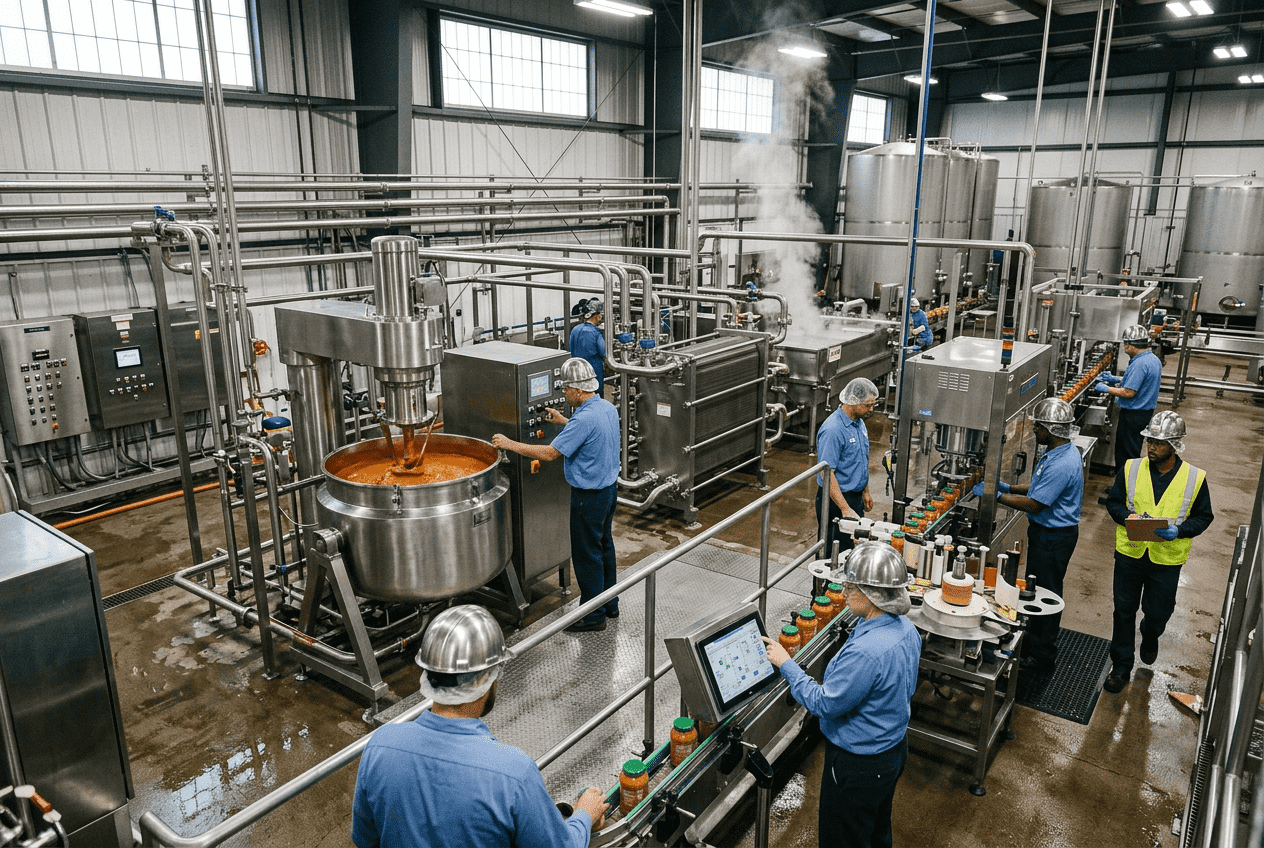
Ground Beef Processing Line Execution
[trp_language language=”en_US”]
Ground Beef Line Planning in the United States
Quick Answer

A ground beef processing line in the United States typically starts with raw material receiving, trimming, and pre-blending, then moves through grinding, fat standardization, pathogen intervention, final blending, forming when required, packaging, metal detection or X-ray, and cold storage. The best line design depends on whether the plant handles fresh trim, frozen blocks, or a mixed raw material strategy; whether it produces chubs, retail trays, patties, nuggets, or meatballs; and what throughput, lean point accuracy, food safety, and labor goals the operation must achieve.
For most U.S. processors, the highest-performing systems are not built around a single machine. They are engineered as an integrated production line where trim handling, tempering, grinder plate selection, in-line fat analysis, recipe controls, intervention steps, packaging format, and downstream logistics all work together. That is especially important for operations supplying high-volume markets such as Chicago, Dallas, Los Angeles, Atlanta, and the Northeast distribution corridor through New Jersey and Pennsylvania.
Disruptive Process Solutions supports this kind of full-line execution across North America. Rather than approaching a protein project as a simple equipment purchase, the company works as an engineering and integration partner for processors that need profitable capacity, reliable compliance, and scalable automation. Readers looking for a partner overview can review the DPS company background, while those planning a broader line upgrade can explore integrated engineering and project delivery services.
In practical terms, a successful ground beef line should deliver six outcomes at once: controlled raw material temperature, consistent particle definition, accurate lean point, validated E. coli O157:H7 risk reduction, packaging suited to the target market, and labor-efficient line balancing. If one of those six fails, profitability usually erodes through giveaway, rework, slowdowns, recalls, or customer complaints.
| Line Objective | Typical U.S. Target | Why It Matters | Main Equipment Area |
|---|---|---|---|
| Raw material temperature | Controlled for clean grinding and blending | Improves texture, yield, and microbial control | Receiving, tempering, tote or combo handling |
| Throughput | Matched to upstream and packaging speed | Prevents bottlenecks and idle labor | Grinders, blenders, conveyors, fillers |
| Lean point accuracy | Tight compliance with product spec | Reduces giveaway and customer rejections | Fat analysis, recipe controls, blending |
| Pathogen reduction | Validated intervention and sanitation | Supports USDA and customer food safety plans | Steam, organic acid, hygienic design |
| Package performance | Retail-ready or foodservice-ready | Drives shelf life and logistics efficiency | Chub, MAP tray, vacuum systems |
| Labor productivity | Balanced staffing by line zone | Lowers cost per pound processed | Automation, ergonomic handling, controls |
The table above summarizes the core design priorities. In most retrofit projects, processors discover that the real gains come from aligning these priorities instead of overinvesting in a single high-capacity grinder or former while leaving the rest of the line constrained.
Ground Beef Processing Line: Trimming, Grinding, Blending, and Forming

The standard ground beef process begins with receiving raw trim or primal-derived material in combos, lugs, or boxed product. After verification of temperature, lot identity, and quality, the material moves to trimming and visual inspection. Trimming stations remove excessive hard fat, gland material, bruised tissue, bone fragments, and out-of-spec lean. At this step, ergonomic table design, knife management, and smart combo staging can have a major effect on labor efficiency.
After trimming, processors generally create a pre-blend of lean and fat components. This gives the grinder a more uniform feed and reduces batch-to-batch variability. Depending on the plant layout, pre-blending may occur by tote loading, belt blending, or transfer into a paddle blender. Some facilities use coarse grinding before the final blend; others prefer to standardize the formula first and then run a single final grind. The right sequence depends on product style, target particle size, and intervention placement.
Grinding itself must be designed around particle definition and temperature management. Overworked meat can smear, darken, and lose the fresh visual appeal retailers expect. Underprocessed material can produce poor package presentation and inconsistent cook performance. Once the product leaves the grinder, it may pass through a final blender to correct lean point and improve homogeneity before packaging or forming.
Forming is not mandatory for every ground beef line, but it becomes essential for processors supplying burger patties, IQF meatballs, protein bites, or nugget-style beef items. In those cases, the line must synchronize grinder discharge with feed screws, form plates, conveyors, freezing, or tray loading. A poorly integrated former can become the rate limiter even when the grinding side of the operation has spare capacity.
In U.S. regional markets, product mix often drives line architecture. Texas and the Midwest may emphasize foodservice patties and large chubs; the Southeast may require value-pack retail trays; West Coast processors supplying club stores may prioritize larger format packs and high-volume fresh ground programs. Plants near major freight corridors such as Kansas City, Memphis, and the Inland Empire benefit from designing SKUs around distribution efficiency as much as around machine speed.
| Process Step | Primary Function | Key Control Point | Common Risk | Typical Upgrade |
|---|---|---|---|---|
| Receiving | Verify incoming meat and documentation | Temperature and lot control | Warm raw material | Digital receiving and staging control |
| Trimming | Remove defects and standardize input | Visual quality and yield | Labor variability | Ergonomic trim stations |
| Pre-blending | Balance lean and fat inputs | Formula consistency | Uneven feed to grinder | Automated combo dosing |
| Grinding | Create target particle size | Plate and blade setup | Smear and heat rise | Optimized grinder head configuration |
| Final blending | Homogenize product | Lean point correction | Overmixing | Recipe-driven blending control |
| Forming or filling | Create final retail or foodservice format | Weight accuracy and shape | Throughput mismatch | Integrated servo controls |
This process table shows where value is either captured or lost. In many plants, the difference between an average line and a high-performing line is not a different sequence, but a tighter level of control at each step.
Fresh vs Frozen Raw Material Handling and Tempering Systems

One of the most important decisions in ground beef line design is whether the plant will run fresh trim, frozen blocks, or a hybrid raw material model. Fresh systems often offer easier particle definition, shorter conditioning time, and a more direct path to retail-ready product. Frozen systems can improve raw material flexibility, inventory planning, and sourcing economics, especially when processors buy trim from multiple harvest facilities or balance production across seasons.
Fresh raw material handling usually relies on combo dumpers, tote lifts, sanitary conveyors, and trim inspection tables. Temperature control is maintained through cooler staging, short dwell time, and tightly managed room conditions. The biggest design risk with fresh product is not always the equipment itself; it is dwell time. If material waits too long between receiving, trim, and grind, texture and safety margins narrow quickly.
Frozen raw material lines require more planning. Blocks may need deboxing, pallet handling, block breakers, flakers, or crushers before tempering and blending. Tempering systems are especially important because grinding overly hard blocks can overload the equipment, while overtempered blocks can increase smear and free moisture. Common tempering strategies include controlled refrigerated rooms, microwave or radio-frequency assistance in selected applications, and timed staging systems that bring the core temperature into a narrow operating window.
For U.S. processors serving national customers, hybrid systems are increasingly common. Fresh domestic trim may be supplemented with frozen inventory to manage supply fluctuations around holidays, weather events, or cattle cycles. Plants near ports such as Los Angeles/Long Beach, Savannah, Houston, and Newark may also structure frozen handling around imported ingredients or long-range distribution planning. That makes material flow engineering as important as the machine list.
DPS often approaches these projects from a technological capability standpoint first. The team’s strength is in integrating process engineering, utilities, automation, and plant layout so raw material temperature, equipment duty, and room design support each other. That matters in protein plants where refrigeration load, floor traffic, and washdown conditions can easily undermine theoretical machine capacity if the system is not designed holistically.
| Raw Material Strategy | Advantages | Challenges | Best Fit |
|---|---|---|---|
| Fresh trim only | Excellent texture, simple flow | Short shelf and scheduling pressure | Retail fresh programs near harvest sources |
| Frozen blocks only | Inventory flexibility, sourcing leverage | Tempering complexity, higher handling load | Large-scale foodservice and regional balancing |
| Fresh plus frozen blend | Supply resilience, formula flexibility | More complex controls | Multi-SKU processors |
| Coarse-ground inbound | Reduced trim labor | Less control over initial particle definition | Contract manufacturing setups |
| Primal-derived in-house trim | Strong quality control | Higher labor and fabrication dependency | Integrated beef operations |
| Multi-source boxed beef trim | Commercial flexibility | Lot segregation and verification needs | National distribution plants |
The table helps buyers compare raw material strategies beyond simple ingredient cost. In reality, the right choice depends on the plant’s procurement model, customer specs, and cold-chain infrastructure.
Grinder Selection: Plate Size, Blade Configuration, and Throughput
Choosing the correct grinder is about much more than pounds per hour. Plate diameter, motor load, feed system design, auger geometry, knife arrangement, and the relationship between first and final grind all affect product quality and uptime. For ground beef, grinders are commonly selected to preserve visible particle definition while still delivering enough output to keep fillers, tray lines, or formers continuously fed.
Plate size influences both throughput and texture. Larger plates generally support higher volume and can reduce pressure build-up, but they must still match the target end product. Blade configuration matters just as much. Single-knife setups can work in some applications, while Unger-style systems with multiple cutting stages provide improved definition for certain formulations. The wrong combination can result in smear, excessive compression, and inconsistency between shifts.
Throughput should always be measured at line level rather than machine level. A grinder rated at a high hourly capacity is not useful if the upstream trim team cannot feed it steadily or if the downstream packaging line runs at half that pace. This is where controls and load balancing become important. Variable frequency drives, hopper level sensors, and coordinated discharge conveyors can stabilize flow and reduce manual intervention.
From a manufacturing capability perspective, DPS works well with processors that need custom integration around grinding and blending rather than a generic equipment package. That can include proprietary tanks or utility skids, custom transfer systems, and complete installation of the mechanical, electrical, and controls scope. Those capabilities are especially valuable in brownfield U.S. plants where column spacing, sanitation zones, and legacy refrigeration often limit equipment choices.
| Grinder Factor | What to Evaluate | Impact on Product | Impact on Operations |
|---|---|---|---|
| Plate diameter | Output requirement and particle target | Texture definition | Capacity and energy use |
| Hole size | Final grind specification | Visual appearance and mouthfeel | Changeover frequency |
| Knife count | Single or multi-stage cutting | Smear versus clean cut | Maintenance and setup skill |
| Feed screw design | Product movement and compression | Uniformity | Motor load and wear |
| Material temperature | Fresh, tempered, or mixed input | Color and bind | Throughput stability |
| Sanitary design | Cleanability and access | Food safety confidence | Washdown time |
This grinder comparison table shows why specification by horsepower alone is incomplete. The right grinder must fit the product style, sanitation plan, and the pace of the entire line.
The line chart above illustrates a realistic investment trend in U.S. ground beef processing systems. Capital spending has been pushed by labor shortages, stricter data visibility requirements, and retailer demand for consistent pack quality. Looking toward 2026, processors are expected to prioritize automation, energy efficiency, and traceability-ready controls.
Lean Point Control: Fat Analysis and Recipe Consistency Technology
Lean point control is central to the economics of ground beef. Selling a product that consistently runs too lean creates giveaway. Running too fat creates compliance risk, customer disputes, and rejected lots. Because even small deviations become expensive at high volume, leading processors use in-line or near-line fat analysis combined with recipe management software and disciplined material segregation.
The best systems tie raw material identity to measured composition. As lean and fat components enter the line, operators or automated controls can direct them into the blend based on target outcomes such as 73/27, 80/20, 85/15, 90/10, or a custom formulation. Near-infrared analysis, X-ray-based composition tools, and lab-verified calibration programs all play a role, depending on scale and required precision.
Recipe consistency also depends on batch logic. A processor may have the right average lean point over a shift but still create batch-to-batch swings that hurt forming, texture, and label accuracy. The solution is a combination of controlled lot staging, measured dosing, intelligent rework policy, and automation that captures what was actually blended, not what was planned on paper.
This is an area where service capability matters. DPS supports clients as an owner-minded engineering partner, helping them evaluate feasibility, capital planning, equipment integration, utility design, and execution management. That is valuable when the business case for lean point technology must be justified not only by food safety and quality, but also by payback through reduced giveaway and improved first-pass yield.
| Lean Point Control Tool | Main Benefit | Common Use | Payback Driver |
|---|---|---|---|
| Near-line fat analyzer | Fast composition checks | Batch verification | Less giveaway |
| In-line composition system | Continuous data feedback | High-volume plants | Tighter spec control |
| Recipe software | Formula standardization | Multi-SKU production | Fewer operator errors |
| Automated combo dosing | Measured ingredient loading | Large blends | Improved repeatability |
| Lot segregation protocol | Better traceability | Regulated food safety programs | Faster investigations |
| SPC dashboards | Trend visibility | Continuous improvement | Lower variance over time |
The table above explains why lean point management is both a quality tool and a financial tool. Many U.S. processors recover significant annual value by narrowing blend variance by even a few tenths of a percent.
The area chart highlights a steady shift toward automated recipe control in protein plants. By 2026, U.S. buyers are expected to place even greater emphasis on software-connected blending, audit-ready records, and predictive maintenance tied to composition performance.
Patty, Nugget, and Meatball Forming Equipment Integration
When a plant extends beyond bulk ground beef into formed products, equipment integration becomes more demanding. Patty lines require precise weight control, shape retention, and sometimes interleaving, stacking, or direct tray loading. Meatball lines need portion consistency, rolling or shaping control, and often a smooth transfer into cooking or freezing. Nugget-style beef products may involve added ingredients, bind systems, breading, or downstream thermal processing.
Formers must be selected based on product geometry, moisture level, throughput, and whether the line will run fresh or frozen discharge. Servo-driven systems improve repeatability and changeover, but they also require well-matched upstream flow. If the blend is too warm, too sticky, or inconsistent in particle size, the former may produce weight variation or shape defects that affect case yield and customer satisfaction.
Integration is not only mechanical. It also includes controls, sanitation zoning, and utility coordination. A former feeding an IQF tunnel or spiral freezer needs synchronized conveyor speeds and backup logic to avoid pileups. A patty line serving retail club packs needs reliable transfer into packaging with minimal manual touches. Plants near major demand centers such as Phoenix, Denver, or the Carolinas may prioritize flexible multi-SKU systems that can switch between foodservice patties and retail formats during the same week.
For buyers comparing options, the real question is whether the forming system will fit the existing operation. Floor space, washdown access, rework handling, and packaging alignment all matter as much as the rated strokes per minute.
| Product Type | Typical Forming Need | Critical Control | Downstream Link |
|---|---|---|---|
| Retail burger patties | Accurate weight and diameter | Shape retention | Tray pack or stack pack |
| Foodservice patties | High throughput | Thickness uniformity | Freezing and boxing |
| Meatballs | Roundness and piece count | Portion control | IQF or cook line |
| Beef nuggets | Complex shape capability | Mixture consistency | Breading or cooking |
| Seasoned beef portions | Gentle handling | Ingredient distribution | Vacuum or tray packaging |
| Hybrid value-added items | Frequent changeover | Recipe integrity | Multi-format packaging |
This forming table helps clarify how product type drives equipment choice. A line optimized for patties may not be the best answer for meatballs or further-processed beef items without significant change parts and controls support.
E. coli O157:H7 Intervention: Steam Pasteurization and Organic Acid Treatment
No discussion of a U.S. ground beef processing line is complete without addressing E. coli O157:H7 risk management. A robust line design supports the plant’s validated food safety plan through hygienic zoning, controlled product flow, sanitation access, lot traceability, environmental management, and where applicable, intervention technology. Steam pasteurization and organic acid treatment are two commonly discussed options, though the correct approach depends on the processor’s upstream process, raw material source, and regulatory framework.
Steam-based intervention is typically associated with carcass or trim surface treatment in broader beef operations, but its place in the total risk reduction strategy should be evaluated carefully. Proper validation, contact conditions, dwell time, and integration with product flow are essential. Organic acid systems, often using lactic acid or similar approved treatments, can help reduce surface contamination when applied under controlled conditions and with a clear sanitation and verification program.
The most successful processors do not treat intervention as a stand-alone machine purchase. They build it into the total line concept: raw material segregation, traffic patterns, cleanable conveyor design, temperature management, rapid lot identification, and disciplined preventive controls. Plants in USDA-inspected environments serving major retail or QSR customers typically need strong documentation to show both control and consistency.
Looking toward 2026, U.S. policy and customer expectations are moving toward tighter digital traceability, more defensible validation records, and broader use of data-driven verification. Sustainability will also shape intervention decisions. Processors increasingly want systems that reduce water, chemical use, and energy demand while still meeting food safety objectives.
The bar chart reflects relative demand across major U.S. ground beef market channels. Fresh retail and foodservice remain dominant, but value-added and specialty programs continue to influence line flexibility and intervention planning.
Packaging Options: Chub, MAP Tray, and Vacuum for Ground Beef
Packaging format determines more than shelf appearance. It affects shelf life, labor, distribution cube, leak risk, consumer convenience, and channel fit. Ground beef processors in the United States typically choose among chub packaging, modified atmosphere packaging (MAP) trays, and vacuum formats, with some plants running more than one format to serve different customers.
Chubs are efficient for foodservice, processors, and high-volume retail backroom operations. They offer strong throughput and favorable material use, though the presentation is less consumer-facing than tray systems. MAP trays are common for retail because they support attractive color presentation and shelf-ready merchandising. However, they require careful control of gas mix, seal integrity, and cold-chain discipline. Vacuum formats provide excellent product protection and can extend shelf performance, though the visual appearance differs from traditional bright-red tray presentations.
Package choice should match the sales channel. A retailer in Miami may prioritize case-ready fresh appearance and manageable shrink. A distributor in the Midwest may prefer chubs for speed and cube efficiency. Processors serving private label programs around New York, Philadelphia, or Southern California often need flexible packaging cells that can switch between store-specific tray footprints, label systems, and pallet patterns.
Buyers should also consider secondary packaging, coding, checkweighing, and palletizing. A high-speed primary pack system can still lose efficiency if case packing or label verification is manual and inconsistent. In retrofit projects, these downstream steps often become the hidden bottleneck.
| Packaging Format | Best Use Case | Main Advantage | Main Limitation |
|---|---|---|---|
| Chub | Foodservice and processing supply | High efficiency and low material cost | Limited retail presentation |
| MAP tray | Retail case-ready | Strong visual appeal | Higher packaging complexity |
| Vacuum pack | Extended distribution and bulk use | Protection and shelf performance | Different appearance from MAP |
| Overwrap tray | Short local retail runs | Lower initial equipment cost | Shorter shelf life |
| Bulk poly bag | Institutional or further processing | Simple and economical | Limited end-user convenience |
| Portion-packed formats | Meal kits and premium retail | Consumer convenience | Higher labor and film cost |
The table above compares packaging options by commercial fit. For many operations, the most profitable answer is a modular packaging area that can support more than one format without excessive changeover time.
This comparison chart summarizes how leading packaging formats are typically evaluated. Actual selection should always reflect product objective, retailer expectations, and total delivered cost.
Production Efficiency: Line Balancing and Labor Optimization
Production efficiency in a ground beef facility depends on line balancing more than on peak machine speed. If trimming, tempering, grinding, blending, intervention, packaging, and palletizing are not aligned, the operation will cycle through starvation, blockage, rework, and overtime. The goal is steady flow.
Line balancing starts with accurate capacity mapping. Every zone should be measured in pounds per hour, labor hours per shift, sanitation turnaround, and uptime impact. Many processors are surprised to learn that their largest delays come from material presentation, combo changes, package film replenishment, or QA hold points rather than from the grinder itself. Once these constraints are visible, automation and staffing can be targeted more intelligently.
Labor optimization does not simply mean reducing headcount. In protein operations, it means placing people where judgment and dexterity matter, while automating repetitive handling, data capture, and transfer tasks. Combo dumpers, conveyors, automatic form loading, checkweighing, label verification, and palletizing can all improve throughput stability while making the work safer and easier to standardize.
Case studies in U.S. plants often show that modest control improvements deliver major returns. A packaging line in a Midwestern beef facility may gain more from synchronized conveyor logic than from adding another grinder. A Southeast processor may unlock capacity by redesigning room flows and reducing forklift interference. This is consistent with the DPS approach: practical capital planning, disciplined design-build-manage execution, and a focus on client profitability rather than equipment volume alone. Examples of project thinking and execution style can be seen in selected DPS case experience, while processors evaluating hardware scope can explore available processing equipment solutions.
Looking to 2026, major trends include vision-based inspection, stronger SCADA connectivity, digital maintenance workflows, energy monitoring, and sustainability metrics built into project justification. Water use, compressed air consumption, and refrigeration efficiency are now part of the conversation, especially for multi-site processors and enterprise procurement teams.
| Efficiency Lever | Typical Problem Solved | Operational Benefit | Strategic Benefit |
|---|---|---|---|
| Capacity mapping | Hidden bottlenecks | Better scheduling | Smarter capital allocation |
| Automated handling | Manual lift and transfer delays | Less fatigue and faster flow | Improved labor resilience |
| Integrated controls | Stop-start line behavior | Stable throughput | Higher OEE |
| Inline quality checks | Late defect discovery | Less rework | Better customer consistency |
| Sanitary design upgrades | Long washdown windows | Shorter changeovers | More available production time |
| Energy and utility optimization | Rising operating cost | Lower cost per pound | Sustainability progress |
The table makes clear that line efficiency is operational and financial at the same time. Processors that track these levers systematically are usually better positioned for margin protection during raw material volatility.
FAQ
What is the ideal temperature for grinding ground beef raw material?
The ideal range depends on product style and whether the input is fresh or tempered frozen material, but the goal is always the same: cold enough to cut cleanly and control microbial risk, yet not so hard that the grinder smears, overloads, or creates poor particle definition.
Should a processor choose fresh trim or frozen blocks?
Fresh trim is often best for direct retail freshness and texture, while frozen blocks provide sourcing flexibility and inventory control. Many U.S. plants use a hybrid strategy to balance supply, cost, and schedule reliability.
How important is lean point control technology?
It is critical. Even small deviations in fat content can create major annual giveaway or compliance issues. In-line or near-line fat analysis paired with recipe control usually offers a strong return in medium- and high-volume operations.
What packaging format is best for ground beef?
There is no single best format. Chubs are efficient for foodservice and processing, MAP trays are strong for retail display, and vacuum packs can support shelf life and bulk distribution. The correct choice depends on sales channel and logistics strategy.
Can one line produce both bulk ground beef and patties?
Yes, if the system is engineered for it. The line needs compatible blend consistency, flexible transfer design, validated changeover procedures, and controls that let the plant switch between filling and forming without creating sanitation or scheduling problems.
What are the biggest causes of poor ground beef line performance?
Common causes include inconsistent raw material temperature, grinder mis-specification, weak lean point control, poor forming integration, packaging bottlenecks, and unbalanced staffing across the line.
How should a processor evaluate a supplier or integrator?
Look beyond the equipment list. Evaluate process knowledge, USDA and food safety understanding, utilities integration, controls capability, installation management, and whether the partner can support layout, commissioning, and throughput ramp-up. A full-scope engineering and execution model often reduces project risk more than a low initial machine quote.
What trends will shape ground beef lines in 2026?
Expect more recipe automation, digital traceability, stronger intervention documentation, energy-conscious refrigeration and utility design, labor-saving material handling, and sustainability metrics included in capital approval decisions.
For U.S. manufacturers planning a new line or retrofit, the most reliable path is to treat ground beef processing as a complete system rather than a collection of stand-alone machines. Engineering, utilities, automation, sanitation, packaging, and commercial goals must be aligned from the start. That is where a partner with process depth, installation experience, and owner-focused project execution can create measurable value.
[/trp_language]
Complete Company Portfolio

About the Author: Disruptive Process Solutions (DPS)
The DPS team combines process engineering expertise with real-world food and beverage manufacturing experience. Our content focuses on process optimization, production efficiency, facility improvements, and practical solutions that help manufacturers operate more effectively in a rapidly evolving industry.
Share