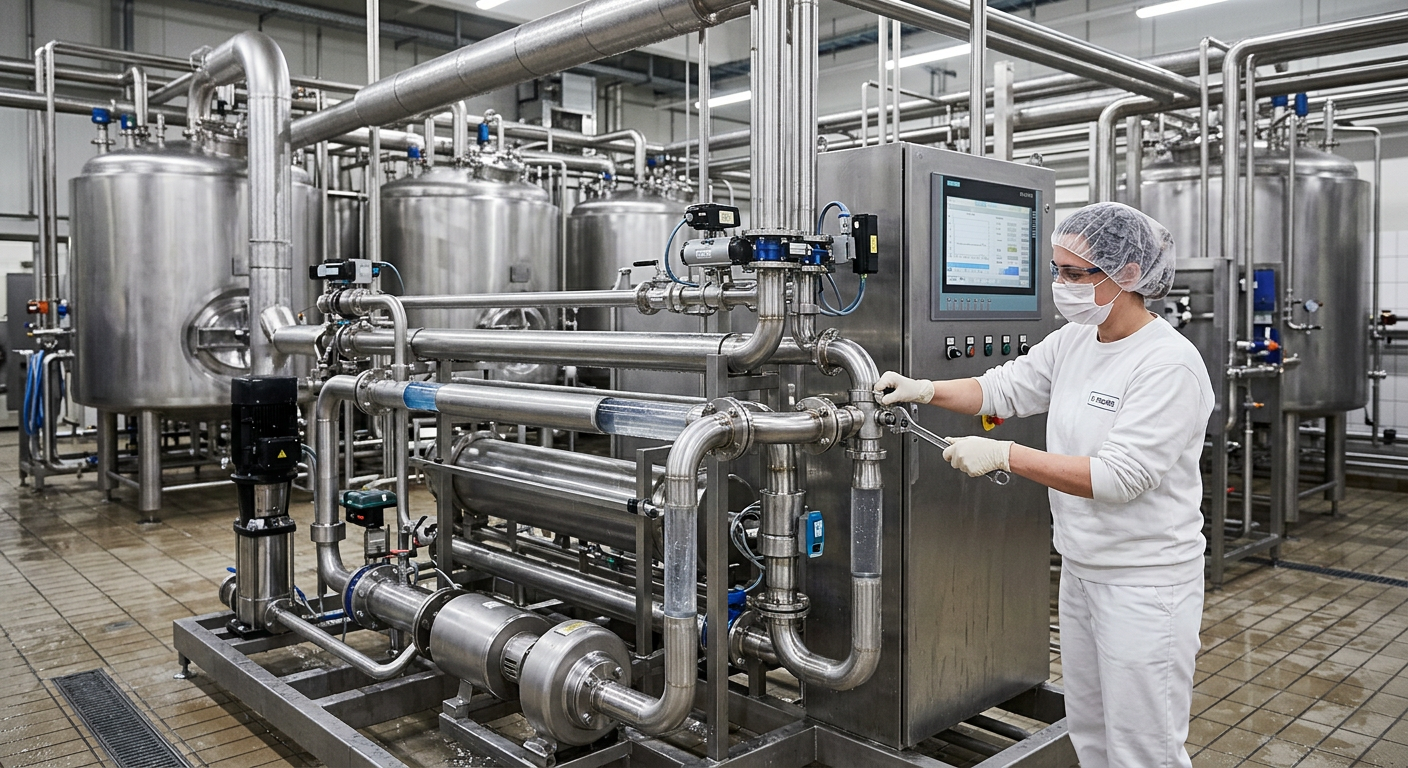
Hard Seltzer Production Line Solutions
[trp_language language=”en_US”]
Hard Seltzer Processing Systems in the United States
Hard seltzer production in the United States is no longer a niche packaging exercise. It is now a serious manufacturing category that demands disciplined process engineering, precise utilities, and repeatable quality control. Producers entering this segment need more than tanks and a canning line. They need a complete system that starts with sugar wash fermentation, creates a neutral and stable alcohol base, strips unwanted aroma and haze, blends flavor and alcohol accurately, carbonates to tight CO2 targets, and fills under controlled oxygen and pressure conditions. For breweries, distilleries, co-packers, and beverage startups, the right hard seltzer production line is a combination of fermenters, centrifuges, membrane filtration, deaerated water systems, blending skids, carbonation equipment, fillers, CIP, controls, and utility integration.
Across U.S. markets such as Los Angeles, Chicago, Dallas, Charlotte, Atlanta, and New York, successful hard seltzer projects are increasingly judged on three metrics: speed to market, flavor consistency, and cost per case. That is why manufacturers often look for an engineering-led partner that can evaluate process flow, utilities, automation, sanitation, and expansion capacity before capital is committed. Companies seeking a more strategic project approach can learn more about the team behind DPS and how integrated execution supports faster commercialization.
Quick Answer

A hard seltzer production line typically converts a fermented sugar wash into a neutral, clear, carbonated alcoholic beverage through six main stages: sugar dissolution and fermentation, solids separation, fine filtration, dilution with deaerated water, flavor and alcohol blending, then carbonation and packaging. The most important equipment usually includes conical fermenters or unitanks, yeast handling systems, centrifuges or clarification equipment, membrane filtration, deaerated water systems, inline blending and dosing skids, carbonation systems, bright tanks, and can or bottle fillers designed for low dissolved oxygen and accurate pressure control.
In the United States, buyers should evaluate not only throughput but also downstream quality risk. Poor oxygen management can mute flavor and shorten shelf life. Weak filtration design can leave residual aroma, sulfur notes, or haze. Inaccurate dosing can create label claim risk around ABV and flavor concentration. An underbuilt utility package can make a line look affordable during quoting but expensive during startup. For that reason, the best hard seltzer line solution is rarely the cheapest collection of equipment. It is the line that delivers target volume, stable product specs, sanitary design, compliance, and expansion flexibility.
For many U.S. manufacturers, the fastest route is either a brewery retrofit using existing fermentation and packaging assets or a greenfield beverage plant designed around multi-SKU flavored alcohol production. Both can work, but the correct answer depends on throughput, flavor complexity, packaging mix, and long-term growth expectations.
| Decision Area | What to Define | Typical U.S. Priority | Risk if Overlooked | Recommended Approach | Impact on Profitability |
|---|---|---|---|---|---|
| Alcohol base | Fermented sugar wash or sourced neutral base | Low cost and neutral sensory profile | Off-aroma, variable ABV | Run pilot trials and sensory validation | High |
| Water quality | RO, disinfection, DAW specification | Low oxygen and flavor neutrality | Oxidation and poor taste consistency | Design water treatment with monitoring | High |
| Filtration | Centrifuge, membrane, polishing steps | Crystal-clear base | Haze and residual yeast character | Stage clarification and fine filtration | High |
| Blending | Flavor, acid, sweetener, ABV control | SKU flexibility | Rework and label deviation | Use inline dosing with recipe control | High |
| Packaging | Can, sleek can, bottle, variety pack | High-speed filling | Foaming and oxygen pickup | Match filler to CO2 and package format | Medium to high |
| Scale plan | Retrofit or greenfield | Capex efficiency | Costly future bottlenecks | Model years 1, 3, and 5 capacity | High |
The table above shows why line design should start with operating assumptions, not equipment catalogs. Hard seltzer margins depend on consistent alcohol, stable flavor, and efficient packaging throughput, so every early specification has downstream cost implications.
Hard Seltzer Production Process: Sugar Wash Fermentation to Finished Can

The standard hard seltzer process begins with brewing a sugar wash rather than a traditional malt wort. The sugar source may be sucrose, dextrose, liquid sugar, or other fermentable carbohydrate systems selected for cost, availability, and fermentation behavior. In many U.S. facilities near major freight corridors such as Houston, Savannah, and Long Beach, ingredient logistics influence sugar format selection just as much as process preference.
After sugar dissolution, the base is adjusted for nutrients, pH, and micronutrients to support yeast health. Unlike beer, sugar wash can be nutritionally sparse, so nutrient strategy is essential for reliable attenuation and reduced off-notes. Fermentation typically aims for a higher alcohol base than the finished package, often in the range that allows later dilution with deaerated water and precise final ABV adjustment.
Once fermentation is complete, the liquid usually contains suspended yeast, fermentation byproducts, color, trace aroma compounds, and potentially sulfur notes. Clarification by centrifuge and filtration follows. The goal is not only visual clarity but sensory neutrality. The filtered alcohol base is then blended with deaerated water, flavor systems, acidulants, sweeteners if used, and functional ingredients where applicable. Carbonation is applied inline or in a bright tank, then the product is sent to packaging under carefully managed oxygen, temperature, and pressure conditions.
| Process Step | Main Objective | Typical Control Points | Key Equipment | Common U.S. Challenge | Engineering Note |
|---|---|---|---|---|---|
| Sugar preparation | Uniform fermentable feed | Brix, temperature, dissolution rate | Mix tank, transfer pumps | Ingredient variability | Design agitation to avoid stratification |
| Fermentation | Create alcohol base | pH, temperature, gravity, nutrients | Fermenters, glycol controls | Off-flavors from nutrient imbalance | Automate temperature ramping |
| Primary clarification | Remove yeast and solids | Turbidity, flow stability | Centrifuge or settling system | Yield loss | Balance solids removal with product recovery |
| Fine filtration | Achieve clear neutral base | Micron rating, differential pressure | Membrane skid | Membrane fouling | Size CIP and prefiltration correctly |
| Blending | Set ABV and flavor profile | Flow ratio, Brix, pH, recipe control | Inline blender, dosing skid | Flavor inconsistency across shifts | Use mass flow and automated dosing |
| Carbonation and packaging | Finish and protect product | CO2 volumes, DO, seam integrity | Carbonator, bright tank, filler | Foaming at filler bowl | Integrate temperature and pressure control |
The process table matters because each stage affects the next one. A weak fermentation plan increases filtration load. A poor filtration train increases flavor masking costs. An imprecise blending skid creates finished-goods variation that QC cannot fully fix after packaging.
Product types also influence process flow. Some producers target clean citrus profiles with low sweetness and minimal acid impact. Others produce cocktail-inspired, botanical, or functional hard seltzers with more aggressive flavor loads. Variety packs may require rapid changeover between lime, berry, mango, black cherry, and seasonal SKUs. Co-packers serving multiple brands need recipe protection, allergen segregation planning, and fast sanitation turnover. These realities shape valve matrices, automation philosophy, and tank allocation.
The line chart reflects a realistic processing outlook in the United States: category growth is no longer explosive, but capacity investment continues because beverage plants are diversifying into agile flavored alcohol formats that share utilities and packaging assets.
Key Equipment: Fermenters, Centrifuges, Carbonation Systems, and Fillers

At the equipment level, hard seltzer production succeeds when unit operations are selected as an integrated system rather than as separate purchases. Fermenters must support sanitary sugar wash processing, efficient cooling, and dependable yeast performance. Conical fermenters and unitanks remain common in retrofits because breweries already know how to operate them. In a greenfield facility, however, the tank farm may be designed around higher cycle rates and closer coupling to filtration and blending.
Centrifuges are often justified when producers want faster turnaround and better solids removal than gravity settling can provide. Membrane filtration systems downstream then polish the base for clarity and sensory neutrality. Carbonation systems need precise control because hard seltzer often has a lighter body than beer, making carbonation perception more exposed. Fillers must handle low-viscosity, carbonated liquid without excessive foam, oxygen pickup, or pressure instability.
Additional supporting equipment includes yeast propagation or dosing systems, CIP skids, DAW generation, inline analyzers, utility modules, and automation. Buyers in manufacturing hubs such as Milwaukee, St. Louis, Denver, and Sacramento often discover that ancillary equipment determines startup success more than the headline vessels do.
| Equipment | Primary Role | Best Fit | Selection Criteria | Typical Bottleneck | Operational Benefit |
|---|---|---|---|---|---|
| Fermenters | Alcohol base generation | Retrofit and greenfield | Volume, cooling, sanitation, controls | Temperature control lag | Stable fermentation and faster turnover |
| Centrifuges | Remove yeast and solids | Medium to large plants | Flow rate, product loss, CIP integration | Shear sensitivity and recovery | Improved clarification speed |
| Membrane filters | Polish and neutralize base | Quality-focused lines | Micron rating, flux, cleaning regime | Fouling | Clear and aroma-reduced product |
| Carbonation systems | Set final CO2 | All carbonated SKUs | Pressure, temperature, flow control | Inconsistent CO2 pickup | Tighter spec control |
| Bright tanks | Buffer and final conditioning | Multi-SKU operations | Pressure rating, agitation, scheduling | Tank availability | Packaging stability |
| Fillers | Put product into cans or bottles | High-volume packaging | Speed, DO control, package compatibility | Foam and seam defects | Higher yield and shelf life |
This equipment comparison helps procurement teams avoid a common mistake: selecting each machine by isolated throughput. In practice, line efficiency depends on how tank residence time, filtration speed, carbonation rate, filler output, and CIP windows align across the whole plant.
For buyers comparing suppliers, questions should include: Can the controls system communicate across process and packaging? Can recipes be locked by SKU? Is the skid fabricated for U.S. sanitary expectations? Are spare parts and field service available domestically? What happens if the line must later support RTDs or non-alcoholic sparkling beverages? Those are often more important than a small difference in quoted lead time.
The comparison chart illustrates what U.S. project teams often value most when selecting a line partner. In complex beverage projects, integration capability and oxygen-sensitive packaging performance usually outrank headline vessel pricing.
Deaerated Water Systems (DAW) for Hard Seltzer Base Production
Deaerated water is one of the most underestimated parts of hard seltzer manufacturing. Because hard seltzer is visually clear and often light in flavor, oxidation can become apparent quickly through taste dulling, aroma fade, and reduced shelf stability. DAW systems strip dissolved oxygen from process water before dilution and blending, helping preserve flavor brightness and reduce oxidation risk.
In most U.S. facilities, the water train may include filtration, reverse osmosis, disinfection, storage, and deaeration. The exact design depends on municipal water quality, seasonal swings, and local compliance expectations. Plants in Phoenix, Las Vegas, and inland California may deal with different mineral loads than facilities near the Great Lakes or the Carolinas. For hard seltzer, consistency matters as much as purity.
DAW is especially important when blending a high-proof or high-ABV fermented base down to final package strength. If the dilution water carries oxygen, the producer can compromise the product even after investing in excellent filtration and low-oxygen packaging. That is why many successful projects specify dissolved oxygen targets at multiple points, not just at the filler.
Water system design often sits within broader utility planning, alongside compressed air, glycol, steam, process drains, and CIP chemistry handling. Manufacturers evaluating complete beverage infrastructure can review integrated engineering and project services that support both process performance and plantwide execution.
| DAW Element | Purpose | Typical Design Consideration | Operational Risk | Monitoring Method | Business Value |
|---|---|---|---|---|---|
| Pre-filtration | Remove particulates | Local water quality profile | Downstream fouling | Differential pressure | Protects membranes and valves |
| RO treatment | Reduce minerals and contaminants | Recovery rate and reject handling | Flavor inconsistency | Conductivity | Creates neutral base water |
| Disinfection | Control microbes | UV or chemical strategy | Biofilm formation | Micro checks | Improves sanitary reliability |
| Deaeration | Lower dissolved oxygen | Vacuum or membrane approach | Oxidation in blending | DO meter | Extends flavor life |
| Storage tank | Buffer supply to blender | Headspace protection | Oxygen reabsorption | DO trend monitoring | Stabilizes operations |
| Distribution loop | Deliver water to use points | Sanitary piping and flow regime | Contamination and warming | Temperature and sanitation logs | Supports repeatable batching |
The DAW table shows that water is not a utility afterthought. In hard seltzer production, water is a core ingredient and should be engineered as such.
Membrane Filtration for Clear, Aroma-Free Hard Seltzer Base
Membrane filtration is often the defining quality step in hard seltzer production. A fermented sugar wash can finish with residual yeast, colloidal haze, and volatile compounds that undermine the “clean” drinking experience consumers expect. The filtration train may include coarse clarification, centrifugation, and one or more membrane stages. The exact approach depends on throughput, alcohol level, desired neutrality, and whether the plant prefers batch or more continuous flow.
The goal is not merely visual clarity. The target is a base that is neutral enough to let flavor additions perform predictably. If the base carries sulfur, fermentation esters, or variable haze, flavor houses end up compensating for process inconsistency. That can increase ingredient cost and still fail to create a stable sensory profile from Miami to Seattle.
Proper membrane design requires attention to flux, fouling tendency, CIP chemistry, thermal limits, and skid control. Oversized systems waste capital; undersized systems force long production days and frequent cleaning. Plants shipping nationally through hubs like Newark, Kansas City, and Memphis particularly benefit from robust filtration because packaged product may face variable warehouse temperatures and longer transit chains.
Facilities planning their own fabricated process skids, tanks, and sanitary systems often evaluate custom process equipment options to match the filtration train with real plant constraints rather than adapting the process to generic hardware.
From a technology perspective, this is one area where a specialist integrator adds value. Strong beverage engineering teams can coordinate membrane selection, pump curves, CIP sequencing, and automation so that the filtration skid actually performs at the promised throughput after startup. That engineering depth matters more than a membrane brochure. It is also where DPS-style technical capability becomes relevant: combining process, mechanical, electrical, controls, PLC, and SCADA expertise so sanitation, flow control, and recipe logic work together rather than in isolation.
Blending and Dosing Systems for Flavor and Alcohol Consistency
After the neutral base is prepared, blending becomes the commercial heart of the operation. This is where the beverage becomes a brand. Hard seltzer blending systems must control alcohol, flavor, acid, sweetness, color if any, and functional ingredients where applicable. In the U.S. market, consistency is critical because repeat buyers expect the same profile whether the product was packed in North Carolina, Texas, or California.
Manual blending can work for pilot or very small batch operations, but scale usually demands automated inline systems. Flow meters, load cells, recipe management, inline Brix monitoring, and feedback loops help hold SKU targets. Alcohol consistency is especially important for regulatory compliance and consumer trust. Flavor consistency matters for every case that reaches a supermarket, stadium, convenience chain, or national club store.
Blending design should also account for product types. A citrus SKU with acid and natural flavor may behave differently than a tropical profile with emulsified notes or a sweetened cocktail-style seltzer. If future line extensions may include energy-alcohol hybrids, teas, or sparkling RTDs, dosing flexibility becomes even more valuable. This is why buying advice should always include a five-year product roadmap, not just current demand.
On the manufacturing side, the ability to build and integrate tanks, CIP systems, and custom skids into a coordinated line can simplify startup and future changeovers. That kind of manufacturing capability is valuable when the project requires tailored vessel sizes, sanitary piping assemblies, and utility-ready modules that fit the plant rather than forcing the plant to fit off-the-shelf equipment.
The area chart reflects an important industry shift: U.S. producers are moving from manual or semi-manual blending toward automated inline dosing because flavor consistency, traceability, and labor efficiency now matter as much as basic throughput.
Carbonation Precision: Achieving Target CO2 Volumes in Hard Seltzer
Carbonation in hard seltzer is deceptively technical. Because the beverage body is light and the base is relatively neutral, even small variation in CO2 can noticeably change drinking perception. Under-carbonation makes the product feel flat and thin. Over-carbonation can increase bite, foaming losses, and package instability during distribution.
Achieving target CO2 volumes requires control of temperature, pressure, product flow, residence time, and package handling. Inline carbonators are popular for efficiency, but they must be coordinated with bright tank management and filler conditions. If product warms up between carbonation and filling, CO2 can break out of solution and create foaming problems. This is particularly relevant in high-throughput U.S. facilities operating long shifts in warmer climates such as Texas, Florida, or Southern California.
Precision also matters for logistics. Products moving through ports, truck lanes, and regional DC networks may encounter vibration and heat. A line designed only for ideal factory conditions may struggle in real distribution. For that reason, carbonation targets should be validated with shelf-life and transport simulations, not just tank readings.
Service capability plays a major role here. Producers benefit from a partner that can design the process, coordinate trades, manage installation, program controls, commission the line, and stay involved through startup troubleshooting. That end-to-end project management approach reduces the gap between what was engineered on paper and what actually runs on the floor.
Quality Control: Microbial Stability, Brix, and Pressure Management
Quality control for hard seltzer blends beverage science, packaging discipline, and risk management. The main objectives are microbial stability, sensory consistency, label accuracy, and package integrity. Because hard seltzer often appears simple, some operators underestimate its process sensitivity. In reality, low flavor load and high clarity make flaws easier to detect.
QC programs should include fermentation tracking, alcohol verification, pH, Brix where relevant, dissolved oxygen, carbonation, turbidity, package seam or closure checks, and microbiological monitoring. If sweeteners or flavor systems are added after filtration, sanitary blending and packaging practices become even more important. Pressure management across bright tanks, carbonation equipment, and fillers is essential to avoid foaming, yield loss, and variable CO2 retention.
For U.S. co-packers and national brands, documentation matters. Retailers and audit frameworks increasingly expect stronger traceability, sanitation records, and preventive maintenance evidence. Plants designed for SQF, BRC, FDA, or multi-standard compliance tend to perform better operationally because the discipline required by those systems usually improves consistency as well.
| QC Parameter | Why It Matters | Typical Check Point | Common Failure Mode | Corrective Action | Result if Controlled |
|---|---|---|---|---|---|
| ABV | Label and tax compliance | Post-blending, pre-packaging | Incorrect dilution ratio | Recalculate and adjust blend | Consistent legal product |
| Dissolved oxygen | Flavor stability | DAW, bright tank, filler | Oxidation pickup | Check seals, purge, water system | Longer shelf life |
| CO2 volumes | Mouthfeel and package behavior | Carbonator and package | Flat or over-gassed product | Reset pressure and temperature | Uniform sensory profile |
| Turbidity | Visual clarity | After filtration | Membrane breakthrough | Inspect filter integrity | Clear finished beverage |
| Microbial load | Stability and safety | Water, blend, filler environment | Post-process contamination | Sanitation review and hold product | Reduced spoilage risk |
| Seam or closure integrity | Package protection | Packaging line | Leaks and pressure loss | Adjust seamer or capper | Better transport performance |
The QC table underlines that testing should be built into production flow. It is more economical to detect deviation at blending or filtration than after truckloads leave the plant.
The bar chart shows where project demand is likely to come from in the near term. Dedicated co-packers and greenfield beverage facilities are expected to remain especially active because they need flexible systems that can switch across multiple alcohol and non-alcohol categories.
Scaling Hard Seltzer Production: From Brewery Retrofit to Greenfield Facility
Scaling strategy is one of the biggest capital decisions in the category. A brewery retrofit can be highly attractive if the site already has fermentation assets, utilities, trained operators, and a packaging hall. This path is common in places like Portland, Grand Rapids, Tampa, and Asheville, where beverage producers want to enter hard seltzer without building a new plant. However, not every brewery is ideal. Wort-oriented piping, tank allocation, filtration limitations, or packaging oxygen performance may create hidden constraints.
Greenfield facilities offer cleaner process flow, dedicated DAW, optimized blending rooms, future-ready utilities, and better traffic separation. They are often the right choice for co-packers, multi-brand platforms, or beverage groups expecting high SKU counts and significant growth. Around trade and logistics corridors such as Dallas-Fort Worth, Inland Empire, Columbus, and the I-85 corridor, greenfield development can align well with national distribution models.
When comparing retrofit and greenfield options, model not just startup capex but throughput per labor hour, product changeover time, utility intensity, quality risk, maintenance access, and expansion cost. A cheaper retrofit can become more expensive if it limits packaging speed or forces too much manual blending.
| Criteria | Brewery Retrofit | Greenfield Facility | Best When | Main Limitation | Strategic Takeaway |
|---|---|---|---|---|---|
| Initial capex | Usually lower | Usually higher | Fast market entry needed | Legacy asset constraints | Good for controlled risk entry |
| Startup speed | Potentially faster | Longer development cycle | Existing utilities are usable | Hidden rework during integration | Validate existing infrastructure first |
| SKU flexibility | Moderate | High | Limited flavor set | Shared tank conflicts | Greenfield wins for variety packs |
| Sanitary zoning | May be constrained | Designed intentionally | Low-complexity operations | Traffic and storage overlap | Important for co-packers |
| Expansion potential | Site dependent | Can be planned from day one | Known long-term growth | Land or utility ceilings | Model years 1 through 5 |
| Total operating efficiency | Variable | Usually higher | Large-volume production | More capital required upfront | Often best for national platforms |
This table helps buyers frame the business case, not just the engineering case. The correct decision depends on whether the project is a tactical launch, a contract manufacturing platform, or a long-term beverage network investment.
Case experience matters here. Project partners that have worked across brewing, spirits, RTD, carbonated soft drinks, juices, kombucha, and aseptic beverage lines can often identify cross-category efficiencies early. Real execution value comes from spotting the true bottleneck before the client spends millions in the wrong place. That practical, profit-first mindset is why many manufacturers review proven project case studies and execution examples before selecting an engineering partner.
FAQ
What industries use hard seltzer processing systems?
Craft breweries, large breweries, spirits producers, RTD beverage manufacturers, contract packers, co-packers, and diversified beverage plants all use hard seltzer line solutions. Some food and beverage groups also add seltzer capability to multi-category facilities serving club stores, retail chains, foodservice, and private label programs.
What is the best alcohol base for hard seltzer?
That depends on brand positioning and tax structure, but many U.S. producers prefer a fermented sugar wash because it supports a clean base and can integrate well with brewery-type assets. The right answer depends on flavor goals, regulatory structure, and production economics.
Do small producers need a centrifuge?
Not always. Smaller lines may rely on settling and filtration. However, as throughput increases or cycle time becomes more valuable, centrifuges can improve clarification speed and reduce tank occupancy.
Why is deaerated water so important?
Because finished hard seltzer is typically delicate and clear, oxygen pickup can quickly hurt taste and shelf life. DAW protects the base during dilution and blending.
What should buyers ask suppliers before purchasing a line?
Ask about throughput under real operating conditions, dissolved oxygen control, CIP design, domestic service support, automation depth, spare parts, utility loads, sanitation validation, and expansion capability for future RTDs or additional SKUs.
How many product types can one line handle?
A well-designed line can support multiple flavors, sweetener systems, and package formats, but flexibility depends on valve matrices, recipe controls, cleanability, and tank scheduling. Variety-pack production often requires better automation than single-SKU runs.
What are the main applications beyond hard seltzer?
The same core assets can often support sparkling RTDs, flavored malt-style beverages, canned cocktails with adjusted process design, non-alcoholic sparkling waters, and certain functional beverages.
How should U.S. manufacturers think about local suppliers?
Regional service access matters. A supplier with strong support in North Carolina, Texas, California, the Midwest, and the Northeast can reduce downtime, speed commissioning, and improve spare parts availability. For national operations, domestic field coverage can be worth more than a slightly lower purchase price.
What trends will shape hard seltzer projects through 2026?
Three major trends stand out. First, more automated inline blending, traceability, and SCADA-based recipe control will reduce variation and labor dependence. Second, sustainability pressure will drive better water recovery, lower chemical use, lightweight packaging strategies, and energy-aware utility systems. Third, policy and compliance expectations will continue to tighten around labeling accuracy, sanitation documentation, and multi-site quality consistency. Plants that design for these realities now will scale more smoothly later.
Why consider DPS for a hard seltzer production project?
Because hard seltzer lines perform best when engineering, fabrication, installation, controls, and project management are coordinated from the beginning. DPS brings process, mechanical, electrical, plumbing, structural, and controls expertise into a single project framework; supports beverage manufacturing with fermentation, blending, filtration, carbonation, filling, water treatment, CIP, and utility integration; and executes through a design-build-manage approach focused on profitability rather than just equipment delivery. For U.S. manufacturers looking for a serious capital partner, that combination can reduce risk from concept through commissioning.
In short, hard seltzer production in the United States is a process engineering challenge wrapped in a fast-moving consumer category. The right solution combines clean fermentation, smart clarification, reliable membrane filtration, strong DAW design, precise blending, disciplined carbonation, and packaging control. Whether the project is a brewery retrofit in Denver, a co-packing line in Charlotte, or a greenfield beverage plant near Dallas or Savannah, success comes from designing the full system around quality, flexibility, and profitable scale.
[/trp_language]
Complete Company Portfolio

About the Author: Disruptive Process Solutions (DPS)
The DPS team combines process engineering expertise with real-world food and beverage manufacturing experience. Our content focuses on process optimization, production efficiency, facility improvements, and practical solutions that help manufacturers operate more effectively in a rapidly evolving industry.
Share

