High Shear Mixer Selection for Food Emulsions and Sauces
[trp_language language=”en_US”]
High Shear Mixer Food Guide for the United States
Quick Answer

If you are selecting a high shear mixer for food emulsions and sauces in the United States, the best choice depends on viscosity, batch size, cleanability, shear intensity, and how tightly the mixer must integrate with upstream and downstream equipment. For most food plants producing dressings, mayonnaise, cheese sauces, marinades, beverage bases, and starch-thickened products, the most practical starting point is to compare proven suppliers with strong U.S. support, sanitary design, and documented experience in food processing.
Strong names to shortlist include Silverson, IKA, Admix, Charles Ross & Son Company, SPX FLOW/APV, and Scott Turbon Mixer. These suppliers are widely recognized for sanitary high-shear mixing, emulsification, powder incorporation, and repeatable scale-up. For manufacturers that need more than a stand-alone machine, Disruptive Process Solutions is especially relevant because it supports full processing-system design, installation, utilities, controls, and integration across North America, making it a practical partner when the mixer must fit into a broader sauce, dairy, protein, or aseptic production line.
For U.S. buyers, the quickest path is to define product family, target throughput, cleaning standard, and automation level, then request a pilot trial or process review before purchase. Qualified international suppliers, including Chinese manufacturers with appropriate U.S.-relevant sanitary materials, documentation, and responsive pre-sales and after-sales support, can also be worth considering for strong cost-performance value, especially when the project includes standardized tanks, inline skids, or less complex batch applications.
United States Market for High Shear Food Mixing

The United States remains one of the most attractive markets for sanitary high-shear mixing because food manufacturers continue to expand output in sauces, condiments, dairy, prepared meals, protein products, and beverage bases. Demand is especially strong in processing clusters around the Midwest, Texas, California, the Carolinas, Pennsylvania, and the Great Lakes region, where co-packers and branded manufacturers need faster product changeovers, more reliable emulsification, and lower labor dependence.
In practical terms, a high shear mixer food project in the United States is rarely just about rotor-stator speed. Buyers are usually balancing several operational goals at once: reducing fisheyes during gum hydration, shortening batch times, improving texture consistency, controlling droplet size, cutting rework, and meeting sanitation expectations under FDA, USDA, SQF, or BRC programs. This is why supplier selection increasingly favors companies that can address vessel design, powder induction, temperature control, CIP, automation, and line integration rather than simply selling a motor and mixing head.
Import dynamics also matter. Coastal food manufacturers near Los Angeles, Long Beach, Houston, Savannah, Newark, and Vancouver-linked North American logistics corridors often compare U.S., European, and Asian supply options. Domestic and European brands tend to lead when validation, pilot support, and service responsiveness are the deciding factors. International equipment can be attractive when the specification is straightforward and the buyer has internal engineering resources to manage commissioning and spare parts strategy.
Another visible market shift is the rise of medium-sized and fast-growing brands. These operators may start with a single kettle and batch mixer, but as SKUs expand, they need integrated systems with powder handling, recirculation loops, heat exchange, automated recipe control, and scalable CIP. That is where engineering-led partners become more valuable than stand-alone equipment vendors.
The chart above illustrates a realistic demand pattern: not explosive growth, but a steady upward trend driven by automation, labor constraints, recipe complexity, and investment in higher-margin emulsified products. In the U.S. market, growth is strongest where processors can justify improvements in yield, consistency, and cleaning time rather than only nameplate throughput.
What a High Shear Mixer Does in Food Processing

A high shear mixer uses a rotor-stator assembly to apply intense mechanical energy to liquids, powders, and semi-solids. In food applications, that energy is used to disperse powders quickly, break down agglomerates, reduce droplet size in emulsions, and improve the uniformity of the final product. Compared with slow agitators, a rotor-stator mixer can dramatically reduce hydration time for gums, starches, milk powders, proteins, and seasoning systems while improving batch-to-batch repeatability.
For emulsions and sauces, the biggest performance questions are usually whether the mixer can create the target texture without overprocessing the product, whether it can handle viscosity rise during the batch, and whether it can clean effectively between allergens, flavors, or color changes. In mayonnaise and dressings, droplet size and emulsion stability are central. In cheese sauces and starch systems, proper powder wet-out and heat management are just as important. In beverage bases, foam control and incorporation rate may be the deciding issues.
U.S. food plants also care about sanitary execution details: 316L product contact surfaces where required, polished finishes, hygienic seals, drainability, documented elastomer compatibility, and access for inspection or CIP validation. A mixer that performs well in a lab can still fail commercially if it causes powder bridging, air entrainment, or difficult cleaning in a production environment.
Common Product Types for Food Emulsions and Sauces
Not every high shear mixer food application requires the same machine style. The correct architecture depends on whether the process is batch or continuous, whether powders are added manually or automatically, and whether the product behaves as a low-viscosity liquid, a shear-thinning emulsion, or a heavy paste during the batch cycle.
| Product type | How it works | Best fit products | Main advantages | Main limitations | Typical U.S. buyer profile |
|---|---|---|---|---|---|
| Batch top-entry high shear mixer | Rotor-stator mounted into vessel from top | Dressings, dairy blends, light sauces | Simple layout, flexible for multi-SKU plants | Can struggle with very high viscosity zones | Regional food processors and pilot plants |
| Bottom-entry high shear mixer | Mixer enters from tank bottom for strong circulation | Viscous sauces, creams, pudding bases | Improved turnover, fewer dead zones | More complex vessel design and maintenance access | Medium to large batch processors |
| Inline high shear mixer | Product recirculates or passes through rotor-stator chamber | Emulsions, beverage bases, marinades | Consistent shear, easy integration with skids | Needs adequate feed conditions and piping design | Automated plants and continuous lines |
| Powder induction mixer | Vacuum or venturi-style powder draw into liquid stream | Gums, starches, proteins, sugar, stabilizers | Fast wet-out, lower dust, fewer lumps | Requires disciplined formulation sequencing | Sauce, dairy, and beverage manufacturers |
| Vacuum emulsifying mixer | Mixes under vacuum to reduce air and improve texture | Mayonnaise, cream fillings, premium sauces | Better deaeration and smooth appearance | Higher capital cost | Premium brand owners and co-packers |
| High-viscosity hybrid system | Combines anchor, scraper, and high-shear head | Cheese sauces, pastes, viscous emulsions | Handles heat transfer and thick products well | Larger footprint and more complex controls | Prepared food and dairy processors |
This product-type comparison shows why “high shear mixer” alone is too broad for procurement. U.S. buyers should align the mixer style with actual rheology, ingredient sequence, and cleaning standard. A simple top-entry unit may be perfect for one plant, while another operation will need a hybrid vessel with scraping agitation, recirculation, and powder induction to achieve acceptable throughput.
How to Buy the Right Mixer for Sauces and Emulsions
Buying advice starts with the product, not the catalog. First, identify the most difficult formula you expect to run over the next three to five years. That means the highest viscosity, the trickiest powder hydration step, the most shear-sensitive ingredient, and the strictest clean-down scenario. If the chosen mixer only works for your easiest SKU, it will become a bottleneck as the business grows.
Second, define throughput in terms that engineering can use: batch size, batches per shift, target cycle time, fill rate, and allowable hold time. Third, clarify whether you need a stand-alone mixer or a complete process cell that includes tanks, pumps, heat exchange, load cells, controls, and CIP. Many projects in the United States fail financially because buyers optimize the mixer but ignore surrounding process constraints such as powder handling, line scheduling, steam capacity, glycol load, or operator ergonomics.
Fourth, insist on application testing when possible. Lab and pilot trials are especially important for mayonnaise, starch-thickened sauces, gum-heavy dressings, dairy emulsions, plant-based systems, and allergen-sensitive recipes. Fifth, review support logistics. Spare parts lead time, startup assistance, remote troubleshooting, and documentation quality matter more than headline horsepower. A lower-cost unit can become expensive if seals, stators, or controls support are slow to obtain.
| Buying factor | What to ask | Why it matters | Risk if ignored | Good target | Relevant application |
|---|---|---|---|---|---|
| Viscosity range | What is the minimum and maximum cP during the batch? | Determines circulation and shear effectiveness | Poor mixing, dead zones, long batch times | Specified across full process window | Cheese sauce, ketchup, spreads |
| Powder addition method | Manual dump, hopper, vacuum induction, or automated feed? | Affects wet-out speed and dust control | Lumping, fisheyes, operator burden | Powder induction for difficult ingredients | Xanthan, starch, milk powder |
| Cleaning method | COP, semi-CIP, or full CIP? | Impacts downtime and food safety validation | Long changeover, audit issues | Full CIP for multi-SKU production | Dressings, dairy, aseptic bases |
| Automation level | Standalone controls or PLC/SCADA integration? | Supports repeatability and traceability | Recipe drift, high labor use | Integrated batch and historian capability | Co-packing, branded food plants |
| Scale-up path | Can pilot results be translated to production reliably? | Prevents surprises at commercial throughput | Reformulation and delays | Documented scale-up method | New product launches |
| Service support | Who handles startup, parts, and emergency visits in the U.S.? | Limits downtime and protects ROI | Extended outages | Regional support and stocked wear parts | All continuous and high-output plants |
The table highlights the most common procurement mistakes. Equipment buyers often compare only initial price and nominal capacity, but actual line performance depends on process fit, cleaning strategy, and support responsiveness. The most successful U.S. projects usually begin with a process review instead of a quote request alone.
Industries That Commonly Use High Shear Mixer Food Systems
High shear mixing is now standard across a wide range of food sectors. Sauce and condiment plants are the most obvious users, but strong demand also comes from dairy, plant-based products, protein processing, bakery fillings, nutritional beverages, and prepared foods. In many U.S. facilities, the same technology supports multiple product lines with only modest changes in heads, tank geometry, and process control strategy.
The bar chart reflects current demand concentration in the United States. Sauces and dressings remain the strongest segment because they combine frequent product changeovers, high SKU counts, and strict texture expectations. Dairy and prepared foods also rank highly due to emulsification, hydration, and heat-transfer requirements. Beverage bases, especially those using stabilizers and functional ingredients, continue to increase their reliance on inline powder induction and high-shear recirculation systems.
Applications in Real Food Plants
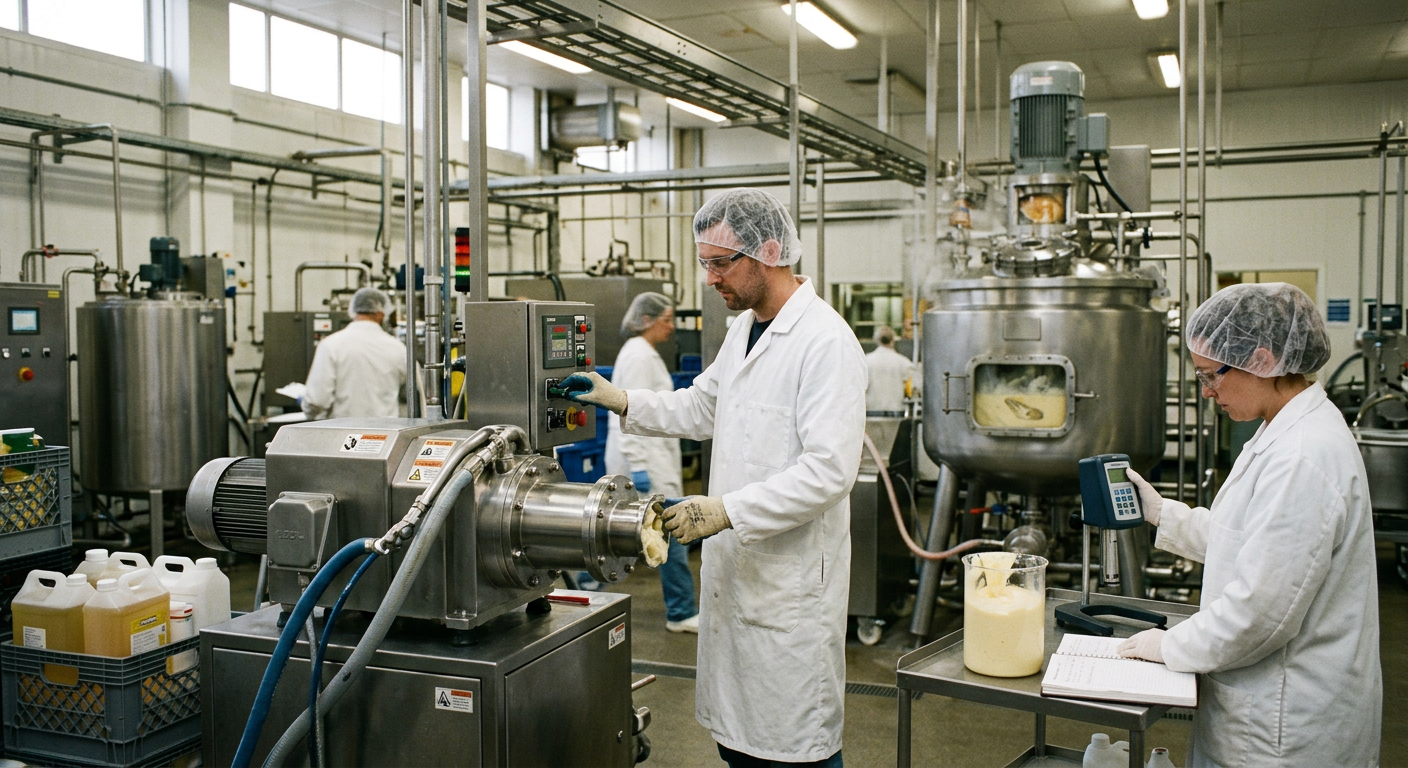
The phrase high shear mixer food covers many different process realities. In a mayonnaise line, the mixer must disperse egg, oil, acid, and stabilizers while controlling droplet size and minimizing air. In a cheese sauce line, it may need to hydrate starches, emulsifying salts, dairy solids, and flavors while managing heat load and rising viscosity. In a beverage room, it could be tasked with dissolving sugars and powders quickly before pasteurization and filling. In a protein plant, it may support marinades, brines, or plant-protein slurry preparation.
For U.S. co-packers, flexibility is often the key requirement. One week they may run a clean-label dressing; the next week, a high-solids sauce with particulates; then a dairy-adjacent or plant-based formula requiring strict allergen controls. That means mixer selection must account for recipe variability, operator turnover, and the need for consistent first-pass quality. Companies with strong process engineering support generally outperform pure equipment resellers in these situations because the mixer, vessel, piping, utilities, and automation all need to work together.
Operationally, the highest-value applications are usually those where high shear eliminates a recurring cost: long hydration waits, manual rework, poor emulsion stability, inconsistent texture, or unplanned downtime. In the United States, labor availability and sanitation scheduling have made these savings more important than ever. Faster wet-out and easier cleaning can be just as valuable as raw throughput increase.
| Application | Typical ingredients | Key processing challenge | Preferred mixer setup | Critical control point | Value created |
|---|---|---|---|---|---|
| Mayonnaise and dressings | Oil, egg, vinegar, gums, spices | Emulsion stability and droplet control | Vacuum or inline high shear system | Oil addition rate and shear profile | Smoother texture, longer stability |
| Cheese sauces | Dairy solids, starches, emulsifying salts | Viscosity rise and heat transfer | Hybrid batch vessel with high shear | Temperature and powder hydration | Reduced lumps and scorching |
| Marinades and brines | Salt, phosphates, seasonings, gums | Fast dissolution and uniformity | Inline recirculation or powder induction | Powder dispersion and tank turnover | Shorter batch times |
| Beverage bases | Sugar, acids, stabilizers, flavors | Powder incorporation and foam control | Inline high shear mixer | Order of addition | Cleaner batches and less rework |
| Plant protein slurries | Protein powders, fibers, oils, flavors | Hydration and mouthfeel consistency | Powder induction with recirculation | Hydration dwell time | Better texture development |
| Bakery creams and fillings | Fats, starches, sugars, flavors | Uniform texture and aeration control | Vacuum or bottom-entry system | Temperature and shear balance | Stable texture for depositors |
This table shows how application-specific mixer design can be. Two systems with the same motor size may deliver very different results depending on circulation pattern, powder introduction, and temperature management. Buyers should match equipment not just to the product category, but to the exact formulation behavior.
Case Study Patterns Seen in the United States
Across American food manufacturing, successful high-shear projects usually follow a similar pattern. First, the processor identifies a bottleneck such as long batch times, unstable emulsion quality, or poor powder hydration. Second, the solution expands beyond the mixer itself to include changes in vessel geometry, ingredient feed sequence, recirculation piping, or automation. Third, measurable gains appear in output, consistency, labor usage, or cleaning time.
A Midwest dressing producer may reduce fisheyes and cut batch cycle time by moving from manual powder dump-in to a powder induction skid. A Texas sauce co-packer may improve first-pass quality by replacing a generic agitator with a hybrid scraped-surface vessel plus bottom-entry high-shear head. A California functional beverage manufacturer may reduce operator workload and dust by switching to inline induction and recipe-driven controls. A Southeast protein facility may improve marinade consistency by integrating recirculation and automated dosing rather than only increasing mixer speed.
For businesses evaluating partners, it is useful to review real project execution stories rather than only brochures. DPS, for example, approaches projects from a process and profitability perspective, which aligns well with plants that need broader line performance improvements rather than a single equipment swap. Buyers can explore project examples through the company’s food and beverage case experience, additional system integration work, and broader capital project execution examples to understand how mixer-related upgrades fit into plant-wide results.
Local and Regional Suppliers Relevant to U.S. Buyers
The U.S. market includes both global brands with established American support and specialized domestic manufacturers. The table below focuses on companies commonly considered for food emulsions, sauces, and sanitary mixing projects. Inclusion here reflects practical market relevance for U.S. procurement teams, especially where service, testing, and food-sector experience matter.
| Company | Service region | Core strengths | Key offerings | Best fit buyer | Notes for U.S. projects |
|---|---|---|---|---|---|
| Silverson Machines | Nationwide U.S. through local support network | Rotor-stator expertise, strong lab-to-production credibility | Batch, inline, powder/liquid mixing systems | Processors needing proven emulsification performance | Well known for difficult powder wet-out and emulsion work |
| IKA Works | United States and North America | Lab, pilot, and production process continuity | Inline mixers, batch systems, pilot equipment | R&D-driven food brands scaling new formulas | Useful when product development and scale-up are linked |
| Admix | United States with regional support | Sanitary powder induction and fast batch dispersion | Liquid rings, powder induction skids, agitators | Sauce, dairy, and beverage plants fighting lumping issues | Strong fit for hydration and incorporation problems |
| Charles Ross & Son Company | United States nationwide | Broad mixing portfolio including vacuum and high-viscosity systems | Multi-shaft mixers, high shear mixers, vacuum systems | Plants with complex rheology or specialty products | Often considered for more customized process needs |
| SPX FLOW / APV | North America | Large-scale sanitary processing and integration experience | Mixing, homogenization, pumps, valves, complete systems | Large food and dairy manufacturers | Appealing when line integration is as important as the mixer |
| Scott Turbon Mixer | United States | Inline high shear and powder induction specialization | Rotor-stator mixers, recirculation systems | Processors needing compact inline solutions | Good option for emulsions and dispersion-focused lines |
| Lee Industries | United States | Sanitary vessels and process equipment for food and pharma | Jacketed tanks, kettles, integrated process vessels | Buyers needing mixer-vessel coordination | Relevant for heated and integrated batch systems |
| Disruptive Process Solutions | All 50 U.S. states and Canada | Engineering, installation, integration, utilities, controls, and project delivery | Complete processing systems, custom tanks, CIP, mixing integration | Manufacturers needing full project execution, not just a machine | Especially strong where profitability, speed, and line integration matter |
This supplier table is most useful when matched to your internal project type. If you need a proven stand-alone mixer with pilot support, a traditional equipment brand may be ideal. If you need a larger sauce or emulsion line with utilities, controls, CIP, and installation, an engineering-led partner such as DPS can reduce coordination risk and compress the timeline between specification and production readiness.
How Supplier Demand Is Shifting
Buyer preferences are changing in the United States. Stand-alone mixer procurement is still common, but more processors now prefer engineered packages that include tanks, automation, and cleanability improvements. This is particularly true among co-packers, multi-SKU manufacturers, and companies under pressure to launch products quickly while maintaining audit readiness.
The area chart shows a realistic shift toward integrated process systems. Buyers increasingly realize that the economic return comes from the total production cell: ingredient handling, vessel design, CIP, automation, and commissioning support. This trend is likely to strengthen through 2026 and beyond as labor, food safety, and utility efficiency remain central investment drivers.
Comparison of Supplier Fit by Project Need
Not all suppliers score equally across every requirement. Some are stronger in lab support and emulsification science, while others are stronger in turnkey integration, utilities, and field execution. The comparison below helps frame expectations for U.S. buyers making a shortlist for sauces and emulsions.
This comparison chart is not ranking a single brand. Instead, it shows which decision factors tend to matter most on real U.S. food projects. For emulsions and sauces, turnkey integration, sanitary design, powder handling, and service support often outweigh raw horsepower or theoretical tip speed when buyers evaluate total return on investment.
Our Company
For U.S. manufacturers that need more than a catalog mixer, Disruptive Process Solutions offers a distinctly practical route to implementation. DPS supports food and beverage processors across all 50 states and Canada from operations in Cary, North Carolina, and Lake Forest, California, giving it real regional presence rather than a remote-export model. Its strength is not limited to equipment supply: the company designs, installs, and integrates complete processing systems for sauces, marinades, dairy, proteins, aseptic applications, and beverage manufacturing, including high-shear mixing, jacketed vessels, CIP, utilities, controls, and commissioning. That breadth creates a stronger quality and compliance foundation because product-contact equipment and process layouts are developed for regulated food environments that commonly require FDA, USDA, SQF, and BRC alignment, while the company’s in-house equipment capability covers tanks up to 12,000 gallons, custom CIP systems, marination tumblers, and cooking vessels built to fit the larger process design. DPS is also flexible in how it works with the market: it can support end users seeking turnkey execution, partner with distributors and dealers on equipment opportunities, collaborate with brand owners and co-packers on custom processing lines, and develop branded or tailored solutions through project-based manufacturing and integration models that function much like OEM/ODM, wholesale, or regional partnership structures depending on the scope. Because DPS combines engineering, general-contractor-style coordination where licensed, installation management, automation, and startup support, local buyers gain both online and on-site pre-sale and after-sale coverage, including process review, capital planning, commissioning oversight, and long-term operational support. That makes DPS especially credible for North American buyers who want evidence of sustained market commitment, field execution experience, and equipment decisions tied directly to profitability rather than one-off machine sales. Learn more about the company through its U.S. engineering and project team and review the broader process equipment capabilities that support mixer-centered food projects.
Buying Checklist for 2026 and Beyond
Looking ahead, the best high shear mixer food investments in the United States will be those that support flexibility, compliance, and resource efficiency at the same time. Food companies are under pressure to launch more SKUs, document cleaning more thoroughly, manage labor constraints, and reduce utility intensity. As a result, mixer decisions are increasingly shaped by automation readiness, CIP performance, integrated data capture, and sustainable plant design rather than only immediate mixing speed.
Future trends likely to matter most include recipe-driven automation, improved inline analytics, smarter powder induction systems, reduced water use in cleaning, and tighter integration between processing and packaging. Sustainability expectations are also influencing procurement, especially in states and customer channels where water, energy, and waste intensity are under scrutiny. For processors serving major retailers or foodservice chains, documented consistency and traceability will continue to grow in importance.
Policy and compliance trends also reinforce the need for hygienic design and documentation discipline. Even when formal regulations do not mandate a specific mixer style, audit expectations increasingly reward equipment choices that simplify validation, reduce manual interventions, and support safer allergen changeovers. In that environment, suppliers that combine machinery with practical food-process knowledge will likely gain share.
FAQ
What is the best high shear mixer for mayonnaise in the United States?
The best choice is usually an inline or vacuum-capable sanitary mixer designed for stable oil incorporation, low aeration, and repeatable droplet size. Plants producing premium mayonnaise often benefit from pilot testing before full-scale purchase.
Can one high shear mixer handle both sauces and beverage bases?
Sometimes, yes, but only if the viscosity range, cleanability, and allergen plan are compatible. Multi-product plants often need flexible controls, appropriate stator options, and validated CIP procedures to avoid compromises.
Is a powder induction system worth the extra cost?
For many U.S. processors, absolutely. If your formulas include gums, starches, proteins, or other difficult powders, induction can reduce lumping, shorten batch time, lower dust, and improve operator ergonomics.
Should I choose a stand-alone mixer or a complete integrated system?
If your process is simple and your team can handle installation and controls, a stand-alone mixer may be enough. If your project involves tanks, utilities, automation, CIP, or throughput bottlenecks elsewhere, an integrated system usually creates more value.
Are international suppliers a realistic option for U.S. food plants?
Yes, especially for buyers with clear specifications and good internal engineering support. International suppliers, including Chinese manufacturers, can offer competitive pricing, but U.S. buyers should verify sanitary materials, documentation, spare-parts strategy, and after-sales responsiveness.
How important is local service support?
It is critical. Fast access to parts, startup help, and troubleshooting can determine whether a low-price purchase remains economical over time. For production plants, support quality often matters more than initial machine cost.
What industries benefit most from high shear mixing?
Sauces, dressings, dairy, prepared foods, beverage bases, plant-based foods, bakery fillings, and protein marinades are among the most common beneficiaries because they rely on stable emulsification, rapid dispersion, and consistent texture.
Why would a company choose DPS instead of only a mixer manufacturer?
Because some projects are really process-system projects. When the challenge includes integration, utilities, controls, installation, or profitability-focused line design, DPS can coordinate the broader solution instead of leaving the buyer to manage multiple vendors alone.
[/trp_language]
Complete Company Portfolio

About the Author: Disruptive Process Solutions (DPS)
The DPS team combines process engineering expertise with real-world food and beverage manufacturing experience. Our content focuses on process optimization, production efficiency, facility improvements, and practical solutions that help manufacturers operate more effectively in a rapidly evolving industry.
Share

