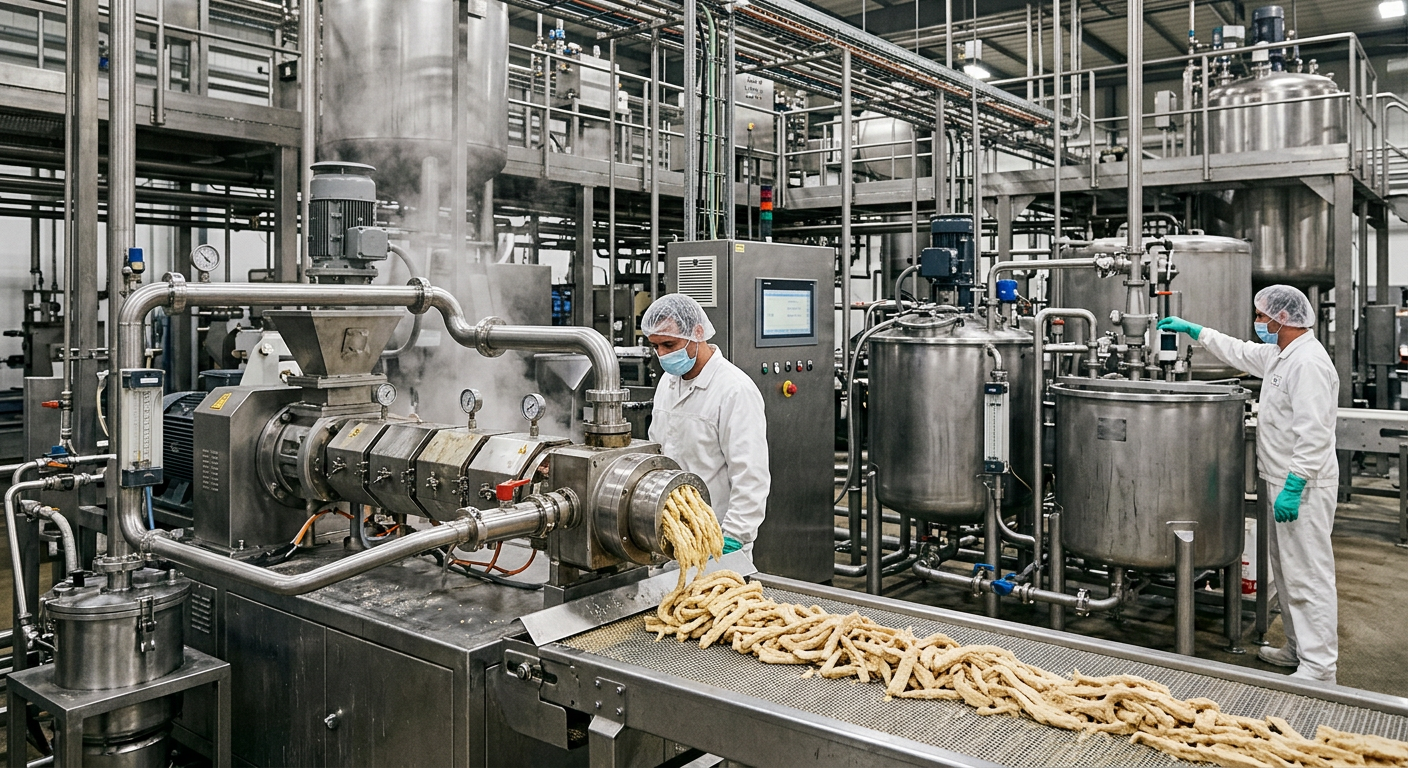
Hot-Fill Sauce Line Design
[trp_language language=”en_US”]
Hot-Fill Sauce Systems for U.S. Food Manufacturers
Designing a hot-fill sauce line in the United States requires more than selecting a kettle and filler. A successful system must match product acidity, viscosity, target throughput, package geometry, cap liner chemistry, cooling profile, sanitary design, and validation strategy. For salsa, BBQ sauce, marinades, wing sauce, pasta sauce, enchilada sauce, and acidified condiments, hot fill remains one of the most practical shelf-stable solutions when the product, container, and closure are engineered together. In U.S. manufacturing hubs such as Chicago, Dallas-Fort Worth, Atlanta, Fresno, Charlotte, Los Angeles, and the New Jersey corridor near Port Newark, buyers are increasingly asking for lines that are flexible, labor-efficient, easy to clean, and scalable.
For most shelf-stable acidic or acidified sauces, the core production sequence is straightforward: formulate and heat, hold for lethality, fill at validated temperature, apply the cap immediately, invert when required to sanitize the closure zone, then cool at a controlled rate to protect package integrity and finished product quality. The details, however, decide whether a line runs profitably or becomes a chronic source of leakers, paneling, flavor drift, and downtime.
This guide explains the process flow, compares hot fill with aseptic and retort technologies, reviews filling temperature and hold-time validation, and outlines bottle, cap, cooling, and sanitation requirements for the U.S. market. It also covers buying advice for multiple capacity bands, major applications, and how an engineering partner can support capital planning, installation, integration, and commissioning.
Quick Answer

A hot-fill sauce line is typically the best choice for acidic or acidified sauces that can be filled hot into heat-resistant containers and sealed for ambient distribution. A standard U.S. line includes batch preparation or continuous blending, thermal processing through a tubular or scraped-surface heat exchanger, an insulated hold section, hot filling, capping, inversion when closure sanitization is required, staged cooling, drying, coding, labeling, and case packing. Critical design decisions include:
- Validated fill temperature and minimum hold time at the coldest point.
- Container and closure materials that tolerate thermal load without distortion or loss of torque.
- pH and water activity targets that support shelf stability.
- Cooling tunnel design that avoids vacuum collapse and bottle deformation.
- CIP and COP systems sized for soil load, changeover frequency, and production schedule.
- Line layout that fits both current demand and future expansion.
In the United States, hot fill is often preferred over aseptic for mid-range sauce projects because it usually has lower complexity, lower sterile-environment requirements, and easier operator training. It is often preferred over retort when brands want lighter packaging, higher line speeds, and less post-package thermal exposure. Still, the right answer depends on formulation, package format, regulatory path, and commercial targets.
Hot-Fill Sauce Line Process Flow: Heating, Holding, Filling, Sealing, and Inversion

The hot-fill process begins upstream, not at the filler. Product rheology, particle size, and heat transfer behavior determine whether the line needs a jacketed batch kettle, a swept-surface vessel, a high-shear mixer, or a continuous system with inline blending and controlled solids feed. Thin sauces may run well through tubular heat exchangers, while viscous, particulate, or shear-sensitive sauces may require scraped-surface technology to avoid burn-on and preserve texture.
After mixing and deaeration when needed, the sauce is heated to a validated process temperature and held long enough to achieve the intended microbial reduction. The hot product moves to the filler with minimal temperature loss through insulated piping and sanitary pumps selected for viscosity and particulates. Filling should be consistent by weight or volume, with minimal splashing to reduce contamination and trapped air. The cap is applied immediately, and many sauces use inversion so the hot product briefly contacts the closure and upper headspace area. Cooling follows in stages to protect both the package and product quality.
| Step | Main Purpose | Typical Equipment | Primary Control Point | Common Risk | Validation Focus |
|---|---|---|---|---|---|
| Ingredient receiving | Verify raw material quality and consistency | Tanks, bins, scales, sifters | Supplier approval and lot traceability | pH drift, spice contamination | COA review and incoming inspection |
| Batching and mixing | Create uniform formulation | Jacketed kettle, high-shear mixer | Brix, viscosity, solids dispersion | Settling or poor emulsion stability | Recipe control and in-process sampling |
| Heating | Raise product to process temperature | Tubular or scraped-surface heat exchanger | Outlet temperature | Scorching or insufficient heating | Calibrated temperature instrumentation |
| Holding | Maintain lethality conditions | Hold tube or insulated balance tank | Residence time at minimum temperature | Short hold due to flow variation | Flow-rate verification and challenge study |
| Filling and capping | Package product hygienically | Hot filler, capper, torque station | Fill temperature and closure torque | Leakers, underfill, air entrainment | Package integrity and net-content checks |
| Inversion and cooling | Sanitize closure zone and stabilize package | Inverter, cooling tunnel, conveyors | Inversion time and cooling curve | Cap liner damage, bottle paneling | Thermal profile and visual package review |
The process table above shows why line design must be integrated. A filler alone cannot solve process instability caused by poor upstream mixing, undersized heating, or excessive cooling shock. For U.S. plants running multiple SKUs, recipe management and automated control of temperature, flow, and timing are especially important because changeovers can affect both food safety and throughput.
In real projects, line designers also account for operator access, sanitation zoning, and utility routing. Facilities near Houston or Savannah may prioritize ingredient receiving and export-oriented pallet flow, while co-packers in Southern California or the Inland Empire may emphasize multi-SKU flexibility and short runs for emerging brands.
Hot Fill vs Aseptic vs Retort: Processing Technology Comparison for Sauces

Hot fill, aseptic, and retort each serve valid roles in sauce production, but they are not interchangeable. The correct technology depends on product acidity, particulate load, sensory goals, package style, cost structure, and production scale. In the United States, hot fill is especially common for acidic and acidified sauces sold in PET, glass, or selected polypropylene containers. Aseptic becomes attractive for premium quality retention, cold-wall sterile packaging, and certain large-scale beverage-like sauces. Retort remains important for low-acid foods, highly robust shelf stability, and some institutional or legacy package formats.
| Factor | Hot Fill | Aseptic | Retort |
|---|---|---|---|
| Best fit product type | Acidic or acidified sauces | Sterile products with high quality targets | Low-acid or very robust shelf-stable products |
| Package environment | Clean, not fully sterile | Sterile packaging zone | Package sterilized after sealing |
| Capital complexity | Moderate | High | Moderate to high |
| Typical package options | Glass, heat-set PET, some PP | Cartons, pouches, bottles, bag-in-box | Cans, jars, retort pouches, trays |
| Flavor and texture retention | Good when optimized | Often excellent | Can be reduced by severe post-package heat |
| Operational skill requirement | Moderate | Very high | High |
| Typical line speed range | Low to high depending on package | Medium to very high | Batch-dependent |
| Ideal buyer profile | Sauce brands, co-packers, regional processors | Large-scale processors seeking premium quality | Processors of low-acid shelf-stable foods |
The comparison matters commercially. A hot-fill line often gives U.S. sauce producers the best balance between package flexibility, manageable capital cost, and reliable shelf stability for acidified products. Aseptic may outperform hot fill in flavor retention and energy efficiency at scale, but it demands much tighter sterile controls, more advanced operator capability, and higher validation burden. Retort may be required for low-acid products, but it can limit packaging options and may create additional thermal stress on flavor, color, and texture.
The market trend above reflects a realistic pattern seen across the United States: more regional brands are moving from manual kettles and semi-automatic fillers into integrated hot-fill systems. Growth is strongest in the Southeast, Texas, the Midwest, and California, where co-manufacturing, private label, and premium condiment categories continue to expand.
Filling Temperature Requirements and Hold Time Validation
There is no universal fill temperature for every sauce. The correct target depends on pH, viscosity, particulates, package format, closure design, and process authority guidance. What matters is not just the nominal setpoint on the HMI, but the validated temperature at the coldest point in the product stream and the minimum time that temperature is maintained. Plants that only monitor kettle temperature can miss actual product conditions at the filler bowl or valve.
In practice, many U.S. acidified sauce lines are designed around fill temperatures commonly ranging from the high 180s to low 190s Fahrenheit, but formulation and package specifics can move that target up or down. Validation should include start-up, normal running, and upset conditions such as slowdowns or short stops. Hold time calculations must consider flow velocity, tube dimensions, viscosity effects, and whether product particulates heat at the same rate as the continuous phase.
| Sauce Type | Typical pH Range | Common Fill Temperature Range | Hold-Time Concern | Packaging Note | Validation Priority |
|---|---|---|---|---|---|
| BBQ sauce | 3.6-4.1 | 185-195°F | High viscosity can affect heat penetration | Heat-set PET or glass common | Viscosity-linked residence time |
| Wing sauce | 3.2-3.9 | 180-190°F | Oil phase stability during heating | Liner compatibility important | Emulsion stability and cap contact |
| Pasta sauce | 4.0-4.4 | 190-205°F | Particles and chunks may require special study | Glass often preferred | Cold-spot and particulate validation |
| Salsa | 3.8-4.3 | 185-200°F | Chunk size distribution affects uniformity | Wide-mouth glass or PP | Fill consistency and closure sanitation |
| Marinade | 3.0-4.0 | 180-190°F | Lower viscosity may shorten thermal lag | PET often feasible | Temperature loss to filler minimized |
| Enchilada or taco sauce | 3.8-4.3 | 185-195°F | Suspended spices can settle during delay | Both glass and PET used | Agitation and filler temperature control |
The table shows ranges, not fixed standards. A qualified process authority should confirm exact targets. U.S. buyers should ask equipment suppliers whether the line can document actual hold conditions with calibrated sensors, data logging, and alarm handling. A good design will also minimize temperature drop between the hold section and filler through short transfer paths, insulated piping, and flow controls that reduce residence variability.
Future-facing plants are also adding digital batch records and historian-based verification. By 2026, more processors are expected to adopt integrated thermal validation dashboards tied to recipe control, making deviation review easier during SQF, BRC, and FDA audits.
Bottle and Cap Selection: Heat Resistance, Seal Integrity, and Compatibility
Package selection can make or break a hot-fill project. A sauce may be perfectly processed, yet still fail in the marketplace if the bottle panels, the neck finish creeps, the cap liner softens, or vacuum distortion damages label appearance. In the U.S. market, glass remains a premium and highly tolerant option, while heat-set PET and selected polypropylene containers are widely used for cost, freight, and breakage advantages. The closure system must match the package material, filling temperature, inversion requirement, and product chemistry.
Neck finish precision, thread design, venting behavior, liner material, and cap application torque all affect seal integrity. For oil-rich or highly acidic sauces, compatibility testing is essential. Some brands also need induction sealing, tamper evidence, or hot-tack performance depending on distribution channels and retail requirements.
| Packaging Option | Heat Resistance | Strengths | Limitations | Best Use Case | Key Qualification Test |
|---|---|---|---|---|---|
| Glass bottle | Excellent | High thermal tolerance, premium appearance | Heavier, breakage risk | Pasta sauce, salsa, premium condiments | Thermal shock and closure vacuum test |
| Glass jar | Excellent | Wide-mouth filling, good for particulates | Freight cost | Chunky sauces and dips | Torque retention and panel inspection |
| Heat-set PET bottle | Good | Lightweight, lower freight cost | Can deform with poor cooling design | BBQ sauce, marinades, wing sauce | Vacuum panel and dimensional stability |
| Polypropylene bottle | Moderate to good | Useful in selected formats, resilient | Less common in some retail channels | Specialty sauces and foodservice packs | Cap fit and creep resistance |
| Metal lug cap | High | Excellent vacuum closure for glass | Requires precise application | Glass jars and jars with vacuum button | Button down, torque, compound integrity |
| Plastic continuous-thread cap | Varies by resin and liner | Fast application and broad availability | Needs careful liner matching | PET and PP bottles | Torque retention and leak test |
For buyers sourcing packaging in the United States, regional supply availability matters. Glass may move efficiently through Midwest and Northeast distribution lanes, while PET preforms and molded containers may be easier to source in the Southeast and along major logistics corridors near Atlanta, Dallas, or Southern California. Import-heavy packaging programs should also account for port congestion risks through Long Beach, Houston, Savannah, or Newark, especially when specialty closures are involved.
The comparison chart simplifies a broader engineering decision. It should not replace package trials, but it highlights that material choice is always a system choice. Container, cap, induction seal if used, label adhesive, shrink band, and cooling profile must all be tested together.
Cooling Tunnel Design: Rate of Cooling and Bottle Deformation Prevention
Cooling is where many otherwise strong hot-fill lines fail. If the package cools too slowly, product quality can suffer and throughput can drop. If it cools too aggressively, bottles may panel, warp, or lose dimensional stability. A well-designed cooling tunnel uses staged water temperatures and controlled residence time to reduce thermal stress while preserving vacuum and seal integrity.
For PET packages, gradual reduction in temperature is especially important. For glass, the key concern is often thermal shock and closure performance. Tunnel design should also account for bottle spacing, conveyor stability, spray pattern, water recirculation, sanitation, and maintenance access. Plants running multiple bottle heights need adjustable spray zones or tunable recipes by SKU.
| Design Element | Why It Matters | Good Practice | Risk if Ignored | Best Fit Packages | Monitoring Method |
|---|---|---|---|---|---|
| Staged cooling zones | Reduces thermal shock | Use descending water temperature profile | Warping or glass stress | All package types | Zone temperature trending |
| Conveyor dwell time | Controls final package temperature | Match line speed to bottle mass | Undercooled cases or wet packs | Glass and PET | Residence-time verification |
| Spray coverage | Ensures uniform cooling | Nozzle mapping by bottle profile | Uneven cooling and distortion | PET bottles | Thermal imaging or surface checks |
| Water quality management | Prevents scaling and biofilm | Filtration and sanitation loop | Nozzle plugging and hygiene issues | All | Conductivity and microbiology checks |
| Drainage and drying | Improves labeling and coding | Air knives after tunnel exit | Label adhesion failures | All retail packs | Surface moisture inspection |
| Recipe-based changeover | Supports different SKUs | Automated zone setpoints by format | Manual errors during product switches | Multi-SKU plants | PLC recipe confirmation |
Cooling systems also affect utilities. Water recirculation, pump sizing, heat rejection, and wastewater handling should be addressed early in project planning. In drought-sensitive regions of California, recirculated and filtered systems can materially improve sustainability. In colder climates such as the Upper Midwest, seasonal utility variations can influence tunnel performance and should be modeled during design.
The area chart reflects a strong industry shift: more U.S. processors are adopting smart cooling with recipe controls, variable-speed pumps, and water management features. By 2026, this trend is expected to accelerate as sustainability reporting and package lightweighting become more important.
pH and Water Activity: Critical Parameters for Hot-Fill Shelf Stability
Hot fill is not a substitute for formulation control. Shelf stability depends on the relationship between thermal process, pH, water activity, preservatives when used, packaging integrity, and post-process handling. For acidified sauces, pH is often the central hurdle, but water activity still influences spoilage risk, texture, and shelf-life performance.
U.S. manufacturers should define finished-equilibrium pH targets, understand ingredient buffering effects, and verify that acid addition achieves the same result at scale as it did in the benchtop kitchen. Water activity becomes particularly important in thick sauces, reduced-sugar formulations, and specialty products positioned as “clean label.” Products with particulates require special attention because local pH distribution can vary if acidification is not uniform.
| Parameter Scenario | Typical Range | Operational Meaning | Risk Level | Common Product Example | Recommended Action |
|---|---|---|---|---|---|
| High-acid sauce | pH below 4.0 | Strong fit for hot-fill processing | Lower when package integrity is strong | Vinegar-forward wing sauce | Validate fill and cap sanitation |
| Acidified sauce near regulatory limit | pH 4.0-4.6 | Tighter control needed | Moderate to high | Tomato-based sauces | Frequent finished-equilibrium pH checks |
| Low water activity sauce | aw below 0.85 | Additional hurdle to microbial growth | Lower depending on pH | Concentrated glaze | Confirm texture and fill behavior |
| Higher water activity sauce | aw above 0.90 | Needs stronger combined controls | Moderate | Pourable marinades | Control pH and thermal process tightly |
| Chunky particulate sauce | Variable by solids phase | Potential local non-uniformity | High if mixing is poor | Salsa with peppers and onions | Assess equilibrium and heat penetration |
| Reduced-sugar clean-label sauce | Formula-specific | May reduce traditional preservation margin | Moderate to high | No-added-sugar BBQ sauce | Rebuild hurdle strategy and shelf-life study |
The key lesson is simple: shelf stability is built into the formulation and then protected by the process and package. Brands entering major retail or club channels in the United States should ensure their process authority documentation, scheduled process, and shelf-life support are robust enough for customer and regulatory review.
CIP and COP Systems for Hot-Fill Sauce Lines
Sauce plants typically face heavier soil loads than many beverage lines. Sugar, starch, spices, oil, tomato solids, and protein inclusions can create stubborn fouling in tanks, piping, fillers, and heat exchangers. That is why hot-fill sauce projects should evaluate both CIP and COP from the beginning. CIP handles fixed equipment such as kettles, heat exchangers, piping, and fillers designed for automatic circulation cleaning. COP handles removable parts such as valves, nozzles, gaskets, and change parts that require immersion or manual support cleaning.
For many U.S. processors, the best sanitation design is not the cheapest one in purchase price. It is the one that minimizes downtime, labor, water, and chemistry while consistently restoring hygienic condition. Recovery tanks, conductivity control, automated valve matrices, and recipe-based cleaning sequences can pay back quickly in multi-shift operations.
From a technological capabilities standpoint, modern engineering partners should be able to integrate process, controls, utilities, and data systems into a unified sanitation strategy. That includes automated CIP skids, thermal loops, conductivity and temperature instrumentation, PLC-based sequencing, and SCADA visibility for audit-ready cleaning records. These capabilities are particularly valuable for U.S. plants that must meet FDA expectations while also supporting SQF or BRC certification.
From a manufacturing capabilities standpoint, processors benefit when the project team understands not only sanitation theory but also how tanks, custom CIP systems, cooking vessels, and sauce handling equipment are fabricated and integrated. Matching spray devices, pump curves, line velocities, and drainability to real production conditions reduces soil carryover and shortens restart time after cleaning.
From a service capabilities standpoint, the strongest partners support capital planning, equipment selection, utility coordination, installation, controls integration, start-up, and operator training. A project partner such as food and beverage engineering services in the United States can help processors align sanitation design with throughput, compliance, and total lifecycle cost rather than making piecemeal decisions late in the project.
Line Layout and Equipment Selection for Various Throughput Targets
Throughput target is the anchor decision in line layout. A 20 bottles-per-minute startup line and a 250 bottles-per-minute regional co-packing line do not just differ in speed; they differ in accumulation strategy, automation level, utility demand, sanitation architecture, labor model, maintenance complexity, and building layout.
Smaller lines often use batch kettles feeding a piston or overflow filler with semi-automatic capping and simpler cooling. Mid-range lines usually add continuous product feed, rotary or inline hot filling, automated cap handling, and enclosed cooling tunnels. High-throughput systems may require multiple prep vessels, continuous thermal systems, advanced recipe controls, large CIP skids, and downstream automation including case packing and palletizing.
| Throughput Range | Typical Buyer | Upstream System | Filling System | Cooling Approach | Best Buying Advice |
|---|---|---|---|---|---|
| 10-30 bpm | Emerging brand or pilot plant | Single kettle, manual batching | Semi-auto or small inline filler | Compact staged cooling or ambient assist | Prioritize flexibility over max speed |
| 30-60 bpm | Regional manufacturer | Dual kettles or small continuous system | Inline automatic filler | Short cooling tunnel | Design for future automation upgrades |
| 60-120 bpm | Growing co-packer | Integrated thermal processing | Rotary or high-efficiency inline filler | Full staged tunnel with controls | Invest in CIP and accumulation early |
| 120-200 bpm | Large regional platform | Continuous blending and heat treatment | Rotary monoblock with automated cap feed | Long controlled cooling tunnel | Model utilities and labor in detail |
| 200-300 bpm | National brand or major co-manufacturer | Multiple prep assets and redundant pumps | High-speed integrated filler/capper | Advanced tunnel with recipe controls | Plan for reliability, not only speed |
| 300+ bpm | Enterprise-scale operation | Continuous plant-wide process system | High-speed integrated platform | Engineered cooling and downstream robotics | Use phased master planning and digital tools |
Buying advice should also include site-specific realities. Space-constrained facilities in the Northeast may need vertical utility routing and compact skids. Greenfield plants in Texas or the Carolinas may benefit from expansion-ready layouts with future filler positions, extra utility stubs, and pallet flow designed for truck access. Plants receiving imported ingredients through Savannah, Houston, or Long Beach should align bulk storage and scheduling with logistics variability.
The demand chart reflects broad equipment interest across sauce categories. It also explains why many U.S. manufacturers want flexible lines that can run both smooth and particulate products. For that reason, engineering should begin with the most difficult product, not the easiest one.
Case-study thinking is also useful during equipment selection. In one common scenario, a producer plans a large capacity expansion when the actual bottleneck is controls, routing, or changeover inefficiency. A disciplined engineering approach can uncover those issues before unnecessary capital is spent. Companies looking for a broader project perspective can review process project examples and implementation cases to understand how line design, controls, and utilities affect output more than nameplate filler speed alone.
When evaluating suppliers, buyers should consider more than machine price. They should review sanitary design, spare parts access in the United States, control integration capability, operator ergonomics, FAT and SAT support, and whether the supplier can coordinate utilities, upstream process, and downstream packaging. This is where a full-scope partner can be valuable. Organizations that combine engineering, integration, installation, and project management help reduce the gap between a vendor quote and an operating line. To understand that model, buyers can explore the background of an integrated U.S. engineering partner and how design-build-manage execution supports schedule and profitability.
For processors that need custom tanks, vessels, or cleaning systems, it is also useful to work with teams that understand both standard OEM packages and tailored fabrication. Information on process equipment for food and beverage manufacturing can help buyers compare off-the-shelf options with custom assets built around sauce viscosity, thermal duty, and sanitation needs.
FAQ
What sauces are best suited to hot fill?
Acidic and acidified sauces are the most common fit, including BBQ sauce, marinades, wing sauce, many salsas, and certain pasta or ethnic sauces. Final suitability depends on formulation, particulates, package choice, and validation.
Can hot fill replace retort for every shelf-stable sauce?
No. Low-acid products or products requiring post-package sterilization may still need retort. Hot fill is highly effective, but only when the product and process are appropriate.
Is inversion always required?
Not always. Some closures and process designs do not require it, while others rely on inversion to expose the cap interior to hot product. Closure design and validation determine the need.
What is the biggest package risk on hot-fill sauce lines?
For PET, deformation and vacuum-related paneling are common concerns. For glass, closure integrity and thermal shock are major issues. In both cases, cap selection and cooling profile are critical.
How important is pH testing?
It is essential. pH is one of the main shelf-stability controls for acidified sauces. Plants should verify not only initial pH but also equilibrium pH in the finished product.
What cleaning system should a sauce plant choose?
Most plants need both CIP and COP. Fixed systems such as tanks, piping, and fillers should be designed for CIP where possible, while removable parts may still require COP support.
How should a startup buy its first hot-fill line?
Start with the most challenging SKU, define realistic throughput, confirm package supply, and invest in validation and sanitation first. Avoid buying a filler without understanding the upstream thermal process and downstream cooling needs.
What are the key 2026 trends for U.S. hot-fill sauce lines?
The biggest trends are recipe-driven automation, digital validation records, water-saving cooling tunnels, lightweight heat-resistant packaging, stronger sustainability reporting, and more flexible multi-SKU lines. Regulatory and customer expectations are also pushing better traceability, energy management, and documented hygienic design.
What industries use hot-fill sauce lines besides consumer condiments?
Foodservice, private label manufacturing, co-packing, meal kit supply, club retail packs, institutional food production, and selected specialty ethnic foods all use hot-fill systems. Applications range from retail bottles to larger foodservice containers.
Who should lead a hot-fill line project?
The best results usually come from a cross-functional team that includes operations, quality, maintenance, sanitation, packaging, and process engineering. An integrated project partner with process, utility, controls, and installation expertise can help tie those disciplines together for U.S. execution.
For U.S. manufacturers, the most profitable hot-fill sauce line is not the one with the most stainless steel or the highest advertised speed. It is the one that matches the product, package, site, people, and commercial plan. A disciplined design process that covers technology, manufacturing practicality, and service execution can reduce project risk and improve long-term performance.
[/trp_language]
Complete Company Portfolio

About the Author: Disruptive Process Solutions (DPS)
The DPS team combines process engineering expertise with real-world food and beverage manufacturing experience. Our content focuses on process optimization, production efficiency, facility improvements, and practical solutions that help manufacturers operate more effectively in a rapidly evolving industry.
Share

