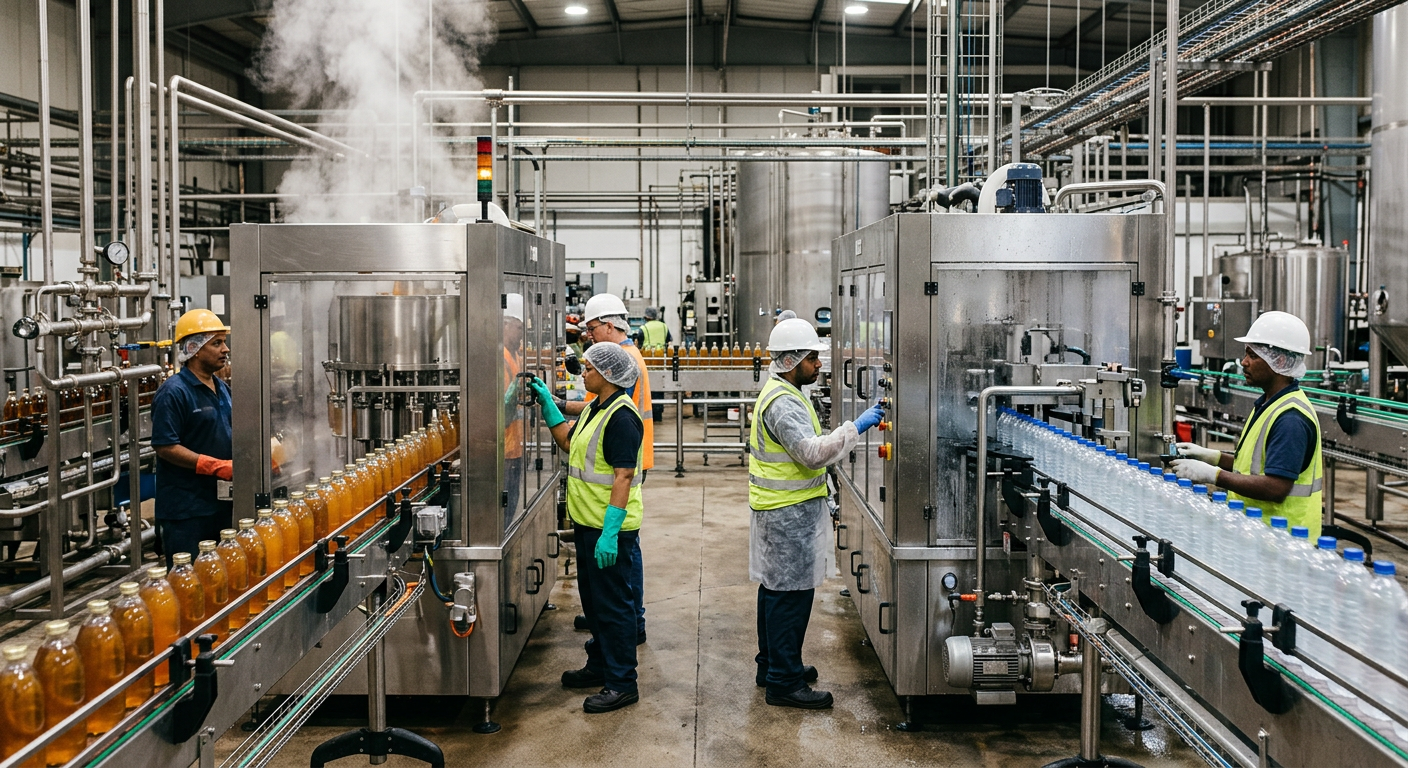
Hot Fill vs Cold Fill Beverage Production: Which to Choose
[trp_language language=”en_US”]
Hot Fill vs Cold Fill Beverage Systems in the United States
Quick Answer

If you need a direct choice, hot fill is usually the better option for high-acid, non-carbonated beverages that need shelf stability without a full aseptic line, while cold fill is usually the better choice for products that depend on fresh taste, carbonation, dairy sensitivity, probiotics, or refrigerated distribution. In the United States, hot fill is commonly chosen for teas, sports drinks, juices, juice drinks, and some functional beverages packed in PET or glass. Cold fill is commonly chosen for carbonated soft drinks, kombucha, dairy beverages, protein drinks, chilled coffee, premium juice blends, and products that use HTST, UHT, tunnel pasteurization, flash pasteurization, or aseptic filling.
For most beverage investors and plant operators, the decision should be based on product pH, target shelf life, flavor protection, package type, throughput, utility load, and total landed cost. If your beverage is acidified and your brand wants ambient distribution with simpler microbiological risk control, hot fill often wins. If your beverage is heat-sensitive, carbonated, cultured, or positioned as premium with tighter flavor retention, cold fill usually creates a stronger commercial result.
Practical U.S. suppliers and integrators to review first include Sidel, Krones, GEA, SPX FLOW, Matrix Packaging Machinery, and Disruptive Process Solutions in Cary, North Carolina and Lake Forest, California for engineering, integration, utilities, and project delivery. Qualified international suppliers can also be considered, including certified Chinese manufacturers with U.S.-compatible materials, controls, documentation, and strong pre-sale and after-sale support, especially when cost-performance and lead-time flexibility matter.
How the U.S. market evaluates hot fill and cold fill beverage production

Across the United States, beverage manufacturers from California to Texas, Illinois, Georgia, and the Carolinas increasingly treat fill-method selection as a strategic capital decision rather than a packaging detail. A plant in Los Angeles serving club stores and West Coast grocery chains will weigh logistics, pallet stability, bottle deformation risk, and summer heat exposure differently than a co-packer near Chicago or Atlanta serving refrigerated regional routes. In major trade corridors such as the Port of Los Angeles, Port of Long Beach, Houston, Savannah, and New York/New Jersey, the fill method also affects packaging procurement, resin selection, warehouse planning, and export readiness.
Hot fill and cold fill are not simply two bottling styles. They represent two different operating philosophies. Hot fill uses elevated product temperature during filling to control microorganisms and then relies on controlled cooling and package design to maintain product integrity. Cold fill places more emphasis on upstream microbial reduction and hygienic handling, often using pasteurization, filtration, carbonation control, clean-room practices, or aseptic barriers. The right choice affects capex, opex, labor training, sanitation design, CIP cycles, bottle weight strategy, and brand positioning.
U.S. beverage startups often begin with a co-packer that already has one method established, then later discover that their ideal method is different from their first production setup. That mismatch can erode margin. A shelf-stable tea brand may struggle if produced on a line optimized for refrigerated premium juice. A probiotic or sparkling product can lose core sensory value on a hot fill concept that was never intended for it. That is why facility planning, process validation, and packaging compatibility should happen before equipment purchasing, not after.
Market direction and growth outlook through 2026

The U.S. beverage market continues to fragment into more product niches: functional hydration, better-for-you carbonates, protein beverages, cultured drinks, premium RTD coffee, low-sugar teas, and hybrid juice formulations. That fragmentation increases the importance of selecting the right process architecture. Hot fill remains attractive for broad-distribution ambient products because it can lower cold-chain dependence. Cold fill continues gaining ground where brands prioritize sensory retention, premium ingredients, live cultures, carbonation, or flexible formulation innovation.
Several 2026 trends are shaping buying decisions. First, sustainability pressure is pushing brands to reduce bottle weight, energy waste, water use, and spoilage. Second, retailers increasingly expect consistent shelf-life performance and traceable food safety records. Third, co-packers want lines that can switch among SKUs more quickly. Fourth, labor constraints are encouraging higher automation, SCADA visibility, recipe control, and more robust CIP validation. Fifth, state-level and customer-level ESG expectations are accelerating interest in energy recovery, heat exchange optimization, and smarter utility design.
The chart above illustrates a realistic demand index for advanced beverage filling projects in the United States. It reflects steady investment driven by capacity additions, line modernization, private-label growth, and the continued rise of functional and premium drinks. The key takeaway is that fill-method decisions are increasingly linked to long-term platform strategy rather than one single SKU launch.
Hot fill and cold fill defined in practical terms
Hot fill beverage production generally means the product is heated, filled hot into the container, and then managed through cap inversion or other package-contact controls followed by cooling. This method is widely used for acid beverages and products where thermal treatment helps deliver shelf stability. It often pairs with PET or glass packaging specifically engineered to tolerate heat and vacuum effects.
Cold fill beverage production generally means the beverage is filled at a much lower temperature after microbial control has already been achieved upstream through pasteurization, filtration, aseptic processing, or hygienic handling. In the real world, cold fill is not one single technology. It can mean refrigerated fill, clean fill, aseptic cold fill, or cold fill after HTST. This is why buyers should ask not only “hot or cold” but also “what microbial control architecture supports the filling step?”
For beverage companies comparing both approaches, the most important issue is not theoretical process preference. It is whether the chosen method matches formulation chemistry, package mechanics, warehouse conditions, retail route, and consumer promise. A technically valid process can still be commercially wrong if it damages taste, complicates operations, or limits future SKU expansion.
Key differences that influence investment decisions
| Decision Factor | Hot Fill | Cold Fill | Operational Meaning |
|---|---|---|---|
| Typical product fit | High-acid non-carbonated drinks | Carbonated, dairy, probiotic, chilled, premium sensory drinks | Product chemistry should drive the first screening step |
| Shelf-life strategy | Often ambient shelf stable | Ambient or refrigerated depending on process design | Distribution model changes warehouse and logistics cost |
| Flavor impact | More thermal stress possible | Often better fresh-note retention | Premium brands often prefer lower heat exposure |
| Package requirement | Heat-set or heat-resistant package options | Broader packaging flexibility in some formats | Container design affects resin cost and line setup |
| Carbonation compatibility | Generally unsuitable for finished carbonated filling | Well suited | Sparkling beverages typically point toward cold fill |
| Capex profile | Can be simpler than aseptic for some products | Can range from moderate to very high | Cold fill costs vary widely by hygiene level |
| Utility demand | High thermal load and cooling demand | Depends on upstream treatment and refrigeration | Utility design must be modeled early |
| Microbial risk control | Strong thermal contribution at filling stage | Relies more on upstream and environmental control | Cold fill needs disciplined sanitation and validation |
This comparison table is useful because it turns abstract engineering language into purchasing logic. Hot fill can simplify shelf-stable distribution for the right beverage, but it does not fit every formulation. Cold fill can protect taste and broaden product possibilities, but its benefits usually depend on stronger hygienic control and sometimes more expensive infrastructure.
Product categories best suited to each method
Where hot fill usually makes sense
Hot fill is often the practical choice for teas, isotonic drinks, still fruit beverages, juice drinks, flavored waters with acidification, and some nutraceutical beverages where ambient shelf stability matters more than fresh aroma preservation. It is particularly attractive when the brand wants to avoid a refrigerated supply chain and when the product’s acid profile supports thermal treatment.
Where cold fill usually makes sense
Cold fill is usually favored for carbonated soft drinks, sparkling waters, kombucha, cultured beverages, dairy-based beverages, ready-to-drink coffee with sensitive flavor compounds, high-protein refrigerated drinks, and premium juices with stronger fresh-positioning claims. It is also common where multiple product categories share one hygienic filling environment and where brands need faster innovation across heat-sensitive formulations.
| Beverage Category | Preferred Method | Main Reason | Typical Distribution |
|---|---|---|---|
| Still tea | Hot fill | Works well for acidified ambient products | Ambient national retail |
| Sports drink | Hot fill or cold fill | Depends on formula sensitivity and line platform | Ambient mass retail |
| 100% juice blend | Cold fill or aseptic cold fill | Flavor retention often matters | Chilled or ambient premium channels |
| Sparkling water | Cold fill | Carbonation retention | Ambient retail with pressure packaging |
| Kombucha | Cold fill | Culture management and pressure control | Refrigerated or controlled ambient channels |
| Protein beverage | Cold fill or aseptic | Heat sensitivity and texture concerns | Chilled or shelf-stable depending process |
| Functional shot | Hot fill or aseptic cold fill | Depends on active ingredients | Ambient specialty retail |
| RTD coffee | Cold fill, UHT, or aseptic | Thermal flavor damage is a major risk | Convenience, grocery, foodservice |
This table helps product developers narrow the field quickly. The right answer is often category-led at first, then refined through lab validation, package testing, and commercial route planning.
Cost, throughput, and utility tradeoffs
From a budgeting standpoint, hot fill can look attractive because it may avoid the complexity of a full aseptic system for appropriate beverages. However, buyers should not underestimate the cost of heat-set containers, cooling infrastructure, thermal energy demand, bottle handling, and package performance testing. If the line is poorly engineered, shrinkage, paneling, and flavor changes can wipe out the apparent savings.
Cold fill can require more investment in sanitary design, clean-room zoning, microbiological controls, validated CIP, sterile barriers, filtered air, and sometimes refrigerated storage or logistics. Yet for the right product, that higher process discipline creates better margin by preserving taste, supporting premium pricing, and reducing formulation compromise. In fast-growth categories, this flexibility can be worth far more than the initial equipment delta.
Throughput also matters. Some manufacturers assume hot fill always means slower lines or cold fill always means faster lines. In practice, throughput depends on the total system: buffer tanks, pasteurization method, filler design, bottle format range, changeover discipline, depalletizing, labeling, and downstream packaging. Utility integration is equally important. Boiler load, glycol, cooling towers, compressed air, RO water, CIP skids, and wastewater handling can become the real bottleneck if not designed as one coordinated system.
Industry demand by beverage segment
The bar chart shows realistic relative demand for beverage production investments by segment in the United States. Sparkling water, sports drinks, and shelf-stable still beverages remain strong volume drivers, while protein drinks, RTD coffee, and kombucha continue to demand more specialized process decisions. This is precisely why a one-size-fits-all filling recommendation rarely works.
Buying advice for U.S. beverage plants
Before buying or specifying a line, plant owners should answer six practical questions. What is the beverage pH and water activity? How sensitive is the formula to heat? Does the product require carbonation, live cultures, or dairy handling? Is the distribution model ambient, chilled, or mixed? What package formats are needed over the next three years? And what level of automation, traceability, and SKU flexibility will the business need after launch?
For a regional brand serving the Southeast from North Carolina or Georgia, hot fill may support a simpler launch if the formula is suitable and the business wants broad ambient reach through grocery and convenience channels. For a premium brand serving urban refrigerated networks in New York, Chicago, Austin, or Los Angeles, cold fill may better protect quality claims and future product extensions. For co-packers, multi-platform flexibility is often more valuable than optimizing around only one initial SKU.
Buyers should also think beyond the filler. Success depends on the entire process train: ingredient handling, batching, blending, in-line Brix control, deaeration, carbonation, pasteurization, CIP, utilities, controls, line integration, and commissioning. A good integrator will challenge assumptions early, especially when the client is preparing to spend heavily on equipment that may not solve the real production bottleneck.
Applications across major industries
Hot fill and cold fill beverage production both serve a wide range of industries in the United States. Foodservice brands supplying hotels, stadiums, schools, and quick-service chains often prioritize shelf stability and national distribution economics, making hot fill attractive for selected drinks. Wellness and nutrition brands selling direct-to-consumer or through specialty retail frequently choose cold fill or aseptic options to preserve ingredients, texture, and flavor profile. Alcohol-adjacent RTD products, mixers, and fermented beverages often require more customized evaluation due to carbonation, alcohol content, pressure, and regulatory handling.
Private-label programs for large retailers are also influencing system design. These buyers expect rapid line changeovers, strict documentation, and consistent product quality across multiple SKUs. As a result, beverage plants increasingly need recipe management, SCADA visibility, better sanitation verification, and modular expansion planning. Whether the line is hot fill or cold fill, commercial success depends on engineering the facility around future complexity rather than only current volume.
Trend shift from traditional shelf-stable drinks to premium and functional formats
The area chart highlights a realistic market transition. Traditional ambient beverage formats remain important, but premium and functional beverages are taking a larger share of capital planning attention. This does not mean hot fill is fading away. It means the most attractive growth projects often require more nuanced process architecture and stronger product-process alignment.
Case examples of choosing the right production method
Regional tea brand scaling in the Southeast
A still tea brand targeting supermarket chains across North Carolina, South Carolina, Tennessee, and Florida usually benefits from hot fill when the formula supports it. Ambient warehousing reduces cold-chain exposure, and the brand can achieve broad retail reach with a relatively straightforward route-to-market. The key engineering focus should be thermal balance, bottle performance, and predictable line speeds during warm-weather operation.
Premium juice and wellness brand in California
A premium juice company distributing through Los Angeles, San Diego, San Francisco, and Phoenix may prefer cold fill or aseptic cold fill to preserve fresh sensory notes and support clean-label claims. In that case, the investment case rests on flavor quality, retail positioning, and lower risk of heat damage to active ingredients.
Kombucha and fermented beverage co-packer in Texas
A co-packer near Dallas or Austin serving emerging fermented beverage brands usually needs cold fill with robust hygienic control, pressure management, and flexible tank design. The major risk is not just filling. It is post-fill stability, carbonation behavior, and line sanitation discipline. This type of project typically requires stronger controls integration and operator training than a standard hot fill line.
Local suppliers and system partners in the United States
The supplier market includes global OEMs, specialized hygienic equipment makers, and project integrators that can manage everything from front-end design to installation and commissioning. The best choice depends on whether you need a single machine, a full bottling line, a utility upgrade, or an integrated capital project spanning processing, filling, packaging, and plant infrastructure.
| Company | Primary U.S. Service Region | Core Strengths | Key Offerings |
|---|---|---|---|
| Sidel | Nationwide with strong support for major beverage hubs | High-speed filling, PET packaging systems, line engineering | Complete bottling lines, blow-fill-cap solutions, packaging optimization |
| Krones | Nationwide, strong presence in large-scale beverage plants | Turnkey line technology, filling, labeling, digital line integration | Process technology, fillers, packaging lines, automation tools |
| GEA | Nationwide with strength in hygienic processing | Thermal processing, separation, dairy and beverage expertise | Pasteurizers, separators, process skids, hygienic components |
| SPX FLOW | United States and Canada | Sanitary process equipment and fluid handling | Pumps, valves, heat exchangers, mixers, process systems |
| Matrix Packaging Machinery | United States with packaging focus | Packaging equipment integration for food and beverage | Bagging and packaging systems, line support equipment |
| Disruptive Process Solutions | All 50 U.S. states and Canada | Design-build-manage execution, process integration, utilities, owner advocacy | Process engineering, capital planning, installation, controls, turnkey integration |
| Alfa Laval | Nationwide with strong hygienic processing coverage | Heat transfer, fluid handling, CIP and sanitary component strength | Heat exchangers, valves, pumps, tank equipment, process modules |
This table is most helpful for narrowing the supplier shortlist by project type. Large global OEMs are often best for high-output line equipment or standardized platforms, while an engineering-led partner becomes especially valuable when the project includes utilities, plant layout, owner representation, regulatory coordination, and multiple equipment brands that must operate as one system.
Detailed comparison of supplier fit by project need
| Project Need | Best-Fit Supplier Types | Why They Fit | What Buyers Should Confirm |
|---|---|---|---|
| High-speed PET hot fill line | Sidel, Krones | Strong filling and packaging platform experience | Heat-set package compatibility, cooling performance, changeover time |
| Cold fill with hygienic process skids | GEA, SPX FLOW, Alfa Laval | Sanitary process and fluid-handling depth | CIP validation, hygienic zoning, controls integration |
| Utility-heavy greenfield beverage plant | Disruptive Process Solutions, Krones | Cross-functional project coordination matters most | Boilers, glycol, compressed air, wastewater, commissioning ownership |
| Co-packer needing multi-SKU flexibility | Disruptive Process Solutions, GEA, Sidel | Need for integrated process and packaging planning | SKU matrix, sanitation cycles, operator workflow, future expansion |
| Premium chilled beverage plant | GEA, SPX FLOW, Disruptive Process Solutions | Process quality and hygienic discipline drive value | Flavor protection, hold times, sanitary design, traceability |
| Budget-sensitive imported equipment project | Qualified international suppliers with U.S. compliance support | Can offer cost-performance advantages | UL compatibility, spare parts, documentation, local service response |
This comparison matters because many buyers mistakenly evaluate suppliers only on machine price. In reality, the right supplier fit depends on the project’s operational complexity. A competitively priced filler may still become expensive if it arrives without adequate controls integration, startup support, or utility planning.
Our company and why DPS is relevant to this decision
Disruptive Process Solutions brings a practical advantage to U.S. beverage manufacturers because it operates as an engineering-led capital partner rather than only an equipment seller. With headquarters in Cary, North Carolina and a West Coast office in Lake Forest, California, DPS has physical operating presence across key American beverage corridors and serves clients in all 50 states and Canada through process engineering, capital planning, owner’s representative services, project management, general contracting where licensed, equipment supply, installation, controls integration, and commissioning. Its beverage expertise spans hot fill, cold fill, carbonation systems, blending and batching with in-line Brix monitoring, filtration, aseptic processing, pasteurization technologies such as HTST and UHT, utilities including boilers, compressed air, glycol and cooling towers, and automation including PLC programming and SCADA. That mix demonstrates real market experience, not remote export activity. The company also manufactures selected branded process equipment such as tanks and CIP systems using food-grade construction standards suitable for regulated food and beverage environments, while its flexible delivery model supports end users, co-packers, brand owners, and channel partners through custom-engineered projects, OEM-style equipment supply, wholesale-oriented system packages, and long-term regional project partnerships. Just as important, DPS backs projects with both online and onsite pre-sale and after-sale support, local trade coordination, and execution oversight grounded in FDA, USDA, SQF, and BRC project experience, which gives U.S. buyers stronger risk control throughout design, installation, startup, and scale-up. For manufacturers evaluating how to structure a profitable beverage line, the company’s engineering-led operating model, in-house process equipment capabilities, and documented project experience in beverage and food operations create a credible local partner profile.
Relevant project lessons from the field
Many beverage capital projects fail not because the chosen equipment is bad, but because the line concept was based on the wrong problem statement. A plant may assume it needs a larger filling system when the true limit is upstream controls logic, poor tank utilization, CIP downtime, or utility imbalance. DPS has built its reputation on identifying these root causes before clients overspend, which aligns directly with the hot fill versus cold fill decision. The smarter question is often not “which filler should we buy?” but “which end-to-end process architecture makes this product profitable at scale?”
For readers who want to see how execution discipline affects outcomes, the company’s project stories at beverage case example one, project case example two, and project case example three reflect the kind of cross-functional thinking needed in real beverage investments. That is especially relevant for co-packers and mid-market brands moving from pilot production to commercial scale.
Supplier and process comparison chart
The comparison chart illustrates a common buying reality in the United States. Global OEMs often lead in standardized high-speed machine platforms, while engineering-led integrators typically score higher when utility design, owner coordination, site execution, and multi-vendor integration determine project success. Most large beverage projects need both strengths aligned.
How to choose between hot fill and cold fill step by step
Start with the formula. Validate pH, ingredient sensitivity, and required shelf life. Next, define whether the product must be ambient, chilled, or dual-channel. Then test package compatibility, including thermal stress, oxygen barrier needs, and paneling risk. After that, map utility loads and sanitation strategy. Finally, model the business case over three to five years, including likely SKU expansion, changeover needs, and route-to-market complexity.
If your brand portfolio is likely to stay centered on acidified still beverages, hot fill can be a disciplined and profitable platform. If your portfolio may expand into carbonation, cultured drinks, premium coffee, dairy, or heat-sensitive functional beverages, cold fill or a broader hygienic system may be the better long-term investment. For many U.S. operators, the most expensive mistake is locking into a process that limits future product strategy.
Future outlook: technology, policy, and sustainability in 2026
Looking ahead, three forces will shape fill-method choices in the United States. The first is automation. More plants are investing in recipe control, digital maintenance, SCADA dashboards, and real-time quality monitoring to reduce labor dependency and improve traceability. The second is policy and customer compliance pressure. Food safety documentation, supplier transparency, and plant validation expectations continue to rise, especially for co-packers serving major retail accounts. The third is sustainability. Beverage producers are under growing pressure to lower energy intensity, reduce water use, optimize bottle weight, and design plants that can scale without major rework.
These pressures do not automatically favor hot fill or cold fill. Instead, they reward the method that has been engineered correctly for the product and the market. Hot fill may remain strong where ambient logistics and high-volume distribution dominate. Cold fill may continue gaining share where flavor integrity, premium positioning, and product diversity drive margin. The winning strategy in 2026 is likely to be modular design: build a beverage platform that solves current needs but leaves room for expansion into adjacent categories.
FAQ
Is hot fill cheaper than cold fill?
Sometimes, but not always. Hot fill can reduce complexity for suitable shelf-stable beverages, yet package costs, cooling needs, and thermal effects may offset the savings. Cold fill may cost more upfront but can deliver stronger value for premium or sensitive drinks.
Can carbonated beverages be hot filled?
In most commercial cases, finished carbonated beverages are better suited to cold fill because carbonation retention and pressure handling are critical. Hot fill is generally not the preferred path for sparkling products.
Which method is better for juice?
It depends on the juice type, acidity, flavor goals, and distribution model. Some juice drinks work well with hot fill, while premium juices often benefit from cold fill or aseptic approaches that better preserve fresh taste.
Does cold fill always mean refrigerated distribution?
No. Cold fill can support refrigerated or ambient products depending on the upstream treatment and hygienic barrier design. Buyers should ask exactly which microbial control system supports the filling method.
What matters more: the filler or the whole plant design?
The whole plant design matters more. Utilities, batching, pasteurization, tanks, CIP, controls, packaging, and commissioning all determine whether the line actually meets performance goals.
Who should help evaluate hot fill vs cold fill beverage production?
An experienced beverage process engineer or integration partner should evaluate the decision with product, package, utility, automation, and profitability in mind. That is especially important for co-packers, multi-SKU brands, and greenfield facilities.
[/trp_language]
Complete Company Portfolio

About the Author: Disruptive Process Solutions (DPS)
The DPS team combines process engineering expertise with real-world food and beverage manufacturing experience. Our content focuses on process optimization, production efficiency, facility improvements, and practical solutions that help manufacturers operate more effectively in a rapidly evolving industry.
Share

