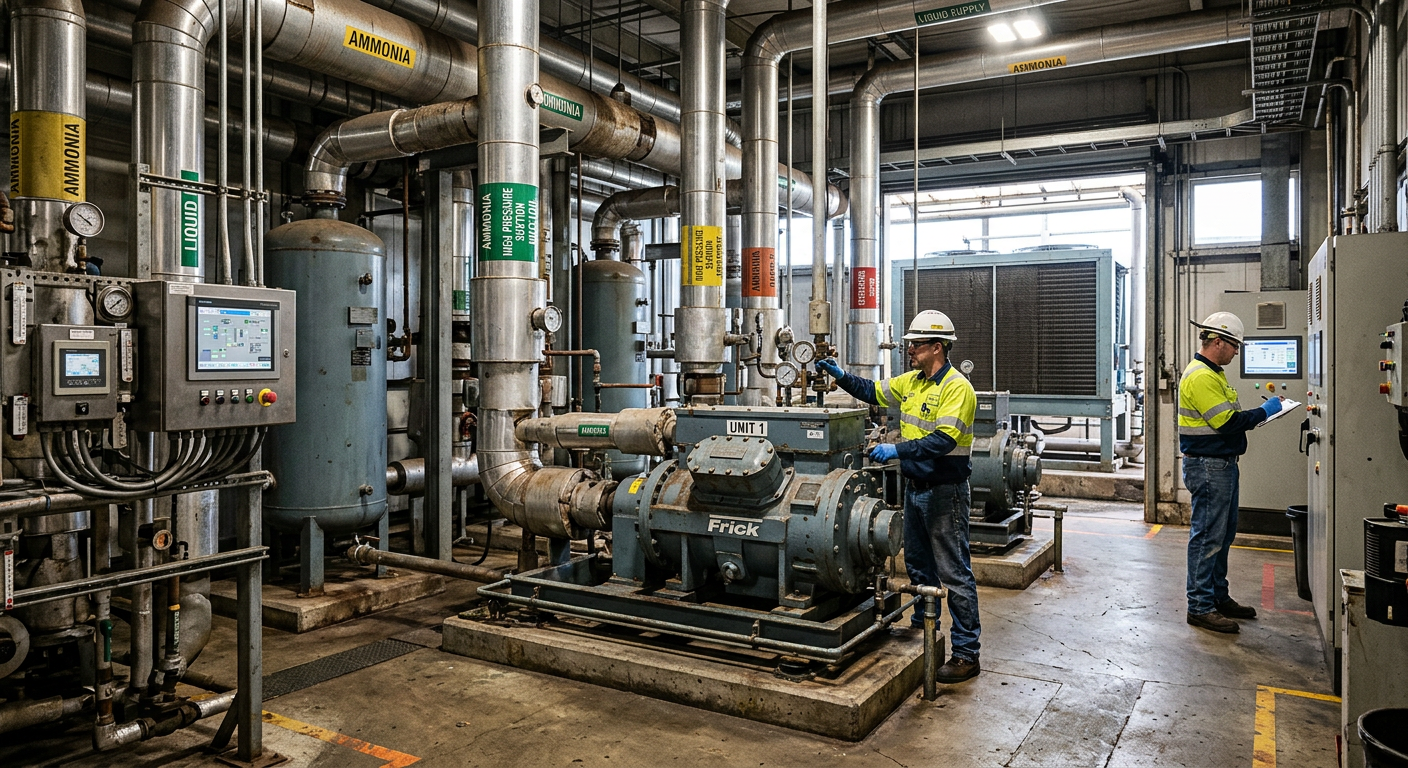
Industrial Refrigeration System Design for Food Plants
[trp_language language=”en_US”]
Industrial Refrigeration Food Plant Systems in the United States
Quick Answer

If you are planning an industrial refrigeration system design for a food plant in the United States, the best approach is to match the refrigeration architecture to the product, hygiene standard, throughput target, utility cost profile, and future expansion plan of the facility. For meat, poultry, seafood, dairy, frozen foods, beverages, and prepared foods, the most common choices are ammonia systems, low-charge ammonia packages, cascade systems, CO2-based systems, glycol secondary loops, and hybrid refrigeration plants. In practice, U.S. food manufacturers often shortlist established suppliers and contractors such as Johnson Controls, GEA, EVAPCO, Mayekawa, Stellar, and CIMCO Refrigeration for large-scale or technically demanding projects.
For immediate action, focus on providers with strong U.S. field service coverage, proven food plant references, compliance knowledge for FDA, USDA, SQF, and BRC environments, and the ability to integrate utilities, controls, commissioning, and operator training into one scope. Qualified international suppliers can also be worth considering when they hold relevant U.S. certifications, offer dependable pre-sales engineering, and maintain responsive after-sales support, especially when cost-performance is a major factor in greenfield builds or capacity expansions.
United States Market Overview

The U.S. industrial refrigeration market for food plants remains highly active because cold-chain resilience, labor efficiency, food safety, and energy management have become board-level priorities. New capacity is being added around major food manufacturing corridors such as the Midwest, Texas, California’s Central Valley, the Southeast, and logistics-connected areas near Chicago, Dallas-Fort Worth, Atlanta, Los Angeles, Charlotte, and the port regions serving imported ingredients and exported finished goods. Refrigeration is no longer treated as a standalone utility package; it is now a strategic production asset tied directly to yield, shelf life, sanitation windows, uptime, and operating margin.
Food manufacturers in the United States increasingly expect refrigeration systems to support multiple plant objectives at once: precise temperature pull-down, stable room conditions, lower refrigerant charge, reduced energy intensity, safer machinery layouts, and better visibility through PLC and SCADA integration. This has also increased demand for engineering partners that can coordinate process loads, building loads, utility loads, heat rejection, condensate control, and expansion phasing early in design rather than after equipment procurement.
In many projects, the winning solution is not simply the cheapest rack or compressor package. The better solution is the one that aligns with production economics over a ten- to twenty-year lifecycle, especially where chilled processing rooms, blast freezing, spiral freezers, cold storage, ingredient cooling, glycol loops, and sanitation utilities interact with each other. This is particularly relevant in sectors such as poultry, beef, ready meals, frozen bakery, dairy, beverage concentration, and refrigerated distribution.
The chart above illustrates a realistic upward investment pattern driven by modernization, cold-chain capacity growth, energy pressure, and stricter environmental planning. While project timing varies by sector, the underlying direction remains clear: food plants are moving toward smarter, safer, and more integrated refrigeration infrastructure.
Core Industrial Refrigeration System Types for Food Plants

System selection should begin with process temperatures, room temperatures, load diversity, product sensitivity, utility costs, maintenance capability, and local code considerations. The most effective designs also consider future SKUs, seasonality, sanitation cycles, and peak-hour electrical exposure.
| System Type | Typical Temperature Range | Best-Fit Food Applications | Main Advantages | Key Limitations | Typical U.S. Plant Size Fit |
|---|---|---|---|---|---|
| Central Ammonia | Medium to very low temperature | Meat, poultry, frozen food, cold storage | High efficiency, strong capacity, proven for large plants | Safety management and skilled maintenance required | Large regional and enterprise plants |
| Low-Charge Ammonia Package | Medium to low temperature | Dairy, prepared foods, beverage, modular expansions | Reduced refrigerant inventory, compact footprint | May be less flexible for complex multi-load campuses | Mid-size to large plants |
| CO2 Cascade | Low and frozen applications | Frozen foods, blast cells, distribution rooms | Lower global warming impact, strong low-temp performance | Higher design complexity, pressure-specific expertise needed | Mid-size to large plants |
| Glycol Secondary Loop | Moderate chilled processes | Beverage, fermentation support, ingredient cooling | Good separation from occupied spaces, flexible distribution | Lower efficiency than direct systems in some cases | Small to large plants |
| Freon/HFO Packaged Systems | Coolers and process zones | Smaller food plants, retrofit spaces | Simple deployment, common service familiarity | Refrigerant transition risk and lifecycle cost concerns | Small to mid-size facilities |
| Hybrid Ammonia-Glycol or CO2 | Mixed temperature loads | Multi-product campuses, phased expansions | Balances safety, reach, and performance | More integration engineering required | Mid-size to very large plants |
This comparison is useful because many U.S. food plants are not purely freezer or cooler operations. A practical system may combine central refrigeration for low-temperature loads with glycol or secondary loops for sanitary process areas, tank cooling, and utility support.
How Food Plant Refrigeration Loads Are Defined
Industrial refrigeration design for food plants begins with disciplined load mapping. Designers should quantify product pull-down, storage loads, people loads, lighting loads, fan heat, infiltration, washdown recovery, packaging room heat, tank jacket loads, process water cooling, air compressor heat interaction, and future throughput scenarios. Facilities near humid climates such as North Carolina, Florida, Georgia, Louisiana, and Texas often face very different moisture-control and door-opening challenges than inland plants in Iowa, Nebraska, or Kansas.
For example, a poultry plant with evisceration rooms, chilled marination, spiral freezing, and finished-goods blast storage has a different refrigeration profile than a dairy beverage campus with silo cooling, HTST support, ingredient rooms, and packaging halls. Similarly, a frozen entrée producer in the Midwest may prioritize low-temperature reliability and defrost strategy, while a beverage co-packer in California may focus more on glycol stability, utility redundancy, and energy management.
Good design also links refrigeration to plant operations. If the sanitation shift begins at midnight, system logic should reflect washdown humidity recovery. If raw and ready-to-eat zones are segregated, evaporator placement and airflow should support zoning integrity. If the client expects phased growth, headers, machine room pads, condenser yard access, and electrical distribution should be sized to avoid expensive rework later.
Top U.S. Suppliers and Refrigeration Partners
The companies below are commonly considered in the United States for industrial refrigeration equipment, integrated systems, and food plant execution. Their strengths differ, so buyers should match vendor profile to project scope rather than assume one brand fits every facility.
| Company | Primary Service Region | Core Strengths | Key Offerings | Best Fit | Practical Buyer Note |
|---|---|---|---|---|---|
| Johnson Controls | Nationwide United States | Large installed base, controls, industrial refrigeration expertise | Ammonia systems, controls, service, lifecycle support | Major food plants and campus utilities | Strong option for multi-site operators needing national support |
| GEA | Nationwide with strong industrial coverage | Process integration and refrigeration engineering depth | Compressors, packages, heat transfer, process systems | Dairy, protein, beverage, complex process plants | Useful where refrigeration and process systems must work together |
| Mayekawa | United States and global support network | Industrial compressor technology, low-temp capability | Compressors, packages, engineered refrigeration solutions | Frozen foods, cold storage, industrial applications | Often shortlisted for robust low-temperature performance |
| EVAPCO | Nationwide through reps and partners | Heat rejection equipment and evaporative solutions | Condensers, cooling towers, closed-circuit coolers | Plants needing strong condenser yard design | Important partner where water, heat rejection, and footprint matter |
| Stellar | Nationwide with food-sector focus | Design-build execution for food and cold-chain projects | Engineering, construction, refrigeration integration | Greenfield and expansion projects | Valuable when one firm coordinates facility and utility scope |
| CIMCO Refrigeration | United States and Canada | Industrial refrigeration contracting and service | Ammonia, CO2, service, retrofit, controls | Plants needing contractor-driven implementation | Often considered for technically demanding industrial work |
This supplier set illustrates the range of options available in the U.S. market: OEM-led technology providers, refrigeration specialists, and fully integrated design-build organizations. The best procurement strategy often involves one lead engineering partner coordinating several specialist suppliers rather than attempting to source each item in isolation.
Industry Demand by Food Segment
Different sectors place very different demands on refrigeration systems. Temperature precision, pull-down speed, latent load, sanitation cycles, and uptime tolerance vary substantially by product category.
The bar chart reflects typical demand intensity in food manufacturing. Protein and frozen applications tend to rank high because they combine production cooling, storage, rapid pull-down, and strict shelf-life protection. Beverage projects are often less low-temperature-intensive overall, but they still require reliable chilled water, glycol, ingredient cooling, and packaging environment support.
Buying Advice for U.S. Food Manufacturers
When buying an industrial refrigeration system for a U.S. food plant, start with business outcomes before equipment lists. The right questions include: What is the cost of downtime? Where does product loss occur today? How often will SKUs change? Will this plant expand in three years? Is the site labor-constrained? Are water and electricity costs increasing faster than expected? What training level can the maintenance team realistically support?
Buyers should request a basis of design that clearly defines room conditions, process conditions, ambient assumptions, redundancy philosophy, refrigerant strategy, code basis, controls integration, and future capacity allowances. It is also wise to compare not only installed cost but lifecycle cost, including energy use, defrost strategy, compressor turndown, maintenance intervals, water consumption, parts availability, and operator familiarity.
In the United States, food plants near logistics hubs such as Chicago, Kansas City, Dallas, Atlanta, Fresno, and the Inland Empire often benefit from better contractor availability and faster parts distribution, but they can also face tighter project schedules and higher competition for field labor. That makes early procurement planning essential for compressors, vessels, evaporators, condenser equipment, switchgear, and control panels.
Comparison of Buying Priorities by Plant Type
| Plant Type | Top Refrigeration Priority | Preferred System Tendencies | Critical Design Detail | Main Risk if Underdesigned | Recommended Procurement Style |
|---|---|---|---|---|---|
| Poultry Processing | High uptime and sanitary airflow control | Ammonia or hybrid systems | Washdown recovery and humidity management | Condensation, product loss, line stoppage | Integrated design-build with controls scope |
| Dairy Processing | Stable product temperatures | Low-charge ammonia or glycol loops | Tank cooling integration | Quality drift and batch inconsistency | Process-plus-utility coordinated procurement |
| Frozen Prepared Foods | Low-temperature performance | Ammonia, CO2 cascade, hybrid | Freezer load diversity and defrost | Reduced throughput and freezer bottlenecks | Capacity-driven engineered package |
| Seafood | Rapid pull-down and corrosion resistance | Ammonia or hybrid with coated components | Salt exposure and drainage design | Spoilage and accelerated equipment wear | Specialist contractor with coastal experience |
| Beverage | Utility integration and control precision | Glycol, chilled water, hybrid systems | Fermentation, blending, filler demand matching | Packaging instability and lost production hours | Utility master planning approach |
| Cold Storage | Energy efficiency at scale | Ammonia, CO2, advanced controls | Door infiltration and rack sequencing | High operating cost and uneven room conditions | Lifecycle-cost bid comparison |
This table helps buyers connect refrigeration strategy to plant economics. A dairy facility does not buy refrigeration the same way a frozen entrée plant does, even when their equipment budgets appear similar on paper.
Applications Across Food and Beverage Operations
Industrial refrigeration in food plants supports far more than cold rooms. It is often embedded in production quality, sanitation performance, and line efficiency. Common applications include carcass chilling, trim cooling, brine and marinade temperature control, fermentation tank jackets, bright beer cooling, syrup room support, process water chilling, spiral freezer operation, IQF systems, blast cells, ingredient storage, dock conditioning, ripening rooms, and finished goods distribution areas.
In protein facilities, temperature management directly affects yield, food safety, texture, and shelf life. In dairy and beverage plants, refrigeration stabilizes sensitive process steps and prevents batch variation. In prepared foods, it protects line continuity across cook, cool, package, and warehouse transitions. In mixed-use campuses, a plant may use one refrigeration backbone to serve both production and distribution functions, which raises the importance of intelligent controls, load shedding, and future expansion planning.
Trend Shift in U.S. Food Plant Refrigeration
By 2026, three trends are shaping system decisions in the United States: lower refrigerant charge strategies, deeper controls integration, and sustainability-linked utility planning. Plants are steadily moving away from isolated refrigeration procurement toward integrated utility architecture that connects refrigeration with boilers, compressed air, cooling towers, water systems, and plant-wide automation.
The area chart represents a realistic shift toward smart, integrated planning. Projects increasingly include remote visibility, compressor optimization, alarming, automated sequencing, and energy dashboards because management teams want operational insight, not just refrigeration tonnage.
Case Study Patterns Seen in U.S. Projects
In real-world food and beverage projects, refrigeration success often depends on upstream planning rather than late-stage equipment changes. A common mistake is approving building layout before finalizing product flow, sanitation zoning, and utility corridors. That can create longer pipe runs, difficult maintenance access, drainage conflicts, and evaporator placements that interfere with hygienic design.
Another recurring pattern is underestimating controls. Plants that treat refrigeration controls as an afterthought often lose efficiency and visibility. A better approach is to define operator dashboards, alarm logic, production mode changes, and load prioritization from the start. This is especially important for co-packing operations and plants with variable schedules.
For examples of project execution philosophy and practical capital planning, buyers can review DPS project stories such as the food and beverage engineering case example, the process integration project case, and the facility execution case study. These illustrate how utility, process, and operational objectives need to be aligned for profitable plant outcomes rather than managed as disconnected line items.
Local Supplier and Integrator Landscape
Local coverage matters in the United States because emergency response, startup support, and technician availability can materially affect uptime. Buyers should assess not only OEM brand reputation but also the actual local service footprint that will support the facility after commissioning.
| Provider Type | Typical Service Region | What They Usually Do Best | Where They Need Coordination | Best Use Case | Buyer Checkpoint |
|---|---|---|---|---|---|
| National OEM | Multi-state or nationwide | Equipment technology and broad service access | May need outside process integrator | Large standardized rollouts | Confirm actual local technician density |
| Regional Refrigeration Contractor | One to several states | Installation, retrofit, and emergency service | Limited process engineering scope | Brownfield upgrades and plant support | Review food-plant sanitation experience |
| Design-Build Food Specialist | Nationwide project execution | Cross-discipline coordination | May subcontract specialist packages | Greenfield or major expansion | Ask for utility and process integration examples |
| Utility Systems Integrator | Regional or nationwide | Controls, SCADA, sequencing, optimization | Needs mechanical partner alignment | Plants with visibility and efficiency goals | Validate food-grade automation references |
| International Equipment Supplier | U.S. via reps or partners | Competitive pricing and niche equipment | Service response can vary | Value-engineered procurement packages | Require certification and support commitments |
| Owner’s Representative-Led Team | Project-specific | Protects buyer interests across vendors | Requires strong project governance | Complex capital programs | Ensure clear responsibility matrix |
This table is important because many project risks emerge between scopes rather than inside them. The more interfaces a project has, the more valuable disciplined integration becomes.
Supplier and Solution Comparison Snapshot
This comparison chart highlights the criteria many U.S. food manufacturers now use when screening partners. Beyond compressor brand or initial bid price, they increasingly value service reach, lifecycle support, and the ability to integrate refrigeration into the wider production system.
Our Company Perspective
Disruptive Process Solutions brings a particularly practical fit for industrial refrigeration food plant projects in the United States because the company operates as a full-scope food and beverage engineering partner rather than a narrow equipment reseller. Its work spans process engineering, capital planning, owner’s representation, project management, general contracting where licensed, equipment manufacturing, installation, controls, PLC programming, SCADA, and commissioning, which is important when refrigeration must be coordinated with boilers, compressed air, cooling towers, glycol, CIP, process piping, and utility infrastructure. From an E-E-A-T standpoint, the strength lies in proven execution across both food and beverage environments, including protein, dairy, aseptic systems, prepared foods, brewing, spirits, RTD beverages, and co-packing, supported by technical capabilities across structural, mechanical, plumbing, electrical, process, and automation disciplines. The company serves end users, manufacturers, co-packers, brand owners, and strategic partners through flexible project models that resemble turnkey delivery, engineered supply, managed installation, and broader design-build-manage collaboration rather than one-size-fits-all contracting. Its proprietary equipment line, including tanks, CIP systems, tumblers, and cooking vessels, demonstrates direct manufacturing involvement, while its North Carolina headquarters and California presence support real market coverage across the United States instead of remote export-style engagement. Buyers also benefit from a local-service mindset built around pre-project feasibility, transparent planning, field execution oversight, and after-startup support, with experience serving projects across all 50 states and Canada. For companies evaluating an engineering-led refrigeration and utility partner, that combination of operational honesty, regional presence, integration depth, and food-sector specialization is often more valuable than selecting hardware alone. To learn more about the company’s background, visit the about the DPS team page, and for related fabricated systems and process assets, review the equipment solutions portfolio.
Future Trends for 2026 and Beyond
Looking ahead, U.S. food plants are expected to keep shifting toward lower-emission refrigerant strategies, tighter heat recovery integration, AI-assisted alarm filtering, predictive maintenance, and utility orchestration at the plant level. Sustainability pressure is no longer limited to corporate reporting; it increasingly influences financing, insurance conversations, customer requirements, and plant expansion approvals. That means refrigeration systems will be evaluated not only for tonnage and reliability but also for water use, power demand, refrigerant management, and the ability to document performance over time.
Policy and compliance trends will also continue shaping equipment decisions. Plants should expect closer attention to refrigerant selection, process safety management, operator training, cybersecurity for control systems, and documented energy performance. Facilities that design flexibility into machine rooms, controls architecture, and condenser yards today will be better positioned to adapt to future policy and production shifts without major reconstruction.
Frequently Asked Questions
What is the best refrigeration system for a U.S. food plant?
There is no single best system for every facility. Large protein and frozen food plants often favor ammonia or hybrid systems, while beverage and dairy facilities may prefer low-charge ammonia or glycol-based architectures depending on process needs and operator capabilities.
How early should refrigeration design start in a new food plant project?
It should start during concept and capital planning, before building layout and utility corridors are locked. Early planning prevents expensive redesign of pipe routing, machine room location, condenser yards, electrical feeds, and sanitation zoning.
Are international suppliers realistic options in the United States?
Yes, if they can meet U.S. certification requirements, provide reliable parts and service support, and demonstrate strong pre-sales engineering plus after-sales responsiveness. They can be especially attractive when cost-performance matters and the local support model is credible.
What industries rely most heavily on industrial refrigeration?
Poultry, beef, pork, seafood, dairy, frozen prepared foods, cold storage, and selected beverage applications all depend heavily on industrial refrigeration for safety, quality, throughput, and shelf life.
What should buyers ask suppliers before awarding a project?
Ask for basis-of-design documentation, local service plan, controls scope, redundancy philosophy, refrigerant strategy, code approach, commissioning plan, startup training, lifecycle maintenance assumptions, and food-plant references with similar process loads.
Why is integration so important in food plant refrigeration?
Because refrigeration interacts with process equipment, utilities, sanitation, automation, and building layout. Poor integration leads to hidden cost, operational instability, and reduced profitability even if the major equipment itself is technically sound.
[/trp_language]
Complete Company Portfolio

About the Author: Disruptive Process Solutions (DPS)
The DPS team combines process engineering expertise with real-world food and beverage manufacturing experience. Our content focuses on process optimization, production efficiency, facility improvements, and practical solutions that help manufacturers operate more effectively in a rapidly evolving industry.
Share

