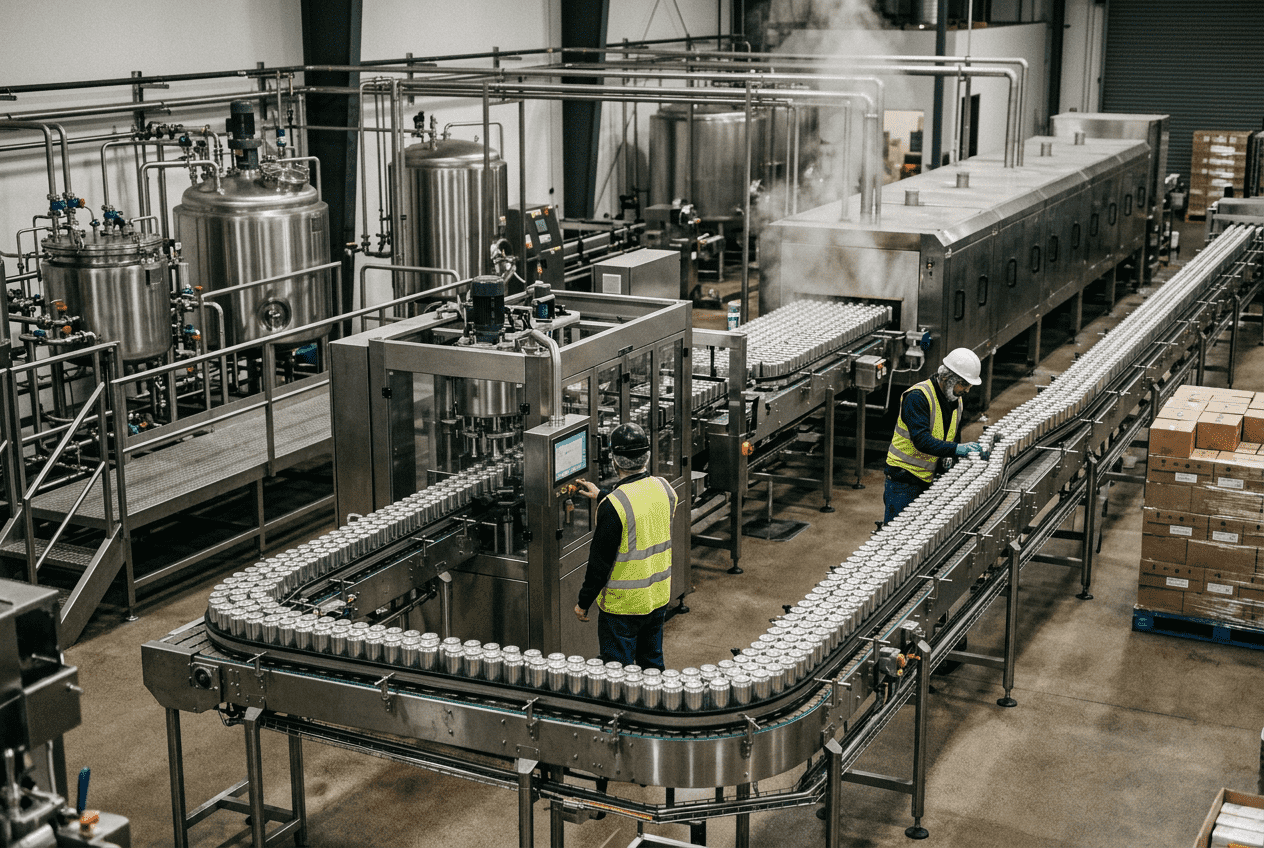
Kombucha Fermentation Systems
[trp_language language=”en_US”]
Kombucha Fermentation Systems for U.S. Beverage Producers
Kombucha fermentation systems are the integrated tanks, controls, sanitation methods, utility connections, and monitoring tools used to produce consistent fermented tea at commercial scale. In the United States, the best system design usually combines controlled primary fermentation, protected secondary conditioning, strong contamination prevention, and process data that supports repeatable flavor, acidity, carbonation, and shelf stability. For brands moving from pilot batches to regional or national production, system design matters as much as recipe development.
Across the U.S. beverage market, kombucha producers in hubs such as Los Angeles, Austin, Chicago, Seattle, Portland, Denver, Atlanta, and the Research Triangle increasingly need fermentation systems that are not only food-safe and scalable, but also economically efficient. Freight access through ports such as Long Beach, Savannah, Houston, and Newark supports ingredient and packaging supply chains, while regional co-packing growth is raising expectations for automation, documentation, and sanitary design. That is why many manufacturers now evaluate kombucha equipment not as stand-alone tanks, but as part of a complete processing platform that includes brewing, blending, utilities, CIP, controls, packaging, and expansion planning.
Quick Answer

For most U.S. commercial kombucha operations, the most effective approach is a two-stage system: an oxygen-accessible primary fermentation setup for SCOBY activity, followed by a tightly controlled secondary system for flavoring and natural carbonation or a separate carbonation step for precise package performance. Open or semi-open primary vessels can support acetic acid bacteria performance, but they must be paired with rigorous sanitation, insect exclusion, airflow control, and environmental monitoring. Closed tanks are often preferred as producers scale because they simplify contamination control, improve data collection, and integrate more easily with automated cleaning and transfer systems.
The right system depends on product type. Raw traditional kombucha, flavored kombucha, low-sugar functional beverages, and hard kombucha all have different process demands. A startup selling in one metro area may begin with jacketed atmospheric tanks and manual testing. A multi-state brand supplying grocery chains usually needs engineered vessel design, glycol temperature control, inline instrumentation, closed transfer paths, and documented sanitation programs that support FDA expectations and private-label quality audits.
For companies seeking expansion, retrofits, or greenfield design, it is useful to work with a partner that understands both beverage process engineering and capital efficiency. Disruptive Process Solutions is known in North America for approaching projects from a profitability and execution standpoint, not just an equipment-sales perspective.
| Decision Area | Small Batch Producer | Regional Brand | National Scale Producer | Main Risk if Undersized | Main Benefit if Engineered Well |
|---|---|---|---|---|---|
| Primary vessel type | Atmospheric tank | Jacketed semi-closed tank | Engineered sanitary fermenter | Inconsistent acidification | Stable fermentation kinetics |
| Secondary conditioning | Manual bottles | Closed brite or conditioning tank | Automated conditioning loop | Uneven carbonation | Predictable package pressure |
| Temperature control | Room control | Basic glycol jackets | Zoned glycol automation | Flavor drift | Repeatable sensory profile |
| Cleaning method | Manual wash | Portable CIP | Centralized validated CIP | Biofilm contamination | Reduced downtime and better hygiene |
| Monitoring | pH and taste | pH, temperature, Brix logs | SCADA and alarms | Late process correction | Real-time quality control |
| Expansion readiness | Limited | Moderate | High | Costly rebuilds | Lower long-term capital cost |
The table above shows why equipment selection should match growth stage. Many U.S. brands outgrow early manual systems quickly, especially after retail placement expands from local natural stores to national chains.
Two-Stage Fermentation: Primary and Secondary System Design

Commercial kombucha production is generally most stable when primary and secondary steps are treated as different process environments. Primary fermentation focuses on converting sweet tea into an acidic fermented base through a symbiotic culture of bacteria and yeast. Secondary fermentation or conditioning focuses on flavor integration, carbonation management, and packaging readiness. Trying to force both objectives into one vessel often creates inconsistency.
In the primary stage, tea concentration, sugar load, inoculation ratio, vessel geometry, oxygen exposure, temperature, and residence time affect the balance between yeast metabolism and bacterial acid production. In the secondary stage, the process becomes more sensitive to residual sugar, fruit additions, botanicals, pressure, dissolved CO2, and microbiological risk from post-fermentation ingredients.
A two-stage system design also helps with scheduling. Producers can keep primary fermenters running in a predictable rotation while conditioning tanks are used for product-specific SKUs such as ginger, berry, citrus, or adaptogen blends. This matters for co-packers and multi-SKU plants where tank occupancy directly impacts throughput and margin.
| Parameter | Primary Fermentation | Secondary Conditioning | Why It Matters | Typical U.S. Control Priority | Recommended Equipment Feature |
|---|---|---|---|---|---|
| Main objective | Acidification and culture activity | Flavoring and carbonation | Separates microbial and sensory control | High | Dedicated vessels for each phase |
| Oxygen exposure | Moderate to high | Low to controlled | Supports bacteria early, limits oxidation later | High | Vent design and sealed conditioning tanks |
| Pressure tolerance | Atmospheric | Low to moderate pressure | Prevents unsafe pressure rise | High | Rated tanks and relief devices |
| Ingredient additions | Tea, sugar, starter | Juice, extracts, flavors | Late additions increase contamination exposure | Medium | Sanitary dosing ports |
| Cleaning frequency | Batch-to-batch | Every turnover | Secondary tanks often face sticky residues | High | Spray devices and CIP returns |
| Instrumentation | Temperature, pH, time | Pressure, pH, CO2, temperature | Different data drives different decisions | High | Integrated sensors |
The explanation is straightforward: a successful kombucha plant treats primary and secondary as linked but separate process systems. That reduces flavor drift, lowers contamination risk, and improves production planning.
In practical U.S. operations, primary vessels may be grouped near brewing systems and sugar handling, while secondary tanks are positioned closer to blending, filtration if used, and packaging. This layout supports better labor flow and minimizes unnecessary movement of live product across the plant. Facilities in high-cost industrial markets such as Southern California or northern New Jersey often prioritize compact layouts, while larger greenfield sites in Texas or the Carolinas may have more room for dedicated process zones.
Fermenter Selection: Open vs Closed Vessels for Kombucha Production

Open versus closed fermenters is one of the most debated topics in kombucha processing. Open fermenters provide broad surface area and easier oxygen availability for acetic acid bacteria. They also allow visual observation of SCOBY formation. However, they are more vulnerable to airborne contamination, fruit flies, cleaning variability, and environmental swings. Closed fermenters improve sanitation control, transfer integrity, and automation compatibility, but they must be engineered to support the oxygen needs of the process or the fermentation profile may change.
For many U.S. producers, the answer is not purely open or purely closed. Instead, it is a controlled atmospheric or low-pressure sanitary vessel with managed venting, screened air exchange, and cleanable internals. These hybrid approaches retain process functionality while reducing contamination exposure.
| Feature | Open Vessel | Closed Vessel | Best Use Case | Main Limitation | Operational Note |
|---|---|---|---|---|---|
| Oxygen access | Excellent | Controlled or limited | Primary fermentation | Closed tanks may need vent strategy | Balance oxygen with sanitation |
| Contamination protection | Lower | Higher | Scaled production | Open systems need stricter room hygiene | Use filtered or screened air pathways |
| Automation compatibility | Moderate | High | Multi-tank facilities | Open systems are harder to integrate fully | Closed systems support sensors better |
| Cleaning consistency | Variable | High | Food-safe scale-up | Manual cleaning risk in open tanks | CIP saves labor |
| Pressure capability | Minimal | Possible | Secondary carbonation | Open tanks cannot hold CO2 | Do not use primary tanks for pressure conditioning unless rated |
| Retail audit readiness | Lower to moderate | High | National retail supply | Documentation burden is higher for open systems | Closed systems simplify quality narratives |
The table makes clear that vessel selection depends on business goals, not only fermentation philosophy. A local artisanal producer in Portland may accept more manual involvement. A national contract manufacturer shipping through Chicago, Dallas, and Atlanta distribution lanes usually prefers closed sanitary systems with repeatable cleaning and control performance.
Companies evaluating new vessels should also consider floor loading, utility availability, future SKU count, operator skill level, and whether tanks need to serve multiple beverages. A partner with broad beverage engineering experience can align these variables during planning. DPS supports such evaluations through process engineering and system integration services, which is especially useful when kombucha lines share infrastructure with tea, juice, or other functional beverages.
SCOBY Health and Contamination Control in Fermentation Systems
SCOBY health is less about preserving a single visible pellicle and more about maintaining a stable microbial ecosystem across batches. At commercial scale, consistent inoculum management, acid reserve, sugar concentration, and vessel sanitation do more to protect fermentation performance than simply transferring thick cellulose mats. Producers need to understand their working culture biologically, not just visually.
Healthy fermentation systems maintain proper starter strength, use validated hold times, prevent cross-contact with spoilage organisms, and avoid excessive mechanical stress that could alter microbial balance. Common contamination threats include wild yeast, mold spores, lactic acid bacteria not intended in the process, and residues from flavor additions. Fruit flies remain a serious concern in warm beverage facilities, especially during summer months in Gulf Coast and Southeast markets.
Environmental control is essential. Positive room practices, screened drains, dry floor management, hygienic hose storage, and well-defined raw versus fermented product zones all reduce risk. Operators should also monitor pH decline curves and sensory changes that may indicate culture drift before finished product defects appear in the market.
| Control Point | Target Practice | Why It Helps | Common Failure Mode | Corrective Action | Review Frequency |
|---|---|---|---|---|---|
| Starter ratio | Use validated inoculation percentage | Speeds safe acidification | Slow pH drop | Increase acid reserve and verify seed health | Every batch |
| Tank sanitation | Documented cleaning cycle | Removes biofilm and residue | Recurring off-notes | Review CIP chemistry and coverage | Every turnover |
| Air exposure control | Screened vents and protected room airflow | Limits insects and spores | Surface contamination | Upgrade barriers and room hygiene | Daily |
| Ingredient handling | Sanitary transfer of tea, sugar, flavors | Prevents external microbial load | Secondary contamination | Use closed dosing and verified storage | Each receipt and batch |
| Culture rotation | Track age and performance by lot | Prevents unnoticed drift | Variable acidity | Refresh seed train | Weekly |
| Operator practices | Gowning, hand hygiene, traffic control | Reduces human contamination | Random quality events | Retrain and audit compliance | Daily and monthly audit |
This checklist works because contamination rarely comes from one dramatic event. It more often comes from small repeated failures: a drain issue, an unclean gasket, a sugary hose left wet, or an inconsistent inoculation routine.
Oxygen Transfer and Aeration Systems for Primary Fermentation
Primary kombucha fermentation requires enough oxygen to support acetic acid bacteria without creating a chaotic, contamination-prone environment. Oxygen transfer in commercial systems depends on liquid depth, vessel diameter, exposed surface area, vent design, agitation policy, and air quality management. Unlike beer fermentation, kombucha typically benefits from more oxygen exposure early in the process, though the exact need varies by culture and product profile.
Most commercial producers do not use aggressive aeration in the way some industrial fermentations do. Instead, they rely on vessel geometry and controlled passive exchange. In certain designs, low-shear recirculation or carefully filtered airflow can improve uniformity, but overhandling may disrupt pellicle development or shift the flavor profile too sharply toward acetic character.
Facilities in humid climates such as Florida, Louisiana, and coastal Texas should pay special attention to intake air quality and condensation. Moist environments can raise the risk of microbial ingress if air pathways are not well managed. Cleanable vent systems, insect-proof barriers, and validated room conditions are therefore part of oxygen management, not separate concerns.
The chart above illustrates realistic growth in U.S. kombucha processing capacity as more brands invest in engineered systems. As capacity rises, oxygen control becomes more deliberate and data-driven rather than artisanal alone.
Temperature, pH, and Time Control for Consistent Fermentation Outcomes
Kombucha quality depends heavily on the relationship between temperature, pH, and time. These variables should not be monitored independently. Temperature affects microbial activity rate, pH decline reflects acidification progress and safety direction, and time ties both together into a predictable fermentation curve. Commercial production should define acceptable windows rather than single-point targets.
For example, a producer may target a specific temperature range to achieve balanced acidity and reduced process variance across seasons. In colder Midwestern winters, room-driven systems may ferment too slowly. In warm Arizona or Georgia summers, uncontrolled heat may accelerate fermentation and produce harsh acid notes. Jacketed tanks with glycol support give operators a more stable process regardless of climate.
pH monitoring should be frequent enough to detect lagging fermentation early. Time alone is not a reliable release criterion because two tanks with the same age can show different acid development. The strongest plants combine online or nearline measurements with trained sensory review and written action limits.
| Variable | What to Monitor | Impact on Product | Too Low | Too High | Best Control Method |
|---|---|---|---|---|---|
| Temperature | Batch and zone temperature | Fermentation speed and flavor balance | Slow acidification | Sharp acidity and flavor loss | Jacketed tank with glycol loop |
| pH | Start, mid-point, endpoint | Safety and sensory profile | Microbial risk and sweetness retention | Overly sour product | Calibrated meter and trend logs |
| Time | Residence time by batch | Batch reproducibility | Underdeveloped fermentation | Tank bottleneck and overacidification | Digital batch tracking |
| Sugar conversion | Residual sweetness trend | Flavor and carbonation potential | Unstable package performance | Flat taste | Brix plus lab checks |
| Batch temperature uniformity | Top-to-bottom variance | Even fermentation | Stratification | Localized overactivity | Proper tank design and gentle recirculation |
| Hold conditions post-fermentation | Time before transfer | Prevents drift | Packaging delays | Extended acid creep | Scheduled transfer and chilled hold |
This table shows that consistency is not just a matter of checking final pH. It comes from controlling the entire fermentation path, especially in plants producing large weekly volumes.
The bar chart reflects where demand for upgraded fermentation infrastructure is strongest. Co-packers, mass retail suppliers, and functional beverage producers often require the highest control precision.
Wild Yeast and Bacteria Prevention: Sanitation Protocols for Fermentation Tanks
Wild microbe prevention is essential because kombucha is intentionally fermented, yet still vulnerable to unintended organisms. This creates a false sense of security in some facilities. A live process does not excuse poor sanitation; in fact, it requires more discipline. The goal is not sterility in the absolute sense, but controlled microbiology with no unwanted growth.
Effective sanitation protocols begin with hygienic design: smooth internal finishes, drainable piping, minimal dead legs, proper spray coverage, gasket compatibility, and easy visual inspection. Cleaning chemistry must match residues. Tea solids, sugar films, cellulose buildup, and fruit particulates often require different wash and rinse performance than a simple water-based beverage.
Sanitation programs should include pre-rinse, caustic or detergent wash as appropriate, intermediate rinse, acid cycle when needed, sanitizer step if required by the process, and verification. Verification may include ATP checks, visual inspection, conductivity confirmation, and periodic microbiological swabbing. The key is repeatability.
Manufacturers seeking custom-cleanable tanks, CIP skids, and integrated sanitary layouts often benefit from working with firms that can align vessel design and utility design together. DPS also offers equipment solutions for processing systems, which is valuable when fermentation tanks must be matched with custom CIP, utilities, and plant expansion plans.
This trend line highlights a clear 2026 direction in the United States: more producers are moving toward closed, monitorable, clean-in-place fermentation systems to satisfy retailer expectations, labor efficiency goals, and food safety discipline.
Pressure Management for Naturally Carbonated Kombucha
Pressure management becomes critical once kombucha enters secondary conditioning, packaging, or any phase where residual fermentation can generate CO2 in a sealed environment. Naturally carbonated kombucha can be attractive from a branding standpoint, but it introduces package variability if sugar, yeast activity, temperature, and fill timing are not carefully controlled.
Pressure-rated tanks, relief valves, sanitary sample points, and controlled transfer temperatures all help reduce the risk of overcarbonation. Producers should define whether carbonation will come primarily from natural secondary fermentation, forced carbonation, or a hybrid approach. Each method affects equipment selection differently. Natural conditioning requires tighter biological control. Forced carbonation requires gas handling accuracy and bright tank style infrastructure. Hybrid methods can offer better consistency while preserving some fermentation-derived texture.
In U.S. distribution networks, especially summer freight lanes through Phoenix, Las Vegas, or inland Southeast warehouses, package heat exposure can amplify pressure issues. This is why pressure planning should include not only in-plant conditions but also downstream logistics.
| Factor | Risk | Operational Impact | Recommended Control | Equipment Need | Packaging Relevance |
|---|---|---|---|---|---|
| Residual sugar | Continued CO2 generation | Overpressurized package | Verify sugar before sealing | Lab checks and batch release standard | High |
| Warm fill temperature | More active fermentation | Short shelf-life stability | Condition or chill before filling | Temperature-controlled tanks | High |
| Tank pressure rating | Safety hazard | Equipment damage | Use rated vessels only | Relief valves and certified tanks | High |
| Flavor additions | Extra fermentable load | Unexpected carbonation | Validate each SKU separately | Sanitary dosing and records | High |
| Storage temperature | Pressure rise in distribution | Returns and leakage | Cold-chain planning where needed | Warehouse and transport SOPs | Medium to high |
| Filler accuracy | Uneven headspace | Variable package behavior | Calibrate fill volumes | Maintained filling system | High |
The explanation here is simple: pressure problems are usually process problems showing up late. Good tank design helps, but stable carbonation starts with fermentation control upstream.
Analytics and Process Control: Automating Kombucha Fermentation Monitoring
Automation in kombucha is no longer limited to large beverage corporations. Mid-sized U.S. producers are increasingly using sensors, PLC-based controls, and SCADA dashboards to track fermentation status in real time. The most useful data points typically include temperature, pH, batch age, transfer status, tank availability, CIP completion, and alarms tied to deviations from validated process windows.
Automated monitoring does not replace microbiological understanding, but it allows teams to intervene earlier and document decisions better. This is especially valuable for operations running several tanks at once, managing multiple recipes, or supplying customers that require strong production records.
Technologically, the best systems connect fermentation assets with broader plant infrastructure. That means tying tanks into glycol systems, utility consumption, sanitation skids, blending rooms, and packaging line scheduling. DPS is active in this area because its engineering capabilities span process, mechanical, electrical, controls, PLC programming, and SCADA integration. For manufacturers that need design-to-execution continuity, this multi-discipline approach reduces coordination gaps and helps the plant operate as one process instead of a collection of isolated machines.
From a manufacturing standpoint, scalable kombucha systems benefit from custom tanks, CIP packages, sanitary transfer loops, and utility-ready layouts. DPS also manufactures selected process equipment, including tanks and CIP systems, which can be valuable when standard catalog equipment does not fit the product, footprint, or cleaning requirements. On the service side, the company supports capital planning, feasibility, owner representation, installation, integration, and project management, allowing beverage manufacturers to align fermentation expansion with commercial goals rather than treating it as a stand-alone purchase.
The comparison chart shows how system sophistication generally improves scale readiness, auditability, and process repeatability. Higher-tech systems carry more upfront cost, but they often reduce long-term waste, downtime, and rework.
For manufacturers considering future expansion, reviewing prior execution examples can help. The DPS project case studies illustrate how integrated processing and utility projects are planned around throughput, profitability, and long-term plant performance.
FAQ
What is the best fermentation tank for commercial kombucha?
The best choice is usually a sanitary, cleanable tank designed around your production volume, oxygen needs, and cleaning method. Many growing U.S. producers prefer controlled atmospheric or semi-closed vessels for primary fermentation and closed conditioning tanks for secondary processing.
Should kombucha be fermented in open tanks?
Open tanks can work, especially for traditional primary fermentation, but they increase contamination exposure. They are more practical in tightly managed environments with strong sanitation and airflow control. As production scales, many plants move toward more enclosed designs.
How important is temperature control in kombucha production?
Very important. Temperature strongly affects fermentation speed, acid development, and flavor consistency. Seasonal room swings in the United States can create major variability if tanks are not jacketed or climate-controlled.
Can kombucha be naturally carbonated safely at scale?
Yes, but only with strong control over residual sugar, yeast activity, pressure-rated equipment, and package performance. Many producers use hybrid systems to improve consistency while keeping a natural fermentation story.
What sensors are most useful in a kombucha fermentation system?
Temperature and pH are the starting point. As plants scale, producers often add pressure monitoring, batch tracking, CIP verification, tank level sensing, and integrated SCADA dashboards.
How do producers prevent wild yeast and unwanted bacteria?
Through hygienic tank design, validated sanitation protocols, protected air exchange, careful ingredient handling, operator training, and lot-based culture management. Cleaning discipline is just as important as recipe discipline.
What should U.S. co-packers prioritize when designing kombucha systems?
Flexible tank scheduling, strong cleaning capability, clear batch records, closed transfer paths, flavor dosing control, and packaging compatibility. Multi-SKU operations benefit greatly from automation and well-zoned process layouts.
What are the main 2026 trends for kombucha fermentation systems?
The major trends are increased automation, more closed sanitary primary systems, stronger retailer-driven documentation, energy-efficient utilities, water-conscious CIP design, and sustainability-focused material and process choices. Policy pressure around food safety documentation and resource use is also pushing beverage plants toward smarter controls and more transparent operating data.
How does sustainability affect fermentation system design?
Sustainability now influences tank insulation, heat recovery, CIP water reuse strategies where appropriate, efficient glycol design, and reduced product loss during transfers. In states with tighter water and energy pressures, such as California and Arizona, these design choices can materially affect operating cost.
Who should help design a commercial kombucha processing system?
Ideally, a partner experienced in beverage process engineering, utilities, controls, installation, and capital planning. That reduces the risk of buying isolated equipment that does not perform well once integrated into a real production environment.
In summary, kombucha fermentation systems should be designed around controlled biology, sanitary engineering, plant-wide integration, and business scalability. U.S. producers that invest early in clear primary and secondary process separation, good tank selection, contamination control, pressure management, and automation are better positioned to meet retailer standards, maintain flavor consistency, and grow profitably across regional and national markets.
[/trp_language]
Complete Company Portfolio

About the Author: Disruptive Process Solutions (DPS)
The DPS team combines process engineering expertise with real-world food and beverage manufacturing experience. Our content focuses on process optimization, production efficiency, facility improvements, and practical solutions that help manufacturers operate more effectively in a rapidly evolving industry.
Share