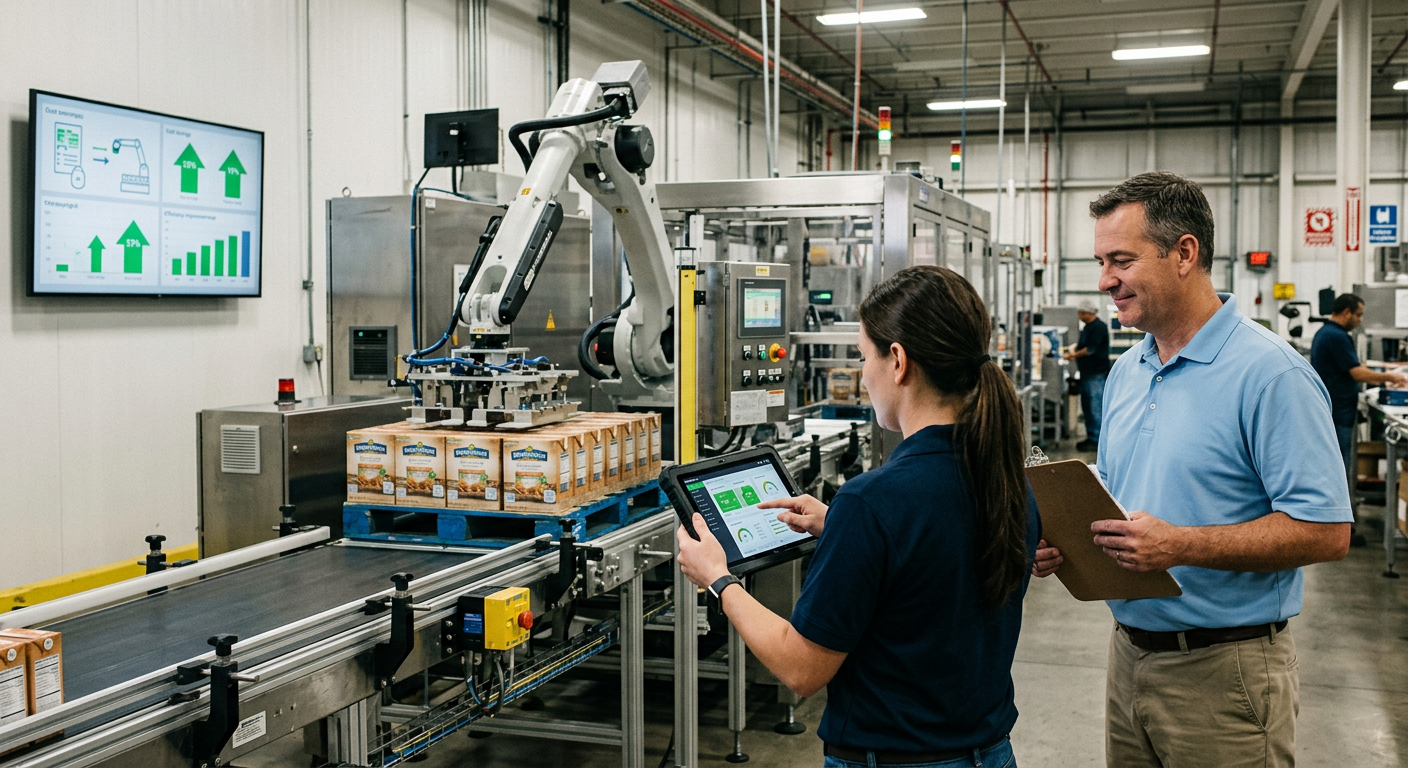
Legacy PLC Upgrade for Food Plants
[trp_language language=”en_US”]
Legacy PLC Modernization for U.S. Food Plants
For food and beverage manufacturers in the United States, upgrading a legacy PLC is no longer a purely technical decision. It is an operational, compliance, cybersecurity, and profitability decision. Across production hubs such as Chicago, Dallas, Fresno, Charlotte, Los Angeles, Atlanta, and the Midwest protein corridor, plants are running aging automation hardware that was once dependable but is now increasingly difficult to support. When a controller fails on a packaging line, blending skid, retort, dairy pasteurizer, or CIP system, the cost of lost production can quickly exceed the price of the upgrade that was deferred.
In food plants, every minute of downtime can affect raw material yields, labor utilization, sanitation windows, customer service levels, and retailer commitments. Legacy PLC systems also limit data visibility, make recipe management harder, and expose facilities to cyber and compliance risk. A structured PLC migration can reduce recovery time, improve maintainability, support plant expansion, and strengthen digital readiness for 2026 and beyond.
Disruptive Process Solutions supports food and beverage manufacturers across the U.S. and Canada with process engineering, controls integration, capital planning, installation oversight, and turnkey execution. Companies evaluating automation modernization often need more than a programmer; they need a partner that can connect operations, utilities, safety, compliance, production scheduling, and project economics into one practical upgrade path. That is especially true in high-throughput facilities near major logistics corridors such as the Port of Los Angeles, Port of Savannah, Houston, and rail-linked manufacturing centers across the Midwest and Southeast.
Quick Answer

A legacy PLC upgrade for a U.S. food plant is critical when the installed controls platform is obsolete, spare parts are hard to source, cybersecurity protections are weak, or compliance expectations have outgrown the system. The best upgrade approach starts with a site survey, I/O inventory, code review, and risk assessment. From there, plants typically choose between a big bang cutover, a phased migration, or a parallel run strategy. Common target platforms include Allen-Bradley ControlLogix, Siemens S7-1500, and Schneider Electric M580. The strongest business case usually comes from avoiding downtime, improving recoverability, tightening access control, and gaining real-time production data.
| Decision Area | What to Evaluate | Why It Matters | Typical U.S. Plant Impact |
|---|---|---|---|
| Controller Obsolescence | Discontinued CPUs, unsupported software, aging backplanes | Raises failure risk and repair delays | Longer outages during production peaks |
| Spare Parts Availability | Lead times, aftermarket reliability, counterfeit exposure | Impacts maintenance response speed | Emergency sourcing at premium prices |
| Cybersecurity | User access, patching limits, network architecture | Protects production and data integrity | Higher risk of disruption or ransomware spread |
| Compliance | Audit trails, recipe control, validation support | Supports FDA, USDA, SQF, BRC readiness | Reduced audit findings and process deviations |
| Downtime Cost | Line rate, labor, product loss, clean-up time | Determines upgrade ROI | Often justifies modernization quickly |
| Future Expansion | SCADA integration, historian, remote diagnostics | Improves long-term flexibility | Supports capacity and OEE initiatives |
The table above shows why PLC modernization should be reviewed as a plant business case, not just a maintenance task. A controller replacement affects uptime, food safety support systems, operator workflows, and long-term digital infrastructure.
Why Legacy PLC Upgrades Are Critical: Obsolescence, Cybersecurity, and Compliance

Legacy PLCs often remain in service far beyond their intended support window. In many U.S. food plants, controllers installed 15 to 25 years ago still manage batching, pasteurization, conveying, canning, filling, refrigeration support, and wastewater utility functions. These systems may still run, but the support ecosystem around them has narrowed dramatically. Software licenses become harder to maintain, trained technicians retire, OEM knowledge fades, and replacement cards come from surplus channels with uncertain quality.
Obsolescence is only one side of the problem. Older automation systems were not designed for today’s connected manufacturing environment. Remote access, historian integration, MES connectivity, cloud analytics, and multi-site visibility create business value, but they also expose weak points in legacy systems. Many older PLC architectures lack modern authentication, encrypted firmware validation, granular role-based access, and secure network segmentation features expected in contemporary industrial environments.
Compliance pressure is also increasing. Food and beverage facilities must be able to support repeatable process control, change management, sanitation documentation, and traceability expectations. While a PLC alone does not create compliance, weak controls can undermine it. If a thermal process, recipe setpoint, or cleaning sequence is difficult to verify, difficult to lock down, or difficult to restore after failure, the plant assumes avoidable risk.
This is where a broader engineering view matters. Integrated food plant services can align controls upgrades with process design, utility needs, operator interfaces, safety systems, and project execution. Instead of treating a migration as a box swap, the upgrade becomes a reliability and performance improvement initiative.
| Legacy Issue | Common Symptoms | Operational Risk | Compliance/Cyber Risk |
|---|---|---|---|
| Unsupported PLC Family | No factory support, limited software access | Extended downtime after failure | Poor change control |
| Aging I/O Cards | Intermittent faults, noisy signals | Nuisance trips, unstable process control | Weak validation confidence |
| Old HMI/SCADA | Slow screens, lost alarms, obsolete OS | Operator error and delayed response | High vulnerability exposure |
| Flat Plant Network | No segmentation between OT and IT | Wide failure propagation | Greater malware risk |
| Poor Documentation | Unknown edits, outdated drawings | Longer troubleshooting time | Audit complications |
| Manual Recovery Methods | Backups missing or untested | Slow restart after outage | Weak resilience posture |
The explanation behind this table is straightforward: legacy risk rarely appears as one dramatic event. It accumulates through smaller weaknesses until one outage exposes all of them at once.
The True Cost of Inaction: Downtime Risk and Sourcing Crisis for Spare Parts

Many plants delay a controls upgrade because the current system is “still working.” That logic can hold until a processor fails on a Friday night, an obsolete communications card dies during a seasonal production surge, or a backup cannot be restored. The cost of inaction is usually hidden in four places: unplanned downtime, expensive emergency procurement, lost production flexibility, and rising labor burden on maintenance and engineering teams.
Consider a prepared foods facility in the Southeast running a high-volume line into retail distribution. If the line loses eight hours due to an obsolete PLC failure, the impact may include wasted raw material, overtime, rescheduling sanitation, freight changes, missed customer windows, and reduced weekly throughput. In dairy, beverage, aseptic, or protein processing, restart complexity can push costs even higher. For plants shipping through national distribution routes from California’s Central Valley, Texas, the Carolinas, or the Great Lakes region, missed schedules ripple fast.
Spare parts are another major issue. Many legacy systems now rely on broker markets or refurbished inventory. That introduces uncertain quality, counterfeit risk, and inconsistent lead times. A plant may think it is saving money by postponing modernization, yet it is really accepting a growing sourcing crisis. In some cases, one failed communication module can sideline an entire process area because the exact part is unavailable.
The line chart illustrates a realistic market trend: U.S. food plant modernization activity is rising as aging infrastructure, cybersecurity expectations, and labor constraints converge.
| Cost Category | Typical Hidden Trigger | Short-Term Effect | Long-Term Effect |
|---|---|---|---|
| Unplanned Downtime | CPU or I/O failure | Missed production hours | Lower customer service performance |
| Emergency Parts Sourcing | No on-site spare or obsolete inventory | Premium purchase cost | Budget volatility |
| Engineering Dependency | Only one person knows the system | Slow fault recovery | Knowledge concentration risk |
| Product Waste | Interrupted batches or thermal cycles | Scrap and rework | Margin erosion |
| Cyber Exposure | Unsupported software or open access | Higher incident likelihood | Insurance and resilience concerns |
| Growth Limitation | No scalable platform for expansion | Project delays | Capital inefficiency |
This table helps quantify why “do nothing” is not a neutral option. It is an active decision to accept higher downtime exposure and a shrinking maintenance support base.
Migration Strategies: Big Bang vs. Phased Cutover vs. Parallel Run
There is no one-size-fits-all migration method. The right strategy depends on production criticality, shutdown windows, code complexity, safety systems, utility interdependencies, and available testing time.
Big bang cutover means replacing the old system in a single planned outage. This can be effective for smaller skids, isolated lines, or facilities with a defined shutdown period. It reduces the duration of mixed old-new architecture, but it raises the importance of detailed planning and off-site testing.
Phased cutover replaces the legacy system in sections. This is often preferred in large plants where utilities, packaging, processing, and CIP areas can be migrated step by step. It reduces immediate risk but requires careful interface management between old and new systems.
Parallel run uses a fully tested replacement system operating alongside the old system before final switchover. This approach can reduce startup risk in mission-critical environments such as aseptic processing, high-value beverage blending, or continuous thermal operations, but it usually demands more design effort and temporary installation planning.
| Migration Strategy | Best Fit | Main Advantage | Main Challenge |
|---|---|---|---|
| Big Bang | Smaller systems or fixed shutdown plants | Fastest total transition | High cutover pressure |
| Phased Cutover | Large plants with multiple process areas | Lower immediate disruption | Temporary mixed architecture |
| Parallel Run | High-risk or continuous process lines | Strong commissioning confidence | More engineering time and cost |
| Weekend Conversion | Discrete packaging or utility skids | Matches production calendar | Tight labor coordination |
| Seasonal Shutdown Upgrade | Processors with annual downtime windows | Large work scope in one event | Heavy pre-work required |
| Hybrid Model | Plants combining utility and line upgrades | Balances speed and risk | More complex project management |
The table shows that migration strategy should match operational reality, not just engineering preference. A poultry plant in Arkansas, a dairy processor in Wisconsin, and a beverage co-packer in California may all need different cutover models.
Platform Selection: Allen-Bradley ControlLogix, Siemens S7-1500, or Schneider M580
Platform selection should reflect plant standards, technician familiarity, OEM ecosystem, network architecture, and long-term support strategy. In the U.S. market, Allen-Bradley ControlLogix is frequently chosen due to installed base familiarity, integration across packaging and process lines, and maintenance team comfort. Siemens S7-1500 is often attractive where high performance, diagnostics, and global standardization matter. Schneider Electric M580 is a strong option for plants emphasizing Ethernet architecture, process applications, and modern distributed control needs.
The right answer is not always the most popular brand. It is the platform that best supports uptime, maintainability, expansion, and cybersecurity in the context of the plant. If a facility has a large installed Rockwell base with PlantPAx direction, ControlLogix may reduce lifecycle friction. If corporate engineering uses Siemens globally, S7-1500 can improve standardization. If the site is rethinking network topology and process control architecture, M580 may deserve serious consideration.
| Platform | Strengths | Best Applications | Selection Notes |
|---|---|---|---|
| Allen-Bradley ControlLogix | Large U.S. installed base, strong integrator support | Packaging, batch, utilities, line control | Good fit where Rockwell standards already exist |
| Siemens S7-1500 | Strong diagnostics, flexible architecture | High-performance process and machine systems | Useful for global standardization programs |
| Schneider M580 | Modern Ethernet-first design, process-friendly approach | Utilities, distributed process systems | Good option in multi-node architectures |
| Controller Redundancy | Improves uptime in critical operations | Aseptic, thermal, continuous processes | Must be justified by downtime cost |
| Open Protocol Support | Easier third-party integration | Mixed OEM plants | Review SCADA, historian, and MES needs |
| Lifecycle Support | Longer-term maintainability | All food sectors | Confirm local talent and spare strategy |
The comparison table is most useful when combined with a site-specific standards review. A technically excellent platform can still be a poor fit if local maintenance capability is weak.
Pre-Upgrade Planning: Site Survey, I/O Inventory, and Documentation Review
The most successful PLC upgrades are won before hardware arrives. Pre-upgrade planning should include a full site survey, I/O count verification, panel condition assessment, code backup validation, network mapping, instrument review, and operational interviews with maintenance, sanitation, production, and quality teams.
A site survey identifies hidden risks such as panel heat loading, insufficient cabinet space, unlabeled field devices, unsupported remote I/O racks, and undocumented interlocks with boilers, refrigeration, compressed air, or wastewater systems. An accurate I/O inventory prevents scope gaps during design. Documentation review reveals whether as-builts match reality or whether years of field edits have drifted from drawings.
Plants should also review process criticality. Not all I/O points are equal. A temperature loop on a pasteurizer, a retort safety chain, a CIP conductivity measurement, and a simple conveyor run signal have very different startup implications. Prioritization helps shape both test scripts and cutover sequencing.
Manufacturers that need deep front-end planning often benefit from a broader engineering partner. About the DPS team explains how an agile food and beverage engineering group can connect process, utilities, controls, and capital planning under one execution model.
| Planning Task | What It Includes | Output | Why It Reduces Risk |
|---|---|---|---|
| Site Survey | Field walkdown, cabinet review, device conditions | Risk register | Finds physical and operational issues early |
| I/O Inventory | Digital, analog, safety, networked devices | Verified point list | Prevents missed signals during design |
| Code Backup Review | Upload, compare, archive, version control | Baseline logic package | Protects against undocumented edits |
| Documentation Review | Electrical drawings, P&IDs, narratives | Gap list and markups | Improves installation accuracy |
| Operations Interview | Operator pain points, startup concerns | User requirements | Improves HMI and alarm design |
| Downtime Analysis | Shutdown window and startup sequence mapping | Cutover plan | Aligns project plan to production reality |
This planning table matters because most upgrade surprises are discovered in the field, not in software. Better planning directly shortens outage duration.
Off-Site Build and Test: Minimizing Production Disruption During Cutover
One of the most effective ways to reduce plant disruption is to perform as much work as possible off-site. That includes panel fabrication, FAT preparation, logic simulation, HMI screen development, network configuration, labeling, and documentation package assembly. A well-managed off-site build compresses cutover time and increases startup confidence.
For U.S. food manufacturers, this approach is especially valuable when production schedules are tight. Plants in high-demand categories such as ready-to-drink beverages, dairy, proteins, sauces, and co-packing often cannot afford lengthy in-plant engineering windows. Building and testing systems off-site allows stakeholders to review logic and screens before installation.
Technological capability is important here. DPS supports controls engineering, PLC programming, SCADA integration, process automation, and utility system coordination, which allows an upgrade to be aligned with broader plant systems rather than treated as an isolated electrical project. Manufacturing capability also matters. Through its process equipment and skid experience, DPS understands how tanks, CIP systems, marination systems, cooking vessels, and utility skids interact with controls architecture in real operating environments. Service capability completes the picture through project management, installation coordination, commissioning oversight, and owner-focused execution.
For plants adding or modifying skid-based systems during modernization, custom process equipment solutions can be integrated into the automation plan to avoid fragmented execution.
The area chart reflects a clear trend shift: more food plants are adopting off-site build and test methods to reduce cutover risk and shorten restart timelines.
Cybersecurity Improvements: Encrypted Firmware, Access Controls, and Network Segmentation
Cybersecurity modernization should be embedded in every PLC upgrade scope. Replacing the controller without improving cyber posture leaves too much value on the table. Modern systems can support better user management, firmware integrity controls, secure remote access methods, segmented industrial networks, and improved event visibility.
At a practical level, food plants should focus on several essentials. First, restrict programming and administrative access to authorized roles. Second, separate business IT traffic from plant OT traffic through network segmentation. Third, document remote access pathways and eliminate informal or unmanaged methods. Fourth, establish tested backup and restore procedures. Fifth, use firmware and software management practices that support integrity and recoverability.
These improvements matter because food plants are now highly connected environments. Historians, ERP links, quality databases, cloud dashboards, OEM service connections, and warehouse systems all increase the need for secure architecture. Plants in major U.S. manufacturing centers often share data across sites, making standard cyber design even more important.
| Cybersecurity Improvement | What It Does | Operational Benefit | Food Plant Relevance |
|---|---|---|---|
| Encrypted Firmware Validation | Helps ensure trusted code integrity | Safer updates and recovery | Important for critical process systems |
| Role-Based Access Control | Limits privileges by user type | Reduces accidental changes | Supports disciplined plant governance |
| Network Segmentation | Separates OT zones and conduits | Contains failures and threats | Vital for multi-line facilities |
| Secure Remote Access | Managed access with logging | Faster support with lower risk | Useful for distributed operations |
| Backup and Restore Testing | Verifies recoverability | Shorter outage duration | Essential for audit and resilience |
| Alarm and Event Logging | Improves visibility into changes | Faster troubleshooting | Helpful for quality and maintenance teams |
The table above shows that cybersecurity is not separate from uptime. In modern food manufacturing, secure architecture directly supports operational continuity.
ROI Calculation: Reduced Downtime, Faster Recovery, and Data Visibility Gains
A strong ROI model for a legacy PLC upgrade should include both hard and soft savings. Hard savings usually include avoided downtime, lower emergency spare costs, reduced scrap, lower contractor premiums during failures, and reduced overtime. Soft savings often include faster troubleshooting, better alarm clarity, stronger data visibility, easier recipe management, and improved confidence in expansion planning.
For example, if a packaging or processing line generates high hourly contribution margin, preventing even one major outage per year can justify a meaningful portion of the project. If the new platform also improves line diagnostics, batch visibility, and changeover consistency, the total return increases further. Plants that operate across multiple states may also use modernization to standardize spare parts, training, and support practices across sites.
Data visibility is especially valuable heading into 2026. Manufacturers increasingly want better production analytics, utility monitoring, downtime categorization, and integration with SCADA or enterprise reporting tools. Modern PLC architecture supports that direction much more effectively than aging isolated systems.
For companies evaluating business impact, project case examples can help frame how engineering, controls, and execution decisions translate into measurable plant outcomes.
| ROI Driver | Typical Measurement | Example Benefit | Financial Effect |
|---|---|---|---|
| Avoided Downtime | Hours prevented per year | Fewer line stoppages | Higher throughput and sales protection |
| Faster Recovery | Reduced mean time to repair | Quicker restart after faults | Lower labor and waste cost |
| Reduced Spare Premiums | Emergency buys avoided | Planned inventory strategy | More stable maintenance budget |
| Improved Data Visibility | Alarm, trend, OEE, batch data | Better decision-making | Supports continuous improvement |
| Standardization | Common platform across lines | Simpler training and support | Lower lifecycle complexity |
| Compliance Support | Traceability and controlled changes | Cleaner audits | Reduced risk exposure |
The explanation here is important: not every benefit shows up as a simple utility savings line item. Some of the strongest returns come from improved resilience and better management visibility.
Looking ahead to 2026, three trends will shape PLC upgrade priorities in U.S. food and beverage manufacturing. First, cybersecurity expectations will continue to rise as insurers, customers, and corporate boards demand stronger OT resilience. Second, sustainability and energy visibility will matter more, pushing plants toward smarter controls architectures that can monitor utilities, CIP efficiency, refrigeration performance, and water usage. Third, policy and compliance pressure around traceability, electronic records, sanitation discipline, and digital accountability will favor modern platforms that integrate more cleanly with plant information systems.
Local supplier and partner selection also matters. In markets such as North Carolina, Texas, California, Illinois, Georgia, and Wisconsin, manufacturers should look for integrators and engineering partners that understand food-specific realities: washdown environments, thermal processes, recipe management, hygienic design interfaces, utility dependence, and compressed shutdown schedules. The best supplier is rarely the cheapest bidder. It is the team that can reduce overall project risk and protect production economics.
Buying advice for plant leaders is simple: start before the emergency. Build an asset list of legacy controllers. Rank systems by downtime cost, spare parts exposure, compliance criticality, and cyber risk. Validate backups. Standardize documentation. Identify preferred migration platforms. Then package projects according to shutdown windows and capital priorities. That turns modernization from a crisis response into a controlled investment program.
FAQ
How do I know if my food plant needs a PLC upgrade now?
If parts are obsolete, backups are unreliable, maintenance depends on one specialist, or the system cannot support secure access and clean recovery, it is time to plan an upgrade.
Which migration approach is safest?
The safest approach depends on the process. Parallel run is often best for critical continuous processes, while phased migration works well in larger multi-area plants. Big bang can be effective when shutdown windows are clear and testing is strong.
Is Allen-Bradley always the best choice in the U.S.?
Not always. ControlLogix is often a strong fit due to installed base and support familiarity, but Siemens S7-1500 or Schneider M580 may be better depending on corporate standards, process needs, diagnostics, and long-term architecture goals.
Can we reduce downtime during the upgrade?
Yes. Off-site panel build, simulation, FAT, documented cutover sequencing, labeled wiring plans, and startup rehearsals can significantly reduce production disruption.
What should be included in the project scope?
Site survey, I/O verification, code archive, documentation review, panel design, HMI updates, network architecture, cybersecurity improvements, FAT, SAT, training, and backup/recovery procedures.
How does this affect compliance?
A modern controls platform can support better change management, more reliable process execution, clearer operator visibility, and stronger documentation practices that help with FDA, USDA, SQF, and BRC expectations.
What food sectors benefit most from legacy PLC modernization?
Nearly all do, but especially beverage, dairy, protein, aseptic, prepared foods, sauces, and co-packing operations where downtime, sanitation, and batch control are tightly linked to profitability.
Why work with a full-scope engineering partner?
Because PLC upgrades in food plants touch process equipment, utilities, safety, scheduling, sanitation, and capital planning. A partner with engineering, manufacturing understanding, and project execution capability can reduce risk across the full plant system.
[/trp_language]
Complete Company Portfolio
About the Author: Disruptive Process Solutions (DPS)
The DPS team combines process engineering expertise with real-world food and beverage manufacturing experience. Our content focuses on process optimization, production efficiency, facility improvements, and practical solutions that help manufacturers operate more effectively in a rapidly evolving industry.
Share