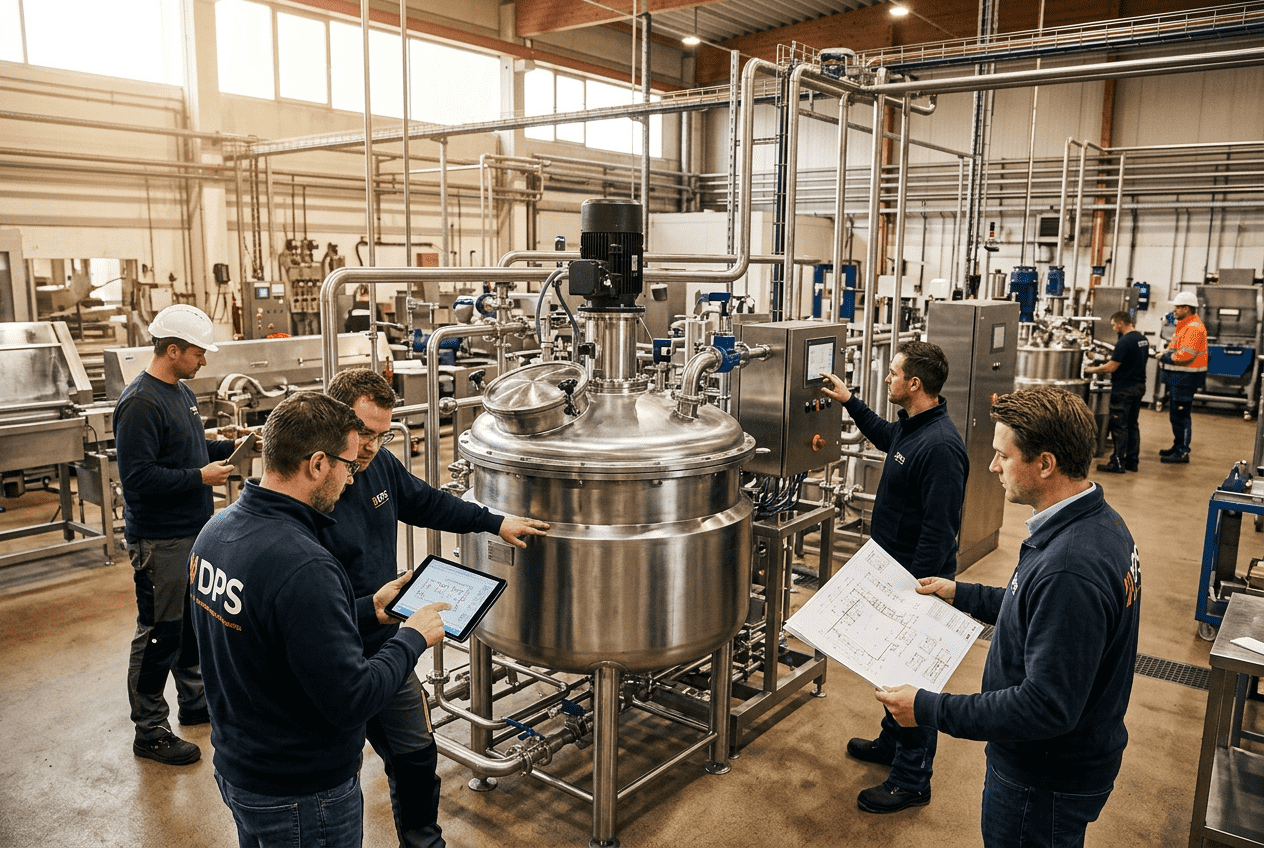
MES Integration for Food Plants: Closing the Gap Between Planning & Production
[trp_language language=”en_US”]
United States MES Systems for Food Manufacturing Flow
Food and beverage manufacturers across the United States are under pressure to run faster, document more, waste less, and comply with stricter customer and regulatory expectations. In many plants, the planning team releases production orders in the ERP system, but operators still rely on paper packets, spreadsheets, radio calls, and manual entries to execute the work on the floor. That gap creates rework, delayed quality decisions, poor visibility into yield loss, and weak traceability. A well-integrated manufacturing execution system, or MES, closes that gap by turning planning data into guided production, connecting machine and sensor data to material usage, and creating a reliable digital record of what actually happened.
For U.S. processors in markets such as poultry in Arkansas, dairy in Wisconsin, sauces in Illinois, protein in Texas, and beverage co-packing in California and North Carolina, MES integration is no longer just an IT project. It is an operational profitability project. It touches throughput, labor utilization, first-pass quality, waste reduction, customer responsiveness, and audit readiness. The strongest business case usually appears where ERP, PLC, SCADA, lab systems, and quality workflows all exist, but the data between them is fragmented.
This page explains how MES integration works in real food plants, what technical requirements matter, where inline sensors and automated workflows create the most value, how to evaluate suppliers in the U.S. market, and how to implement a roadmap that supports both compliance and production performance. It also reflects the practical perspective of Disruptive Process Solutions, a U.S.-based food and beverage engineering firm that approaches automation, controls, utilities, process design, and project execution as one connected system rather than isolated disciplines.
Quick Answer

An MES integrated with ERP, SCADA, PLCs, inline instruments, and quality systems allows a food plant to receive released production orders automatically, route them to lines and operators digitally, collect live process and consumption data, trigger non-conformance workflows in real time, generate electronic batch records, and provide production leadership with accurate visibility into yield, waste, downtime, and traceability. In the United States, this is especially valuable for FDA, USDA, SQF, and BRC environments where documentation accuracy and response speed matter just as much as line efficiency.
In practical terms, MES integration helps food manufacturers do five things better:
- Translate planning into executable work instructions without manual re-entry.
- Track actual versus standard material use during the run, not hours later.
- Escalate quality events immediately when a process value drifts outside limits.
- Create a secure digital batch history suitable for customer, internal, and regulatory review.
- Reduce the disconnect between controls data and business data.
The value is strongest in multi-step production environments such as batching, blending, cooking, CIP, filling, packaging, retort, fermentation, dairy standardization, protein marination, and co-packing. Plants around Chicago, Atlanta, Dallas, Fresno, Kansas City, and the I-95 corridor often prioritize MES because they need tighter coordination between receiving, processing, packaging, warehousing, and outbound logistics linked to major trade hubs and port networks such as Los Angeles, Long Beach, Savannah, Houston, New York and New Jersey.
| Operational Area | Common Manual-State Problem | MES-Integrated Improvement | Typical Impact |
|---|---|---|---|
| Production release | Orders printed or retyped | ERP release sent directly to MES | Fewer scheduling and version errors |
| Ingredient issuing | Paper checks and delayed reconciliation | Lot-controlled digital material consumption | Better traceability and inventory accuracy |
| Process monitoring | Operators log values periodically | Continuous collection from SCADA and sensors | Faster response to drift |
| Yield and waste | End-of-shift estimation | Live actual versus standard comparison | Earlier loss detection |
| Quality deviations | Email or verbal escalation | Automated hold, review, and disposition workflow | Reduced release risk |
| Batch documentation | Paper packets stored physically | Electronic batch record with audit trail | Stronger compliance and retrieval speed |
The table shows why MES projects should be evaluated as operating model improvements, not just software purchases. The technology matters, but the real outcome is disciplined execution at line level.
The growth curve above reflects the broad U.S. trend toward more connected operations. Through 2026 and beyond, capital projects are increasingly expected to include digital execution, sustainability reporting, and stronger data integrity from the start.
Automated Production Order Execution from ERP Release

When a production planner releases an order in ERP, the plant needs that order to become actionable on the floor immediately. In many factories, that handoff still depends on someone emailing a schedule, printing paperwork, or manually assigning tasks in a separate system. MES integration removes that lag. The ERP system sends the order, recipe version, material requirements, due date, line assignment, and lot control rules to the MES platform. MES then sequences work, enforces the right setup, confirms line readiness, and guides operators step by step.
For U.S. food plants, this is critical where production complexity is high. A protein processor in Omaha or Springdale may need to coordinate trim sources, allergens, rework rules, cook schedules, and packaging labels within a tight shipping window. A beverage co-packer near Charlotte or Southern California may need to switch between SKUs rapidly while ensuring syrup, carbonation, filler, and packaging parameters remain aligned to customer specifications. In both cases, an automated release-to-execution workflow reduces planning friction and improves schedule adherence.
Good MES order execution typically includes:
- Automatic order import from ERP or advanced planning systems.
- Electronic dispatch by line, cell, or work center.
- Recipe and formulation control with version locking.
- Material verification by barcode, RFID, or operator confirmation.
- Operator prompts for setup, sanitation, and pre-start checks.
- Real-time production declarations and exception handling.
One of the most important buying questions is whether the plant needs discrete order execution, batch execution, or hybrid execution. Food plants often need all three. A sauce line may run batch cooking upstream, continuous transfer through holding and filling, and discrete case packing downstream. The MES architecture must support that mixed production reality.
| Plant Type | ERP Data Needed | MES Execution Need | Why It Matters |
|---|---|---|---|
| Dairy processing | Formula, lot rules, tank schedule | Batch sequencing and hold logic | Protects quality and allergen control |
| Prepared foods | BOM, routing, packaging specs | Work instruction enforcement | Reduces assembly and labeling errors |
| Protein processing | Yield targets, cut specs, customer orders | Real-time production and waste capture | Improves margin visibility |
| Beverage co-packing | SKU schedule, recipe version, line allocation | Fast changeover control | Maintains OEE during short runs |
| Aseptic processing | Sterility parameters, clean-state requirements | Interlocked procedural execution | Supports release confidence |
| Retort and shelf-stable foods | Cook schedules, lot genealogy | Critical process confirmation | Supports thermal process records |
This table highlights how ERP-to-MES automation is not generic. The data package must be designed around the process, the quality model, and the specific commercial risks of each product family.
Real-Time Yield & Waste Tracking via Inline Sensors

One of the fastest-return MES use cases in U.S. food manufacturing is live yield and waste visibility. Plants usually know their standard yields, but they often discover losses too late. If giveaway, overfill, trim loss, evaporation, solids loss, syrup imbalance, poor batter pickup, or CIP-related product loss is found only at shift close, the corrective opportunity has already passed.
MES changes that by tying inline sensors and machine signals directly to production context. Depending on the process, the plant may use mass flow meters, Coriolis meters, magnetic flow meters, level transmitters, load cells, inline Brix meters, conductivity, pH, temperature, pressure, vision systems, metal detection results, checkweighers, moisture analyzers, and packaging counters. The SCADA or PLC layer captures the raw values, and MES converts them into business meaning: actual ingredient use, giveaway rate, scrap by cause, recovery by line, or yield by product code.
This matters in products where small variances create major annual losses. A dairy beverage line in California with chronic overfill can lose substantial margin even with a fraction of an ounce per bottle. A poultry further-processing facility in Georgia may see major value in live pickup and cook-yield analytics. A sauce plant in New Jersey can use inline Brix and flow balance to identify formulation drift before it becomes rework or hold inventory.
The chart suggests where live yield visibility often drives the strongest demand. Protein, beverage, and dairy operations typically see quick gains because ingredient cost, fill accuracy, and process loss are so financially sensitive.
| Sensor or Data Source | Typical Application | MES KPI Generated | Example Operational Decision |
|---|---|---|---|
| Load cells | Batching and tank weighing | Ingredient variance | Correct addition before batch release |
| Flow meter | Liquid transfer and dosing | Actual versus standard usage | Investigate overconsumption by line |
| Inline Brix meter | Beverage and syrup blending | Formulation conformance | Adjust syrup ratio immediately |
| Checkweigher | Packaged goods | Giveaway trend | Fine-tune filler setpoint |
| Vision system | Package integrity and coding | Defect count by SKU | Hold product before palletizing |
| Moisture analyzer | Baked or protein products | Drying or cook yield | Prevent overprocessing loss |
To make these capabilities useful, sensor data must be time-synchronized, tagged correctly, and tied to order, SKU, batch, lot, and equipment state. Data without context is noise. Data in context is margin intelligence.
Quality Event Escalation: Non-Conformance Workflow Automation
A disconnected plant often handles quality events through phone calls, hallway conversations, shared drives, and delayed spreadsheets. That creates avoidable risk. If an inline metal detector fails, a pH value drifts, a retort cycle misses a parameter, or a sanitation verification step is incomplete, the plant needs an immediate and documented response. MES can automate that response.
In a non-conformance workflow, MES receives an event from SCADA, a lab system, an operator entry screen, or a connected inspection device. It then applies rules: stop the line, place product on hold, alert quality, require supervisory signoff, create an investigation record, route corrective action tasks, and restrict release until disposition is complete. For FDA- and USDA-regulated facilities, speed and traceability are essential. For SQF and BRC certified sites, consistent workflow discipline is equally important.
Examples include:
- Temperature excursion during cook or hold.
- Wrong ingredient lot scanned during batching.
- Allergen clean verification not completed before changeover.
- Fill weight outside tolerance for a sustained period.
- Package code unreadable or wrong customer label applied.
- Environmental monitoring or ATP failure requiring line review.
For plants serving national distribution through hubs like Memphis, Columbus, and Dallas-Fort Worth, a faster digital hold-and-release process also improves logistics. Product can be segregated and dispositioned before it causes warehouse congestion or customer service disruption.
| Trigger Event | Automatic MES Action | Responsible Team | Business Benefit |
|---|---|---|---|
| Critical control limit exceeded | Line stop and escalation alert | Operations and QA | Contains risk immediately |
| Out-of-spec lab result | Batch hold and review task | QA and technical services | Prevents accidental release |
| Wrong lot or allergen mismatch | Material block and supervisor override required | Warehouse and production | Protects traceability integrity |
| Packaging code failure | Segregate affected time window | Packaging and QA | Limits recall scope |
| Sanitation verification incomplete | Prevent start authorization | Sanitation and production | Enforces procedural discipline |
| Repeated minor deviation | Create CAPA trend investigation | Quality systems | Drives continuous improvement |
The explanation is simple: non-conformance automation is not only about compliance. It also reduces ambiguity, protects uptime, and helps managers understand whether failures are isolated or systemic.
Electronic Batch Record Generation & Regulatory Compliance
Electronic batch records, or EBRs, are one of the clearest advantages of MES in food and beverage operations. A complete EBR can combine order data, recipe version, operator actions, machine states, process values, CIP verification, material lots, in-process checks, deviations, hold events, signoffs, and final release status in one searchable record. Instead of hunting through paper folders, scattered spreadsheets, SCADA screens, and maintenance notes, the plant can retrieve the complete production history in minutes.
This is especially valuable in high-compliance environments such as aseptic processing, dairy, ready-to-drink beverages, infant and medical nutrition support operations, protein cooking and chilling validation, and shelf-stable retort products. During audits or customer visits, the ability to show a clean record quickly increases confidence.
The EBR should not be treated as a PDF archive project. It should be designed as a living data model. The best systems support exception-by-exception review, role-based signoff, audit trails, time stamps, and secure change management. Plants that intend to scale across multiple U.S. sites also need template governance so that a facility in California, a second site in Texas, and a third site in the Midwest can work from common standards while preserving local process differences.
The area trend reflects a steady shift across the U.S. market from paper-heavy records to integrated digital execution. By 2026, many capital projects are expected to justify how they will support digital traceability, sustainability metrics, and quicker audit response.
SCADA-to-MES Data Flow: Eliminating Manual Data Handoffs
SCADA is excellent at monitoring and controlling the process. MES is excellent at contextualizing what that process means for production, quality, genealogy, and performance. Problems arise when plants ask SCADA to act like a business system or ask ERP to infer what happened on the line without direct operational data. A strong SCADA-to-MES data flow solves that problem.
In a typical architecture, PLCs control equipment and field devices. SCADA provides visualization, alarming, trending, recipe supervision, and operator interaction at process level. MES receives structured events and values from SCADA or directly from historians and then associates those values with orders, SKUs, lots, operators, shifts, equipment states, and business rules. ERP receives summarized and validated production outcomes such as good quantity, consumed quantity, scrap, lot genealogy, downtime categories, and completion status.
The plants that struggle most with manual handoffs usually have one or more of these issues:
- Machine data exists, but there is no agreed tag naming or hierarchy.
- Production declarations are entered after the fact.
- Downtime reasons are inconsistent by line or shift.
- Quality events live in separate spreadsheets.
- Inventory is updated from paper rather than actual use.
- Recipe changes are not governed across control and business systems.
DPS often approaches this type of problem as both a controls and operations challenge. On the technological side, the company works across process, controls, PLC programming, automation, and SCADA. On the manufacturing side, it understands the realities of batching, blending, pasteurization, aseptic systems, fermentation, retort, dairy, protein, and co-packing. On the service side, it combines engineering, integration, installation, commissioning, and project management to turn architecture decisions into operating assets. You can review related capabilities on the services page.
| Architecture Layer | Primary Role | Key Data | Common Integration Concern |
|---|---|---|---|
| Field devices | Measure or actuate process | Temperature, flow, pressure, level | Signal quality and calibration |
| PLC | Real-time control | Interlocks, sequences, states | Program consistency across lines |
| SCADA or HMI | Visualization and supervision | Alarms, trends, operator actions | Data context often stops here |
| Historian | High-resolution storage | Time-series data | Hard to convert to business KPIs alone |
| MES | Execution and operational context | Orders, batches, lots, downtime, QA | Requires clean master data and workflows |
| ERP | Planning and financial record | Orders, inventory, costing | Needs trusted production confirmations |
The explanation here is that each layer has a different job. Plants get the best results when they stop forcing one layer to compensate for missing design in another.
Technical Specifications and Engineering Requirements
The success of MES integration depends heavily on engineering discipline. Software demonstrations often focus on screens and dashboards, but the real project risk usually sits in network design, device readiness, data models, naming standards, recipe governance, validation rules, cybersecurity, and utility reliability. Food plants should define technical specifications before procurement whenever possible.
At minimum, an MES specification in the United States should address process scope, line list, utility dependencies, source systems, data ownership, cybersecurity standards, historian strategy, user roles, backup and recovery, batch or discrete execution logic, reporting requirements, audit trails, and interfaces to ERP, lab, maintenance, and warehouse functions. Plants with thermal processing, aseptic, or dairy critical controls should also define how MES will support verification, exceptions, and release workflows.
This is where a multidisciplinary partner matters. DPS brings technological capabilities in structural, mechanical, plumbing, electrical, process, and controls engineering, including PLC programming and SCADA. That matters because MES performance depends on the broader plant ecosystem: tanks, CIP systems, pumps, utilities, fillers, refrigeration, compressed air, steam, process water, and instrumentation all influence data quality and execution reliability. You can also explore the firm’s equipment capabilities where custom tanks, CIP systems, and process vessels can be designed with integration requirements in mind.
| Specification Item | Requirement Example | Why It Is Important | Priority |
|---|---|---|---|
| ISA-style equipment hierarchy | Enterprise, site, area, line, unit, asset mapping | Supports scalable data context | High |
| Tag naming standard | Consistent prefixes and metadata | Reduces integration ambiguity | High |
| Time synchronization | NTP across control and server environment | Preserves event sequence integrity | High |
| Cybersecurity | Segmentation, access control, patch policy | Protects production continuity | High |
| Recipe governance | Version control and approval workflow | Prevents unauthorized changes | High |
| Data retention | Defined archive and retrieval policy | Supports audit and analytics needs | Medium |
| Operator interface design | Role-based screens and alarms | Improves adoption and response | Medium |
This table shows that engineering requirements are not optional detail. They are the foundation that determines whether MES becomes a trusted operating system or just another underused application.
Implementation Roadmap and Project Best Practices
MES projects succeed when the plant treats them as phased operational transformations. The best roadmap usually starts with a business case tied to one or two high-value production areas, not a plant-wide “big bang.” Many U.S. manufacturers begin with one pilot line or one process family, prove value in yield, quality, and labor reduction, and then scale across the facility or enterprise.
A practical roadmap often includes six phases:
- Current-state assessment and business case.
- Functional design and technical architecture.
- Master data cleanup and integration preparation.
- Pilot deployment on a selected line or process.
- Stabilization, KPI validation, and user adoption.
- Scale-out to additional lines, plants, or product families.
Best practices include naming one operational owner, standardizing downtime and waste codes early, involving QA from day one, validating lot and genealogy rules before go-live, and training supervisors on exception management rather than just transaction entry. Plants should also measure success using operational KPIs such as schedule attainment, right-first-time rate, live yield accuracy, waste by cause, release cycle time, and audit retrieval time.
DPS is particularly relevant in this phase because its service capabilities go beyond software coordination. The company works as an engineering and execution partner using a design-build-manage approach, handling planning, owner’s representation, project management, general contracting where applicable, equipment integration, and commissioning. For manufacturers balancing capital scope, utility upgrades, controls changes, and MES rollout in one program, that integrated execution model reduces risk. Real-world examples of multidisciplinary delivery can be seen on the project case studies page.
| Phase | Main Activity | Key Deliverable | Common Pitfall |
|---|---|---|---|
| 1. Assess | Map current workflows and losses | Value-based scope definition | Starting with software before process clarity |
| 2. Design | Define architecture and workflows | Functional and technical specification | Ignoring master data quality |
| 3. Prepare | Build interfaces and clean data | Test-ready environment | Late stakeholder alignment |
| 4. Pilot | Deploy on one line or area | Validated use case | Choosing a line with no sponsor |
| 5. Stabilize | Train, tune, and verify KPIs | Sustained operational use | Declaring victory too early |
| 6. Expand | Roll out templates across assets | Scalable plant standard | Copying without local fit |
The explanation is that a staged approach lowers risk and gives leadership real evidence before broader investment. It also helps plants absorb change without overwhelming supervisors and operators.
The comparison chart illustrates why many plants eventually move past disconnected point solutions. They may solve one issue, but they rarely create a unified execution model.
Our Company
Disruptive Process Solutions serves manufacturers across all 50 U.S. states and Canada with a practical focus on profitable execution in food and beverage capital projects. Rather than approaching a plant through one narrow discipline, DPS aligns process engineering, utilities, controls, equipment, installation, and project management around the client’s commercial objectives. That matters for MES-related programs because software results depend on clean process design, reliable equipment integration, and disciplined project delivery.
From a technological perspective, DPS works across process and controls engineering, PLC programming, automation, SCADA, and system integration. From a manufacturing perspective, the company supports beverage, dairy, protein, prepared foods, sauces, aseptic, retort, fermentation, and co-packing applications, while also providing custom process equipment such as tanks, CIP systems, tumblers, and vessels that can be built with digital connectivity in mind. From a service perspective, DPS offers capital planning, feasibility, owner’s representation, project and program management, installation oversight, and turnkey execution through its design-build-manage model.
That combination is useful for U.S. manufacturers that need more than a software reseller. A plant may need utility upgrades, line reconfiguration, instrumentation improvements, recipe control updates, and compliance-driven documentation design at the same time. DPS is structured to address that larger operational picture so the digital layer supports real plant performance. Learn more at our company page.
Looking toward 2026, manufacturers should expect three major trends to shape MES investment decisions in the United States:
- More AI-assisted exception detection using historian and MES data to predict yield drift, fouling, or quality risk before a formal failure occurs.
- Stronger policy and customer pressure for digital traceability, sustainability reporting, energy accountability, and water-use transparency.
- Greater demand for modular plant expansions where new process equipment, controls, utilities, and execution software are designed together rather than retrofitted later.
For plants near major logistics corridors such as Houston, Indianapolis, the Central Valley, the Carolinas, and the Great Lakes region, faster response, better data, and scalable standardization will increasingly separate profitable operators from reactive ones.
FAQ
What is the difference between MES and SCADA in a food plant?
SCADA monitors and controls the process in real time. MES manages execution context, production orders, genealogy, quality workflows, performance metrics, and batch or work-order records. They are complementary, not competing systems.
How long does an MES integration project usually take?
A focused pilot can take a few months, while a multi-line or multi-site rollout can take much longer depending on data cleanup, controls readiness, quality workflow complexity, and ERP interface scope. Plants usually get better results with phased deployment.
Which U.S. food sectors see the best return?
Beverage, dairy, protein, prepared foods, and high-compliance aseptic or retort operations often see strong returns because they have high material cost sensitivity, frequent changeovers, strict traceability needs, or complex batch records.
Do inline sensors have to be replaced to support MES?
Not always. Many projects begin by using existing PLC and SCADA signals. However, adding or upgrading flow meters, load cells, checkweighers, inline analyzers, or vision systems can greatly improve the value of MES by making yield and quality data more accurate.
Can MES help with FDA, USDA, SQF, or BRC compliance?
Yes. MES supports compliance by enforcing workflows, recording time-stamped actions, improving lot traceability, documenting deviations, and generating electronic records that are easier to review during audits or investigations.
What should buyers look for in an MES supplier or integrator?
Look for food-specific process understanding, strong controls integration experience, clear cybersecurity and data architecture standards, realistic implementation planning, and the ability to connect software design to real plant engineering and operations.
Should a plant start with ERP integration or SCADA integration first?
It depends on the pain point. If schedule execution and paperwork errors are the main issue, ERP-to-MES may lead. If hidden process loss and poor real-time visibility are bigger issues, SCADA-to-MES integration may create the fastest value. Many plants need both in a staged plan.
How do we justify MES to leadership?
Build the case around measurable outcomes: reduced giveaway, lower waste, faster quality disposition, improved schedule adherence, less manual entry, reduced audit retrieval time, and better lot traceability. Tie the project to profitability and risk reduction, not just technology modernization.
[/trp_language]
Complete Company Portfolio
About the Author: Disruptive Process Solutions (DPS)
The DPS team combines process engineering expertise with real-world food and beverage manufacturing experience. Our content focuses on process optimization, production efficiency, facility improvements, and practical solutions that help manufacturers operate more effectively in a rapidly evolving industry.
Share