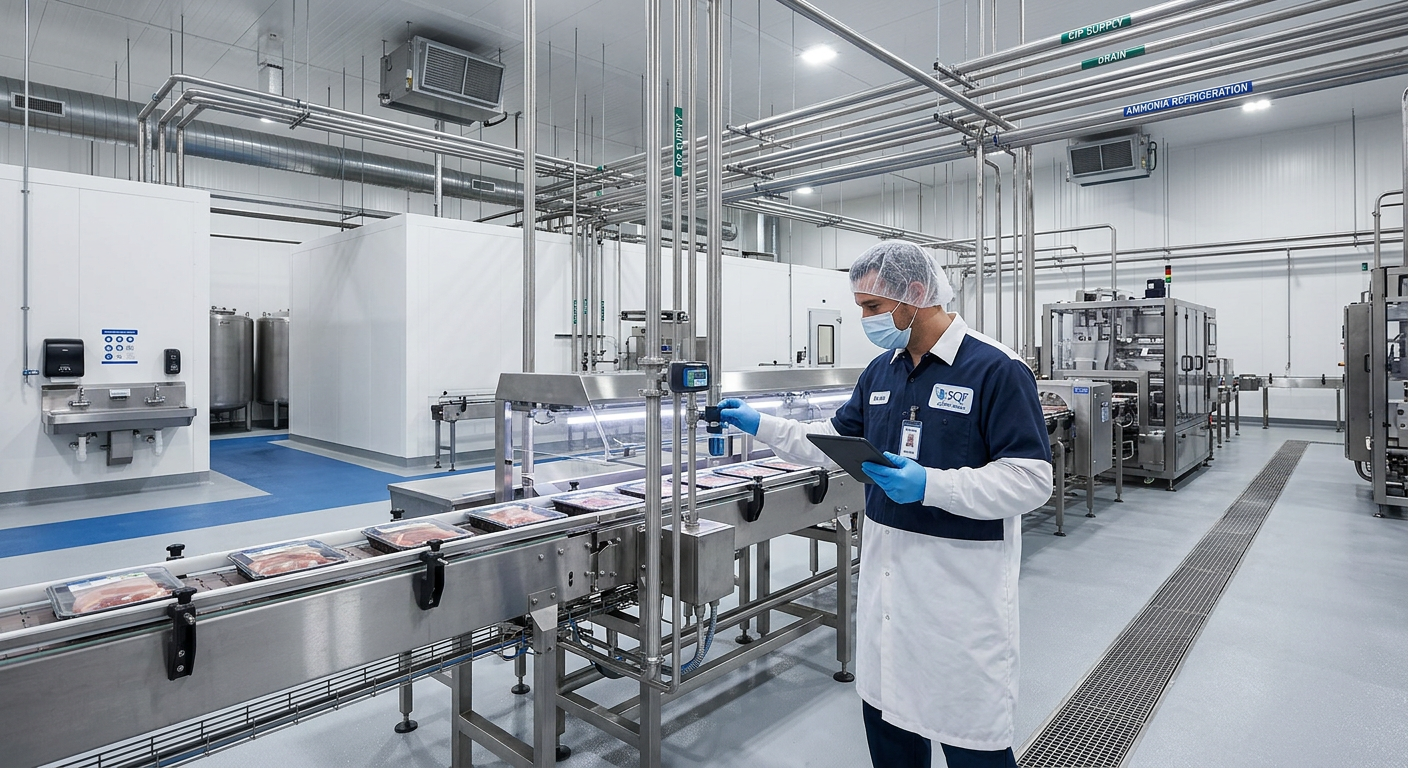
Multi-SKU Production Line Design: Engineering Flexible Manufacturing for High-Mix Operations
[trp_language language=”en_US”]
High-mix production is no longer a niche operating model in the United States. Food and beverage manufacturers from Los Angeles to Chicago, Houston, Atlanta, and New Jersey now manage growing SKU counts, more frequent promotional runs, retailer-specific packouts, club-store formats, and seasonal products on the same production assets. A line that was once optimized for one or two formats now may need to handle dozens of package sizes, recipes, viscosities, labels, closures, and case configurations without destroying plant efficiency.
That is why multi-SKU production line design has become a strategic engineering discipline rather than a simple equipment selection exercise. The right line architecture can reduce downtime, protect labor productivity, support sanitation requirements, simplify automation, and deliver profitable capacity without automatically adding new buildings or duplicating entire lines. For U.S. processors and packagers operating near major trade corridors such as the Port of Los Angeles, Port of Long Beach, Savannah, Houston, Newark, and Memphis distribution networks, responsiveness matters almost as much as throughput.
In this article, the focus is practical: how to engineer flexible manufacturing for high-mix operations, how to measure the hidden cost of changeovers, how to apply SMED concepts in packaging environments, how servo-driven and recipe-based systems reduce manual intervention, and how to calculate whether flexibility beats expansion. The guidance applies across beverages, sauces, proteins, dairy, ready-to-drink products, shelf-stable foods, and co-packing operations throughout the United States.
Quick Answer

A well-designed multi-SKU production line is critical because it allows a manufacturer to run many products, package sizes, and formats with minimal downtime, predictable quality, and stronger asset utilization. In the United States market, where SKU proliferation is driven by retail fragmentation, e-commerce, private label, seasonal launches, and foodservice variation, the winning line is not simply the fastest line. It is the line that can switch quickly, repeat settings accurately, maintain sanitation standards, and preserve OEE while handling product complexity.
For most food and beverage facilities, the best results come from combining five principles: modular line architecture, SMED-based changeover design, recipe management, servo-driven adjustments, and production sequencing based on family logic. When these are integrated correctly, manufacturers often unlock more practical capacity from existing assets than they would from adding another conventional line.
| Design Priority | Why It Matters | Typical U.S. Plant Benefit | Risk If Ignored |
|---|---|---|---|
| Fast changeover | Reduces idle minutes between SKUs | Higher daily run time | Lost output and overtime |
| Repeatable settings | Prevents setup variation by shift | Lower startup scrap | Quality drift and rework |
| Recipe automation | Stores product and format parameters | One-button transitions | Manual setup errors |
| Flexible mechanics | Supports multiple bottles, pouches, trays, or cases | Broader SKU portfolio | Constant retrofit spending |
| Sequencing logic | Minimizes large setup jumps | Smoother schedule execution | Excessive micro-stops |
| OEE tracking by SKU | Exposes hidden losses product by product | Better investment decisions | False view of line performance |
The table above shows why flexibility should be engineered from the beginning. In many U.S. plants, downtime is not caused by a single large failure. It comes from dozens of small setup events, adjustment errors, sanitation resets, film changes, and format mismatches spread throughout the week.
Why Multi-SKU Line Design Is Critical: The Hidden Cost of Changeover Downtime

Many leadership teams still underestimate the cost of changeovers because they look only at the scheduled setup window. The real cost is larger. It includes equipment stoppage, line clearance, sanitation, trial runs, startup scrap, operator waiting time, QA verification, label verification, coding checks, and downstream starvation or blockage. On a high-mix line, these minutes accumulate faster than most plants realize.
Consider a beverage facility in the Midwest running 18 SKUs across bottle sizes, flavors, and pack patterns. If each changeover takes 55 minutes and the line switches six times per day, that is 330 minutes of planned downtime. Add 10 minutes of stabilization and scrap per change, and the actual impact becomes 390 minutes. Over a five-day week, that is 32.5 hours of lost productive time. At a line rate of 250 units per minute, the opportunity cost is massive even before labor, utilities, and missed order service are counted.
Hidden losses are even sharper in food plants with allergen segregation, USDA inspection touchpoints, washdown requirements, retort scheduling dependencies, and packaging material changes. A sauce line in New Jersey shifting from mild to spicy, glass to PET, and club-store to retail pack may experience not one changeover, but several layered changeovers at once.
| Downtime Element | Visible on Schedule? | Typical Minutes per Event | Common Cause |
|---|---|---|---|
| Mechanical change parts | Yes | 10-35 | Guide rails, stars, flights, heads |
| Sanitation reset | Partly | 15-60 | Flavor, allergen, dairy, protein change |
| Recipe verification | Often no | 5-15 | Manual parameter confirmation |
| Startup scrap | No | 5-20 | Misalignment and unstable settings |
| Code and label checks | No | 3-10 | Retail compliance and traceability |
| Downstream recovery | No | 5-25 | Case packer, palletizer, accumulation refill |
This is why line design matters. A flexible line is not just an equipment line that can technically accept multiple SKUs. It is a system designed so the transition cost between SKUs is operationally acceptable. In high-mix environments, profitability lives in the transition.
The line chart reflects the broad shift in the United States toward flexible manufacturing investments. Growth is driven by retailer pack diversity, co-manufacturing demands, direct-to-consumer channels, and the need to launch products faster without waiting for major greenfield capacity.
SMED Principles Applied to Food and Beverage Packaging Line Changeovers

SMED, or single-minute exchange of dies, is not limited to automotive manufacturing. In food and beverage packaging, it provides one of the most reliable frameworks for reducing changeover time without increasing risk. The concept centers on separating internal tasks that require stoppage from external tasks that can be completed while the line is still running, then simplifying, standardizing, and error-proofing the work.
For packaging lines in the United States, SMED often starts with direct observation. Teams time each step at the filler, capper, labeler, cartoner, case packer, conveyor transfer points, and palletizing system. They document who does what, what tools are needed, where the parts are stored, and where waiting occurs. In many plants, the largest gains come not from exotic technology but from disciplined redesign of basic setup work.
Examples include pre-staging change parts on shadow boards, color-coding format kits, using quick-release clamps, replacing bolted adjustments with indexed handwheels, adding digital position indicators, and aligning sanitation tasks with setup tasks so crews do not queue behind each other.
| SMED Principle | Packaging Line Application | Expected Result | Implementation Note |
|---|---|---|---|
| Separate internal and external work | Pre-stage rails, labels, films, and code data | Shorter stop time | Requires scheduling discipline |
| Convert internal to external | Preset guide assemblies offline | Faster mechanical setup | Use duplicate change kits |
| Simplify fasteners | Use tool-free knobs and cams | Less wrench time | Best for frequent format changes |
| Standardize settings | Use indexed scales and digital readouts | Repeatable setup | Critical for multi-shift operations |
| Parallel work | Separate sanitation, QA, and setup roles | Reduced waiting | Needs strong work instructions |
| Error-proof the process | Interlocks and recipe validation | Lower startup scrap | Integrate with controls |
Plants in high-throughput logistics corridors such as Dallas-Fort Worth, Inland Empire California, and central Pennsylvania often gain outsized benefits from SMED because transportation and fulfillment demands leave little room for missed windows. Faster changeovers mean smaller batch sizes become economically feasible, allowing production to align more closely with market pull.
For facilities looking for execution support, a capable engineering partner should not stop at recommending SMED in theory. It should map the process, quantify downtime, redesign the mechanical interfaces, and integrate the controls logic that makes the new method sustainable. This is where a firm with both process and packaging integration experience becomes valuable.
Recipe Management Systems: Storing 50+ SKU Parameters for One-Button Changeover
Recipe management is one of the most powerful enablers of multi-SKU flexibility. In a modern line, a recipe is not just a formula. It is a controlled data package that can store filling parameters, conveyor speeds, servo positions, label placement offsets, cap torque windows, checkweigher tolerances, coding templates, reject logic, temperature setpoints, and sanitation or allergen notes.
On a high-mix line running 50 or more SKUs, manual setup becomes increasingly risky. Shift-to-shift variation grows, tribal knowledge dominates, and startup waste increases. A recipe management system solves this by making the ideal setup repeatable. The operator selects the SKU, the HMI calls the stored parameters, and the line guides or automatically performs the transition.
In food and beverage plants, recipe architecture should be layered. Product recipe, packaging recipe, pallet pattern recipe, and utility recipe may need separate control. For example, a dairy beverage line in Wisconsin may use the same liquid recipe but different bottle diameters, closure colors, label lengths, and case counts depending on channel. Good system design avoids recreating redundant recipes when only one layer changes.
| Recipe Data Category | Typical Stored Variables | Benefit | Risk if Manual |
|---|---|---|---|
| Product handling | Fill time, pressure, temperature, viscosity compensation | Stable product quality | Underfill or overfill |
| Container setup | Guide width, star wheel positions, transfer timing | Less jamming | Breakage and stoppages |
| Closure control | Capper torque, head height, sorter speed | Seal integrity | Leaks and rework |
| Labeling and coding | Label offset, print format, date code rules | Retail compliance | Mislabeling exposure |
| Case packing | Pack count, pattern, blank size, tape settings | Downstream consistency | Case rejects |
| Quality thresholds | Weight limits, vision standards, reject logic | Automated verification | Inconsistent QA screening |
The explanation behind this table is straightforward: every recurring manual adjustment is a candidate for recipe capture. The larger the SKU portfolio, the more expensive it becomes to rely on memory or printed setup sheets alone.
Technically, this is where advanced controls expertise matters. Disruptive Process Solutions brings process, mechanical, electrical, and controls integration together, including PLC programming, automation, SCADA, and recipe or batch control frameworks. That combination is especially useful when a client wants packaging flexibility without disconnecting it from upstream blending, batching, pasteurization, aseptic systems, or CIP logic. More information on the company’s broader engineering approach can be found on its company overview page.
Servo-Driven Format Adjustment: Tool-Free Changeover for Packaging Equipment
Servo-driven adjustment has changed what “quick changeover” means. Traditional lines depend on hand-cranks, shim packs, rulers, and operator feel. Servo-based systems move those adjustments into controlled motion profiles with stored positions. Guide rails, lane dividers, filler settings, capper head heights, label wrap positions, and collator components can all be repositioned automatically or semi-automatically based on the selected SKU.
The immediate benefit is time reduction, but the deeper benefit is repeatability. A servo does not guess. It returns to the programmed position every time, making startup smoother and reducing quality drift. For plants with frequent bottle, can, tray, carton, or pouch changes, servo-driven format adjustment can remove one of the biggest causes of operator-dependent variation.
This is especially relevant in co-packing and private-label operations where order sequencing changes often. A contract packer near Atlanta serving multiple national brands may run one customer’s 12-ounce sparkling beverage in the morning, another customer’s 16-ounce energy product in the afternoon, and a limited-time pack in the evening. Tool-free, servo-based changes preserve schedule flexibility.
| Adjustment Method | Setup Speed | Repeatability | Training Burden |
|---|---|---|---|
| Manual ruler-based | Slow | Low | High |
| Manual indexed handwheel | Moderate | Medium | Moderate |
| Digital position indicator | Moderate to fast | Good | Moderate |
| Semi-automatic servo | Fast | High | Low to moderate |
| Full automatic servo recipe recall | Very fast | Very high | Low |
| Hybrid servo with manual change parts | Fast | High | Moderate |
The table shows why servo solutions are often justified on lines with frequent product changes. They do not remove every manual task, but they significantly reduce setup time and improve first-pass success.
For manufacturers assessing equipment options, it is also important to review the practical side: spare parts, controls support, hygienic design, washdown compatibility, and local service access in the United States. A flexible line should not become an overengineered maintenance burden. That is why the right design partner should align automation sophistication with labor capability and maintenance readiness.
Modular Line Architecture: Dedicated Lines vs. Flexible Lines vs. Multi-Lane Configurations
There is no universal best architecture for high-mix operations. The right model depends on SKU mix, sanitation boundaries, throughput targets, packaging commonality, labor structure, capital constraints, and growth plans. In practice, most manufacturers are choosing among three broad models: dedicated lines, flexible lines, and multi-lane configurations.
Dedicated lines are usually best when one product family dominates demand, regulatory separation is strict, or line speed is so high that flexibility would impose too much compromise. Flexible lines are best when packaging similarities are sufficient and changeovers can be controlled tightly. Multi-lane systems are attractive when smaller units can be distributed across synchronized paths or when retail assortment packs require varied collations.
| Architecture | Best Use Case | Main Strength | Main Limitation |
|---|---|---|---|
| Dedicated line | High-volume stable SKU | Maximum speed | Low adaptability |
| Flexible shared line | Medium to high SKU mix | Capital efficiency | Setup discipline required |
| Multi-lane line | Small formats or parallel feeds | Output balance | Controls complexity |
| Hybrid hub-and-spoke | Shared upstream, split downstream | Balanced flexibility | Integration planning needed |
| Modular cells | Growing brands and co-packers | Scalable expansion | Space coordination |
| Portable skid modules | Pilot and specialty products | Fast deployment | Lower throughput ceiling |
The explanation here is that architecture should be selected at the system level, not machine by machine. A line that appears cheaper on paper may create downstream congestion, cleaning conflicts, utility overload, or labor inefficiency once integrated into the full plant.
This is where full-scope engineering is crucial. DPS supports process engineering, capital planning, owners representation, project management, installation, equipment integration, and general contracting functions where applicable. That matters because multi-SKU flexibility often reaches beyond the packaging machine itself into utilities, CIP, compressed air, water systems, structural modifications, electrical distribution, and controls architecture. Details about these capabilities are available through the firm’s services page.
The demand comparison above highlights where flexibility is currently most urgent: beverage systems and co-packing operations lead, but dairy, prepared foods, sauces, and protein processors are also increasing investment as packaging and channel complexity rises.
Sequencing Strategies: Gray-Code Scheduling and Product Family Batching
Even the best line will underperform if the production schedule ignores transition logic. Sequencing strategies matter because the cost of moving from SKU A to SKU B is not equal to the cost of moving from SKU A to SKU Z. The goal is to reduce cumulative changeover burden across the week while still meeting customer demand.
Product family batching is the most common method. Similar SKUs are grouped by container size, closure, allergen profile, film width, label stock, case pattern, or sanitation category. This reduces extreme setup jumps. A line may run 12-ounce bottles from low-viscosity to higher-viscosity products, or non-allergen items before allergen-containing products, or standard retail packs before club packs.
Gray-code scheduling is more advanced and useful when multiple change variables interact. The concept is to sequence products so each successive SKU differs from the previous one by the smallest practical number of setup variables. Instead of changing bottle diameter, cap style, label length, and case count all at once, the schedule aims to change only one major variable at a time where possible.
In a U.S. plant shipping through Memphis, Kansas City, or Columbus distribution channels with tight fulfillment windows, sequencing can improve order responsiveness without buying more equipment. It is one of the lowest-cost productivity improvements available when implemented with planner, operations, and quality alignment.
The area chart illustrates a continuing operational trend: U.S. manufacturers are moving away from long, single-SKU campaigns toward more responsive high-mix scheduling. That trend is expected to intensify into 2026 as private label growth, retailer differentiation, and consumer preference fragmentation continue.
OEE Optimization for Multi-SKU Environments: Measuring and Maximizing Line Utilization
OEE in a multi-SKU environment must be measured more carefully than in a stable, single-product plant. If all products are averaged together, management may believe the line is healthy when several SKUs are actually unprofitable to run. OEE should be segmented by product family, package format, shift, and changeover type.
Availability losses include planned setups, sanitation, waiting for QA release, and delayed materials. Performance losses include speed reductions due to unstable containers, difficult films, sticky products, or accumulation imbalance. Quality losses include startup scrap, coding errors, label rejections, seal failures, and fill deviations.
The most effective plants maintain a “golden run” benchmark for each major SKU family and compare current runs against it. They also track post-changeover stabilization time separately from the mechanical changeover itself. This is important because a line that changes in 12 minutes but needs 25 minutes to produce good product is not truly a 12-minute changeover line.
From a technology standpoint, modern OEE improvement depends on integrated controls, data collection, and operator visibility. This is consistent with DPS’s technological capabilities across PLC programming, SCADA, automation, utility integration, and process controls. In high-mix settings, the value is not only in machine connectivity but in turning that connectivity into practical operating decisions.
ROI Calculation: Flexible Multi-SKU Line Investment vs. Capacity Expansion
One of the most important strategic questions in the United States market is whether to invest in a more flexible line or build additional capacity. The answer depends on utilization, SKU growth, demand variability, labor, utilities, and building constraints. Too many manufacturers assume expansion is the only path to growth when better line design could unlock significant hidden capacity.
A disciplined ROI model compares the following:
- Current changeover minutes per week
- Expected reduction after upgrades
- Recovered production hours
- Incremental saleable output
- Labor impact
- Scrap reduction
- Maintenance effect
- Energy and utility impact
- Avoided building or line duplication cost
For example, if a plant in North Carolina or California reduces changeover time from 45 minutes to 15 minutes across 30 weekly changeovers, it recovers 900 minutes, or 15 productive hours. At 180 units per minute, that equals 162,000 additional units per week. If contribution margin is favorable, the payback can be much faster than expected.
| Investment Option | Capital Range | Speed to Benefit | Best When |
|---|---|---|---|
| SMED retrofit | Low | Fast | Manual setup is the main loss |
| Recipe management upgrade | Low to medium | Fast | Parameter variation drives scrap |
| Servo changeover package | Medium | Moderate | Frequent format changes occur |
| Modular line redesign | Medium to high | Moderate | System bottlenecks are structural |
| New flexible line | High | Longer | Growth is strong and mix is complex |
| Dedicated capacity expansion | High to very high | Longer | One or two SKUs dominate demand |
In many cases, the most profitable path is not a greenfield build, but a targeted flexibility upgrade that recovers enough hidden capacity to defer expansion for several years. This aligns with the operating philosophy of firms that focus on profitable capital deployment rather than simply selling the largest project. A good example of that business-minded approach can be seen in project case studies and execution examples, where problem solving and ROI discipline take priority over unnecessary capital spending.
This comparison chart emphasizes that in high-mix environments, modular flexible lines and strong recipe systems often produce better returns than simply adding dedicated equipment, especially when the product portfolio continues to evolve.
FAQ
What industries benefit most from multi-SKU line design?
Beverages, dairy, sauces, dressings, prepared foods, protein processing, plant-based products, shelf-stable foods, and co-packing operations all benefit. Any operation dealing with retailer variety packs, seasonal launches, or multiple customer formats should evaluate flexible line design.
What product types are most difficult in a high-mix environment?
Products with major viscosity differences, allergen changes, fragile containers, unusual closures, mixed case packs, or strict coding and traceability requirements tend to create the biggest setup burden. Aseptic and retort applications also require careful system integration.
How many SKUs justify a recipe management system?
There is no fixed number, but once a line regularly handles more than 10 to 15 recurring combinations of product and package, recipe automation often starts paying back. At 50 or more SKU variants, it becomes a major operational advantage.
Should a manufacturer choose dedicated lines or one flexible line?
That depends on volume concentration. If a small number of SKUs dominate demand and require maximum speed, dedicated lines may be better. If demand is distributed across many formats, a flexible line is often the smarter U.S. investment.
How does sanitation affect multi-SKU design?
Sanitation can determine the architecture. Allergen separation, dairy cleaning, protein washdown, and flavor carryover all influence how much flexibility is practical. Hygienic design, CIP strategy, drainage, materials of construction, and cleaning validation should be part of the line concept from day one.
What should buyers ask equipment suppliers?
Ask for actual changeover time by format, recipe storage limits, servo axis list, spare parts strategy, service coverage in the United States, washdown rating, startup scrap expectations, and examples from comparable food or beverage plants. Also ask whether OEE data can be segmented by SKU.
How do local suppliers fit into the decision?
Local support matters for uptime. Manufacturers in the Southeast may prioritize service access from North Carolina, Georgia, or Florida. West Coast plants may want rapid support from California or nearby integrators. Midwestern processors may prefer regional fabrication and controls service. The best solution often combines major OEMs with a strong integrator that can manage local trades, commissioning, and long-term optimization.
What are the key buying signals that a plant needs a redesign?
Repeated overtime, frequent schedule misses, long startup scrap windows, inconsistent setup by shift, growing SKU count, heavy dependence on one technician, and pressure to add products without adding floor space are all signs that the current line design is no longer aligned with the business model.
What future trends should U.S. manufacturers watch through 2026?
By 2026, several trends will shape multi-SKU line engineering in the United States: wider use of digital twins for changeover planning, more servo and vision-based self-adjustment, stronger sustainability pressure around packaging material reduction, rising demand for energy-efficient utility systems, greater traceability expectations, and policy pressure around food safety documentation and labor productivity. Flexible lines will also need to support more recyclable materials, lightweight containers, and retailer-specific data requirements without sacrificing throughput.
How can DPS help with multi-SKU projects?
DPS works as a full-scope food and beverage engineering partner across North America. On the manufacturing side, the company supports complete processing and packaging environments in beverages, proteins, dairy, sauces, prepared foods, aseptic systems, and related applications. On the technology side, DPS integrates process, utilities, controls, PLC programming, SCADA, and automation so flexibility does not stop at the machine level. On the service side, the firm supports planning, design, installation, project management, owners representation, integration, and execution under its Design Build Manage model. For clients evaluating custom tanks, CIP systems, or related proprietary hardware, additional information is available on the equipment solutions page.
In summary, multi-SKU line design is not just about running more products on the same footprint. It is about aligning engineering, controls, utilities, sanitation, scheduling, and capital strategy with the realities of the United States market. The best systems reduce changeover friction, protect product quality, improve labor productivity, and turn complexity into a competitive advantage. For manufacturers operating in a landscape shaped by faster launches, narrower inventories, and expanding SKU portfolios, flexibility is no longer optional. It is a core profit lever.
[/trp_language]
Complete Company Portfolio

About the Author: Disruptive Process Solutions (DPS)
The DPS team combines process engineering expertise with real-world food and beverage manufacturing experience. Our content focuses on process optimization, production efficiency, facility improvements, and practical solutions that help manufacturers operate more effectively in a rapidly evolving industry.
Share

