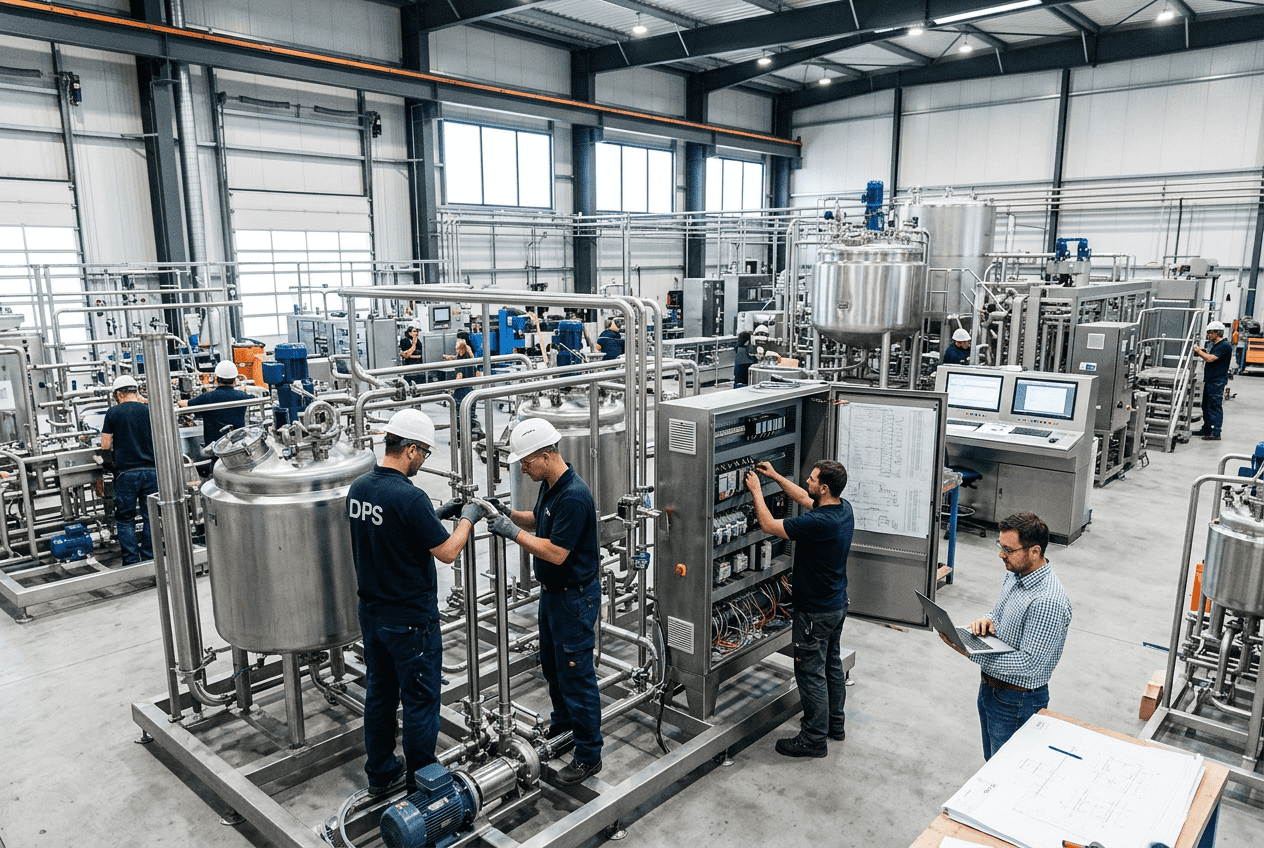
Non-Carbonated Beverage Processing
[trp_language language=”en_US”]
Still Beverage Processing Systems in the United States
Non-carbonated beverage processing in the United States centers on one goal: delivering safe, stable, great-tasting drinks at the required shelf life and production cost. For juices, teas, enhanced waters, dairy alternatives, and functional beverages, the right approach usually comes down to product chemistry, target distribution, package format, and throughput. In practical terms, most U.S. manufacturers choose among hot fill, cold fill with preservatives or chilled distribution, and aseptic processing. They also balance pasteurization method, pH control, package selection, and filler technology to protect both product quality and plant profitability.
Across U.S. beverage hubs such as Chicago, Dallas, Los Angeles, Atlanta, the New Jersey corridor, and the Carolinas, producers are reworking still drink lines to handle shorter runs, cleaner labels, and more demanding retailers. Import gateways like the Ports of Los Angeles and Long Beach, Savannah, Houston, and New York/New Jersey also influence equipment lead times, packaging sourcing, and co-packing strategy. For manufacturers planning new lines or retrofits, the best projects start with process design rather than equipment shopping. That is especially true when the portfolio includes multiple SKUs, varying acidity, pulp, botanicals, sweetener systems, or sensitive functional ingredients.
Quick Answer

For still beverages in the U.S. market, hot fill is commonly used for acidic products such as many teas and juices, cold fill works where refrigerated distribution or preservatives are acceptable, and aseptic is the premium route for shelf-stable, preservative-free products that need long distribution windows. The optimal system depends on pH, water activity, solids, viscosity, package type, desired shelf life, and retail channel. Gravity fillers fit low-viscosity drinks, piston fillers fit thicker or particulate products, and flowmeter fillers fit high-speed, high-accuracy operations. Strong line design also requires validated thermal processing, sanitary tanks and piping, effective CIP, package compatibility, and microbiological risk control.
For buyers, the fastest way to reduce project risk is to align process authority, engineering, utilities, automation, and packaging decisions early. This is where an integrated partner matters. Disruptive Process Solutions approaches beverage projects with an engineering-first model designed to improve long-term profitability, not just install equipment. In the United States, that matters because labor, utilities, freight, and compliance costs vary widely by region, from California to Texas to North Carolina.
| Decision Area | Primary Question | Typical Options | Main Risk | Best Use Case | Key KPI |
|---|---|---|---|---|---|
| Process method | How will the product be stabilized? | Hot fill, cold fill, aseptic | Underprocessing or overprocessing | Shelf-stable line design | Micro pass rate |
| Thermal treatment | What heat load is acceptable? | HTST, flash, UHT | Flavor damage | Tea, juice, nutrition drinks | Retention of flavor and color |
| Filling system | How accurate and versatile must filling be? | Gravity, piston, flowmeter | Giveaway or foaming | SKU-dependent | Fill variance |
| Package | What package survives process and distribution? | PET, glass, carton, pouch | Paneling, breakage, oxygen ingress | Retail and e-commerce | Damage rate |
| Micro control | How is spoilage prevented? | Acidification, sanitation, filtration | Yeast, mold, spore issues | Acid and low-acid drinks | Shelf life stability |
| Utilities | Can the plant support the process? | Steam, glycol, compressed air, RO water | Capacity bottlenecks | New or expanded facilities | OEE and uptime |
The table above shows why still beverage processing should be treated as a full system decision. Choosing a filler before confirming product chemistry, sanitation philosophy, and package behavior often causes rework later.
Processing Methods for Still Beverages: Hot Fill, Cold Fill, and Aseptic

Hot fill remains one of the most common methods for acidic still beverages in the United States. Product is heated to a validated temperature, filled hot into compatible containers, and held long enough to sanitize the package interior and closure zone. This method is widely used for teas, juice drinks, and some functional beverages where the flavor profile can tolerate the heat impact. It is attractive because it can avoid preservatives and does not require a fully aseptic filling environment. The tradeoff is package limitation, thermal stress, and potential flavor darkening over time.
Cold fill is simpler from a filling standpoint but depends heavily on microbiological strategy. In many cases, it is paired with chilled distribution, preservatives, tight hygienic design, or filtration. It can work well for fresh-positioned products sold regionally around markets like Charlotte, Miami, Phoenix, or Seattle, where rapid replenishment supports shorter shelf life models. Cold fill can preserve delicate aromas better than hot fill, but if the hurdle strategy is weak, spoilage risk rises quickly.
Aseptic processing is the most robust shelf-stable route for many modern still drinks, especially premium, low-additive, and functional products. The product is sterilized separately from the package, and both are brought together in a sterile filling zone. This approach supports long ambient shelf life with excellent flavor retention versus prolonged heat exposure. It is common in carton packs, some PET applications, and specialized bottles. Capital cost, operational discipline, validation, and operator training are all higher.
From a market standpoint, U.S. producers are increasingly interested in aseptic and advanced hot fill because retailers want longer shelf life and consumers want cleaner labels. National distribution through grocery, club, convenience, e-commerce, and foodservice all reward process consistency.
| Method | Typical Product pH | Package Match | Capital Level | Shelf Life Potential | Common U.S. Use |
|---|---|---|---|---|---|
| Hot fill | Usually below 4.6 | Heat-set PET, glass | Moderate | 6 to 12 months | Tea, juice drinks |
| Cold fill refrigerated | Varies | PET, HDPE, glass | Lower to moderate | Short to medium | Regional fresh beverages |
| Cold fill with preservatives | Usually acidic | PET, glass | Moderate | Medium | Value-oriented retail SKUs |
| Aseptic carton | Acid or low-acid | Carton | High | Long | Nutrition, dairy alternatives |
| Aseptic bottle | Acid or low-acid | Specialized PET/HDPE | High | Long | Functional and premium RTD |
| Hybrid line strategy | Portfolio-dependent | Multiple | High but flexible | Variable | Co-packers and multi-SKU plants |
For manufacturers planning a new facility, process selection should also account for labor availability, state utility rates, sanitation staffing, and the local warehouse network. A line that looks inexpensive on paper may become costly if it requires high manual intervention in a tight labor market.
Juice, Tea, and Functional Beverage Processing Line Design

Juice, tea, and functional beverage line design starts with the product matrix. Juice systems often need blending accuracy, deaeration, pulp handling, and Brix control. Tea lines may need extraction, filtration, aroma protection, and color management. Functional beverages frequently require high-shear mixing, powder induction, hydration time, ingredient protection, and separation control. Some formulas also introduce vitamins, botanicals, proteins, emulsions, sweetener blends, or fiber systems that change viscosity and thermal sensitivity.
A well-designed line typically includes water treatment, ingredient receiving, batching, thermal processing, surge capacity, filling, secondary packaging, and CIP. Utilities are just as important: steam, glycol, compressed air, chilled water, drains, wastewater handling, and controls integration often determine whether the plant can hit output targets. In fast-growing beverage corridors from Dallas-Fort Worth to inland Southern California to the Research Triangle, many expansion projects fail not because the filler is undersized, but because utility and changeover design were not solved early.
On the technological side, DPS supports projects with process, mechanical, electrical, controls, and automation expertise. That means recipe control, SCADA visibility, in-line Brix monitoring, water treatment, sanitation design, and integration of thermal systems are developed as one coordinated production environment instead of disconnected pieces. For U.S. beverage operators, this is important when the same site may run tea in one shift, juice in another, and a functional line extension on weekends.
| Line Element | Juice Priority | Tea Priority | Functional Beverage Priority | Typical Challenge | Engineering Focus |
|---|---|---|---|---|---|
| Water treatment | Flavor neutrality | Consistent mineral profile | Ingredient compatibility | Source variability | RO and disinfection |
| Blending | Brix and pulp consistency | Sweetener dispersion | Powder hydration | Batch repeatability | Automation and metering |
| Filtration | Clarity target | Leaf fines removal | Stability | Pressure drop | Filter sizing |
| Thermal process | Color retention | Aroma retention | Active protection | Heat damage | Residence time control |
| Filling | Foam and pulp behavior | Temperature control | Accuracy on premium SKUs | Changeover time | Filler match to product |
| CIP | Sugar removal | Tea stain control | Allergen and oil removal | Downtime | Circuit validation |
Buying advice for U.S. processors: if your commercial plan includes club packs, foodservice jugs, and retail singles, design the backbone for the broadest sanitation and utility needs first, then optimize around container sizes. That usually protects capital better than chasing the cheapest individual machine quote.
Pasteurization and UHT Options for Non-Carbonated Beverages
Pasteurization for still beverages is not one-size-fits-all. HTST and flash pasteurization are common for acidic beverages where the goal is to reduce spoilage organisms while limiting sensory damage. UHT goes further, using higher temperatures and shorter times to create a commercially sterile product suitable for aseptic filling. Tunnel pasteurization is less common for many still beverages than for packaged products in specific formats, but it can have niche applications.
The right thermal process depends on the organism risk, acidity, package, storage temperature, and the product’s tolerance for heat. Juice drinks often perform well under carefully tuned HTST. Tea may require close attention to color pickup and aroma retention. Functional drinks with vitamins or botanical notes may benefit from UHT plus aseptic filling, especially when distributed nationally from hubs near Memphis, Indianapolis, or central Pennsylvania where warehousing feeds broad U.S. coverage.
DPS also brings manufacturing capability into this part of the decision. The company designs and supplies process equipment such as tanks and CIP systems and integrates complete thermal and utility infrastructure. That matters because pasteurization performance is only as reliable as the surrounding surge control, valve matrix, temperature instrumentation, and sanitation execution.
| Thermal Option | Heat Exposure | Quality Impact | Package Requirement | Capital Need | Best Fit |
|---|---|---|---|---|---|
| HTST | Moderate | Generally good | Hot fill or hygienic downstream | Moderate | Acid beverages |
| Flash pasteurization | Short and controlled | Better flavor retention | Fast downstream handling | Moderate | Tea and juice drinks |
| UHT | Very high, very short | Strong shelf stability with careful design | Aseptic filling | High | Premium shelf-stable drinks |
| Tunnel pasteurization | Packaged product heat treatment | Package-dependent | Heat-tolerant container | Moderate to high | Specific packaged applications |
| Batch pasteurization | Longer | More quality tradeoff | Small-scale flexibility | Lower | Pilot and niche production |
| HPP adjunct strategy | Non-thermal post-fill | Excellent fresh profile | Pressure-compatible package | High service cost | Premium chilled beverages |
The key point is that thermal processing should be validated against actual product formulation, not a generic category assumption. A lightly acidified botanical drink can behave very differently from a standard juice blend.
Filling Technologies for Still Beverages: Gravity, Piston, and Flowmeter Fillers
Filler choice affects speed, accuracy, foaming, sanitation complexity, and SKU flexibility. Gravity fillers are simple and effective for free-flowing, low-viscosity still drinks. They are common where foaming is manageable and the product does not contain heavy particulates. Piston fillers excel with thicker beverages, products with particulates, or applications where volumetric consistency across variable textures matters. Flowmeter fillers use mass or magnetic flow measurement and are favored in modern high-speed beverage plants because they offer strong accuracy, recipe flexibility, and reduced product giveaway.
For a U.S. plant supplying both regional grocery and national chains, fill accuracy can have major margin impact. A 1% giveaway on a high-volume line can erase substantial annual profit. At the same time, an overengineered filler can be unnecessary for a narrow SKU mix. Matching the filler to the commercial model is essential.
Service capability is critical here. DPS supports end-to-end project planning, installation, integration, and execution management so that fillers are not dropped into lines without upstream and downstream alignment. That includes owner-side advocacy, project management, and full-system coordination with conveyors, closure systems, clean utilities, controls, and commissioning.
| Filler Type | Best Viscosity Range | Particulate Handling | Accuracy Level | Speed Potential | Typical Buyer |
|---|---|---|---|---|---|
| Gravity | Low | Limited | Good | Moderate to high | Tea and water-based drinks |
| Piston | Medium to high | Good | Very good | Low to moderate | Smoothies and thicker blends |
| Magnetic flowmeter | Low to medium | Limited to controlled | Excellent | High | Large-scale beverage plants |
| Mass flowmeter | Low to medium | Controlled | Excellent | High | Premium and high-accuracy lines |
| Vacuum-assisted systems | Specialized | Low | Good | Moderate | Specific bottle formats |
| Hybrid multi-format systems | Variable | Application-specific | Very good | Moderate | Co-packers |
When comparing suppliers, U.S. buyers should also ask about spare parts lead times, local service coverage, recipe memory, CIP integration, closure torque verification, and integration with existing PLC standards.
pH and Acidification Control for Microbiological Stability in Still Drinks
pH is one of the most important control points in still beverage processing. In broad terms, beverages below pH 4.6 are easier to stabilize microbiologically than low-acid drinks, but that does not mean they are automatically safe or stable. Acid-tolerant yeasts, molds, and certain spoilage organisms still create major issues. Acidification strategy must account for the acid type, buffering capacity, flavor impact, regulatory labeling, and ongoing process verification.
Citric acid, malic acid, phosphoric acid, and blended acidulant systems are commonly used depending on flavor profile and brand positioning. Functional beverages with botanicals or minerals may show pH drift, precipitation, or flavor imbalance over time. In those cases, bench work and shelf life studies are essential before commercial launch.
Best practice in U.S. plants is to combine formulation control with calibrated inline or at-line measurement, batch records, and operator verification. For high-risk products, this should link to automated recipe management and hold-and-release logic. Producers serving major retailers from distribution centers in Columbus, Kansas City, or Allentown cannot rely on manual memory when thousands of cases may ship across the country within days.
| Control Factor | Why It Matters | Common Tool | Typical Failure Mode | Corrective Action | Business Impact |
|---|---|---|---|---|---|
| Final pH | Micro stability | Calibrated pH meter | Incorrect dosing | Reblend or hold | Reduced recall risk |
| Acid distribution | Taste consistency | Agitation validation | Stratification | Mix longer or redesign tank | Better sensory uniformity |
| Buffering capacity | pH drift management | Lab trials | Unexpected upward drift | Formula adjustment | Longer shelf life |
| Water chemistry | Acid demand changes | RO and mineral control | Source fluctuation | Standardize treatment | More predictable production |
| Ingredient interaction | Stability and clarity | Compatibility study | Precipitation | Reformulate | Lower returns |
| Verification frequency | Compliance and traceability | SOP and automation | Missed checks | Electronic records | Audit readiness |
The explanation behind this table is simple: pH is not just a lab number. It is a production variable tied to taste, sanitation, thermal process assumptions, and legal defensibility.
Preservative-Free Processing Options for Clean Label Non-Carbonated Beverages
Clean label demand continues to reshape the U.S. still beverage category. Many brands want to remove potassium sorbate, sodium benzoate, and similar preservatives while keeping ambient distribution. The main preservative-free pathways are hot fill, aseptic processing, refrigeration, validated thermal processing with tight hygienic design, or in selected chilled cases, HPP. Each route changes capex, logistics, and package selection.
Preservative-free is not a single technology claim; it is a full operating discipline. Plants need strong hygienic zoning, sanitary piping, validated CIP, disciplined ingredient handling, and microbial environmental monitoring. A brand can remove preservatives from the label, but if the plant design is weak, the total business risk often increases.
Here the U.S. market has shifted from simple shelf-stable tea toward more complex functional drinks with lower sugar, botanical inclusions, and protein or fiber systems. Those formulas may be less forgiving. A preservative-free strategy therefore works best when engineering, QA, and commercialization teams are aligned from the start.
For manufacturers evaluating clean-label line upgrades, it often makes sense to review process engineering and integration services before buying hardware. In many cases, profitability improves more from better line architecture, controls, and sanitation planning than from a single high-profile machine purchase.
Bottle and Package Selection: PET, Glass, Carton, and Pouch Options
Package selection affects process compatibility, shelf life, freight cost, sustainability claims, and consumer perception. PET dominates many U.S. still beverage categories due to cost, weight, and line speed. Heat-set PET is often used for hot fill, while standard PET may work in cold fill or aseptic applications depending on system design. Glass supports premium positioning and strong barrier performance but increases freight and breakage concerns. Cartons are popular for aseptic nutrition and shelf-stable products, especially where brand owners want strong sustainability messaging. Pouches are expanding in kids, value, and convenience channels but require careful product-package matching.
Regional logistics matter. West Coast distribution through Los Angeles or Oakland may favor lighter packages to control freight, while Northeast urban delivery can raise warehouse and handling costs that also make lightweight options attractive. E-commerce introduces another layer because damage resistance and dimensional weight both affect profitability.
| Package Type | Process Compatibility | Barrier Performance | Freight Efficiency | Brand Positioning | Main Tradeoff |
|---|---|---|---|---|---|
| PET | Cold fill, hot fill, some aseptic | Moderate | Excellent | Mainstream to premium | Heat and oxygen limitations |
| Glass | Hot fill and cold fill | Excellent | Poorer | Premium and natural | Weight and breakage |
| Aseptic carton | Aseptic only | Very good | Very good | Health and shelf-stable | Higher system complexity |
| Pouch | Cold fill or specialized fill | Variable | Excellent | Convenience and value | Perception and recyclability debates |
| HDPE bottle | Cold fill and some aseptic | Good | Good | Utility and foodservice | Aesthetics for premium retail |
| Multilayer bottle | Specialized applications | Enhanced | Good | Extended shelf life | Higher material cost |
If packaging is a major bottleneck, U.S. processors should also review domestic equipment and vessel support from partners with fabrication capability. A look at custom processing equipment options is useful when standard tank, CIP, or surge solutions do not fit the available floor plan or run strategy.
Shelf Life Extension Strategies for Non-Refrigerated Still Beverages
Extending shelf life without refrigeration requires multiple hurdles working together. Thermal treatment, acidification, package barrier, oxygen control, hygienic design, closure integrity, and warehouse conditions all contribute. For some beverages, deaeration and low dissolved oxygen can substantially improve flavor stability. For others, light protection and oxygen scavenging closures are more important. Shelf life is never just one number from the lab; it is a total supply chain outcome.
Ambient drinks in the United States may sit in summer heat in Phoenix, move through humid Gulf Coast warehouses near Houston, or spend weeks in inland distribution before reaching stores in Denver or Minneapolis. Real shelf life planning therefore includes transportation and retail abuse conditions, not ideal lab storage only.
A practical extension strategy often includes: validated kill step, controlled pH, low oxygen pickup, sanitary hold tanks, closed transfers, package testing, accelerated studies, and periodic real-time verification. For brands moving from regional to national distribution, these measures usually become mandatory.
A recent type of case frequently seen in U.S. beverage expansion is a manufacturer planning major capital spending to add throughput when the true bottleneck lies elsewhere. DPS has built a reputation for stepping back and diagnosing the entire operation first. That can mean identifying controls logic, utility constraints, or poor line balance before recommending major equipment purchases. This kind of business-minded execution is one reason larger food and beverage manufacturers across North America use the company for design, build, and managed delivery rather than isolated machine procurement.
| Shelf Life Lever | Impact on Safety | Impact on Quality | Investment Level | Common U.S. Application | Notes |
|---|---|---|---|---|---|
| Validated thermal process | High | Medium to high | Moderate to high | Hot fill and aseptic lines | Core stability tool |
| Lower dissolved oxygen | Low direct | High flavor benefit | Moderate | Tea and juice | Supports color retention |
| Acidification control | High for acid drinks | Medium | Low to moderate | Juice drinks | Needs verification |
| Improved barrier packaging | Medium | High | Moderate | National distribution SKUs | Reduces oxidation |
| Sanitary design and CIP | High | High indirect | Moderate | All product types | Often underappreciated |
| Warehouse temperature control | Medium | High | Operational | Premium functional beverages | Part of total chain management |
In 2026, future trends in the U.S. still beverage market are likely to include more automation-led recipe control, stronger traceability expectations from retailers, continued sustainability pressure on packaging, and growing state-level attention to water use, wastewater, and energy efficiency. Lines that can switch formats quickly, use less utility intensity, and support clean-label processing will be better positioned.
For project examples and execution style, manufacturers can review selected case studies and project outcomes to see how integrated planning improves ramp-up and reduces hidden costs.
FAQ
What is the best processing method for a shelf-stable acidic tea in the United States?
Hot fill is often the most practical starting point if the flavor profile tolerates the heat and the package is compatible. Aseptic may be better for premium quality retention or broader format flexibility.
When should a beverage manufacturer choose aseptic instead of hot fill?
Aseptic is often the better choice when the product is heat-sensitive, preservative-free, expected to have long ambient shelf life, or is low-acid. It also fits brands seeking premium sensory performance and national distribution.
Are flowmeter fillers worth the added cost?
Usually yes for high-speed U.S. operations with multiple SKUs, tight fill accuracy goals, and significant product value. Reduced giveaway and better automation often justify the investment.
How important is pH control for still drinks?
It is critical. pH affects microbial risk, thermal process assumptions, flavor, and shelf life. It should be tightly monitored with documented verification.
Can a clean-label beverage be shelf-stable without preservatives?
Yes, but only with the right total process. Hot fill, aseptic, strong hygienic design, validated sanitation, and package compatibility are usually required.
What package works best for non-carbonated beverages?
There is no universal best option. PET works well for many mainstream products, glass fits premium positioning, cartons fit aseptic shelf-stable systems, and pouches fit convenience-driven applications.
What should U.S. buyers ask before purchasing a still beverage line?
Ask about process validation, utility loads, CIP logic, filler accuracy, package flexibility, spare parts availability, service response, automation integration, and expansion path for future SKUs.
How should manufacturers evaluate local suppliers in the United States?
Review regional service coverage, install base, fabrication support, code compliance, lead times through ports or domestic factories, and whether the supplier can integrate controls, utilities, and commissioning rather than only ship equipment.
Which industries use non-carbonated beverage processing systems?
Juice, tea, functional wellness drinks, plant-based beverages, dairy alternatives, sports nutrition, school beverage programs, foodservice concentrates, and co-packing operations all rely on these systems.
What makes DPS relevant for U.S. still beverage projects?
DPS combines engineering, equipment integration, project management, and on-the-ground execution for food and beverage manufacturers across North America. Its approach is especially valuable for companies that want complete process systems aligned with profitability, not just a collection of machines.
For beverage manufacturers in the United States, the strongest non-carbonated beverage processing strategy is the one that aligns product science, equipment design, package selection, utilities, and commercial reality from day one. Whether the product is a value juice drink for the Southeast, a premium functional beverage shipping coast to coast, or a multi-SKU co-packing line near major freight lanes, profitable execution depends on treating the process as a complete engineered system.
[/trp_language]
Complete Company Portfolio

About the Author: Disruptive Process Solutions (DPS)
The DPS team combines process engineering expertise with real-world food and beverage manufacturing experience. Our content focuses on process optimization, production efficiency, facility improvements, and practical solutions that help manufacturers operate more effectively in a rapidly evolving industry.
Share