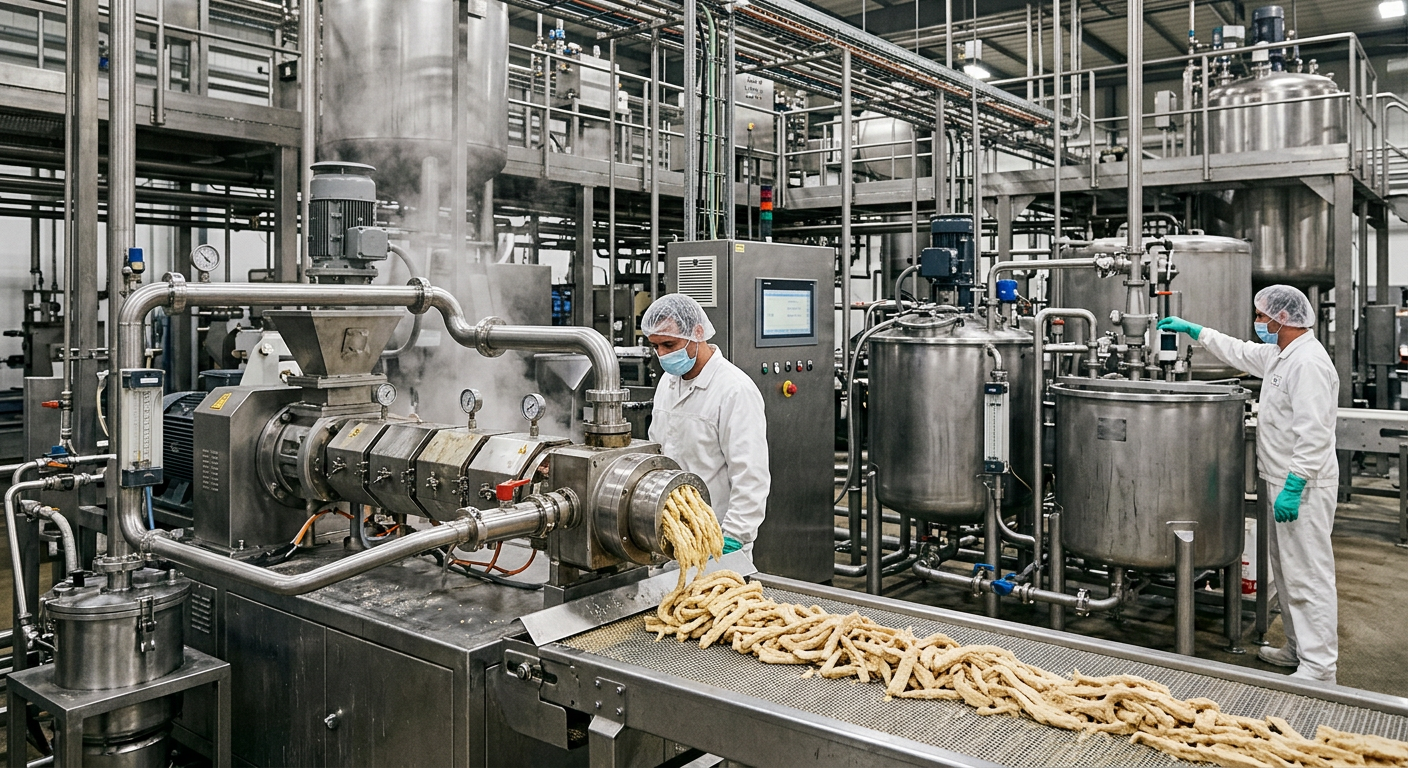
Plant Protein Texturization and Hydration System Design
[trp_language language=”en_US”]
Plant Protein Texturization Solutions in the United States
Quick Answer

If you are planning a plant protein texturization and hydration project in the United States, the most practical path is to work with suppliers and integrators that can combine extrusion, hydration, mixing, utility design, controls, and commissioning into one coordinated scope. For U.S. manufacturers, the strongest options typically include Coperion, Bühler, Wenger, Marel, GEA, and specialized engineering partners such as Disruptive Process Solutions for full-system design and integration.
For immediate action, shortlist companies based on your product target: high-moisture meat analogs, dry textured vegetable protein, soy chunks, pea protein crumbles, fava blends, or customized plant-based ingredient systems. In major manufacturing corridors such as the Midwest, Texas, California, the Carolinas, and the Great Lakes region, local engineering support matters because utilities, sanitation, controls, and plant layout often determine project success more than the extruder alone.
Buyers should also consider qualified international suppliers, including Chinese manufacturers with relevant North American compliance support, strong documentation, and responsive pre-sales and after-sales teams. In some cases, these suppliers offer attractive cost-performance advantages for feeders, dryers, mixers, conveyors, and auxiliary skids, provided validation, spare parts, and commissioning support are clearly defined before purchase.
United States Market Overview for Plant Protein Texturization

The U.S. market for plant protein texturization continues to evolve from simple soy-based textured vegetable protein lines into more advanced systems designed for pea, wheat, fava, chickpea, rice, and blended formulations. Demand is no longer driven only by burger analogs. Manufacturers are now building lines for nuggets, shreds, crumbles, jerky alternatives, prepared meals, frozen entrees, snacks, and hybrid protein products that combine plant and animal inputs. This broader application base is changing how systems are specified.
In practical terms, processors in Chicago, Minneapolis, St. Louis, Kansas City, Charlotte, Los Angeles, Fresno, and Dallas are looking for flexible systems that can handle frequent recipe changes, variable upstream flour characteristics, tighter moisture control, and food safety expectations aligned with FDA, USDA, SQF, and BRC programs. Ports and logistics hubs such as Long Beach, Houston, Savannah, and Newark also influence equipment sourcing because imported components, stainless vessels, motors, controls packages, and spare parts need predictable lead times.
Across the United States, the market is split into several buyer groups: ingredient manufacturers producing dry TVP at scale, branded food companies entering meat alternatives, co-manufacturers seeking multi-SKU flexibility, and established meat processors investing in blended or plant-based line extensions. Each group buys differently. Ingredient producers usually prioritize throughput and consistent bulk density. Brand owners emphasize texture fidelity and fast commercialization. Co-packers want changeover flexibility. Large processors focus on integration with existing utilities, chilled environments, batching, packaging, and clean-in-place systems.
These market dynamics have increased the value of full-system engineering. A texturization project is not just an extruder purchase. It often includes dry ingredient receiving, bulk handling, loss-in-weight feeding, preconditioning, extrusion, hydration, cooling, size reduction, drying or chilling, conveying, metal detection, packaging, waste handling, utility balance, recipe control, SCADA, and sanitation strategy. U.S. buyers who treat texturization as a plant-wide process investment typically see better uptime and lower rework than those who procure isolated equipment packages.
The line chart above illustrates a realistic growth pattern in project activity, including expansions, retrofits, and new installations. Even where consumer sentiment has fluctuated, the processing base has matured because companies are diversifying applications and improving formulation economics rather than relying on a single category.
Core Product Types in Plant Protein Texturization and Hydration

Plant protein texturization systems in the United States are usually designed around one of several end-product architectures. The correct equipment train depends on moisture target, protein source, final geometry, and downstream packaging format. Understanding these categories helps buyers avoid overspending on unnecessary features or underspecifying critical process controls.
| Product Type | Typical Protein Inputs | Moisture Range | Main Process Style | Common End Uses | Key Design Priority |
|---|---|---|---|---|---|
| Dry TVP Granules | Soy, pea, wheat blends | 8% to 12% after drying | Low-moisture extrusion plus drying | Chili, sauces, shelf-stable mixes | Bulk density consistency |
| Chunks and Pieces | Soy concentrates, pea blends | 8% to 12% after drying | Extrusion, cutting, drying | Foodservice, ready meals | Uniform size and hydration speed |
| High-Moisture Fibrous Protein | Pea isolate, soy isolate, fava blends | 45% to 70% | High-moisture extrusion with cooling die | Chicken-style strips, pulled textures | Fiber development |
| Hydrated Crumbles | Dry TVP, pea protein pieces | 50% to 65% | Post-extrusion hydration and mixing | Taco fillings, pasta sauces | Water uptake control |
| Hybrid Protein Bases | Plant proteins plus meat inputs | Varies by formulation | Hydration, blending, thermal processing | Blended patties, sausages | Texture balance and bind |
| Functional Ingredient Bases | Pulses, cereals, specialty proteins | Variable | Customized extrusion and conditioning | Snacks, nutrition, industrial ingredients | Recipe flexibility |
This table shows why equipment cannot be selected based on the phrase plant protein texturization alone. The mechanical and thermal demands of dry TVP differ sharply from those of high-moisture fibrous structures. Hydration systems also vary: some plants need batch rehydration with vacuum assistance, while others need continuous hydration integrated directly with seasoning, cooling, and forming.
How Hydration System Design Changes the Final Texture
Hydration is one of the most underestimated stages in plant protein processing. Buyers often focus on screw design, die geometry, and motor power, but hydration control frequently determines bite, juiciness, yield, and line efficiency. In U.S. commercial operations, hydration systems may include jacketed tanks, ribbon blenders, paddle mixers, vacuum mixers, inline water dosing, steam injection, dwell conveyors, surge hoppers, and metered transfer pumps depending on the product.
For dry textured proteins, the hydration system must distribute water uniformly without overworking the structure. Excess shear can break pieces, reduce visual appeal, and increase fines. Under-hydration leads to hard centers and inconsistent cook performance. For high-moisture products, hydration and thermal conditioning are even more tightly linked. Protein functionality shifts rapidly with small changes in residence time, feed moisture, and cooling die performance.
U.S. manufacturers serving retail and foodservice also care about downstream stability. A good hydration design supports marination, seasoning adhesion, freezing tolerance, and retort or chilled shelf-life requirements. It also affects labor. Poorly designed hydration skids often require manual intervention, extra tote staging, or frequent cleaning breaks, which raises operating cost.
The area chart reflects a broad trend shift toward more diverse protein inputs and more customized texturization targets. As protein sources expand, hydration system precision becomes more important because different proteins absorb water and respond to shear differently.
Buying Advice for U.S. Manufacturers
When evaluating plant protein texturization suppliers in the United States, buyers should prioritize process fit over headline capacity. A line advertised at high throughput can still underperform if the formulation needs frequent cleaning, low shear handling, multiple feeder streams, or strict allergen segregation. The most important questions are practical: what product are you making, what texture is required, what utility load is available, what sanitation regime is mandatory, and how quickly do you need to commercialize?
Start with the following procurement checkpoints. Confirm the supplier can run your protein source at production-relevant scale. Ask whether the scope includes hydration and not only extrusion. Verify utility assumptions for steam, chilled water, glycol, compressed air, and electrical service. Review automation depth, including recipe handling, alarm history, and data collection. Require a spare parts strategy for wear components and controls hardware. Finally, define acceptance criteria before purchase, including throughput, moisture range, texture target, startup support, and operator training.
| Buying Factor | Why It Matters | What to Ask Suppliers | Risk if Ignored | Best Fit Buyer Type | Practical U.S. Note |
|---|---|---|---|---|---|
| Protein Compatibility | Different proteins behave differently under shear and heat | Which materials have been validated? | Inconsistent texture and low yield | Brand owners, ingredient producers | Request pilot data using your own raw materials |
| Hydration Integration | Texture depends on controlled water uptake | Is hydration batch, continuous, or hybrid? | Hard centers or soggy product | Co-manufacturers, prepared foods plants | Match hydration to downstream freezer or cooker |
| Utility Design | Utilities can limit real output | What are exact load requirements? | Costly retrofits after installation | Retrofit projects | Audit existing steam, power, and cooling first |
| Sanitation Strategy | Wet and dry zones need different cleaning logic | How are cleanability and access handled? | Long downtime and contamination risk | Multi-SKU plants | Account for SQF and allergen programs |
| Automation Depth | Recipe repeatability improves yield | What PLC, HMI, and SCADA options exist? | Operator variability | High-volume plants | Insist on remote support capability |
| Service Footprint | Downtime is expensive | Where are technicians and parts located? | Slow restart after failure | All buyer types | Regional support in the U.S. is a major advantage |
This table is designed to translate strategic buying logic into operational questions. In many U.S. projects, the winning supplier is not the one with the lowest base equipment price, but the one whose scope reduces commissioning delays, texture variability, and post-installation change orders.
Industries Driving Demand
Plant protein texturization is no longer confined to dedicated vegan brands. Demand in the United States now comes from multiple industries with different performance targets. Prepared foods companies want consistent crumbles for sauces and frozen entrees. Foodservice suppliers want strips and chunks that survive hot hold conditions. Ingredient manufacturers need stable, dry texturized material for broad distribution. Meat processors are exploring blended systems to manage cost, nutrition, and sustainability objectives.
The bar chart shows realistic relative demand by application segment. Prepared foods and meat alternatives remain strong, but hybrid proteins and ingredient manufacturing are increasingly important because they offer broader menu and formulation flexibility across the U.S. market.
| Industry | Main Product Need | Preferred Texture Style | Operational Priority | Typical Plant Location Pattern | Common Packaging Output |
|---|---|---|---|---|---|
| Prepared Foods | Crumbles, strips, fillings | Rehydratable and stable | High throughput | Midwest and Southeast | Bags, cases, frozen packs |
| Retail Meat Alternatives | Fibrous analogs | High-moisture structured | Texture authenticity | California and Northeast | Retail trays, pouches |
| Foodservice Supply | Chunks and shreds | Heat-hold tolerant | Portion uniformity | Texas, Illinois, Georgia | Bulk bags, frozen cartons |
| Ingredient Processing | Dry TVP | Stable and shelf-ready | Low cost per pound | Kansas, Iowa, Minnesota | Super sacks, bulk totes |
| Hybrid Protein Processing | Plant-meat blends | Balanced bite | Integration with existing lines | Traditional meat regions | Chubs, trays, foodservice cases |
| Snacks and Nutrition | Crisp or functional base | Specialized textures | Formulation agility | West Coast and Northeast | Pouches, sachets, cartons |
The table shows that each industry segment creates a different equipment priority set. A supplier that is ideal for large-volume dry TVP may not be the best partner for chilled high-moisture analogs. This is why industry fit should be discussed early in specification.
Applications and Process Configurations
Application design starts with the final eating experience. Crumbles for pasta sauce need a different internal structure than fibrous strips for fajitas or breaded nuggets. U.S. processors increasingly ask for systems that can switch between textures with minimal changeover. This is feasible, but only within realistic process boundaries. The more product types a single line must support, the more important feeder accuracy, screw configuration, moisture control, and downstream modularity become.
Common configurations include low-moisture extrusion followed by drying for shelf-stable TVP, high-moisture extrusion with cooling die for refrigerated or frozen analogs, and hybrid lines where dry texturized material is rehydrated, seasoned, and blended for further cooking or packaging. Auxiliary systems such as deflavoring, dewatering, vacuum mixing, and inline seasoning are increasingly important, especially when processors are targeting cleaner flavor profiles and shorter ingredient lists.
In the United States, application choices are also influenced by labor, utilities, and real estate. A retrofitted plant near Chicago may favor compact skids with limited floor disruption. A greenfield site in Texas may justify a fully integrated bulk receiving, extrusion, drying, and packaging line. A co-manufacturer near Los Angeles may emphasize fast sanitation and allergen segregation to support multiple customer programs. Process design has to match those realities.
Case Study Patterns Seen in Successful U.S. Projects
Successful plant protein texturization projects generally follow a few repeatable patterns. First, the buyer defines the commercial target clearly: ingredient supply, branded finished goods, or co-packing flexibility. Second, the project team aligns formulation, equipment, and utilities before fabrication starts. Third, the line is commissioned against measurable acceptance standards rather than vague expectations about “good texture.”
One common success pattern is the staged rollout. A manufacturer launches with one core texture profile, proves market demand, then expands into additional SKUs using modular feeders, hydration tanks, and downstream seasoning systems. Another successful model is the retrofit-plus-controls approach, where a plant uses existing conveyors, packaging, or utility infrastructure and invests mainly in the critical texturization, hydration, and automation modules. This reduces capital intensity while accelerating speed to market.
Plants that struggle often underestimate ingredient variability. Protein isolate from one supplier may behave differently from another even when the label appears similar. That is why pilot testing, formulation validation, and commissioning with production-grade raw materials are so important. U.S. buyers who front-load this work usually reduce post-startup troubleshooting.
For broader examples of integrated capital project thinking, DPS shares project experience and execution philosophy through its food processing case study work, additional project execution examples, and a further system integration case portfolio. These types of project references are useful because texturization lines rarely succeed as stand-alone equipment purchases; they succeed when embedded in a profitable plant-wide process strategy.
Local and Regional Suppliers for Plant Protein Texturization in the United States
The supplier landscape in the United States includes global extrusion specialists, large processing OEMs, and engineering integrators that tie equipment into a complete operating plant. The table below is meant as a practical starting point for buyers comparing service regions, core strengths, and typical offerings.
| Company | Service Region | Core Strengths | Key Offerings | Best Fit Projects | Buyer Note |
|---|---|---|---|---|---|
| Coperion | United States and global | Twin-screw extrusion, feeders, compounding precision | Extruders, feeders, process systems | Ingredient-scale and advanced formulation lines | Strong for technically demanding extrusion work |
| Bühler | United States and global | Food extrusion expertise and application support | Texturization systems, process development | Dry and high-moisture protein applications | Useful for broad product development support |
| Wenger | North America | Extrusion systems and food process know-how | Extruders, dryers, controls | TVP and specialty protein applications | Established U.S. processing presence |
| GEA | United States and global | Large-scale process engineering and thermal systems | Extrusion-related process integration, utilities, automation | Complex industrial food plants | Strong for large integrated processing environments |
| Marel | United States and global | Downstream food handling and prepared foods integration | Mixing, forming, cooking, conveying | Plants linking texturization with finished product lines | Helpful when downstream automation is critical |
| Disruptive Process Solutions | All 50 U.S. states and Canada | Full-scope engineering, installation, integration, utilities | Plant-protein hydration, texturization, deflavoring, controls, commissioning | Turnkey and retrofit processing projects | Best when buyers need one partner across design-build-manage stages |
This comparison is helpful because it separates core equipment manufacturers from project integrators. In many U.S. builds, both are needed. An extrusion OEM may provide the heart of the process, while an engineering partner handles layout, utilities, sanitary design, project management, controls, installation, and startup.
Supplier and System Comparison
The next chart provides a simplified comparison of what buyers often value most when screening suppliers: technical flexibility, integration depth, U.S. service responsiveness, and suitability for plant-wide projects.
This chart is not a universal ranking. It reflects the practical reality that buyers with greenfield or complex retrofit needs often place extra value on coordination across process, utilities, controls, installation, and commissioning. That is where integrated delivery models become especially valuable.
Our Company Fit for Plant Protein Texturization Projects
For U.S. manufacturers seeking a partner that goes beyond equipment supply, Disruptive Process Solutions stands out because it combines process engineering, capital planning, equipment integration, installation, utilities, controls, and commissioning within a single Design-Build-Manage model. In plant-protein applications, DPS has direct expertise in hydration, texturization, and deflavoring lines, supported by structural, mechanical, plumbing, electrical, process, and controls engineering as well as PLC programming, automation, and SCADA integration. That matters because a texturization system must meet the same real-world benchmarks as any serious North American food project: sanitary design, FDA and USDA readiness where relevant, and compatibility with SQF and BRC expectations. DPS also manufactures selected process equipment such as tanks and CIP systems, giving buyers tighter control over material quality, fabrication coordination, and testing within broader line integration. From a commercial standpoint, the company works flexibly with end users, co-manufacturers, brand owners, and regional partners through turnkey project delivery, proprietary equipment supply, custom-engineered scopes, and broader integration support rather than a one-size-fits-all sales model. Most importantly for local buyers, DPS is not operating as a distant exporter. It is headquartered in Cary, North Carolina, maintains a West Coast office in Lake Forest, California, serves all 50 states and Canada, and executes with a vetted regional partner network that supports both online and on-site pre-sales planning, installation management, startup, troubleshooting, and long-term project oversight. Buyers can learn more about the company’s approach on its about page and review related process equipment capabilities as part of evaluating a local, long-term operating partner.
How to Select the Right System Architecture
Choosing the right architecture means balancing present demand with future flexibility. A dedicated dry TVP line is often the most economical option for large ingredient volumes. A modular line with hydration and downstream seasoning may be better for prepared foods. High-moisture systems are more capital intensive, but they can unlock premium texture profiles for retail and foodservice channels. The correct answer depends on product margin, SKU complexity, labor model, and plant constraints.
It is also important to match system architecture to utility strategy. Plants in older industrial zones may face power limitations, wastewater constraints, or restricted ceiling height. New sites in logistics-friendly corridors near Dallas, Raleigh, Kansas City, or Inland Empire distribution routes may have more flexibility. These local realities directly influence whether a project should use central bulk handling, modular skids, or phased expansion.
2026 Trends in Plant Protein Texturization
Looking ahead through 2026 and beyond, several trends are shaping procurement and design decisions in the United States. First, protein diversification will continue. Pea remains important, but fava, chickpea, lentil, rice, and blended systems are gaining attention as companies chase better cost structures, cleaner flavor, and supply resilience. Second, sustainability metrics are becoming more operational. Buyers want lower water use, better energy recovery, reduced waste, and smarter CIP cycles rather than broad sustainability claims alone.
Third, policy and compliance pressure will keep pushing documentation quality upward. Even when a product is not directly regulated like meat, large retailers and co-manufacturing partners increasingly demand stronger traceability, sanitation controls, validation records, and digital production visibility. Fourth, automation is becoming a competitive necessity. Recipe management, inline moisture monitoring, predictive maintenance, and remote support can significantly improve consistency and labor efficiency.
Another major trend is commercial realism. U.S. manufacturers are moving away from highly idealized product concepts that are difficult to scale. Instead, they are specifying systems that can run economically, tolerate ingredient variability, and support multiple applications. This shift favors flexible line design and stronger integration between R&D, operations, and capital project teams.
Frequently Asked Questions
What is the difference between plant protein texturization and hydration?
Texturization generally refers to the thermal and mechanical transformation of plant proteins into a structured form, often through extrusion. Hydration refers to controlled water addition and absorption before, during, or after that transformation. Both are connected, but they solve different process problems.
Can one line handle soy, pea, and fava proteins?
Often yes, but not always without compromises. Multi-protein capability depends on feeder design, screw configuration, moisture control, cleaning access, and the final texture targets. Validation with your exact formulations is essential.
Do U.S. buyers need a full turnkey partner?
Not in every case. If your plant already has strong internal engineering, utilities, and automation teams, you may only need core equipment. But for greenfield builds, capacity expansions, or high-risk retrofits, a turnkey or integration-focused partner can reduce delays and change orders.
Are international suppliers worth considering?
Yes, especially for auxiliary equipment and cost-sensitive scopes. The key is to confirm compliance documentation, controls compatibility, spare parts access, commissioning support, and a clear after-sales structure in the United States.
What is the biggest mistake in plant protein texturization projects?
The most common mistake is buying around a machine instead of designing around the full process. Utilities, hydration, sanitation, controls, ingredient variability, and downstream handling have a major impact on commercial success.
How long should buyers plan for commissioning?
That depends on line complexity, ingredient readiness, and operator training, but buyers should plan for more than mechanical startup. Real commissioning includes recipe tuning, moisture balancing, sanitation verification, and sustained production trials.
[/trp_language]
Complete Company Portfolio

About the Author: Disruptive Process Solutions (DPS)
The DPS team combines process engineering expertise with real-world food and beverage manufacturing experience. Our content focuses on process optimization, production efficiency, facility improvements, and practical solutions that help manufacturers operate more effectively in a rapidly evolving industry.
Share

