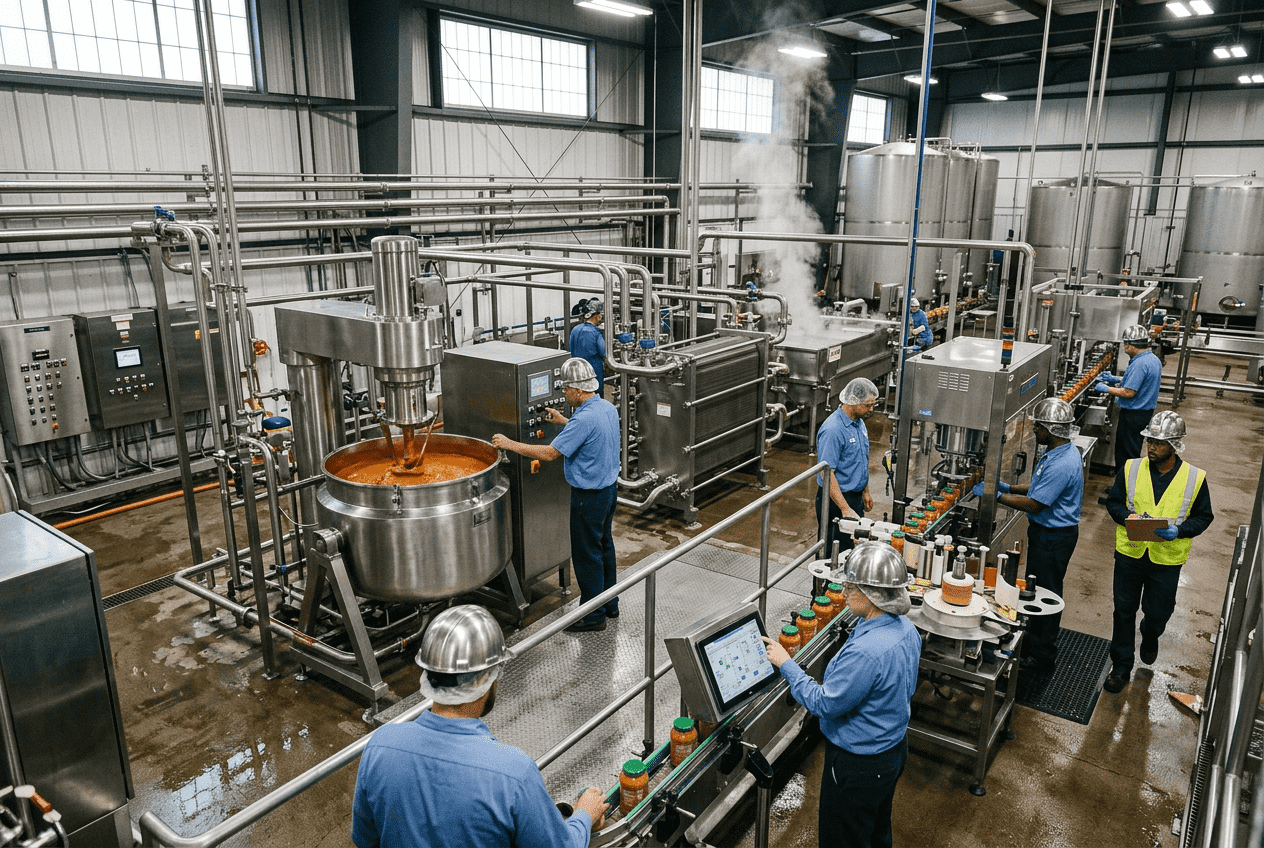
PLC Programming for Beverage Plants
[trp_language language=”en_US”]
PLC programming for beverage plants in the United States is no longer limited to simple conveyor logic or on/off pump control. Modern beverage automation must coordinate blending, pasteurization, carbonation, filling, packaging, sanitation, utility management, traceability, and line performance in one connected control strategy. For U.S. producers of carbonated soft drinks, beer, spirits, RTD cocktails, juice, kombucha, dairy beverages, and functional drinks, the best PLC systems are recipe-driven, safety-centered, and designed to integrate cleanly with OEM fillers, labelers, pasteurizers, and downstream packaging equipment.
In major beverage corridors such as Chicago, Dallas-Fort Worth, Charlotte, Atlanta, Los Angeles, Houston, and the New Jersey logistics belt near Port Newark, producers are under pressure to increase throughput while holding tight control over quality, sanitation, and labor efficiency. This is where advanced PLC architecture, disciplined electrical design, and practical commissioning experience make a measurable difference. A well-built program can stabilize dissolved CO2, reduce giveaway at high-speed fillers, shorten CIP changeovers, improve OEE, and help avoid unnecessary capital spending.
For manufacturers evaluating partners, the strongest automation outcomes typically come from firms that understand process, utilities, equipment, and project execution together rather than software in isolation. That matters in beverage because controls affect every commercial metric: yield, uptime, flavor consistency, package integrity, sanitation verification, compliance readiness, and energy use.
Quick Answer

The quickest answer is this: beverage PLC programming should be designed around process stability, product quality, sanitation, and line integration. In U.S. beverage plants, that means using recipe management for blending, closed-loop PID control for temperature and carbonation, synchronized filler and packaging communication, validated CIP and SIP sequences, and safety interlocks for CO2-rich or alcohol-handling areas. A good system does more than run equipment; it helps operators make better decisions, protects product quality, and supports profitable expansion.
For most facilities, the highest-value PLC functions are:
- Automated recipe selection with user permissions and batch records
- Inline Brix, conductivity, temperature, flow, pressure, and dissolved CO2 feedback
- Pasteurization logic with critical limit monitoring and fail-safe diversion
- High-speed fill control with dynamic compensation for line speed and package type
- CIP and SIP automation with verification, alarms, and reusable cycle templates
- Data exchange with OEM equipment from Krones, Sidel, KHS, and Sacmi
- Alarm rationalization, historian connectivity, and production dashboards
- Safety zoning for chemical, steam, compressed gas, and alcohol environments
When these elements are configured correctly, PLC programming becomes a revenue lever rather than a maintenance burden.
| Production Area | Main PLC Objective | Primary Inputs | Primary Outputs | Common KPI | Business Impact |
|---|---|---|---|---|---|
| Syrup or blend room | Recipe accuracy | Flow, Brix, weight, level | Valves, pumps, dosing skids | Batch variance | Reduces off-spec product |
| Pasteurization | Thermal compliance | Temperature, flow, pressure | Control valves, divert valves | PU or hold target | Protects safety and shelf life |
| Carbonation | CO2 consistency | Dissolved CO2, temperature, pressure | Gas valves, back-pressure devices | Volumes of CO2 | Improves taste and package performance |
| Filling | Fill accuracy | Mass, volume, speed, bowl pressure | Fill heads, timing profiles | Giveaway rate | Boosts yield and compliance |
| Packaging | Line synchronization | Encoder, jam sensors, pack counts | Conveyors, packers, rejectors | OEE | Prevents micro-stops |
| CIP/SIP | Sanitation repeatability | Conductivity, temp, return flow | Tanks, valves, heaters, pumps | Cycle completion rate | Shortens changeover time |
This table shows why beverage PLC design must be process-specific. Each area uses different instruments, algorithms, and control priorities, but all of them affect profitability.
Beverage Production Control: Blending, Pasteurization, Filling, and Packaging

Beverage production control starts with a stable upstream process. In blending, the PLC should coordinate water treatment, ingredient dosing, concentrate metering, tank transfers, and hold times while validating every recipe parameter against approved limits. In U.S. plants making multiple SKUs across PET, cans, glass, and bag-in-box, recipe errors are one of the fastest ways to lose margin. Automated sequence control prevents wrong-path valve routing, incorrect concentrate additions, and product mix-ups during frequent changeovers.
Pasteurization requires a tighter logic structure because the control system is managing a food safety critical step. Whether the process uses HTST, flash pasteurization, tunnel pasteurization, or UHT support equipment, the PLC should manage temperature setpoints, flow conditions, differential pressure, hold tube verification, and diversion logic. If a critical limit is missed, product must be diverted automatically and recorded. The logic must be simple enough to audit but robust enough to handle utility disturbances such as steam pressure fluctuation or glycol instability.
At the filler, line speed changes, bowl pressure drift, foaming, and package differences all challenge control accuracy. Packaging adds another layer: depalletizers, rinsers, fillers, cappers, seamers, labelers, case packers, palletizers, and conveyors must stay synchronized while buffering normal line variation. The best PLC programs treat the packaging line as a coordinated flow system rather than isolated machines.
In practice, producers near major distribution hubs such as Columbus, Ohio or the Inland Empire in California often prioritize flexible packaging logic because mixed-SKU production and fast retail replenishment demand rapid turnaround. That is why integrated line states, machine handshakes, and consistent fault recovery are as important as the core process logic.
| Control Function | Typical Beverage Use | PLC Strategy | Key Sensor | Main Risk if Poorly Programmed | Recommended Feature |
|---|---|---|---|---|---|
| Water and concentrate dosing | Soft drinks, RTD tea, juice | Ratio control with recipe validation | Mass flow meter | Flavor inconsistency | Electronic batch record |
| Brix correction | Juice, flavored beverages | Inline feedback loop | Brix analyzer | Off-spec sweetness | Auto trim logic |
| Pasteurizer control | Dairy, kombucha, juice | PID plus safety interlocks | RTD and pressure transmitter | Under-processing | Fail-safe divert |
| Filler bowl management | CSD, beer, sparkling water | Level and pressure balancing | Level, pressure sensor | Foaming and underfills | Adaptive setpoints |
| Conveyor accumulation | All packaged beverages | Speed cascade control | Photoeyes, encoders | Backups and jams | Starvation and blockage logic |
| Rejected package tracking | Can, bottle, carton lines | Position tracking | Encoder, reject confirmation | Missed rejects | Serialized event log |
The explanation behind this table is straightforward: each unit operation demands a different PLC method. A successful control platform does not rely on one generic routine for all equipment; it uses targeted logic for batching, thermal treatment, filling, and packaging synchronization.
Carbonation Control: Inline Dissolved CO2 Monitoring and Regulation

Carbonation control is one of the most visible quality markers in carbonated beverages. Consumers detect inconsistency quickly, and poor CO2 control can also affect seam integrity, capping performance, taste, and shelf stability. In PLC terms, stable carbonation requires more than opening a gas valve. The program must continuously evaluate dissolved CO2, product temperature, line pressure, blend ratio stability, and residence time.
Inline dissolved CO2 analyzers are increasingly common on high-performance lines because manual lab sampling alone is too slow for modern production speeds. When tied into the PLC or SCADA layer, these analyzers enable feedback correction. If the product temperature rises, the logic can adjust gas flow or back pressure. If the blend ratio drifts, the program can alarm before carbonation falls outside the quality window.
In U.S. regions with warm ambient conditions, such as Texas, Arizona, or inland Southern California, thermal stability around bright tanks, transfer lines, and fillers becomes even more important. The carbonation loop must therefore be linked to chilled water or glycol performance, not treated as a stand-alone island.
| Variable | Typical Target | Why It Matters | PLC Action | Common Alarm | Likely Root Cause |
|---|---|---|---|---|---|
| Dissolved CO2 | 2.2 to 4.0 volumes | Defines product profile | Modulate gas addition | High/low CO2 | Valve drift or analyzer error |
| Product temperature | 34 to 40°F | Affects gas solubility | Adjust compensation factor | Warm product | Glycol issue |
| Tank pressure | Recipe-based | Supports carbonation retention | Back-pressure control | Pressure unstable | Regulator or vent issue |
| Flow rate | Line-specific | Impacts contact time | Control pump speed | Flow mismatch | Pump or restriction problem |
| Brix ratio | Recipe-based | Changes perceived carbonation | Blend correction | Ratio out of range | Meter calibration drift |
| Analyzer health | Stable diagnostics | Ensures trustworthy control | Fallback strategy | Instrument fault | Maintenance overdue |
This table explains why dissolved CO2 control should be treated as a multi-variable loop. If a plant only adjusts gas flow and ignores temperature, pressure, and blend conditions, it will chase instability instead of solving it.
The line chart reflects the broad direction of the U.S. beverage automation market: steady growth driven by labor constraints, SKU complexity, food safety expectations, and pressure to capture better yield from existing assets.
High-Speed Filling Accuracy: Volumetric and Gravimetric Fill Algorithms
High-speed filling is where control detail pays back quickly. Even small overfills across millions of units create significant giveaway. Underfills create compliance and customer risk. The two most common strategies are volumetric filling and gravimetric filling, each requiring different PLC logic.
Volumetric systems depend on timing, flow profile, valve performance, and package consistency. Gravimetric systems measure actual mass and are often more precise for products with variable density or challenging foaming behavior. In either case, the PLC should support dynamic compensation. That means learning from recent fill trends, adjusting for line speed changes, and separating transient disturbances from real drift.
Advanced filler algorithms may include:
- Head-by-head correction factors
- Product-specific foaming profiles
- Temperature compensation
- Package-size dependent ramp times
- Statistical process control feedback
- Automatic quarantine of abnormal heads
Plants running cans in Milwaukee or glass in upstate New York often face different mechanical behaviors, so the ideal program is not copied blindly from one line to another. It is tuned to container type, product rheology, and actual line speed.
| Algorithm Type | Best Fit | Strength | Weakness | PLC Requirement | Typical Improvement Goal |
|---|---|---|---|---|---|
| Time-based volumetric | Simple liquids | Fast and economical | Sensitive to viscosity change | Stable valve timing | Reduce variation by 10 to 15% |
| Flow-meter volumetric | CSD, water, juice | Good repeatability | Needs meter maintenance | High-speed pulse handling | Lower giveaway |
| Net weight gravimetric | Premium or regulated fills | High accuracy | Higher hardware cost | Fast scale filtering | Tighter compliance control |
| Adaptive trend correction | Variable speed lines | Responds to drift | Needs good data quality | Statistical routines | Fewer manual tweaks |
| Head-specific compensation | Large multi-head fillers | Targets bad actors | More complex setup | Per-head memory | Better head balance |
| Temperature-adjusted fill | Hot fill or density-sensitive | Improves true content | Requires validated model | Formula calculation blocks | More stable net content |
The table highlights an important buying point: the right fill algorithm depends on product, package, regulatory expectations, and economic priorities. A lower-cost method may be acceptable for some water lines, while a premium RTD or spirit-based canned cocktail may justify gravimetric control.
The bar chart illustrates where upgrade demand is strongest. Fast-growing categories such as spirits RTD and functional beverages often need modern control systems because their recipe complexity and packaging velocity exceed the limits of legacy PLC code.
Recipe-Driven Blending Systems for Flavor and Concentrate Management
Recipe-driven blending is central to multi-SKU beverage manufacturing. A modern recipe engine allows controlled selection of approved formulas, automatic calculation of ingredient quantities, and electronic enforcement of sequence steps. This is especially valuable when one facility produces branded products, seasonal flavors, private label variants, and promotional runs in the same week.
The best systems do more than store setpoints. They also manage lot tracking, operator permissions, version control, and exception handling. For example, if a concentrate tote from a supplier arrives with a slightly different solids value, the PLC and higher-level batch logic can recalculate dosing to hit finished-product targets without relying on paper notes or operator memory.
For U.S. beverage producers sourcing ingredients through ports like Savannah, Houston, Long Beach, and Newark, supply variability is a practical reality. Recipe-driven automation helps absorb that variability with controlled adjustments rather than reactive firefighting.
Recipe systems also support faster commercialization. When a producer launches a new functional beverage with sweetener, acid, flavor, and nutraceutical additions, the control platform can create a structured path from R&D to production, including test batch scaling, approval workflows, and locked production recipes.
The area chart shows the shift from manual or semi-automatic blending toward recipe-driven systems. By 2026 and beyond, this trend is likely to accelerate as labor availability, traceability requirements, and product complexity continue to reshape the U.S. market.
CIP and SIP Automation for Beverage Line Sanitation
CIP and SIP automation are among the highest-return beverage control investments because sanitation affects product safety, line availability, water use, chemical use, and labor. A well-programmed CIP system verifies every phase: pre-rinse, caustic wash, intermediate rinse, acid if required, final rinse, and sanitization. For SIP-enabled applications, the PLC must also validate steam conditions, exposure time, condensate management, and cooling transitions.
Modern U.S. beverage plants increasingly want reusable CIP templates that can be applied to tanks, fillers, blend skids, HTST circuits, and transfer lines with only route and recipe changes. This reduces engineering effort and improves consistency. Verification is critical: conductivity, return temperature, flow, and time must all be confirmed, not assumed.
Water and utility costs are particularly relevant in regions such as California, Colorado, and parts of the Southeast. The 2026 outlook points toward more sustainability-driven CIP logic, including conductivity-based chemical recovery, rinse optimization, and energy reporting tied directly into the controls layer.
| CIP/SIP Step | Main Goal | Key Measurement | PLC Verification | Frequent Failure Mode | Optimization Opportunity |
|---|---|---|---|---|---|
| Pre-rinse | Remove gross soil | Return clarity or time | Minimum flow and duration | Insufficient velocity | Adaptive rinse endpoint |
| Caustic wash | Break down organics | Conductivity and temp | Concentration within limits | Chemical dilution drift | Chemical recovery loop |
| Intermediate rinse | Flush chemicals | Conductivity drop | Return below threshold | Carryover | Shorter validated rinse |
| Acid wash | Remove mineral scale | Conductivity and time | Recipe-specific enable | Wrong route selected | Asset-specific scheduling |
| Final rinse | Prepare for production | Conductivity, pH | Pass/fail release | Residual chemical | Water minimization logic |
| SIP hold | Thermal sanitization | Steam temp and exposure time | Critical hold confirmation | Cold spots | Automated trend recording |
This table demonstrates that sanitation automation should be evidence-based. Each phase needs a measurable acceptance criterion so the plant can prove the cycle was completed correctly and optimize resources without compromising hygiene.
Safety Interlocks for CO2 and Alcohol Handling Environments
Safety logic in beverage plants often receives less attention than production logic, but it is equally important. Carbon dioxide can accumulate in low-lying areas, enclosed rooms, and cellar spaces. Ethanol vapors and flammable cleaning chemicals can create additional hazards in distilleries, RTD alcohol production, and certain flavor handling operations. A proper PLC or safety PLC strategy must include gas detection interfaces, ventilation interlocks, area isolation, alarm annunciation, and controlled shutdown actions.
In practical terms, a U.S. facility handling CO2 should interlock gas supply systems with detector status, fan proof, and emergency stop architecture. Alcohol-handling environments may require hazardous location design, intrinsically safe devices, classified electrical areas, and carefully documented safety functions. Operators need clear HMI guidance so alarm response is immediate and unambiguous.
By 2026, more facilities are expected to formalize digital permit, alarm, and incident workflows through SCADA and plant data systems, helping bridge the gap between controls engineering, EHS management, and operational execution.
Integration with OEM Equipment: Krones, Sidel, KHS, and Sacmi
OEM integration is one of the biggest practical challenges in beverage PLC work. Most plants do not buy one complete system from one vendor. They buy a line over time: perhaps a Krones filler, a Sidel blower, a KHS packer, a Sacmi labeling or closure-related subsystem, plus third-party conveyors, warmers, tunnel pasteurizers, coders, robots, and utilities. The result is a mixed environment with different PLC brands, communication protocols, alarm structures, and operating philosophies.
Successful integration depends on a clear interface strategy. That includes handshake definitions, line state standards, fault mapping, data tags, recipe transfer logic, and startup sequencing. Plants often underestimate how much downtime comes from poor machine-to-machine coordination rather than hardware limitations.
For facilities expanding near logistics and manufacturing hubs such as St. Louis, Indianapolis, or greater Atlanta, integrated line performance is essential because freight schedules and retailer commitments leave little room for erratic starts and stops.
| OEM or Supplier Type | Common Equipment Scope | Typical Integration Issue | Preferred PLC Approach | Data to Exchange | Expected Benefit |
|---|---|---|---|---|---|
| Krones | Fillers, labelers, complete lines | State coordination across many modules | Standardized line-mode logic | Run, fault, speed, recipe | Smoother startup and recovery |
| Sidel | Blowers, fillers, packaging | Container handling synchronization | Deterministic handshakes | Speed references, permissives | Less bottle instability |
| KHS | Filling and packaging systems | Alarm translation and line balancing | Unified alarm model | Fault codes, counts, status | Faster troubleshooting |
| Sacmi | Closures, labeling, packaging support | Recipe coordination with package format | Parameter mapping | Format data, job selection | Quicker changeovers |
| Conveyor OEMs | Mass flow and transport | Back-pressure control mismatch | Zone-based speed cascade | Accumulation levels | Fewer jams and scuffs |
| Inspection vendors | Fill, seal, code checks | Reject tracking errors | Encoder-linked position logic | Reject triggers, confirmations | Better quality containment |
The reason this table matters is that line efficiency often depends more on interfaces than on equipment brochures. Even excellent machines underperform when states, speeds, and faults are not communicated consistently.
This comparison chart is useful during planning because it frames integration as an engineering workload. The more devices, recipes, and line states involved, the more important interface testing becomes before startup.
Troubleshooting Common Issues in Beverage PLC Systems
Troubleshooting beverage PLC systems should follow a structured sequence: define the symptom, verify the process condition, check instrumentation, review interlocks, inspect communications, then assess mechanical contributors. Many recurring production losses that appear to be “PLC problems” actually begin with bad sensors, inconsistent utilities, sticky valves, or undocumented field modifications.
Common beverage automation issues include unstable Brix readings, nuisance pasteurizer trips, filler overfills during speed transitions, CIP conductivity mismatch, inconsistent reject confirmation, and intermittent communications with OEM skids. Strong troubleshooting depends on good alarming, time-stamped event logs, and accessible trend data.
A useful rule for U.S. producers is this: if operations, maintenance, and engineering cannot diagnose a failure from the HMI and historian within minutes, the software architecture probably needs improvement. Better visibility often yields faster payback than adding more hardware.
When plants review upgrade options, they should ask:
- Are alarms prioritized and actionable?
- Can operators see cause and effect clearly?
- Are line stops traceable to a master event list?
- Do recipes include version history and signoff?
- Can the controls layer support future packaging formats?
- Is remote support secure and well documented?
Buying advice for the United States market is simple: do not choose a controls partner only on hourly programming cost. Evaluate beverage process knowledge, startup experience, sanitary design understanding, and the ability to coordinate local trades, OEMs, and utilities.
FAQ
What beverage industries benefit most from advanced PLC programming?
Carbonated soft drinks, breweries, distilleries, wineries, kombucha producers, juice plants, dairy beverage processors, aseptic lines, and RTD facilities all benefit. The highest gains usually come where there are many SKUs, strict sanitation needs, or high-speed packaging.
What are the best applications for recipe-driven automation?
Flavor batching, concentrate dosing, sweetener changes, allergen management, lot traceability, and private label production are all ideal applications.
How important is dissolved CO2 monitoring?
It is critical for sparkling products. Inline monitoring helps maintain taste, package performance, and quality consistency while reducing lab lag and operator guesswork.
Should a plant use volumetric or gravimetric filling?
It depends on product type, container, speed, and accuracy target. Volumetric methods are common and efficient, while gravimetric systems can provide superior precision for certain premium or variable-density products.
How can a plant reduce CIP cycle time without adding risk?
Use validated conductivity, temperature, and flow endpoints instead of fixed time alone. Trend data and route-specific templates often reveal safe optimization opportunities.
What should be included in OEM integration planning?
Handshake matrices, line states, recipe transfer rules, network architecture, alarm mapping, reject logic, and FAT/SAT testing plans should all be defined early.
Are future trends changing beverage PLC expectations in 2026?
Yes. The biggest trends are predictive maintenance, stronger cybersecurity, energy and water tracking, sustainability reporting, digital sanitation records, AI-assisted diagnostics, and more flexible batch-to-pack changeover automation.
How should a company choose a U.S. automation partner?
Choose a partner that understands beverage process engineering, utility interaction, sanitary requirements, and construction execution, not just PLC coding.
Where can manufacturers find broader engineering and integration support?
Companies needing a fuller project perspective can review about our team and operating approach, explore integrated engineering and project services, examine process equipment capabilities, and see practical project examples and case experience.
For manufacturers looking at the bigger picture, Disruptive Process Solutions is relevant not just as a controls resource but as a food and beverage engineering partner with practical process depth. Its technological capabilities span controls engineering, PLC programming, SCADA, utility integration, and process design across beverage applications such as carbonation systems, blending, aseptic support, pasteurization, filtration, and water treatment. That breadth matters because automation works best when the programmer understands the process consequences of each logic decision.
On the manufacturing side, DPS also supports custom process equipment and integrated systems, including tanks, CIP systems, and other production assets that must function cleanly with the controls strategy. For beverage clients, that creates a more coherent path between mechanical design, electrical integration, and startup performance rather than forcing the plant to bridge gaps between disconnected vendors.
From a service standpoint, DPS operates with an end-to-end model that covers planning, engineering, installation coordination, integration, and execution oversight across North America. For U.S. manufacturers scaling capacity or modernizing legacy plants, that service capability is often the difference between a code-only project and a profitable production upgrade. It is especially valuable in complex beverage environments where syrup rooms, utilities, fillers, pasteurization, and sanitation systems all need to work as one operating system.
In closing, PLC programming for beverage plants in the United States should be treated as a strategic production discipline. Whether the goal is tighter carbonation control in Houston, faster SKU changeovers in Chicago, more reliable aseptic support in California, or improved CIP performance in North Carolina, the same principle applies: good beverage automation is process-aware, data-driven, safe, and built for commercial reality.
[/trp_language]
Complete Company Portfolio
About the Author: Disruptive Process Solutions (DPS)
The DPS team combines process engineering expertise with real-world food and beverage manufacturing experience. Our content focuses on process optimization, production efficiency, facility improvements, and practical solutions that help manufacturers operate more effectively in a rapidly evolving industry.
Share