Produce Wash Line Design in 2026: Advanced Sanitation Systems
[trp_language language=”en_US”]
U.S. Produce Wash Line Engineering Guide for 2026
Designing a produce wash line in 2026 is no longer just about rinsing soil off vegetables. In the United States, processors are being pushed by retailer standards, FSMA expectations, labor constraints, water costs, and customer demand for cleaner, longer-lasting fresh products. A modern line must combine the right wash technology, validated sanitation chemistry, controlled water reuse, gentle handling, reliable dewatering, and integration with grading, cutting, and packaging. The best systems are built around the actual product mix: root vegetables, leafy greens, herbs, cut vegetables, and mixed produce all behave differently on the line.
Quick Answer

The quickest answer is this: for most U.S. produce processors in 2026, the best wash line design uses air bubble washing for delicate leafy products, brush roller washing for root vegetables, integrated ozone or peracetic acid sanitation for microbial control, two-stage dewatering with a vibratory screen and air knife, sanitary conveyors with variable speed control, and a recirculated water loop supported by filtration and monitored chemistry. The line should also connect cleanly to sizing, cutting, weighing, and packaging while supporting HACCP verification, daily sanitation, and documented preventive controls.
For a processor shipping into major markets such as Chicago, Los Angeles, Dallas, Atlanta, Philadelphia, Seattle, and New York, the line must do more than “work.” It must protect shelf life, reduce bruising, keep water usage under control, and maintain throughput during seasonal volume spikes. Processors receiving product through California’s Central Valley, Yuma, Salinas, South Texas, Florida, or warehouse hubs near the Port of Savannah and Port of Long Beach often need flexible wash systems that can handle changing field conditions throughout the year.
In practical terms, buying advice for 2026 comes down to five decisions:
- Match the wash technology to the produce category rather than forcing one machine to do every job poorly.
- Select sanitation chemistry based on pathogen risk, contact time, residue expectations, and wastewater constraints.
- Design dewatering as a process step, not an afterthought, because moisture affects packaging performance and shelf life.
- Engineer recirculation and filtration from the start to reduce total operating cost.
- Choose an integrator that understands process engineering, installation, controls, compliance, and startup, not just equipment sales.
The U.S. market is moving toward integrated lines that are more automated, easier to clean, and better instrumented. Buyers increasingly ask for conductivity monitoring, ORP tracking, flow balancing, recipe-driven conveyor speeds, and remote diagnostics. That trend is strongest among fresh-cut processors, foodservice suppliers, and multi-site manufacturers serving national retail and club channels.
The chart above reflects a realistic market direction: processors are steadily increasing spending on line upgrades, especially when projects support water savings, labor reduction, and food safety verification.
| Produce Category | Primary Wash Method | Typical Sanitation Method | Dewatering Need | Packaging Sensitivity | Best Use Case |
|---|---|---|---|---|---|
| Leafy greens | Air bubble flume | PAA or ozone-assisted water | High | Very high | Bagged salads and blends |
| Spinach and baby leaves | Gentle bubble wash | Low-residue sanitizer control | High | Very high | Fresh-cut retail packs |
| Carrots | Brush roller wash | PAA rinse or chlorinated legacy systems where allowed by spec | Medium | Medium | Whole and peeled carrot lines |
| Potatoes | Brush roller with spray bars | Sanitized rinse | Low to medium | Low | Bulk and foodservice |
| Radishes and beets | Brush plus spray wash | Validated oxidizing chemistry | Medium | Medium | Trimmed and bunched products |
| Herbs | Very gentle bubble wash | Carefully controlled PAA | High | High | Clamshell and pouch formats |
This selection table shows why product-first design matters. A line built for potatoes will often damage spring mix, while a delicate greens washer may not remove enough soil from carrots or beets.
Air Bubble and Brush Roller Washing Technology Selection

Wash technology selection should start with product biology, field load, target throughput, and acceptable mechanical force. Air bubble systems are ideal when processors need flotation, gentle agitation, and broad contact between water and product. They are commonly chosen for romaine, spring mix, spinach, kale, herbs, and cut vegetables that bruise easily. Brush roller systems are better when the product arrives with attached soil, rough skin, or surface debris that needs physical scrubbing. Potatoes, carrots, radishes, beets, and some onions fit this category.
For U.S. operations supplying supermarkets in Boston, Miami, Houston, Denver, and Minneapolis, line versatility is attractive, but over-flexibility can create compromise. A dual-path line often works better than a single universal washer. One path may use a bubble tank with turbulence control and soft transfer points for greens. A second path may use brush rollers with top sprays, debris removal, and adjustable dwell time for root crops.
Key design variables include tank residence time, bubble density, product depth, brush stiffness, spray pressure, make-up water rate, and discharge transfer geometry. In 2026, more processors are requesting servo-adjusted speeds, recipe memory by SKU, and CIP-friendly wash modules to reduce changeover time.
| Design Factor | Air Bubble Washer | Brush Roller Washer | Primary Advantage | Main Risk | Recommended Product |
|---|---|---|---|---|---|
| Mechanical action | Low to moderate | Moderate to high | Tailored cleaning intensity | Overhandling if mis-set | Greens vs roots |
| Soil removal | Good for light soil | Excellent for heavy soil | Cleaner incoming product | Excess wear on delicate items | Carrots, potatoes |
| Bruise protection | Excellent | Fair to moderate | Better shelf life | Leaf damage if transfer points are poor | Spinach, herbs |
| Water loading | Higher tank volume | Lower bath volume, higher spray use | Flexible water balance | High recirculation contamination | Mixed-use facilities |
| Maintenance | Blowers and nozzles | Brushes, shafts, bearings | Predictable service planning | Brush replacement cost | Root vegetable operations |
| Best throughput range | Medium to high | Medium to high | Scalable design | Bottleneck at discharge if undersized | Most commercial lines |
A useful buying rule is simple: if your biggest complaint is field grit, choose more physical cleaning; if your biggest complaint is bruising or short shelf life, choose gentler product movement. Where processors handle both categories, a front-end receiving and destoning system can reduce the cleaning burden before product enters the wash section.
Application-specific design matters in industries such as fresh-cut salads, retail meal kits, frozen vegetable preparation, institutional foodservice packs, and value-added root vegetable processing. In those sectors, performance is measured not only by visible cleanliness but by cut quality downstream, package seal integrity, and days of shelf life in refrigerated distribution.
Ozone and PAA Sanitation System Integration for Pathogen Control

Pathogen control in produce wash systems is a water-management problem as much as a chemistry problem. In U.S. operations, peracetic acid, often shortened to PAA, remains a leading choice because it is effective across a broad pH range, works in cold water, and aligns well with many produce applications when validated correctly. Ozone also attracts attention because it decomposes without persistent residue and can support lower chemical carryover, but it requires precise engineering, off-gas management, and careful control around worker safety and contact conditions.
For most fresh-cut produce facilities, the right question is not “ozone or PAA?” but “where should each technology be used?” PAA is commonly favored in the main wash loop or final antimicrobial stage due to practical dosing and proven processor familiarity. Ozone can be useful in supplemental water treatment, recirculation support, or targeted sanitation zones where the system is designed to maintain effectiveness without creating instability.
In 2026, regulators and customers are paying closer attention to validation data, not assumptions. Processors need documented concentration targets, contact time logic, sensor calibration, and corrective action plans. This is especially important for shipments entering large distribution corridors through New Jersey, Southern California, the Midwest, and Southeastern cold-chain hubs.
| Sanitation Option | Strength | Operational Challenge | Best Integration Point | Monitoring Need | Typical U.S. Use |
|---|---|---|---|---|---|
| PAA | Broad antimicrobial utility | Chemical dosing control | Main wash or final rinse stage | Concentration checks | Fresh-cut produce |
| Ozone | Low residue profile | Gas management and process stability | Water treatment loop | ORP and safety monitoring | Premium water reuse systems |
| Dual system | Layered control strategy | Higher engineering complexity | Primary wash plus recirculation support | Integrated controls | Large plants |
| Single-pass sanitized rinse | Simple validation | Higher water cost | Final rinse zone | Flow and chemical checks | Smaller facilities |
| Recirculated treated water | Water savings | Cross-contamination risk if poorly designed | Prewash and intermediate stages | Turbidity, chemistry, flow | High-volume processors |
| Manual chemical program | Low capital entry | Operator variation | Limited applications | Frequent hand checks | Small regional packers |
The table highlights that chemistry choice is inseparable from system design. A processor can buy excellent sanitizer and still underperform if the wash tank short-circuits, organic load is too high, or dosing is not linked to changing throughput. The strongest projects define sanitation by zone: incoming dirty wash, intermediate wash, final antimicrobial intervention, and clean water finishing.
Future trends for 2026 include tighter automation of dosing skids, better digital logging for HACCP and preventive controls, and stronger sustainability pressure to reuse water safely rather than discharge excessive volumes. Buyers should also consider local wastewater permit conditions and the effect of sanitation chemistry on downstream treatment.
This industry demand view shows why sanitation system integration is a top buying priority: leafy greens and fresh-cut segments have the highest sensitivity to wash water control, while meal kits and foodservice packs are also driving investment because of shelf-life and consistency requirements.
Two-Stage Dewatering with Vibratory Screen and Air Knife Design
Dewatering is one of the most underrated parts of produce line performance. Too much residual moisture can dilute seasoning, reduce package seal quality, cause clumping in weighers, create fogging inside bags, and shorten refrigerated shelf life. In 2026, a two-stage dewatering design using a vibratory screen followed by an air knife section is often the best balance between water removal and gentle handling.
The first stage, a vibratory screen or shaker conveyor, removes free water efficiently while spreading product into a more consistent bed depth. The second stage, an air knife or controlled blower tunnel, strips surface water before product enters grading, cutting, checkweighing, or packaging. For cut lettuce, baby spinach, shredded vegetables, herbs, and washed root crops, this combination improves downstream stability without excessive dwell time.
Design details matter. Air velocity must be strong enough to remove moisture but not so aggressive that it flips leaves, dries edges, or causes weight giveaway. Vibration frequency must support drainage without compacting soft product. The transfer between stages should avoid drop heights and pinch points.
| Dewatering Element | Primary Function | Ideal Produce Types | Design Note | Common Error | Operational Benefit |
|---|---|---|---|---|---|
| Vibratory screen | Remove free water | Greens, herbs, cut veg | Use adjustable amplitude | Too much vibration | Better flow to next stage |
| Inclined shaker | Drain and spread product | Root and cut vegetables | Match slope to product shape | Short screen length | Reduced pooling |
| Air knife | Remove surface moisture | Bagged salad items | Balance air speed and nozzle distance | Leaf displacement | Improved packaging |
| Blower tunnel | High-volume drying assist | Heavier produce items | Provide access for cleaning | Hard-to-clean plenums | More stable line speed |
| Drip conveyor | Passive drainage | Robust vegetables | Useful before active drying | Insufficient dwell time | Lower load on air system |
| Moisture verification point | Confirm target condition | All critical SKUs | Link to QA checks | No measurement discipline | Better shelf-life consistency |
Processors often see the biggest hidden return from dewatering in packaging. Multihead weighers run more consistently, baggers seal better, and operators spend less time cleaning up standing water around the pack area. For plants supplying chains in Phoenix, St. Louis, Charlotte, and the Pacific Northwest, where distribution distances differ significantly, moisture control can directly affect delivered shelf life.
Conveyor and Material Handling for Root Vegetables and Leafy Greens
Material handling is where many produce projects either protect value or quietly destroy it. Conveyors must be designed around product fragility, sanitation, and traffic flow. Root vegetables usually tolerate cleated belts, roller inspections, and more assertive elevation changes. Leafy greens require broad belts, shallow troughing, low drop transfers, cleanable supports, and precise speed matching between equipment.
In mixed-product facilities, one of the best approaches is segmented handling architecture: dirty receiving, prewash transfer, wash discharge, dewatering, inspection, clean conveyance, and packaging feed. Each zone should have a defined hygiene level and maintenance strategy. Crossovers should be minimized, and where possible, operator access should not force people to lean across open product.
Applications vary by industry. A foodservice root vegetable plant near Idaho or Wisconsin may prioritize ruggedness and mud tolerance. A leafy greens operation near Salinas, Yuma, or New Jersey may prioritize hygiene, low bruising, and rapid sanitation. Meal kit suppliers near urban fulfillment centers often need flexible conveyor routing because SKU variation changes daily.
The trend is clear: processors are moving from basic conveyor layouts toward hygienic, automated handling with easier washdown, less manual sorting, and better line balancing.
When reviewing conveyors, buyers should ask:
- Can this system handle the dirtiest and most delicate product day?
- Are belt materials and frame geometry compatible with daily sanitation?
- Is there enough access for inspection, brush cleaning, and maintenance?
- Can the controls system coordinate speed changes across the line?
- Will the layout support future grade sizing, cutting, or robotic pack assistance?
Water Recirculation and Filtration for Sustainable Operation
Water is now a strategic utility in produce processing. In many U.S. regions, water cost, wastewater discharge, and sustainability reporting are making recirculation and filtration central design topics. Plants in California, Arizona, Texas, and parts of the Southeast often feel this pressure most strongly, but even facilities in water-rich areas are facing customer expectations around environmental stewardship.
A sustainable wash line does not mean maximum recirculation at all costs. It means using water where it adds the most hygienic value and reusing water only where risk is controlled. Typically, the dirtiest stages receive the least clean reusable water, while the cleanest stages receive higher-quality treated or fresh water. Filtration may include rotary drum screens, static screens, settling, hydrocyclones, bag filters, or more advanced polishing steps depending on solids load and reuse goals.
Instrumentation is increasingly important. Turbidity, flow, oxidation-reduction potential, temperature, and tank level data help operators keep the system in control. Automated dump-and-refresh logic can prevent degraded water quality before it affects product. In 2026, U.S. buyers are also more interested in reporting dashboards that connect water usage to pounds processed.
| Water System Component | Role in the Line | Best Use Area | Key Benefit | Limitation | 2026 Trend |
|---|---|---|---|---|---|
| Rotary drum screen | Remove coarse solids | Prewash recirculation | Protects pumps and nozzles | Not fine polishing | Common baseline |
| Settling tank | Reduce sediment load | Root vegetable lines | Low operating cost | Large footprint | Used in soil-heavy lines |
| Bag or cartridge filter | Capture fine particles | Intermediate clean loops | Better water clarity | Consumable replacement | Growing in fresh-cut plants |
| Hydrocyclone | Separate dense particles | Sand and grit removal | No moving parts in core function | Limited on light solids | Useful for root crops |
| Ozone-assisted loop | Support water sanitation | Polished recirculation | Lower chemical residue profile | Higher control complexity | Premium installations |
| Automated make-up and bleed | Balance water quality | Whole system | Stable operation | Needs controls integration | Strong adoption |
This table shows how sustainable operation is achieved by layering technologies rather than relying on one “magic” filter. For many processors, the best path is a staged recirculation strategy that lowers water use substantially while preserving the cleanest final contact conditions.
Policy trends also matter. In 2026, more corporate buyers are requiring ESG-style reporting, and more plants are preparing for tighter local utility expectations. Projects that reduce water consumption per pound of produce while protecting food safety will remain strong candidates for capital approval.
Grade Sizing, Cutting, and Packaging Line Integration
A wash line should not be designed as an island. The real value appears when washing connects smoothly to grading, sizing, cutting, optical inspection, weighing, and packaging. If line integration is poor, the wash system may perform well on its own but still create backups, inconsistent feed rates, and excess labor downstream.
For root vegetables, grade sizing may include roller graders, diverging lane sortation, or camera-based systems depending on pack style. For leafy products, the critical integration points are usually feed metering, cut quality protection, and moisture consistency before weighers and baggers. In mixed application plants, packaging may include pillow bags, vertical form-fill-seal systems, clamshells, trays, foodservice bulk bags, or case-ready retail formats.
U.S. processors near logistics hubs like Atlanta, Inland Empire, Kansas City, and Harrisburg often benefit from flexible packaging line integration because they ship to multiple channels with different case counts, pallet patterns, and labeling needs. As a result, 2026 line design increasingly includes recipe-based controls, modular discharge options, and data links between wash line speed and packaging equipment performance.
| Downstream Function | Connection to Wash Line | Design Priority | Typical Risk if Ignored | Best Control Feature | Business Benefit |
|---|---|---|---|---|---|
| Grade sizing | Stable product feed | Even loading | Mis-sorts | Variable speed metering | Higher pack consistency |
| Cutting | Moisture and orientation control | Clean feed presentation | Smearing and poor cuts | Matched conveyor speed | Better yield |
| Optical inspection | Surface visibility | Low excess water | False rejects | Dewatering verification | Reduced giveaway |
| Weighing | Consistent bulk density | Product separation | Scale instability | Distribution control | Improved accuracy |
| Bagging or clamshell filling | Clean discharge | Low splash and moisture | Seal issues | Interlocked speed logic | Fewer rejects |
| Case packing | Line balancing | Steady packaged output | Operator pileups | Buffer accumulation logic | Lower labor pressure |
One of the smartest buying questions is whether the supplier can engineer the interfaces, not just the machines. Integration determines whether the entire process behaves like one system or a collection of separate assets.
The comparison illustrates why engineered integration usually outperforms piecemeal purchasing, especially when processors expect growth, tighter retailer requirements, or future automation.
HACCP Compliance and Daily Sanitation Protocols for Produce Lines
Compliance is not a separate layer added after installation. HACCP thinking, preventive controls, sanitary design, and daily cleaning requirements should shape the wash line from the beginning. A produce line should be laid out to support hazard analysis, defined intervention points, accessible cleaning, drainability, and documented verification.
Daily sanitation protocols in U.S. facilities typically include dry debris removal where applicable, pre-rinse, foam or detergent application, manual detail cleaning, rinse verification, sanitizer application, reassembly checks, pre-op inspection, and startup verification. Equipment frames should avoid hollow-body contamination risks, standing water traps, and inaccessible bearings over open product zones.
Operators and quality teams should clearly understand control points such as antimicrobial dosing, final rinse condition, metal detection if applicable downstream, package seal performance, and temperature management through the process. Records must be practical enough that teams actually use them during busy production days.
| HACCP / Sanitation Item | Why It Matters | Daily Check | Typical Record | Common Failure | Design Solution |
|---|---|---|---|---|---|
| Wash chemistry concentration | Pathogen control | Start-up and interval testing | QA log or digital trend | Drift during high load | Automated dosing skid |
| Water clarity / solids load | Cross-contamination reduction | Visual and sensor review | Turbidity record | Late water changeout | Bleed and refresh logic |
| Equipment cleanability | Sanitation effectiveness | Pre-op inspection | Sanitation checklist | Harborage points | Open-frame hygienic design |
| Dewatering hygiene | Post-wash contamination prevention | Nozzle and plenum check | Maintenance / QA form | Dirty air knife zone | Tool-less access |
| Conveyor condition | Foreign material and residue control | Belt and splice review | Operator inspection sheet | Worn belt edges | Scheduled replacement plan |
| Packaging transfer area | Final product protection | Surface sanitation and moisture check | Line release log | Standing water near fillers | Improved drainage and zoning |
This table shows how compliance is improved through design. Good engineering lowers the burden on operators and makes the right behavior easier to sustain every day.
For plants selling to national retailers or operating under SQF or BRC expectations, documented sanitation and start-up verification are increasingly important. The same is true for co-packers handling multiple customer standards in one facility.
Our Company
Disruptive Process Solutions, or DPS, works with food and beverage manufacturers across the United States and Canada on engineered capital projects that must perform in the real world, not just on a proposal sheet. In produce applications, that matters because wash lines sit at the intersection of process design, sanitation, utilities, controls, installation, and startup. A processor needs more than a machine vendor; it needs a partner that can engineer, build, and manage the entire project.
From a technological capability standpoint, DPS supports process engineering, mechanical and utility integration, controls architecture, PLC programming, automation, and SCADA-informed system visibility. That means a produce wash line can be designed with coordinated conveyor speeds, monitored sanitation dosing, recirculation control, pump logic, utility tie-ins, and startup support that aligns with production goals rather than isolated equipment operation. You can learn more about the company background on the About Us page.
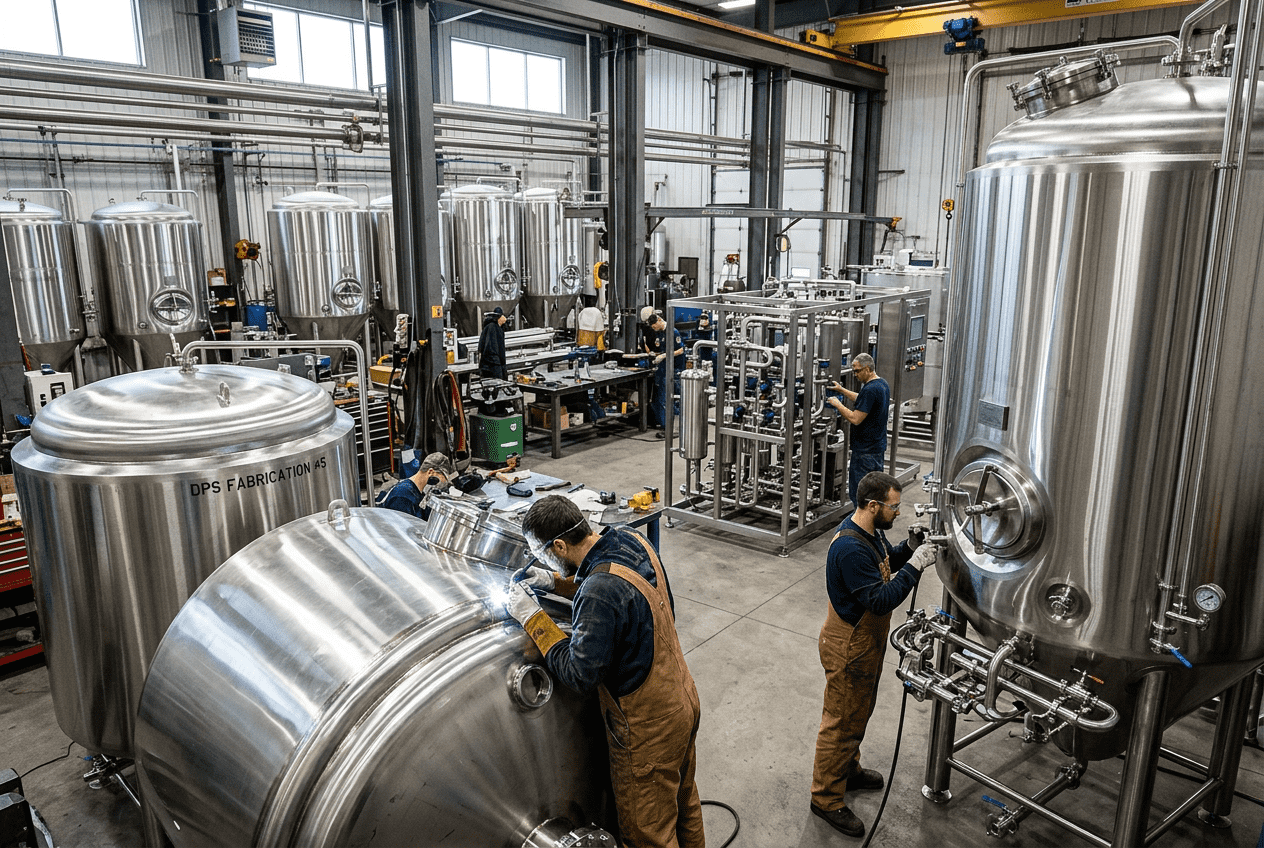
From a manufacturing capability standpoint, DPS also brings proprietary equipment experience into broader processing projects. That approach is useful when a customer needs custom tanks, CIP support equipment, specialty process skids, or integrated fabrication that standard catalogs cannot solve cleanly. Produce processors often benefit when utility skids, tanks, and process modules are designed to fit the line as-built rather than forced into the layout later. Additional capabilities are outlined in the equipment solutions section.
From a service capability standpoint, DPS operates through an end-to-end model covering planning, design, capital project support, owner representation, installation management, and execution oversight. That is especially valuable for U.S. processors expanding in active facilities, relocating lines, or balancing production continuity with modernization. Whether the need is feasibility, detailed engineering, integration, or full delivery, the firm’s broader offering is described on its service capabilities page. For examples of project work and execution style, readers can review selected case studies and project examples.
What differentiates this approach is business-minded engineering. The project is not only about buying hardware; it is about improving profitability through the right scope, utility planning, controls strategy, labor model, and startup sequence. In the produce segment, that often means avoiding overbuilt systems in low-risk areas while investing heavily where food safety, shelf life, and throughput actually depend on the design.
FAQ
What is the best produce wash line for leafy greens in the United States?
For most leafy greens, an air bubble wash system with controlled agitation, antimicrobial dosing, sanitary transfer conveyors, and strong dewatering is the preferred configuration. Final design depends on leaf fragility, throughput, and pack format.
Is PAA better than ozone for produce sanitation?
Neither is universally better. PAA is often easier to validate and operate in the main wash system. Ozone can be effective in well-engineered water treatment applications. Many plants use a combination strategy by zone.
Why is dewatering so important after washing?
Residual moisture affects shelf life, package seals, weighing consistency, and visual quality. A two-stage dewatering system helps stabilize downstream operations and reduce package-related rejects.
Can one wash line handle both root vegetables and leafy greens?
Sometimes, but not always well. If the product mix is broad, separate wash paths or modular zones usually deliver better cleaning, less damage, and easier sanitation than a one-size-fits-all machine.
How much water can be recirculated safely?
That depends on product risk, solids loading, filtration performance, chemistry control, and validation. Safe recirculation is a system-engineering question, not a fixed percentage.
What U.S. regulations most affect produce wash line design in 2026?
FSMA preventive controls, customer food safety standards, wastewater requirements, worker safety expectations, and retailer shelf-life demands all influence line design and documentation.
What industries use advanced produce wash lines?
Fresh-cut produce, retail salad packing, foodservice vegetables, meal kits, frozen vegetable preparation, value-added root vegetable processing, and specialty herb packing all rely on these systems.
How should buyers compare suppliers?
Look beyond equipment price. Compare process fit, sanitation design, automation depth, utility requirements, installation capability, startup support, parts access, and the supplier’s ability to integrate the full line.
What future trends matter most in 2026?
More sensor-driven sanitation control, stronger water reuse expectations, better hygienic automation, digital recordkeeping for compliance, and project decisions tied to total cost of ownership rather than only purchase price.
What is the smartest first step for a processor planning an upgrade?
Start with a process review that maps product types, throughput, sanitation risks, water balance, labor model, and downstream packaging needs. The best wash line comes from whole-system planning, not isolated equipment shopping.
[/trp_language]
Complete Company Portfolio
About the Author: Disruptive Process Solutions (DPS)
The DPS team combines process engineering expertise with real-world food and beverage manufacturing experience. Our content focuses on process optimization, production efficiency, facility improvements, and practical solutions that help manufacturers operate more effectively in a rapidly evolving industry.
Share