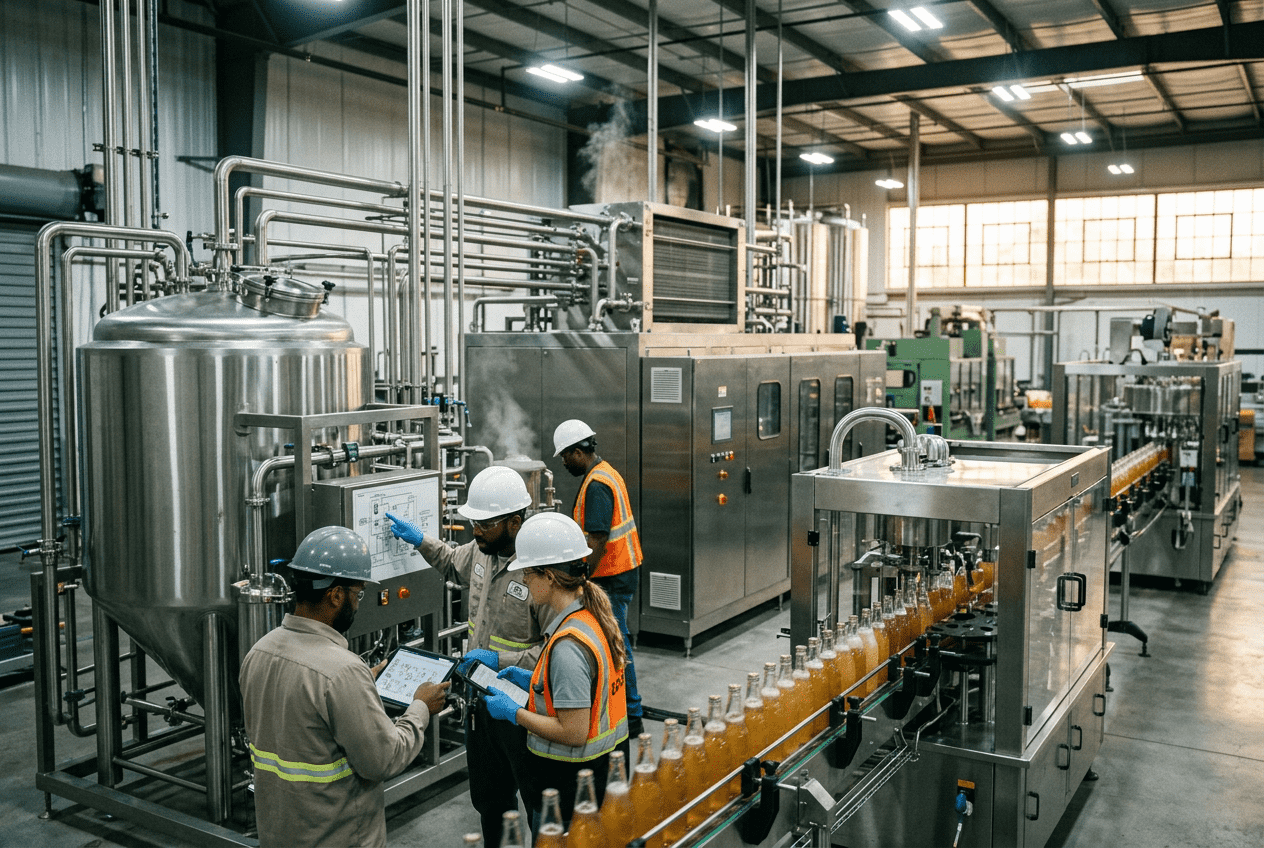
Recipe Management for Food Manufacturing
[trp_language language=”en_US”]
Digital Recipe Control for Modern Food Manufacturing in the United States
In the United States, recipe management in food manufacturing is no longer just a way to store formulas. It is the operating backbone that connects R&D, quality, purchasing, production, maintenance, automation, and compliance. A modern recipe management system controls ingredients, process steps, critical parameters, version history, allergen rules, lot traceability, operator instructions, and plant-floor execution. For manufacturers producing sauces, proteins, dairy, beverages, prepared meals, nutraceutical products, or aseptic items, recipe control directly affects yield, safety, uptime, labor efficiency, and margin.
As U.S. food and beverage plants face tighter labor markets, rising ingredient costs, stricter FDA and USDA scrutiny, and growing customer demands from retail, foodservice, and co-packing channels, the old model of paper binders and tribal knowledge is becoming too risky. Plants in Chicago, Fresno, Dallas, Atlanta, Charlotte, Houston, Minneapolis, and the Los Angeles-Long Beach corridor increasingly need digital recipe systems that scale across multiple lines and facilities while supporting ERP, MES, PLC, and SCADA integration.
Quick Answer

Recipe management in food manufacturing is the structured control of formulas, processing instructions, batch logic, quality checkpoints, allergen data, and revision history so a product can be made consistently, safely, and profitably at production scale. In U.S. plants, effective recipe management usually includes:
- Ingredient definitions with approved specifications
- Batch sizes and automated scaling logic
- Critical process parameters such as temperature, time, flow, pH, Brix, pressure, and agitation speed
- Step-by-step operator instructions
- Version control with approvals, rollback capability, and audit trails
- Allergen segregation and label compliance checks
- Costing tied to live ingredient and packaging prices
- Execution links to ERP, MES, PLC, and plant-floor automation
For many U.S. manufacturers, the best results come when recipe management is treated as part of a broader plant systems strategy rather than a standalone software purchase. That is why engineering-led partners with process, controls, and installation experience can add real value during design and implementation. Companies looking to understand that broader approach can review how DPS approaches food and beverage project execution as part of end-to-end processing and automation programs.
| Recipe Management Element | What It Controls | Why It Matters in U.S. Plants |
|---|---|---|
| Formula master data | Ingredients, percentages, units, density, losses | Prevents incorrect batching and supports standardization across sites |
| Processing instructions | Mix order, hold times, heating curves, cooling targets | Reduces operator variability and protects product quality |
| Critical limits | Temperature, pH, Brix, pressure, cook times | Supports food safety plans and customer specifications |
| Version control | Revisions, approvals, effective dates, rollbacks | Creates traceability for audits and investigations |
| Allergen rules | Segregation, rework eligibility, label impacts | Helps avoid recalls and misbranding risk |
| Costing and yield | Ingredient pricing, overuse, scrap, batch yield | Improves margin visibility and purchasing decisions |
This table shows why recipe management should be viewed as an operating control system, not simply a digital cookbook.
What Recipe Management Actually Means in Food Manufacturing

In a manufacturing environment, a recipe is the full production definition of a product. It includes not only what goes in, but how, when, where, and under what conditions it is processed. A barbecue sauce formula in Kansas City, a cultured dairy product in Wisconsin, or a retorted soup in New Jersey each requires more than a list of ingredients. The plant needs sequence control, quality checkpoints, permissible substitutions, lot consumption rules, sanitation conditions, and instructions for startup, hold, rework, and changeover.
U.S. manufacturers often operate under mixed regulatory and customer requirements. A protein processor may need USDA alignment, a beverage plant may need FDA beverage controls, and a co-packer may also need SQF or BRC expectations imposed by retailers. That means recipe management must connect to quality management and production records in a way that supports real audits, not just internal convenience.
At a practical level, recipe management spans five layers:
- Product definition: what the product is supposed to be
- Process definition: how it must be made
- Execution control: how operators and automation carry it out
- Compliance control: how records prove it was made correctly
- Financial control: how cost and yield are measured batch by batch
Plants with multiple SKUs, seasonal formulations, retailer-specific variants, or regional ingredient sourcing need even stronger controls. A salad dressing plant shipping through Savannah, a beverage facility supplying the Northeast via Port Newark, or a frozen prepared foods site serving the Midwest all benefit when recipe data is standardized and centrally governed.
Beyond Ingredient Lists: CPPs, Process Instructions, and Scaling Logic

Many recipe failures do not begin with the formula itself. They begin with missing process detail. A recipe may call for 1,200 pounds of tomato base, 250 pounds of sugar, and 40 pounds of spice blend, yet still fail if the system does not define when the spice is added, how long to shear, when to open steam, how quickly to cool, or how long to hold before filling. This is where critical process parameters, or CPPs, become essential.
CPPs commonly include temperature ramp rates, cook or pasteurization time, vessel pressure, agitation speed, in-line Brix limits, homogenization pressure, dwell time, retort profile, and final fill temperature. For dairy and aseptic applications, even tighter control may be required. If a process depends on pH or viscosity windows, those values should not live in an operator’s memory. They should be embedded in recipe logic and tied to alarms, prompts, and exception handling.
Scaling logic is equally important. A formula that works in a 50-gallon pilot kettle can behave differently in a 2,000-gallon batch tank or a continuous blending skid. Ingredient sequencing, hydration time, heat transfer, foam generation, and solids dispersion may all shift with scale. Strong recipe management accounts for:
- Minimum and maximum batch size
- Density and conversion logic
- Evaporation or cook loss assumptions
- Yield targets by product family
- Equipment-specific step timing
- Automated tolerances for weigh-up and metering
| Recipe Layer | Typical Data Included | Execution Risk if Missing |
|---|---|---|
| Ingredient definition | Item code, lot rules, allergen status, unit of measure | Wrong raw material or label mismatch |
| Step sequence | Add order, mix duration, transfer point, hold | Inconsistent texture, flavor, or stability |
| CPPs | Time, temperature, pressure, pH, Brix, speed | Food safety and quality failure |
| Scaling logic | Batch-size formulas, tolerances, loss factors | Yield loss and off-spec production |
| Operator prompts | Verification checks, scans, signoffs | Skipped steps and poor traceability |
| Exception handling | Deviation rules, rework, hold procedures | Improper recovery from line issues |
For plants adding automation, this is where engineering depth matters. A partner with controls, PLC, and process design experience can align recipe logic to actual vessel, utility, and line capabilities. DPS is active in that space through integrated processing, controls, and project execution support, including services for engineering, automation, and project delivery tailored to food and beverage operations.
Version Control: Tracking Changes, Rollbacks, and Audit Trails
A recipe is never static. New suppliers are approved. Salt levels are adjusted. Sugar is reduced. Spice is rebalanced. Packaging changes trigger net weight changes. Thermal process validations are updated. Customer-specific variants are introduced. Without strict revision control, these routine changes can create major risk.
Version control in food manufacturing should answer six questions immediately:
- What changed?
- Who changed it?
- Why was it changed?
- Who approved it?
- When did it go live?
- What batches used which version?
This matters during internal investigations, customer complaints, line deviations, and regulatory audits. If a product shipped from a plant in Texas to a retailer distribution center in Atlanta is later questioned for flavor inconsistency or allergen labeling, the company must trace exactly which formula revision was active, which lots were consumed, and what instructions were executed.
Rollback capability is equally valuable. If a new supplier changes hydration behavior or a reformulation reduces finished-product stability, the plant should be able to return to a previous approved recipe without confusion or delay. Paper systems rarely do this well. Spreadsheets only do it if the organization is unusually disciplined. Purpose-built digital systems do it by design.
The chart above reflects the broader direction of the U.S. market: more manufacturers are moving toward formalized, software-driven recipe governance as labor, compliance, and traceability demands increase.
Allergen Management and Regulatory Compliance Integration
Allergen control is one of the strongest business cases for modern recipe management. In U.S. manufacturing, mismanaged allergen information can trigger recalls, brand damage, customer chargebacks, and direct regulatory exposure. A robust system should identify allergens at the ingredient level, carry them through every formula and variant, and connect that information to scheduling, line clearance, sanitation validation, label approval, and rework rules.
For example, if a plant in California runs both dairy-based beverages and non-dairy functional drinks, recipe logic should prevent inappropriate rework, flag allergen-sensitive changeovers, and support the sequencing of products to reduce wash time and contamination risk. In protein and prepared foods, soy, wheat, milk, egg, sesame, and tree nut impacts must be tightly governed.
Recipe management also supports broader compliance integration by linking to:
- Approved ingredient specifications
- Nutrition and label data
- Preventive controls and CCP or quality checkpoint records
- Electronic batch records
- Supplier approvals and country-of-origin considerations
- USDA, FDA, SQF, and BRC audit evidence
| Compliance Area | Recipe Management Function | Operational Benefit |
|---|---|---|
| Allergen labeling | Maps allergenic ingredients to finished goods | Reduces label mismatch risk |
| Sanitation verification | Supports product sequencing and changeover rules | Lowers cross-contact exposure |
| Lot traceability | Captures lot consumption by batch | Speeds recalls and investigations |
| Customer specifications | Controls product-specific tolerances and test limits | Improves conformance across SKUs |
| Electronic approvals | Records release and revision signoff | Strengthens audit readiness |
| Regulatory reporting | Ties recipe data to records and labels | Supports FDA and USDA documentation |
In regulated environments, the best systems do not isolate recipe data from the rest of operations. They integrate it with quality and production workflows so compliance becomes part of execution, not an afterthought.
Cost Optimization: Real-Time Ingredient Pricing and Yield Analysis
Recipe management is also a financial tool. Ingredient markets in the United States can move quickly due to freight shifts, weather, commodity volatility, labor disruptions, and port congestion. Dairy solids, proteins, oils, sweeteners, packaging materials, and spice blends can all change in cost within weeks. A recipe system that only stores target percentages, without current cost linkage, leaves margin management blind.
Real-time or near-real-time costing allows a plant to model the effect of ingredient substitutions, packaging changes, batch-size adjustments, and yield losses before they hit the P&L. This is especially useful for co-packers and multi-plant networks where margin can erode through small, repeated variances.
Yield analysis should extend beyond final weight. Mature plants analyze:
- Over-dispensing by ingredient
- Cook loss or evaporation variance
- Line startup loss
- Rework rates
- Changeover waste
- Fill-weight giveaway
- Downtime-related scrap
Prepared foods, proteins, and sauce operations often show especially strong demand because they combine formulation complexity with high SKU counts and tight margin pressure.
| Cost Driver | What the System Should Measure | Business Value |
|---|---|---|
| Ingredient price shifts | Current unit cost by approved supplier | Improves reformulation and sourcing decisions |
| Usage variance | Target versus actual consumption | Exposes over-dosing and handling loss |
| Yield loss | Expected versus actual finished output | Highlights process inefficiency |
| Packaging cost impact | SKU-level packaging burden | Supports customer pricing and margin review |
| Rework economics | Recovered value versus labor and risk | Guides smarter hold/rework decisions |
| Waste by line or product | Scrap rate trends by run | Targets operational improvement projects |
When these insights are linked to purchasing and execution data, management can identify where margin is leaking: not only in raw materials, but also in line performance and formulation discipline.
Digitizing Recipes: From Paper to Centralized Digital Platforms
Many U.S. plants still operate with a mix of paper batch sheets, ERP notes, spreadsheets, and operator knowledge. That may work for a small facility with a limited SKU count, but it becomes fragile as the business grows. Multi-line sites, co-packing facilities, plants with frequent changeovers, and operations shipping nationally cannot rely on disconnected documents for recipe execution.
Digitization should not begin with software alone. It should begin with process mapping. Before migrating recipes into a platform, companies should standardize naming conventions, units of measure, revision policies, approval workflows, ingredient master data, line capabilities, and batch record expectations.
A practical digitization roadmap usually follows these stages:
- Collect current recipes, formulas, and production records
- Clean and normalize ingredient and unit data
- Define product families and equipment mapping
- Separate formula data from process instructions and QC checks
- Build approval and change workflows
- Pilot on one line or one product family
- Integrate with ERP, MES, and controls after validation
For manufacturers expanding or building new capacity, it is often more efficient to design recipe digitization alongside the facility and process architecture rather than retrofitting it later. That is particularly true for plants adding new syrup rooms, batching areas, thermal systems, CIP skids, or automated transfer networks. Companies evaluating hardware for those environments can review process equipment capabilities from DPS in conjunction with automation planning.
| Digitization Stage | Primary Activity | Common Mistake to Avoid |
|---|---|---|
| Data collection | Gather formulas, SOPs, specs, labels | Ignoring undocumented operator knowledge |
| Data cleanup | Standardize units, naming, and codes | Allowing duplicate ingredient masters |
| Workflow design | Set roles for creation, review, approval | Leaving approvals informal |
| Pilot deployment | Test on selected products or lines | Trying to digitize the whole plant at once |
| Systems integration | Connect ERP, MES, PLC, quality systems | Missing field mapping and exception logic |
| Plant rollout | Train users and monitor compliance | Assuming adoption will happen automatically |
The explanation is straightforward: digitization succeeds when companies treat recipes as controlled operational data, not just documentation to be uploaded.
Integration with ERP, MES, and PLCs for Seamless Execution
The strongest recipe management programs in the United States are integrated, not isolated. ERP, MES, PLC, and SCADA systems each play a different role:
- ERP typically manages item masters, inventory, purchasing, production orders, and standard costs
- MES manages plant execution, work orders, electronic batch records, and operational visibility
- PLC systems control equipment behavior in real time
- SCADA provides supervisory control, visualization, alarming, and historical data
Recipe management sits across these layers. It should receive approved data from upstream business systems, drive execution logic on the floor, and return actual usage and performance data back into reporting and costing systems.
For a beverage blending and batching line, that may mean the ERP releases a production order, the MES calls the approved recipe version, the PLC meters ingredients into a blend tank, SCADA records Brix and transfer events, and actual consumption posts back for inventory and costing. In a protein marination or prepared foods environment, it may involve weigh-up verification, thermal processing steps, hold-and-release status, and packaging reconciliation.
This integration is particularly valuable in facilities that depend on utilities and process coordination, such as plants with CIP systems, boilers, glycol, compressed air, process water treatment, and automated transfer skids. The technical challenge is not just software compatibility. It is making sure the process design, controls architecture, and recipe logic all reflect actual operating conditions.
The trend is clear: hybrid systems remain common today, but fully integrated digital environments are gaining share as manufacturers invest in plant modernization.
This is also where a full-scope engineering and integration partner can be more effective than a software vendor alone. DPS works across process engineering, controls, project management, and installation, which matters when the objective is not simply to buy a system but to make recipe execution work reliably inside a real production environment. Manufacturers exploring complete processing and controls outcomes can also see examples in project case studies from DPS.
Best Practices: Employee Training, Audits, and Continuous Improvement
Even the best recipe software will fail if the plant does not manage adoption. Sustainable recipe control depends on disciplined people, documented governance, and recurring review. Best practices usually include the following:
- Define ownership across R&D, quality, operations, controls, and finance
- Train operators on both the steps and the reasons behind them
- Use permissions so only authorized personnel can edit recipes
- Run periodic revision audits to remove obsolete versions
- Track deviations, overrides, and recurring manual workarounds
- Review yield and loss trends by product family
- Test rollback and disaster recovery procedures
- Include recipe compliance in internal food safety and operational audits
Training is especially important in plants with high turnover or multilingual workforces. Instructions should be clear, visual where possible, and tied to practical line behavior. If operators routinely bypass prompts because they slow production, the workflow likely needs redesign. Recipe discipline should help the floor, not fight it.
Continuous improvement also means using recipe data to improve the process itself. A plant may discover that two approved versions create unnecessary complexity, that one ingredient is driving outsized variance, or that an equipment bottleneck is forcing manual interventions. In some cases, the best fix is not a capital project. In others, process redesign, controls changes, or equipment upgrades may produce outsized gains.
This is one area where DPS’s model stands out in the U.S. market. Rather than approaching projects as isolated installs, the company combines technological capabilities such as controls engineering, PLC programming, SCADA, utility integration, and process automation with manufacturing capabilities across beverages, proteins, dairy, prepared foods, aseptic, retort, sauces, and plant-based processing. On the service side, DPS supports capital planning, engineering, owner’s representation, project management, general contracting, equipment supply, installation, and commissioning. That combination can be valuable when recipe control must align with both business objectives and plant-floor realities.
| Selection Criterion | Questions to Ask | Why It Matters |
|---|---|---|
| Process fit | Can it handle batch, continuous, or hybrid production? | Prevents poor fit with line design |
| Revision control | Does it provide approvals, audit trails, and rollback? | Critical for compliance and troubleshooting |
| Allergen controls | Can it enforce sequencing and labeling logic? | Reduces recall risk |
| Integration depth | Will it connect to ERP, MES, PLC, and SCADA? | Improves execution and reporting |
| Usability | Can operators and supervisors use it easily? | Drives adoption on the floor |
| Implementation support | Who will map recipes to real equipment and workflows? | Determines practical project success |
For buying advice, U.S. manufacturers should resist choosing solely on license cost. The right decision depends on product complexity, line automation level, audit exposure, and growth plans. A sauce plant with two kettles has different needs than a national co-packer launching a greenfield beverage facility.
The comparison chart reflects a common market reality: the more closely recipe control is tied to execution and integration, the more operational value it tends to deliver.
FAQ
What types of products benefit most from recipe management?
Products with variable ingredients, complex processing, strict allergen exposure, or frequent SKU changes benefit the most. This includes sauces, dressings, protein marinades, dairy products, RTD beverages, aseptic products, prepared foods, soups, cultured products, and co-packed formulations.
Is recipe management only useful for large enterprise plants?
No. Mid-sized U.S. plants often see some of the fastest payback because they are large enough to feel the pain of inconsistency but small enough to implement improvements quickly. Sites with annual revenue above roughly $20 million often have a strong case for structured recipe control.
How does recipe management help with audits?
It creates a controlled record of approved formulas, revisions, execution steps, and batch history. That supports FDA, USDA, SQF, BRC, customer, and internal audit requirements.
Can recipe management reduce labor dependency?
Yes. It captures process knowledge in a repeatable system, reducing dependence on a few experienced operators and improving training speed for new staff.
What is the difference between recipe management and batch control?
Recipe management defines what should happen. Batch control executes it through people, systems, and automation. In advanced plants, the two are tightly linked.
Should a company digitize recipes before or after plant expansion?
Ideally during planning. If a company is adding new lines, utilities, or processing areas, recipe architecture should be designed alongside the physical and controls infrastructure.
How do local supply chains affect recipe strategy in the United States?
Regional sourcing can create variability in cost, ingredient functionality, and logistics. Plants near Houston, Savannah, Chicago, or Southern California may face different freight profiles and supplier lead times. A strong recipe system helps model substitutions and manage those changes without losing control.
How should companies evaluate local suppliers and integrators?
Look beyond software brochures. Evaluate whether the partner understands your product category, can support field integration, has controls experience, and can translate formulas into executable line behavior. Local responsiveness matters, but so does national delivery capability if you operate across several states.
| 2026 Trend | Expected Direction in the U.S. | Recommended Action |
|---|---|---|
| AI-assisted formulation analysis | Faster optimization of cost and quality tradeoffs | Prepare clean master data and validation rules |
| Deeper automation integration | More recipe-driven batch execution at PLC level | Align controls standards across lines |
| Sustainability reporting | Greater focus on waste, water, and energy by SKU | Tie recipe and utility data together |
| Policy and traceability pressure | Higher documentation expectations from regulators and customers | Expand electronic batch and audit records |
| Multi-site standardization | More national brands harmonizing plant practices | Create corporate recipe governance |
| Supplier variability management | More substitution logic due to market volatility | Build approved alternate ingredient pathways |
Looking toward 2026, recipe management will become more connected to sustainability, resilience, and portfolio planning. Manufacturers will increasingly use recipe systems to reduce water usage during changeovers, lower energy intensity in thermal processing, manage supplier variability, and support reformulation for nutrition or label claims. Plants that still rely on static documents will find it harder to compete on speed, compliance, and margin.
For U.S. manufacturers, the central lesson is simple: recipe management is not an isolated IT project. It is a production, quality, compliance, and profitability discipline. When it is designed well, integrated correctly, and maintained through training and continuous improvement, it becomes one of the most valuable control systems in the plant.
[/trp_language]
Complete Company Portfolio
About the Author: Disruptive Process Solutions (DPS)
The DPS team combines process engineering expertise with real-world food and beverage manufacturing experience. Our content focuses on process optimization, production efficiency, facility improvements, and practical solutions that help manufacturers operate more effectively in a rapidly evolving industry.
Share