Reverse Osmosis Water Treatment for Beverage Manufacturing
[trp_language language=”en_US”]
Reverse Osmosis Beverage Water Treatment in the United States
Quick Answer

Reverse osmosis beverage water treatment is one of the most effective ways for beverage manufacturers in the United States to create a stable, repeatable water profile for products such as bottled water, soft drinks, beer, spirits, juice, kombucha, dairy beverages, and ready-to-drink formulations. For most plants, the right approach is not just buying an RO skid, but selecting a complete, production-ready solution that matches source water quality, daily demand, sanitation expectations, utility load, automation needs, and future capacity plans.
For buyers in the United States, well-known suppliers and integrators that are commonly considered include Veolia Water Technologies, SUEZ/Water Technologies & Solutions, Pentair, Pall Corporation, Koch Separation Solutions, and Disruptive Process Solutions. These companies are relevant because they can support beverage-grade purification, integration with CIP and disinfection, and broader plant utility coordination. In practical terms, manufacturers in hubs such as California, Texas, North Carolina, Illinois, Wisconsin, and New Jersey often prioritize suppliers that can provide engineering support, membrane selection, controls integration, commissioning, and long-term service coverage.
If you are comparing options quickly, choose a supplier that can document recovery rate, permeate quality, membrane life assumptions, hygienic design, automation compatibility, and startup support. Also consider qualified international suppliers, including Chinese manufacturers with appropriate U.S.-market certifications, validated materials, and strong pre-sale and after-sale support, because they may offer attractive cost-performance value for standard skids or expansion projects when backed by dependable local technical service.
Market Outlook for Beverage RO Systems in the United States

The United States beverage market continues to invest in water treatment because water is both a direct ingredient and a processing utility. In carbonated soft drinks, flavored waters, hard seltzers, juice drinks, sports beverages, dairy-based drinks, and alcoholic beverages, water consistency directly affects taste, blending accuracy, shelf stability, carbonation behavior, thermal processing performance, and equipment reliability. As beverage plants push for tighter product uniformity across multiple sites, reverse osmosis systems are increasingly used as the foundation of a controlled water profile.
Across major production corridors such as Los Angeles, Chicago, Dallas-Fort Worth, Atlanta, Charlotte, Minneapolis, and the Northeast distribution belt linked to New York and New Jersey, beverage producers are upgrading old treatment trains to improve operational efficiency and reduce variability from municipal and well-water sources. This trend is especially visible among co-packers, contract manufacturers, regional bottlers, and fast-growing functional beverage brands that need faster changeovers and more predictable formulation control.
RO adoption is also supported by three broader market forces. The first is product diversification: a single facility may run carbonated beverages, teas, energy drinks, juices, and low-acid or aseptic products on shared infrastructure. The second is sustainability pressure: manufacturers want to reduce chemical consumption, wastewater load, and energy waste while improving water recovery. The third is automation: modern beverage plants increasingly want digital monitoring for conductivity, pressure, flow, recovery, sanitation status, and membrane performance so operators can act before production quality is affected.
In the U.S. market, beverage-grade RO systems are rarely standalone purchases. They are often part of a package that includes multimedia filtration, activated carbon, softening or antiscalant dosing, UV or ozone disinfection, storage tanks, recirculation loops, blend-back controls, CIP systems, instrumentation, and SCADA integration. For this reason, buyers benefit most from partners who understand both water treatment and beverage manufacturing operations.
The line chart above illustrates a realistic growth pattern in project activity related to beverage reverse osmosis systems in the United States. The rise reflects sustained investment in plant modernization, quality assurance, and flexible manufacturing capacity.
How Reverse Osmosis Supports Beverage Manufacturing

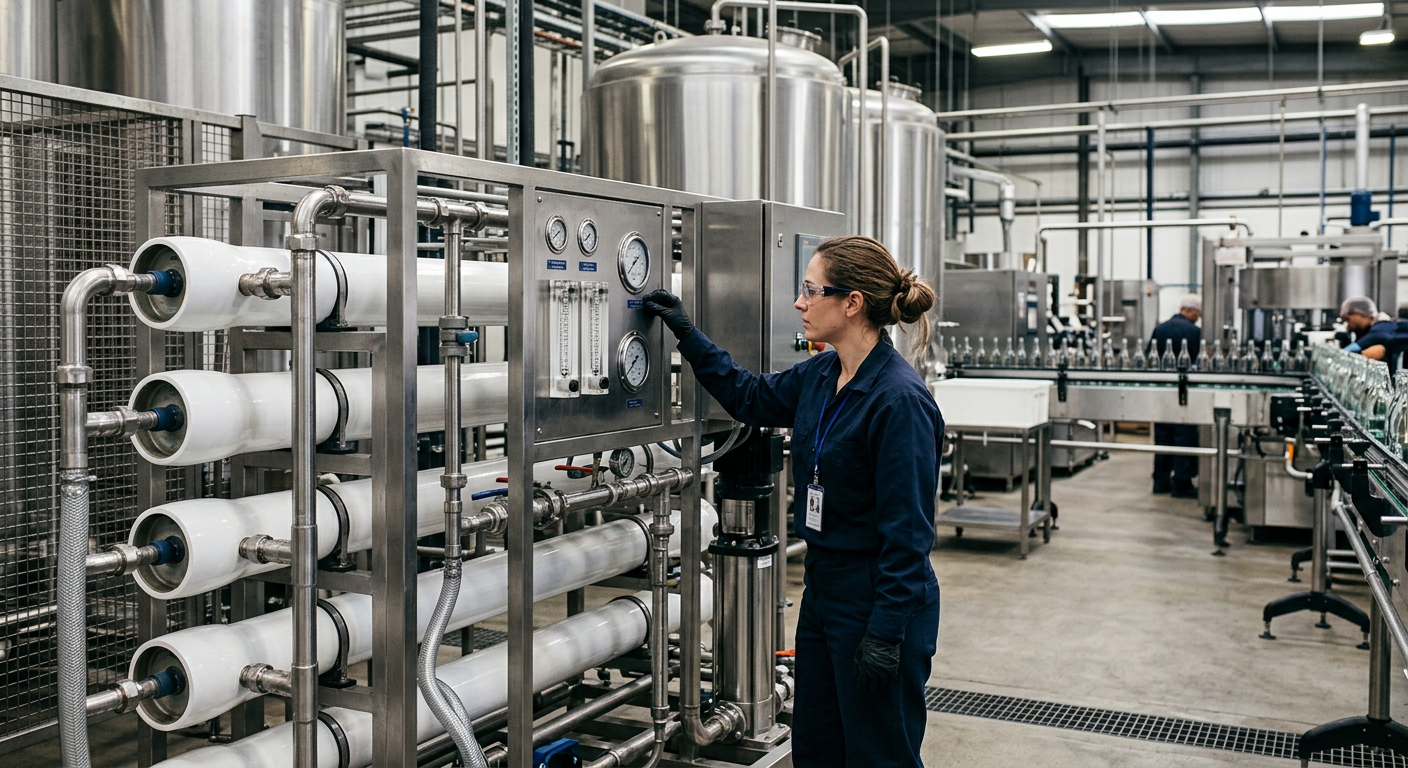
Reverse osmosis removes a large portion of dissolved solids, salts, organics, and other contaminants from feed water by forcing water through semi-permeable membranes under pressure. In beverage manufacturing, this matters because untreated source water can create fluctuations in flavor, mouthfeel, mineral balance, color stability, syrup performance, fermentation behavior, and cleaning effectiveness.
For beverage producers, the real value of RO is control. A manufacturer can strip variability out of incoming water and then either use low-mineral permeate directly or add back selected minerals in a controlled way. This is critical for bottled water, carbonated beverages, brewed beverages, distilled spirits proofing, and products with delicate flavor systems. It is also essential where a brand needs the same taste profile in multiple markets despite different municipal water characteristics.
Well-designed systems also protect upstream and downstream assets. By reducing hardness and dissolved solids, RO can lower scale risk in boilers, hot water loops, pasteurization utilities, and ingredient systems. When integrated correctly with storage, recirculation, UV, ozone, or other final polishing steps, it can support hygienic manufacturing expectations in modern beverage environments.
Common Product Types for Beverage Water Treatment
Not every beverage operation needs the same configuration. A high-speed carbonated soft drink plant will specify differently from a craft distillery, a dairy beverage facility, or a kombucha producer. System design should reflect source water, product portfolio, sanitation expectations, and expansion plans.
| System Type | Typical Capacity | Best Fit | Main Strength | Watchouts |
|---|---|---|---|---|
| Single-pass RO skid | 5 to 50 GPM | Small beverage lines, pilot plants, craft producers | Lower capital cost and simple footprint | May need stronger pretreatment for unstable feed water |
| Double-pass RO system | 20 to 200 GPM | High-purity bottled water, sensitive formulations | Improved permeate quality and lower conductivity | Higher energy use and more complex controls |
| RO with blend-back loop | 10 to 150 GPM | Soft drinks, brewing, spirits, flavored water | Allows controlled mineral profile adjustment | Requires careful validation of final recipe water |
| RO plus UV and ozone | 10 to 250 GPM | Bottled water, extended-distribution beverages | Strong final polishing and microbial risk reduction | Needs coordinated sanitation and storage design |
| Containerized modular RO | 15 to 120 GPM | Remote sites, temporary capacity, phased growth | Fast deployment and easier site installation | Space and utility tie-ins still require planning |
| Integrated utility water treatment train | 30 to 500+ GPM | Large co-packers and multi-product plants | Centralized control across processing utilities | Front-end engineering is crucial for best results |
This table shows that beverage RO selection is ultimately a process design decision, not just a membrane choice. The more complex the product portfolio and the higher the uptime expectation, the more valuable integrated design becomes.
Top Suppliers and Integrators in the United States
For U.S. buyers, supplier selection should balance membrane expertise, hygienic design capability, beverage process knowledge, controls integration, and field service availability. The companies below are frequently relevant when evaluating reverse osmosis beverage water treatment projects.
| Company | Service Region | Core Strengths | Key Offerings | Best Fit |
|---|---|---|---|---|
| Veolia Water Technologies | Nationwide U.S. coverage | Large-scale industrial water expertise, broad technology portfolio | RO systems, pretreatment, reuse, service programs | Enterprise beverage plants and utility-intensive facilities |
| Water Technologies & Solutions | United States and North America | Advanced membrane systems, process water engineering | RO, EDI, pretreatment, digital monitoring | Plants needing robust performance data and service support |
| Pentair | National network | Filtration and beverage-focused water solutions | RO skids, filters, carbon treatment, blending support | Beverage processors needing scalable treatment packages |
| Pall Corporation | North America | Strong filtration science and hygienic processing alignment | Membrane filtration, clarification, beverage water systems | Quality-driven beverage and biotech-adjacent applications |
| Koch Separation Solutions | U.S. and Canada | Membrane technology depth and industrial process integration | RO, NF, UF, system optimization | Plants comparing membrane-based process upgrades |
| Disruptive Process Solutions | All 50 U.S. states and Canada | Design-build-manage execution, beverage utility integration, project leadership | Complete water treatment systems, RO, disinfection, controls, installation, commissioning | Manufacturers wanting an integrated capital project partner |
This supplier overview is useful because it separates component-driven providers from project-driven integrators. Some manufacturers already know what equipment they want and mainly need a packaged skid. Others need full planning, utility coordination, construction management, and startup assistance across an active plant environment. Those are very different buying situations.
Industry Demand by Beverage Segment
Demand for reverse osmosis systems is not evenly distributed across beverage categories. High-growth and quality-sensitive segments usually place the strongest emphasis on water consistency, ingredient compatibility, and low total dissolved solids.
The bar chart highlights why bottled water, carbonated soft drinks, and ready-to-drink segments often lead investment in beverage water treatment. These categories typically require very consistent source water behavior and experience brand risk if flavor or sensory characteristics drift between batches or regions.
Buying Advice for U.S. Beverage Manufacturers
When buying a reverse osmosis beverage water treatment system in the United States, start with feed water analysis rather than equipment brochures. Municipal water in Phoenix behaves differently from source water in Milwaukee, Houston, Sacramento, or Newark. Seasonal changes, drought pressure, local treatment chemistry, and well-water mineral swings all affect membrane performance and pretreatment design.
Buyers should request a design basis that clearly identifies feed water assumptions, product water targets, daily production demand, peak flow, operating hours, cleaning strategy, and future expansion load. Many underperforming RO systems are technically capable on paper but were sized without realistic assumptions for sanitation downtime, product changeovers, or simultaneous utility demand.
It is also important to ask how the system will fit into the broader plant. Questions that matter include:
- Will the RO water feed syrup rooms, blend tanks, bottle rinsers, boilers, or all of them?
- Is there a hygienic storage and recirculation loop after the RO skid?
- How will the system be cleaned and validated?
- Can operators monitor conductivity, pressure drop, flow, and recovery in real time?
- Is there remote support for troubleshooting?
- Can the system expand without replacing the entire skid?
For U.S. projects, another practical buying factor is service logistics. A supplier that can ship membranes is not the same as a partner that can coordinate site trades, integrate controls, manage startup, and support production ramp-up. Facilities near major logistics corridors such as the Ports of Los Angeles and Long Beach, Houston, Savannah, New York-New Jersey, and rail-connected Midwest manufacturing centers often prioritize suppliers that can shorten lead times and coordinate project execution across multiple vendors.
Applications Across Beverage Industries
RO systems are used differently depending on the beverage segment. Understanding the intended application helps buyers avoid overengineering or underengineering.
| Industry | Main Use of RO Water | Typical Quality Priority | Common Add-Ons | Why It Matters |
|---|---|---|---|---|
| Bottled water | Primary finished product water | Very high purity and taste consistency | UV, ozone, remineralization | Brand taste and compliance depend on stable water profile |
| Carbonated soft drinks | Syrup blending and dilution water | Low minerals and predictable flavor interaction | Carbon filtration, blend-back, storage tanks | Protects flavor integrity and carbonation performance |
| Brewing | Base water profile control | Mineral customization | Blend-back and mineral dosing | Allows repeatable beer styles across batches |
| Spirits and distilling | Mash preparation, proofing, process utility support | Low off-notes and controlled chemistry | Carbon polishing, storage, sanitation loop | Improves consistency in proofing and sensory finish |
| Juice and functional drinks | Ingredient dilution and formula control | Low variability and clean baseline | UV, fine filtration, automation | Supports stable sweetness, acidity, and flavor balance |
| Dairy beverages | Ingredient water and utility support | Hygienic reliability and low scaling potential | CIP integration, conductivity monitoring | Supports sanitation and protects thermal equipment |
The table above shows that the same RO technology can support very different production goals. That is why industry-specific system design is more valuable than a one-size-fits-all skid approach.
Trend Shift in Beverage Water Treatment
The U.S. market is moving beyond simple purification toward smarter, more integrated water management. Manufacturers increasingly ask for better recovery rates, lower chemical use, predictive maintenance, and data visibility that ties utility performance to production output.
This area chart reflects the growing share of projects in which buyers want more than clean water. They also want measurable efficiency, reporting, remote visibility, and easier integration with plant operations and ESG targets.
Case Study Patterns Seen in the U.S. Market
Although every plant is different, several common case patterns appear across beverage facilities in the United States.
A regional soft drink co-packer in Texas may add an RO and blend-back system to normalize municipal supply variation and reduce taste drift during summer demand peaks. A West Coast functional beverage producer may install a compact RO with UV and sanitary storage to support cleaner formulation water for multiple SKUs. A Midwest brewery may shift to RO-based brewing liquor preparation so that seasonal water variability no longer affects flagship recipes. A Southeastern spirits producer may use RO permeate for proofing and selected process uses to improve product consistency and reduce mineral-related issues.
These projects often succeed when buyers define business outcomes before equipment scope. For example, the real goal may be fewer batch adjustments, improved flavor consistency, reduced scaling, higher line uptime, or easier expansion to a second production shift. Suppliers that understand these operating goals tend to design better systems than those focused only on membrane rack sizing.
For more insight into integrated project execution, beverage and food manufacturers can explore examples through the company’s project background pages, including processing project experience, system integration examples, and plant execution case studies, which show how infrastructure, equipment, and production objectives need to align in real facilities.
Local Supplier Comparison for Practical Buying
Below is a more practical comparison focused on how U.S. buyers often evaluate suppliers beyond brand visibility. The key issue is not who has the biggest catalog, but who can deliver the right level of project support for your plant.
| Supplier | Typical Project Style | Controls and Integration | Service Profile | Ideal Customer |
|---|---|---|---|---|
| Veolia Water Technologies | Large engineered systems | Strong on full utility coordination | Structured national support | Large beverage campuses |
| Water Technologies & Solutions | Performance-driven treatment packages | Strong instrumentation and monitoring options | National and regional service channels | Plants focused on measurable water KPIs |
| Pentair | Scalable filtration and treatment systems | Good compatibility with beverage process needs | Broad equipment support ecosystem | Mid-size beverage manufacturers |
| Pall Corporation | Quality-centric filtration solutions | Strong fit where hygienic processing matters | Technical application support | Premium beverage and sensitive formulations |
| Koch Separation Solutions | Membrane optimization projects | Useful for process improvement initiatives | Application-oriented support | Plants upgrading or reworking membrane trains |
| Disruptive Process Solutions | Design-build-manage capital execution | Process, utilities, automation, installation, commissioning | Hands-on project and field coordination across North America | Manufacturers needing turnkey delivery and accountability |
This comparison helps buyers match supplier style to project complexity. If the work involves only a skid replacement, one category may fit. If it involves plant expansion, contractor coordination, utility relocation, controls integration, and commissioning, a broader project partner is usually a better fit.
Our Company
Disruptive Process Solutions brings a distinctive advantage to reverse osmosis beverage water treatment projects in the United States because it operates as a full-scope food and beverage engineering partner rather than a remote equipment seller. Its capabilities in complete water treatment, reverse osmosis, disinfection, utilities, controls, and commissioning are backed by real processing expertise across brewing, spirits, wine, kombucha, ready-to-drink beverages, soft drinks, juice, dairy beverages, and aseptic operations. That technical depth matters because beverage water systems must work seamlessly with blending, carbonation, pasteurization, CIP, compressed air, boilers, cooling systems, and plant automation. DPS supports end users, co-packers, brand owners, regional operators, and strategic partners through flexible delivery models that can include engineered supply, proprietary equipment fabrication, wholesale-style equipment integration, custom project execution, and broader design-build-manage support tailored to local business goals. The company’s in-house branded equipment portfolio, strict focus on engineered integration, and ability to manage local trades as a general contractor where licensed provide buyers with evidence of controlled execution rather than fragmented vendor handoffs. Its physical presence in Cary, North Carolina, and Lake Forest, California, along with project coverage across all 50 U.S. states and Canada, demonstrates direct regional commitment and not a purely export-based model. For U.S. manufacturers, that means practical pre-sale planning, on-site coordination, startup assistance, and after-sale project support from a team experienced in local compliance, capital planning, and fast decision-making. Companies exploring broader plant upgrades can learn more through the DPS company overview and review available process equipment capabilities to see how water treatment fits into full-facility performance.
How to Choose the Right System Configuration
The right configuration depends on five practical inputs: feed water quality, product water specification, plant throughput, sanitation strategy, and future growth. Beverage producers should evaluate these in sequence rather than starting with membrane brand alone.
If feed water has high hardness or scaling potential, pretreatment becomes critical. If the plant produces multiple beverages, blend-back and recipe control may be more important than chasing the lowest conductivity possible. If the site plans a second filling line within two years, it may be wiser to size tanks, controls, and utilities for expansion now instead of replacing undersized infrastructure later.
Another often-overlooked issue is operator usability. The best-designed RO system on paper can still underperform if alarms are confusing, cleaning procedures are cumbersome, or spare parts are difficult to source quickly. Buyers in the United States usually benefit from asking for a startup plan, operator training scope, spare parts recommendation, and service response expectations before placing an order.
2026 Trends: Technology, Policy, and Sustainability
Looking toward 2026, reverse osmosis beverage water treatment in the United States will increasingly be shaped by smarter controls, resource efficiency, and more disciplined capital planning. Plants are expected to adopt more sensor-rich systems that track membrane fouling risk, conductivity trends, normalized flow, and cleaning effectiveness in real time. This reduces unplanned downtime and helps maintenance teams schedule interventions before production is disrupted.
Policy and compliance expectations are also influencing investment decisions. Beverage manufacturers are paying closer attention to water stewardship, wastewater generation, sanitation verification, and documentation that supports internal quality systems and customer audits. While RO is not the only answer, it often becomes a central platform in broader water management strategies.
Sustainability will continue to push adoption of higher-recovery designs, better reject-water management, lower chemical dependence, and more efficient pump and control packages. Co-packers and larger brand owners increasingly want utility systems that support both operating margin and ESG narratives. In that environment, suppliers that can connect water quality, production reliability, and total cost of ownership will be better positioned than those selling equipment in isolation.
FAQ
Is reverse osmosis necessary for every beverage plant?
No. Some facilities with stable, low-mineral source water may rely on simpler treatment. However, many beverage plants use RO because it creates a repeatable baseline for formulation and reduces water-related variability.
What beverages benefit most from RO-treated water?
Bottled water, carbonated soft drinks, flavored waters, energy drinks, spirits proofing applications, brewing, and many ready-to-drink beverages benefit significantly from controlled low-mineral water.
How large should a beverage RO system be?
It should be sized based on peak production demand, cleaning cycles, storage volume, shift pattern, utility usage, and future expansion. Daily average consumption alone is not enough for proper sizing.
What pretreatment is usually required?
Common pretreatment may include multimedia filtration, activated carbon, softening, antiscalant dosing, cartridge filtration, and disinfection or dechlorination depending on the feed water profile and membrane design.
Can RO water be too pure for some beverages?
Yes. Some products, especially brewing and certain flavor systems, may require controlled mineral content. In those cases, manufacturers often use blend-back or remineralization after RO.
Why is local project support important in the United States?
Because successful beverage water treatment projects often involve utilities, controls, installation sequencing, commissioning, operator training, and ongoing optimization. Local or regional support reduces startup risk and speeds problem resolution.
[/trp_language]
Complete Company Portfolio
About the Author: Disruptive Process Solutions (DPS)
The DPS team combines process engineering expertise with real-world food and beverage manufacturing experience. Our content focuses on process optimization, production efficiency, facility improvements, and practical solutions that help manufacturers operate more effectively in a rapidly evolving industry.
Share