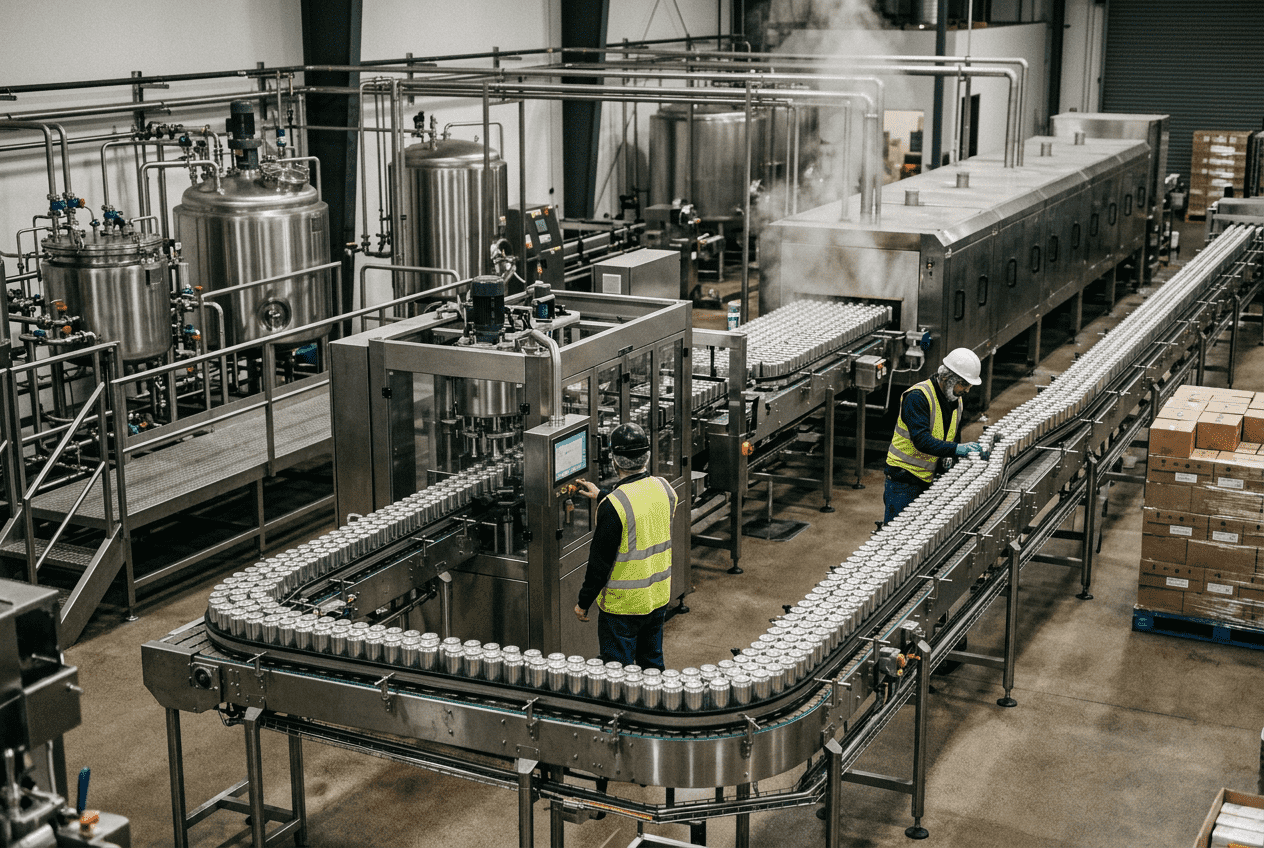
RTD Beverage Processing Solutions
[trp_language language=”en_US”]
RTD Beverage Manufacturing Guide in the United States
Quick Answer

RTD beverage processing in the United States depends on product type, target shelf life, distribution channel, formulation sensitivity, and packaging format. In practical terms, hot fill is often used for acidic teas, juices, and still functional drinks; cold fill is suitable when paired with refrigeration or preservative strategies; UHT and aseptic processing are preferred for shelf-stable dairy, plant-based, protein, and premium coffee products; and HPP is ideal for refrigerated beverages that need fresh flavor with minimal thermal impact. The right answer is not a single machine or fill technology. It is a coordinated system that aligns formulation, thermal treatment, blending, utilities, sanitation, controls, package choice, and compliance.
For U.S. beverage manufacturers, especially those producing coffee, tea, protein drinks, alcoholic RTDs, and nutraceutical beverages, the best processing strategy balances microbial safety, sensory quality, throughput, labor efficiency, and capital cost. Companies expanding in markets such as California, Texas, Illinois, Florida, New Jersey, and North Carolina also need to consider local labor availability, freight access, co-packing density, and proximity to ports like Los Angeles, Long Beach, Savannah, Houston, and New York/New Jersey.
Manufacturers that treat RTD production as an integrated engineering project usually scale faster and more profitably. That includes process design, utility planning, batch automation, filling line selection, clean-in-place, and startup execution. DPS supports this type of end-to-end approach through beverage engineering, system integration, and capital project delivery across North America. You can learn more about the company’s background on its about page.
RTD Beverage Processing Methods: Hot Fill, Cold Fill, UHT, and HPP Compared

Each RTD processing method solves a different commercial problem. The right technology depends on pH, water activity, ingredient load, package type, desired ambient or chilled distribution, and consumer expectations. For example, a shelf-stable black tea in PET may fit a hot-fill platform, while a dairy-based protein latte often requires UHT and aseptic filling. A fresh juice shot sold through refrigerated retail may favor HPP.
In the U.S. market, buyers increasingly ask not only whether a drink is safe, but also how processing affects flavor retention, vitamin stability, emulsions, and label claims. This is especially relevant in premium channels in cities such as Austin, Seattle, Chicago, Atlanta, and Denver, where RTD coffee, adaptogenic beverages, and better-for-you products compete on quality as much as convenience.
| Method | Best Fit Products | Shelf Life | Packaging Compatibility | Main Advantage | Main Limitation |
|---|---|---|---|---|---|
| Hot Fill | Acidic teas, juices, sports drinks | Ambient, medium to long | PET, glass, some specialty bottles | Proven and widely available | Heat impact on flavor and nutrients |
| Cold Fill | Refrigerated beverages, short-life products | Short to medium | PET, HDPE, glass | Lower thermal damage | Requires cold chain or stronger hurdles |
| UHT | Protein drinks, dairy alternatives, coffee | Long ambient | Aseptic cartons, bottles, pouches | Excellent shelf stability | Higher capex and validation complexity |
| HPP | Fresh juices, wellness shots, premium refrigerated RTDs | Refrigerated extended shelf life | Flexible bottles and some cups | Fresh taste preservation | Batch process and refrigerated distribution |
| HTST + Cold Fill | Dairy drinks, some non-acid beverages | Refrigerated | Plastic bottles, cartons | Good throughput | Not suitable for ambient shelf-stable goals |
| Flash Pasteurization | Beer cocktails, kombucha, select RTDs | Medium, depending on package and pH | Cans, bottles | Supports continuous production | May require strict downstream control |
The table above shows why processing selection should start with product risk and route-to-market rather than with a favorite machine. A beverage destined for ambient retail at national scale has very different requirements from a regional refrigerated launch sold through natural grocers.
| Beverage Type | Typical pH | Common U.S. Target Channel | Recommended Process | Key Engineering Focus | Common Risk |
|---|---|---|---|---|---|
| Black Tea RTD | Low acid to acidified | Convenience and grocery | Hot fill | Flavor protection, bottle management | Cooked taste |
| Cold Brew Coffee | Low acid | Premium retail and e-commerce | UHT or aseptic | Oxygen control, fouling management | Sediment and flavor drift |
| Protein Shake | Neutral | Club, grocery, direct-to-consumer | UHT | Homogenization and heat stability | Gelation |
| Juice Shot | Acidic | Refrigerated wellness | HPP | Package compression resistance | Cold chain cost |
| Alcoholic Seltzer Cocktail | Acidic | C-store and liquor | Cold fill or tunnel pasteurization | CO2 retention, TTB compliance | Flavor stripping |
| Plant-Based Latte | Neutral | National ambient distribution | UHT aseptic | Emulsion stability | Separation |
For manufacturers comparing technologies, the biggest mistake is isolating processing from packaging and plant design. A hot-fill drink may need vacuum panels and specific resin behavior. A UHT protein line may need advanced homogenization, aseptic surge capacity, and sterile barriers. An HPP program may need logistics planning near tolling hubs and refrigerated warehouse space.
The growth trend shown above reflects the continuing expansion of the U.S. RTD category, especially in coffee, functional hydration, energy, and spirit-based canned beverages. By 2026, processors that can switch flexibly between multiple SKUs and package sizes are likely to outperform single-product operations.
Formulation Challenges for Shelf-Stable RTD Beverages

Formulating a shelf-stable RTD beverage is often harder than selecting a filler. Stability issues appear at the intersection of chemistry and process conditions. Proteins can aggregate, coffee can separate, botanicals can precipitate, sweeteners can leave lingering notes, and vitamins may degrade under thermal load. When a drink scales from benchtop to commercial plant, seemingly minor variables such as shear profile, hold time, deaeration efficiency, and dissolved oxygen become critical.
In the United States, formulation pressure is increasing because buyers want clean labels, lower sugar, functional ingredients, and longer shelf life without sacrificing taste. This is why engineering support is increasingly valuable during product development, not just after commercialization.
| Challenge | Most Affected Products | Root Cause | Processing Impact | Mitigation Strategy | Plant Design Consideration |
|---|---|---|---|---|---|
| Protein Sedimentation | Shakes, coffee-protein blends | Poor suspension and particle size control | Fouling and inconsistent fill | Homogenization, stabilizer tuning | High-shear mixing and recirculation |
| Emulsion Break | Creamy and plant-based drinks | Oil phase instability | Visual defects | Emulsifier optimization | Precise batch control |
| Flavor Fade | Tea, coffee, citrus, botanicals | Thermal damage and oxidation | Reduced shelf appeal | Deaeration and process minimization | Oxygen management |
| Vitamin Loss | Functional beverages | Heat and light sensitivity | Claim risk | Overage strategy and package protection | Controlled exposure and validation |
| Sweetener Aftertaste | Reduced-sugar RTDs | High-intensity sweetener profile | Consumer rejection | Blended sweetener system | Accurate dosing system |
| pH Drift | Acidified drinks, kombucha blends | Ingredient interaction and fermentation carryover | Shelf stability risk | Buffering and tighter QA limits | Inline monitoring |
The key lesson from this table is that formulation cannot be separated from process engineering. A stable product on paper may still fail if the plant cannot deliver repeatable temperature control, ingredient addition sequencing, or hygienic transfer conditions.
Processing Equipment for RTD Coffee, Tea, and Protein Drinks
RTD equipment packages vary by beverage style, but most successful U.S. plants share several core systems: ingredient receiving, water treatment, storage tanks, batch vessels, blending and dosing, thermal treatment, homogenization if needed, filling and packaging, CIP, and plantwide controls. The exact lineup depends on whether the product is still or carbonated, ambient or chilled, dairy or non-dairy, alcoholic or non-alcoholic.
For coffee, tea, and protein beverages, the most important engineering issue is often not the filler itself but upstream process control. Coffee extraction, tea brewing, protein hydration, powder handling, and thermal load management all affect downstream uptime. A filler can only run consistently if the process room feeds it consistently.
DPS brings relevant technological capabilities in this area, including integration of HTST, UHT, flash pasteurization, HPP-adjacent process planning, carbonation systems, filtration, inline Brix monitoring, aseptic considerations, utilities, PLC programming, and SCADA-driven process visibility. These capabilities are especially useful for plants seeking consistent production across multiple RTD SKUs.
| Equipment | RTD Coffee | RTD Tea | Protein Drinks | Main Purpose | Common Upgrade Trigger |
|---|---|---|---|---|---|
| Water Treatment System | Yes | Yes | Yes | Consistent water quality | Flavor inconsistency or scaling |
| Brewing/Extraction Vessels | Yes | Yes | No | Flavor extraction | Capacity growth |
| Powder Induction System | Sometimes | Sometimes | Yes | Fast hydration and reduced clumping | Protein dusting and labor issues |
| High-Shear Mixer | Sometimes | Limited | Yes | Dispersion and uniformity | Stability failures |
| Homogenizer | Sometimes | Rarely | Yes | Particle size reduction and stability | Separation complaints |
| UHT/HTST System | Yes | Yes | Yes | Microbial control | Shelf-life target increase |
This equipment overview shows that protein drinks generally demand the most mechanically complex process systems, while tea lines often prioritize heat management and flavor preservation. Coffee sits in the middle, with special attention to extraction solids, oil behavior, and sediment control.
From a manufacturing standpoint, DPS also supports equipment supply and integration with tanks, custom CIP systems, vessels, and utility-connected process skids. More information on integrated hardware and system categories is available on the equipment solutions page. For manufacturers expanding from one filler to a full process room, this kind of integration reduces startup risk and finger-pointing between vendors.
Blending and Batch Control Systems for Consistent RTD Production
Consistency is one of the biggest economic drivers in RTD manufacturing. Variability in Brix, pH, viscosity, proof, caffeine load, or flavor concentration can lead to rework, giveaway, downtime, and customer complaints. As product portfolios grow, manual batching becomes a bottleneck. Automated recipe management, mass flow verification, inline Brix measurement, and SCADA-based batch history become essential for high-mix operations.
For U.S. co-packers and branded manufacturers, blending control is especially important when supplying major retailers that expect lot traceability and specification discipline. Plants in high-throughput markets such as Dallas-Fort Worth, Southern California, and the Midwest often justify automation quickly because labor variability and rapid changeovers can otherwise erode margin.
| Control Feature | What It Monitors | Operational Benefit | Quality Benefit | Ideal Plant Type | ROI Driver |
|---|---|---|---|---|---|
| Recipe Management | Ingredient setpoints | Faster changeovers | Lower formulation error | Multi-SKU plants | Reduced labor dependence |
| Inline Brix Monitoring | Soluble solids | Real-time correction | Consistent sweetness | Tea, juice, energy drinks | Lower giveaway |
| Mass Flow Dosing | Liquid additions | Precise batching | Tighter spec control | Functional RTDs | Reduced overuse of ingredients |
| Batch Historian | Time and event data | Traceability | Audit support | Regulated facilities | Faster root-cause analysis |
| Automated CIP Validation | Cycle parameters | Less downtime uncertainty | Sanitation repeatability | Dairy and protein lines | Higher uptime |
| SCADA Dashboards | Plantwide KPIs | Operator visibility | Fewer unnoticed deviations | Growth-stage plants | Better management response |
The practical meaning of this table is simple: automation is not only about sophistication; it is about protecting margin. In RTD, one poorly controlled high-value ingredient stream can cost more in a year than the control upgrade needed to fix it.
The demand chart highlights why flexible batch systems matter. Functional RTDs and coffee continue to pull capacity, while protein drinks remain highly attractive due to price point and repeat purchase behavior. This mix favors facilities designed for process versatility rather than narrow single-line dependence.
Packaging Considerations: Cans, Bottles, and Cartons for RTD Products
Packaging affects more than branding. It influences oxygen pickup, thermal performance, freight cost, shelf presence, line speed, sustainability profile, and retailer acceptance. In the U.S., cans are strong for alcoholic RTDs, sparkling functional drinks, and many coffees. PET bottles remain common for teas and still beverages. Cartons are especially relevant for shelf-stable dairy and plant-based products using aseptic systems.
Regional distribution matters. Products moving through long freight corridors from California to the Midwest, or from Texas to the Southeast, may prioritize lightweight packaging and pallet efficiency. Products launched in urban premium channels like New York City, San Francisco, and Boston may lean toward premium glass or specialty cans despite higher costs.
| Format | Common Products | Advantages | Disadvantages | Processing Pairing | Distribution Fit |
|---|---|---|---|---|---|
| Aluminum Cans | Alcoholic RTDs, coffee, energy drinks | Lightweight, recyclable, fast filling | Liner compatibility and dent risk | Cold fill, tunnel pasteurization, some aseptic | National retail |
| PET Bottles | Tea, juice, sports drinks | Low cost, flexible shapes | Oxygen and heat limitations | Hot fill, cold fill | Mass market |
| Glass Bottles | Premium coffee, mixers, specialty RTDs | Premium perception and barrier performance | Heavy and fragile | Hot fill, cold fill | Premium and foodservice |
| Aseptic Cartons | Protein, dairy alternatives, kids drinks | Ambient shelf life and sustainability appeal | Higher equipment complexity | UHT aseptic | Grocery and club |
| HDPE Bottles | Dairy and refrigerated beverages | Durable and familiar | Lower premium image | Cold fill, HTST | Regional chilled |
| Flexible Bottles for HPP | Juices and wellness shots | Suitable for pressure process | Cold chain requirement | HPP | Natural and specialty retail |
Packaging selection should also account for line integration. A fast can line with underdesigned depalletizing, rinsing, or downstream packout will still struggle. DPS supports manufacturing capability across full processing and utility integration, helping clients connect package selection with actual plant execution, not just brand strategy.
The area chart shows a clear shift toward products that demand better ingredient systems and gentler processing. As clean-label and sugar-reduction expectations rise, packaging must help protect flavor and claims because formulation margins for error become smaller.
TTB and FDA Labeling Requirements for Alcoholic and Non-Alcoholic RTDs
Labeling in the United States can be one of the most misunderstood elements of RTD commercialization. Non-alcoholic beverages generally fall under FDA requirements, while alcoholic RTDs may also fall under TTB oversight depending on composition, alcohol source, and category. A canned vodka soda, flavored malt beverage, or wine-based cocktail may have very different regulatory pathways despite appearing similar on shelf.
Manufacturers should align regulatory review with formulation and packaging decisions early. Claims around sugar reduction, protein content, caffeine, functional ingredients, organic positioning, and alcohol statements can affect both label layout and product classification. Interstate distribution magnifies the need for accuracy because one labeling error can delay an entire launch.
From a service standpoint, DPS supports compliance-aware project delivery through engineering, integration, and execution that account for FDA, USDA, SQF, and BRC expectations. This matters because sanitation design, traceability, and documented process control are operational cousins of compliant labeling.
Companies preparing for audits or new line installations can review broader engineering and project support through the service offerings page.
Scaling from Pilot Production to Commercial RTD Manufacturing
Scaling an RTD beverage from pilot to commercial output is where many brands discover hidden risk. A product that works in 20-gallon trials may fail at 2,000-gallon batch size because heating curves change, powders hydrate differently, and hold times lengthen. Commercial filling lines also impose constraints on viscosity, foam, dissolved gas, and particulate load.
In the United States, the scale-up path often moves from kitchen development to pilot plant, then to co-packing, and eventually to owned production. Each step changes economics. Co-packing can accelerate launch, but long term profitability may require dedicated infrastructure, especially for complex beverages with sensitive formulations or proprietary process needs.
Good scale-up programs validate more than microbiology. They also verify utility demand, CIP cycle design, automation logic, maintenance access, ingredient receiving, warehouse flow, and labor strategy. Plants near logistics corridors such as Charlotte, Indianapolis, Memphis, and Inland Empire often have distribution advantages, but utility capacity and wastewater limits must still be confirmed before committing capital.
DPS is particularly relevant here because its design-build-manage model connects planning, engineering, installation, and execution under one operating philosophy. Instead of treating scale-up as a string of disconnected purchases, the approach ties capital spending to first-year profitability and long-term expansion.
This comparison chart reflects what sophisticated buyers often prioritize when selecting an RTD project partner: not isolated equipment alone, but integrated capability across process, utilities, controls, compliance, and execution. That is especially important for facilities targeting aggressive growth curves.
For examples of project execution and facility problem-solving, visit the case studies section. Real-world project experience is valuable when moving from concept to commercial volumes because theoretical design choices quickly become operational realities.
Market Trends: Functional RTDs, Clean Label, and Sugar Reduction
The U.S. RTD market is being reshaped by premium convenience. Consumers want beverages that are portable, better tasting, better for them, and aligned with specific lifestyle goals. Functional RTDs with protein, adaptogens, nootropics, electrolytes, probiotics, energy systems, and fortified nutrition continue to attract investment. At the same time, ingredient scrutiny is rising. Clean-label expectations, lower sugar targets, and sustainability claims are forcing manufacturers to rethink both formulas and plants.
By 2026, several trends are likely to define processing decisions:
- More hybrid beverages, such as coffee plus protein, tea plus botanicals, and alcohol plus functional flavor systems.
- Greater use of automation to manage SKU complexity and labor shortages.
- Broader demand for recyclable, lightweight, and lower-footprint packaging.
- More pressure to document sanitation, traceability, and quality data digitally.
- Increasing attention to water use, energy recovery, and wastewater impact in plant design.
- Policy and retailer pressure for transparent sugar, caffeine, and additive labeling.
Future-ready RTD plants will therefore need flexible utility systems, modular process skids, recipe-driven automation, and the ability to run multiple formats efficiently. This is especially true for large multi-state distribution strategies and co-packing operations serving many brands.
FAQ
What is the best processing method for shelf-stable RTD coffee?
For low-acid coffee requiring ambient shelf life, UHT with aseptic filling is often the preferred solution. It helps protect shelf stability while supporting national distribution, though formulation and oxygen management remain critical.
When should a beverage brand choose HPP instead of hot fill?
HPP is usually best when the brand wants a refrigerated product with fresher flavor and minimal thermal damage. It is common for juice blends, wellness shots, and premium chilled beverages rather than for mainstream ambient shelf-stable launches.
Are cans better than bottles for RTD products?
Not always. Cans are excellent for portability, carbonation, and many alcoholic or functional RTDs. Bottles may be better for hot fill, premium shelf presence, or products needing specific consumer handling. The right choice depends on process, channel, and brand goals.
What are the biggest scale-up mistakes in RTD manufacturing?
Common mistakes include underestimating utility demand, ignoring ingredient handling complexity, relying on manual batching too long, failing to validate CIP, and choosing packaging before fully confirming process compatibility.
How early should labeling compliance be addressed?
At the formulation stage. In the United States, FDA and TTB implications can affect product classification, claims, alcohol declarations, nutrition panels, and commercial launch timing.
How can a manufacturer improve consistency across multiple RTD SKUs?
Use standardized recipes, automated dosing, inline analytical tools, batch history systems, validated CIP, and strong operator training. Consistency improves significantly when process design and controls are built together.
What should buyers look for in an RTD processing partner?
Look for practical experience with beverage formulation realities, thermal processing, blending systems, packaging integration, utilities, compliance, controls, and startup execution. A partner should understand both capital efficiency and production economics.
Why do U.S. RTD projects benefit from integrated engineering?
Because processing, utilities, controls, packaging, and compliance are deeply connected. Integrated engineering reduces rework, shortens startup time, and improves the odds that the line will meet actual production and profitability targets.
Choosing the Right RTD Processing Partner in the United States
For buyers in the United States, the best RTD processing solution is rarely the cheapest quote or the most familiar technology. It is the system that supports the product you want to sell, at the margin you need, through the channels you plan to serve. Whether you are building a shelf-stable protein platform for club retail, a premium canned coffee line for national grocery, or an alcoholic RTD line for multi-state launch, success depends on aligning processing, packaging, automation, utilities, and regulatory readiness.
DPS is positioned for these projects because it combines technological capabilities, manufacturing capabilities, and service capabilities within one capital project framework. That includes process engineering, utility infrastructure, controls, installation management, proprietary equipment support, and execution across North America. The company’s approach is especially relevant for manufacturers who want honest guidance, scalable plant design, and disciplined project management rather than fragmented vendor coordination.
If your organization is evaluating a new RTD plant, an expansion, a process upgrade, or a packaging conversion, a structured engineering review is often the fastest way to reduce risk and avoid spending capital in the wrong place. In a market moving as quickly as RTD in the United States, profitable growth usually starts with better system design.
[/trp_language]
Complete Company Portfolio

About the Author: Disruptive Process Solutions (DPS)
The DPS team combines process engineering expertise with real-world food and beverage manufacturing experience. Our content focuses on process optimization, production efficiency, facility improvements, and practical solutions that help manufacturers operate more effectively in a rapidly evolving industry.
Share